














 0 comments





Key Takeaways:
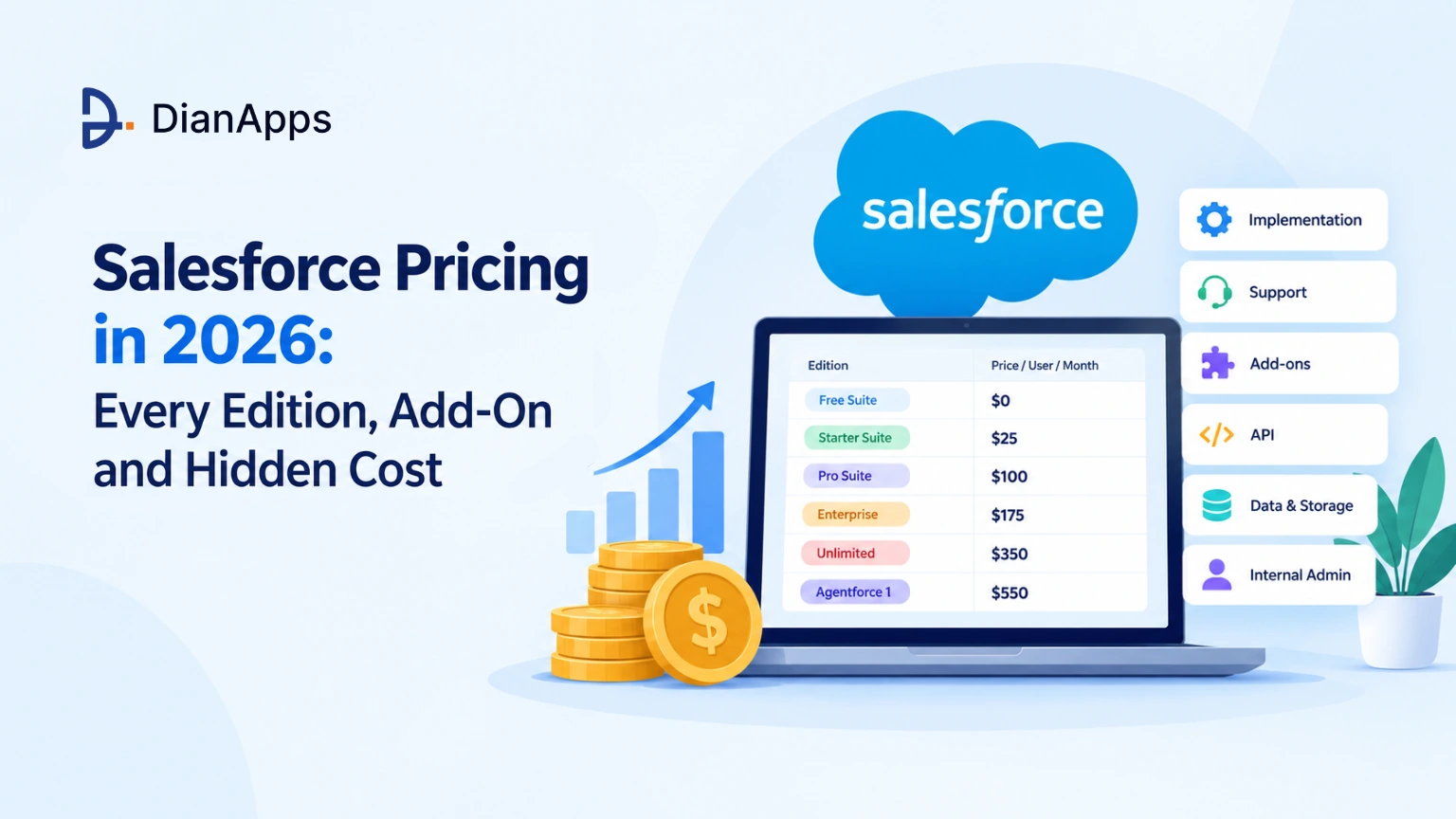
- Salesforce plans range from $0 to $550/user/month.
- Enterprise costs $175/user/month, while Unlimited is $350.
- Implementation, support, and add-ons can significantly increase year-one costs.
- Pro + API can cost $125/user/month, making Enterprise worth comparing for integration-heavy teams.
Quick Answer: Salesforce pricing in 2026 ranges from free for up to two users to $550/user/month for Agentforce 1. Enterprise is $175/user/month, but implementation, Premier Success, integrations, storage and internal admin can make the total year-one cost much higher than the licence price alone.
Salesforce raised Enterprise and Unlimited pricing by roughly 6% in late 2025. Enterprise went from $165 to $175 per user per month, and Unlimited from $330 to $350.
A surprising number of pricing pages still quote the old figures, including some published in 2026. If you’re budgeting from a comparison article rather than Salesforce’s own pricing page, check which numbers you’re working with.
And the per-user price is the smaller part of the story. To understand why, it helps to first understand what Salesforce is and how its broader platform, products, and customer data model fit together.
The Edition Ladder
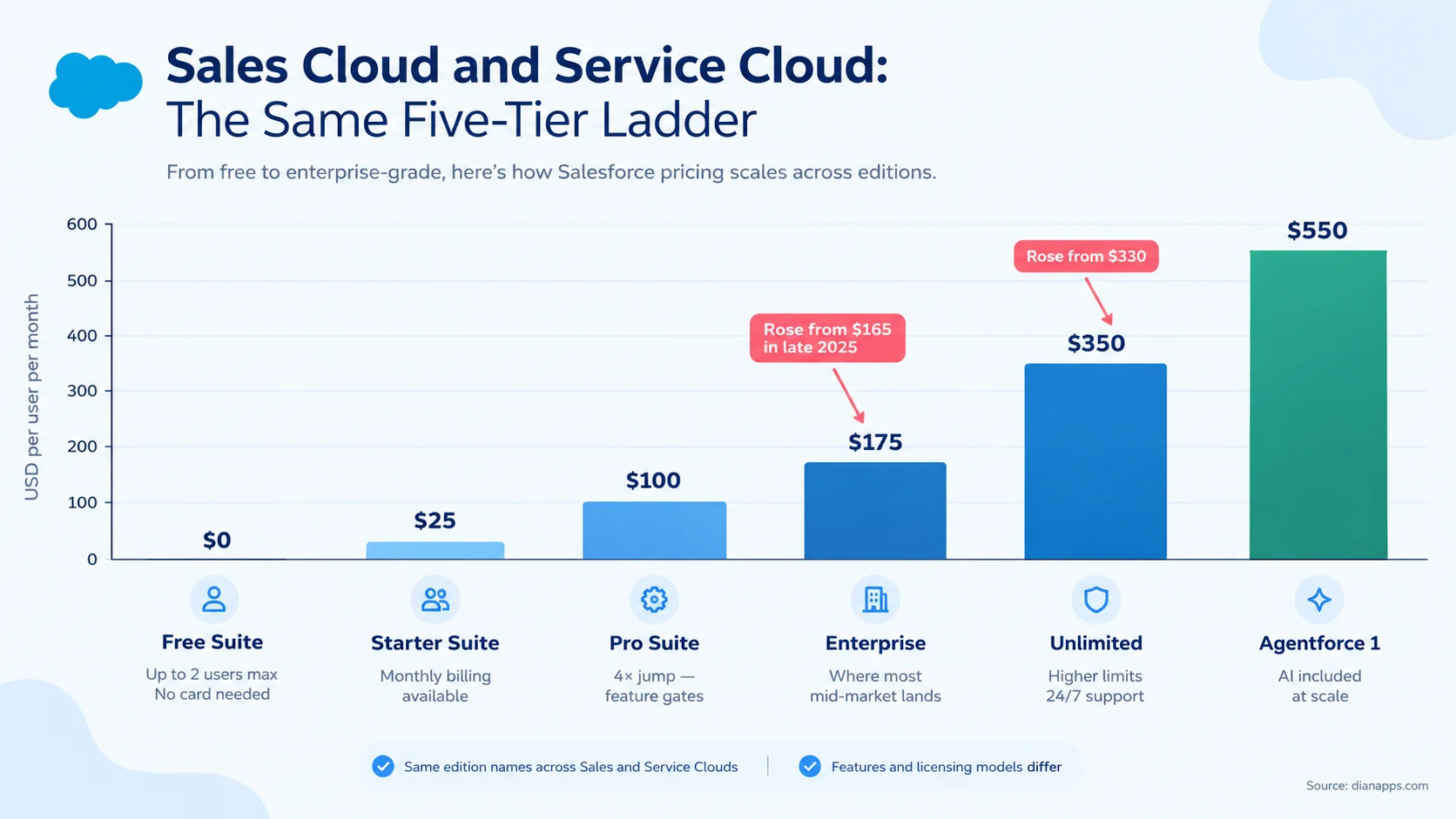
| Edition | Price/user/month | Billing | Best for |
|---|---|---|---|
| Free Suite | $0 | None | Up to 2 users. Basic leads and opportunities |
| Starter Suite | $25 | Monthly or annual | Small teams needing a clean system of record |
| Pro Suite | $100 | Annual | Growing teams needing customisation |
| Enterprise | $175 | Annual | Where most mid-market lands |
| Unlimited | $350 | Annual | Higher limits, 24/7 support, more sandboxes |
| Agentforce 1 | $550 | Annual | AI agents included at scale |
Salesforce clouds use identical edition names and prices, but their functionality and licensing models differ substantially. See our Salesforce clouds comparison for a breakdown of what each cloud is designed to handle.
Three things worth knowing about the ladder:
- There’s A Genuinely Free Tier: Free Suite costs nothing, requires no card, and supports two users permanently, separate from the 30-day trial. It’s rarely mentioned, and it’s a legitimate way to evaluate the interface before committing.
- Starter Is The Only Tier With Monthly Billing: From Pro upward, you’re signing a twelve-month commitment. That changes both cash flow and switching cost the moment you cross that line.
The Starter-to-Pro jump is 4×, and it isn’t about seats. It’s about feature gates, customisation, automation, and reporting capabilities that unlock at Pro.
Note also that “Essentials” no longer exists. It was replaced by Starter Suite, with Pro Suite added beneath Enterprise. Older comparison articles still reference it.
Related: Salesforce editions compared in detail
What the Sticker Price Doesn’t Include
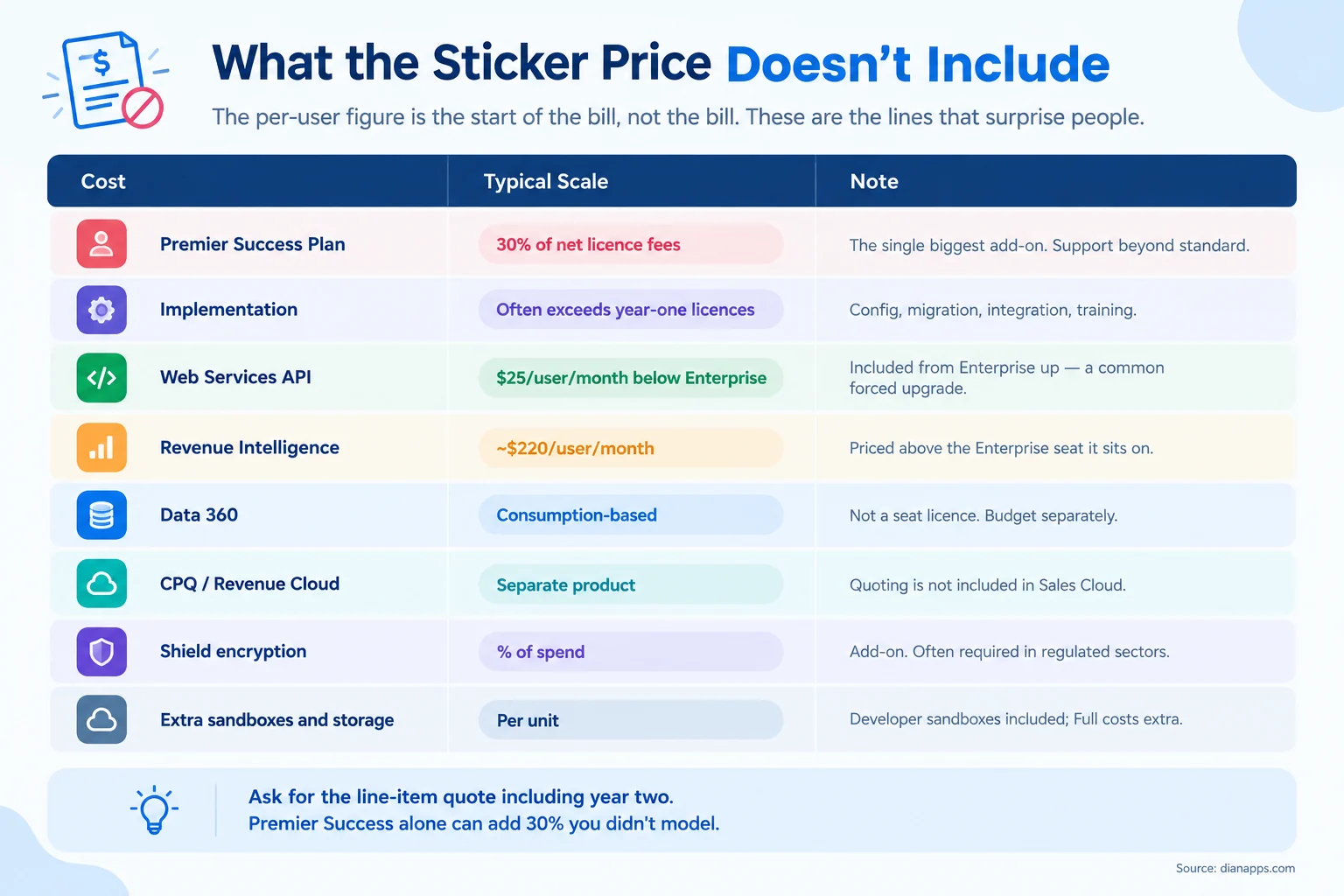
Premier Success at 30% of net licence fees is the one that surprises people most. Standard support is included; anything beyond it is a percentage of your entire licence spend, not a flat fee. On a $200,000 licence bill, that’s $60,000.
The Web Services API gotcha deserves particular attention. On Pro Suite and below, API access is a $25 per user per month add-on. From Enterprise upward, it’s included.
That’s a $125 effective price for Pro plus API, against $175 for Enterprise, which includes API and considerably more. If you need integrations, Pro is rarely the right answer, and this pricing structure is why.
Implementation frequently exceeds year-one licences. Configuration, data migration, integration, training, and change management. It’s the largest single line in most first-year budgets, and the one least often quoted upfront.
Need Salesforce Development Support?
Build, integrate, and scale Salesforce with experienced developers.
Related: Salesforce customization cost · how to reduce Salesforce licence costs
A Realistic Total Cost Model
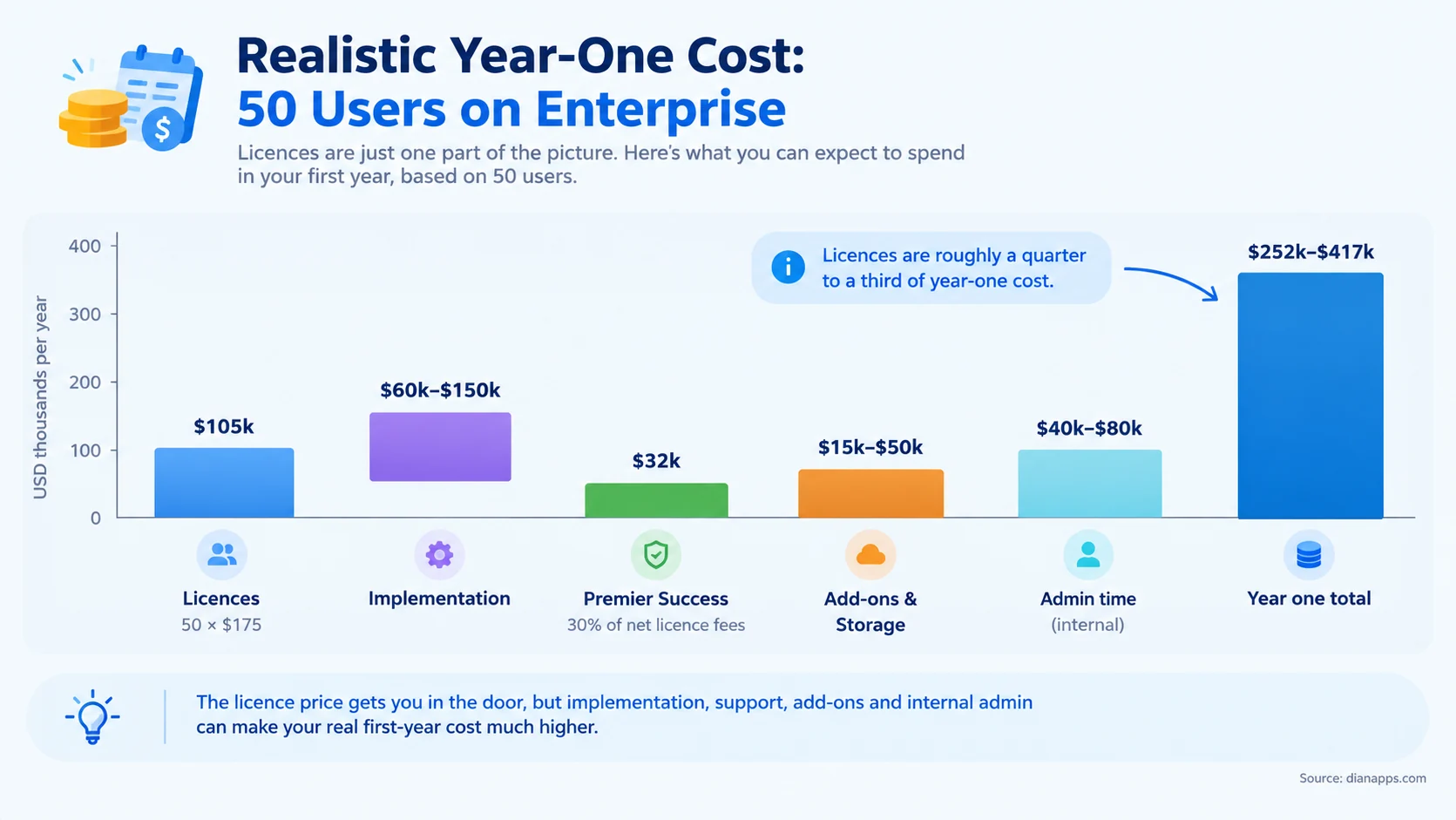
Licences are roughly a quarter to a third of what you’ll spend in year one. That ratio is the single most useful thing on this page for anyone building a budget. For organisations without an internal Salesforce team, Salesforce consulting services can also help scope implementation, integrations and ongoing administration before those costs become difficult to predict.
| Line | 50 users on Enterprise | Notes |
|---|---|---|
| Licences | ~$105,000 | 50 × $175 × 12 |
| Implementation | $60,000 – $150,000 | Varies enormously with scope |
| Premier Success (optional) | ~$32,000 | 30% of licence fees |
| Add-ons and storage | $15,000 – $50,000 | Sandboxes, integrations, extra storage |
| Internal admin time | $40,000 – $80,000 | Frequently omitted from budgets |
| Year-one total | $252,000 – $417,000 | Against a $105,000 licence figure |
Internal costs can also include Salesforce administration, training and certification, particularly when businesses choose to manage more of the platform in-house. Salesforce certifications can help teams build the skills needed to manage and extend the platform.
Year two is cheaper but not dramatically so. Licences recur, Premier Success recurs, admin time recurs, and most organisations continue development work rather than stopping.
- For Context On The Market: one dataset of over two thousand verified purchases puts the median Salesforce contract at around $74,700 per year. That’s a useful sanity check; most customers are smaller than the fifty-user example above.
Related: Salesforce ROI: how to calculate and prove it
Planning Your Salesforce Budget?
Get expert guidance on licensing, implementation, and CRM costs.
Pricing by Cloud
| Product | Entry price | Notes |
|---|---|---|
| Sales Cloud | $25–$550/user/month | The five-tier ladder above |
| Service Cloud | $25–$550/user/month | Identical ladder and pricing |
| Marketing Cloud | Priced separately | Contact-based rather than purely per-seat |
| Account Engagement | Priced separately | Formerly Pardot; B2B marketing automation |
| Commerce Cloud | Often revenue-based | Pricing varies substantially by model |
| Data 360 | Consumption-based | Not a seat licence; budget separately |
| Salesforce Platform | ~$25/user/month | Custom apps without CRM objects |
| CRM Analytics | Priced separately | Per user, above the base edition |
| Revenue Cloud / CPQ | Separate product | Quoting is not included in Sales Cloud |
The Platform licence is the cost lever most buyers never hear about. At roughly $25 per user per month, it covers people who need custom apps but never touch Leads, Opportunities or Cases: warehouse staff, field engineers, internal teams. In most organisations, that’s more people than expected.
Salesforce has a much broader product portfolio beyond these core licences, so it is worth checking the Salesforce products included in a quote before assuming every line item is part of the base CRM.
Related: the Salesforce Platform explained · Salesforce clouds compared
Which Edition Do You Actually Need?
| If you… | Edition | Why |
|---|---|---|
| Want to see the interface first | Free Suite | Two users, no card, permanent |
| Are under 10 people with a simple pipeline | Starter | Monthly billing, no annual lock-in |
| Need customisation but no integrations | Pro | The only case where Pro makes sense |
| Need API access or integrations | Enterprise | Pro + API costs $125; Enterprise is $175 and includes far more |
| Have complex processes or many users | Enterprise | The default for a reason |
| Need higher limits or 24/7 support | Unlimited | Check whether limits are genuinely binding first |
| Are deploying AI agents at scale | Agentforce 1 | Otherwise buy Agentforce as an add-on |
The honest guidance: most organisations land on Enterprise, and most that buy Unlimited could have stayed on Enterprise with a targeted add-on. Before upgrading a whole org for one feature, price the add-on route.
Negotiation Levers
Salesforce list pricing is a starting point, particularly above about twenty users.
Contract length. Multi-year commitments attract meaningful discounts. Weigh that against locking in before you know your real usage.
Timing. Salesforce’s fiscal year ends 31 January, and quarter-ends matter. Negotiating into a quarter close is a real advantage.
Volume. Discounts scale with seat count. If you’re growing, negotiating the price of future seats now is worth more than discounting today’s.
Bundling. Adding a second cloud is a negotiation moment. Buying separately six months apart costs more than buying together.
Uplift caps. This is the one people miss. Negotiate a cap on annual price increases at renewal. Without one, you’re exposed to whatever Salesforce decides, and it raised prices 6% in 2025.
What you can’t negotiate: the edition feature set. If you need something gated at Enterprise, no discount gets it into Pro.
How It Compares
| Platform | Entry | Typical mid-tier | Notes |
|---|---|---|---|
| Salesforce | $25 | $175 | Deepest platform, highest implementation cost |
| HubSpot | Free–$20 | ~$100–150 | Faster to deploy, less customisable |
| Zoho CRM | ~$14 | ~$40–52 | Substantially cheaper, smaller ecosystem |
| Pipedrive | ~$14 | ~$50–99 | Sales-focused, simpler |
| Microsoft Dynamics 365 | ~$65 | ~$95–105 | Strong fit inside a Microsoft estate |
Comparing headline prices is misleading. The gap narrows once implementation, admin, and add-ons are included, and it narrows further if the cheaper platform can’t do what you need without workarounds.
The honest framing: for a ten-person team with a simple pipeline, Salesforce is expensive overkill, and Pipedrive or HubSpot will serve better. For an organisation with genuine process complexity, the price difference stops being the deciding factor.
Related: Salesforce vs HubSpot · Salesforce alternatives compared
Where to Go Next
For a detailed edition-by-edition comparison, see Salesforce editions compared.
For reducing what you already pay, how to reduce Salesforce licence costs, the Platform licence alone frequently saves more than any negotiation.
For building the business case, Salesforce ROI and CRM statistics.
For what implementation actually costs, Salesforce customization cost.
For comparing alternatives, Salesforce alternatives, Salesforce vs HubSpot, Salesforce vs Zoho, and Salesforce vs custom CRM.
For smaller organisations specifically, Salesforce for startups and SMBs and Pro Suite explained.
For the products you’re pricing, Salesforce clouds compared and every Salesforce product.
The Number That Should Change Your Budget
Licences are a quarter to a third of year-one cost. Most budgets we see are built around the licence figure with implementation as an afterthought, and that’s the gap that turns into a difficult conversation in month four.
Model the whole thing before you sign, including year two, which is cheaper but not by as much as people expect.
Need Help With Salesforce Costs?
Talk to our team about your Salesforce requirements and budget.
 0 comments







Leave a Comment
Your email address will not be published. Required fields are marked *