















 0 comments





Key Takeaways:
- 63 Salesforce certifications remain after 24 credentials were announced for retirement and 16 were renamed.
- The 16 renamed certifications took effect on July 24, 2026, with no exam retake required.
- The 24 retiring certifications are scheduled to retire on February 1, 2027.
- Platform Administrator remains the primary entry point for people starting a Salesforce career.
- Agentforce Specialist is becoming an important differentiator as Salesforce shifts its certification ecosystem toward AI and agents.
- Platform Developer II and Technical Architect carry stronger signals because they require more advanced practical or evaluative components.
- Standard Salesforce certification exams cost around $200, while architect-level exams and the CTA board review cost substantially more.
- Most active certifications require recurring maintenance through Trailhead modules after Salesforce releases.
- Certifications are useful signals, but hands-on production experience matters more than collecting credentials.
- Companies evaluating Salesforce partners should check certifications for the specific consultants assigned to the project, not just the firm’s total certification count.
Quick Answer: There are 63 Salesforce certifications remaining in 2026. Sixteen were renamed on July 24, 2026, while 24 certifications are scheduled to retire on February 1, 2027. For beginners, Platform Administrator remains the strongest starting point. For experienced professionals, Agentforce Specialist, Platform Developer II, and architect-level credentials can provide stronger differentiation. However, certifications should be evaluated alongside real-world Salesforce delivery experience.
Salesforce has just completed the largest clear-out of its certification catalogue in years. 24 certifications are retiring, 16 have been renamed, and 63 remain.
Most articles you’ll find on this were published in June 2026, urging you to book an exam before the window closed. Those deadlines have now passed; registration shut on 24 July, and the last day to sit a retiring exam was 31 August.
So this guide is written for where things actually stand: what the changes mean now, which certifications are worth your time, and for anyone evaluating a Salesforce partner rather than sitting an exam, what the changes mean for reading someone else’s credentials.
The Three Dates, and Two Have Passed
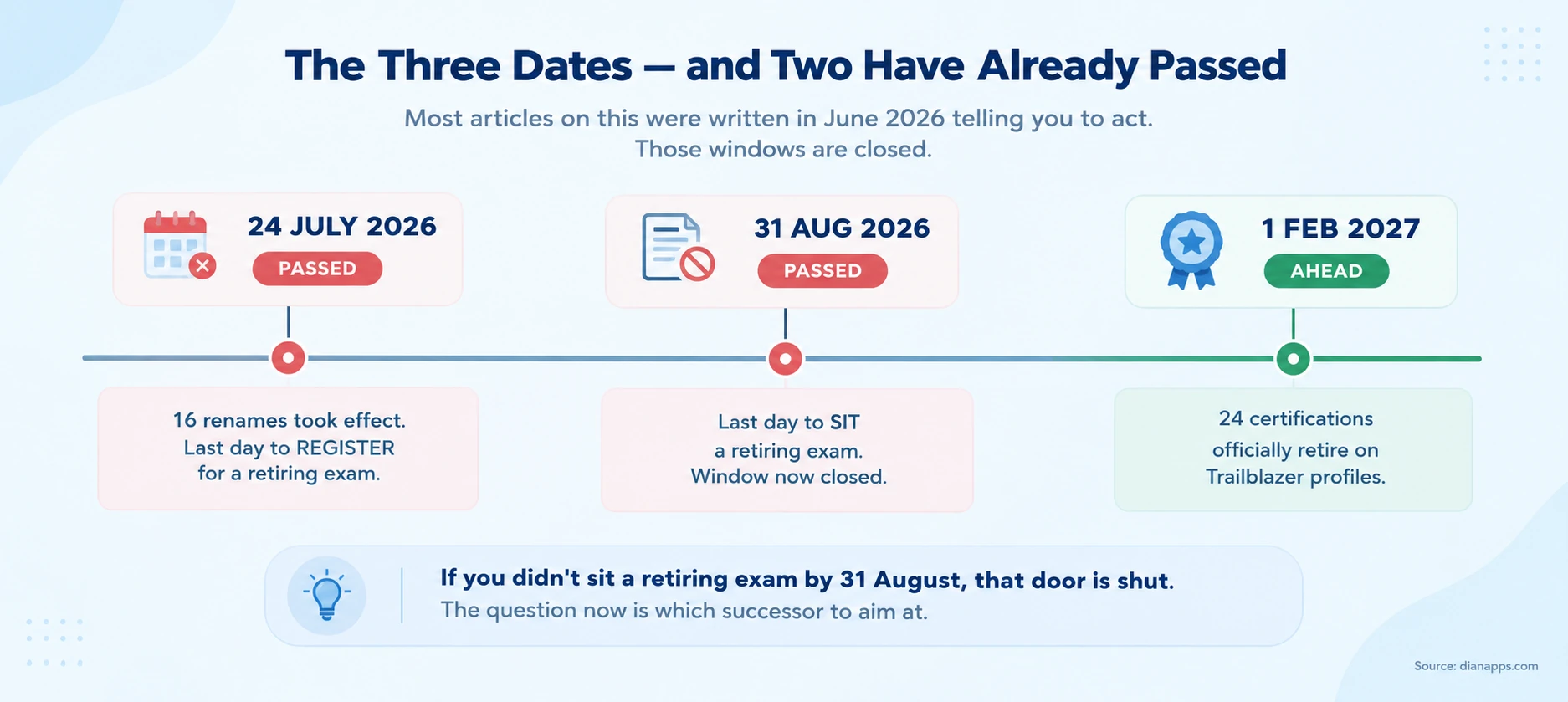
A correction worth making, because a lot of coverage conflates these: the retirement date is 1 February 2027, not July 2026. July was the rename date and the registration cutoff. Two different things are happening on the same day, which is where the confusion comes from.
What this means depending on where you stand:
| Your situation | What to do |
|---|---|
| You hold a renamed certification | Nothing, except update your CV and LinkedIn |
| You hold a retiring certification | Nothing urgent. It stays valid and stays on your profile |
| You were studying for a retiring exam | Stop. Redirect to the successor, see below |
| You’re starting out | Unaffected. Platform Administrator is unchanged |
| You’re evaluating a partner | See the buyer section below |
What Was Renamed
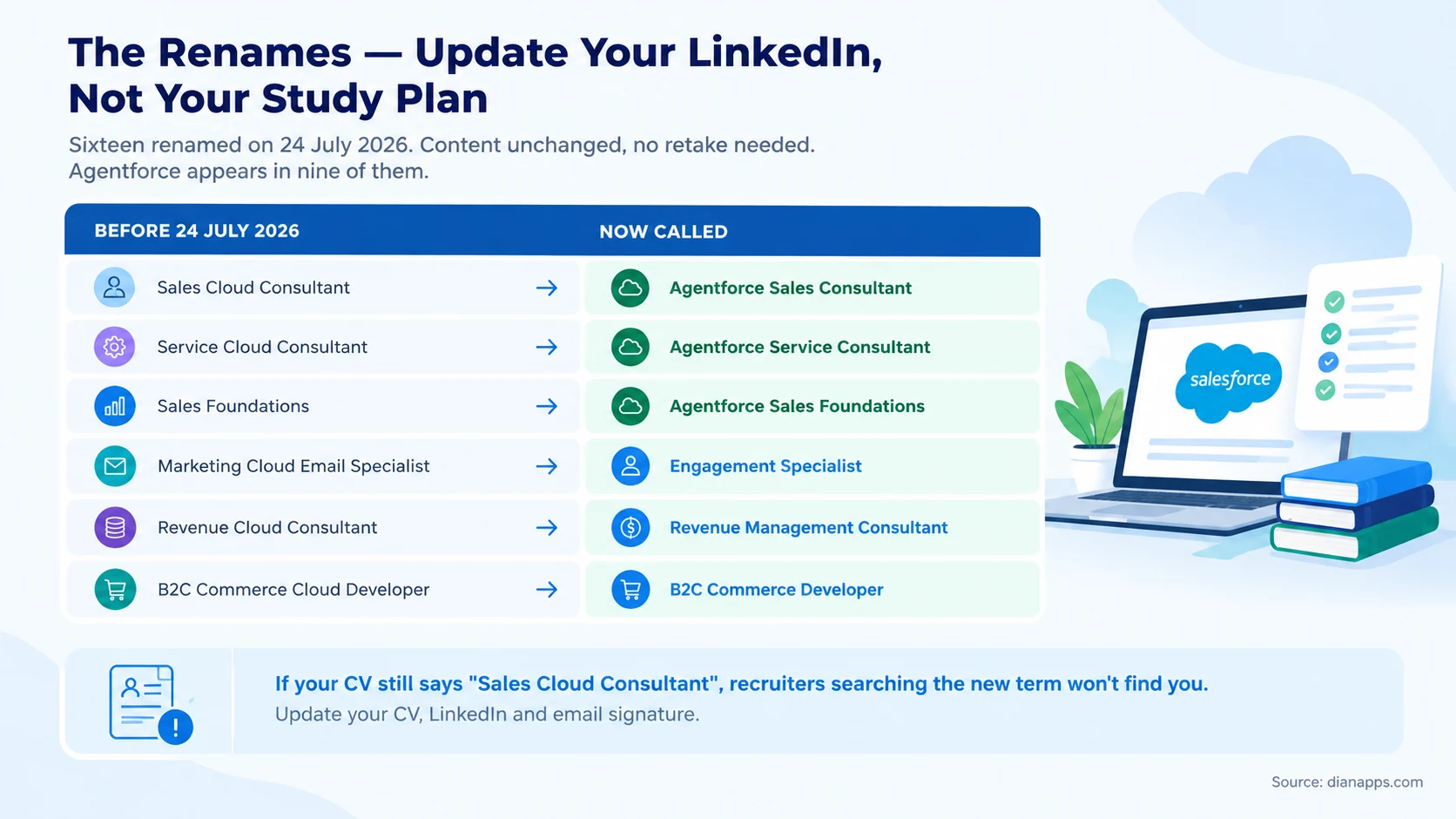
Sixteen certifications changed names on 24 July 2026. The exam content did not change, and nobody needs to retake anything. Your credential is the same credential with a different label.
“Agentforce” appears in nine of the sixteen. That’s the story: Salesforce is reorganising how it describes itself around agents rather than clouds, and the certification catalogue now reflects that.
Three renames that aren’t about Agentforce, and are quietly interesting:
- Marketing Cloud Email Specialist → Engagement Specialist, reflecting that the product long ago stopped being about email
- Revenue Cloud Consultant → Revenue Management Consultant, shifting from product name to business outcome
- B2C Commerce Cloud Developer → B2C Commerce Developer, dropping a redundant word
The Practical Action: Update your CV, LinkedIn, and email signature. A recruiter searching “Agentforce Sales Consultant” won’t find a profile that says “Sales Cloud Consultant”, and your credential will read as out of date to anyone who knows the catalogue changed.
What Is Retiring, and What to Do Instead
24 certifications retire on 1 February 2027; the pattern is clear once you look at the list: most are Accredited Professional credentials, which were product-specific rather than role-based. Salesforce is consolidating around roles.
| Retiring area | Certifications affected | Where to go instead |
|---|---|---|
| CPQ | CPQ Administrator, CPQ & Billing Consultant, Industries CPQ Developer | Revenue Management Consultant |
| Marketing Cloud satellites | Account Engagement Consultant, Advanced Cross Channel, Intelligence, Personalization | Agentforce Marketing certifications, expected late 2026 |
| MuleSoft | Both MuleSoft credentials | No direct replacement |
| Industry APs | Energy & Utilities, Consumer Goods, Media Cloud, Contact Center | Being re-evaluated for the Agentforce era |
| Architecture | B2B Solution Architect | Application and System Architect track |
| Nonprofit | Nonprofit Success Pack Consultant | Aligns with the NPSP-to-Agentforce Nonprofit shift |
Two Things Worth Knowing If You Hold One:
- Your Credential Stays Valid: It remains on your Trailblazer profile permanently, marked as retired from February 2027. Retirement means Salesforce stopped maintaining the exam, not that your expertise expired.
- Maintenance Requirements Stop: You no longer need to complete annual maintenance modules for a retired credential, which is a small mercy.
And one consequence that matters more than it sounds is that retired certifications stop appearing on public verification pages. If you’re a consultancy that displays verified credentials to prospects, or a professional whose credential gets checked, that’s a real change, not a cosmetic one.
The MuleSoft situation deserves a flag. Both MuleSoft certifications are retiring with no announced replacement. If you built a specialty there, the formal validation disappears in February 2027, though the skills obviously don’t.
See MuleSoft for Salesforce.
The Certification Map
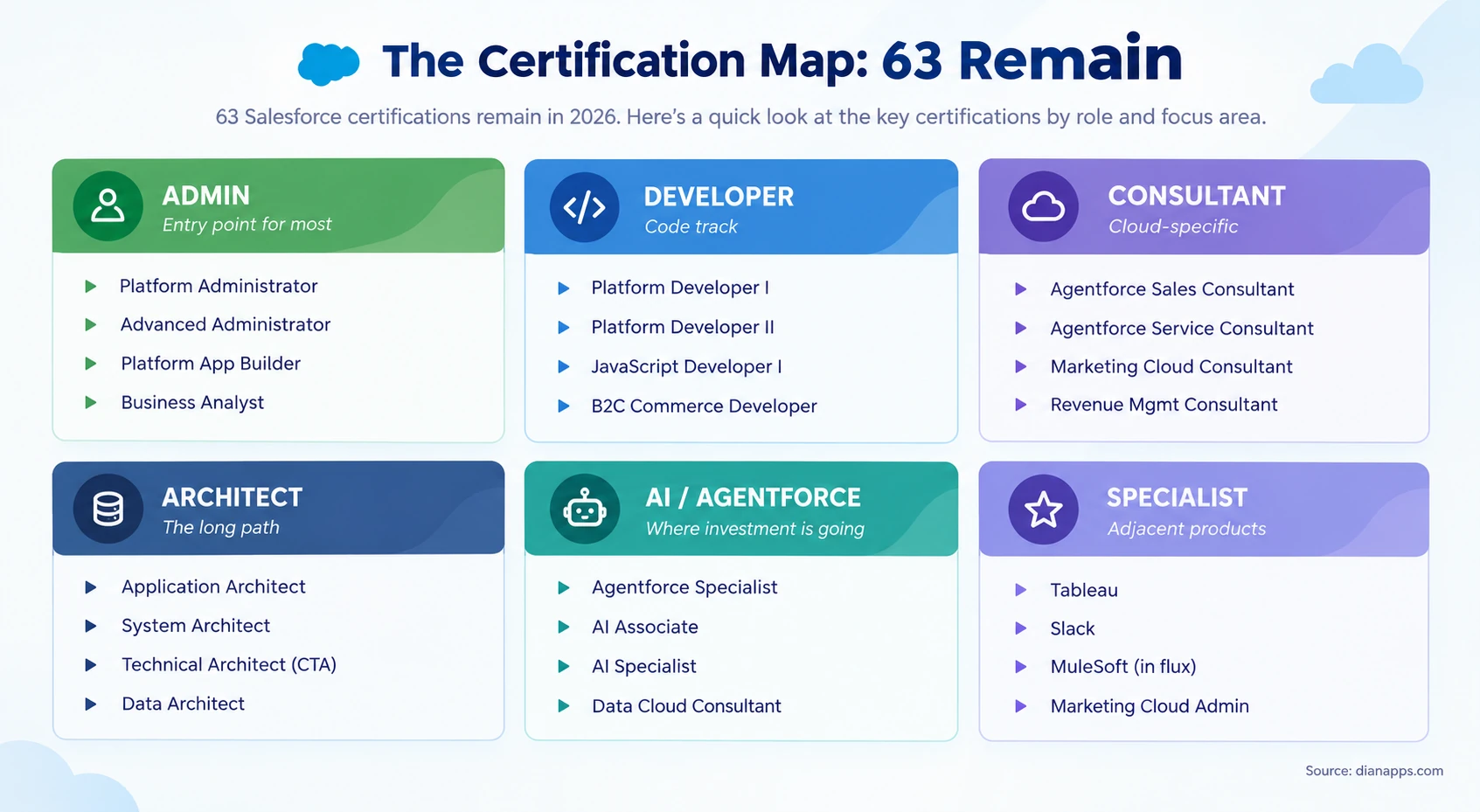
- Six Certification Tracks: Admin, Developer, Consultant, Architect, AI and Agentforce, and Specialist, with the main credentials in each
63 certifications remain, covering every core role. The headline isn’t that Salesforce is shrinking the catalogue; it’s tightening it around roles people actually hire for.
Start with the track your job title sits in, not the one with the highest reported salary. The most common mistake is collecting credentials across tracks rather than going deep in one.
Deeper: Admin vs developer vs architect vs consultant
Which Certifications Hiring Managers Actually Value
This is the question behind the question, and the honest answer is that they’re not weighted equally.
| Certification | Signal strength | Why |
|---|---|---|
| Platform Administrator | Strong baseline | The genuine entry point. Expected, not impressive |
| Platform Developer II | Strong | Requires a practical assessment, not just multiple-choice |
| Technical Architect (CTA) | Very strong | A board review; genuinely difficult and rare |
| Agentforce Specialist | Rising fast | Currently the clearest differentiator in the market |
| Consultant certifications | Moderate | Useful, but experience in that cloud matters more |
| Platform Developer I | Baseline | Expected of any developer, proves little on its own |
| AI Associate | Weak alone | Entry-level; good as a starting point, not a credential to lead with |
- The Pattern: Credentials requiring a practical component ( PD2, CTA) carry far more weight than multiple-choice exams. Everyone knows which is which.
And the Uncomfortable Truth: A candidate with eight certifications and no production experience is a worse hire than one with Platform Administrator and three years of shipped work. Certifications prove exposure. Delivery history proves capability. Every experienced hiring manager weights them accordingly.
We cover how to test for the difference in 40 Salesforce developer interview questions.
Cost, Format and Maintenance
| Item | Detail |
|---|---|
| Standard exam fee | ~$200 USD, plus local tax |
| Architect-level exams | ~$400 USD |
| CTA board review | ~$6,000 USD |
| Retake fee | ~$100 USD (half the original) |
| Format | Multiple choice, typically 60 questions, 105 minutes |
| Pass mark | Varies by exam, generally 62–68% |
| Delivery | Online proctored or test centre |
| Maintenance | Free Trailhead modules, released with each seasonal update |
- Maintenance Is the Part People Forget: Most active certifications require completing a maintenance module with each Salesforce release, three times a year. Miss them, and the credential can lapse. It’s free and takes under an hour, but it’s a recurring commitment across every certification you hold, which is a genuine argument against collecting them.
Retired credentials no longer require maintenance, which is one small upside of the clear-out.
Choosing the Right Salesforce Partner?
Get expert guidance on evaluating Salesforce expertise, certifications, implementation capabilities, and the right partner for your project.
Realistic Study Time
Published estimates are optimistic. These assume you’re working full-time and studying evenings.
| Certification | Realistic study time | Prerequisite experience |
|---|---|---|
| AI Associate | 2–4 weeks | None |
| Platform Administrator | 2–4 months | Some hands-on org time |
| Platform App Builder | 6–10 weeks | Admin-level familiarity |
| Platform Developer I | 3–5 months | Programming background helps considerably |
| Agentforce Specialist | 4–8 weeks | Admin knowledge plus hands-on agent work |
| Advanced Administrator | 2–3 months | 1–2 years administering an org |
| Platform Developer II | 4–6 months | Real development experience, not optional |
| Architect track | 1–3 years | Several years across technical and functional work |
- The Honest Caveat: These assume genuine hands-on practice, not just reading. A free Developer Edition org and one real project teach more than any amount of question-bank drilling, and it’s the difference between passing an exam and being able to do the job.
Trailhead is the primary resource, and it’s free. Beyond that, practice exams are worth paying for, and Trailblazer Community groups are underrated.
For Buyers: Reading a Partner’s Certifications
Most content on this topic is written for people sitting exams. If you’re evaluating a consultancy instead, four things matter.
- Certifications Per Consultant, Not Total: A firm advertising “200+ certifications” across 300 staff is thinner than one with 80 across 40 specialists. Ask for the ratio.
- Certifications Belong To Individuals, Not Companies: When people leave, the credentials go with them. Check the Trailblazer profiles of the specific people proposed for your project, not the firm’s aggregate.
- Watch For Retired Credentials Being Presented As Current: From February 2027, retired certifications stop appearing on public verification pages. A partner still listing CPQ Administrator or a retired Accredited Professional in 2027 is either not maintaining their materials or hoping you won’t check.
- Watch For Old Names: A partner listing “Sales Cloud Consultant” after July 2026 hasn’t updated. Same signal as the partner tier change: Base, Ridge, and Crest were retired in March 2026 and replaced by Select and Summit.
- Weigh Certifications Against Delivery Evidence. Ask for a named case study at your project size and industry. Certifications are a filter, not a decision.
For organizations that need help assessing their options, Salesforce Consulting Services can provide guidance on partner selection, implementation requirements, and the expertise needed for the project.
Deeper: how to choose a Salesforce implementation partner · top Salesforce consulting companies
Need Certified Salesforce Talent?
Build your Salesforce team with experienced developers who bring hands-on expertise beyond certifications and can handle real-world project requirements.
Is Certification Worth It?
If you’re entering the ecosystem: yes, clearly. Platform Administrator is the most reliable route in; it has no prerequisites, and Trailhead makes the training free. It’s the single highest-return credential in the catalogue for someone with no Salesforce background.
If you’re already working in Salesforce, it depends on the certification. A second or third credential in the same track has diminishing returns. A credential in a genuinely different area — Agentforce Specialist for an experienced admin, say opens doors that another consultant cert won’t.
If you’re collecting them: probably not. Beyond four or five, additional certifications signal enthusiasm rather than capability, and each one adds a maintenance obligation three times a year.
Where certification genuinely converts to money: the specialist and architect ends. Agentforce Specialist is the current market differentiator because demand outstripped supply quickly. CTA remains rare enough to command a substantial premium.
Where it doesn’t: entry-level multiple-choice credentials held without any hands-on work. The market has become good at spotting this.
Related: Salesforce developer hourly rates by region · admin vs developer vs architect
How to Re-Plan Your Study Path
If the changes disrupted your plan, four steps:
- Check Whether Your Target Certification Is On Either List: Renamed means carry on, same exam, new name. Retiring means stop.
- Map To The Successor: CPQ work points to Revenue Management Consultant. Marketing Cloud satellite credentials point to the Agentforce Marketing certifications expected in late 2026. MuleSoft has no successor, so redirect to integration architecture more broadly.
- Consider Whether Agentforce Specialist Should Come First: For most people already working in Salesforce, it’s currently the credential with the best ratio of effort to market recognition. See what Agentforce is.
- Don’t Rush A Replacement: Salesforce has signalled more Agentforce-centric credentials arriving. Sitting a certification purely because your original plan broke is a poor reason to spend three months.
Where to Go Next
For understanding the roles these certifications map to, admin vs developer vs architect vs consultant.
For what certifications are worth in salary terms, Salesforce developer hourly rates by region.
For evaluating a partner’s credentials, how to choose a Salesforce implementation partner and top Salesforce consulting companies.
For the technology behind the newest credentials, what is Agentforce and Data 360?
For free training, what is Trailhead?
For hiring rather than being hired, how to hire a Salesforce developer and 40 developer interview questions.
The complete guide to Salesforce is the hub.
If You’re Reading This to Evaluate a Partner Rather Than Sit an Exam
Certification counts are the easiest thing for a consultancy to inflate and the hardest for a buyer to interpret. Two hundred certifications across three hundred staff sounds impressive and means very little.
What matters is the ratio per consultant, whether the specific people on your project hold them, and whether the credentials are current rather than retired.
Have a Salesforce Project in Mind?
Tell us what you’re building or where you need help, and our Salesforce team can discuss the right approach for your project.
 0 comments







Leave a Comment
Your email address will not be published. Required fields are marked *