












 0 comments





As businesses continue to experience a hike in data generation, the need for effective utilization of customer data becomes essential. Salesforce stands out as a leading customer relationship management (CRM) platform, offering startups and businesses a powerful solution to use their data effectively.
With changing business technologies, Salesforce remains at the forefront, empowering companies to engage clients innovatively and take their growth to new heights.
Salesforce introduces modern features tailored to address evolving business needs. With an emphasis on easy navigation and enhanced functionalities, users can apply Salesforce’s capabilities more effectively than ever before.
For a startup, the question isn’t whether Salesforce is powerful. It’s whether you need it yet, which plan to start on, and how to avoid paying for more than you use.
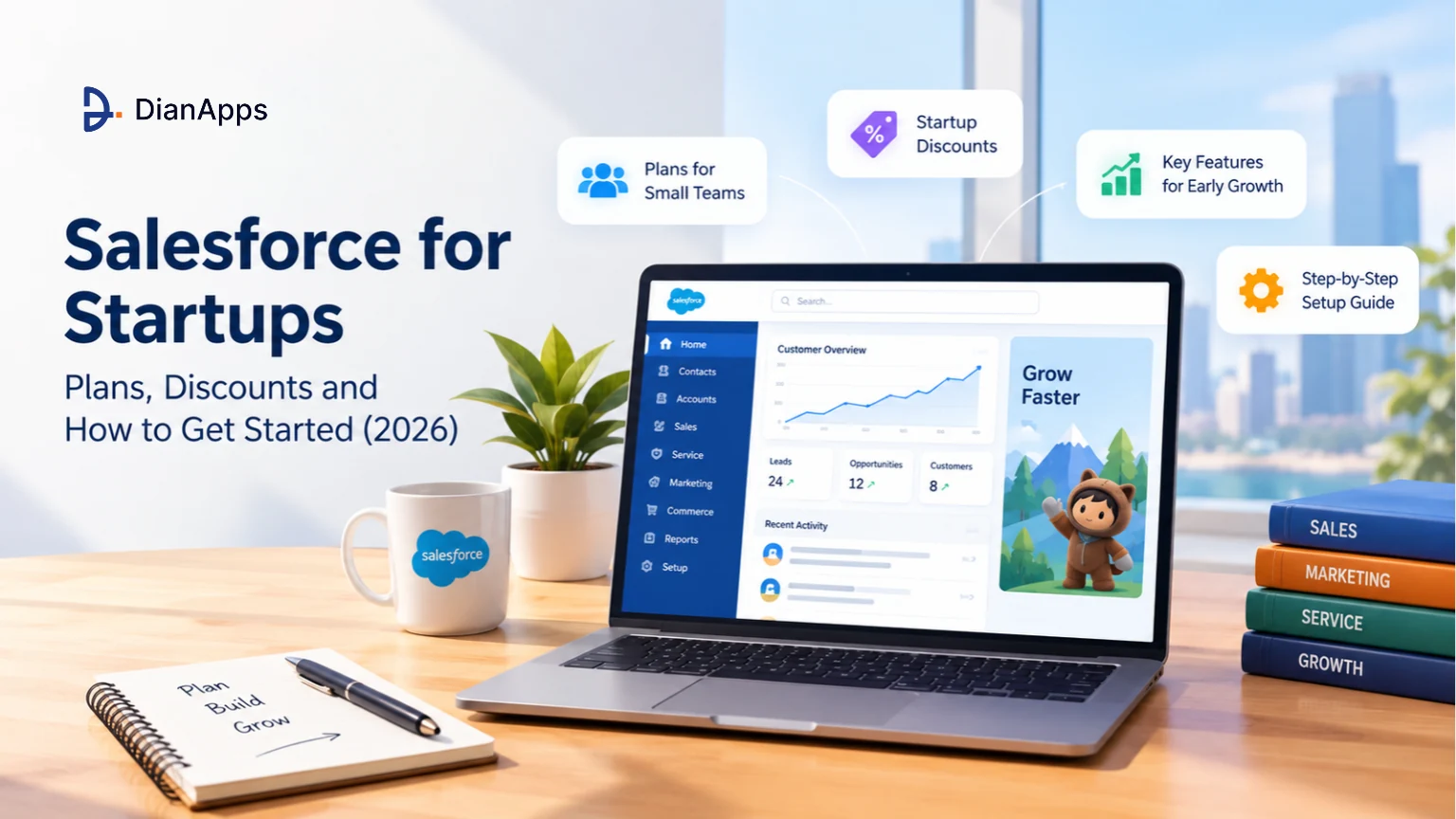
This guide covers Salesforce’s plans for small teams, the Salesforce Launchpad discount for startups, the features that matter early on, and how to get set up.
What’s New for Startups in 2026
- Free Suite: a permanently free plan for up to 2 users, good for founders testing a CRM.
- Starter Suite: $25 per user per month, with sales, service, marketing, and commerce tools in one simple app. It is the only Salesforce plan you can pay monthly.
- Pro Suite: $100 per user per month (billed annually), adding forecasting, quoting, deeper customization and automation, and AppExchange apps.
- Salesforce Launchpad for Startups: Salesforce’s startup program, with free and discounted plans for eligible early-stage companies.
- AI agents: Agentforce, Salesforce’s AI platform, now comes with the larger editions (Core, Advanced, and Max) launched in September 2026.
Salesforce AI Features Worth Knowing About
1. Agentforce AI Agents
Agentforce (which replaced Einstein Copilot) is Salesforce’s AI agent platform. Agents can answer customers, follow up with leads and update records, using out-of-the-box actions or custom actions built with Flow, Apex or MuleSoft APIs. This integration allows for enhanced automation of tasks through out-of-the-box actions or custom actions calling Flows, Apex, or MuleSoft APIs.
2. Prompt Builder
The prompt builder feature enables users to create, test, and refine prompt templates without the need for coding. It empowers users to ground prompts with dynamic CRM data, including merge fields, and use them in Flows and Agentforce agents.
3. AI for Customer Service
AI drafts replies and summarizes cases for support agents, and Agentforce Service Agent can answer customers directly, enhancing the efficiency of customer support interactions. By directly exposing verified Knowledge Articles in the help center (Experience Cloud site) or Agent Console, more cases can be diverted, leading to quicker resolutions.
Note: most AI features come with the larger editions or as paid add-ons. On Starter and Pro Suite, check what’s included before you plan around them.
Should a small business use Salesforce?
Well, that’s an obvious question to pop up in the minds of an entrepreneur. Let us answer why you should choose Salesforce for your business for the following reasons.
1. Streamlined Customer Management
Salesforce goes beyond simple contact management by facilitating true customer management, supporting business operations, and providing the agility and scalability needed for fast-growing enterprises. It enables startups to build strong relationships with their initial customers, essential for survival and growth.
Essentially, CRM acts as a guide for businesses, helping them understand their customer relationships, navigate challenges, and steer toward successful deals.
2. Enhanced Sales Efficiency
The power of Salesforce development services lies in its ability to provide a comprehensive view of each customer, including past interactions, order status, transaction history, and more. This functionality isn’t restricted to large companies; startups can benefit too.
A good CRM platform like Salesforce goes beyond storing contact information by helping to qualify leads, prompting timely follow-ups, and enabling analysis of sales data for continuous improvement.
3. Simplified IT Infrastructure
As your organization expands, so do your IT needs, including sharing CRM data, collaborating on sales initiatives, and accessing information on the go. Maintaining in-house software systems for these tasks is daunting, especially for small businesses without dedicated IT departments. However, using a platform like Salesforce to develop mobile apps for internal and customer use can maximize productivity.
Targeted employee smartphone apps streamline tasks, such as conducting vehicle checks or approving customer quotes, leading to significant efficiency gains.
4. Customer Support in the Same App
Managing customer service can become challenging in the long run. Cloud-based CRM systems offer solutions by integrating with other cloud services, such as social media platforms like Facebook, Twitter, and LinkedIn. This integration provides startups with insights into customer and prospect activities, allowing them to anticipate needs and address issues proactively.
Salesforce Starter Suite includes basic service tools such as cases and email support, so a small team can answer customers from the same place it sells. As you grow, Service Cloud adds messaging channels such as web chat and WhatsApp, and Omni-Channel routing. Service Cloud Essentials, the old small-business edition, has been replaced by Starter and Pro Suite.
5. Scalable Growth On-Demand
Your CRM platform must also scale accordingly as your company expands. Using scalable and extensible CRM software is essential to avoid the hassle of switching systems, adjusting processes, and retraining staff as your business grows.
From Pro Suite upward, you can add apps from the Salesforce AppExchange to meet evolving business needs. Starter Suite does not include AppExchange access. This flexibility allows for efficient growth without the complexity of managing and updating software. Additionally, you can create custom apps on the Salesforce Platform to tailor the CRM to your specific requirements.
Salesforce Features Startups Use Most
- Lead and opportunity tracking: see every deal and its next step.
- Email integration with Gmail and Outlook: emails and meetings logged automatically.
- Reports and dashboards: pipeline and revenue at a glance.
- Mobile app: update deals and check customers on the go.
- Simple automation: follow-up reminders and lead assignment (more automation in Pro Suite).
- Security: two-factor authentication is required for all users, and Salesforce supports compliance programs such as GDPR. HIPAA-covered use needs specific services and a signed agreement with Salesforce.
Salesforce Products for Startups
1. Sales Cloud
Sales Cloud is where most startups begin: lead, contact, and deal tracking, pipeline reports, and sales forecasting. It can help startups automate administrative tasks and manage leads in an efficient manner. Then direct your strategy quickly when you need to.
2. Service Cloud
You can now take your business to new heights with Salesforce Service Cloud. When you depend on Service Cloud along with an AI-powered service platform built from the ground up to customize service across every touchpoint, you’re in a favorable position to build long-lasting relationships with your customers.
3. Marketing Cloud
Startups can crack more deals and increase their return on investment if they can use tools like Marketing Cloud Account Engagement (formerly Pardot) to uncover actionable insights about customers.
Most early-stage startups don’t need a separate marketing product at first: Starter and Pro Suite include basic email marketing.
Salesforce Plans for Startups
| Plan | Price (Per User/Month) | Best For |
| Free Suite | $0 (up to 2 users) | Founders testing a CRM |
| Starter Suite | $25 (monthly or annual billing) | Small teams that need a simple, all-in-one CRM |
| Pro Suite | $100 (annual billing) | Growing teams that need forecasting, quotes, automation, and apps |
| Core / Advanced / Max | $195 / $395 / $550 (annual billing) | Scaling companies that need full customization and AI agents |
You can try Starter or Pro free for 30 days, with no credit card needed for Starter.
Is There a Salesforce Discount for Startups?
Yes. Salesforce Launchpad for Startups offers eligible early-stage companies Starter Suite free for 12 months (for up to 30 users) or 50% off Pro Suite, plus startup coaching and community events. At the time of writing, it is aimed at startups that raised less than $3 million in their latest round, are not already Salesforce customers, and have fewer than 30 users. Check the current terms on Salesforce’s Launchpad page before you apply.
How to Get Started with Salesforce as a Startup
- Write down your sales process: stages, who owns leads, and what you need to report on.
- Start a free trial or apply to Launchpad.
- Import your contacts and deals from spreadsheets with the Data Import Wizard, after cleaning duplicates.
- Connect Gmail or Outlook and your calendar.
- Set up a pipeline dashboard and two or three key reports.
- Train the team in a short session, then review after 30 days.
Common mistakes: buying a bigger plan than you need, importing messy data, over-customizing before you know your process, and skipping user training.
Why Choose DianApps as your Salesforce Development Company?
DianApps offers comprehensive Salesforce development services facilitated by a team of certified developers. We assemble our thoughts and execute tailored Salesforce solutions to address the unique needs of businesses across various industries, including B2B & B2C, Social Networking, Travel and Leisure, eCommerce, Entertainment, Banking and Finance, Healthcare, Real Estate, Education, Food, and more.
Our Approach to Salesforce Development and Implementation
- Brainstorming & Research: Before commencing the Salesforce app development process, our team conducts thorough research and brainstorming sessions to analyze the project’s goals comprehensively.
- Design & Development: We select the best design layouts that complement your Salesforce app project, guided by our team’s expertise in design and development.
- Quality Control: We prioritize offering top-quality services to our clients. Our team of quality analysts diligently checks every aspect of your app to ensure its quality meets the highest standards.
- Support: Our commitment to client satisfaction includes providing 24/7 Salesforce CRM assistance to address any project-related issues promptly.
- Launch: After rigorous testing and cross-checking, our team deploys and launches your Salesforce application in the market, ensuring a smooth and successful rollout.
Conclusion
Ultimately, the goal of every startup is to prosper and grow in the long run. Salesforce is a leading CRM platform that evolves by adopting top-notch technology and practices to make it easier for startups to work effectively. With benefits like real-time insights on their customers, better customer service, and increased revenues, Salesforce can grow with a startup from its first customers to an enterprise sales team. The key is starting on the right plan and adding only what you need.
For selecting the right set of solutions for your startup, it’s better to carefully consider the factors before hiring a Salesforce development company. Being a startup, you need to pay more attention to every little detail while investing in a strong Salesforce CRM solution.
 0 comments





Your email address will not be published. Required fields are marked *