














 0 comments
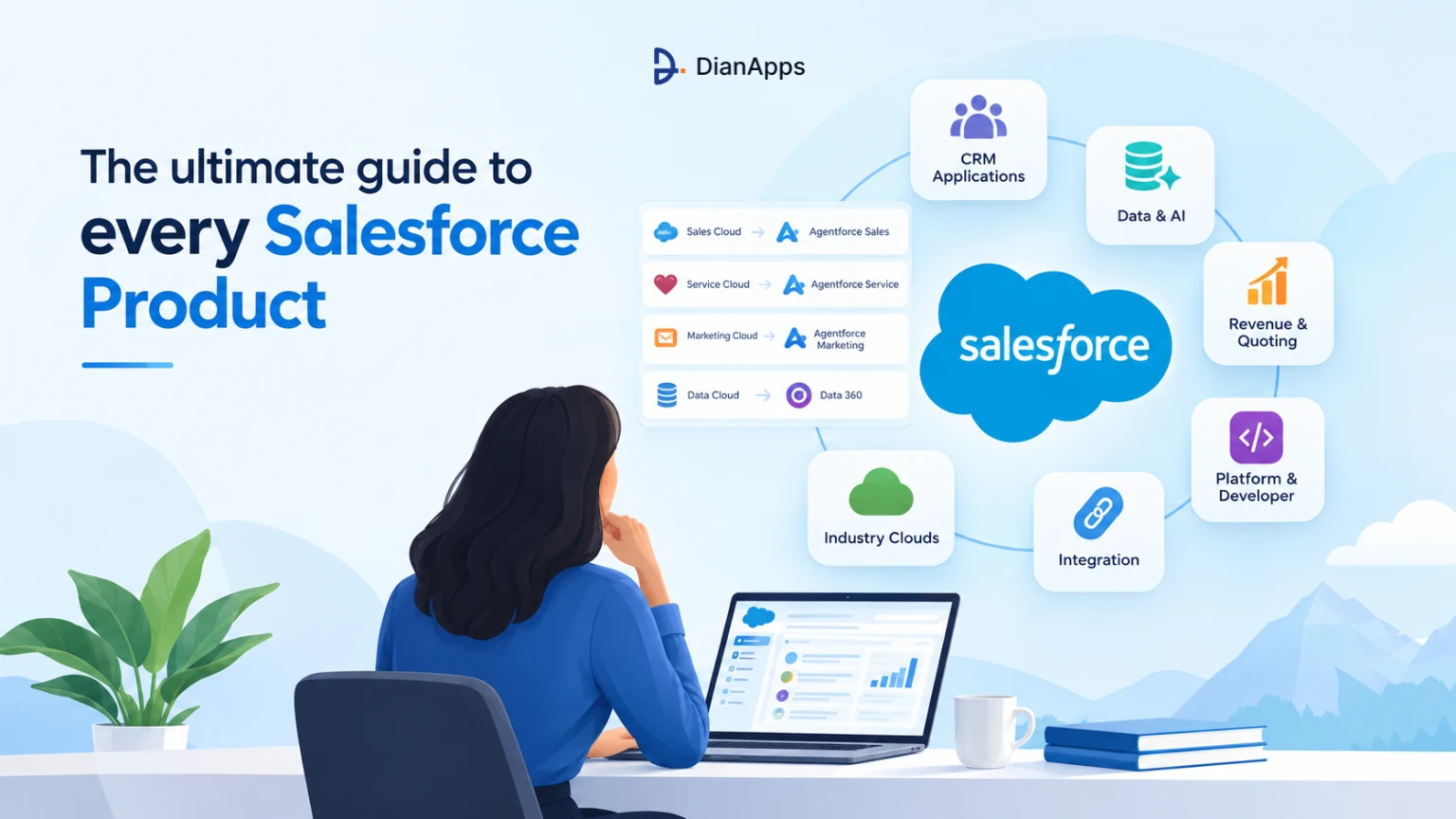





Key Takeaways:
- Salesforce has around 50 individually named products organized across six major families.
- The six families include CRM applications, Data and AI, Revenue and Quoting, Platform and Developer, Integration, and Industry Clouds.
- Major products have been renamed, including Sales Cloud to Agentforce Sales, Service Cloud to Agentforce Service, Marketing Cloud to Agentforce Marketing, and Data Cloud to Data 360.
- Products such as Data 360, CPQ, Salesforce Shield, Tableau, MuleSoft, and Slack can involve separate licensing or contracts.
- Einstein and Agentforce are different: Einstein focuses on predictive AI, while Agentforce focuses on agentic AI that can take action.
- Salesforce Platform can offer a lower-cost option for users who need custom applications without the full CRM functionality.
- Most organizations should start with the Salesforce products they actually need rather than buying the entire portfolio upfront.
- Salesforce has also discontinued several older products, making it important to check whether a product list is current.
Quick Answer: Salesforce has around 50 individually named products in 2026, covering CRM, data and AI, revenue and quoting, platform and development, integration, and industry-specific needs. Several familiar products have new names, such as Sales Cloud becoming Agentforce Sales and Data Cloud becoming Data 360. Since many products are licensed separately, businesses should review the line-item quote and choose only the products that match their actual requirements.
Salesforce sells around fifty individually named products; most buyers touch four or five.
The problem with every product list you’ll find is that Salesforce renamed a large part of the portfolio and most lists predate it. Sales Cloud is Agentforce Sales. Data Cloud is Data 360. Pardot has been renamed twice. A list using the old names isn’t wrong exactly, but it won’t match what appears on your quote.
This is the current inventory, grouped by family, with old names mapped, plus the thing that actually causes budget surprises: which products are included in your licence and which are separate contracts.
The Portfolio, by Family
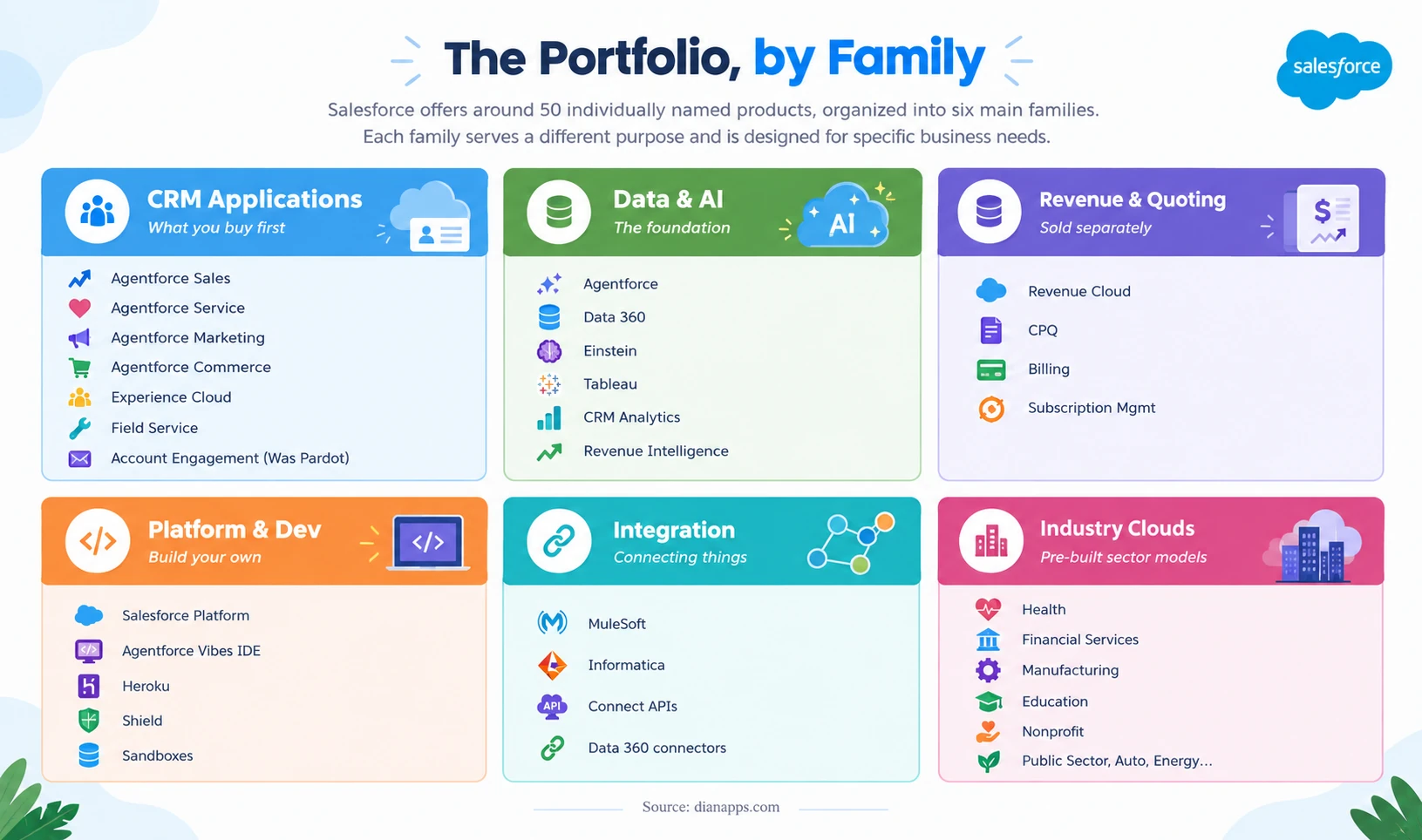
Six families are a useful grouping because it maps to how products are actually licensed and who buys them. Salesforce’s own navigation groups things by audience, which is why two lists of “all Salesforce products” rarely match.
CRM Applications
The products most people mean when they say “Salesforce”.
| Product | Current name | What it does |
|---|---|---|
| Sales Cloud | Agentforce Sales | Pipeline, forecasting, quoting, deal management |
| Service Cloud | Agentforce Service | Cases, routing, knowledge, chat, phone, self-service |
| Marketing Cloud | Agentforce Marketing | Email, journeys, SMS, advertising, personalisation |
| Commerce Cloud | Agentforce Commerce | B2B, D2C and B2C storefronts, order management |
| Experience Cloud | Unchanged | Portals, communities, partner and customer sites |
| Field Service | Unchanged | Work orders, scheduling, mobile engineers, assets |
| Account Engagement | Was Pardot | B2B marketing automation and lead nurture |
Sub-products worth knowing, because they appear on quotes as separate lines: Sales Engagement, Einstein Conversation Insights, Sales Programs, Service Intelligence, and Digital Engagement for messaging channels.
Deeper: Salesforce clouds compared
Data and AI
The fastest-moving family, and the one where names have changed most.
| Product | Current name | What it does |
|---|---|---|
| Agentforce | - | AI agents that take action across every cloud |
| Data Cloud | Data 360 | Unifies customer records across all systems |
| Einstein | Unchanged | Predictive AI, scoring, forecasting, generative help |
| Prompt Builder | - | Reusable AI prompt templates grounded in your data |
| Agent Builder | - | Configures agent topics, actions, and guardrails |
| Tableau | Unchanged | Analytics and visualisation across systems |
| Einstein Analytics / Wave | CRM Analytics | Analytics built into the CRM |
| Revenue Intelligence | Unchanged | Pipeline and revenue analytics for sales leadership |
The distinction people get wrong: Einstein and Agentforce are not the same thing. Einstein is predictive – scoring, recommending, forecasting. Agentforce is agentic – taking action. They coexist, and Salesforce sells both.
And Data 360 isn’t a cloud. It’s a foundation layer, priced on consumption rather than seats, and it behaves differently from standard Salesforce objects.
Deeper: What is Agentforce · Data 360 explained
Revenue and Quoting
A family that confuses buyers more than any other, because the naming has shifted repeatedly.
| Product | Status | What it does |
|---|---|---|
| Revenue Cloud | Current umbrella | Quote-to-cash: CPQ, billing, subscriptions |
| CPQ | Within Revenue Cloud | Configure, price, quote - complex product pricing |
| Billing | Within Revenue Cloud | Invoicing, payments, revenue recognition |
| Subscription Management | Within Revenue Cloud | Recurring revenue and renewals |
Two things to know before a conversation about this:
It’s a separate licence, not part of Sales Cloud. Organisations regularly assume quoting is included and discover otherwise at contract stage.
The certification landscape here has changed. CPQ Administrator, CPQ & Billing Consultant, and Industries CPQ Developer are all retiring, with Revenue Management Consultant as the successor – a reliable signal that Salesforce is consolidating this family. See Salesforce certifications.
Platform and Developer Products
What you use to build rather than buy.
| Product | Current name | What it does |
|---|---|---|
| Force.com / Lightning Platform | Salesforce Platform | The platform underneath everything; own licence type |
| Code Builder | Agentforce Vibes IDE | Browser-based development environment |
| Heroku | Unchanged | Applications outside platform limits, any language |
| Salesforce Shield | Unchanged | Platform encryption, event monitoring, field audit trail |
| DevOps Center | Unchanged | Free source-driven deployment tooling |
| Sandboxes | Unchanged | Development and testing environments |
| AppExchange | Unchanged | Marketplace for third-party application |
The Platform licence is the cost lever most buyers never hear about. At roughly a sixth the price of a full CRM seat, it covers users who need custom apps but never touch Leads, Opportunities, or Cases.
Deeper: the Salesforce Platform explained · Salesforce DevOps · sandboxes explained
Integration Products
| Product | What it does | Notes |
|---|---|---|
| MuleSoft | Enterprise integration and API management | Own product, own licence, own skill set |
| Informatica | Data integration and governance | Acquired; positioning still settling |
| Data 360 connectors | Pull data in for unification | Part of Data 360, not standalone |
| Connect / REST / Bulk APIs | Native platform APIs | Included with your edition |
Worth knowing: you don’t need MuleSoft to integrate Salesforce. The native APIs handle a great deal, and MuleSoft earns its cost when you’re orchestrating across many systems rather than connecting two.
Deeper: Salesforce integration guide · MuleSoft for Salesforce
Industry Clouds
Pre-built data models for specific sectors, genuine object models, not templates.
| Industry cloud | What it adds |
|---|---|
| Health Cloud | FHIR-aligned clinical model: patient, care plan, encounter |
| Financial Services Cloud | Household and relationship model, financial accounts, policies |
| Manufacturing Cloud | Sales agreements, account forecasting, rebates |
| Education Cloud | Student journey: applications, programmes, affiliations |
| Agentforce Nonprofit (was Nonprofit Cloud) | Gift transactions, grantmaking, programme management |
| Public Sector Solutions | Licensing, permitting, case and grant management |
| Automotive, Energy & Utilities, Media, Consumer Goods | Sector-specific models for each |
The buying argument is arithmetic. Rebuilding an industry data model is a six-figure project you then maintain permanently. The industry cloud costs more per seat, and Salesforce maintains it.
Deeper: Salesforce for healthcare · financial services · manufacturing · nonprofit
Products That Were Renamed
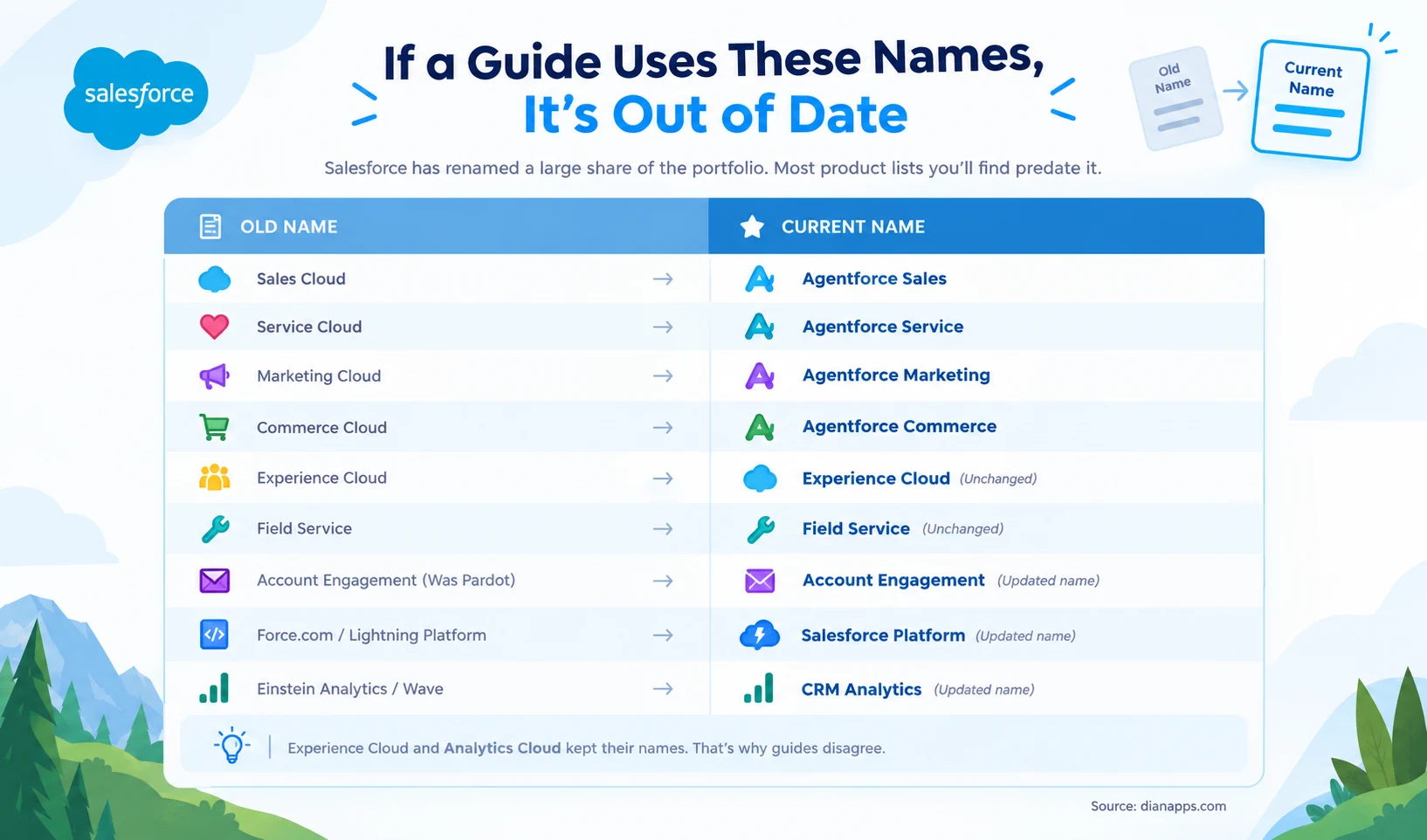
Why this matters practically:
Your quote won’t match older articles. If you’re researching using a 2024 product list and then read a proposal, the names won’t line up.
A partner still using old names hasn’t updated. Same signal as the retired partner tiers – Base, Ridge, and Crest were replaced by Select and Summit in March 2026.
Pardot has been renamed twice – Pardot, then Marketing Cloud Account Engagement, then Account Engagement. Six names for one product family in about six years, if you count the sub-variants. It’s the clearest example of naming churn in the portfolio.
And two clouds kept their names. Experience Cloud and Analytics Cloud weren’t folded into the Agentforce rebrand, which is precisely why guides written at different times appear to contradict each other.
What’s Included and What Costs Extra
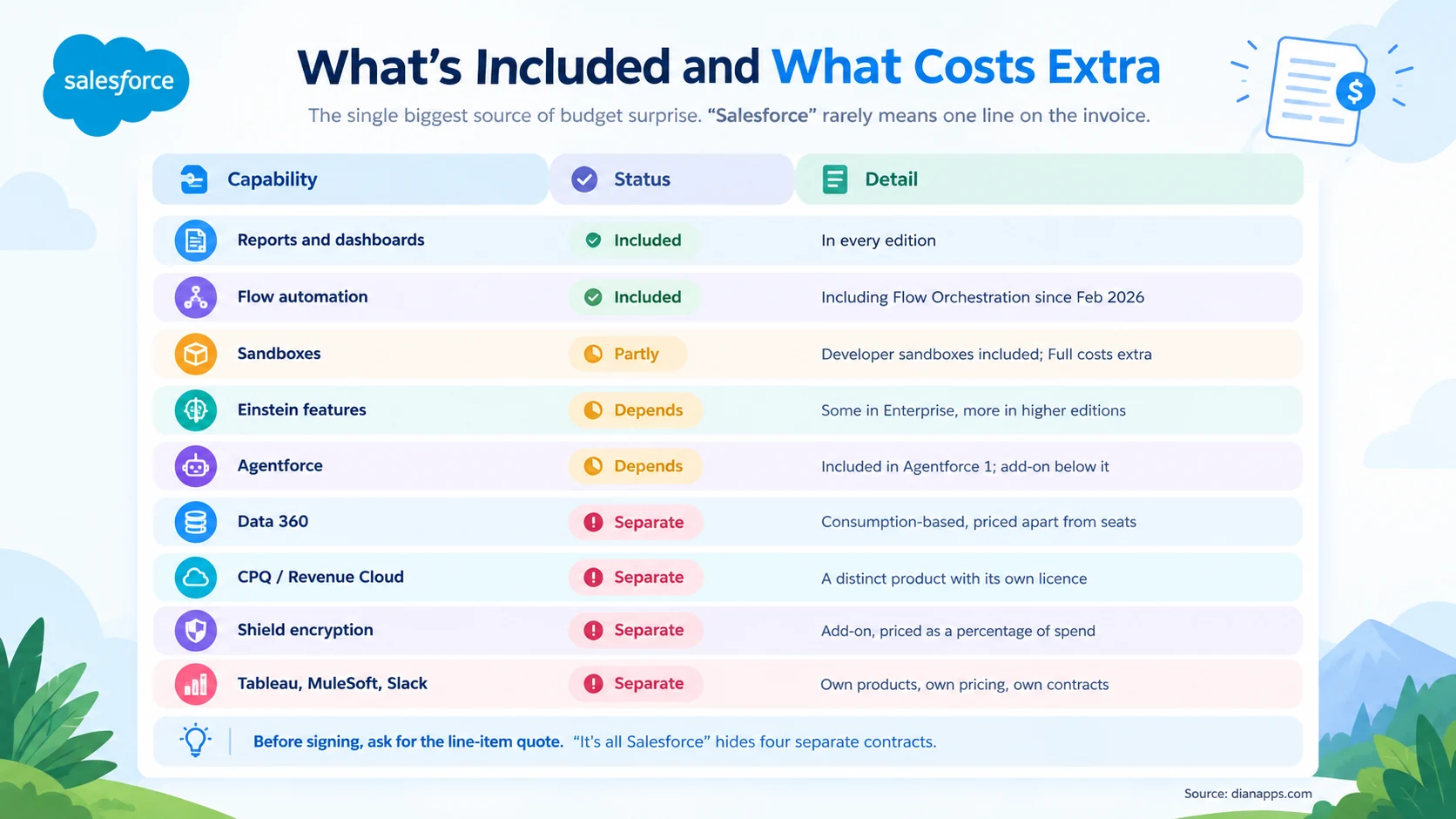
This is where budgets break, and it’s the most useful section on this page.
The Pattern: your edition includes the core CRM application plus platform capabilities – reports, Flow, standard APIs, developer sandboxes. Almost everything else is a separate line.
Three that surprise people most:
Data 360 is consumption-priced, not per-seat. Budgeting it as “another licence” produces the wrong number entirely.
CPQ is not part of Sales Cloud. If quoting is in scope, it’s a separate product.
Tableau, MuleSoft, and Slack are separate companies’ products that Salesforce now owns. Separate contracts, separate renewal cycles, separate account teams in some cases.
The question to ask before signing: give me the line-item quote. “It’s all Salesforce” can hide four contracts.
Not Sure What’s Included in Your Salesforce Quote?
Get a line-by-line review of your Salesforce quote and find out what you actually need, what costs extra, and what can wait.
Which Products Do You Actually Need?
| If you’re… | Core need | Consider adding |
|---|---|---|
| B2B sales-led | Agentforce Sales | Account Engagement, CPQ if quoting is complex |
| Support-heavy | Agentforce Service | Field Service if you have engineers on the road |
| B2C at volume | Agentforce Service + Marketing | Data 360 to unify identity across channels |
| Ecommerce | Agentforce Commerce | Order Management is included; Service for post-purchase |
| Regulated industry | The relevant industry cloud | Shield if compliance requires encryption |
| Building custom apps | Salesforce Platform licences | Heroku for anything outside governor limits |
| Many systems to connect | Native APIs first | MuleSoft only if orchestrating several systems |
The Honest Guidance: Most organisations need two CRM applications and nothing else for the first year. Everything in the “consider adding” column is a year-two conversation, and buying it upfront is how implementations stall.
Ready to Build Only What You Need?
Hire experienced Salesforce developers to customize, integrate, and scale the products your business actually needs.
Data 360 and Agentforce specifically come later. They’re what you add once you have data worth unifying and processes worth automating – not what you start with. This is where Salesforce Consulting Services can help businesses prioritize the right products, plan their rollout, and avoid paying for capabilities they are not ready to use.
Related: Salesforce pricing · Editions compared · Reducing licence costs
Products That No Longer Exist
Worth a short list, because stale guides still mention them
| Product | Status |
|---|---|
| Salesforce Functions | Retired January 2025. Use Heroku or async Apex |
| Vaccine Cloud | A COVID-era product, no longer offered |
| Work.com | Largely absorbed into other products |
| Salesforce IoT Cloud | Discontinued; Data 360 handles this territory |
| Desk.com | Retired; superseded by Service Cloud Essentials |
If a product list you’re reading includes any of these as current, treat the rest of it as similarly dated. It’s a quick reliability test.
Deeper: Salesforce Functions is retired – What to use instead
Where to Go Next
Understanding the groupings – Salesforce clouds compared · what is Salesforce · the Salesforce Platform
Cost – Salesforce pricing · editions compared · reducing licence costs · Salesforce ROI
The AI and data layer – what is Agentforce · Data 360 explained
Industry clouds – healthcare · financial services · manufacturing · retail · nonprofit · education
Platform and developer – Salesforce DevOps · sandboxes · Salesforce Shield · Heroku · Agentforce Vibes IDE
Integration – Salesforce integration · MuleSoft · API integration
Buying – choosing an implementation partner · Salesforce alternatives
Most Organisations Buy More Products Than They Use
Salesforce is sold by product, so the natural direction of a sales conversation is toward more of them. Nobody in that meeting is incentivised to say “you don’t need Data 360 yet.”
We are, because an implementation covering two products properly succeeds, and one covering five badly becomes a rescue project.
Have a Salesforce Quote You Want Reviewed?
Send us your quote, and we’ll help you understand what you’re paying for, what you need now, and what can wait.
 0 comments





Leave a Comment
Your email address will not be published. Required fields are marked *