













 0 comments





Key Takeaways:
- CRM manages known customer relationships, while a CDP unifies known and anonymous customer data.
- Identity resolution connects records across systems using deterministic and probabilistic matching.
- Data warehouses support analytics, while CDPs activate customer profiles across operational systems.
- Salesforce Data 360 implementation can cost 1.5–3 times the first-year licence.
- Fix integration and data quality issues before investing in a CDP.
Quick Answer: A CRM manages known customer relationships, while a customer data platform (CDP) unifies known and anonymous customer data across systems. Businesses need a CDP when identity gaps prevent reliable personalisation, automation, or customer engagement. Data warehouses serve analytics needs, while MDM platforms govern master data. A CDP complements your CRM rather than replacing it, but integration or data quality improvements may be sufficient if your needs are simpler.
A CRM records what you know about people you already know. A CDP works out that the anonymous website visitor, the email subscriber, and the support ticket are all the same person, then makes that unified profile available to every system that needs it.
They aren’t alternatives. A CDP takes your CRM as an input; it doesn’t replace it.
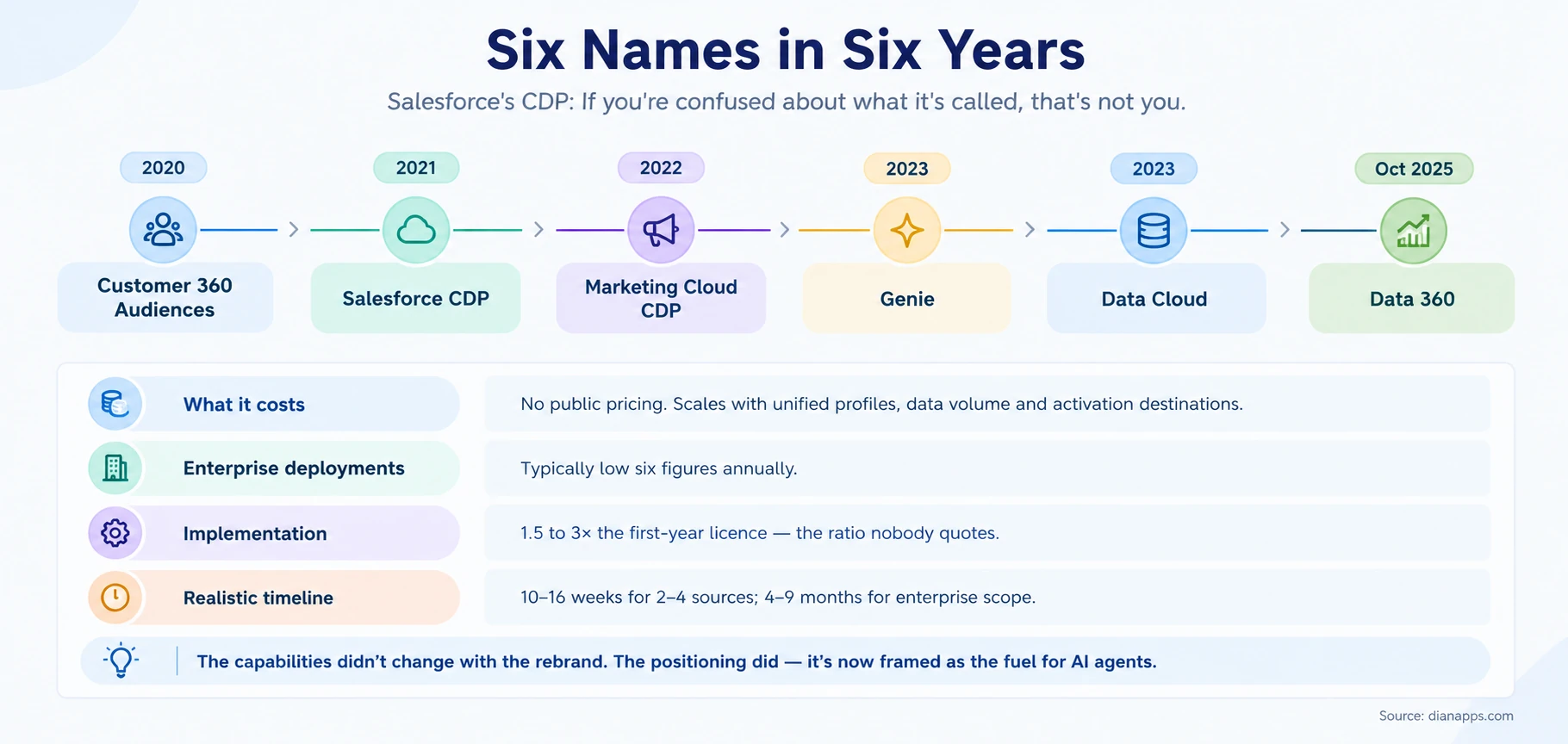
The confusion is understandable, and Salesforce has contributed to it: its CDP has carried six different names in six years, most recently becoming Data 360 in October 2025. If you’re unsure what the product is called, that’s not you.
Four Systems, Four Jobs
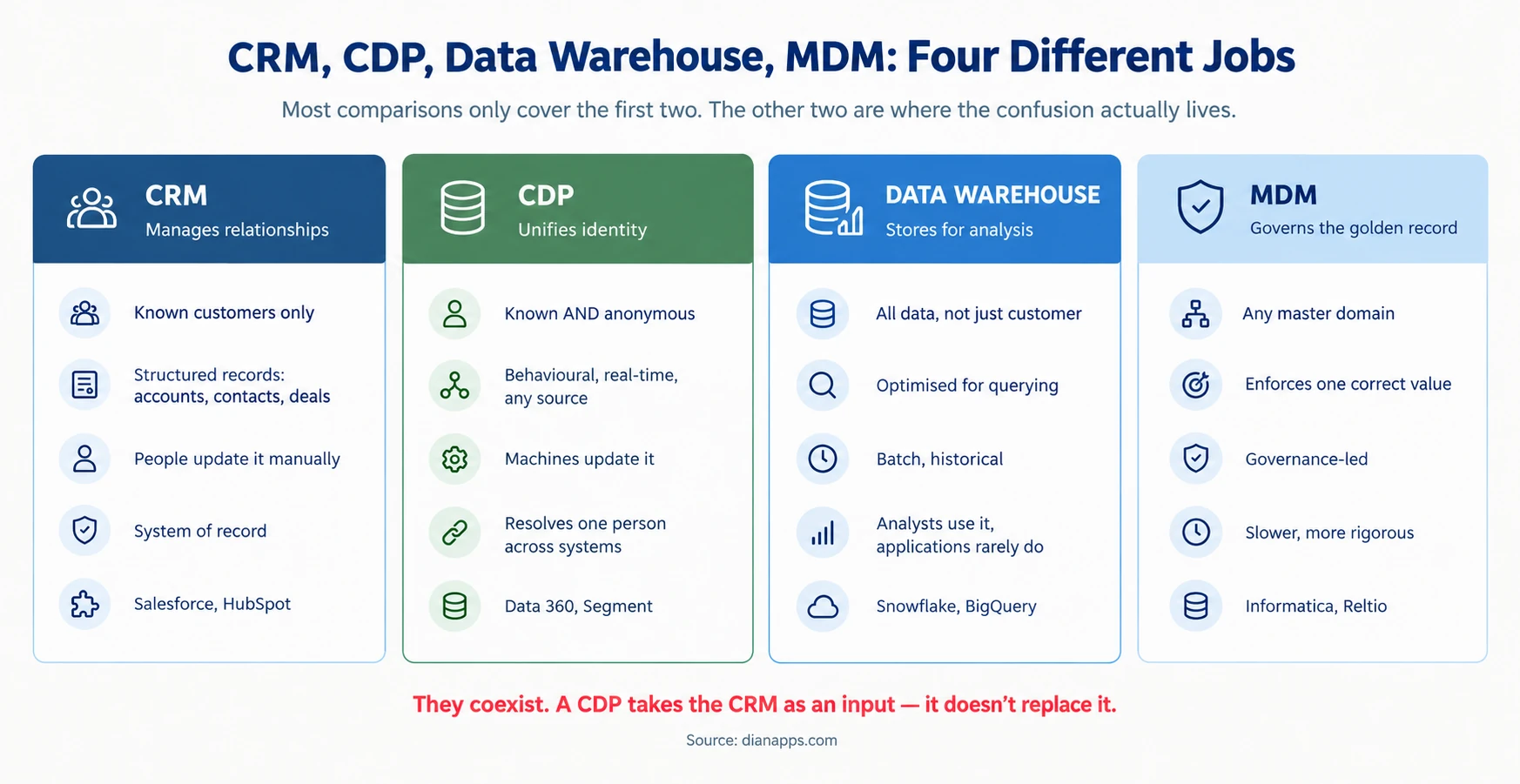
- Most CDP-vs-CRM articles compare two things: The confusion in practice is four-way, because data warehouses and MDM platforms overlap with both.
- The distinction that matters most: a CRM holds people you know, entered by people. A CDP holds people you know and people you don’t yet, assembled by machines from behavioural signals.
Where CDPs and warehouses differ is purpose rather than data. A warehouse is optimised for analysts asking questions. A CDP is optimised for applications taking action, pushing a segment to an ad platform, triggering a journey, grounding an AI agent.
Where CDPs and MDM differ is rigour. MDM enforces one governed correct value with approval workflows. A CDP stitches identities probabilistically and fast. They coexist in large organisations, solving different problems at different layers.
What Identity Resolution Actually Does
This is the core of a CDP and the part most explanations skip.
The Problem: The same person appears as j.smith@work.com in your CRM, an anonymous cookie on your website, a phone number in your support system, and a loyalty number at the till. Four records, one human, no connection between them.
What a CDP does about it:
- Deterministic matching uses exact identifiers: same email, same customer ID. High confidence, limited reach.
- Probabilistic matching infers a match from patterns: same device, same household, similar behaviour. Wider reach, lower confidence.
- Most CDPs use both, with rules you configure. Getting those rules right is the actual work of a CDP implementation, and it’s where projects succeed or fail.
Before introducing a CDP, businesses should review their existing Salesforce integrations to identify whether disconnected systems or inconsistent records are creating the problem.
Why your CRM can’t do this: it was built to store relationships you’ve already established, not to infer new ones from anonymous signals. Adding more fields to Salesforce doesn’t produce identity resolution.
Related: the Salesforce data model explained
Where Salesforce Data 360 Sits
Data 360 is Salesforce’s CDP, and it’s a strong one, named a Leader in the 2026 Gartner Magic Quadrant for CDPs for the third consecutive year, and in both 2026 IDC MarketScapes for AI-enabled CDPs.
- What Changed With The Rebrand: The positioning, not the capabilities. Data 360 is now framed as the live context that fuels AI agents rather than as a standalone marketing data platform. This connection becomes particularly relevant when exploring how Agentforce works, since AI agents need relevant customer context to carry out tasks effectively.
That framing matters more than it sounds. Historically, most CDP implementations were marketing-centric, and organisations then rebuilt point-to-point integrations to make the output usable for sales and service. Data 360 is positioned as operational across all of them, which is either a genuine advantage or marketing, depending on how much of your estate is Salesforce.
Data 360 is part of Salesforce’s wider product ecosystem, which includes tools for sales, service, marketing, analytics and AI.
Three practical facts:
- There’s no public pricing. It scales with unified profiles, data volume, and activation destinations. Enterprise deployments typically start in the low six figures annually.
- Implementation runs 1.5 to 3× the first-year licence. That ratio is the single most useful number here, and it’s rarely quoted upfront.
- Timelines: Roughly 10–16 weeks for a focused deployment with two to four sources and one activation destination; four to nine months for enterprise scope with complex identity rules.
And A Genuine Technical Advantage: Zero-copy data sharing with Snowflake, BigQuery, and Redshift means you can use warehouse data without duplicating it, which removes a real cost and governance problem.
Related: Data 360 explained · what is Agentforce
Do You Actually Need a CDP?
The usual advice is “you need a CDP when data lives in five or more systems.” That’s a reasonable rule of thumb, and it’s not quite the right test.
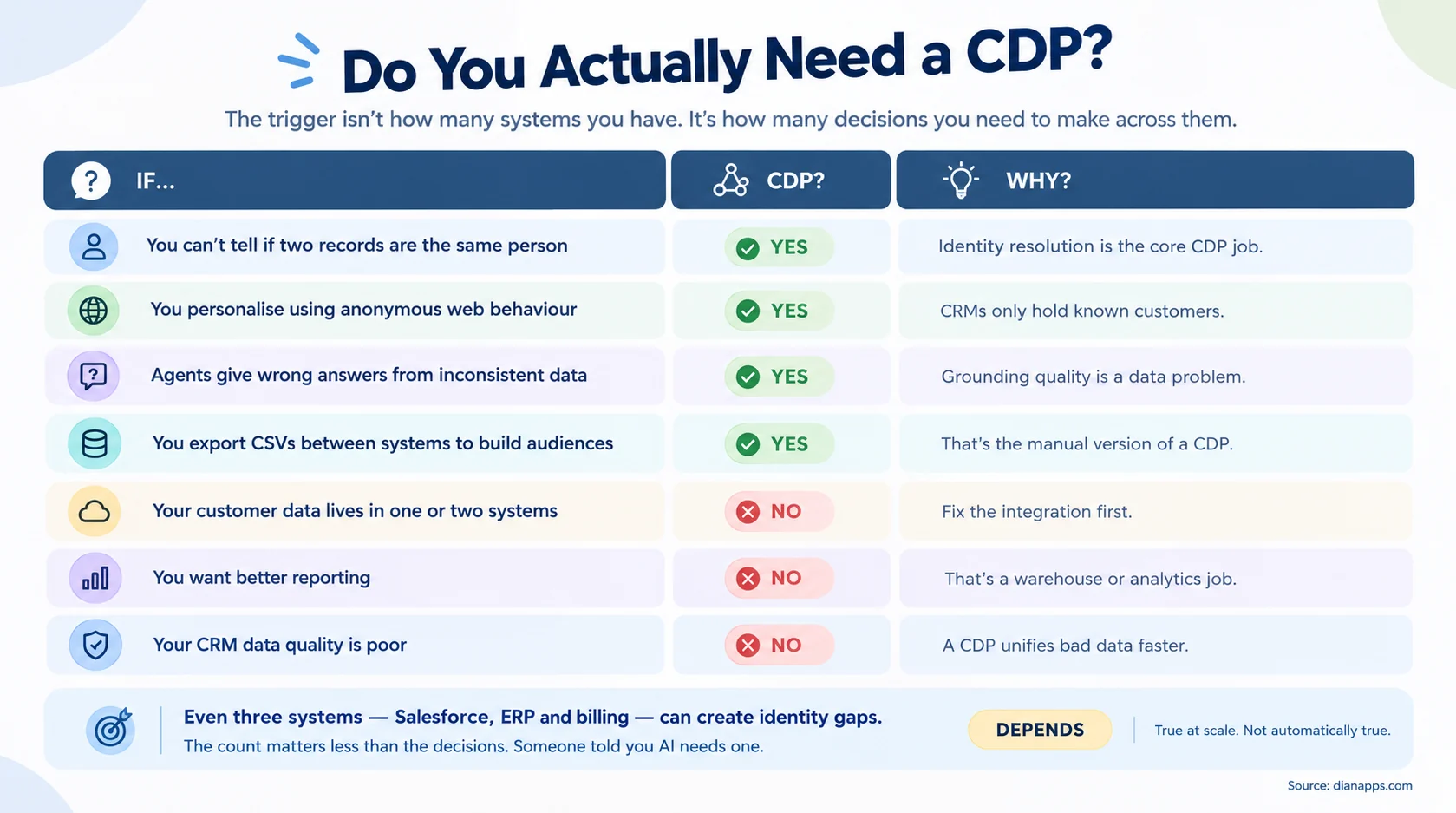
The better question is how many operational decisions do you need to make reliably across systems? Even a modest estate, Salesforce plus an ERP plus billing, creates identity gaps and inconsistent definitions that block automation.
The Clearest Signal You Need One: You cannot reliably tell whether two records refer to the same person, and that’s costing you something measurable: duplicate outreach, wrong personalisation, an agent giving a confident wrong answer.
The clearest signal you don’t:
- Your data lives in one or two systems. Fix the integration. A CDP is an expensive way to solve a two-system problem. In these cases, Salesforce integration services may be a more practical starting point than investing in a separate customer data platform.
- You want better reporting. That’s a data warehouse or an analytics tool. CDPs are built for activation, not analysis.
- Your CRM data quality is poor. A CDP will unify bad data faster. Clean first; this is the most common expensive mistake in this category.
Before investing in a customer data platform, businesses should first identify where their customer data is getting disconnected and what is preventing teams from using it effectively. Salesforce consulting services can help assess existing integrations, improve CRM data quality, and determine whether a CDP is genuinely necessary or a simpler fix would solve the problem.
How They Work Together
| CRM | CDP | |
|---|---|---|
| Holds | Known customers | Known and anonymous |
| Data type | Structured records | Behavioural, transactional, any source |
| Updated by | People, manually | Systems, automatically |
| Primary job | Manage the relationship | Resolve identity, activate segments |
| Real-time? | Not typically | Yes, by design |
| Who uses it | Sales, service, marketing teams | Other systems, mostly |
| Replaces the other? | No | No |
The Flow In Practice: Your CRM feeds customer records into the CDP. Your website, app, commerce platform and support system feed behavioural data. The CDP resolves them into unified profiles, then pushes segments and signals back out, into marketing for campaigns, into service for context, into an AI agent for grounding.
The CRM stays the system of record for the relationship. The CDP becomes the system of record for identity.
Common Mistakes
- Buying a CDP to fix data quality. It unifies whatever it’s given. Bad data becomes unified bad data, faster.
- Treating it as a marketing tool. If only marketing uses it, you’ve bought an expensive segmentation engine. The value comes from sales, service, and AI using the same profiles.
- Underestimating identity resolution configuration. The matching rules are the project. Vendors demo them as a toggle; in practice they take iteration and real decisions about acceptable false-match rates.
- Not budgeting implementation properly. At 1.5–3× the first-year licence, this is the line that surprises people most.
- Starting with everything. A focused first use case, one problem, two to four sources, one activation destination, ships in weeks. Attempting the full estate takes most of a year and frequently stalls.
Related: Salesforce integration guide
The Market Context
| Metric | Figure | Source |
|---|---|---|
| CDP market size | ~$4.58bn (2026) | Vendor-cited research |
| Projected | $13.14bn by 2031 | 23.47% CAGR |
| CDP adopters achieving ROI in 3–6 months | ~45% | Vendor-cited |
| Achieving ROI within 18 months | ~88% | Vendor-cited |
Treat the ROI Figures With Caution: They come from CDP vendor research and survey self-reporting, and organisations that invested heavily have an incentive to report success. The market growth rate is more reliable than the return claims.
Related: CRM statistics · CRM market share
Where to Go Next
For Salesforce’s CDP specifically, Data 360 explained.
For the AI that depends on it, what is Agentforce.
For understanding the CRM half, what is Salesforce, how Salesforce works, and the Salesforce data model.
For connecting systems without a CDP, Salesforce integration and MuleSoft for Salesforce.
For cost context, Salesforce pricing and every Salesforce product.
For the wider market, CRM statistics and CRM market share.
Most Organisations Don’t Need a CDP Yet
The honest position: CDPs solve a real and specific problem, and most organisations asking about them have a different problem: integration, data quality, or a process nobody agreed on.
Those are cheaper to fix, and fixing them first is what makes a CDP worth buying later.
Want a straight answer on whether a CDP is your problem?
Tell us where your data actually breaks. We’ll tell you whether it’s an integration fix, a data quality job, or genuinely a CDP, including when the answer costs you nothing.
 0 comments












Leave a Comment
Your email address will not be published. Required fields are marked *