















 0 comments
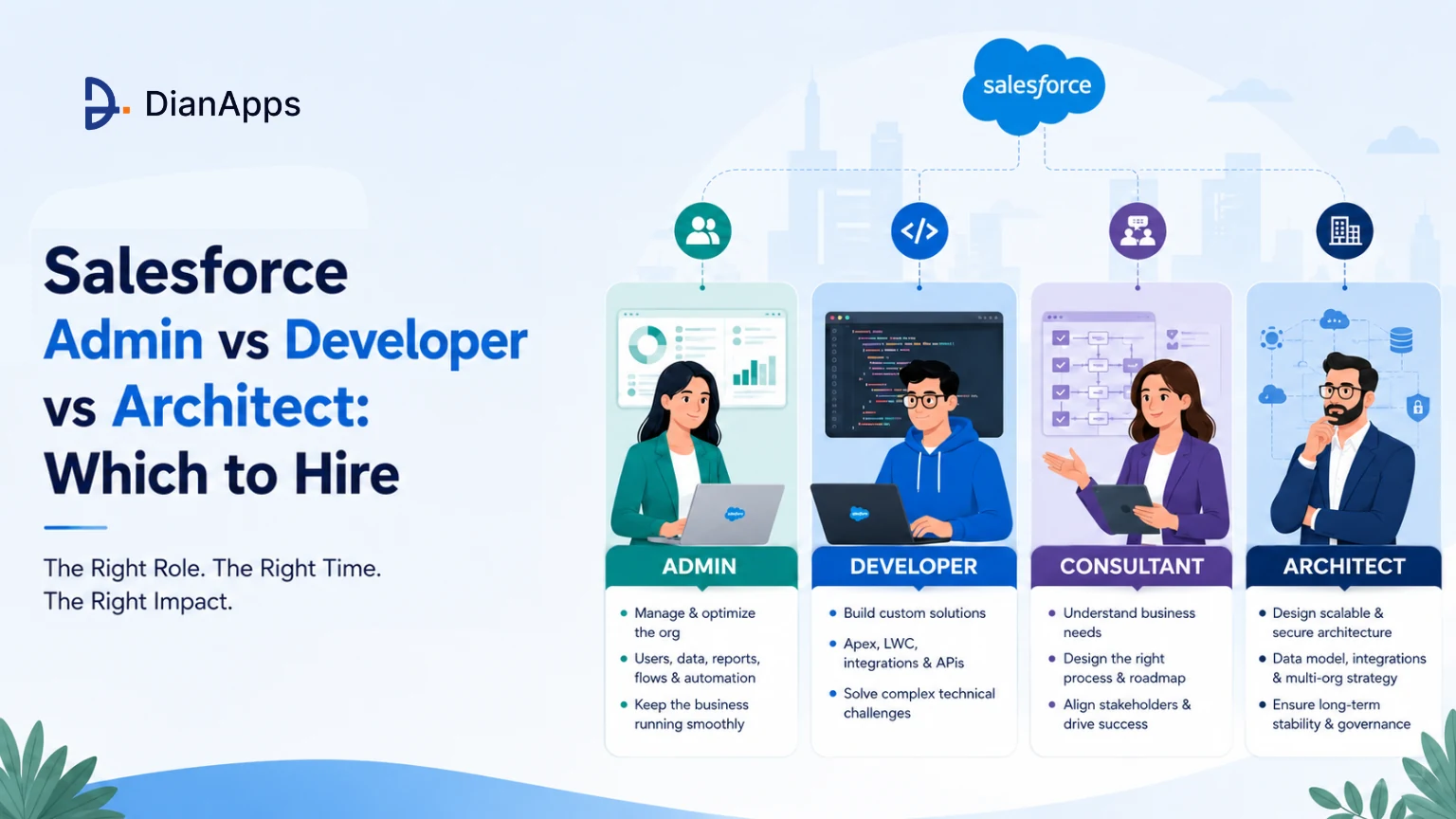





Key Takeaways :
- Most Salesforce teams should start by assessing whether they actually need development capacity, since admins can resolve a large share of typical requests with declarative tools.
- Developers are the right hire when the backlog consistently requires Apex, LWC, integrations, testing, or deployment work that configuration cannot handle.
- Consultants solve process and requirements problems, while architects solve scale, integration, security, and multi-org problems.
- Hiring should follow workload rather than title, with the article’s 30-hours-per-week rule providing a practical threshold for dedicated developer capacity.
Quick Answer: An admin keeps the org running and solves 70-90% of typical requests without code. A developer handles the remaining 10-30% that genuinely need Apex, LWC, or integrations. A consultant decides what to build when nobody agrees on the process. An architect decides how it fits together when scale, multi-cloud, or multi-org is the problem. Hire in that order unless a specific symptom says otherwise.
Almost everything written on this question is aimed at people choosing a career. This one is aimed at people deciding who to hire, a different question with a different answer.
Most organisations that think they need a developer need an admin, and most that think they need an admin at scale actually need an architect. Getting this wrong costs more than hiring a weaker candidate for the right role.
Four Roles, Four Different Problems
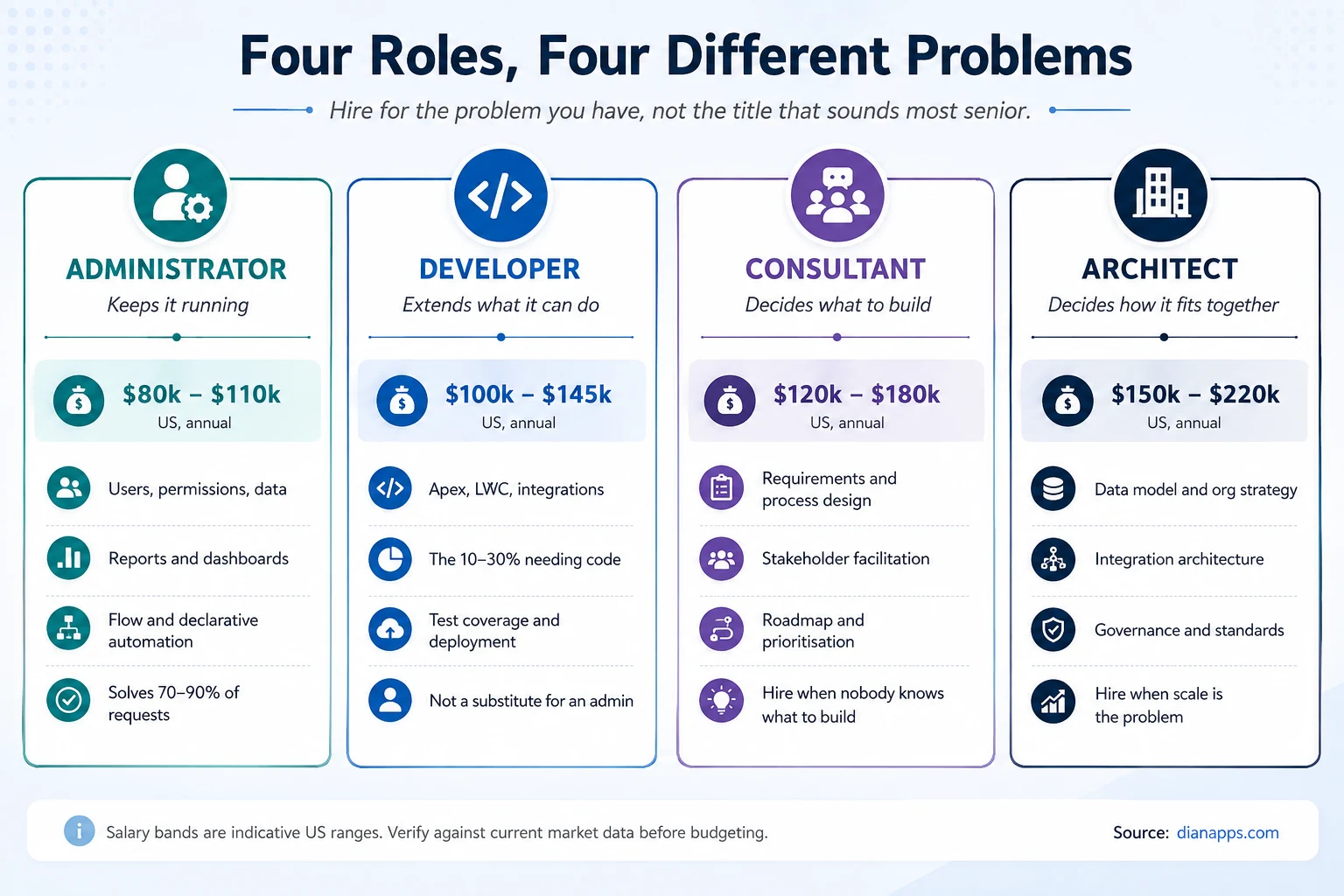
Comparison of Salesforce administrator, developer, consultant, and architect showing what each does and typical US salary bands
The Framing That Resolves Most Confusion: These aren’t seniority levels; an excellent admin isn’t a junior developer and an architect isn’t a promoted developer. They solve different categories of problems, and the salary differences reflect scarcity and scope rather than a ladder.
What Each Role Actually Does
Administrator
Manages users, profiles, and permission sets. Builds reports and dashboards. Creates fields, objects, validation rules and page layouts. Automates with Flow, handles data quality, imports and deduplication. Manages the three annual releases.
- The Number Worth Knowing: A competent admin resolves 70-90% of typical business requests using declarative tools alone. That’s the reason the hiring sequence starts here.
- Skills: The platform’s declarative toolkit, business process understanding, data hygiene and enough scepticism to ask why before building.
- Certification: Salesforce Certified Administrator, then Advanced Administrator.
Developer
Writes Apex for logic the declarative tools can’t express, builds Lightning Web Components. Integrates external systems. Maintains test coverage and deployment pipelines. Debugs governor limit exceptions.
They handle the 10–30% an admin can’t, particularly when custom logic is required. Understanding Flow vs Apex helps teams decide when configuration has reached its limit.
Skills: Apex, SOQL, Lightning Web Components, governor limits, Git and CI/CD.
The core skills include Apex, SOQL, Lightning Web Components, governor limits, Git and CI/CD. For teams assessing the development side of the role, the Apex programming guide provides a deeper look at the language and where it fits on the platform.
Certification: Platform Developer I, then II. JavaScript Developer I for LWC-heavy work.
Consultant
Gathers requirements, facilitates between stakeholders, designs the process, builds the roadmap, and runs the implementation. Often the person who works out that the requested feature isn’t the actual problem.
- Hire One When Nobody Can Agree What Should Be Built: Which is more common than it sounds and is why implementations stall.
- Skills: Requirements elicitation, process design, stakeholder management and enough platform knowledge to know what’s feasible.
- Certification: Sales Cloud or Service Cloud Consultant, plus cloud-specific credentials.
Architect
Owns the data model org strategy, integration architecture, security design and technical governance. Decides whether you run one org or several, how systems connect and what standards everyone follows.
- Hire One When Scale Is The Problem: Multi-cloud, multi-org, an acquisition, or an org where every change breaks something unrelated.
- Skills: Solution design across clouds, integration patterns, data model design, security architecture, and the ability to say no with a reason.
- Certification: Application Architect and System Architect, leading to Certified Technical Architect – rare, expensive and genuinely difficult.
Your Symptom and Who Fixes It
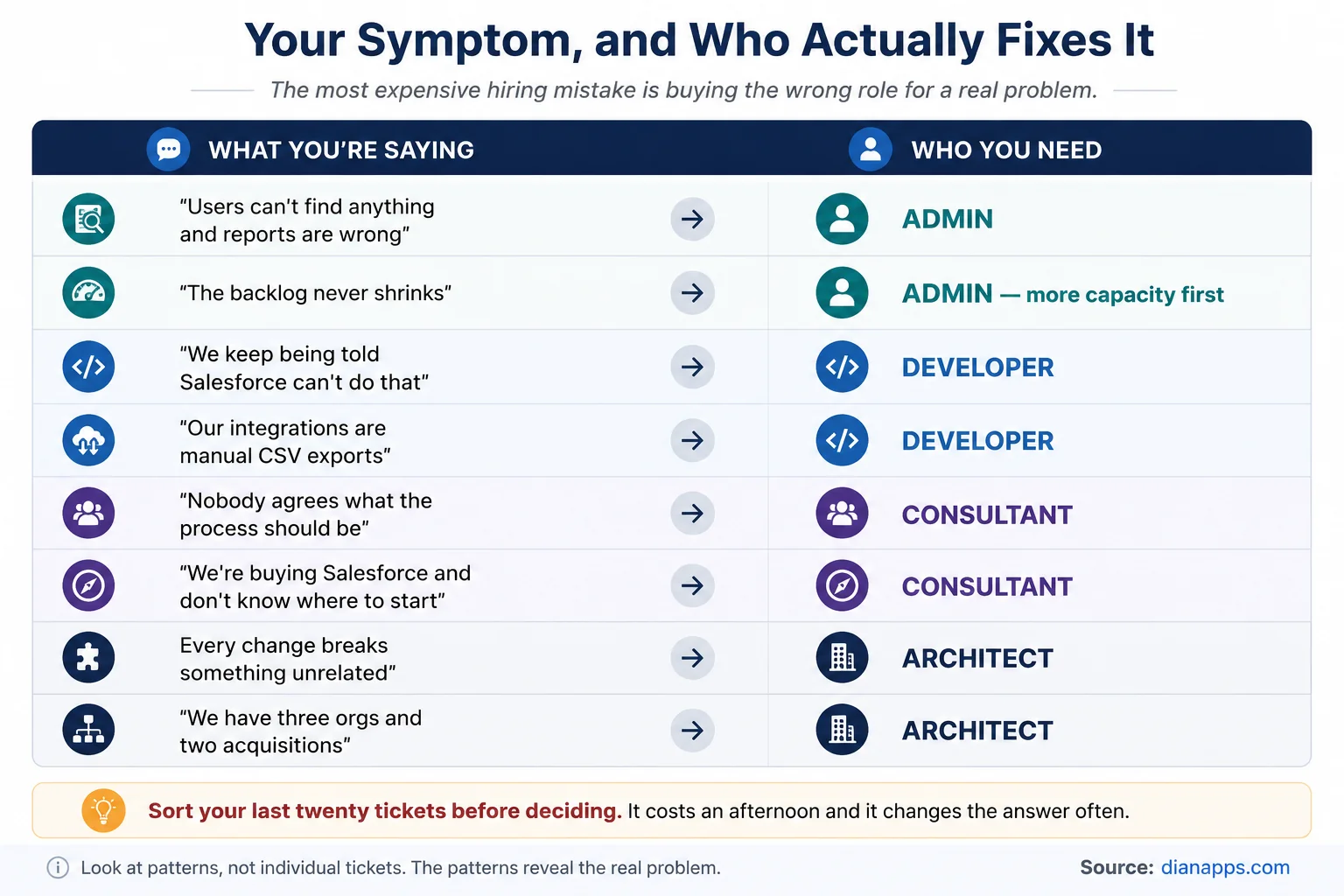
Table mapping eight common symptoms to the Salesforce role that resolves each
The diagnostic that beats all of this: sort your last twenty backlog items. If fewer than about a third genuinely need Apex, a Lightning Web Component, or an external integration, more admin capacity will clear more of your queue per pound spent than a developer will.
We cover that test in more depth in 8 signs your business needs Salesforce development help.
Not Sure Which Salesforce Role You Need?
Share your recent Salesforce backlog and get help identifying whether you need an admin, developer, consultant, architect, or a combination of roles.
Salary Bands (US)
| Role | Entry | Mid | Senior |
|---|---|---|---|
| Administrator | $62,000 - $80,000 | $80,000 - $100,000 | $100,000 - $130,000 |
| Developer | $85,000 - $100,000 | $100,000 - $127,000 | $127,000 - $160,000 |
| Consultant | $85,000 - $110,000 | $110,000 - $145,000 | $145,000 - $180,000 |
| Architect | - | $140,000 - $175,000 | $175,000 - $220,000+ |
Two things these numbers hide.
Salary is roughly 65-75% of the true cost. Add employer taxes, benefits, recruitment fees, tooling, and three to six months of ramp-up. A $120,000 developer costs closer to $180,000 in year one. See in-house vs outsourced Salesforce development.
Specialists command a premium. CPQ, Marketing Cloud, and increasingly Agentforce skills add roughly 20-35% over a generalist at the same level, in any of these roles.
Regional detail: Salesforce developer hourly rates by region
Can One Person Wear Two Hats?
Sometimes, and the combinations that work aren’t obvious.
| Combination | Works? | Why |
|---|---|---|
| Admin + Consultant | Often | A good admin already does requirements work informally |
| Admin + Developer | Sometimes | Common in smaller orgs but the developer half tends to get squeezed out by daily support |
| Developer + Architect | Sometimes | Natural progression but architecture needs time that delivery pressure removes |
| Consultant + Architect | Often | Complementary - one decides what, the other how |
| Admin + Architect | Rarely | Different altitudes. Day-to-day support and long-range design compete badly |
| All four in one person | No | This is a partner engagement, not a hire |
When the required skills span multiple roles, Salesforce Development Services can provide the broader delivery capacity without forcing one person to split their time between day-to-day administration, development, and architecture.
The Pattern: Roles adjacent in scope combine reasonably. Roles at opposite ends of the day-to-day-versus-strategic spectrum don’t, because urgent work always displaces important work.
Team Composition by Organisation Size
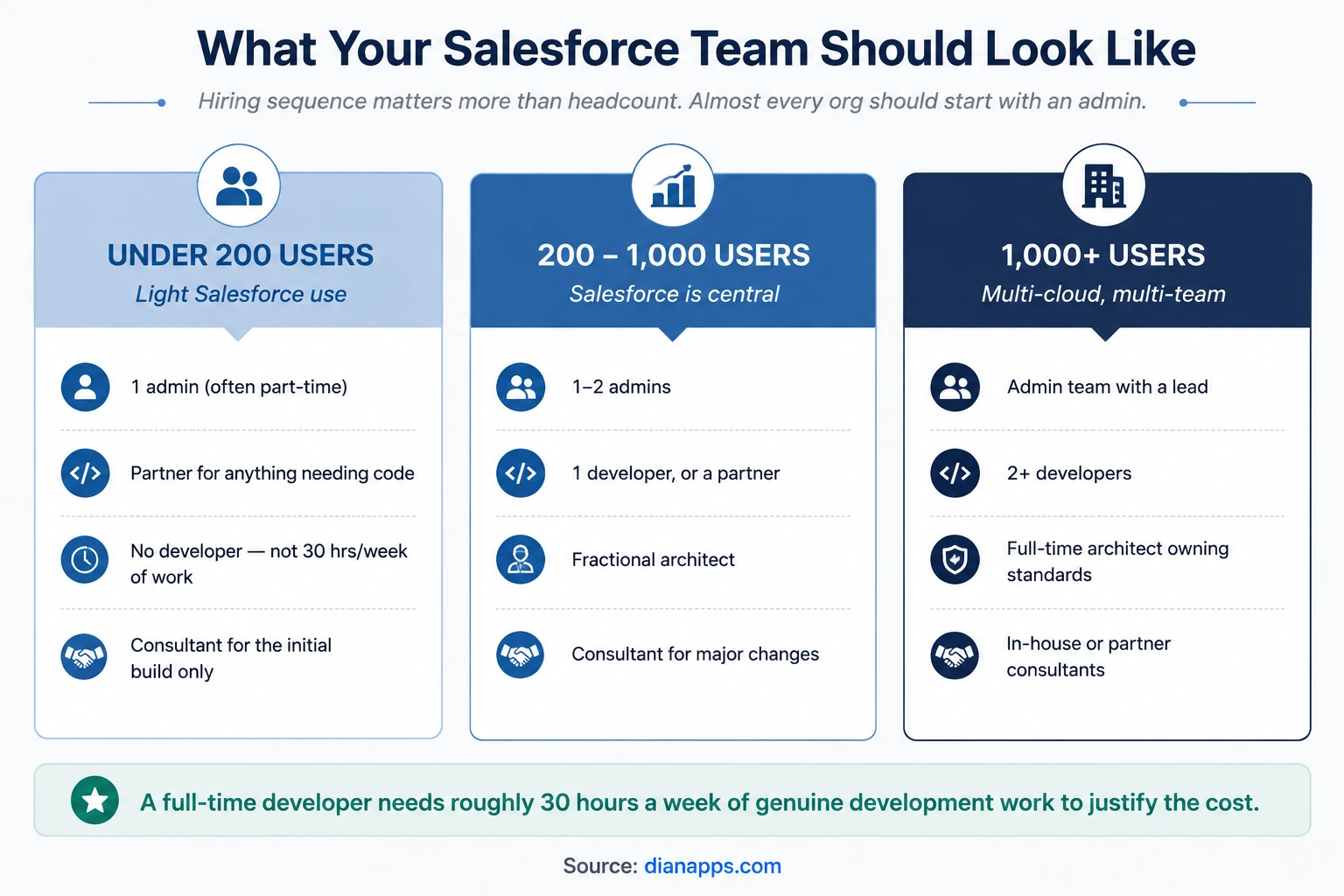
Recommended Salesforce team composition for organisations under 200 users, 200 to 1000 users and 1000 plus users
The Rule That Governs The Whole Picture: A full-time developer needs roughly 30 hours a week of genuine development work to justify the cost. Below that, you’re paying for availability – which is why most sub-200-user organisations are better served by an admin plus a partner than by a developer hire.
Related: How to hire a Salesforce developer · Choosing a development partner
Need Salesforce Development Capacity?
Add experienced Salesforce developers when your backlog has enough genuine Apex, LWC, integration, and technical work to justify dedicated engineering capacity.
Career Paths (If You’re Choosing Rather Than Hiring)
Briefly, since it’s the other half of this question.
- Start As An Admin: Almost every experienced Salesforce professional did, and it’s the fastest route into the ecosystem – the Administrator certification has no prerequisites. More importantly, developers who never learned the declarative tools write code for problems configuration already solved.
- From Admin, Three Directions: Developer (learn Apex and LWC), consultant (deepen business and process skills), or senior admin specialising in a cloud.
- Architect Is A Destination Not an Entry Point: It requires several years across both technical and functional work, and the Technical Architect credential is among the hardest in enterprise software.
- The AI Shift Is Real: Professionals who can configure and customize Agentforce and Einstein are in demand across all four roles, and it’s currently the fastest way to differentiate at any level.
Where to Go Next
If you’ve decided you need a developer, how to hire a Salesforce developer covers skills, screening, and onboarding.
If you’re not sure the work needs code at all, 8 signs your business needs Salesforce development help and configuration vs customization.
If you’re weighing hiring against partnering, in-house vs outsourced, and choosing a development partner.
For budgets, Salesforce developer hourly rates and Salesforce customization cost.
If you want the broader technical picture behind what Salesforce developers actually build, the complete Salesforce development guide covers the platform, development process, architecture and implementation considerations.
Before You Write the Job Description
The most common conversation we have with organisations about hiring is that they’ve written a job description for the wrong role.
Usually it’s a developer specification for a backlog that’s mostly configuration. Occasionally it’s an admin specification for an org that has outgrown one and genuinely needs an architect to decide how the pieces fit before anyone builds anything else.
Both are expensive to discover six months in.
We’re a certified Salesforce Consulting Partner and reviewing a backlog to work out what it actually calls for is free and takes us about an hour.
Hiring for Salesforce but Not Sure Where to Start?
Tell us about your org, backlog, and team structure, and we’ll help you identify the right Salesforce skills and delivery model.
 0 comments











Leave a Comment
Your email address will not be published. Required fields are marked *