















 0 comments
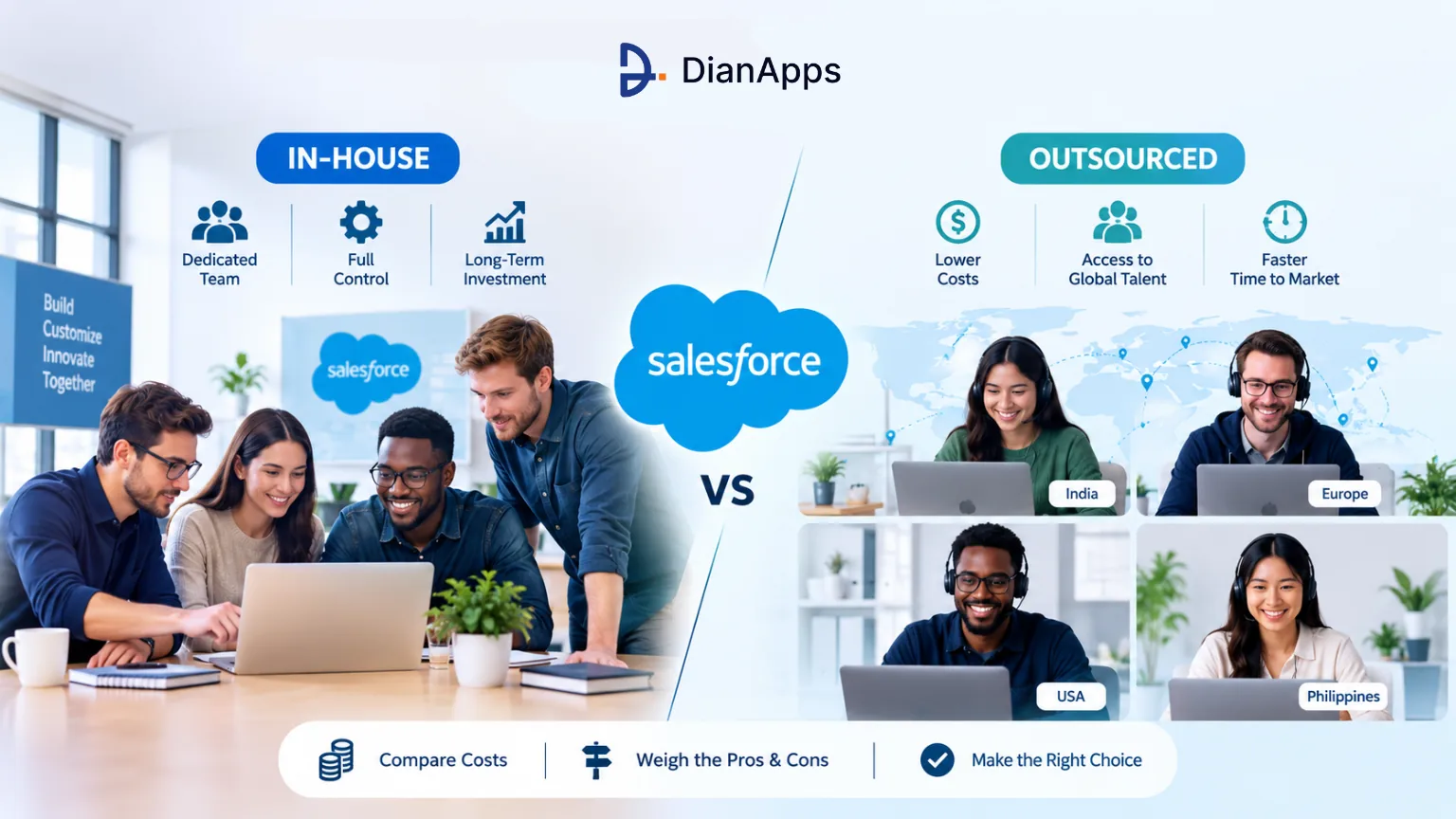





Outsourcing firms write most comparisons of this question, and they all reach the same conclusion.
We’re an outsourcing firm, so here’s a different approach: nine criteria, scored honestly, with four in-house wins outright, and a clear statement of when hiring internally is the better decision, including when it’s better than hiring us.
TL;DR: Outsourced delivery typically costs 40 – 60% less than an equivalent in-house team for predictable, high-volume work, and starts in 2 – 4 weeks rather than 2 – 4 months. In-house wins on business context, day-to-day responsiveness, knowledge retention, and data control. Most mid-market organisations end up hybrid: architect and decisions in-house, delivery capacity outsourced. The failure mode is outsourcing the architecture too.
The Real Cost of an In-House Salesforce Developer
Salary is the number people compare; it’s roughly 60% of the real one.
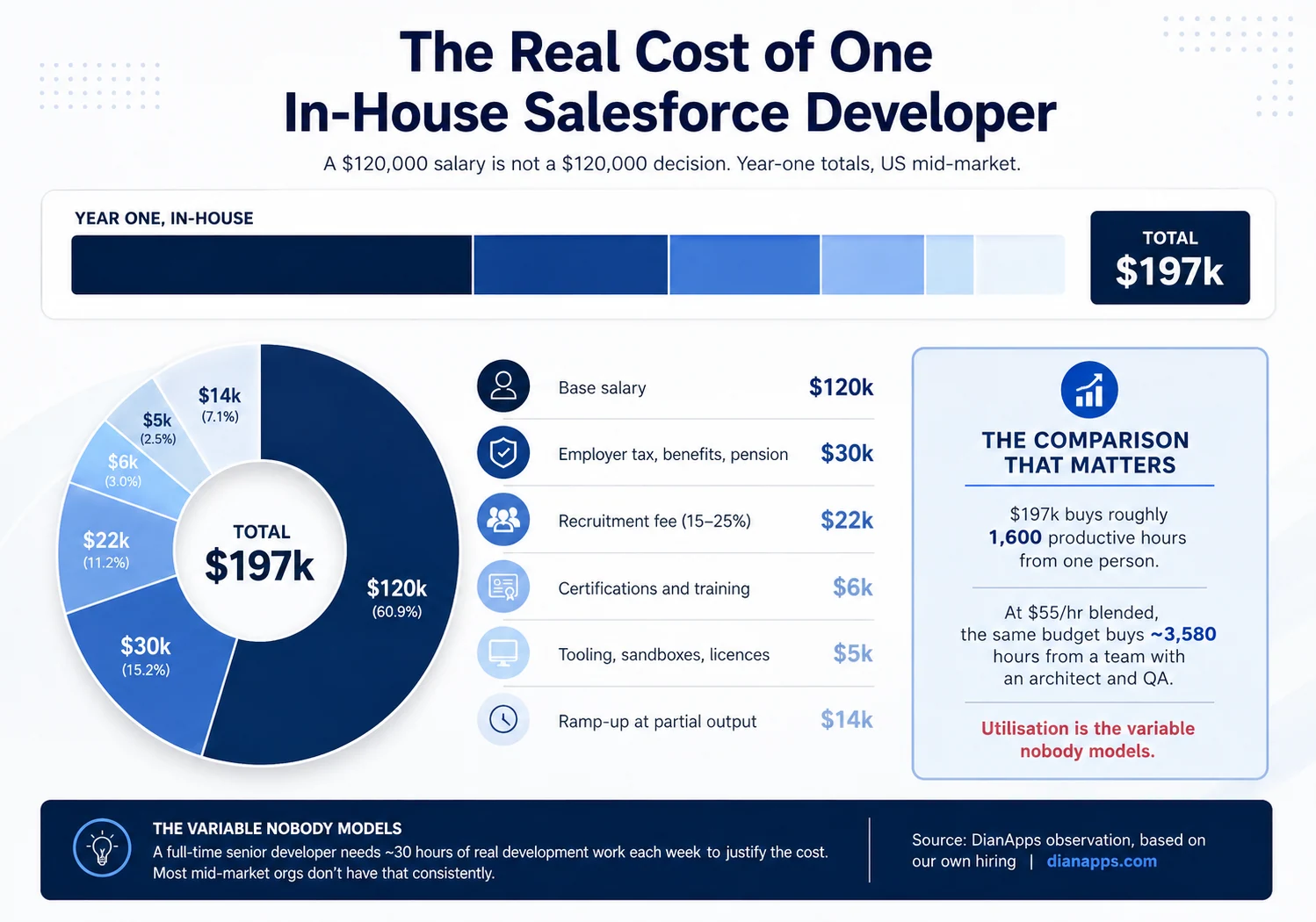
The additions that get left out of the comparison:
- Employer taxes, benefits, and pension, typically 20–30% on top of salary
- Recruitment fees at 15- 25% of first-year salary if agency-sourced
- Certification and training, because the platform ships three releases a year
- Sandboxes, tooling and licences
- Three to six months at partial productivity while they learn your org
And the Variable Nobody Models: Utilisation, a full-time senior developer needs roughly 30 hours a week of genuine development work to justify the cost. Most mid-market orgs don’t have that consistently, which means you’re paying for availability during the quiet quarters at the same rate as the busy ones.
Full breakdown: Salesforce development cost · Developer hourly rates by region
Nine Criteria, Scored Honestly
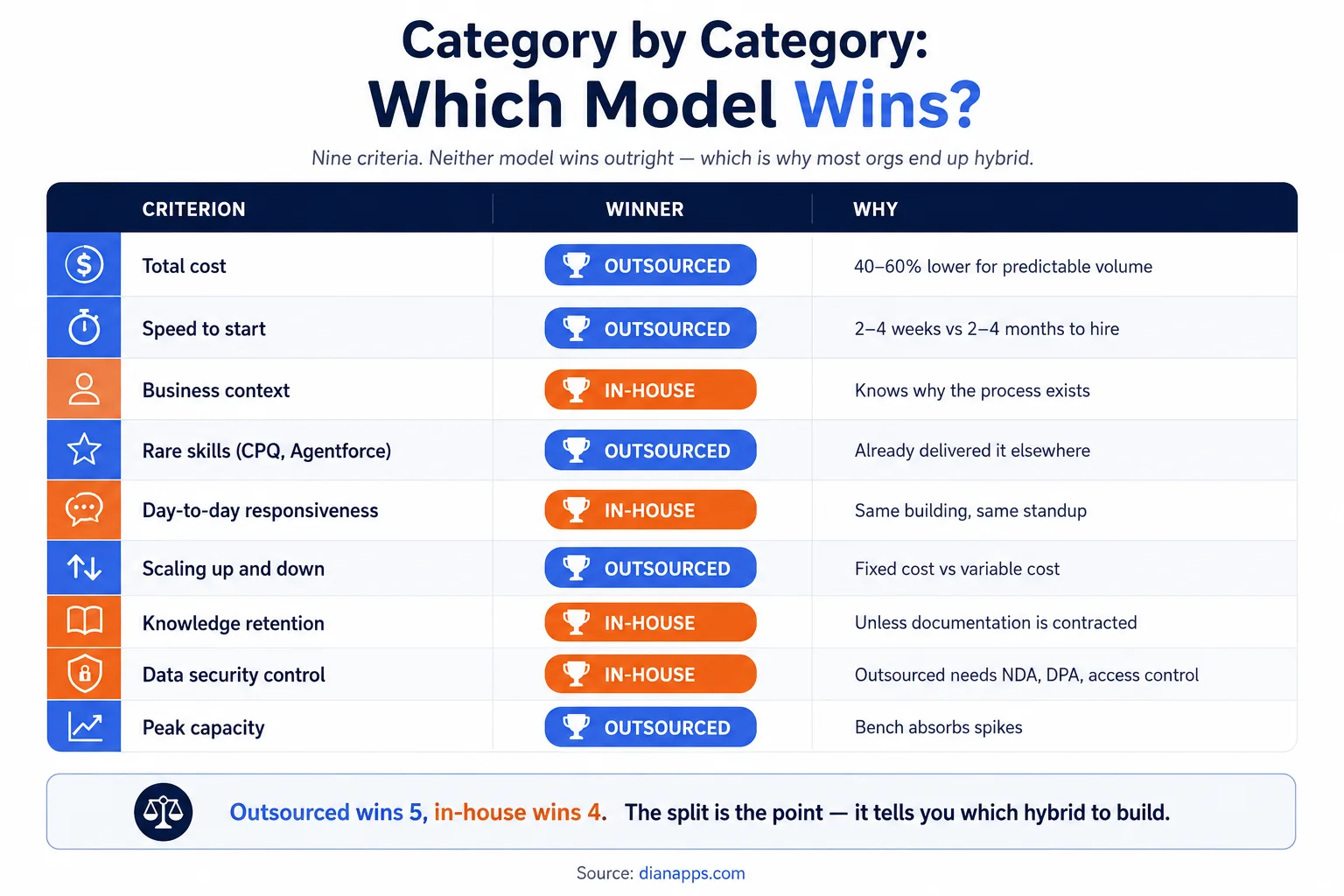
Outsourced Wins Five, In-House Wins Four: The split is the useful part; it tells you which functions to keep and which to buy.
Where outsourcing genuinely wins
- Total Cost: For predictable, high-volume work, outsourced delivery commonly reduces annual cost by 40–60% versus an equivalent in-house team once recruitment, benefits, and idle time are counted.
- Speed To Start: Two to four weeks against two to four months for a permanent hire, including notice periods. If your backlog is urgent, that gap is the whole decision.
- Rare and Emerging Skills: Agentforce is the current example; building that capability internally means upskilling people on a platform where formal training paths are still maturing. An established partner has already worked through the data-quality and configuration problems of a first rollout, several times.
- Scaling in both directions: In-house cost is fixed regardless of workload. Outsourced capacity flexes with demand, and flexing down is the part in-house can’t do at all.
- Peak Absorption: A partner’s bench covers a spike. An in-house team of two covers it with overtime and slipped deadlines.
Where in-house genuinely wins
- Business Context: An internal developer knows why a process exists, not just what the ticket says. That produces better solutions and fewer round trips. No partner replicates this in the first six months.
- Day-To-Day Responsiveness: For small, frequent changes, someone in the same standup will always beat a ticket queue.
- Knowledge Retention: The reasoning behind decisions stays with your organisation, unless documentation is a contractual deliverable from your partner, which it should be either way.
- Data Security Control: Outsourcing means granting external access to an org containing your customer data. That’s manageable with NDAs, DPAs, permission-scoped access, and named individuals, but it’s a control you’re actively giving up rather than one you retain by default.
Outsourcing Models Compared
“Outsourcing” describes five different arrangements with very different risk profiles. When evaluating Salesforce Development Services, the right model depends on your backlog, internal architecture ownership, required expertise, and how much delivery capacity you actually need.
| Model | How it prices | Best for | Main risk |
|---|---|---|---|
| Staff augmentation | Monthly per person | Extending an existing team you already manage | You supply the management and architecture |
| Dedicated team | Monthly per person, 10–20% below hourly | Ongoing programmes needing several skill sets | Underused if your backlog is thin |
| Project / fixed scope | Quoted per deliverable | Clear, stable requirements | Change requests for anything unlisted |
| Managed services | Retainer or ticket-based | Steady-state support and enhancement | Can become a black box without reporting |
| Freelance / contract | Hourly | Short, well-specified tasks | No continuity, no documentation, quality varies |
Staff Augmentation Is The One Most Often Chosen Wrongly: It assumes you have an architect and an acceptance process already. If you don’t, you’re buying developer hours and then discovering you need everything around them.
Related: How to hire a Salesforce developer · Choosing a development partner
Not sure which model fits your backlog?
Send us your last twenty tickets, and we’ll tell you whether you need a hire, a partner, or neither before you commit to either.
Get a free backlog review from our Salesforce development team →
Onshore, Nearshore or Offshore?
If you outsource, location shapes the engagement more than the rate does.
| Rate | Overlap | Best for | |
| Onshore (US, UK, AU, CA) | $120 - 200/hr | Full | Regulated industries, board-visible programmes |
| Nearshore (LatAm, Eastern Europe) | $45 - 85/hr | 4 - 6 hours | Collaborative work needing real-time discussion |
| Offshore (India, SE Asia) | $25 - 55/hr | 2 - 4 hours | Well-specified build work with clear acceptance |
Nearshore Is The Underrated Middle: Roughly 40–55% below onshore rates while keeping enough overlap for daily collaboration, which for most mid-market programmes matters more than the remaining cost gap.
The Honest Note on Offshore: It’s efficient when requirements are clear, and someone owns architecture and acceptance. It disappoints when the expectation is that the offshore team will also define the solution, manage the project, and catch its own mistakes. That’s an agency engagement being bought at staffing prices.
Full detail: Developer hourly rates by region
The Risks Nobody Puts in the Comparison Table
Most articles list “communication gaps” and stop; the risks that actually cost money:
Knowledge Leaving With The Engagement: The single biggest outsourcing risk isn’t quality; it’s that the reasoning behind decisions walks out when the contract ends.
Make documentation a contractual deliverable with acceptance criteria, not an aspiration.
- Nobody Owning Architecture: Two outsourced developers with no architect produce two architectures. This is the most common cause of outsourced work that technically delivers and structurally fails.
- Access Sprawl: External users accumulate permissions nobody audits. Scope access to named individuals, review it quarterly, and revoke on rotation, not at contract end.
- Data Residency and Compliance: If you’re subject to GDPR, HIPAA, or similar, where your partner’s team sits and where data is processed is a contractual matter, not a detail. Get a DPA. See Salesforce compliance and data security.
- Release Cycles Nobody Owns: Salesforce ships three releases a year. If your contract doesn’t say who regression-tests against them, the answer is nobody. See managing Salesforce releases.
- Sub-Contracting: Some firms sell you a team and deliver a different one. Ask who specifically does the work, and ask to meet them.
Ready to Move Forward With Salesforce?
Let’s find the right Salesforce solution for your business and delivery needs.
The Hybrid Model Most Mid-Market Orgs Land On
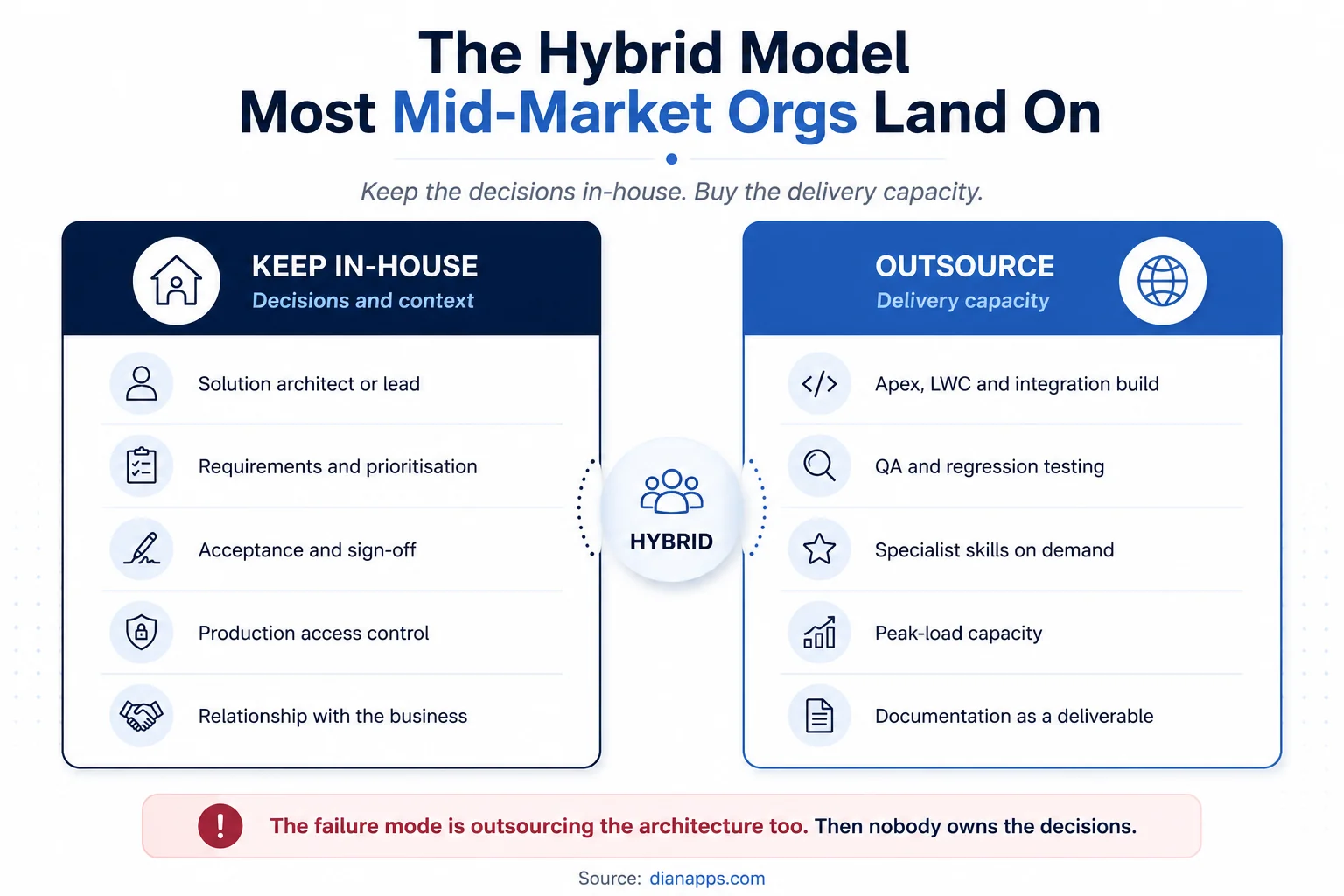
The principle: keep the decisions, buy the capacity.
An in-house architect or technical lead owns solution design, standards, and acceptance. An outsourced team delivers the build, QA, and specialist work. You get business context and continuity where they matter, and flexible capacity where they don’t.
The failure mode is outsourcing the architecture as well. At that point nobody in your organisation understands what was built or why, and you’re dependent rather than resourced.
A workable starting shape for a mid-market org: one in-house admin or lead, one in-house or fractional architect, and an outsourced delivery pod that scales with the backlog.
A Decision Framework by Company Size
- Under 200 Employees, Light Salesforce Use: One admin in-house, partner for anything requiring code. A full-time developer won’t be 30 hours busy.
- 200–1,000 Employees, Salesforce Central to Operations: In-house admin plus lead, outsourced delivery. This is where hybrid clearly wins.
- 1,000+ Employees, Multiple Clouds And Integrations: In-house architecture function with governance, outsourced or blended delivery pods. Some enterprises build fully in-house; it’s defensible at this scale, and it’s a genuine ongoing hiring commitment.
- Any Size, Mid-Project And Urgent: Outsource. A four-month hiring cycle isn’t an answer to a problem you have now.
- Any Size, Deeply Regulated With Data Residency Constraints: In-house or strictly onshore, and expect to pay for it.
Four questions that settle it
- Is there 30+ hours a week of development work, consistently?
No → partner.
- Do you have someone who can own architecture?
No → you need a partner who provides one, not staff augmentation.
- Is the work continuous or project-shaped?
Project-shaped → partner.
- Can you wait 2–4 months to start?
No → partner.
Where to Go Next
If you’ve decided to hire, how to hire a Salesforce developer covers skills, screening, and onboarding.
If you’ve decided to partner, how to choose a Salesforce development partner and the top Salesforce development companies cover the shortlist.
If you’re still building the budget, Salesforce development cost and developer hourly rates have the numbers.
If you’re not sure the work needs a developer at all, start with custom Salesforce development and configuration vs customization.
The complete Salesforce development guide is the hub for all of it.
Tell Us Your Backlog, and We’ll Tell You Which Model Fits
We sell outsourced Salesforce development. We also tell organisations to hire internally when that’s the better answer, usually when there’s a consistently full backlog, and Salesforce sits at the centre of daily operations.
On a scoping call you’ll get an honest read on:
- Whether your backlog justifies a full-time hire, a partner, or a hybrid
- Which items are configuration and shouldn’t cost developer rates at all
- What the work would cost either way, including year two
- Which delivery model fits: augmentation, dedicated team, or project
We’re a certified Salesforce Consulting Partner with teams across the US, UK, Australia, Canada, UAE, and India, which means we can quote onshore, nearshore, and offshore and tell you honestly where the difference matters.
Book a Salesforce development scoping call →
Or read more about how we approach Salesforce development first.
 0 comments










Leave a Comment
Your email address will not be published. Required fields are marked *