















 0 comments





Key Takeaways:
- Zoho CRM Enterprise costs $40 per user monthly, compared with Salesforce Enterprise at $175.
- Zoho covers core CRM features, including pipelines, forecasting, automation, and AI.
- Salesforce offers deeper cross-object reporting, broader integrations, and industry-specific data models.
- Zoho One bundles CRM with finance, support, analytics, and other business applications.
- Growing teams may outgrow Zoho when reporting, integrations, hiring, or scalability become constraints.
Quick Answer: Zoho CRM can deliver core sales capabilities at roughly 75% less than Salesforce at comparable tiers. It suits cost-conscious small and midsize businesses that need pipelines, forecasting, automation, and AI without enterprise-level complexity. Salesforce may justify its higher cost when a business requires advanced reporting, extensive integrations, industry-specific data models, or greater scalability.
Zoho CRM costs roughly 75% less than Salesforce at every equivalent tier, and it is not a lesser product in the way that price gap implies.
This is a different comparison from Salesforce against Pipedrive or Monday. Those are simpler tools that trade capability for speed. Zoho competes on breadth; it has custom modules, workflow automation, forecasting, its own AI, and an ecosystem of connected business applications. At Enterprise it’s $40 per user against Salesforce’s $175.
So the useful question isn’t whether Zoho can do the job. For most organisations it can. The question is what you give up, and the honest answer is narrower and more specific than either vendor’s comparison page suggests.
Zoho is one of several platforms worth evaluating before committing to Salesforce. Our guide to Salesforce alternatives and their switching costs covers other options and the trade-offs involved in moving away from Salesforce.
The Price Gap, Tier by Tier
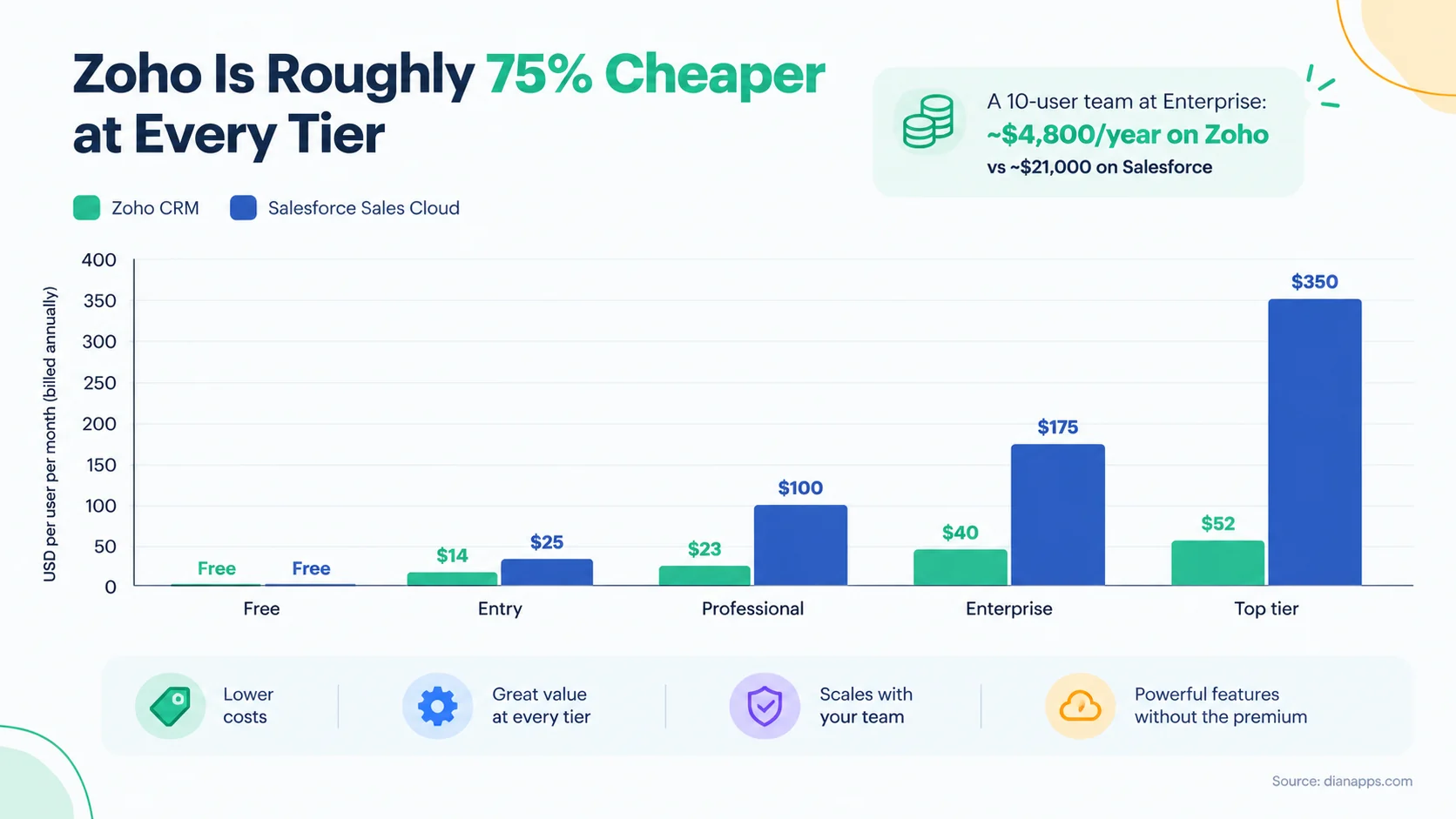
| Tier | Zoho CRM | Salesforce | Gap |
|---|---|---|---|
| Free | Up to 3 users | Free Suite, 2 users | - |
| Entry | $14 (Standard) | $25 (Starter Suite) | 44% |
| Professional | $23 | $100 (Pro Suite) | 77% |
- A Structural Difference Worth Noticing: Zoho’s tiers rise gradually: $14, $23, $40, $52. Salesforce jumps 4× from Starter to Pro Suite, which is the steepest single step in either ladder and the point where a lot of small organisations stall.
And the implementation gap compounds it. Zoho is typically configured in days to weeks without a partner. Salesforce Enterprise for a small team commonly carries $5,000–$15,000 of first-year implementation.
HubSpot is another option worth considering before making a decision, and our Salesforce vs HubSpot comparison breaks down how their pricing, capabilities, and administration requirements compare.
What You Actually Give Up
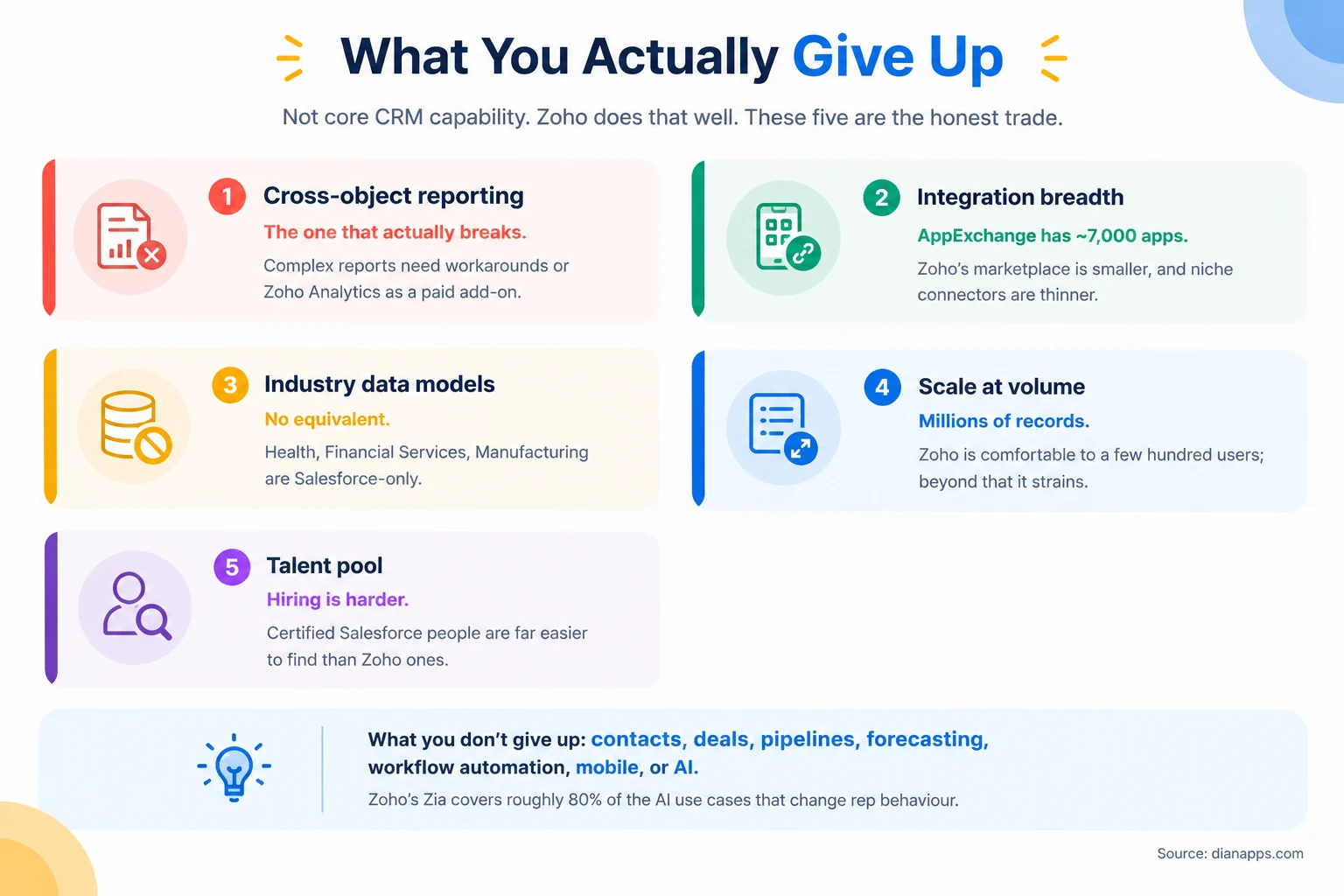
- Cross-object reporting is the one that genuinely breaks. This is the most consistent criticism of Zoho across sources, including sympathetic ones: getting complex reports out, spanning several objects, with sophisticated filtering, requires workarounds or Zoho Analytics as a separate paid product.
That matters more than it sounds, because reporting is what leadership actually consumes. A CRM that holds the data but can’t produce the board pack is a problem you feel monthly.
- Integration breadth is the second. AppExchange has roughly 7,000 applications. Zoho’s marketplace is meaningfully smaller, and the gap shows most in niche or industry-specific connectors rather than the obvious ones.
- Industry data models have no Zoho equivalent. Health Cloud, Financial Services Cloud, and the rest ship object models that would otherwise be a six-figure build. If you’re in a regulated sector, that’s a genuine differentiator rather than a marketing one.
- Scale. Zoho is comfortable from three users to a few hundred. Beyond that, it strains where Salesforce doesn’t.
- And hiring. The certified Salesforce talent pool is far larger. Finding someone who can administer Zoho well is harder, and that’s a real operational cost people underestimate.
What You Don’t Give Up: Contacts, deals, pipelines, forecasting, workflow automation, mobile, or AI. Zoho’s Zia covers roughly 80% of the AI use cases that actually change rep behaviour, at under a quarter of the price.
Where Zoho Is Genuinely Sufficient
-
- Most SMBs, honestly. If your requirement is a well-run sales pipeline with automation, forecasting, and decent reporting, Zoho does that competently at $40 a seat.
- Three situations where it’s clearly the better choice:
- Cost is a genuine constraint. Not preference, constraint. The difference between $4,800 and $21,000 a year for ten users is a hire.
- You want the wider suite. Zoho One bundles Books, Desk, Analytics, Mail, Projects, and more. For a small business wanting one vendor across finance, support, and CRM, that’s a coherent proposition Salesforce doesn’t match at this price.
- You have no admin and won’t hire one. Zoho is configurable by a capable generalist. Salesforce degrades without someone accountable for it.
If you’re also comparing simpler CRM platforms, our guide to Salesforce vs Pipedrive vs Monday CRM explains how their pricing, setup requirements, and feature limitations differ from Salesforce.
Related: Salesforce for startups and SMBs
Six Signals You’ve Outgrown Zoho
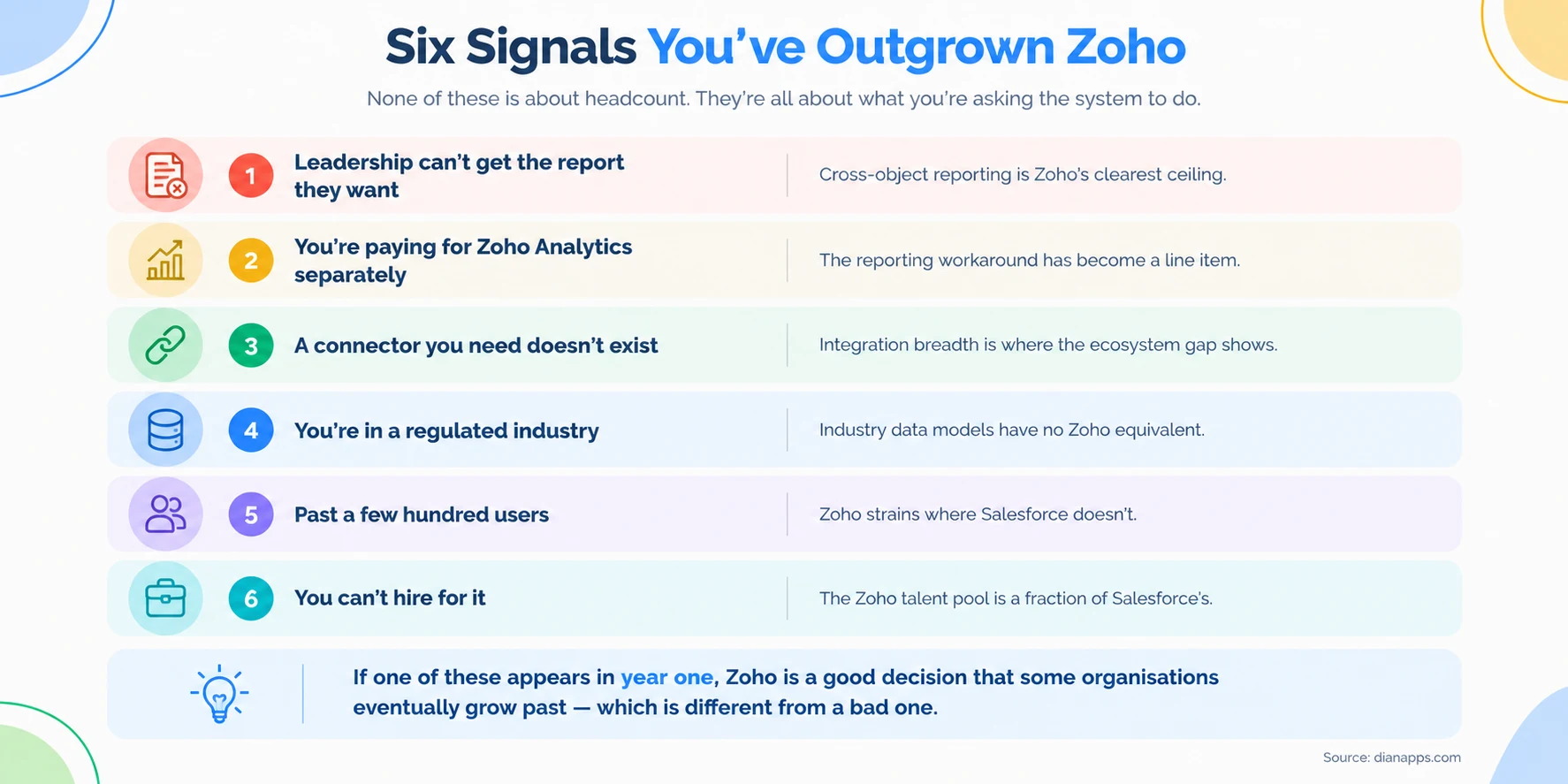
- None of these appear in year one. Zoho is a good decision that some organisations eventually grow past, which is a different thing from a bad decision.
- The first two are the same problem surfacing twice. Leadership can’t get the report they want, and then you find yourself paying for Zoho Analytics as a separate product to solve it. At that point, the cost gap has narrowed, and the reporting problem still isn’t fully solved.
- The regulated-industry signal is the cleanest. If you’re moving into healthcare, financial services, or another sector with an industry cloud, that’s a structural reason rather than a preference.
Migrating Zoho to Salesforce
It’s a real project, and more straightforward than most CRM migrations.
What transfers reasonably well: contacts, accounts, deals, and activity history. Both platforms use recognisable relational CRM structures, so the object mapping is more predictable than moving from a board-based tool.
What gets rebuilt: workflow automation, custom modules, reports and dashboards, and every integration. Zoho’s automation doesn’t translate; it’s rebuilt as Flow.
The one people underestimate: If you’re on Zoho One, you’re not just migrating a CRM. Desk, Books, and the rest either stay and need integrating, or they go too, which turns a CRM migration into a systems programme.
For businesses planning this transition, Salesforce consulting services can help map existing CRM data, rebuild workflows and integrations, and plan the migration around operational requirements without introducing unnecessary complexity.
Cost reality: for a 50-user organisation, the annual licence difference is around $81,000, which is large enough that migration pays back faster here than in most comparisons. That’s the exception in this sub-cluster, not the rule.
Before treating the licence difference as the full cost of switching, it’s worth reviewing Salesforce licence costs, including the factors that can increase the amount a business pays as its requirements grow.
Related: Salesforce alternatives and switching cost
The Verdict
| If you are… | Choose | Why |
|---|---|---|
| Cost-constrained SMB | Zoho | The gap is too large to ignore |
| Want one vendor across finance, support, CRM | Zoho One | Salesforce has no equivalent at this price |
| No admin, won’t hire one | Zoho | Configurable by a capable generalist |
| Reporting is board-critical | Salesforce | Cross-object reporting is Zoho’s clearest ceiling |
| Regulated industry | Salesforce | Industry data models have no equivalent |
| Past a few hundred users | Salesforce | Zoho strains where Salesforce doesn’t |
| Complex integration landscape | Salesforce | AppExchange breadth and API maturity |
- The honest summary: Zoho wins on price, and it isn’t close. Salesforce wins on reporting depth, ecosystem, industry models, and scale.
For a 30-person business with straightforward requirements, Zoho is usually the right answer, and we’d say so. The gap closes as complexity rises, and reporting is normally where it closes first.
Where to Go Next
For the wider field, 12 Salesforce alternatives compared.
For other head-to-heads, Salesforce vs Hubspot | Salesforce vs Pipedrive and Monday | vs Dynamics 365 | Salesforce vs custom CRM
For Salesforce cost details, Salesforce pricing 2026 | Salesforce editions compared and reducing Salesforce licence costs.
For the industry models Zoho lacks, Salesforce clouds compared.
For building the case either way, Salesforce ROI.
For smaller organisations, Salesforce for startups and SMBs and Pro Suite explained.
Zoho Is the Most Credible Challenger, and We’ll Say So
We implement Salesforce. Of the alternatives we’ve compared, Zoho is the one where the honest answer is most often “take the cheaper option”.
It’s a real CRM with real capability, and a 30-person business paying $175 a seat when $40 would do the job is a decision worth revisiting.
Where Salesforce genuinely earns the difference is narrower than its marketing suggests: reporting depth, industry data models, ecosystem breadth and scale. If none of those describe you, the price gap is the whole argument.
Tell us what leadership needs to see
Reporting is usually where this decision turns. We’ll tell you whether Zoho gets you there, and if it does, we’ll say so.
 0 comments








Leave a Comment
Your email address will not be published. Required fields are marked *