















 0 comments






Key Takeaways:
- Build Salesforce ROI around measurable time savings and cost avoidance rather than inflated revenue projections.
- Include licenses, implementation, admin time, add-ons, and ongoing costs when calculating total Salesforce investment.
- Establish baseline metrics before implementation so improvements can be measured and defended later.
- Use a realistic 50%, 75%, and 100% adoption ramp instead of assuming full benefits from year one.
- Build conservative, expected, and optimistic scenarios, then commit to the conservative case when presenting to finance.
Quick Answer: Salesforce ROI is calculated by comparing the net business gain against the total investment, including licenses, implementation, administration, and add-ons. A defensible business case should focus on measurable time recovery and cost avoidance, model revenue gains cautiously, establish baseline metrics before launch, and account for a realistic adoption ramp.
Most published Salesforce ROI figures wouldn’t survive a finance review. One partner advertises a 340% average return across its client base. A widely-shared statistics page cites 998% in 18 months. A vendor calculator offers a worked example with a 0.6-month payback period, a system paying for itself in under three weeks.
The defensible benchmark is considerably more modest: around $3.10 returned per $1 spent, from Nucleus Research’s 2023 analysis of 63 case studies. That’s still a strong return by business software standards. It’s just not 998%.
This guide covers how to build a case with numbers you can defend when someone in finance starts asking where they came from. That starts with understanding exactly what Salesforce is being used to do, because the ROI case should be tied to the processes and capabilities the platform is actually replacing or improving.
The Formula, and Its Weak Point
ROI = (Net Gain ÷ Investment Cost) × 100
The arithmetic is trivial. Everything difficult sits in the two inputs.
Investment cost is the easier half, and most business cases still get it wrong by counting licences only. The full figure is licences plus imple11 mentation plus admin time plus add-ons plus year-two costs. For a mid-market rollout, licences are typically a quarter to a third of year-one spend.
Investment cost is the easier half, and most business cases still get it wrong by counting licences only. If the implementation involves significant customization, integrations, or workflow redesign, the cost of Salesforce consulting services should also be accounted for rather than treating implementation as a one-time technical expense. For a mid-market rollout, licences are typically a quarter to a third of year-one spend. That calculation should also account for the Salesforce products and add-ons your organisation actually uses, because the CRM licence is only one part of the wider platform investment.
Net gain is where cases fall apart. It’s the sum of four benefit categories, and they are not equally defensible.
Four Benefit Categories
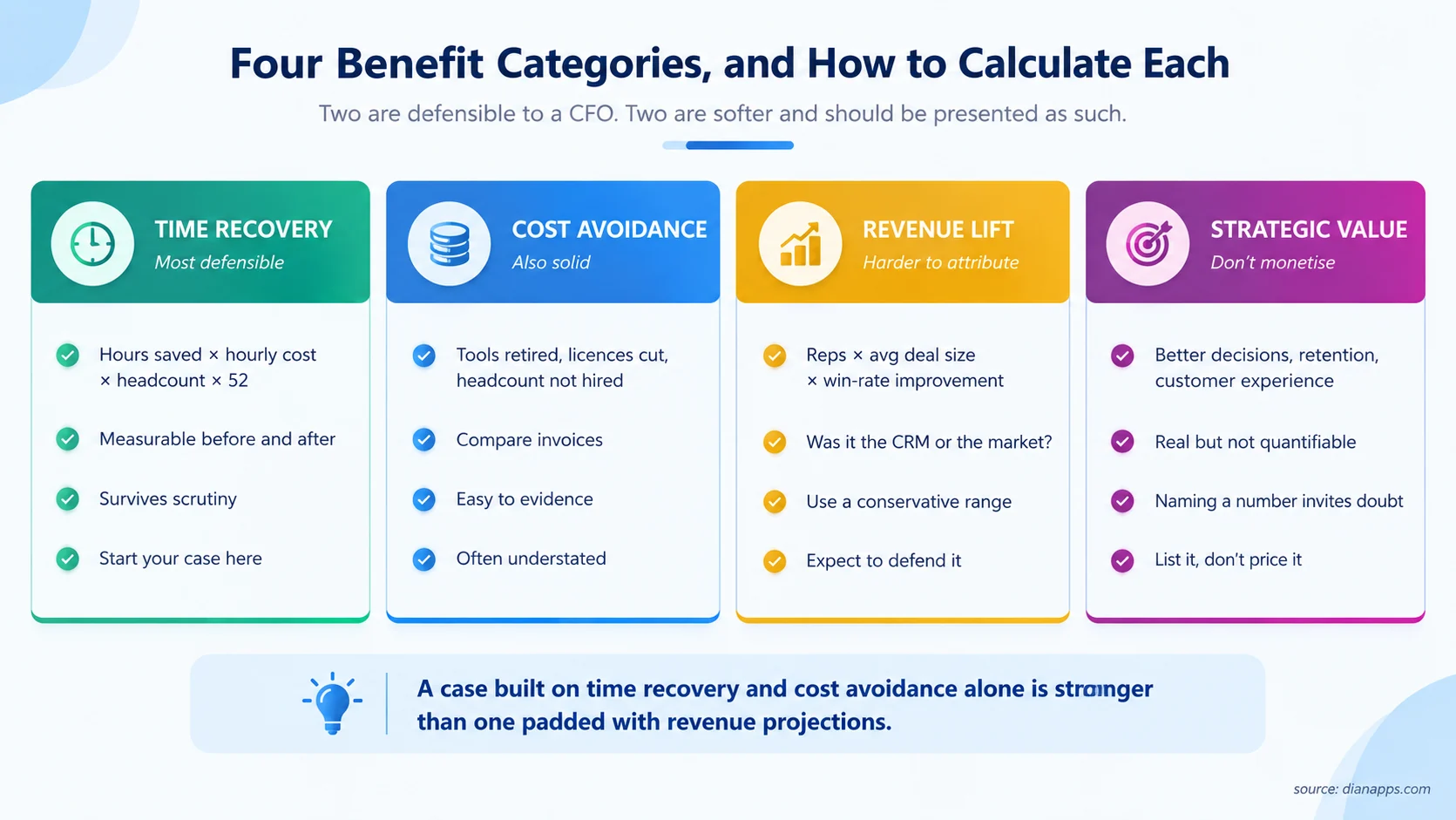
Time recovery is your strongest ground.
Hours saved per person per week × hourly cost × headcount × 52
It’s measurable before and after, the arithmetic is transparent, and nobody argues with it. Start every business case here.
- Cost avoidance is nearly as solid: Tools retired, licences cancelled, headcount not hired. You can evidence it with invoices, and it’s frequently understated because people forget the small subscriptions that disappear.
Revenue lift is where cases get challenged.
Reps × average deal size × win-rate improvement
That’s the formula Salesforce’s own calculator uses, with win-rate improvement benchmarked at 20–29% from their customer data. Use it, but present it as a range and expect to defend the attribution; revenue went up, and proving the CRM caused it rather than the market or a pricing change is genuinely hard.
Strategic Value, List It, Don’t Price It: Better decisions, improved customer experience, staff retention. These are real, they matter, and attaching a dollar figure to them invites exactly the scepticism that undermines the numbers you can defend.
The benefits will also vary depending on which part of Salesforce your business is using. A sales-focused implementation has a different value model from one built around service, marketing, commerce, or another cloud, so a Salesforce clouds comparison can help define which processes should actually appear in the ROI model.
A case built on time recovery and cost avoidance alone is stronger than one padded with revenue projections. Counterintuitive, and true.
Baseline Before You Start
This is the single most common failure, and it’s unfixable after the fact.
You cannot prove improvement without a before number. If you don’t measure the current state, then in eighteen months you’ll be arguing that things feel better, which is not a business case outcome.
What to capture before go-live:
| Metric | Why it matters |
|---|---|
| Hours per week on manual data entry | The backbone of time recovery |
| Average sales cycle length | Cycle-time improvement is measurable |
| Win rate by segment | Needed to evidence revenue lift |
| Cases resolved per agent per day | Service productivity baseline |
| Time to onboard a new hire | Ramp savings |
| Cost of tools you plan to retire | Cost avoidance, with invoices |
| Report production time | Frequently the largest hidden saving |
Assign an owner and a reporting cadence to each one. A baseline nobody re-measures is just a spreadsheet.
Model the Ramp
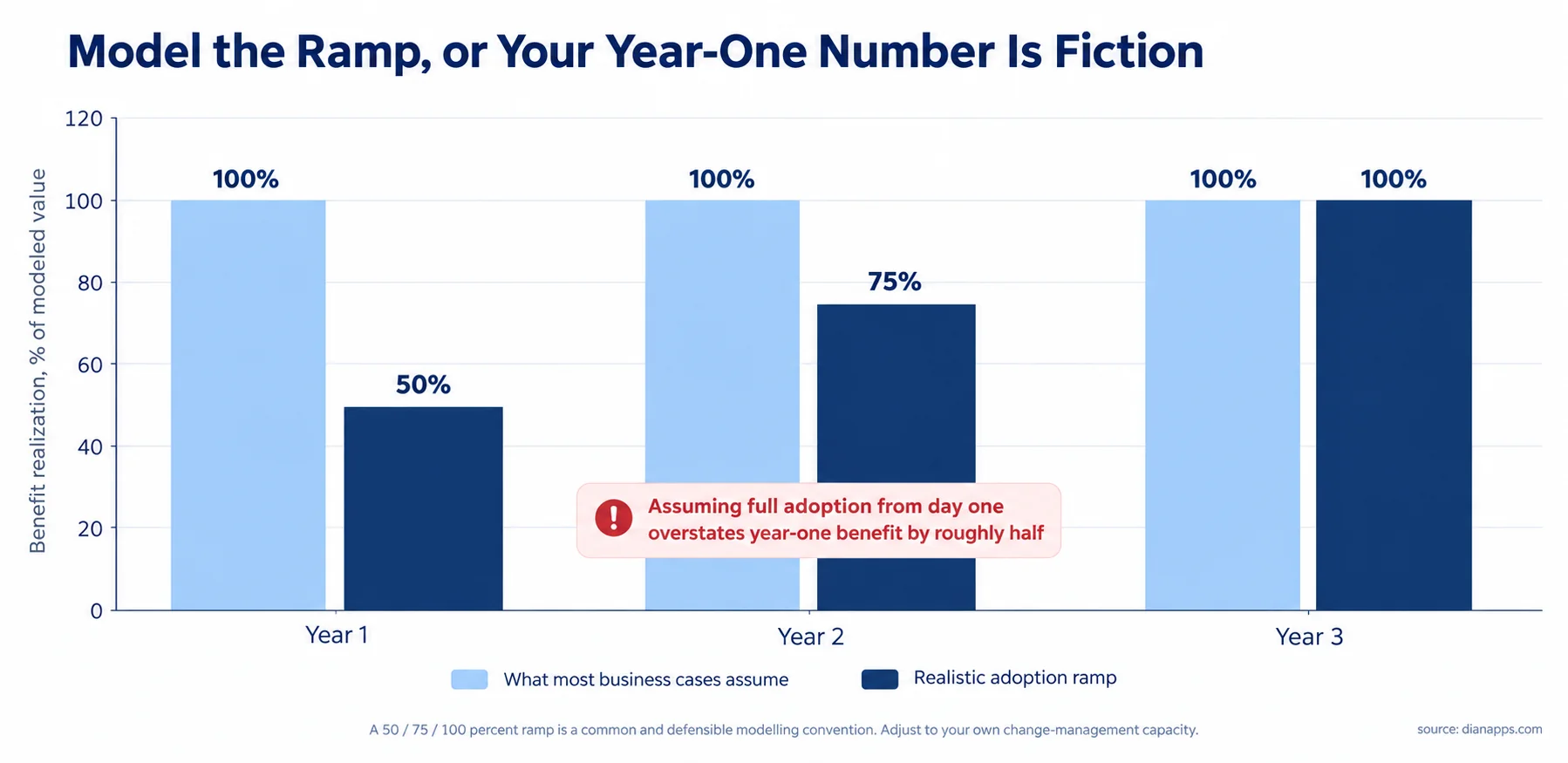
Assuming full benefit from day one overstates year-one value by roughly half.
A common and defensible convention is 50% of modelled benefit in year one, 75% in year two, 100% in year three. Adjust it to your own change-management capacity; a well-resourced rollout with a dedicated owner ramps faster than one bolted onto someone’s existing job.
- Why This Matters Commercially: A case that shows full benefit immediately looks naive to anyone who has run a software rollout. Showing the ramp signals that you’ve thought about adoption, which is the thing that actually determines whether the benefits arrive.
- It Changes the Payback Calculation Materially: Salesforce and its partners report payback periods of 6–12 months. With a realistic ramp, most mid-market implementations land at the longer end of that or beyond.
Build Three Scenarios, Not One
Salesforce’s own guidance recommends this, and it’s better advice than most partner content offers.
| Scenario | Assumptions | Use it for |
|---|---|---|
| Conservative | Low adoption, slow ramp, no revenue lift claimed | The number you commit to |
| Expected | Realistic ramp, modest revenue lift | The number in the deck |
| Optimistic | Fast adoption, upper-range benefits | Context, clearly labelled |
Commit to the conservative number; if you present the optimistic case and deliver the expected one, you’ve failed against your own projection despite a genuinely good outcome.
Adjust assumptions for adoption rate, local labour costs and project scope rather than borrowing a benchmark wholesale.
Claims That Won’t Survive Scrutiny
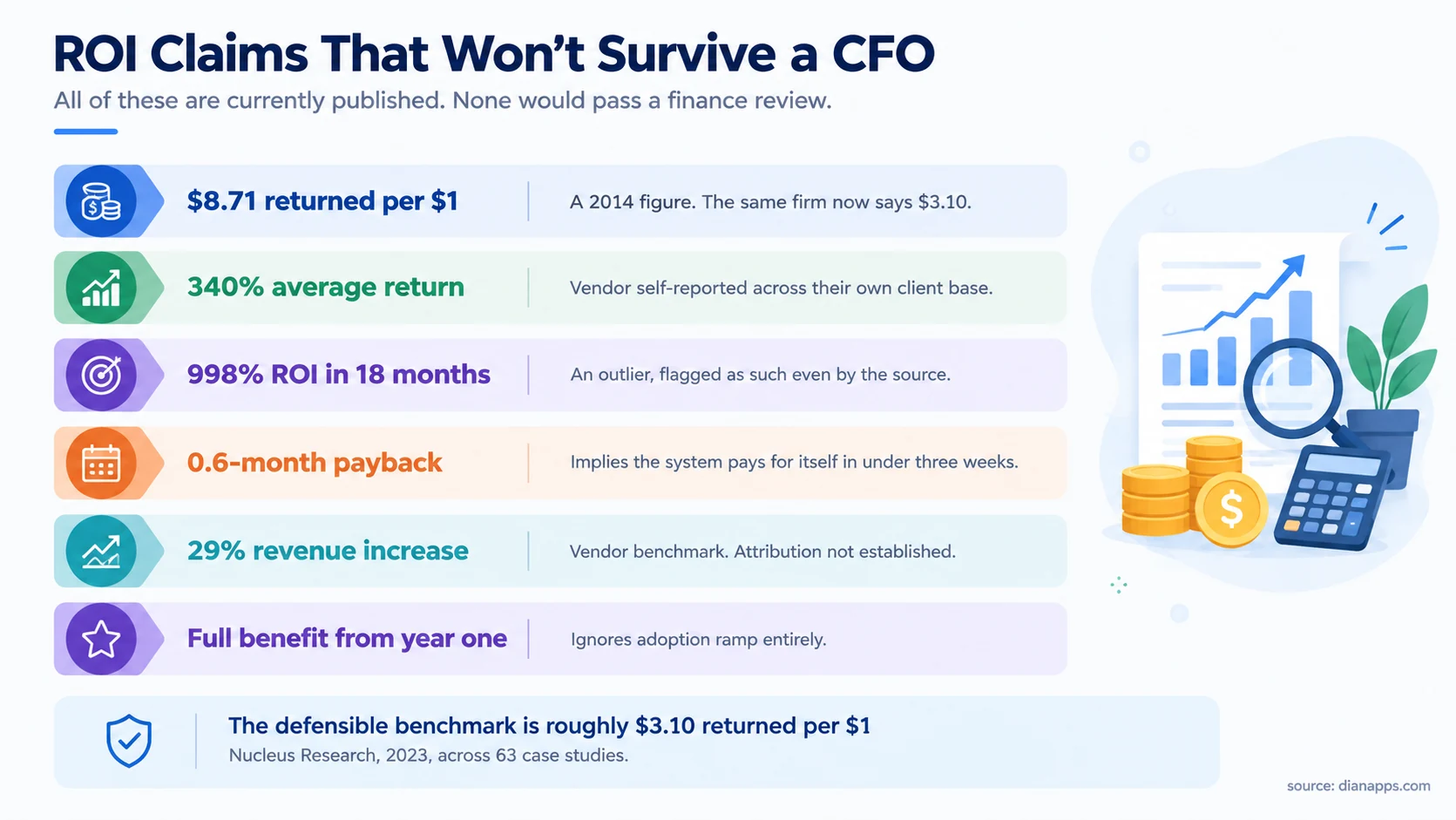
Every figure above is currently published somewhere. The $8.71 one appears on most CRM statistics pages as though it describes today; it’s from 2014, and the same research firm’s 2023 re-analysis puts it at $3.10.
How to sanity-check any ROI claim you’re handed:
Who produced it?
- A vendor or partner reporting on its own client base is not independent research.
What’s the sample?
- “Across 500+ companies we implemented” is self-selected. Nucleus’s 63 case studies with a stated methodology is different in kind.
What year?
- ROI benchmarks age badly, and implementation costs have risen.
Does the payback period pass a smell test?
- Anything under six months for a full CRM implementation deserves questions.
Related: CRM statistics 2026
Need a Salesforce ROI Model You Can Defend?
Build a Salesforce business case around your actual costs, adoption ramp, measurable benefits, and realistic scenarios.
A Worked Example
A 50-person sales and service organisation on Enterprise.
Costs, year one:
| Line | Amount |
|---|---|
| Licences (50 × $175 × 12) | $105,000 |
| Implementation | $90,000 |
| Internal admin time | $50,000 |
| Add-ons and storage | $20,000 |
| Total year one | $265,000 |
Benefits, modelled at 100% then ramped:
| Benefit | Calculation | Full value |
|---|---|---|
| Time recovery - sales | 4 hrs/week × $45 × 30 reps × 52 | $280,800 |
| Time recovery - service | 2 hrs/week × $35 × 20 agents × 52 | $72,800 |
| Cost avoidance | Three tools retired | $34,000 |
| Revenue lift (conservative) | Modest win-rate improvement | $120,000 |
| Full annual benefit | $507,600 |
Now apply the ramp:
| Year 1 (50%) | Year 2 (75%) | Year 3 (100%) | |
|---|---|---|---|
| Benefit | $253,800 | $380,700 | $507,600 |
| Cost | $265,000 | $175,000 | $180,000 |
| Net | −$11,200 | $205,700 | $327,600 |
Payback lands early in year two, and three-year ROI is roughly 100%, which is to say around $2 returned per $1 spent, in the same territory as the Nucleus benchmark.
Note What The Honest Version Does: Year one is slightly negative. A case showing a positive first year is usually one that skipped the ramp, and a CFO who has seen a software rollout before will spot it.
Tracking Value After Launch
Most business cases are written, approved, and never revisited. That’s a missed opportunity in both directions.
Re-measure your baseline metrics on a fixed cadence, quarterly for the first year, then annually. Same metrics, same method, same owner.
Report against the conservative scenario, which is what you committed to.
Expect the shape to differ from the model. Some benefits arrive faster than projected, others don’t arrive at all. That’s normal and worth documenting, because it makes your next business case more credible.
And use the data at renewal. An organisation that can evidence delivered value negotiates from a stronger position than one that can’t. See how to reduce Salesforce licence costs.
Turn Your Salesforce Business Case Into Results
Hire experienced Salesforce developers to build, customize, integrate, and optimize your Salesforce environment around the outcomes in your ROI model.
When the Honest Answer Is No
Worth stating, since almost nobody writing about Salesforce ROI does.
If your process is simple and your team is small, the numbers frequently don’t work. A ten-person team with a straightforward pipeline will struggle to generate $265,000 of annual benefit, and a cheaper tool will deliver most of the value.
If you have no owner for the system, model the benefits at a much lower ramp or don’t proceed. Adoption is the variable that determines everything, and it doesn’t happen on its own.
If your data is poor, fix that first. A CRM built on bad data produces reports nobody trusts, and no ROI model survives that.
Related: Salesforce vs custom CRM · Salesforce for startups and SMBs
Where to Go Next
For the cost side of the equation, Salesforce pricing 2026 and editions compared.
For reducing the investment figure, how to reduce Salesforce licence costs.
For the benchmark data and why published figures disagree, CRM statistics 2026.
For what implementation actually costs, Salesforce customization cost.
For whether the platform fits at all, Salesforce vs custom CRM, Salesforce alternatives and Salesforce for startups and SMBs.
For protecting adoption, which is what determines whether any of this arrives, how to choose an implementation partner.
The Number You Commit To Is the One That Matters
There’s a temptation to present the best case, because it gets approved faster. It also sets the bar you’ll be measured against eighteen months later.
A conservative model that you beat is a better outcome than an optimistic one you miss, and it’s the difference between a second budget request that gets approved and one that doesn’t.
Ready to Build Your Salesforce Business Case?
Share your current Salesforce costs, processes, and growth plans with our team, and let’s work through the numbers, assumptions, and implementation requirements together.
 0 comments









Leave a Comment
Your email address will not be published. Required fields are marked *