















 0 comments





Key Takeaways:
- HubSpot offers a simpler setup and integrated marketing automation for growing teams.
- Salesforce provides deeper customisation, industry clouds and enterprise scalability.
- HubSpot onboarding fees, monthly pricing and contact-based costs can increase total spending.
- Salesforce requires greater investment in implementation, administration and AI pricing.
- Compare migration costs, process complexity and team needs before switching CRM platforms.
Quick Answer: HubSpot is generally better for small and mid-sized teams that want easier setup and integrated marketing automation, while Salesforce suits businesses needing advanced customisation, industry-specific capabilities and enterprise-scale workflows. However, licence prices alone do not show the full cost. HubSpot onboarding and contact-based pricing, along with Salesforce implementation and administration, can significantly affect your total investment.
The two highest-ranking pages for this search are written by HubSpot and Salesforce. Each explains why it beats the other.
We’re a Salesforce consulting partner, so we have our own interest here, and you should read this knowing it. What we can offer that the vendor pages can’t is the cost lines neither of them advertises, and there are meaningful ones on both sides.
Understanding what Salesforce is and how its CRM platform works also helps put this comparison into context, particularly when evaluating whether its broader capabilities justify the additional cost.
HubSpot is genuinely cheaper. It also carries a mandatory, non-negotiable onboarding fee and prices its Starter tier three times higher if you won’t commit annually. Salesforce has the higher ceiling. It also effectively requires an administrator and has shipped three different AI pricing models in eighteen months, all of which currently run simultaneously.
Licence Cost by Team Size
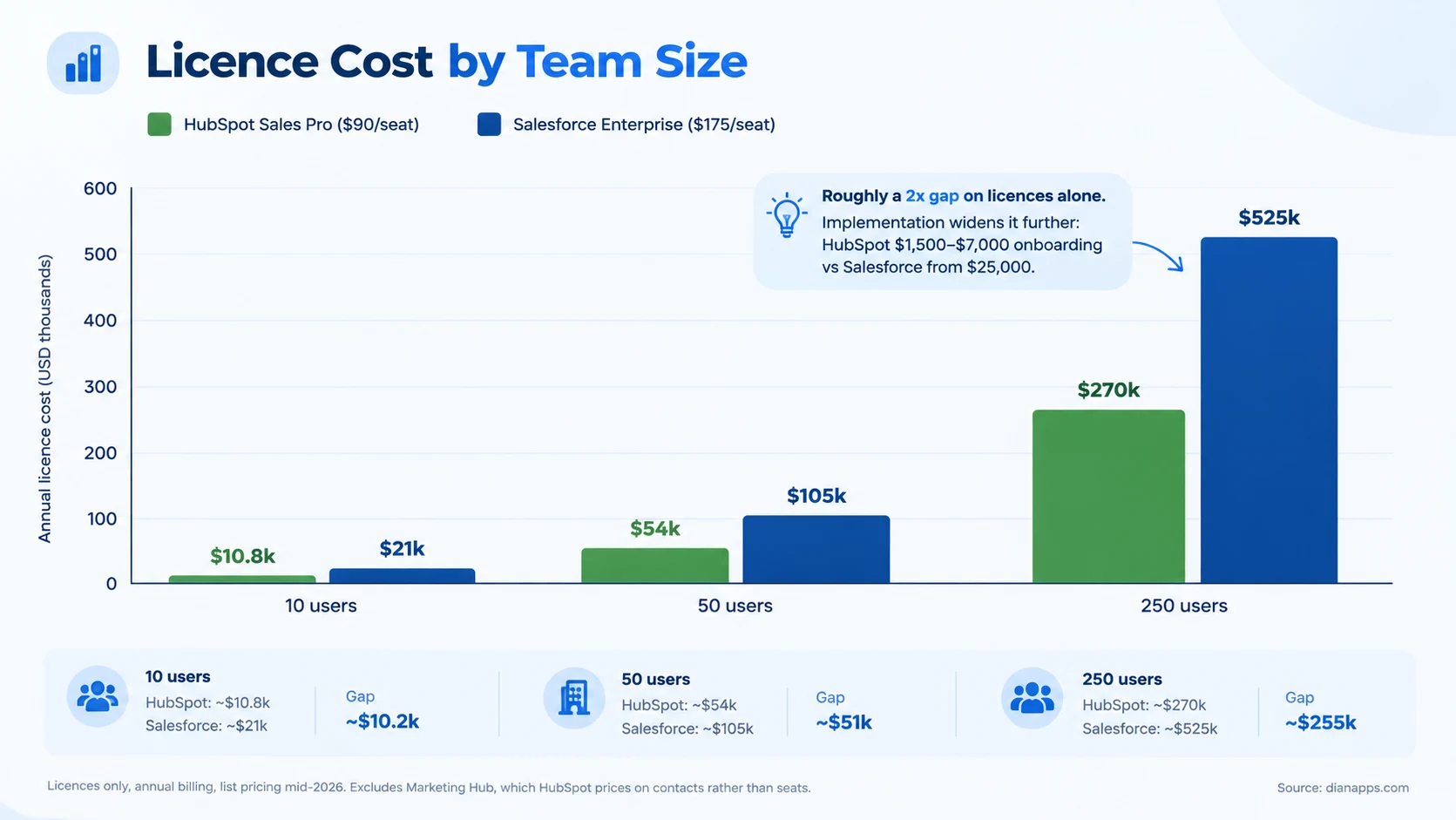
| Team size | HubSpot Sales Pro | Salesforce Enterprise | Gap |
|---|---|---|---|
| 10 users | ~$10,800 | ~$21,000 | ~$10,200 |
| 50 users | ~$54,000 | ~$105,000 | ~$51,000 |
| 250 users | ~$270,000 | ~$525,000 | ~$255,000 |
That’s licences only, and it’s the comparison both vendors would rather you stopped at: HubSpot because it flatters them, Salesforce because they’d prefer to discuss capability.
Current entry pricing on both sides:
| HubSpot | Salesforce | |
|---|---|---|
| Free tier | Yes, genuinely useful | Free Suite, 2 users |
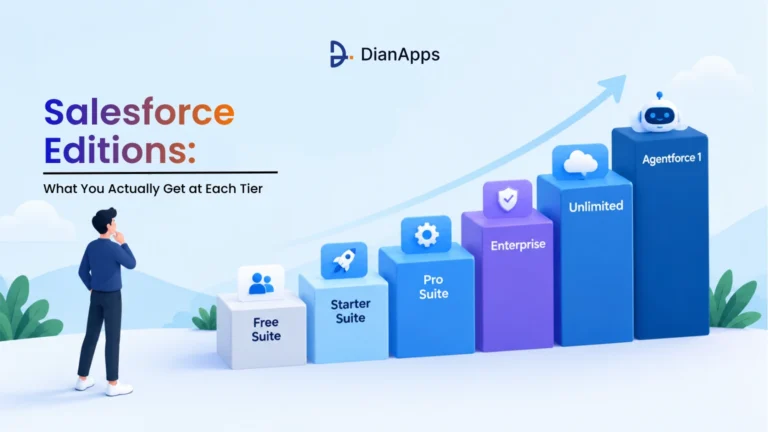
| Entry paid | $7/seat annual, $20 monthly | $25 (Starter Suite) |
| Mid tier | $90/seat (Sales Pro) | $100 (Pro Suite) |
| Main tier | $150/seat (Enterprise) | $175 (Enterprise) |
| Top tier | — | $350 (Unlimited), $550 (Agentforce 1) |
Related: Salesforce pricing 2026
What Neither Vendor Leads With
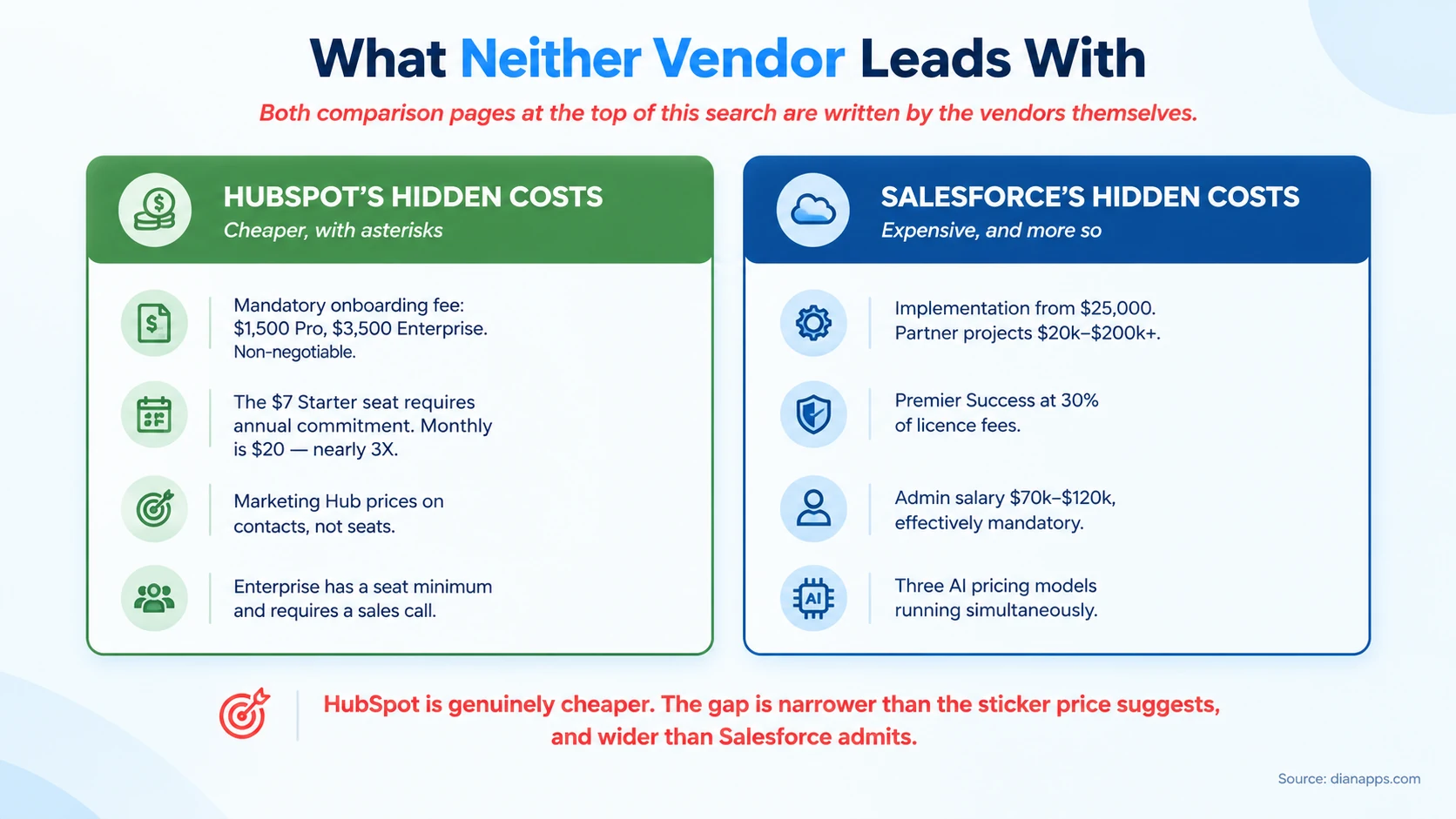
HubSpot’s mandatory onboarding fee is the one that surprises people. Professional carries roughly $1,500 and Enterprise around $3,500, varying by hub. It’s one-time, required when buying directly, and cannot be negotiated away. That’s unusual in SaaS, and it isn’t on the pricing page in a way most buyers notice.
The $7 Starter seat is annual-commitment pricing. Month-to-month is $20, nearly three times more. Comparisons that quote $7 alongside Salesforce’s $25 aren’t comparing like with like.
Marketing Hub prices on contacts, not seats. If marketing automation is why you’re considering HubSpot, your cost scales with database size rather than headcount, and it can move quickly. Marketing Professional starts around $800 per month as a flat platform fee before contact tiers.
On Salesforce’s side, implementation is the honest problem. Partner projects run $20,000 to $200,000 and up. Add Premier Success at 30% of licence fees if you want support beyond standard, and an administrator at $70,000–$120,000 who is effectively mandatory rather than optional.
Comparing Salesforce and HubSpot Costs?
Share both vendor quotes with our team. We’ll help you compare licensing, onboarding, implementation, administration, and AI costs before you commit.
Related: how to reduce Salesforce licence costs · Salesforce ROI
Ease of Use and Admin Overhead
This is HubSpot’s clearest win, and it isn’t close.
You can have a working HubSpot pipeline in a day, without help. Salesforce implementation runs weeks to months, and most organisations use a partner.
- The structural difference: HubSpot is opinionated. It decides how things should work, and you adapt. Salesforce is a platform; it can model almost any process, which means someone has to decide what that process is and build it.
- That cuts both ways: HubSpot’s opinions are good ones, and they get you moving fast. They’re also a ceiling, and you’ll meet it if your process is genuinely unusual.
- The admin question is the practical version: Salesforce without a dedicated owner degrades, data quality drops, automation breaks silently, and nobody trusts the reports within two years. HubSpot survives neglect better. If you can’t name who will own the system, that’s a real argument for HubSpot regardless of anything else.
For businesses that need Salesforce’s deeper customisation without taking on unnecessary complexity, Salesforce consulting services can help assess existing workflows, identify implementation gaps, and determine what level of ongoing administration the platform will require.
Customisation Ceiling
| HubSpot | Salesforce | |
|---|---|---|
| Custom objects | Yes, from Enterprise | Yes, from Pro Suite |
| Custom code | Limited | Apex, LWC, build almost anything |
| Industry data models | No | Health, Financial Services, Manufacturing and others |
| App marketplace | ~1,500 apps | AppExchange, several thousand |
| Build your own apps | No | Yes, it’s a platform |
Salesforce’s ceiling is genuinely much higher, and for most organisations that’s irrelevant. The question isn’t which platform can do more; it’s whether you’ll ever need what the extra buys.
Where the ceiling matters concretely: regulated industries with pre-built data models, organisations building applications that aren’t CRM at all, and companies whose process genuinely doesn’t fit a standard pipeline.
For businesses evaluating industry-specific capabilities, comparing Salesforce clouds can clarify which options support their requirements and whether those capabilities justify choosing Salesforce over HubSpot.
Marketing Automation
HubSpot’s strongest genuine advantage, and the reason marketing-led organisations pick it.
HubSpot includes marketing automation in the same platform, on the same database, with one contact record. Email, landing pages, forms, workflows, attribution- all of it works together because it was built together.
Salesforce offers a wider range of products for sales, marketing, service, commerce, and other business needs, but Marketing Cloud and Account Engagement (formerly Pardot) have separate pricing, interfaces, and, historically, separate data models.
- The Honest Framing: If marketing automation is a primary requirement and you’re under a few hundred people, HubSpot’s integrated approach is better. At enterprise scale with complex segmentation, Marketing Cloud does things HubSpot can’t.
AI: Agent Hub vs Agentforce
Both shipped serious AI agents in 2026, and the capability gap has narrowed considerably. The differentiators now are data access and depth rather than whether the feature exists.
HubSpot renamed Breeze to Agent Hub on 30 July 2026; most comparison content still says Breeze, which is a quick way to date what you’re reading.
HubSpot’s pricing model is better designed, and that’s worth saying plainly. Since April 2026, its agents bill on outcomes: $0.50 per resolved conversation, $1.00 per recommended lead. Previously it charged per conversation whether or not the agent resolved anything. “You pay when it works” is a genuinely fairer meter.
Salesforce has shipped three AI pricing models in roughly eighteen months: $2 per conversation, Flex Credits at $0.10 per action, and per-user licences from $125 per month, and all three currently run simultaneously. That’s confusing to budget against, and it’s a fair criticism.
Where Salesforce is genuinely ahead: grounding agents in unified data via Data 360, governance controls, permission-based AI access, audit trails and sandbox testing for agent behaviour. HubSpot’s agents can only reason over data inside HubSpot; if your product usage data lives in a warehouse, Agent Hub can’t see it without workarounds.
Related: what is Agentforce
Comparing quotes from both and unsure what’s missing?
Vendor quotes rarely include the same lines. We’ll normalise them: onboarding, implementation, admin, AI consumption, so you’re comparing the same thing.
The Verdict by Profile
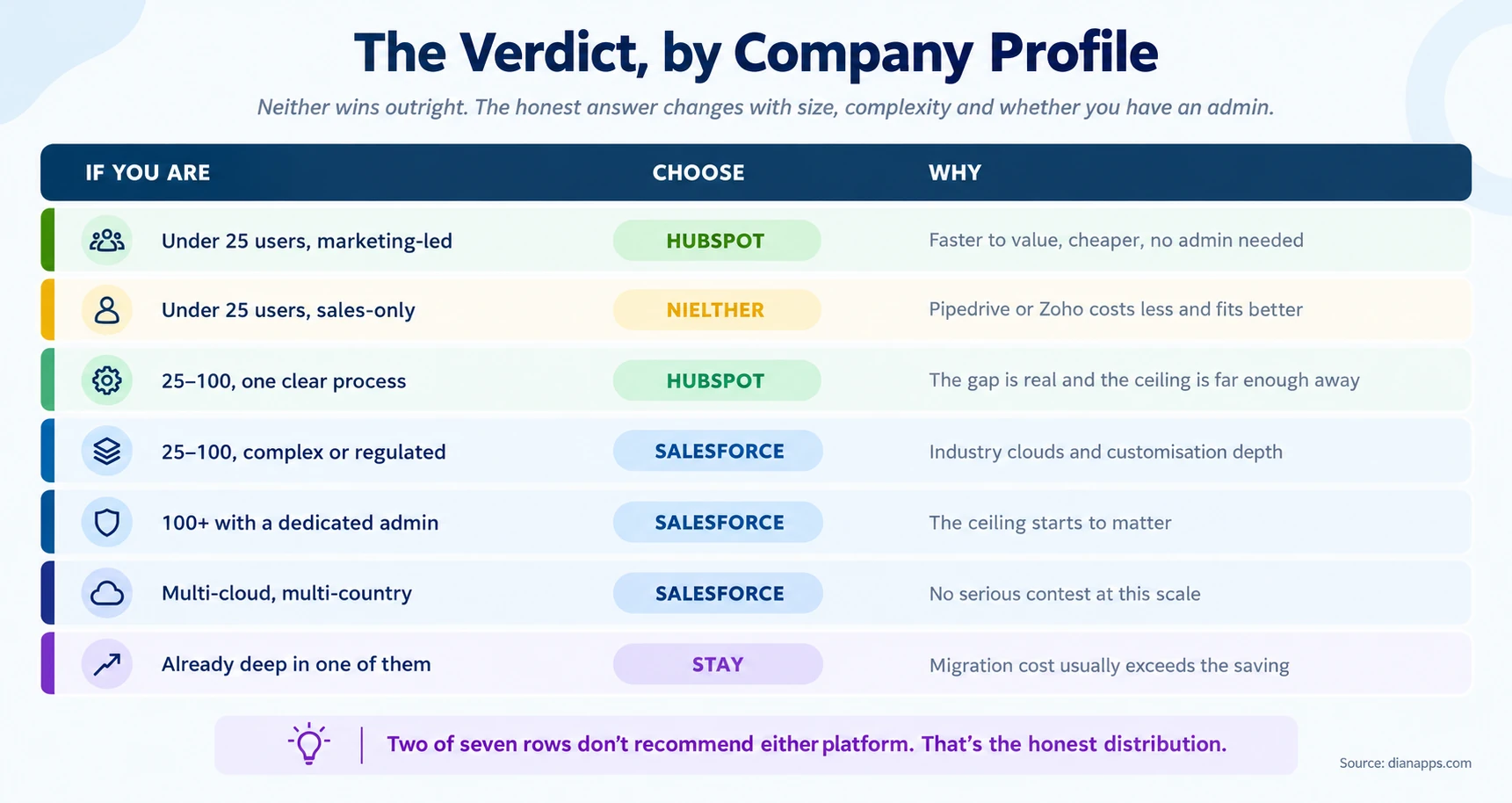
Two of seven rows don’t recommend either platform, which is the honest distribution. A twelve-person sales team with a simple pipeline is better served by Pipedrive or Zoho than by either of these.
The three questions that actually decide it:
Is marketing automation a primary requirement? If yes, HubSpot’s integrated approach is a real advantage.
Will you have a dedicated administrator? If no, HubSpot. Salesforce without an owner degrades reliably.
Is your process genuinely unusual, or regulated? If yes, Salesforce’s ceiling and industry clouds matter. If no, you’re paying for optionality you won’t use.
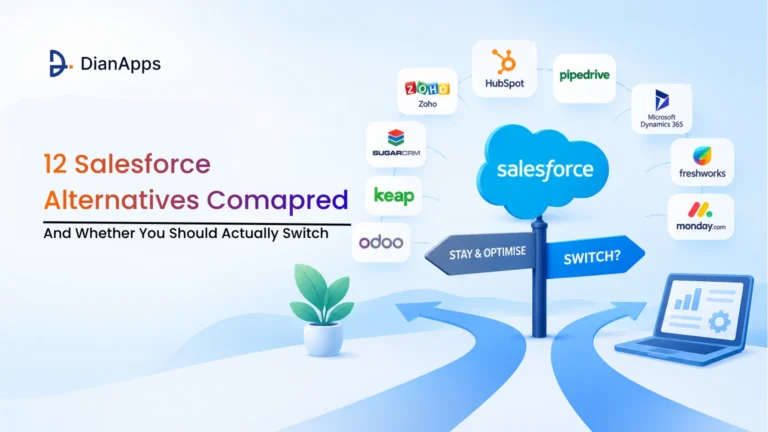
Related: Salesforce alternatives compared
Migration in Both Directions
HubSpot to Salesforce is the more common direction at scale, and it’s a genuine project. Your object model differs, integrations get rebuilt, and HubSpot’s marketing automation needs replacing with Marketing Cloud or Account Engagement, which is a second implementation, not a migration.
Salesforce to HubSpot happens more than Salesforce would like, usually driven by cost and complexity. The trap is that heavily customised Salesforce orgs don’t map onto HubSpot’s opinionated model. Custom objects, complex automation and unusual sharing rules have no direct equivalent, so you’re simplifying by force.
Both directions cost more than the licence saving in year one. For a 50-user organisation, the annual licence gap is around $51,000; a full migration frequently exceeds that.
And the honest warning for either direction: if the reason for moving is that the current implementation is poor, that follows you. Bad data migrates. Untrained users stay untrained.
Not Sure Whether to Choose Salesforce or HubSpot?
Let’s assess your business processes, customisation needs, marketing requirements, and long-term costs to help you decide which CRM makes the most sense.
Related: Salesforce alternatives and switching cost
Where to Go Next
For other head-to-heads, Salesforce vs Zoho · Salesforce vs Dynamics 365 · Salesforce vs Pipedrive and Monday · Salesforce vs custom CRM
For Salesforce cost details, Salesforce pricing 2026, editions compared and reducing licence costs.
For building the case either way, Salesforce ROI and CRM statistics.
For what Salesforce’s ceiling actually buys, Salesforce clouds compared and the Salesforce Platform.
For smaller organisations, Salesforce for startups and SMBs.
We’d Rather You Chose Well Than Chose Us
We implement Salesforce. That’s a real bias, and we’ve stated it.
It’s also why we’d rather you didn’t pick Salesforce for a 15-person sales team. A project that shouldn’t have happened is a bad outcome for everyone, and HubSpot or Pipedrive would serve you better.
Where we’re genuinely useful is the harder middle: organisations where the answer depends on process complexity, regulatory requirements, and whether you’ll have an admin.
 0 comments







Leave a Comment
Your email address will not be published. Required fields are marked *