















 0 comments





Key Takeaways
- AI development means building software whose behavior is learned from data, not written as rules. That single difference changes how it’s budgeted, tested, and maintained.
- The API call is the easy 10%. Retrieval, evaluation, guardrails, cost control, and monitoring are the actual work.
- Data preparation and evaluation consume more than half of most AI project budgets, and evaluation is the stage teams skip most often.
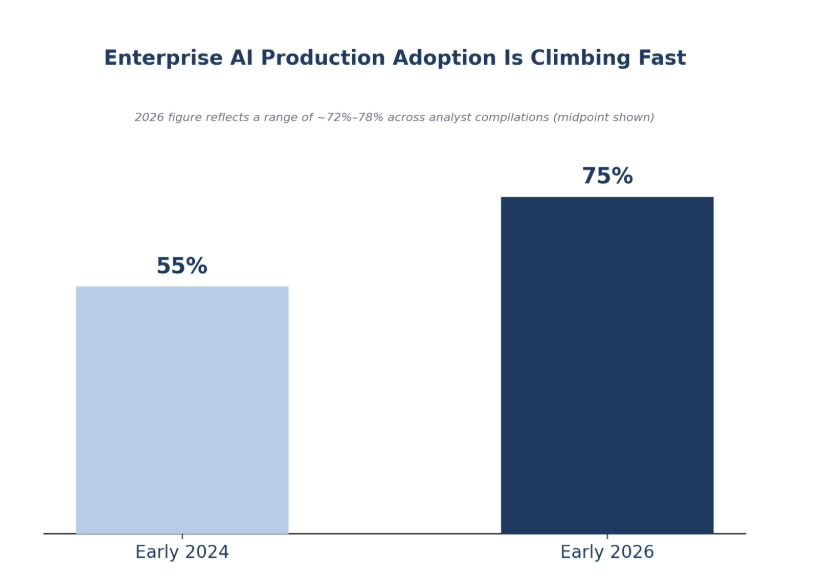
- No PhD required. Gartner expects 40% of enterprise applications to embed task-specific AI agents by the end of 2026, and almost none of that work involves training a model from scratch.
Quick Answer: AI development is the practice of building software systems that learn patterns from data and produce probabilistic outputs, rather than following rules a programmer wrote by hand. It covers everything from selecting and preparing data, to choosing or training a model, to wrapping that model in an application with evaluation, monitoring, and guardrails. The defining difference from traditional software development is that you cannot fully specify the behavior in advance. You shape it, measure it, and improve it.
Who This Guide Is For ?
- Business and product leaders deciding whether AI fits a specific problem
- Engineers moving from traditional software into AI work
- Founders and buyers evaluating AI development partners or quotes
If you already run production AI systems, skip to AI development vs software development and what AI developers do all day. Everything before that will be familiar.
AI Development Definition
AI development is the end-to-end process of designing, building, evaluating, and operating software whose behavior is derived from data rather than explicitly programmed. It spans data engineering, model selection or training, application engineering, evaluation, deployment, and continuous monitoring.
The phrase covers a wide range of work in 2026, and the range is worth naming precisely because vendors use the same term for very different things:
| What people mean by “AI development” | What’s actually involved |
| Building a product on top of a hosted model | Prompt design, retrieval, tool integration, evaluation, application code |
| Building a classical ML system | Feature engineering, model training, validation, deployment, monitoring |
| Fine-tuning an existing model | Dataset construction, training runs, evaluation, versioning, serving |
| Training a foundation model from scratch | Large-scale data curation, distributed training, enormous compute budgets |
| Embedding AI into an existing product | Integration engineering, UX design for uncertainty, cost and latency control |
The first and last categories account for the overwhelming majority of commercial AI work today. Training a foundation model from scratch is the work of a small number of well-funded labs, and the average cost of training a frontier model has been reported at roughly $200 million, which explains why almost nobody does it.
Organizations formalizing how they manage AI risk increasingly anchor on the NIST AI Risk Management Framework, which gives a vendor-neutral vocabulary for trustworthiness, measurement, and governance.
What Is AI Development in Simple Terms?
Traditional programming works like a recipe. You write the steps, the computer follows them, and the same input always produces the same output.
AI development works more like training an apprentice. You show the system many examples, or you give it access to a model that has already seen billions of examples, then you shape its behavior with instructions, context, and feedback. You test it on cases you care about. When it gets things wrong, you don’t fix a line of code. You improve the data, the context, the instructions, or the model.
That single shift creates every downstream difference in how AI projects are budgeted, staffed, tested, and shipped.
A practical example. Suppose you want to flag fraudulent transactions.
- Traditional approach: write rules. Flag anything over $5,000 from a new device in a foreign country. Simple, explainable, easy to evade, and it breaks every time fraud patterns shift.
- AI approach: train a model on a labeled history of transactions so it learns the combinations that correlate with fraud, including combinations no analyst would have written down. Harder to explain, needs monitoring, and adapts as patterns change.
Neither is universally right. The AI approach wins when the rules are too numerous, too subtle, or too fast-changing for a human to maintain.
Understand the key differences between Casual AI vs Traditional AI.
What Is Artificial Intelligence Technology?
Artificial intelligence technology is the collection of methods that let software perform tasks normally requiring human judgment: recognizing images, understanding language, making predictions, planning actions, and generating content.
The main branches, and where each one shows up in commercial work:
| Technology | What it does | Typical business use |
| Machine learning development services (ML) | Learns patterns from structured data | Churn prediction, demand forecasting, credit scoring |
| Deep learning | Multi-layer neural networks for complex patterns | Image recognition, speech, recommendation |
| Natural language processing (NLP) | Understands and generates human language | Search, classification, summarization |
| Large language models (LLMs) | General-purpose text and reasoning models | Assistants, drafting, extraction, code generation |
| Computer vision | Interprets images and video | Quality inspection, medical imaging, retail analytics |
| Speech and audio | Transcription, synthesis, voice interaction | Call center analytics, voice assistants |
| Retrieval-augmented generation (RAG) | Grounds a model in your own documents | Internal knowledge assistants, support automation |
| AI agent services | Plans and executes multi-step tasks with tools | Workflow automation, research, coding assistance |
| Reinforcement learning | Learns from reward signals | Robotics, pricing, game-playing, model alignment |
In 2026, most new commercial projects sit in the LLM, RAG, and agent columns. Classical ML has not gone anywhere though. Forecasting, scoring, and recommendation systems remain the highest-ROI AI in many companies, and they run on techniques that predate the current wave by a decade.
Callout: The most common architectural error in enterprise AI is reaching for a language model when a gradient-boosted tree would be cheaper, faster, more accurate, and easier to explain. Match the technique to the problem, not to the news cycle.
Also Read: AI Development Cost in 2026: Full Pricing Breakdown
What Is the Purpose of AI?
The purpose of AI is to make decisions, predictions, or content at a scale, speed, or consistency that humans cannot sustain, and to handle inputs too unstructured for conventional software.
In practice, commercial AI serves four goals:
- Automate judgment work. Tasks requiring interpretation rather than rule-following: triaging tickets, reviewing documents, screening applications.
- Extract signal from unstructured data. Roughly the majority of enterprise data lives in documents, emails, images, and recordings that traditional systems can’t query.
- Personalize at scale. Recommendations and experiences tailored per user, which is impossible manually past a few hundred customers.
- Predict outcomes. Demand, risk, churn, failure, and fraud, early enough for the prediction to matter.
Adoption is now close to universal at the organizational level, with Stanford’s 2026 AI Index Report finding generative AI in use in at least one business function at 70% of organizations, and the highest year-over-year increases coming from China and Europe.
How Does AI Development Work?
At a high level, every AI system follows the same loop, whether it’s a fraud model or a support assistant:
Define the decision → gather the data → build or select the model → evaluate against real cases → deploy behind guardrails → monitor → improve.
The critical detail most explanations skip: you are not building toward a finished state. You are building toward a measurable one. An AI system is never “done” the way a checkout flow is done. It has a quality score, and that score drifts as data, users, and models change.
Here’s what that loop looks like in a real 2026 project, using an internal knowledge assistant as the example:
- Define the decision: “When an employee asks an HR policy question, return the correct answer with a citation, or escalate.”
- Define success numerically: “85% of a 200-question golden set answered correctly with a valid citation, zero policy hallucinations on the compliance subset.”
- Prepare the data: Collect 1,200 policy documents. Discover 340 are outdated, 80 are scanned images, and 15 contradict each other. Fix that. This is the part that takes longest.
- Build the retrieval layer: Chunk, embed, index, rerank. Test whether the right document actually surfaces before worrying about the model’s wording.
- Design the model layer: System instructions, citation format, refusal behavior when confidence is low.
- Evaluate. Run the golden set. Score it. Fix the worst failure category. Repeat.
- Add guardrails: PII redaction, prompt injection defense, off-topic refusal, escalation path to a human.
- Deploy with observability: Trace every request, log cost, track thumbs-down feedback.
- Monitor and improve: Watch for drift when policies change or the model version updates.
Notice that steps 3, 4, 6, and 9 have no equivalent in traditional software delivery, and together they usually consume more than half the budget.
Also Read: How to Choose an AI Development Company (2026 Checklist)
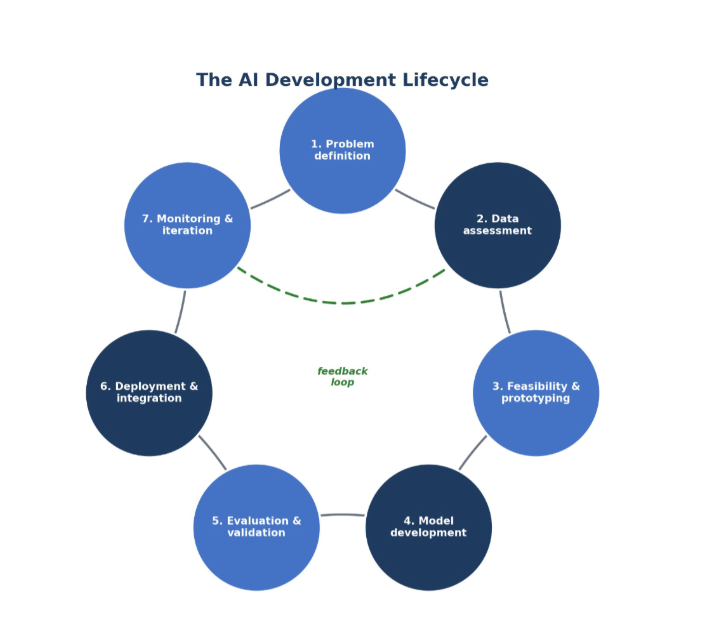
The Main Stages of the AI Development Lifecycle
Seven stages, in order, with the outputs that matter at each.
| # | Stage | Core activity | Output that proves it’s done |
| 1 | Problem definition | Identify the decision, the user, the metric | A one-sentence success criterion containing a number |
| 2 | Data assessment and preparation | Sourcing, cleaning, labeling, permissions, governance | A documented, versioned dataset with known gaps |
| 3 | Feasibility and prototyping | Test whether the approach can work at all | A prototype scored against 30 to 100 real cases |
| 4 | Model development | Select, prompt, retrieve, fine-tune, or train | A model configuration that beats the baseline |
| 5 | Evaluation and validation | Golden sets, adversarial testing, bias checks | A reproducible score and a known failure profile |
| 6 | Deployment and integration | Serving, APIs, UI, auth, cost controls, guardrails | A production system with tracing and rollback |
| 7 | Monitoring and iteration | Drift detection, retraining, prompt and retrieval tuning | A dashboard someone actually looks at weekly |
Which stage would kill your project?
Most builds die at data prep or evaluation, not at the model. Send us your workflow. We’ll tell you where the risk sits.
The stage everyone skips
Stage 5. Teams demo well on ten examples, get excited, and ship. Then they discover the failure modes in production, at the worst possible time, with no way to tell whether last week’s fix made things better or worse.
Building an evaluation set before writing the application feels slow for about four days and then pays back permanently.It’s the single strongest predictor of whether an AI project reaches production, which matters given that McKinsey’s State of AI research found only around a quarter of organizations scaling agentic AI anywhere.
Types of AI Development
| Type | What you’re building | Data requirement | Typical timeline |
| API-based AI integration | Product features on hosted models | Low to moderate | 4 to 12 weeks |
| RAG / knowledge systems | Grounded assistants over your documents | Moderate, quality-critical | 6 to 16 weeks |
| Predictive ML | Forecasting, scoring, classification | High, historical, labeled | 8 to 20 weeks |
| Computer vision | Image and video interpretation | High, labeled images | 12 to 28 weeks |
| Agentic systems | Multi-step autonomous workflows | Moderate, plus tool access | 10 to 24 weeks |
| Fine-tuned models | Task-specialized versions of a base model | High, task-specific examples | 12 to 24 weeks |
| Edge and on-device AI | Inference on phones, cameras, hardware | Varies, plus hardware constraints | 16 to 32 weeks |
| Custom model training | Models built from the ground up | Very high, plus large compute | 6 to 18 months |
Most companies should start in the top two rows. The lower rows are justified by a specific constraint that hosted models genuinely fail, not by a preference for owning things.
Also Read- The AI Development Tech Stack Explained (2026)
What Is Custom AI Development?
Custom AI development means building an AI system tailored to your data, workflows, and constraints, rather than adopting an off-the-shelf tool. It does not necessarily mean training a model from scratch, and that misconception costs companies a lot of money.
There’s a spectrum, and each step up adds cost and control:
| Level | Approach | When it’s the right call |
| 1 | Off-the-shelf SaaS with AI features | The workflow is standard and your data isn’t a differentiator |
| 2 | Hosted model plus custom prompts and tools | You need your own UX and integrations |
| 3 | Hosted model plus retrieval over your data | Your proprietary knowledge is the value |
| 4 | Fine-tuned model | You have thousands of task-specific examples and a quality or cost ceiling |
| 5 | Custom-trained model | Unique data modality, extreme latency or privacy constraints, or genuine research need |
Level 3 is where most successful custom AI development lives in 2026. It gives you the differentiation of your own data without the cost and maintenance burden of owning a model. Skipping to level 4 or 5 before proving value at level 3 is the most expensive avoidable mistake in this field.
AI Development vs Software Development
They share tooling and engineering discipline, but they differ in how correctness is defined, how testing works, and what happens after launch. AI development is a superset: nearly every AI product is also a software product, with additional layers on top.
| Dimension | Traditional software development | AI development |
| Behavior | Deterministic, specified in code | Probabilistic, shaped by data and context |
| Correctness | Passes or fails a test | Scores on a distribution of cases |
| Testing | Unit and integration tests | Evaluation sets, human review, adversarial testing |
| Primary input | Requirements | Requirements plus data |
| Failure mode | Crash, error, wrong state | Confident, plausible, wrong output |
| Marginal cost per user | Near zero | Real inference cost per request |
| Post-launch work | Bug fixes and features | Continuous tuning, drift monitoring, model migrations |
| Debugging | Read the stack trace | Read the trace, inspect retrieval, review the prompt, check the data |
| Definition of done | Feature works to spec | Quality metric meets threshold and stays there |
| Team shape | Engineers, PM, designer | Same, plus data and ML skills, plus domain reviewers |
How is ML development different from normal development?
Three practical differences that engineers feel immediately:
- The feedback loop is slower and noisier. You change a prompt or a feature, and you can’t tell if it helped until you run an evaluation across hundreds of cases.
- Version control covers more surface. Code, prompts, data snapshots, model versions, and retrieval indexes all need versioning together, or you can’t reproduce a result.
- You cannot guarantee behavior, only bound it. Guardrails, refusals, and human review replace the certainty that a well-typed function gives you.
Engineers coming from traditional backgrounds usually adapt within a few months. The hard part is not the math. It’s giving up the expectation of determinism.
Weighing build in-house vs bring in specialists?
See how our engineers handle the data, evaluation, and guardrail work most teams underestimate.
Is AI Development Just Calling an API?
No, though the API call is genuinely the easy 10%. This question deserves a direct answer because it’s asked in good faith and the dismissive version of it is wrong in a specific way.
Calling a hosted model is trivial. Here’s what surrounds that call in a production system:
- Retrieval: Getting the right context into the prompt, which is a search engineering problem with chunking, embeddings, reranking, and freshness handling.
- Evaluation: Knowing whether the output is good, systematically, across hundreds of cases, every time anything changes.
- Cost engineering: Token accounting, caching, tiered routing to smaller models, and context trimming. Often the difference between a viable and non-viable unit economics.
- Latency engineering: Streaming, parallel tool calls, speculative retrieval, and knowing which steps can run concurrently.
- Guardrails: Prompt injection defense, PII redaction, output validation, and refusal behavior.
- State and orchestration: Multi-step workflows that survive failure, resume, and pause for human approval.
- Observability: Tracing every step so you can diagnose why one user got a bad answer last Tuesday.
- Integration: The permissions, sandboxes, and data contracts of whatever systems the AI reads from and writes to.
- UX for uncertainty: Showing citations, confidence, and escape hatches so users can catch the system’s mistakes.
The API call is one line. The rest is the product. Anyone who has taken an AI feature from demo to 10,000 real users recognizes the list immediately.
Anyone can demo. Fewer can ship.
The gap between a demo and 10,000 real users is where budgets disappear. Here’s what came out the other side.
What Does an AI Developer Do?
An AI developer builds and maintains the systems that turn a model’s raw capability into a reliable product feature. The title covers several distinct roles, and knowing which one you need changes who you hire.
| Role | Focus | Typical day |
| AI/LLM application engineer | Product features on top of models | Prompt iteration, retrieval tuning, tool integration, eval runs |
| ML engineer | Training, serving, and scaling models | Feature pipelines, training jobs, deployment, latency work |
| Data scientist | Analysis, experimentation, modeling | Exploratory analysis, hypothesis testing, model prototyping |
| Data engineer | Pipelines and data quality | Ingestion, transformation, governance, freshness |
| MLOps engineer | Infrastructure and reliability | CI/CD, monitoring, versioning, cost controls |
| AI research engineer | Novel methods | Literature, experiments, benchmarking |
What do AI developers actually do all day?
AI engineers train AI Models, build data pipelines, clean data, pretrain AI and build training infrastructures in their day-to-day tasks. These tasks are divided into the respective level of engineers within an organization.
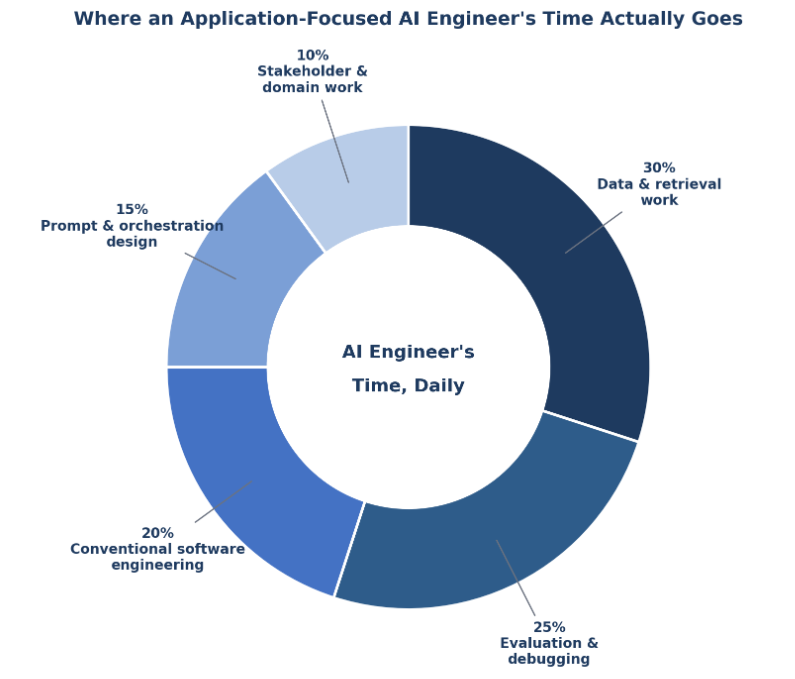
An honest breakdown for an application-focused AI engineer, based on how the work distributes in practice:
- 30% data and retrieval work. Investigating why the right document didn’t surface, fixing chunking, cleaning source material.
- 25% evaluation and debugging. Running eval suites, reading traces, categorizing failures, arguing about what “correct” means for an ambiguous question.
- 20% conventional software engineering. APIs, auth, databases, frontend integration, deployment. This never goes away.
- 15% prompt and orchestration design. Iterating instructions, tool definitions, and control flow.
- 10% stakeholder and domain work. Sitting with the people who know what a good answer looks like, because engineers usually don’t.
Note how little of that is model training. For the majority of AI developers in 2026, training a model is something they do rarely or never.
What Skills Does an AI Developer Need?
Core technical skills:
- Python: still the default for AI work, with TypeScript increasingly common on the application side. Our guide to Python for AI development covers the ecosystem in depth.
- Strong general software engineering: APIs, databases, testing, deployment. This is the most undervalued skill on the list.
- Data manipulation: SQL, pandas or equivalent, and the judgment to spot a broken dataset.
- Understanding of model behavior: Tokenization, context windows, temperature, structured output, and why models fail the way they do.
- Retrieval and search fundamentals: Embeddings, vector search, reranking, hybrid search, chunking strategies.
- Evaluation design: Building golden sets, choosing metrics, detecting regressions.
- Framework familiarity: Enough to pick well and not over-adopt. See our comparison of LLM frameworks.
- Cloud and MLOps basics: Containers, CI/CD, observability, cost monitoring.
Also Read: TensorFlow vs PyTorch in 2026: Which Should You Use?
Non-technical skills that separate good from adequate:
- Problem scoping: Recognizing which problems AI should not solve is worth more than any modeling skill.
- Domain curiosity: You cannot evaluate a legal assistant without learning something about legal work.
- Comfort with ambiguity: Accepting that 92% correct may be the right answer to ship.
- Communication about uncertainty: Explaining probabilistic behavior to stakeholders who expect deterministic software.
Do You Need a PhD to Build AI?
No, and for the overwhelming majority of AI development work a PhD is not the relevant qualification.
The distinction that matters:
| Work type | Background typically needed |
| Building products on existing models | Strong software engineering plus applied AI knowledge |
| Fine-tuning and applied ML | ML fundamentals, often a bachelor’s or master’s, or self-taught with a portfolio |
| Novel architecture research | Graduate-level research training, often a PhD |
| Foundation model training | Specialized research and infrastructure background |
How Long Does It Take to Develop an AI System?
| Deliverable | Typical timeline | What sets the pace |
| Proof of concept | 2 to 5 weeks | Data access and stakeholder availability |
| Production MVP | 6 to 14 weeks | Data quality, integration approvals |
| Full production system | 4 to 8 months | Integration depth, evaluation rigor |
| Enterprise platform | 8 to 18 months | Compliance, security review, change management |
| Custom-trained model | 6 to 18 months | Dataset construction, compute, evaluation |
Enterprise reporting suggests the median time from pilot to production has fallen sharply over the past two years, from around eleven months to a matter of months, largely because teams stopped training models they didn’t need and because tooling for retrieval, evaluation, and deployment matured.
What actually causes delay, in rough order of frequency:
- Data access approvals and permissions mapping
- Discovering the source data is worse than anyone claimed
- No agreed definition of a correct answer
- Security and compliance review scheduled too late
- Scope expanding from one use case to four
- Waiting on a third-party system’s sandbox environment
Only the last one is outside your control. The rest are project management problems wearing technical costumes.
Also Read- AI Development Trends to Watch in 2026
Common Uses of AI Across Industries
| Industry | High-value applications |
| Financial services | Fraud detection, credit risk, document processing, compliance monitoring, client reporting |
| Healthcare | Clinical documentation, imaging support, triage, claims processing, patient communication |
| Retail and eCommerce | Recommendations, demand forecasting, visual search, support automation, pricing |
| Manufacturing | Predictive maintenance, visual quality inspection, supply chain optimization |
| Logistics | Route optimization, ETA prediction, document automation, exception handling |
| Legal and professional services | Contract review, discovery, research, drafting, knowledge retrieval |
| SaaS and technology | In-product assistants, code generation, support deflection, onboarding automation |
| Insurance | Claims triage, underwriting support, fraud detection, policy question answering |
| Real estate | Valuation models, lead scoring, document processing, listing generation |
| Education | Adaptive learning, content generation, grading support, tutoring |
Already know your category? Go straight to the specialists: AI Agents · AI Chatbots · LLM Solutions · Computer Vision · ML Development · Generative AI
Cross-industry benchmarks including the Stanford AI Index report measurable gains concentrated in specific functions: roughly 14% to 15% in customer support, 26% in software development, and 50% in marketing output, with smaller returns on tasks requiring deeper reasoning.
See how these play out in practice in our client case studies.
What Are AI Development Services and How Do Companies Use Them?
AI development services are engagements where an external team provides the strategy, engineering, and operational capability to build and run AI systems. Companies use them for three reasons: they lack in-house AI experience, they need to move faster than hiring allows, or they want an outside opinion before committing a budget.
Common engagement models:
| Model | What it covers | Best when |
| AI readiness assessment | Data audit, use case ranking, feasibility, roadmap | You have budget but no confident direction |
| Proof of concept | One narrow use case proven or disproven quickly | Leadership needs evidence before funding |
| MVP build | A production-ready first version with evaluation and monitoring | You’ve picked the use case and want it shipped |
| Full product development | End-to-end build, launch, and iteration | AI is the product, not a feature |
| Staff augmentation | AI engineers embedded in your team | You have a team but need specialist skills |
| MLOps and managed operations | Running, monitoring, and improving live systems | You built it and now need it to stay good |
What to look for in a partner:
- They ask about your data before they talk about models
- They propose an evaluation method, unprompted
- They give you a run-cost estimate alongside the build cost
- They’re willing to tell you a use case is a bad idea
- They show you failure cases from previous projects, not just wins
What to be wary of: fixed-price quotes with vague scope, fine-tuning proposed before retrieval has been tried, and any pitch where the word “data” appears less often than the word “model.”
Best Practices and Common Mistakes
Best practices
- Write the success metric before the code. One sentence, one number.
- Audit your data first. Two days of sampling saves months of surprises.
- Build the evaluation set in week one. Fifty real cases beats a thousand synthetic ones.
- Start with retrieval, not training. Most quality problems are context problems.
- Instrument cost and latency per request from day one.
- Design the human escape hatch. Every AI system needs a path to a person.
- Version everything together. Code, prompts, data, model, index.
- Ship narrow. One excellent feature beats four mediocre ones, at a fraction of the cost.
Common mistakes
- Solving a problem AI doesn’t fit. If a rule or a query answers it, use a rule or a query.
- Treating the demo as the product. Demos are chosen examples. Production is every example.
- Underfunding data work. It’s routinely 25% to 40% of the budget and the first thing cut.
- No definition of a correct answer. Without it, you can’t improve, only argue.
- Skipping observability. Debugging without traces is guessing with extra steps.
- Locking to one model provider with no abstraction. Pricing and capability leadership shift.
- Measuring adoption instead of outcomes. Usage is a vanity metric. Deflection rate, cycle time, and error reduction are not.
Also Read: Top AI Development Companies in 2026 (Ranked)
What Practitioners Actually Argue About?
Search results and vendor blogs tell you what AI development is supposed to look like. Developer communities tell you where it actually breaks. Five debates worth knowing before you scope a project.
1. “Most AI projects are solving problems that didn’t need AI”
The position: a large share of enterprise AI initiatives replace a database query, a rule, or a well-designed form with a language model, then spend months making the model as reliable as the thing it replaced.
Why it matters for your project: this is the cheapest failure to avoid and the most common one. Before scoping, write down what a SQL query or a decision tree would achieve on the same problem. If the gap is small, the AI is decoration.
2. “The demo-to-production gap is the whole job”
The position: building something that works on ten examples takes an afternoon. Building something that works on the ten thousandth example takes months, and almost nobody budgets for the difference.
Supporting evidence from analyst data: McKinsey has found that while a large majority of enterprises experiment with AI agents, fewer than a quarter have scaled them to production, and Gartner expects more than 40% of agentic AI projects to be cancelled by 2027 over cost, unclear value, and weak risk controls.
3. “Nobody talks about inference cost until the bill arrives”
The position: teams model cost per request, ship, then discover that context windows grew, retry logic multiplied calls, and a single power user is generating a meaningful share of the monthly spend.
The advice that recurs: instrument cost per request on day one, route easy queries to smaller models, and cache aggressively. See our breakdown of what AI apps actually cost to build and run for the token math.
4. “Evaluation is the unglamorous thing that separates shipped from stuck”
The position: teams with a golden test set ship faster, not slower, because they stop debating whether a change helped. Teams without one relitigate the same argument every sprint.
Why this belongs in your process: it is the cheapest 10% of an AI budget and it prevents the most expensive category of failure.
5. “Fine-tuning is the most oversold line item in AI proposals”
The position: a substantial share of quality problems attributed to the model are retrieval problems. Better chunking and reranking cost a fraction of a fine-tuning engagement and fix more.
The nuance: fine-tuning genuinely wins for narrow, high-volume, latency-sensitive tasks with thousands of good examples. It just isn’t the first move, and it is very often sold as one.
🟩 Callout: If you’re evaluating an AI development partner, read these five debates as a checklist. A good partner raises at least three of them before you do.
Want a second opinion before you commit a budget?
We’ll tell you if AI is the wrong tool for your use case, and show you what production AI actually looks like.
Already holding a quote? Bring it.
We’ll tell you what’s missing from it, whether or not you hire us. If it shouldn’t be built, that’s the cheapest thing we can save you.
Summary
- AI development builds software whose behavior comes from data, not from rules written by hand
- The lifecycle has seven stages, and data preparation plus evaluation consume the largest share of effort
- Most commercial AI work in 2026 is application engineering on top of existing models, not model training
- AI development differs from software development in correctness, testing, marginal cost, and post-launch work
- Custom AI development usually means your data plus a hosted model, not a model built from scratch
- AI developers spend most of their time on data, retrieval, and evaluation, not on training
- No PhD required for the vast majority of applied AI roles
- The projects that reach production are the ones with a numeric success metric and an evaluation suite from week one
Where to Start?
If you’re deciding whether AI fits a specific problem in your business, the fastest useful step is not a technology decision. It’s an honest look at the decision you want to automate and the state of the data behind it.
Our team runs structured AI readiness assessments and builds production systems across retrieval, agents, and predictive ML. We’ll tell you when AI is the wrong tool, which happens more often than most vendors will admit.
Explore our AI development services or browse client case studies to see how these systems perform in production.
 0 comments










Leave a Comment
Your email address will not be published. Required fields are marked *