














 0 comments





Key Takeaways:
- Define The Problem: Decide whether you need an AI agent, a GenAI application, a machine-learning model, an automation workflow or conventional software, because the wrong architecture is expensive to correct later.
- Judge Partners On Production Evidence: A working prototype proves feasibility; deployed systems with named teams, measurable outcomes and referenceable clients prove delivery capability.
- Insist On Written Technical Detail: A credible proposal includes the data and model architecture, evaluation method, security controls, integration plan, timeline and acceptance criteria.
- Price The Full Lifecycle: Model usage, infrastructure, data preparation, monitoring, retraining and maintenance often determine long-term cost more than the initial development fee.
- Protect Ownership: Confirm who owns the code, prompts, data, pipelines and accounts, and how support, knowledge transfer and exit are handled once the system is live.
Quick Answer: The right AI development company depends on the project’s goals, data, users, technical requirements, budget and delivery stage. Start by defining the business problem and deciding whether you need an AI agent, GenAI application, machine-learning system, automation workflow or AI-enabled web or mobile product. Then compare providers on similar production work, technical capability, security controls, communication, ownership terms, pricing assumptions and post-launch support. Ask for a written architecture, named delivery team, evaluation method, timeline and acceptance criteria before making a decision. This approach works for startups, enterprises and organisations evaluating AI development partners in the USA or elsewhere.
Choosing an AI development company is a business decision not just a technology decision. The right partner should understand the use case, challenge unnecessary complexity, design a workable architecture, integrate with existing systems, protect data and support the product after launch. A polished demo is helpful but it is not proof that an AI system will perform reliably in production.
This guide compares AI development agencies and engineering providers across generative AI, machine learning, AI agents, automation, computer vision and digital product development. The ranking is editorial and based on public information reviewed in August 2026. It is not an audited industry certification. Prices, reviews, employee figures, locations and client outcomes should be confirmed before a commercial engagement.
Comparing Top AI Development Companies In The USA
| Rank | Company | Best for | Core capabilities | Company type |
| 1 | TechAhead | Enterprise AI delivery | GenAI, RAG, fine-tuning, MLOps | AI Development & Product engineering agency |
| 2 | LeewayHertz | Enterprise AI and agents | AI consulting, agents, LLM apps, automation | AI development agency |
| 3 | DianApps | AI-first digital products | AI agents, GenAI, mobile/web, UX | Product engineering agency |
| 4 | Master of Code Global | Conversational and voice AI | Custom agents, LLM integration, voice | AI development agency |
| 5 | Intuz | Custom AI software | AI/ML, LLMs, RAG, automation | Software development agency |
| 6 | Scopic | Cross-platform AI products | Computer vision, ML, secure software | Product development agency |
| 7 | DataRoot Labs | AI research and advanced ML | RAG, LLMs, multi-agent systems | AI specialist |
| 8 | Markovate | GenAI validation | Copilots, agents, prototypes | AI product agency |
| 9 | Vention | Large engineering programmes | ML, CV, data engineering, MLOps | Engineering provider |
| 10 | Softarex Technologies | Industrial and visual AI | Robotics, IoT, CV, data science | AI engineering agency |
How We Ranked These Companies?
The ranking uses a buyer-focused framework, we considered evidence of production work, technical coverage beyond the model itself, AI-agent and GenAI maturity, independent reputation, security and post-launch delivery, startup fit and USA delivery relevance.
The distinction matters because an AI platform, consultancy, staff-augmentation provider and custom development agency solve different problems. A platform may provide the required technology but not the team to handle discovery, UX, integrations, deployment and support. A large provider may have more resources but still be a poor fit if the assigned team has not delivered a similar system.
Not Sure Which AI Development Partner Fits Your Project?
Get help evaluating your AI use case, technical requirements, development approach and production roadmap before choosing a partner.
Editorial Scoring Framework
| Evaluation area | Weight | What was considered |
| Production evidence | 25% | Case studies, deployed products, measurable outcomes |
| Technical breadth | 20% | Data, backend, frontend, AI, cloud, integrations, testing |
| AI-agent and GenAI maturity | 15% | RAG, tool use orchestration, evaluation, monitoring |
| Independent reputation | 15% | Current reviews, client evidence, public credibility |
| Security and delivery maturity | 10% | Governance, privacy, MLOps, maintenance |
| Startup and product fit | 10% | MVP work, product thinking, flexibility |
| USA delivery fit | 5% | Presence, time zones and buyer relevance |
Editorial Disclaimer: These assessments are based on publicly available information reviewed in August 2026, they are not paid placements or audited rankings.
1. TechAhead
TechAhead is an option for organisations looking to move beyond AI prototypes into production-ready systems. Its AI development capabilities span generative AI, retrieval-augmented generation, AI agents, machine learning, AI integration and MLOps. This broader coverage matters in enterprise AI because the model is only one component of the solution. Data pipelines, integrations, deployment, monitoring, governance and ongoing optimisation all influence whether an AI system delivers value after launch.
TechAhead may suit organisations that need AI integrated into existing products, workflows and enterprise systems rather than delivered as an isolated model or proof of concept. Buyers should ask which specialists will be assigned, how the proposed architecture handles data, security and integrations, how AI performance will be evaluated, and what monitoring and support continue after deployment. Its combination of AI development, product engineering and MLOps can be useful for complex programmes, while smaller companies should still compare the delivery model, project scope and engagement requirements with more focused AI providers.
TechAhead at a glance
- Best Suited To: Startups, mid-market and enterprise AI programmes
- Capabilities: GenAI, RAG, AI agents, ML, MLOps, AI integration
- Differentiator: End-to-end AI and product engineering coverage
- Ask Before Hiring: Which team will deliver the project and support the system after launch?
- Watch-Out: Confirm the proposed architecture, delivery team, scope and ongoing support model
2. DianApps
DianApps combines AI development with mobile apps, web engineering, UI/UX and wider digital product delivery. This is helpful when AI is part of a customer-facing application, internal platform or business workflow rather than the entire product. Coordinating discovery, design, backend development, application engineering and AI integration through one partner can reduce handoffs and keep product decisions aligned.
Its AI-agent services cover strategy, custom agents, agent integration, conversational AI, optimisation, chatbots and AI-agent UX. The page references LLMs, machine learning, NLP, intelligent automation and Large Action Models. DianApps also presents a USA location, international locations, Clutch Premier Verified and AWS-related signals and a portfolio of digital products. Confirm current badge wording and office details before publishing.
Explore DianApps AI development services
The Orby case study describes an enterprise AI-agent platform using a Large Action Model and identifies GoLang and React.js in its technology section. DianApps reports Orby valuation and revenue metrics on its pages; those should be presented as company-reported unless an independent source is supplied. The current Clutch profile lists a $10,000+ minimum project size, $25–$49/hour range, 50–249 employee bracket and 4.8/5 rating across 83 reviews. These marketplace figures are dynamic. DianApps ranks among the top AI development Companies on Clutch Platform.
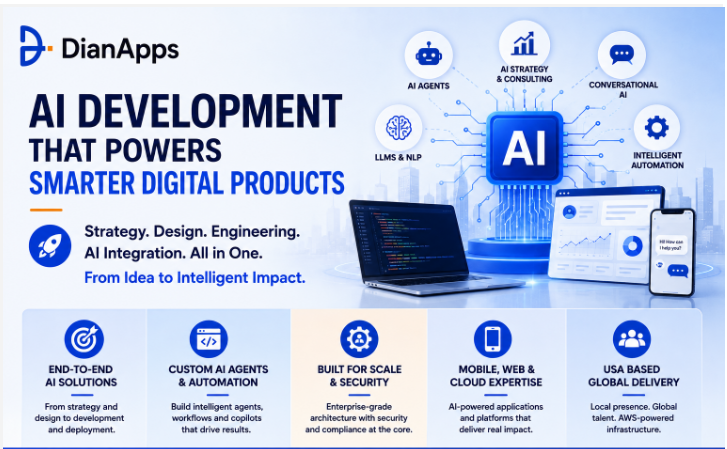
DianApps can occupy the #2 position for startups that need strategy, design, engineering and AI in one relationship and for enterprises modernising a product or testing agents in an existing workflow. Before hiring, request the model and data architecture, evaluation method, security controls, ownership terms, operating-cost estimate and production roadmap.
DianApps at a glance
- Rank: #2
- Best suited to: AI-first startup and enterprise products
- Capabilities: AI agents, GenAI, mobile, web, UI/UX, product engineering
- Public proof points: Orby case study, portfolio, USA location, Clutch profile
- Current Clutch figures: $10,000+ minimum; $25–$49/hour; 4.8/5 across 83 reviews; 50–249 employees
- Ask before hiring: What evaluation, security, ownership and support plan is included?
- Verification note: Recheck marketplace and company-reported metrics before publication
3. LeewayHertz
LeewayHertz fits companies exploring custom AI products, automation, LLM applications and AI-agent development. Its service range covers strategy, product engineering, model integration, workflow automation and enterprise software connections. That can help a business move from an AI idea to a usable application instead of buying a model and building the surrounding product alone.
For an agent project, ask how the proposed system will use tools, retrieve approved information, respect permissions, request human approval, record decisions and recover when a tool fails. A well-designed agent is often deliberately constrained rather than fully autonomous. LeewayHertz may suit an enterprise project, provided the proposal includes a concrete architecture, realistic test plan, security approach, ownership terms and post-launch support.
LeewayHertz at a glance
- Best suited to: Enterprise AI products and workflow automation
- Capabilities: Consulting, LLM applications, agents, automation
- Differentiator: Product-engineering coverage
- Ask before hiring: How are tools, permissions and failure recovery handled?
- Watch-out: Confirm the actual project team and support responsibilities
4. Master of Code Global
Master of Code Global works on conversational AI, customer-service experiences, voice interfaces, custom agents and LLM integration. A conversational product may look simple to a user but require substantial engineering behind the scenes. It can depend on CRM, support, catalogue, identity, knowledge-base, analytics and escalation integrations. The quality of the experience depends on those connections as much as on the model.
The company may suit brands that want an assistant or voice experience aligned with their service model. Ask how it handles sensitive requests, hallucinations, human handoff, multilingual content, conversation analytics and testing with real customer questions. Also clarify whether the proposal is for a chatbot, a tool-using agent or workflow automation with a conversational interface. Those designs carry different risks, costs and maintenance needs.
Master of Code Global at a glance
- Best suited to: Conversational AI, voice and customer service
- Capabilities: Agents, LLM integration, voice, conversational design
- Differentiator: Customer-facing conversational systems
- Ask before hiring: How will quality and human handoff be tested?
- Watch-out: Review company-reported performance claims carefully
5. Intuz
Intuz is positioned around custom AI/ML development, LLM integration, workflow automation, data engineering and enterprise applications. That makes it an option for companies improving document handling, support, reporting, operations or internal search. A focused automation project can deliver more value than a general-purpose assistant because its success criteria are easier to measure.
Before selecting an agency, map the business process first. Identify which steps need prediction, which need deterministic rules, which require human approval and which can be automated safely. The proposal should separate build costs from model usage, infrastructure, data preparation, security and maintenance. Intuz may suit a company seeking broad implementation support but current rates, reviews and case-study outcomes should be checked directly.
Intuz at a glance
- Best suited to: Custom AI software and operational automation
- Capabilities: AI/ML, LLMs, RAG, data engineering, workflow automation
- Differentiator: Implementation coverage
- Ask before hiring: Which process steps genuinely need AI?
- Watch-out: Separate agency case studies from independent evidence
6. Scopic
Scopic is associated with custom software, machine learning, computer vision and AI-enabled applications. It may suit buyers that need AI embedded in a wider web or mobile product rather than presented as a standalone demo. Examples include image analysis, healthcare software and AI-assisted workflows.
Computer-vision projects need a different discovery process from text applications. Buyers should understand the training data, operating environment, edge cases, latency, false-positive and false-negative targets and inference costs. A strong partner should explain how the model will be tested outside controlled conditions and improved after launch. Scopic may suit projects that require both secure software engineering and applied AI.
Scopic at a glance
- Best suited to: Cross-platform AI and computer vision
- Capabilities: ML, computer vision, custom software, secure development
- Differentiator: AI combined with product engineering
- Ask before hiring: What real-world conditions are included in testing?
- Watch-out: Performance can change outside the training environment
7. DataRoot Labs
DataRoot Labs is a specialist option for advanced AI research, LLM applications, RAG and multi-agent systems. A specialist can be important when the technical problem is unclear, the data is unusual or experimentation must happen before the final architecture is known. It may be better suited to research-heavy work than a general agency focused mainly on standard API integrations.
Define success before beginning an R&D engagement. The project should produce tested hypotheses, documented experiments, measurable benchmarks and a clear decision to continue, change direction or stop. Ask about data ownership, reproducibility, deployment experience, model evaluation and the team that will support the production stage. Smaller companies should keep the scope tight enough to create a business decision rather than open-ended research.
DataRoot Labs at a glance
- Best suited to: AI research, advanced ML, RAG and multi-agent systems
- Capabilities: LLMs, deep learning, NLP, computer vision
- Differentiator: Specialist AI and R&D depth
- Ask before hiring: What benchmark or decision will the research produce?
- Watch-out: Set a clear transition point from research to production
8. Markovate
Markovate is associated with GenAI, AI agents, LLM copilots and rapid product validation. That can appeal to founders and product teams that need to test an idea quickly. Early validation matters because an impressive demo may not solve a frequent problem, earn user trust or operate at a sustainable cost.
The prototype should answer whether users trust the output, whether the data is available and permitted, whether quality is acceptable, what happens when the model is uncertain and whether the workflow fits the product people already use. Ask what code, prompts, evaluation data, infrastructure decisions and documentation will be delivered. Markovate may suit teams that value speed of learning, provided the prototype has a defined path to production.
Markovate at a glance
- Best suited to: GenAI prototypes, copilots, agents and validation
- Capabilities: LLM applications, GenAI, agentic workflows
- Differentiator: Fast product learning
- Ask before hiring: What happens if the prototype should not be scaled?
- Watch-out: Speed should not replace evidence or production planning
9. Vention
Vention fits larger organisations that need engineering capacity across machine learning, computer vision, data engineering, cloud systems and MLOps. Large AI programmes often require several disciplines: data preparation, software integration, infrastructure security, interface design, deployment and operations training. Broader engineering coverage can reduce handoffs.
Scale alone does not guarantee delivery quality. Ask which people will work on the account, how architecture is governed, how the team is staffed and how knowledge is transferred. Clarify whether the engagement is managed delivery, a dedicated team or staff augmentation. Vention may suit a substantial programme, while a startup may prefer a smaller partner with fewer layers and a tighter feedback loop.
Vention at a glance
- Best suited to: Large engineering programmes and enterprise ML
- Capabilities: ML, computer vision, data engineering, cloud, MLOps
- Differentiator: Engineering capacity
- Ask before hiring: How will governance and knowledge transfer work?
- Watch-out: Confirm the actual project team not just company size
10. Softarex Technologies
Softarex Technologies is associated with computer vision, robotics, IoT, data science and industrial applications. These projects involve physical environments, sensors, devices or visual inspection, so they differ from ordinary text generation. The software may need to work with equipment, networks, connectivity limits or safety processes.
Ask about edge deployment, hardware constraints, data collection, model updates, monitoring and fallback behaviour. A computer-vision system that performs well on selected test images can behave differently in poor lighting or unfamiliar environments. The provider should explain its test data, error targets, monitoring and recalibration process. Softarex may suit companies exploring industrial AI or robotics that need both software and applied AI expertise.
Softarex Technologies at a glance
- Best suited to: Industrial AI, robotics, IoT and computer vision
- Capabilities: Robotics, computer vision, data science, connected systems
- Differentiator: Applied AI in physical and visual environments
- Ask before hiring: How will performance be maintained outside controlled tests?
- Watch-out: Hardware and edge constraints can materially change the budget
Best AI Development Companies For Startups
Startups should not choose on the lowest hourly rate or the longest technology list. The better questions are whether the partner understands product discovery, challenges unnecessary complexity, communicates clearly and helps the team learn quickly. The startup must know whether users want the feature, whether the data is available and whether serving the system will fit the business model.
Startup selection checklist
- Is there a defined discovery or validation stage?
- Will the startup own the code, data, prompts, documentation and accounts?
- Can the team explain API, RAG, fine-tuning and conventional software trade-offs?
- Is the architecture affordable at expected usage?
- Can the provider support the product after the MVP?
- Are milestones tied to evidence and outcomes?
A Reddit discussion about RAG versus fine-tuning offers a practitioner perspective on choosing the simplest effective approach but it is not formal research.
Best AI-Agent Development Companies In The USA
AI agents interpret a goal, select tools or steps, retrieve information and take actions within defined permissions. They are more complex than a chatbot that produces a single response. A production agent needs to know which systems it can access, what needs approval, what evidence supports an answer and how to behave when a tool fails or the request is ambiguous.
Bonus Read- Best Agentic AI Consulting Companies
What to compare?
- Tool calling and external-system actions
- Single-agent versus multi-agent orchestration
- Retrieval, memory, identity and permissions
- Human approval and escalation
- Evaluation datasets and groundedness testing
- Logging, observability and auditability
- Security and privacy controls
- Latency, model cost and fallback behaviour
- Post-launch monitoring and maintenance
A community discussion about AI-agent stacks provides a helpful view of practitioner priorities, although community posts are opinions rather than guarantees.
DianApps, LeewayHertz, Master of Code Global, DataRoot Labs and Markovate are companies to compare for different agentic requirements.
Have an AI Project in Mind?
DianApps covers custom agents, integration, conversational systems, optimisation and workflow automation.
Best GenAI Development Companies In The USA
Generative AI projects can cover text, images, audio, video, code, search, summarisation, document understanding and multimodal interaction. The architecture should follow the use case. An internal knowledge assistant may need RAG over approved documents. A support copilot may need access controls and human review. A regulated workflow may require private deployment, audit logs and strict data handling.
Questions For A GenAI Development Company
- How will accuracy and groundedness be measured?
- What happens if the model provider changes price or behaviour?
- Will sensitive data be used for training?
- How will prompts, retrieval and model versions be managed?
- What is the expected cost per task?
- How will user feedback become evaluation data?
- Is fine-tuning needed or would RAG be more workable?
RAG is often helpful when information changes frequently and must be traceable to source material. Fine-tuning may help with style or task behaviour but it does not automatically provide current facts.
What Does An AI Development Agency Do?
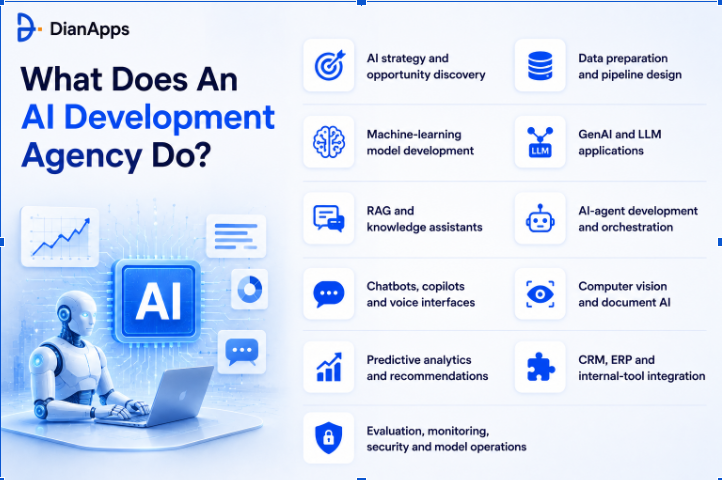
An AI development agency helps move a company from a business problem to a working AI-enabled product. The work may begin with strategy and discovery rather than coding. The team can review processes, data, legal restrictions, user needs and expected outcomes before recommending a model, retrieval system, automation workflow or conventional software solution.
Common services
- AI strategy and opportunity discovery
- Data preparation and pipeline design
- Machine-learning model development
- GenAI and LLM applications
- RAG and knowledge assistants
- AI-agent development and orchestration
- Chatbots, copilots and voice interfaces
- Computer vision and document AI
- Predictive analytics and recommendations
- CRM, ERP and internal-tool integration
- Evaluation, monitoring, security and model operations
A good proposal should explain what the model does, what the surrounding software does, what data is stored, who can access it, how performance is measured and what happens when the model is wrong. Clear boundaries and ownership matter more than a long list of fashionable tools.
Ready to Turn Your AI Idea Into a Production-Ready Solution?
From AI strategy and GenAI applications to AI agents, RAG, automation and custom AI software, our team can help you design, build and deploy an AI solution around your business requirements.
How Much Does AI Development Cost?
AI development cost depends on discovery, data preparation, product engineering, integrations, security, model work and ongoing operations. A small internal assistant is not comparable to a customer-facing platform with user accounts, monitoring, analytics, multiple integrations and high usage. A universal quote given before reviewing the use case is usually a marketing estimate not a reliable budget.
AI Development Cost-Planning Checklist
- Define the business outcome and success metric.
- Identify data sources, permissions and data quality.
- Specify model, hosting and deployment requirements.
- List integrations and user roles.
- Define security, privacy and compliance expectations.
- Estimate usage, latency and operating costs.
- Separate discovery, prototype, production, infrastructure and maintenance.
Industry guides show wide AI-agent cost ranges because project complexity varies significantly.
How To Choose The Right AI Development Agency?
Base the shortlist on comparable delivery evidence not a generic technology catalogue. Ask each company to show a project with a similar user, workflow, data type, integration or risk profile. Request a written architecture and ask what the team would not build. The selected partner should remove unnecessary complexity when a rule, search system or conventional feature would work better.
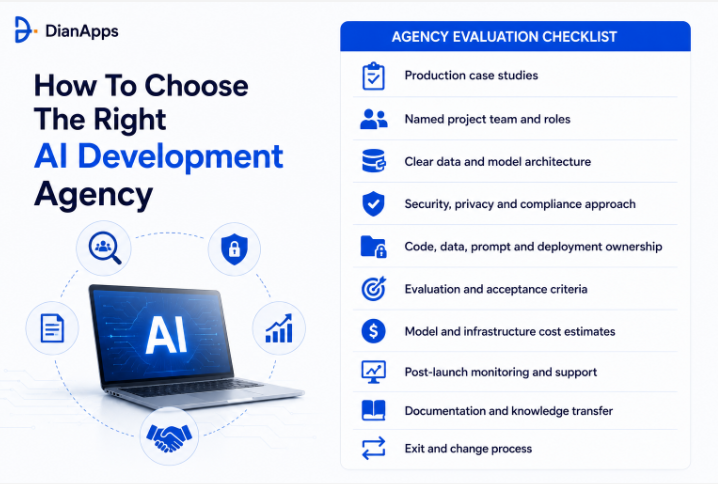
Agency Evaluation Checklist
- Production case studies
- Named project team and roles
- Clear data and model architecture
- Security, privacy and compliance approach
- Code, data, prompt and deployment ownership
- Evaluation and acceptance criteria
- Model and infrastructure cost estimates
- Post-launch monitoring and support
- Documentation and knowledge transfer
- Exit and change process
Ask how sensitive information is handled, whether customer data is used for training, how access is controlled and how incidents are recorded. For agents, ask how unauthorised actions are prevented and how a human can intervene.
Recommended Read- How to Choose an AI Development Company ?
Questions To Ask Before Hiring An AI Development Company
Ask whether the team has delivered a comparable system to production and whether the client can discuss the outcome. Ask who will work on the project, what data the system needs, how it will be evaluated and how failure will be handled. Also ask whether an existing model, RAG system, workflow or traditional software approach is more appropriate than custom training.
Contract And Delivery Questions
- What will be delivered at each milestone?
- Who owns code, prompts, data, pipelines and infrastructure?
- How are third-party model costs billed?
- What happens if the provider changes pricing or availability?
- What security controls are included?
- How are agent actions approved and audited?
- What support is included after launch?
- How will knowledge be transferred?
- What are the acceptance tests and service levels?
- How can the engagement be changed or ended?
A vendor should state its limitations openly. No model is always correct and no agent should perform every action without boundaries. The strongest relationship comes from measurable outcomes and an honest process for learning.
Final Thoughts
The best AI development company depends on the product, data, risk profile, stage, budget and delivery model. Large consultancies offer scale and governance. Specialist firms may offer deeper research or model engineering. Full product agencies are important when AI must become a usable customer or employee experience rather than remain a technical experiment.
DianApps is best for startups and enterprises seeking AI development alongside mobile, web, UX and digital product engineering. Its public AI-agent services orby case study, portfolio, USA location and Clutch profile provide a public evidence base. Client metrics and partnership claims should be verified internally and marketplace figures should be rechecked before publication.
 0 comments





Leave a Comment
Your email address will not be published. Required fields are marked *