












 0 comments





Key Takeaways:
- AI writing tools are waiting for a prompt each and every time, while autonomous AI agents for content creation are working toward a goal from beginning until completion.
- The real difference in prompt-based vs goal-oriented AI is whether the writer/editor is driving each step or the system is planning the steps itself.
- Agentic content workflows are connecting research, drafting, SEO checks and publishing, so teams are no longer passing files from one person to another.
- An automated editorial pipeline is definitely saving time, but human review is still extremely crucial for facts, brand voice and compliance before anything goes live.
- Writing tools are suitable for small one-off tasks, whereas AI agents are making far more sense for brands/businesses publishing content at scale.
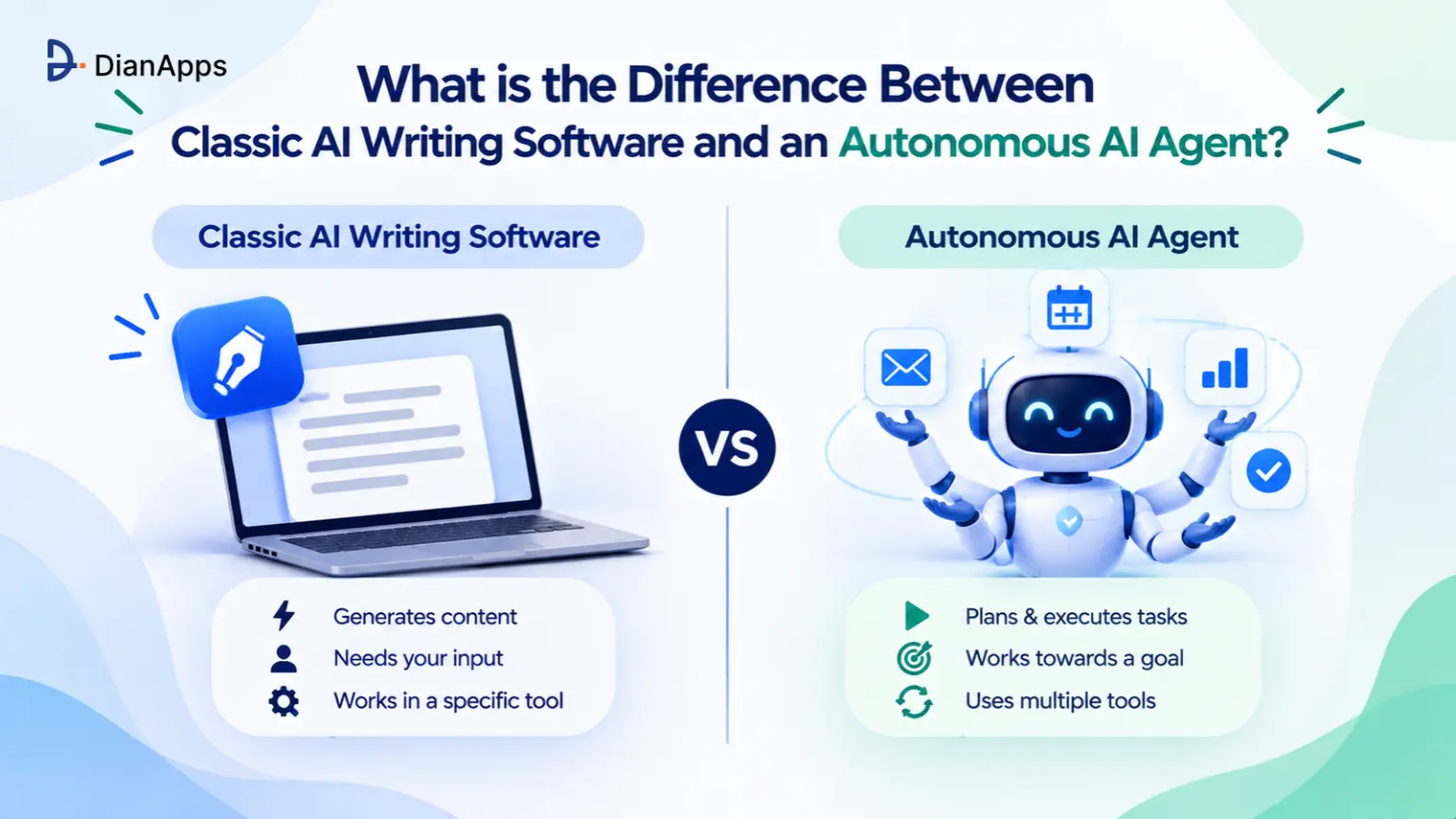
Quick Answer: The AI writing tools vs AI agents difference is mainly about how the work is getting done, as a writing tool gives you text only when you enter a prompt and stops right after that. An autonomous AI agent, on the other hand, takes a goal, plans the steps, uses tools like search engines or a CMS, checks its own work and keeps going until the task is completed.
Content is one of the main reasons why businesses are investing in AI today, but writing a prompt, copying the draft into a document, fixing the headings, adding the keywords and then passing it to someone else for publishing is not making the process any faster for content teams. This is where AI agent orchestration is stepping in, helping businesses move from tools that only write when asked to agents that handle the work from research until publishing, while giving content managers a clear view of what is happening at each stage.
But what is the actual difference between classic AI writing software and an autonomous AI agent, and which one is the right fit for your team? Well, the AI writing tools vs AI agents comparison is much simpler than it sounds once you see how each one is working, so let’s break it down.
What Are Classic AI Writing Tools?
Classic AI writing tools are the tools most marketers and content writers are already using, where you enter a prompt and the tool gives you a blog draft, an email, a product description or a caption within a few seconds. They work on a simple request-and-response pattern, where the user asks, the tool answers, and nothing else happens until the next prompt is entered.
This is helpful for quick drafts and rewrites, but the tool is not aware of the bigger goal, the content calendar or the brand guidelines, and it cannot take any action outside of the text box.
For teams publishing content on a regular basis, depending on writing tools alone is resulting in:
- Prompt Dependency: Writers/editors are spending more time fixing prompts than improving the actual quality of the content.
- Manual Hand-Offs: Research, outlines, SEO checks and publishing are still being done separately by different people in the team.
- Inconsistent Output: The quality of each draft keeps changing depending on how well each person is writing their prompts.
- No Self-Check: The draft is not reviewed against any standard unless someone specifically asks the tool to check it again.
This is why writing tools work well for freelancers and small one-off tasks, but they are not keeping up when a team is publishing dozens of articles every month. So what are autonomous AI agents doing differently from these writing tools inside a content team? Well, let’s take a look at how an agent handles the same work.
What Is an Autonomous AI Agent?
An autonomous AI agent is a system that is given a goal instead of step-by-step instructions, and it then plans the tasks, picks the right tools and carries out the work until the goal is reached or a human approval is needed.
In content teams, autonomous AI agents for content creation are taking a brief with a topic, target keywords and a tone guide, and then handling the research, outline, draft, fact checks, optimisation and even the CMS upload on their own. This is what agentic content workflows are built on, where the AI is moving from being an assistant on the side to becoming a working part of the team that handles the process from beginning until completion.
An agent is able to act instead of only replying because of a few working parts, and each one is playing its own role:
- Planning: The agent breaks a big goal into smaller tasks and decides which task needs to be done first.
- Memory and Context: It remembers the brand guidelines, past articles and the current brief so each and every step stays consistent.
- Tool Access: The agent connects with search engines, SEO platforms, analytics tools and the CMS to actually get the work done.
- Self-Review: It checks its own output against the brief and fixes the gaps before moving on to the next stage.
And that is not all, agents can also pass work over to other specialised agents, which is opening the door to much bigger content systems that we will cover further below. With both sides now clear, it is time to put them next to each other, and the reasons why teams are moving toward agents are not hard to see.
AI Writing Tools vs AI Agents: The Key Differences
Putting both side by side is the easiest way to understand where each one fits, especially when you look at control, scope, memory and who owns the final output.
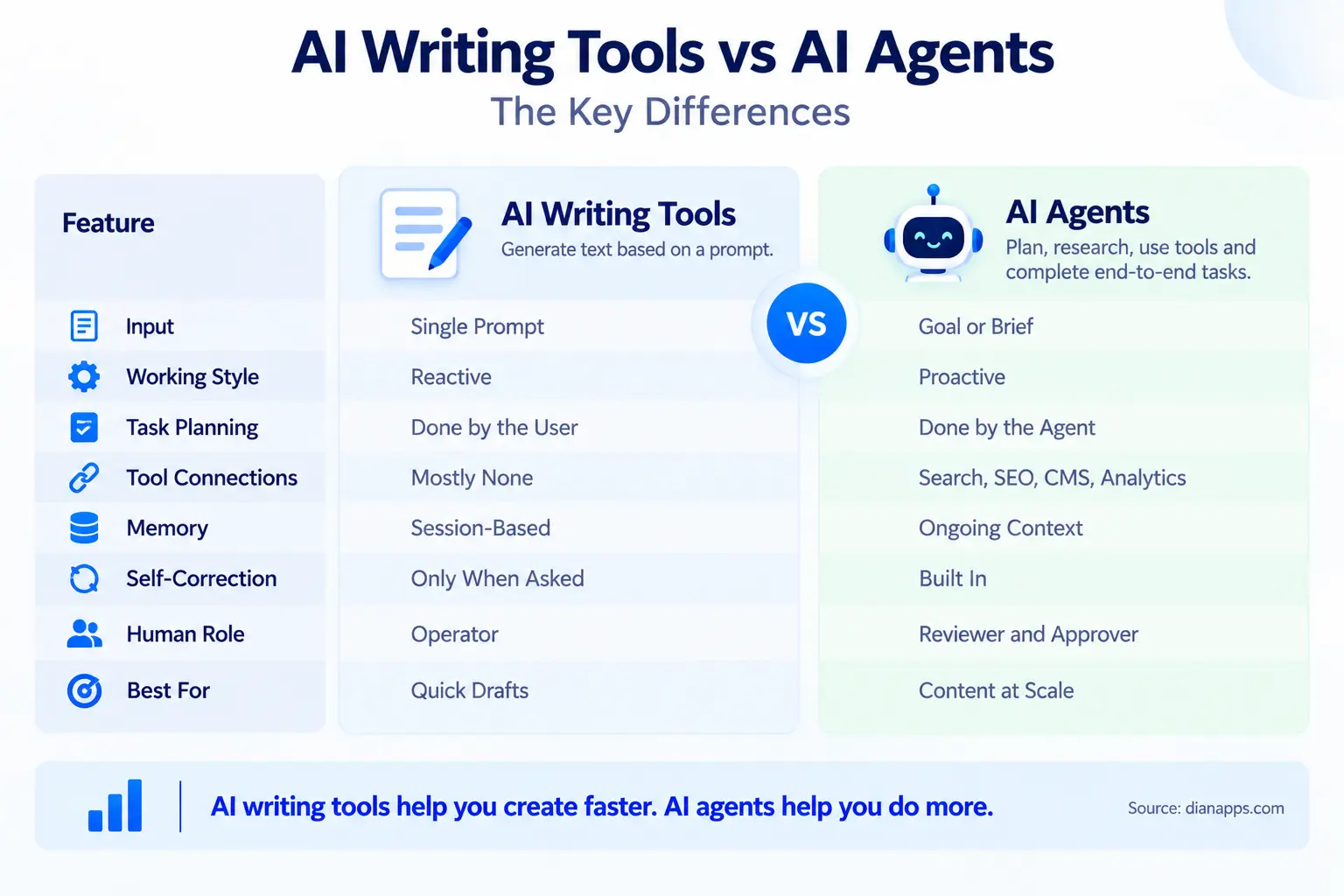
| Feature | AI Writing Tools | AI Agents |
| Input | Single Prompt | Goal or Brief |
| Working Style | Reactive | Proactive |
| Task Planning | Done by the User | Done by the Agent |
| Tool Connections | Mostly None | Search, SEO, CMS, Analytics |
| Memory | Session-Based | Ongoing Context |
| Self-Correction | Only When Asked | Built In |
| Human Role | Operator | Reviewer and Approver |
| Best For | Quick Drafts | Content at Scale |
As you can see, the AI writing tools vs AI agents comparison is not really about which one writes better, as both are often running on similar language models, it is about who is owning the process from start to finish.
A writing tool is making one person faster, whereas an agent is making the whole content system faster, and for agencies, SaaS brands and marketing teams handling large volumes, this difference is extremely crucial. This difference comes from two very different ways of working, so let’s take a look at how each one actually operates.
Ready to Move Beyond Basic AI Writing Tools?
Our AI engineers at DianApps are building custom AI agents that fit right into your content process, tools and brand guidelines without disturbing how your team works.
Prompt-Based vs Goal-Oriented AI: How the Way of Working Changes?
The difference between prompt-based vs goal-oriented AI is mainly about where the thinking happens, either in the head of the person writing the prompts or inside the system that is working toward the goal.
How Prompt-Based AI Works?
In a prompt-based setup, the writer is acting as the project manager, deciding what to ask, reading the answer, asking again and then putting all the pieces together into one article manually.
This gives full control to the writer, which is definitely useful for creative or sensitive content, but it also is taking up a lot of time when the same steps are repeating for every single piece.
How Goal-Oriented AI Works?
In a goal-oriented setup, the team only defines the outcome, the rules and what a good result looks like, and the agent figures out the steps needed to get there on its own.
So instead of asking for an introduction, then an outline and then each section one by one, the team hands over a brief, a keyword list and a tone guide, and the agent comes back with a researched and optimised draft ready for review.
Looking at prompt-based vs goal-oriented AI this way, it is easy to see why most teams are not throwing away their writing tools, they are simply giving them a smaller role inside a bigger agent-led process, and this is exactly where the AI writing tools vs AI agents gap is becoming most visible. But the real value shows up when these agents are connected into one complete workflow, so let’s break it down.
How Agentic Content Workflows Work From Brief to Publishing?
Agentic content workflows are replacing the long chain of manual hand-offs with one connected flow, where each stage triggers the next one automatically and humans step in only where their approval is really needed.
A typical workflow moves through a few clear stages, resulting in a much shorter path from an approved topic to a live page:
- Brief Intake: The agent receives the topic, keywords, audience details and brand voice guidelines from the strategist or the content calendar.
- Research: It studies the top-ranking pages, search intent and common questions to understand what the article really needs to cover.
- Outline: The agent builds a heading structure that matches the search intent and covers the gaps found during the research stage.
- Drafting: It writes each section according to the outline, tone guide and keyword targets while keeping the reader in focus.
- SEO and Quality Checks: The draft is checked for accuracy, keyword placement, readability, internal links and brand compliance before review.
- Human Review: The editor goes through the draft, corrects any claims, adjusts the tone and approves the piece for publishing.
- Publishing and Tracking: The agent uploads the approved piece to the CMS, adds the metadata and tracks its performance in real-time.
This not only saves hours of back-and-forth between writers/editors, this also is helping content teams publish faster without giving readers a poor impression with rushed or half-checked content. This is why agentic content workflows are becoming the preferred choice for teams that are struggling with bottlenecks and missed deadlines.
However, these stages only give consistent results when there is a proper structure holding them together, and that is where the editorial pipeline comes in.
Building an Automated Editorial Pipeline With AI Agents
An automated editorial pipeline is the structure that holds all of these agent activities together, deciding which agent is doing what, in what order and under which rules. Without a proper pipeline, even the smartest agents end up producing scattered results, which is why the setup around the agents is just as important as the agents themselves.
What Goes Into an Automated Editorial Pipeline?
A reliable pipeline is usually made up of a few key parts, and each one is playing its own role in keeping the output accurate and consistent:
- Content Calendar Connection: The pipeline pulls approved topics and deadlines directly from the planning tool, so agents are always working on priority content.
- Knowledge Base: Brand guidelines, product details, approved claims and past articles are kept in one place for agents to refer to during every task.
- Orchestration Layer: This layer coordinates multiple agents, passes work between them and makes sure no stage is getting skipped or repeated.
- Review Checkpoints: Human editors are placed at fixed stages to approve facts, tone and compliance before anything moves to publishing.
- Performance Feedback: Traffic, rankings and engagement data flow back into the system, so future briefs and drafts keep improving over time.
This is how an automated editorial pipeline is turning a bunch of separate AI tasks into one hassle-free production system that a brand can actually trust.
Where Model Context Protocol Fits In?
For agents to research, write and publish on their own, they need safe and consistent access to tools and data, and this is where the Model Context Protocol is stepping in.
MCP gives agents one common way of connecting with CMS platforms, databases, analytics tools and internal documents, which saves developers from building custom integrations for each and every tool in the stack. With this kind of standard connection in place, the automated editorial pipeline becomes much easier to grow, as new tools can be added without rebuilding the entire setup all over again.
Once the pipeline is in place, the next question is how many agents should be working inside it, and the answer depends on the size of your content operation.
Single-Agent vs Multi-Agent Setups for Content Teams
Once a team decides to go ahead with agents, the very next question is whether one agent should handle everything or whether several specialised agents should be working together on different stages.
A single agent is easier to build and manage, and it is suitable for smaller teams producing a limited number of articles, while multi-agent systems assign research, writing, editing and SEO to separate agents that coordinate with each other through an orchestrator.
| Factor | Single-Agent | Multi-Agent |
| Build Effort | Low | Moderate to High |
| Content Volume | Small to Medium | Medium to Large |
| Quality Checks | Self-Review Only | Cross-Agent Review |
| Maintenance | Simple | Needs Orchestration |
Both setups come with their own trade-offs in cost, control and complexity, and our detailed guide on single-agent vs multi-agent workflows covers how to choose the right one based on your team size and content volume.
For most growing content teams, a multi-agent setup is offering better quality control, because each agent focuses on one job and its output is checked by another agent before moving forward. But before handing over any part of the process, it is extremely crucial to understand where agents are still falling short, so let’s take a look.
Build an Automated Editorial Pipeline That Fits Your Team
DianApps is helping businesses set up agentic content systems that are reliable, scalable and fully reviewable at every stage.
Limitations of Autonomous AI Agents for Content Creation
Agents are bringing a big jump in speed and scale, but handing over complete control too early is often resulting in mistakes that are hard to undo, which is why knowing their limits matters.
Some of the common challenges teams are facing while using autonomous AI agents for content creation are:
- Factual Errors: Agents sometimes present wrong or outdated information with full confidence, which hurts credibility if nobody is checking it.
- Generic Voice: Without detailed brand guidelines, the content slowly turns flat and predictable, and readers notice it very quickly.
- Compliance Risks: Industries like finance, healthcare and legal need strict claim checks that an agent just cannot handle on its own.
- Cost and Maintenance: Multi-step agent runs use more computing power and need proper engineering, monitoring and regular upkeep to stay reliable.
- Over-Automation: Removing every human checkpoint puts the brand at risk, especially when content is going live without any approval.
Issues like these don’t just frustrate the editors, they also affect the brand perception, which is why the best setups use agents as the production engine and humans as the final quality check. Keeping these limits in mind, the right choice really depends on your actual needs, so let’s break it down.
When to Choose AI Writing Tools vs AI Agents?
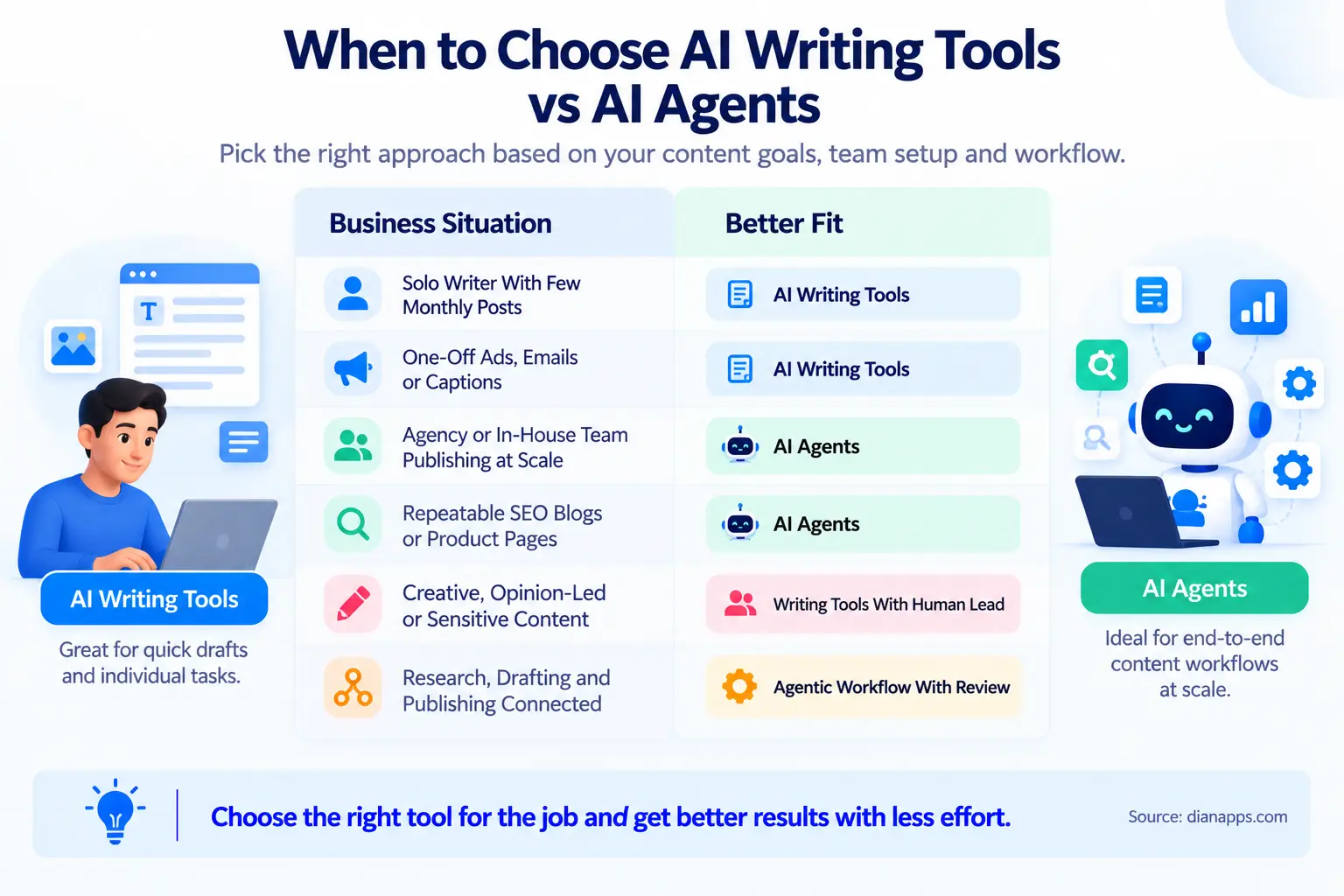
The right choice depends on how much content you are publishing, how your team is set up and how repeatable your process already is, and in a lot of cases, businesses are using both together.
Here is a simple way of looking at it, based on the most common situations that content teams and marketers/business owners are dealing with:
| Business Situation | Better Fit |
| Solo Writer With Few Monthly Posts | AI Writing Tools |
| One-Off Ads, Emails or Captions | AI Writing Tools |
| Agency or In-House Team Publishing at Scale | AI Agents |
| Repeatable SEO Blogs or Product Pages | AI Agents |
| Creative, Opinion-Led or Sensitive Content | Writing Tools With Human Lead |
| Research, Drafting and Publishing Connected | Agentic Workflow With Review |
If your team is spending more time managing prompts, files and hand-offs than actually improving the content, it is a clear sign that your AI writing tools vs AI agents decision should be leaning toward agents.
On the other hand, if your content needs are small and occasional, a good writing tool is definitely doing the job, and an agent-based system is not suitable nor suggested for such a small workload. For businesses that are ready to make the move to agents, having the right development partner makes the whole shift much easier.
How DianApps Is Helping Businesses Build Agentic Content Systems?
At DianApps, our AI development team is building custom agents, orchestration layers and MCP-based integrations that connect directly with your CMS, SEO tools and knowledge bases, so your agentic content workflows run on the tools you are already using.
We are also setting up review checkpoints, brand voice rules and real-time performance tracking inside your automated editorial pipeline, making sure that speed never comes at the cost of quality or brand perception.
Whether you are still comparing prompt-based vs goal-oriented AI or are ready to roll out a full multi-agent system, our team is helping you settle the AI writing tools vs AI agents question based on your volume, budget and long-term goals.
Final Thoughts
The AI writing tools vs AI agents comparison is not about one replacing the other completely, it is more about understanding where each one is adding the most value inside your content process.
Writing tools are still helping individual writers get faster drafts, while autonomous AI agents for content creation are taking over the repeatable, multi-step work that has been eating up hours of manual coordination every week.
As agentic content workflows and the automated editorial pipeline keep getting better, the teams that are combining the speed of agents with the judgement of real editors are the ones that are going to publish more, publish better and keep their brand voice intact, and if you are planning to make that move, we’ve got you covered.
Ready to Bring AI Agents Into Your Content Workflow?
Share your content goals with our team, and we will map out a custom agent setup that matches your volume, tools and editorial standards.
 0 comments











Your email address will not be published. Required fields are marked *