















 0 comments
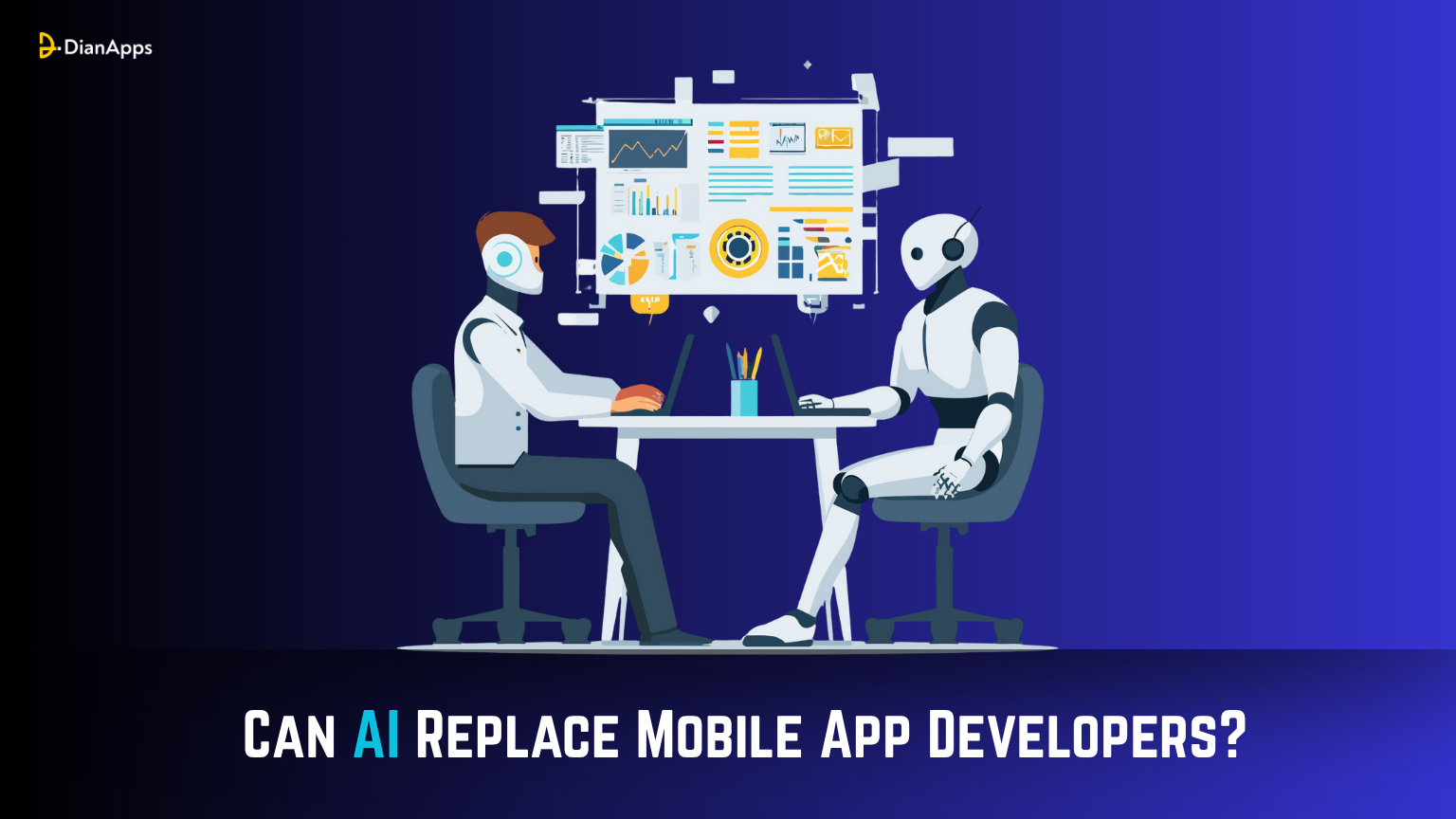





Quick Answer:- No, AI can’t fully replace mobile app developers. While it can help with repetitive processes like coding, testing and debugging, humans are still crucial for architecture design, creativity, user experience, security, business decision making, and quality control. Mobile app development is now about AI + human collaboration where AI can provide speed and efficiency while developers provide guidance, judgment, and accountability.
In simple words, No, AI can’t fully replace mobile app developers – but it is reshaping what they do, and how fast in fact it is. Stack Overflow’s Developer Survey showed that as many as 84% are currently using or intending to integrate AI tools into their workflow, while last year it was 76% and over half, at 51%, now use them daily.
However, just because a larger number use the technology, doesn’t necessarily mean developers are becoming obsolete. As it turns out, only 33% actually trust AI output while a sizable 46% don’t, which goes to show that while AI output might help developers with coding, testing, reviewing, debugging, securing code and documenting what the code is for. However, the product know-how and architecture and ux and security considerations don’t vanish at the sight of an AI.
So it really is about developers evolving and working alongside better tools rather than developing a battle against AI tools. Those developers who can master telling an AI what to do, appraise and verify the work of an AI will continue to enjoy strong demand.
How will we be presenting the AI revolution in mobile app development?
- Current AI capabilities and limitations in mobile development
- Essential skills that keep developers valuable in the AI era
- How AI is reshaping developer roles rather than eliminating them
- Practical strategies for thriving in an AI-enhanced development environment
- Expert predictions for the future of mobile app development
This blog post will clarify AI’s true impact on mobile development and reveal why human expertise remains at the heart of great app creation.
Current State of AI in Mobile App Development
Artificial intelligence has rapidly integrated into mobile app development workflows, transforming how developers approach coding, testing, and deployment.
The current landscape shows AI tools transforming in app development and are essential productivity boosters rather than job replacements, with significant adoption across development teams worldwide.
However, the cross-platform environment is still playing a major role in mobile and according to most recent, mutually equivalent data on Stack Overflow: Flutter is used by 9.4% of professional developers while react Native by 9.0%, the adoration was 60.6% on flutter in comparison with 56.5% on react Native.
AI’s Current Capabilities in Mobile Development
AI has demonstrated impressive capabilities across several key areas of mobile app development:
- Code Generation and Completion: AI tools can generate entire functions, classes, and even complete features based on natural language descriptions or code patterns.
- Automated Testing: AI-powered testing platforms can create comprehensive test suites, identify edge cases, and generate extensive test cases that explore areas of applications that might be overlooked.
- Bug Detection and Resolution: Machine learning algorithms can predict potential failures, identify vulnerabilities early in development, and suggest fixes for common coding issues.
- UI/UX Optimization: AI analyzes user behavior patterns to recommend interface improvements and automatically generate responsive design variations.
- Cross-Platform Development: Enhanced frameworks like Flutter and React Native leverage AI to optimize code compilation and performance across different platforms.
- Documentation and Code Comments: AI automatically generates comprehensive documentation, inline comments, and API specifications from existing codebases.
- Performance Monitoring: Real-time AI analysis of app performance metrics, user engagement patterns, and crash reports to identify optimization opportunities.
- AI coding agents: Newer AI systems can go beyond autocomplete by handling multi-step development tasks such as modifying files, running tests, investigating errors, and iterating on implementations.
What AI Can Do for Mobile App Developers?
Artificial intelligence has proven to be a powerful ally for mobile app developers, delivering tangible improvements in productivity, efficiency, and code quality.
Rather than replacing developers, AI tools are enhancing their capabilities and allowing them to focus on higher-value creative and strategic work.
Motor Oil Group achieved remarkable efficiency gains by integrating Microsoft 365 Copilot into its workflows, allowing staff to complete tasks in minutes that previously took weeks.
This dramatic transformation exemplifies how AI is transforming mobile app development workflows across industries.
To add more, from Starbucks integrating AI into its mobile app to understand customer preferences and suggest personalized beverages to Uber utilizing AI for predictive analytics to enhance user experience and operational efficiency by predicting demand patterns, real-world applications demonstrate AI’s transformative power.
Automation of Repetitive Tasks
The most immediate impact of AI on mobile development comes through automating time-consuming, repetitive tasks that previously consumed significant developer hours:
- Boilerplate Code Generation: AI can instantly create standard project structures, configuration files, and basic CRUD operations, reducing setup time from hours to minutes.
- Database Schema Creation: Automated generation of database models, migration scripts, and API endpoints based on simple data structure descriptions.
- Testing Scaffolding: AI assists in debugging and creates comprehensive test suites automatically, including unit tests, integration tests, and UI automation scripts.
- Code Refactoring: Intelligent restructuring of existing code to improve performance, readability, and maintainability without changing functionality.
- Documentation Generation: Automatic creation of API documentation, code comments, and technical specifications from existing codebases.
- Dependency Management: Smart identification and resolution of package conflicts, security vulnerabilities, and version compatibility issues.
Office workers spend over 50% of their time on repetitive work, and mobile developers face similar challenges with routine coding tasks. AI addresses this directly by handling the mundane aspects of development.
Also read: Top 10+ AI tools to help you in coding
Enhanced Productivity and Efficiency
The productivity gains from AI integration in mobile development are substantial and measurable:
AI’s Impact on Mobile Development Productivity
AI has started to alter how developers’ time is spent. Rather than evaluating AI’s value with inflated claims about percentage gains in productivity, recent data compiled from an investigation of mobile developers shed new light on where AI offers real benefit.
- Increased speed in development workflows: 84% of developers use, plan to use, or have used an AI tool, and 51% of professional developers use one daily.
- Productivity gains: 52% of developers say AI has improved their productivity, rising to 69% among those using AI agents.
- Code generation and completion: AI assistants generate functions, components, boilerplate, and tests from natural-language prompts, freeing developers to focus on product and architecture.
- Faster debugging: AI analyzes error logs and code to suggest fixes, though outputs still need human validation, since 46% of developers don’t trust AI accuracy.
- Cross-platform development: AI speeds up work on Flutter and React Native by generating code, explaining framework-specific syntax, and fixing errors, accelerating tasks rather than replacing developers.
- Time-saving automation: AI agents now handle multi-step development tasks, and about 70% of developers using them say it reduces time spent on specific tasks.
- Human oversight remains critical: Developers avoid AI for high-responsibility work: 76% won’t use it for deployment and monitoring, and 69% won’t use it for project planning.
The only conclusion that the preceding findings would lead to is that AI will ultimately work by enhancing and increasing the leverage available to the developers rather than making their efforts redundant. The AI takes away more of the drudge work while human developers will still need to take decisions about requirements, outputs, architecture, tests, and responsibility for the final deliverable.
AI-powered development features
Current developments of AI for mobile development are beyond just basic code completion; they provide support for multiple phases of the SDLC:
- Natural language to code: Plain-English descriptions give the AI engine context to generate initial code, saving time on repetitive writing tasks.
- Intelligent code suggestions: Contextual code completions, explanations of existing code, function generation, and alternative implementations, with GitHub Copilot the most widely used out-of-the-box tool.
- UI/UX prototyping: AI tools turn wireframes or text inputs into UIs and front-end code, so concepts can be tested earlier and more often.
- Automated testing: Identifies failure-prone cases and scenarios and suggests fixes.
- Code review and refactoring: Surfaces existing technical debt, supports iterative updates, and suggests improvements to keep debt low.
- Security analysis: Flags suspect code and recommends secure coding practices.
- Personalization: AI/ML models enable apps built around user behavior, such as recommendation systems, conversational interfaces, and smart assistants tailored to usage patterns.
- Multi-step development: AI agents can execute instruction-based workflows like editing multiple files, testing outcomes, and investigating issues. Adoption is still limited: 52% of developers use an AI agent or code-generation tool, while 38% don’t intend to.
The Limitations of AI in Mobile App Development
Despite AI’s impressive achievements, the reality remains sobering: 70-85% of GenAI deployment efforts are failing to meet their desired ROI, highlighting significant gaps between AI promises and practical implementation. This failure rate shows critical limitations that make human developers indispensable in mobile app development.
Where AI Falls Short
Current artificial intelligence faces several fundamental limitations that prevent it from fully replacing mobile app developers:
- Lack of Contextual Understanding: AI operates based on patterns learned from data without comprehending underlying concepts, struggling with common-sense reasoning, intuitive understanding, and contextual awareness.
- Creative and Original Thinking Deficit: While AI can generate content based on existing patterns, it fundamentally lacks true creativity and original thought processes essential for innovative app solutions.
- Complex Problem-Solving Limitations: AI struggles with multi-layered business logic, architectural decisions, and strategic planning that require deep understanding of user needs and market dynamics.
- Quality Control Issues: Many AI failures stem from errors in training methods, mislabeled data, or data from unknown sources, leading to unpredictable outputs that require human oversight.
- Emotional Intelligence Gap: Mobile apps require understanding of human psychology, user emotions, and cultural nuances, areas where AI cannot match human insight.
- Ethical Decision-Making: AI cannot make nuanced ethical judgments about user privacy, data handling, or feature implementations that could impact user wellbeing
- Integration Complexity: Real-world mobile development involves complex. integrations with existing systems, legacy code, and third-party services that require human judgment and adaptation.
- Debugging Complex Issues: While AI can identify common bugs, it struggles with systemic issues, performance optimization challenges, and edge cases that require deep technical expertise.
The Human Touch: What Only Developers Can Provide
The irreplaceable value of human developers becomes clear when examining what AI fundamentally cannot replicate. As Demis Hassabis, founder of DeepMind, observed: “Machines excel at computation, but humans excel at creativity. That’s where we must focus.”
Human developers bring essential qualities that remain beyond AI’s reach:
- Strategic Vision: Understanding business objectives, market positioning, and long-term product roadmaps requires human insight into market dynamics and user behavior.
- User Empathy: Developers can understand user pain points, emotional responses, and accessibility needs through direct interaction and personal experience.
- Creative Problem-Solving: Innovative solutions often emerge from human creativity, lateral thinking, and the ability to connect seemingly unrelated concepts.
- Quality Assurance Judgment: Determining what constitutes “good enough” quality, acceptable trade-offs, and user experience priorities requires human judgment.
- Team Collaboration: Mobile development involves cross-functional teamwork, communication with stakeholders, and mentoring, inherently human activities.
- Adaptive Learning: Humans can quickly adapt to new technologies, changing requirements, and unexpected challenges without requiring complete retraining
The limitations of AI in app development aren’t temporary obstacles to be overcome, they represent fundamental differences between artificial pattern recognition and human intelligence.
As experts note: “AI cannot replace human qualities like creativity, empathy, and judgment. Instead, AI will amplify our human capabilities and help cultivate our creative spirit.”
These limitations explain why the future of mobile app development lies not in AI replacement, but in intelligent collaboration between human creativity and artificial intelligence capabilities.
Skills That Make Developers Irreplaceable
Despite the rise of AI in mobile app development, developers bring something to the table that machines simply can’t replicate: human intuition, empathy, and complex decision-making. While tools may change and tasks may shift, the core skill sets of mobile app developers remain indispensable. Let’s explore the critical human abilities that keep developers relevant, even in an AI-powered world.
Creative Problem-Solving
AI can process patterns and data at lightning speed, but when it comes to out-of-the-box thinking, developers still lead the charge. Here’s why creative problem-solving is a non-negotiable skill:
- Adaptability in Unfamiliar Scenarios: Developers often work on unique app concepts where no pre-existing template applies, something AI struggles to manage.
- Innovative Debugging: While AI can identify common bugs, developers diagnose root causes and implement unconventional fixes.
- Cross-Platform Logic Application: Human developers can abstract ideas and reframe logic creatively across iOS, Android, or cross-platform solutions.
- Client-Specific Solutions: Developers tailor functionalities to nuanced business needs, something AI tools can’t fully automate.
Strategic Thinking and Planning
Can AI replace mobile app developers? Not when it comes to strategic thinking. Building successful apps requires a high-level understanding of markets, platforms, and user expectations, areas where developers excel.
- Roadmapping and Scalability: Developers envision long-term scalability and structure the app accordingly, AI lacks this foresight.
- Tech Stack Selection: Choosing the right frameworks and databases involves balancing technical trade-offs that AI cannot contextualize.
- Agile Planning: Human developers thrive in sprint-based planning cycles where flexibility and stakeholder feedback influence direction.
- Monetization Strategy: Developers often collaborate with product teams to integrate monetization logic that aligns with user behavior and market trends.
Human-Centered Design Approach
No matter how advanced AI gets, it doesn’t understand human emotions. The mobile app development process is heavily influenced by empathy, user experience (UX), and accessibility, areas where developers shine.
- Empathy-Driven Design: Developers place themselves in the user’s shoes, creating features that serve real-world pain points.
- UX Adaptability: AI may recommend patterns, but developers test and fine-tune UI/UX to match user behavior in real time.
- Cultural Sensitivity: Apps designed for users in Australia may differ vastly from global standards, developers localize experiences accordingly.
- Accessibility Considerations: Developers proactively ensure that apps are usable by people with disabilities, an area AI often overlooks.
How AI is Changing the Mobile Developer Role?
The question isn’t just “Can AI replace mobile app developers?”, it’s how AI is reshaping their role. The mobile development landscape is evolving rapidly, but instead of displacing developers, AI is redefining their responsibilities. Understanding this transformation is key to staying ahead.
Evolution, Not Replacement
The narrative around AI vs mobile developers often leans into fear, but reality paints a more collaborative picture. AI is not replacing developers, it’s enhancing what they do.
- Accelerated Development Cycles: AI tools like GitHub Copilot and Amazon CodeWhisperer assist with boilerplate code, freeing developers to focus on complex tasks.
- Smart Testing and QA: AI-powered testing platforms automate regression testing, reducing manual effort and speeding up delivery timelines.
- Code Optimization: AI can suggest performance improvements, but human oversight ensures those changes align with the app’s intent.
- Natural Language Programming: AI may allow users to describe functions in plain English, but it still requires developers to validate and implement them effectively.
The shift is clear: AI is becoming a co-pilot rather than a replacement.
Skills Developers Need in the AI Era
To remain indispensable, developers must evolve. As AI app development in 2025 takes shape, the future of mobile app development will demand a blend of technical expertise and AI fluency.
- AI Integration Knowledge: Developers must know how to integrate ML models, chatbots, and recommendation systems into mobile apps.
- Data Fluency: Understanding how to train, clean, and utilize data effectively is becoming a must-have skill.
- Prompt Engineering: Writing prompts for AI tools is a skill in itself, developers who master it will get more accurate and valuable outputs.
- Ethical AI Awareness: Human developers need to ensure AI decisions remain unbiased, secure, and ethical, something no algorithm can fully govern.
- Adaptability to AI Workflows: From collaborating with AI tools to managing AI-generated components, developers need to stay agile in their workflow.
The future belongs to those who treat AI as a tool, not a threat.
Industry Expert Opinions and Predictions
As the discussion surrounding the potential replacement of mobile app developers with AI continues, the available data and surveys indicate the industry is evolving, rather than being eliminated.
Key survey statistics include:
- Eighty-four percent of developers currently use or are planning to use AI tools for coding, and 51% of professional developers are doing so on a daily basis, according to Stack Overflow’s Developer Survey.
- Though there is substantial adoption, a combined 46% of developers either do not trust their AI’s code or need more time to see what else it produces, demonstrating that humans still must play a critical role in testing and decision making.
- A 2026 Clutch survey noted that 75% of developers anticipate AI to “dramatically transform software development” over the next five years, whereas 80% expect it to “primarily empower developers”.
- Gartner forecasts that over 65% of engineering teams will move away from dedicated IDE usage as a necessity, and view it as optional, when utilizing agentic coding by 2027.
In conclusion, it appears as though most sources agree the future is in a developer working with AI bots rather than a bot taking their place, where the majority of AI will handle tedious and repetitive tasks rather than design decisions and comprehensive product testing.
Popular Quotes From Tech Leaders
- Satya Nadella (CEO, Microsoft):
“AI won’t replace developers. Developers who use AI will replace those who don’t.” - Jensen Huang (CEO, NVIDIA):
“AI is the new electricity, but it still needs humans to wire the grid.” - Sundar Pichai (CEO, Google):
“AI will unlock creativity, not constrain it. Developers will do more, not less.” - Marc Andreessen (VC & Co-founder, Andreessen Horowitz):
“We are at the beginning of a software revolution fueled by AI, not a developer apocalypse.”
Predictions for the Road Ahead
- AI won’t replace app developers, but job roles will shift. Expect more demand for AI-integrated app experiences and personalization.
- AI tools will become standard in the dev stack. Just like Git and IDEs, tools like ChatGPT, Bard, and Copilot will be everyday companions.
- New job titles will emerge. Terms like AI Product Developer, Prompt Engineer, and AI UX Strategist may soon become common.
- The focus will move toward strategy and empathy. As AI handles execution, developers will be required to take more ownership of planning, vision, and user advocacy.
So, will AI replace app developers entirely? Not likely, but it will definitely replace the old way of working.
The Future of Mobile App Development: AI + Human Collaboration
Instead of asking, “Will AI eliminate Software Development?” the more powerful question is: How can AI and developers work together to build better apps? The future lies in this synergy, not separation. As AI tools continue to evolve, developers will step into roles that demand creativity, judgment, and innovation, something no algorithm can replicate.
- AI will execute tasks: Automation of code generation, testing, debugging, documentation, and most rote elements will take over from here.
- Humans will direct work: Requirement definitions, architectural planning, business logic, user experience, security and the overall technical strategy will fall to developers.
- AI agents will go far beyond ‘autocomplete’: Multi-stage tasks like implementing a full feature, creating a pull request, fixing bug(s), and running tests will be increasingly delegated to our agents.
- Human oversight will remain crucial: You will still need to analyze the results of the generated code to ensure accuracy, security, and assumptions match.
- Developers will write fewer lines of code: This time and energy saved by automation may be redirected to system design, the user experience, performance, and problem-solving challenges.
- AI fluency will be standard: All developers will be required to have prompts, analyze the output, integrate with respective tools, and manage the inputs from our helpers.
- Mobile development will grow even more iterative: With increased speed and reduced development cycle time through AI agents, rapid prototyping and refinement of app features will accelerate.
- The role won’t be abolished-rather, redefined: Instead, developers become AI-assisted engineers, who will then guide, evaluate, and take ultimate responsibility over the resulting product.
- The best approach to success: AI handles velocity and breadth; humans handle wisdom, originality, and accountability.
Practical Advice for Mobile App Developers
The rise of AI in mobile app development isn’t a warning, it’s a wake-up call. Developers who embrace this shift will not only stay relevant but become industry leaders. So instead of asking, “Will AI replace app developers?”, start asking, “How can I future-proof my skills alongside AI?”
Here’s a practical roadmap to help you evolve with the technology, not against it.
1. Embrace AI Tools That Complement Your Workflow
Adopting the right AI tools can elevate your productivity and free up time for higher-value work.
- GitHub Copilot: Suggests real-time code completions directly in your IDE. Great for boilerplate and repetitive functions.
- ChatGPT / Gemini: Use for debugging, documentation generation, and brainstorming architecture ideas.
- Testim / Applitools: AI-powered testing tools that automate regression, visual, and UI testing.
- Codex / Tabnine: Assist with syntax prediction, context-aware completions, and even database query generation.
2. Learn to Write Better Prompts
Prompt engineering is the new coding superpower. Whether you’re using AI to generate UI code or troubleshoot a bug, the way you phrase your instructions drastically affects the output.
- Be clear, concise, and contextual.
- Use past examples in your prompt for reference.
- Iterate and refine based on AI responses.
3. Deepen Your Understanding of Human-Centered Design
AI might help with UI suggestions, but only humans can truly understand user emotions.
- Study UX psychology
- Conduct real-time user interviews
- Create journey maps and storyboards
- Prioritize inclusivity and accessibility
This human layer is what separates competent developers from exceptional ones.
4. Stay Informed on AI Ethics and Security
AI is not just code, it’s data, privacy, and trust. Every developer should:
- Understand the ethical implications of data use
- Evaluate AI-generated features for bias or discrimination
- Stay updated on global AI regulations and compliance standards (especially relevant for Australia)
Also read: AI app development in Australia– Know its key features, costs and process!
5. Cultivate Soft Skills for a Tech-Plus World
As machines take over execution, developers must lean into soft skills:
- Communication: Collaborate with cross-functional teams and non-tech stakeholders.
- Adaptability: Stay agile in your approach as tools and standards change.
- Empathy: Build solutions that feel right, not just function right.
Key Takeaways: The Verdict on AI Replacing Mobile App Developers
So, will AI replace programmers in 2026? The short answer: No. AI won’t replace software engineers, but an engineer using AI will!
On that note, here’s what we’ve learned:
- AI is a tool, not a takeover. It can automate repetitive coding tasks, assist with testing, and generate UI components, but it lacks human intuition, creativity, and ethical judgment.
- The future of mobile app development is hybrid. The most successful apps in 2026 and beyond will be built through a partnership between AI capabilities and human ingenuity.
- Developers who embrace AI will lead the industry. By learning how to collaborate with AI, mobile developers can supercharge their skills, increase efficiency, and unlock new job opportunities.
- Irreplaceable skills still matter most. Strategic thinking, creative problem-solving, and human-centered design can’t be coded into an algorithm.
- AI is evolving fast, and so must developers. Keeping up with AI tools, ethical standards, and emerging workflows is now part of a developer’s job description.
The real risk isn’t that AI will replace developers. It’s that developers who ignore AI will be replaced by those who don’t.
Ready to build the future, not fear it?
Whether you’re an experienced mobile app developer or just starting out, now’s the time to level up with AI-powered tools and forward-thinking strategies.
If you’re a business in Australia looking for AI-integrated mobile app solutions, partner with a team that understands the future.
Let’s build smarter, together.
FAQs
Why are developers resistant to AI?
Many developers are cautious about AI because of concerns around job displacement, loss of creative control, and ethical risks. However, the truth is that AI is more of a co-pilot than a competitor. Resistance often stems from uncertainty, but those who learn to leverage AI tools for mobile development are already seeing gains in productivity and innovation. It’s less about AI vs mobile developers and more about how both can coexist and thrive.
Can AI replace junior developers in 2026?
As AI app development in 2026 becomes more widespread, juniors may start with prompt engineering and AI-tool navigation, working their way up with a deeper understanding of context and design. AI will change the entry point, but not eliminate it.
Do you think agentic AI (AI Agents) will eventually replace developers, or will it become a tool to enhance their capabilities?
Agentic AI is designed to act autonomously with limited human intervention, but even that has boundaries. While these agents can complete tasks like code generation or automated deployment, they still rely on human input for logic, UX, security decisions, and project strategy. In the broader picture, AI tools for mobile developers will enhance workflows rather than wipe them out. Agentic AI is powerful, but it lacks the empathy, ethics, and strategic thinking that make developers irreplaceable.
Will ChatGPT pave the way for AI to take over software development?
ChatGPT and similar tools are indeed shaping the future of mobile app development. They can assist in writing functions, solving errors, and brainstorming feature logic. But ChatGPT is a language model, it doesn’t understand business goals, emotional nuances, or user-centric design in the way developers do. So, while ChatGPT will continue to impact mobile development, it won’t take it over. Developers who learn to use ChatGPT effectively will simply become more efficient, not obsolete.
 0 comments










Leave a Comment
Your email address will not be published. Required fields are marked *