















 0 comments





Key Takeaways:
- The right AI development tech stack depends completely on application requirements, data, scalability, security and performance.
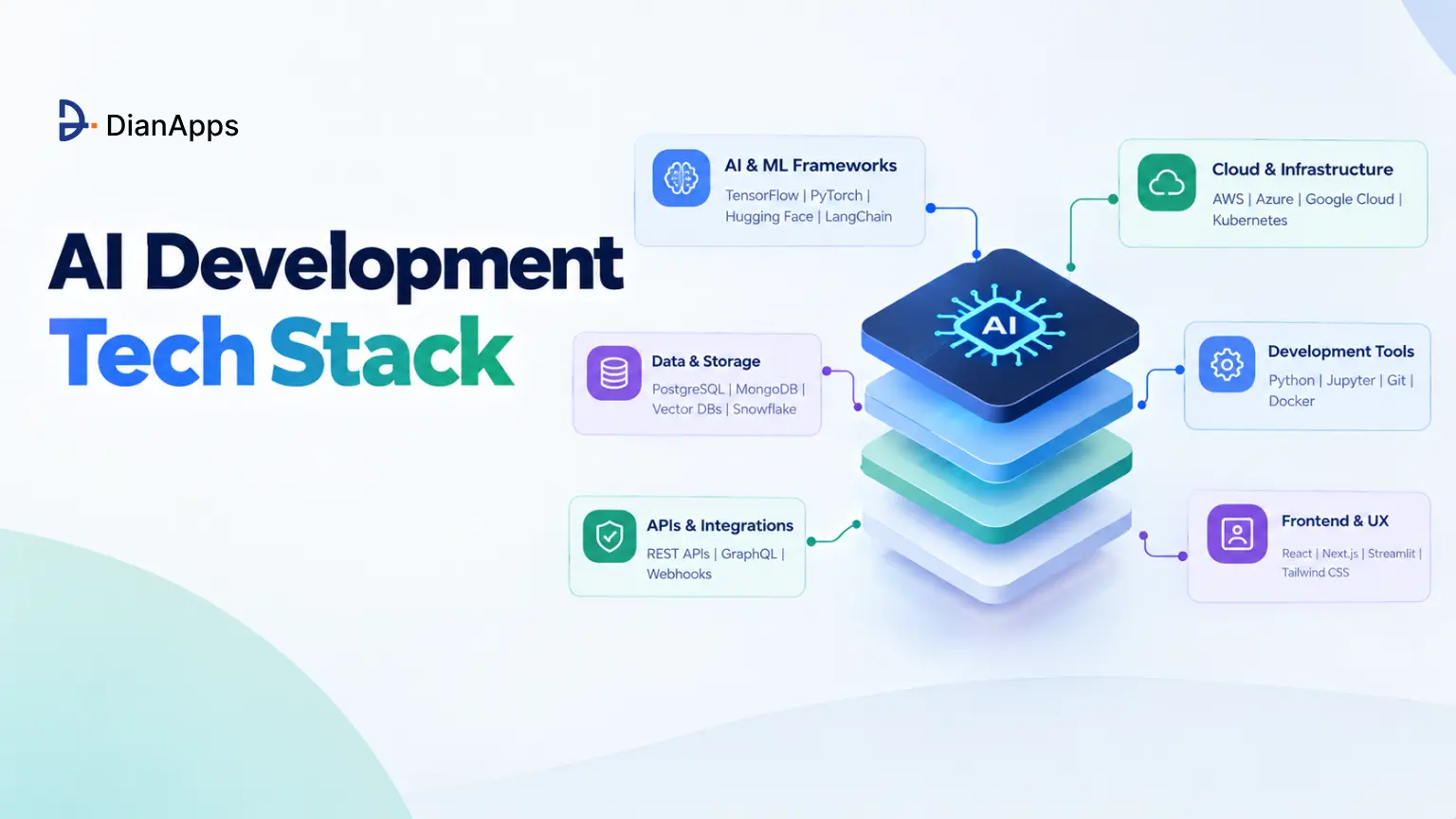
- AI applications combine databases, models, cloud services, backend technologies, APIs and frontend frameworks.
- Python, PyTorch, TensorFlow, Hugging Face and modern backend frameworks support different stages of AI development.
- AWS, Microsoft Azure and Google Cloud provide services/infrastructure for deploying and scaling AI applications.
- MLOps, retrieval systems and modular architectures are becoming increasingly important for production AI applications.
Quick Answer: The AI development tech stack includes data storage, AI models, cloud services, backend technologies, APIs and frontend frameworks in order to build reliable AI applications in 2026. The right combination depends on the application requirements, scalability, security, performance and long term development goals.
Artificial intelligence (AI) based development is evolving rapidly and developers must stay ahead of the curve as an AI Application is only as reliable as the technology supporting it. The right AI tech stack connects data, models, infrastructure, application logic and interfaces. This is why choosing these components is critical as they can improve performance, maintain costs, simplify maintenance and provide better security.
However, there is no universal tech stack that would work for every AI product. An image analysis product will require a completely different combination of technologies than that of a customer support application.
Modern development teams therefore select technologies that are suitable for their actual application. The best approach is to combine proven programming languages, frameworks that are flexible, suitable models for the product and a scalable infrastructure.
In this blog, we will break down the major AI tech stack layers and their roles, also covering databases, models, programming languages, cloud platforms, APIs, interfaces and MLOps tools.
Why AI Development Tech Stack Matters?
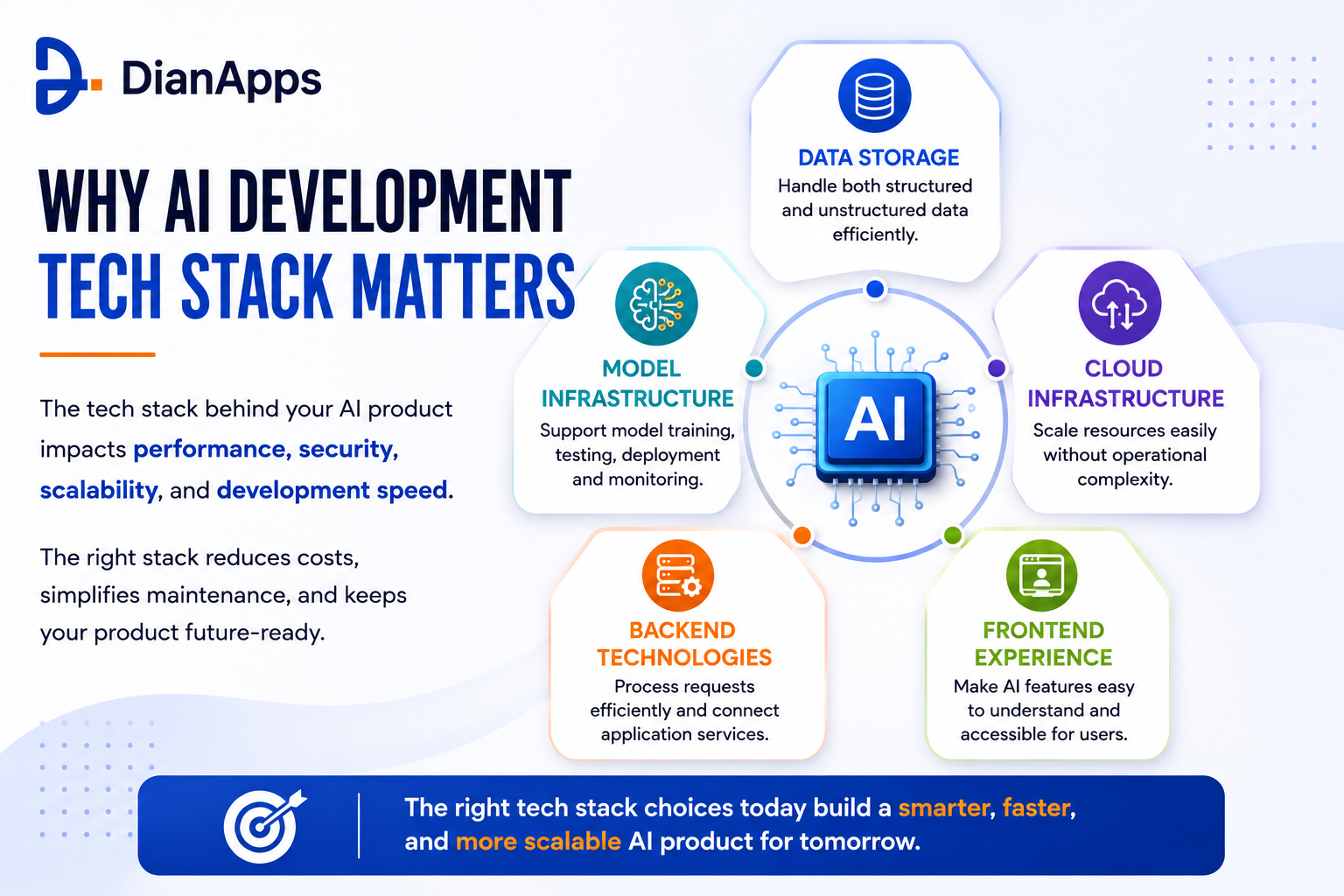
The technology stack behind a product determines how effectively it can handle data, computation power, model inference and users. When we do not focus on selecting the best tech stack, we are indirectly increasing the development time, maintenance and infrastructure costs.
The AI development tech stack also affects the ease with which developers can change the models as AI models and their capabilities are continuously changing with time.
A good tech stack should provide several capabilities, such as:
- Data storage must support both structured and unstructured formats.
- The model infrastructure should support experimentation, evaluation, deployment and monitoring.
- The backend technologies should be able to process requests efficiently while also connecting the application services.
- Cloud infrastructure should provide capacity without creating unnecessary operational complexity.
- The frontend should be to make the AI functionality understandable as well as accessible for users.
These decisions altogether shape the performance of the application, security, scalability and the development speed while also ensuring compatibility with the newer AI development tools and frameworks later.
The Building Blocks of AI Development Tech Stack
An AI application consists of several technology layers interconnected and each layer holding its importance. The most common layers include models, data management, infrastructure, backend processing and user interfaces (UI).
Data Handling and Management
Data is the base of most AI applications as the model requires relevant information. The required storage infrastructure depends on the type and amount of application data to be used with the application.
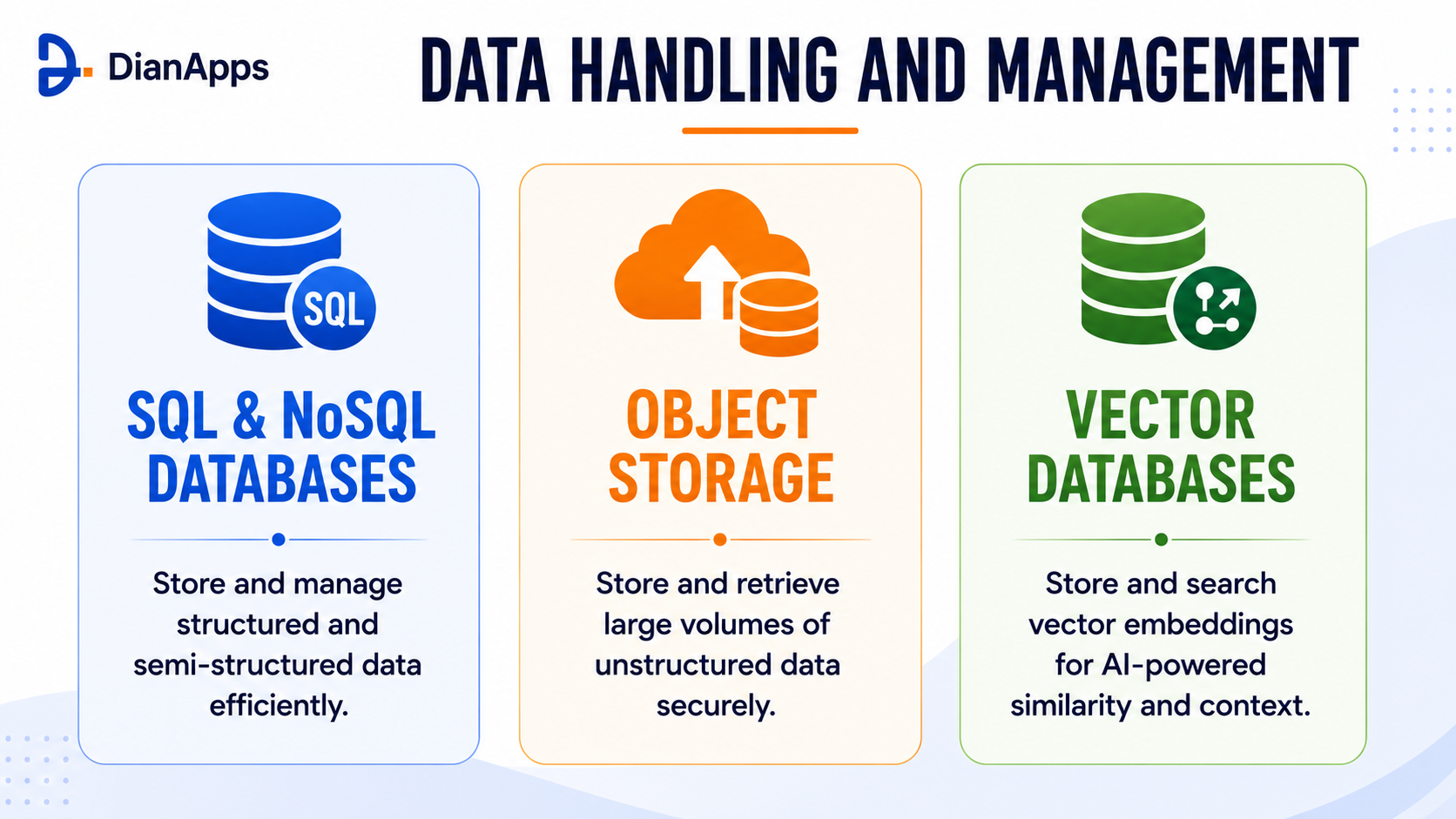
Traditional business applications depend on relational databases for storing structured data while AI applications require additional storage for storing multi-format data such as documents, images, audio, model outputs and more.
SQL & NoSQL Databases
The SQL databases are needed when applications require relationships, transactions, consistency and structured queries. The most common choices for storing the applications and business records are PostgreSQL and MySQL. NoSQL databases come in handy when the structure of the information is less predictable or when it changes constantly.
For example, an AI assistant can store users and billing records inside PostgreSQL and the same application could store conversation metadata or flexible documents inside MongoDB.
This approach avoids forcing every data type into one storage system.
The database should support the application’s actual workload instead of following technology trends. Strong indexing, controls, backups and access remains the top priority regardless of the database type.
Object Storage
The object storage provides managed storage for files that applications do not require continuously. Amazon S3, Azure Blob Storage and Google Cloud Storage are common object storage enterprise options. These storage can hold training datasets, uploaded documents in all formats and files.
This storage also works well with processing pipelines and machine learning workflows where teams can maintain original files separately while storing searchable metadata inside application databases. This separation of files and its meta data keeps application databases efficient while preserving large source datasets.
Vector Databases
The vector databases support semantic retrieval by storing numerical representations of the files which are called embeddings and applications can easily compare these representations to find the information with related meaning. This method supports document search, recommendation systems, knowledge assistants and retrieval workflows.
Common examples include Pinecone, Weaviate, Milvus, Qdrant and PostgreSQL with vector extensions, the best one depends on the scale, filtering, hosting preferences and existing infrastructure.
Vector storage is important in the modern AI tech stack layers supporting retrieval augmented applications.
Bonus Read: What Is AI Development? 2026 Guide That Skips the Buzzwords
AI Models For An Unbeatable Tech Stack
Models provide the intelligence layer that converts inputs into predictions, classifications, recommendations or simple responses. Selecting a model should include more than just comparing benchmark scores or its parameter count. Instead, the teams should also consider accuracy, latency, context requirements, pricing, deployment options available, privacy and integrations available for it.
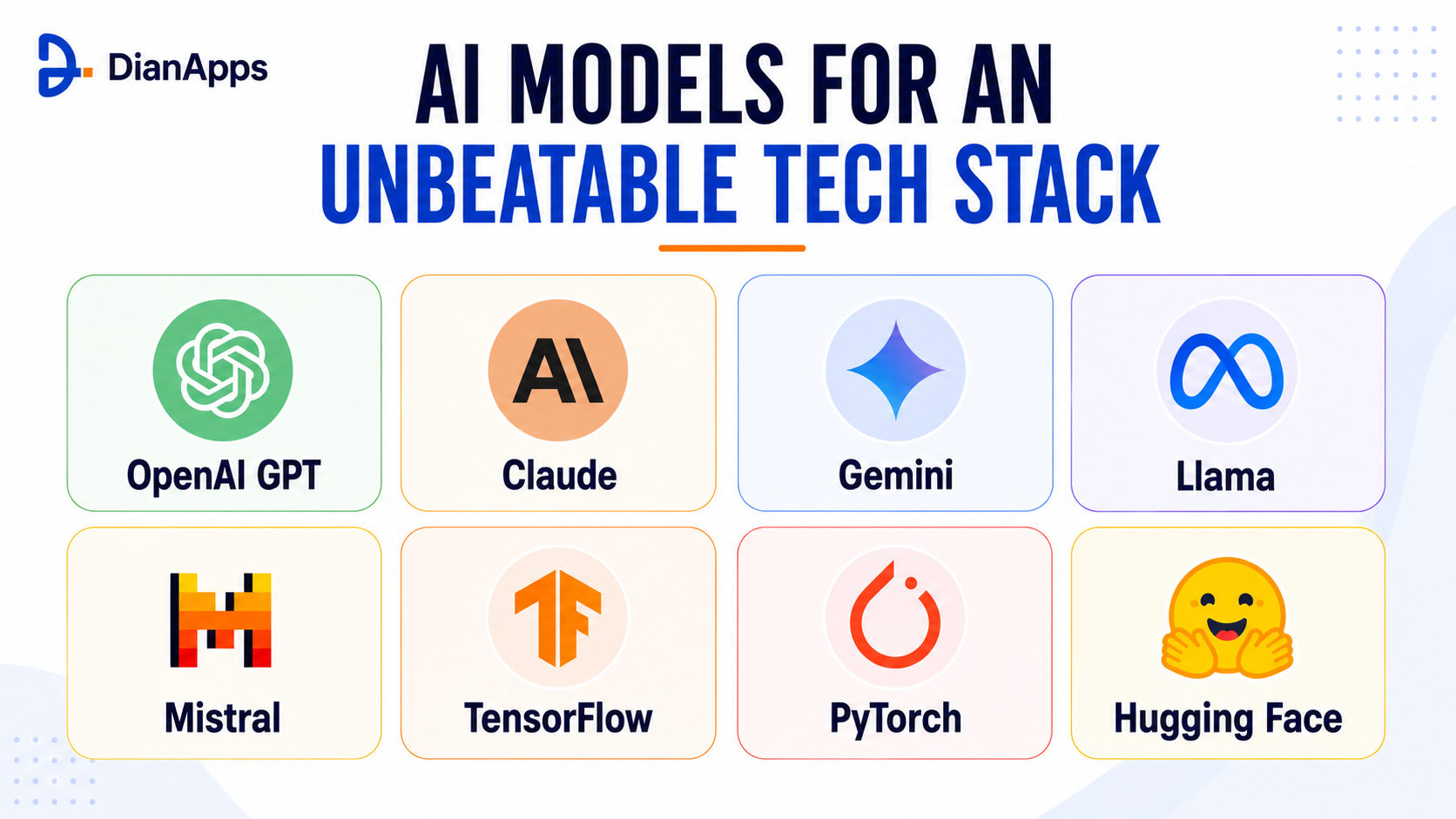
Different popular models provide different strengths when it comes to language, reasoning, coding, vision, audio and multimodal applications.
- OpenAI’s ChatFPT models provide hosted capabilities through application programming interfaces.
- Claude models provide language support on applications and complex reasoning workloads.
- Google’s Gemini model provides multimodal capabilities through google AI and Google cloud.
- Llama models provide more open model options for teams requiring greater control post deployment.
- The mistral model has several efficient options for language and enterprise applications.
- TensorFlow has tools for creating and deploying ML (Machine Learning) models.
- PyTorch provides a widely used framework for model development and research purposes.
- Huggingface has a widely used framework for model libraries, datasets and development infrastructure.
OpenAI GPT
The ChatGPT model supports conversational applications, coding assistants, content processing, reasoning tasks and agent workflows. Teams can access hosted models through APIs and not manage the model infrastructure all by themselves. With this approach, operational requirements can be reduced while also providing the team with access to continuously improving model capabilities.
What would work for you depends on the workload complexity and response requirements, smaller models can handle simpler tasks while reducing the latency and operational costs.
Learn more on LLM Frameworks here.
Claude
The Claude models by Anthropic are another option for language intensive applications. They can support assistants, documents processing, coding workflows, analysis and complete enterprise knowledge application solutions.
Teams should compare Claude with the available alternatives using their own evaluation datasets and production requirements. Normal benchmark rankings cannot predict an application performance on every real world workload.
Gemini
The Gemini models by Google provide models that are designed for language and multi-modal workloads. The latest Google’s documentation lists all the stable and specialized models for integration or other required tasks.
It is very convenient for applications that already run on google cloud services, the team should look for response quality, pricing, latency and integration requirements before selecting models.
Llama
Llama has the open model options for teams who require greater flexibility over deployment. These models can be hosted within a private infrastructure or cloud environment. This flexibility benefits established organisations with specific privacy, customization or deployment requirements; however, self-hosting adds additional responsibilities that involve hardware, optimization, security and operational management.
Also Read: Grok vs Llama vs Gemini vs ChatGPT
Mistral
Mistral provides models that are suitable for several language and enterprise applications requirements. Mistral models can be considered if the team requires to prioritize efficient inference or deployment flexibility.
The model selection process should follow measurable application requirements instead of brand familiarity. A micro model can sometimes outperform a large model when the task is narrowly defined.
TensorFlow & PyTorch
TensorFlow and PyTorch are and will remain an important framework for developing and training machine learning models. They are the most relevant when teams build custom models rather than calling hosted APIs by other providers.
See Comparison: TensorFlow vs. PyTorch
Hugging Face
Hugging Face is another important layer which provides models, datasets, libraries and development resources. Its Transformers library supports both inference and training across multiple model categories.
Running the AI Models
Having these models execute tasks requires an infrastructure that must be capable to handle inference, training, storage, networking and scaling. Cloud platforms have become the go-to option as they provide managed services without requiring every team to operate hardware directly.
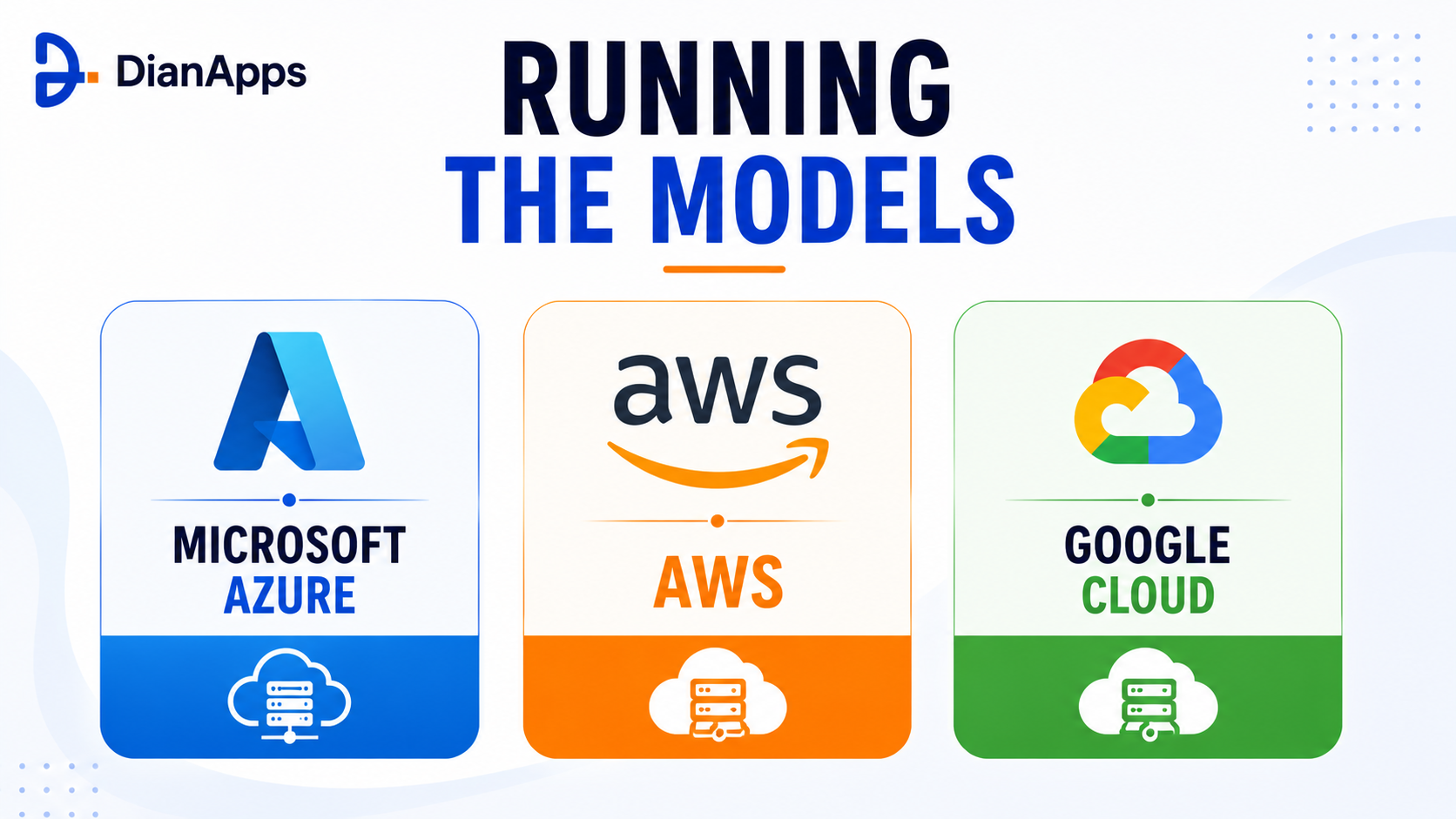
According to the current market, there are three major cloud platforms for AI, namely, Microsoft Azure, Amazon Web Services, and Google Cloud.
Each of these platforms provides a different combination of computing power, model services, evaluation, access control, networking and governance. The best cloud for AI for you is the one that fulfils your application requirements.
Microsoft Azure
Microsoft Provides a unified Azure platform for AI app development and its operations with its capabilities including models, agents, tracing, monitoring, evaluation, access control, networking and governance. This is a suitable solution for organizations that have already invested heavily in Microsoft tech.
Azure’s capabilities can simplify identity management, security controls and integration with the existing systems.
AWS (Amazon Web Services)
AWS provides access to services that cover model development, deployment, generative AI, storage and infrastructure. Amazon Bedrock provides access to foundation models through managed APIs and related application capabilities while Amazon SageMaker AI supports building, training, customizing and deploying machine learning models.
AWS offers both managed model access and deeper machine learning infrastructure options for businesses.
Google Cloud
Google provides AI development services through its evolving AI platform ecosystem known as Google Cloud. Its current generative AI platform includes Gemini models and capabilities for building and governing AI-integrated applications. Google Cloud can be the right choice when applications depend heavily upon Google’s data and analytics ecosystem.
Teams should compare regional availability, pricing, model access, security and existing cloud commitments.
Cloud Platform Comparison
| Cloud platform | Strong fit | Important AI capabilities | Consideration |
| Microsoft Azure | Enterprise Microsoft environments | Foundry, models, monitoring, governance | Strong enterprise integration |
| AWS | Broad infrastructure requirements | Bedrock, SageMaker AI, storage | Large service ecosystem |
| Google Cloud | Data intensive AI applications | Gemini, AI platform services, vector search | Strong data and AI integration |
Backend Data Processing
The backend is one of the most important parts of an application which connects requests with databases, models, business rules and external services. Python is one of the most widely used AI development programming languages as it has extensive support and is easy to use. FastAPI, Django and Flask provide different approaches for creating Python based backend services. Node.js also works effectively when teams prefer JavaScript or TypeScript as the application stack. REST APIs are widely used, while GraphQL can provide flexible data querying for suitable applications.
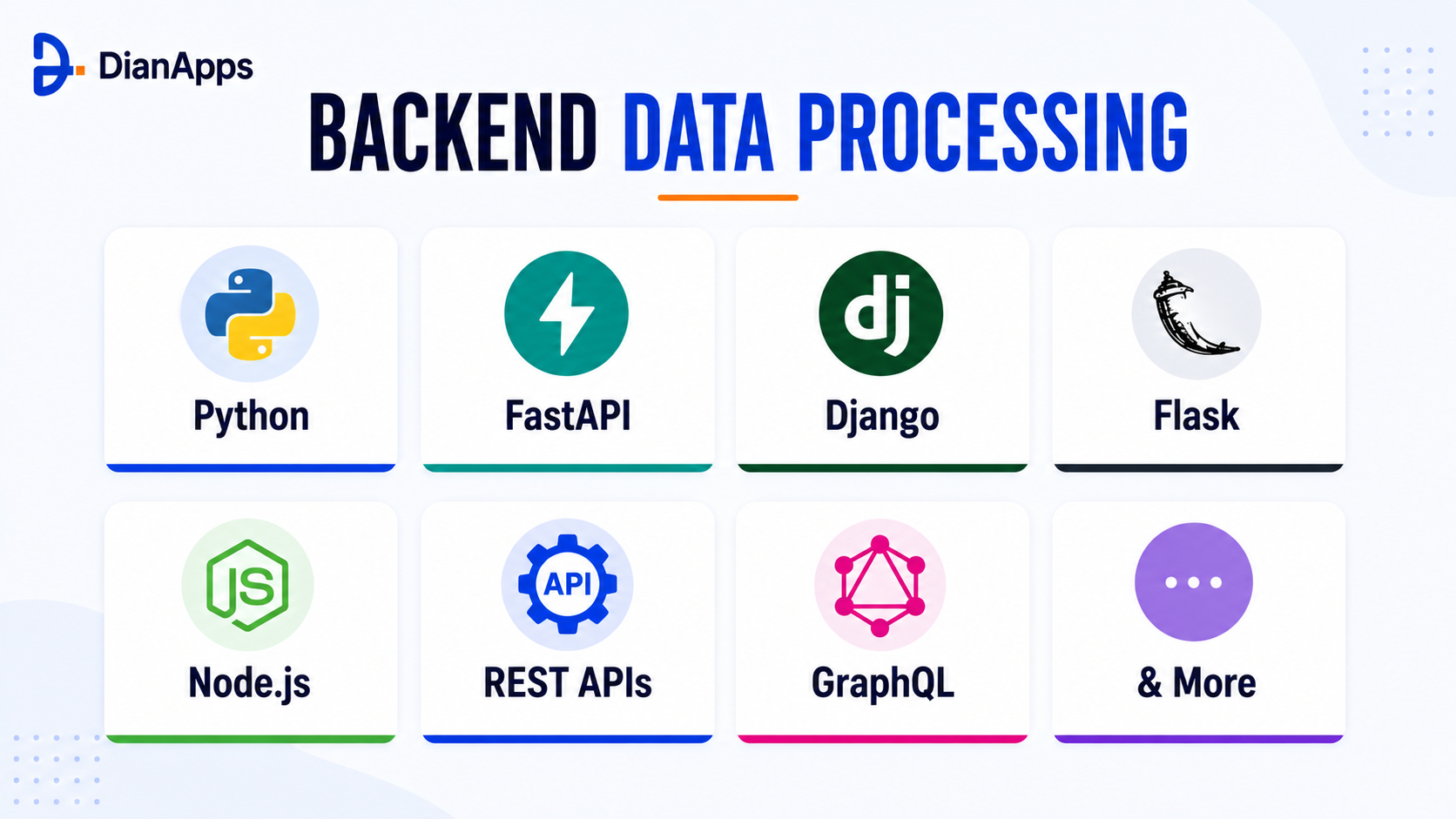
A normal backend may combine Python with FastAPI for model services and PostgreSQL while another application can use Node.js for business services while calling separate Python inference services.
The correct backend architecture that would work for you depends upon team expertise and application complexity. There is little value in introducing additional technologies when a simpler architecture meets requirements.
Python
Python is extensively used across data processing, machine learning, automation and model development practices as its ecosystem includes libraries for numerical computing, machine learning, web services, evaluation and data processing, reliable for such developments.
This makes Python a better choice for teams building applications around machine learning workflows. It can also connect naturally with frameworks such as PyTorch, TensorFlow and Transformers.
Read More: Top LLM Frameworks in 2026 (Compared)
FastAPI
FastAPI is a framework of Python which is designed to build modern application programming interfaces with strong performance and automatic documentation capabilities and works well for AI services where the backend applications need to send requests to models and return results efficiently and quickly.
Developers can use this to create dedicated inference services, authentication endpoints, data processing services and integrations with external AI providers such as those mentioned above. Its asynchronous capabilities can also help applications handle multiple requests efficiently when the underlying workload supports asynchronous processing.
Django
Django is a full featured Python web framework that provides many components required for building complete web applications. It includes capabilities for authentication, database management, administration, routing, forms, security and application configuration.
This works well for larger AI platforms where machine learning functionality is only only one part of the overall product.
For example, an enterprise AI platform could use Django for user management and business logic while connecting separate AI services for model processing.
Flask
Flask is a lightweight framework, again of Python, that provides developers with greater control over backend architecture and application structure. Its simple foundation is useful for smaller AI services, prototypes, internal tools and dedicated model endpoints.
Developers can connect Flask with machine learning libraries and external model APIs without adopting the larger structure of a full web framework, however, larger applications may require additional components for authentication, database management, validation and other backend responsibilities.
Node.js
Node.js allows developers to build backend using JavaScript or TypeScript, which is useful for teams that want a consistent language across frontend and backend development. It is commonly effective for applications that involve frequent network requests, real time communication and external service integrations.
Within an AI tech stack, Node.js can manage application logic while communicating with Python based AI services or external model APIs through various providers. This approach allows teams to use Node.js for the main application while keeping specialized machine learning workloads within Python services.
REST APIs
REST APIs provide a widely adopted method for connecting frontend applications, backend services, databases, AI models and external platforms. An AI application can use REST endpoints to submit prompts, upload documents, retrieve model responses, manage users or initiate data processing tasks.
For example, a frontend application could send a request to an AI backend through an API endpoint after which the backend validates the request, calls the selected model, processes the response and returns the result. REST acts as a communication layer within modern AI development tools and frameworks.
GraphQL
The GraphQL provides an alternative API architecture that allows clients to request specific data fields instead of receiving a fixed response structure. This flexibility can be useful when an AI application has complex data requirements across users, conversations, documents, models and application records.
For example, an AI dashboard could request user information, conversation history, model details and usage statistics through a single GraphQL query, however, GraphQL introduces additional design and security considerations, so it should be selected when its flexibility provides a meaningful advantage over conventional REST APIs.
Connecting the User
The frontend of an application connects users with the AI capabilities operating behind the application through the backend. A strong frontend should present AI responses clearly while also handling the loading states, errors, streaming responses, file uploads, authentication and interactive workflows.
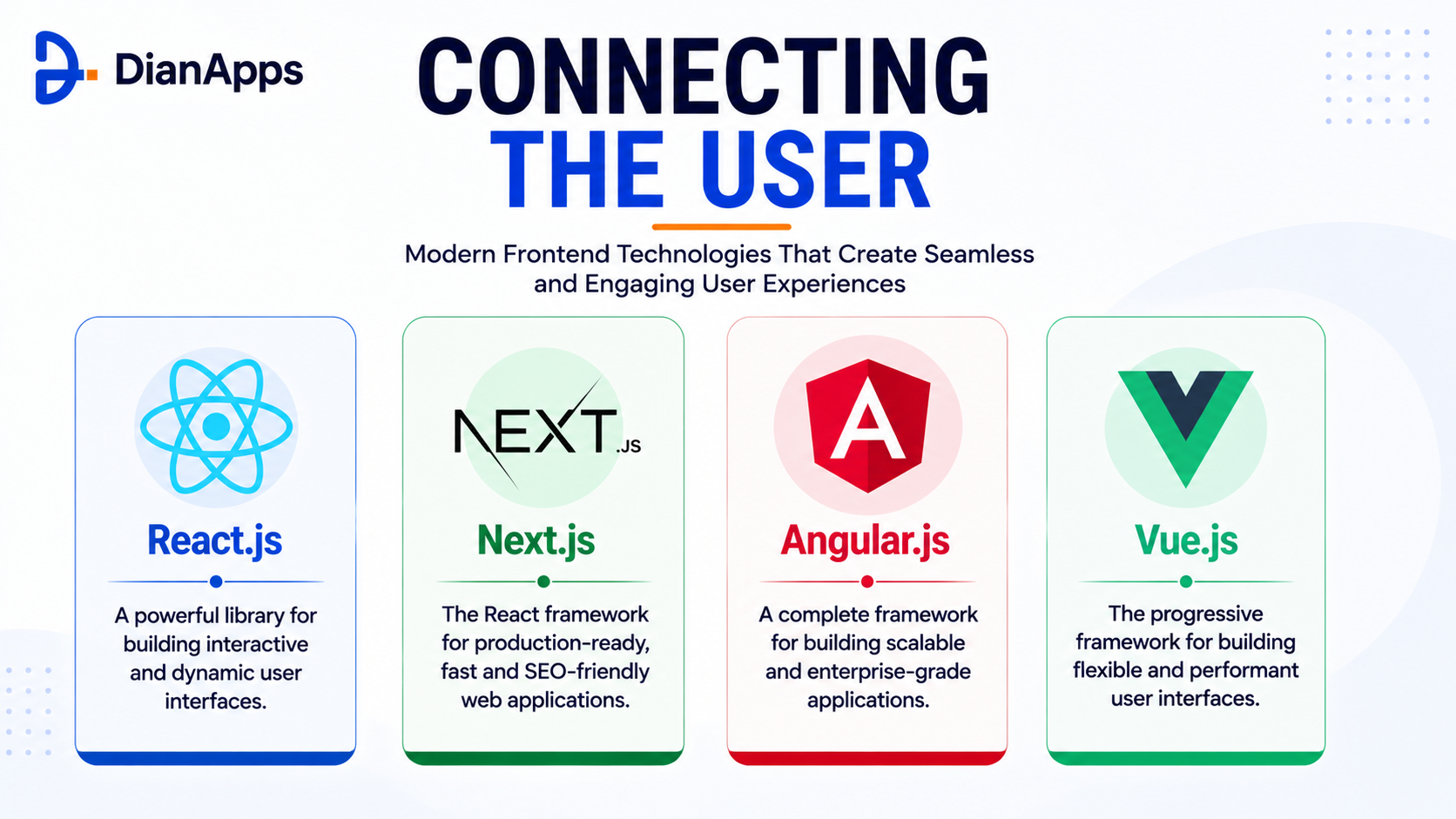
React.js, Next.js, Angular.js, and Vue.js are popular choices for building an application’s frontend as it fits different application requirements. Within a modern AI development tech stack, the frontend also needs to communicate efficiently with backend APIs and model services.
React.js
In modern AI tech stack, React.js (a component based JavaScript library) is commonly used for creating interactive application interfaces. It works well for AI applications that require dynamic conversations, dashboards, real time responses, file uploads and interactive data displays.
Developers can connect React applications with REST APIs, GraphQL services, WebSocket connections and AI model APIs and the large ecosystem also provides libraries for authentication, state management, forms, charts and other application requirements.
This library becomes especially helpful when developers want flexibility over application architecture while selecting separate tools for routing, data fetching and backend communication.
Next.js
Next.js is a React based framework that adds features for routing, server side rendering, static generation, backend functionality and application deployment as these capabilities make it suitable for AI products where performance, search visibility, and application functionality.
AI applications can use Next.js to create chat interfaces, AI powered search platforms, content applications, dashboards, and SaaS products. Developers can also use server side functionality to communicate with AI services without exposing sensitive credentials directly within browser code.
For applications that combine public pages with authenticated AI functionality, Next.js can provide a more complete application structure than using React.js alone.
Also Read: React and NodeJS
Angular.js
Angular.js, commonly referred to as Angular in modern development, is a structured frontend framework designed for building larger web applications. It provides built-in approaches for routing, forms, dependency management, HTTP communication, and application organization.
Angular can be useful for enterprise AI applications where teams prefer a strongly structured development environment. For example, an enterprise AI dashboard could use Angular for managing complex workflows, permissions, analytics, document processing, and model interactions.
Its structured architecture can also help larger development teams maintain consistency across complex applications. However, the framework may involve more architectural decisions and conventions than lightweight frontend alternatives.
Vue.js
Vue.js is a progressive JavaScript framework that provides a flexible approach to building interactive user interfaces. It can support smaller AI tools as well as larger applications that require reusable components and dynamic data interactions.
Developers can connect Vue.js applications with REST APIs, GraphQL, WebSocket services, and external AI providers. Its component based architecture makes it suitable for interfaces such as AI chat windows, recommendation panels, document analysis screens, and analytics dashboards.
Choosing The Right Frontend Framework
| Frontend | Best suited for | Key strength |
| React.js | Interactive AI applications | Flexible component ecosystem |
| Next.js | AI SaaS and public web applications | React with broader application capabilities |
| Angular | Enterprise AI platforms | Structured application architecture |
| Vue.js | Flexible AI interfaces | Accessible and progressive development |
Build Your AI Solution With the Right Tech Stack
Explore our AI development services to turn your idea into a scalable, production ready application.
What’s Changing In Software Development With AI?
AI is constantly changing software development by integrating in everyday development workflows and not remaining a separate technology layer. Developers now use AI for code generation, debugging, testing, documentation, code reviews and application development.
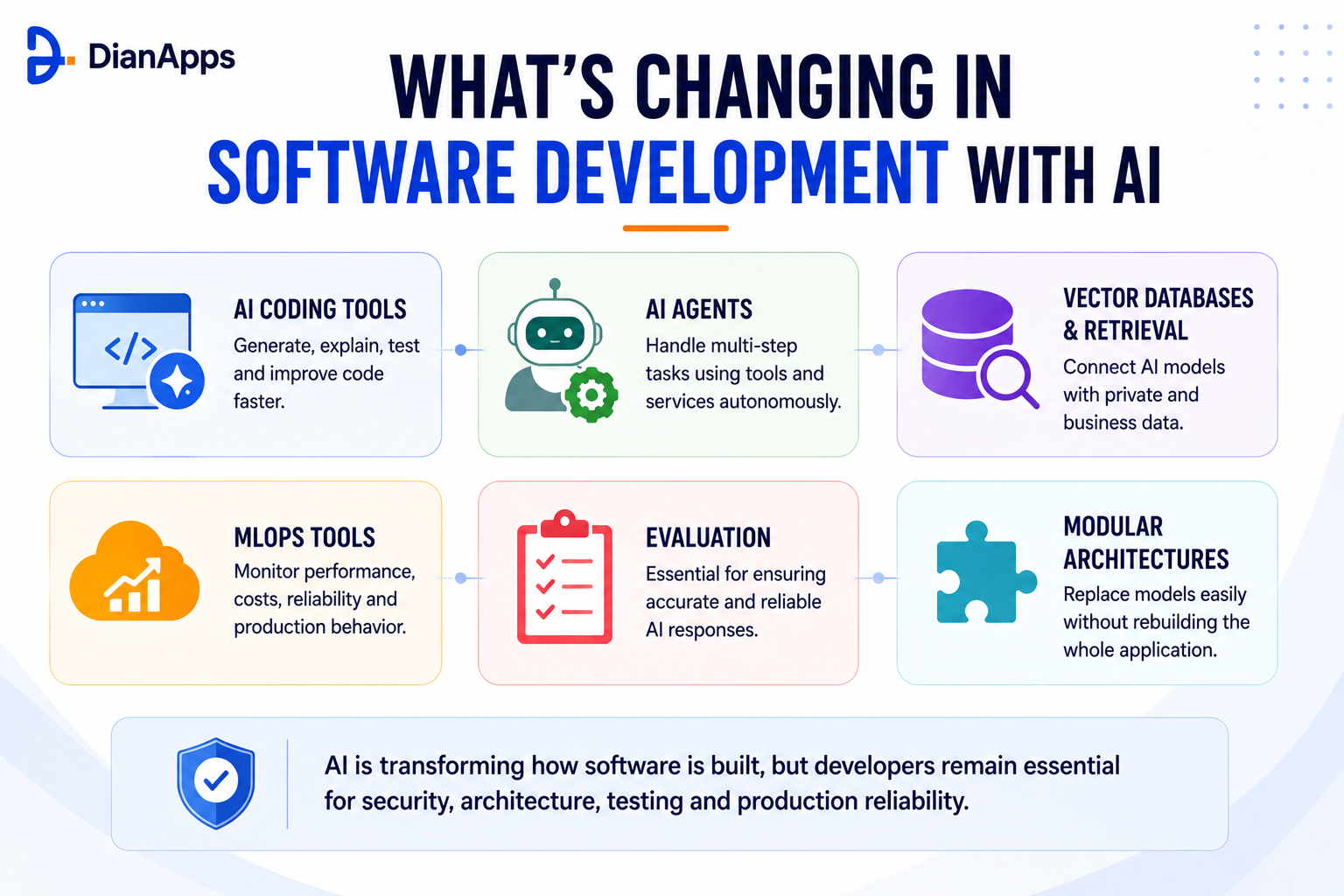
The modern applications combine the traditional software with AI models, retrieval systems, APIs and automation and this has expanded the AI development tech stack more than just databases, backend frameworks and frontend technologies.
Some of the important changes to note are:
- AI coding tools are helping developers generate, explain, test and improve application code.
- AI agents can perform multi step tasks by using approved tools and external services without any human intervention.
- Vector databases and retrieval systems connect AI models with private and business specific information.
- MLOps tools help teams monitor model performance, costs, reliability and production behavior.
- Evaluation has become essential because AI responses can vary across different inputs, models and situations.
- Modular architectures allow developers to replace models without rebuilding the complete application.
AI is changing the way a software/application is designed, tested, deployed and maintained, but the developers still remain important for security, architecture, testing and production reliability. The strongest generative AI tech stack combines AI capabilities with software engineering practices that are proven to be useful rather than replacing them entirely.
Need Help Building an AI Application?
We offer end-to-end AI development services for building secure, scalable, and user focused AI solutions.
Conclusion
The AI development tech stack is no longer limited to models and machine learning frameworks, because modern AI applications depend on connected data, backend, cloud, API and frontend technologies. Choosing the right combination of available technology helps teams build applications that remain reliable, scalable, secure and easier to maintain.
Python, modern backend frameworks, cloud platforms, vector databases, foundation models and frontend technologies each serve different roles within the stack. The best tech stack for AI development completely depends on application requirements, available expertise, data complexity, performance expectations and long term organisational goals.
Teams should prioritize flexible architectures that allow models and supporting technologies to evolve without rebuilding the entire application. A good stack can provide a better and stronger foundation for developing useful AI products while keeping future improvements manageable.
Read this far? Check out AI Development Services for a clearer idea of how modern tech stack influences AI App development.
 0 comments







Leave a Comment
Your email address will not be published. Required fields are marked *