















 0 comments





Key Takeaways:
- Adoption Is Nearly Universal: 88% of organisations are using AI in at least one function but only 39% are reporting any EBIT impact.
- The Market Is Scaling Fast: The global AI market is projected at USD 539 billion in 2026, heading toward USD 3.5 trillion by 2033 at a 30.6% CAGR.
- Agents Are The Defining Trend: 62% of organisations are experimenting with or scaling AI agents and 23% are actively scaling them.
- Developers Are All-In But Sceptical: 84% of developers are using or planning to use AI tools, yet 46% are not trusting the accuracy of the output.
- How Are The Trends Sorted: Evidence from primary research (Stanford AI Index, McKinsey, Gartner, Deloitte, MIT NANDA, Stack Overflow) plus what DianApps’ teams are seeing in client work.
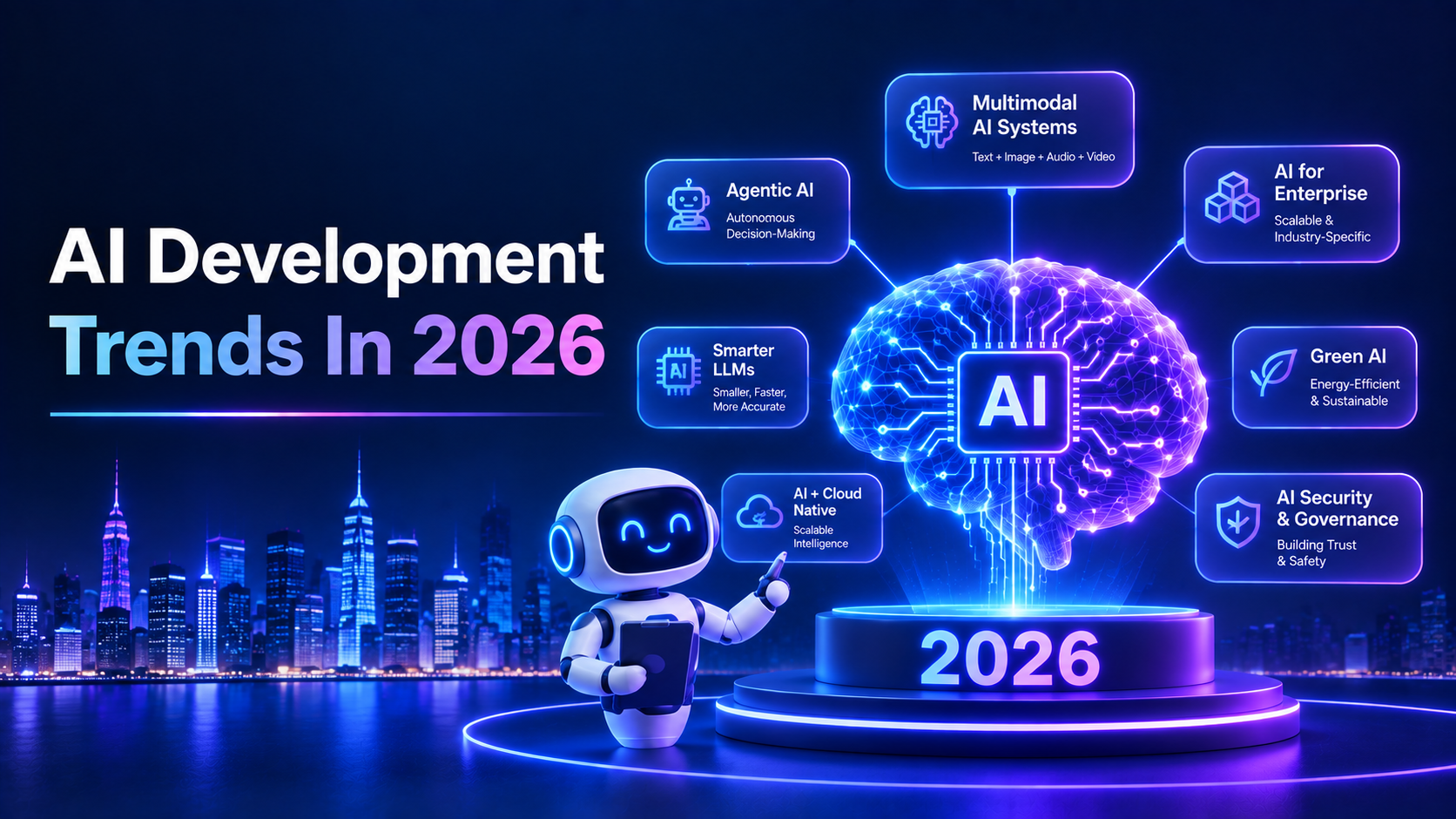
Quick Answer: The top AI development trends of 2026 are agentic AI moving into production, reasoning models trained with verifiable rewards, AI-native software development, domain-specific and small language models, open-weight models closing the frontier gap, multimodal and physical AI, on-device AI for mobile, AI security platforms, governance-by-design and real-time hyper-personalisation.
The AI development trends 2026 is bringing are less about new model launches and more about a hard question, why is nearly every company using AI while so few are seeing profit from it. Adoption is sitting at 88%, agent experimentation at 62% and yet only 39% of organisations are reporting any earnings impact.
This guide is walking through the 10 trends that are shaping how AI products are being built this year, what the primary data is saying about each and, most importantly, what each one is meaning for your product roadmap.
AI Development Market Stats In 2026
Before the trends, we must take a look at the numbers, the table below is collecting the AI development statistics 2026 planning is being built on, each with its source and year and it is the fastest way to ground any conversation about AI development trends 2026 in evidence.
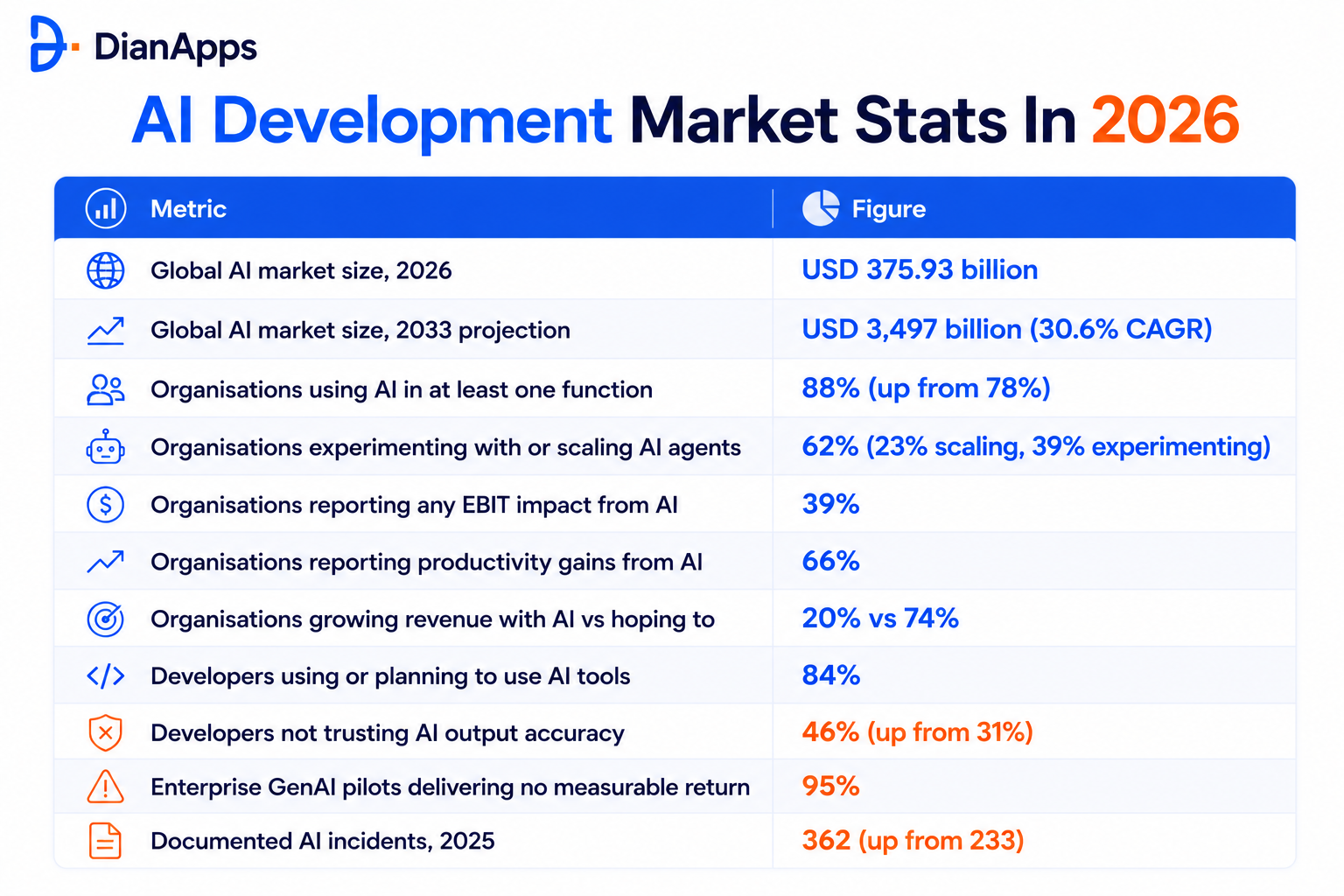
| Metric | Figure | Source, year |
| Global AI market size, 2026 | USD 375.93 billion | Fortune Business Insights, 2026 |
| Global AI market size, 2033 projection | USD 3,497 billion (30.6% CAGR) | Grand View Research, 2026 |
| Organisations using AI in at least one function | 88% (up from 78%) | McKinsey State of AI, 2025 |
| Organisations experimenting with or scaling AI agents | 62% (23% scaling, 39% experimenting) | McKinsey State of AI, 2025 |
| Organisations reporting any EBIT impact from AI | 39% | McKinsey State of AI, 2025 |
| Organisations reporting productivity gains from AI | 66% | Deloitte State of AI in the Enterprise, 2026 |
| Organisations growing revenue with AI vs hoping to | 20% vs 74% | Deloitte State of AI in the Enterprise, 2026 |
| Developers using or planning to use AI tools | 84% | Stack Overflow Developer Survey, 2025 |
| Developers not trusting AI output accuracy | 46% (up from 31%) | Stack Overflow Developer Survey, 2025 |
| Enterprise GenAI pilots delivering no measurable return | 95% | MIT NANDA, The GenAI Divide, 2025 |
| Documented AI incidents, 2025 | 362 (up from 233) | Stanford AI Index, 2026 |
The pattern across every dataset is the same, AI adoption statistics are near saturation while impact statistics are lagging by 40 to 50 points and closing that gap is what the 2026 trends are really about.
Also Read: What Is AI Development? A Complete 2026 Guide
What Is Driving the AI Development Trends of 2026?
Three forces are sitting underneath almost every one of the AI development trends 2026 is producing.
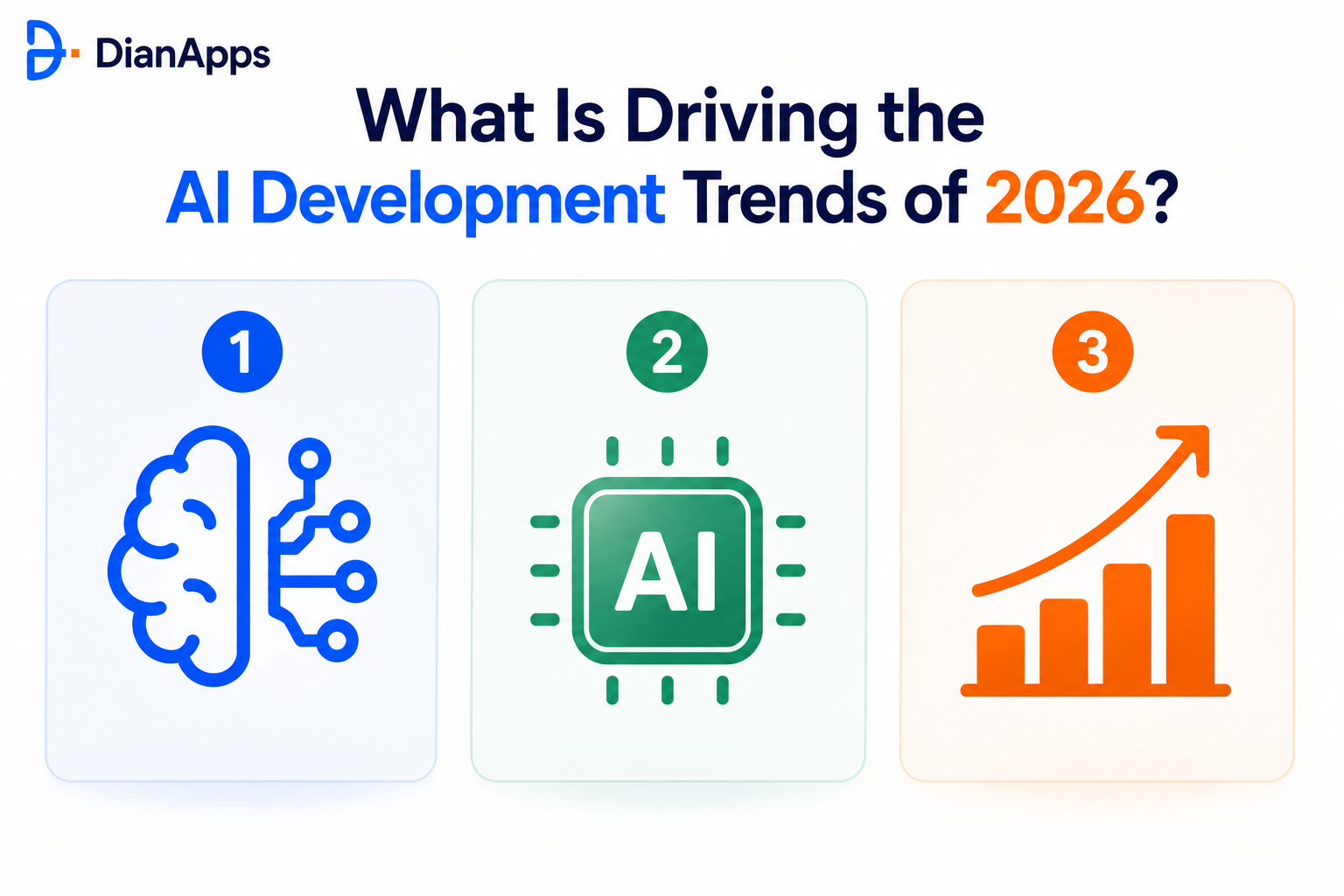
- Reasoning Models Are Making Agents Reliable: Models that are spending compute on “thinking” before answering, trained with reinforcement learning from verifiable rewards, are pushing agent benchmarks from 12% to 66% task success on OSWorld in a single year (Stanford AI Index, 2026).
- Inference Is Becoming Cheap Enough To Embed Everywhere: Falling per-token costs and capable small models are making it economical to put AI into every screen, including on the device itself.
- The Pilot Era Is Ending: After two years of experiments, boards are asking for revenue and margin and that pressure is favouring narrow, measurable, production-grade builds over broad demos.
In short, the future of AI development in 2026 is being defined by reliability, cost and accountability rather than by raw model size.
Also Read: Top Generative AI Development Companies in 2026
The 10 AI Development Trends to Watch in 2026
Each of the AI development trends 2026 below is following the same shape, what is happening, the evidence and what it is meaning for your roadmap.
1. Agentic AI Is Moving From Demos to Production
Agents, systems where the model is deciding which tools to call and in what order, are the headline among the top AI trends 2026 is producing. Multiagent systems are on Gartner’s list of top strategic technology trends for the year (Gartner, 2025) and 23% of organisations are already scaling agents in at least one function (McKinsey, 2025).
Reliability is the reason this is finally working. Agent success on real computer-use tasks jumped from 12% to 66.3% year on year and terminal-based task completion moved from 20% to 77.3% (Stanford AI Index, 2026).
- What It Means For Your Roadmap: Start with one narrow, high-volume workflow (support triage, document processing, internal ops), add human approval steps and tracing from day one and choose an agent framework that is making state explicit. Our comparison of the top LLM frameworks in 2026 is covering the options.
2. Reasoning Models and Verifiable Rewards Are Changing How Models Are Trained
The models behind those agents are getting better at multi-step problems because training is shifting from human preference feedback to reinforcement learning from verifiable rewards (RLVR), where the model is rewarded for answers that can be checked, such as passing tests or matching a maths solution.
The practical effect is that “test-time compute”, letting the model think longer on hard prompts, is becoming a dial developers are controlling per request.
- What It Means For Your Roadmap: Budget for variable latency and cost per call, route easy requests to fast models and hard ones to reasoning models and design UX that is comfortable with a few seconds of visible “thinking” when the task warrants it.
3. AI-Native Software Development Is Reshaping Engineering Teams
AI-native development platforms are among Gartner’s top trends, with the firm predicting that by 2030, 80% of organisations will be evolving large engineering teams into smaller, AI-augmented teams (Gartner, 2025). On the ground, 84% of developers are already using or planning to use AI tools and 31% are using coding agents specifically (Stack Overflow, 2025).
The catch is trust. 46% of developers are not trusting AI output accuracy, up from 31% a year earlier (Stack Overflow, 2025). Adoption is racing ahead of confidence.
- What It Means For Your Roadmap: Treat AI-generated code as a junior engineer’s pull request, non-negotiable review, tests and security scanning. Invest in evals for your own AI features the same way. Teams that are pairing speed with discipline are the ones shipping.
4. Domain-Specific and Small Language Models Are Winning Enterprise Workloads
Gartner is predicting that by 2028 more than half of the generative AI models enterprises use will be domain-specific (Gartner, 2025). Fine-tuned or purpose-built models for legal, medical, financial or retail language are outperforming general models on accuracy per dollar and small models are running where large ones cannot.
- What It Means For Your Roadmap: Stop defaulting to the largest frontier model for every feature. Evaluate a small or domain-tuned model for classification, extraction and retrieval-heavy tasks and reserve frontier models for open-ended reasoning.
5. Open-Weight Models Are Closing the Frontier Gap
Among the emerging AI technologies 2026 is normalising, open-weight models are perhaps the most consequential for cost and control. The performance gap between the best US and Chinese models has narrowed to 2.7 percentage points, down from 17.5 to 31.6 points in 2023 (Stanford AI Index, 2026) and even OpenAI is releasing open-weight gpt-oss models under Apache 2.0.
- What It Means For Your Roadmap: Open-weight models are giving you a credible path to self-hosting for privacy, sovereignty or cost reasons. Build with a model-agnostic framework so switching between hosted and open models is a configuration change not a rewrite.
A model-agnostic AI development tech stack can make it easier to switch between hosted and open-weight models without rebuilding the application.
6. Multimodal and Physical AI Are Expanding What Apps Can Perceive
Vision-language models that are reading screens, photos and video, plus voice in and out, are becoming default capabilities rather than premium add-ons. Gartner is listing physical AI, models that are perceiving and acting in the physical world, among the top strategic trends for 2026 (Gartner, 2025), although household robot task success is still only around 12% (Stanford AI Index, 2026).
- What It Means For Your Roadmap: For mobile teams the near-term win is camera and voice, letting users photograph a receipt, a product or a form and talk to the app about it. Physical AI is a 2027 and beyond bet for most product companies.
7. On-Device and Edge AI Are Becoming a Mobile Default
This is the trend most generative AI trends 2026 lists are missing and it is the one mobile teams are feeling most. Small models running on Apple, Qualcomm and Google silicon are enabling offline features, sub-100 millisecond latency and zero-token-cost inference for everyday tasks such as summarisation, classification and voice.
- What It Means For Your Roadmap: Adopt a hybrid architecture, on-device for latency-sensitive and privacy-sensitive features, cloud for heavy reasoning. Our guide to on-device AI vs cloud AI is going deeper on that split.
8. AI Security Platforms and Confidential Computing Are Becoming Mandatory
As agents are gaining permissions, the attack surface is growing. Gartner is predicting that by 2028 over 50% of enterprises will be using AI security platforms to protect their AI investments and that by 2029 more than 75% of operations in untrusted infrastructure will be secured in use by confidential computing (Gartner, 2025). Documented AI incidents rose to 362 in 2025 from 233 the year before (Stanford AI Index, 2026).
- What It Means For Your Roadmap: Add prompt-injection defences, tool-permission scoping, output validation and audit logs to your definition of done for any AI feature and expect enterprise buyers to ask for them in procurement.
9. Governance, Provenance and Regulation-by-Design
Governance is moving from a policy document to code. Gartner is flagging digital provenance as a strategic trend, warning that organisations lacking it will be open to sanction risks by 2029 (Gartner, 2025), while the Foundation Model Transparency Index fell to 40 points from 58 (Stanford AI Index, 2026). The EU AI Act’s obligations are phasing in through 2026 and 2027 and enterprise buyers are already asking vendors about compliance.
- What It Means For Your Roadmap: Build model cards, data lineage, human-override paths and content-provenance labelling into the product not around it. It is cheaper to design in than to retrofit.
10. Hyper-Personalisation and Real-Time Context Are Redefining UX
The last of the latest AI development trends is the quietest, apps are moving from demographic segments to individual intent, combining on-device signals, session context and LLM reasoning to adapt in real time. Retail, fintech, health and travel apps are leading and the same pattern is spreading to B2B software.
- What It Means For Your Roadmap: Start with one personalised surface (a home feed, a recommendation, a proactive nudge), measure lift against a control group and be transparent with users about what is being used and why.
Build Your AI Team
Hire experienced AI developers to turn emerging AI technologies into production solutions.
Trends Summary: Maturity, Impact and Your First Move
The table below is condensing all 10 AI development trends 2026 into a planning view for product and engineering leaders.
| Trend | Maturity in 2026 | Business impact | First move for product teams |
| Agentic AI in production | Production-ready for narrow workflows | High | Pick one workflow, add approvals and tracing |
| Reasoning models and RLVR | Production-ready | High | Route hard tasks to reasoning models, budget latency |
| AI-native development | Mainstream | High | Enforce review, tests and security scans on AI code |
| Domain-specific and small models | Scaling | High | Benchmark a small model against your frontier default |
| Open-weight models | Scaling | Medium-High | Build model-agnostic, pilot self-hosting |
| Multimodal and physical AI | Multimodal ready, physical emerging | Medium | Ship camera and voice features first |
| On-device and edge AI | Scaling on mobile | High for mobile | Hybrid on-device plus cloud architecture |
| AI security platforms | Early but urgent | High | Add injection defences and permission scoping |
| Governance and provenance | Early | Medium-High | Build model cards and lineage into the product |
| Hyper-personalisation | Mainstream | Medium-High | One personalised surface, measured against control |
If you are only choosing three for this year, choose production agents, AI-native development discipline and small or on-device models, they are the trends with the shortest path from investment to measurable return.
The AI ROI Reality Check: Why Most Pilots Still Fail?
The AI ROI statistics are sobering and any honest look at AI development trends 2026 is needing to say so. To know the AI development cost is equally important because model selection, infrastructure, data readiness and engineering complexity can determine whether an AI initiative produces measurable ROI.
- 95% Of Pilots Return Nothing: MIT’s NANDA initiative found that despite USD 30 to 40 billion in enterprise generative AI spending, 95% of organisations are seeing no measurable business return and only 5% of custom enterprise AI tools reach production.
- Impact Is Concentrated: Only 39% of organisations report any EBIT impact and the 6% of “high performers” attributing 5% or more of EBIT to AI are three times more likely to have redesigned workflows and three times more likely to have senior leadership commitment.
- Aspiration Is Outrunning Results: 74% of leaders hope AI will grow revenue, 20% say it currently is, while 66% are seeing productivity gains.
What is separating the 5% is not model access, everyone is having that, it is four practices:
- Workflow Redesign not Bolt-Ons: AI features that are wrapping an existing process rarely change the numbers, redesigned processes do.
- Narrow, Measurable Use Cases: One workflow with a baseline metric is beating ten demos with none.
- Evals And Observability From Week One: You cannot improve what you are not measuring and you cannot debug an agent you are not tracing.
- Buy Versus Build Discipline: General-purpose tools are being deployed by nearly 40% of organisations but custom enterprise builds are stalling in pilot far more often, build only where the workflow is truly yours.
Have an AI Idea? Let’s Talk
Discuss your AI use case with our experts and find the right path to production.
How DianApps Is Building for the 2026 AI Trends?
DianApps, an AI development company with 150+ engineers, 350+ clients across 25+ countries and a Clutch rating of 4.8/5 from 81+ reviews, is building the products the AI development trends 2026 are describing, agent back ends, RAG assistants, AI-native mobile and web apps and the DevOps that is keeping them running in production.
Our AI practice is spanning LLM development, generative AI, AI agents, conversational AI, ML, NLP and computer vision and our recent work is tracking the trends above closely, LangGraph agents with human-approval steps for operations teams, on-device summarisation and voice features in React Native and Flutter apps and domain-tuned small models for classification at a fraction of frontier cost.
What is setting DianApps apart is full-cycle ownership, the same team is designing the AI, the mobile and web experience, the backend and the deployment, with U.S.-based delivery for North American clients. We are also candid when custom AI is not the right move, if an off-the-shelf tool or a simple SDK call is solving the problem, we are saying so before you spend.
Turn AI Trends Into Products
Build production-ready AI solutions with the right models, frameworks and architecture.
Conclusion
The AI development trends 2026 is defined by are converging on one theme, moving from pilots that impress to systems that pay. Agents, reasoning models and AI-native development are production-ready, small and open-weight models are cutting cost, on-device AI is changing mobile and security and governance are becoming table stakes. The market is heading toward USD 539 billion this year but the 39% EBIT figure is the number that should be shaping your roadmap.
Choose two or three AI development trends 2026 offers with a measurable payback, redesign the workflow rather than bolting AI onto it and instrument everything. If you want a partner that has shipped across these trends, talk to DianApps’ AI development team.
Frequently Asked Questions
What are the top AI development trends in 2026?
- The top AI development trends in 2026 are agentic AI in production, reasoning models trained with verifiable rewards, AI-native software development, domain-specific and small language models, open-weight models, multimodal and physical AI, on-device AI, AI security platforms, governance-by-design and real-time hyper-personalisation.
What is the AI market size in 2026?
- The AI market size 2026 estimates are putting at about USD 539 billion, growing to roughly USD 3.5 trillion by 2033 at a 30.6% compound annual growth rate (Grand View Research, 2026). Corporate AI investment reached USD 581.7 billion in 2025, up 130% year on year (Stanford AI Index, 2026).
What percentage of companies are using AI in 2026?
- 88% of organisations are using AI in at least one business function, up from 78% a year earlier and 62% are experimenting with or scaling AI agents (McKinsey State of AI, 2025). However, only 39% are reporting any EBIT impact, so adoption is far ahead of measurable value.
What are the biggest generative AI trends in 2026?
- The biggest generative AI trends in 2026 are agents that act rather than just answer, reasoning models, domain-specific and small models, open-weight models under permissive licences, multimodal input and output and generative features running on-device. Governance and provenance for generated content are rising alongside them.
Are AI agents ready for production in 2026?
- Yes for narrow, well-instrumented workflows with human approval steps. 23% of organisations are already scaling agents and agent task success on real computer-use benchmarks reached 66.3% (McKinsey, 2025; Stanford AI Index, 2026). Fully autonomous agents on open-ended, high-stakes tasks are still needing human oversight.
What is the ROI of AI for businesses in 2026?
- AI ROI is real but concentrated. 66% of organisations report productivity gains and 40% report cost reduction (Deloitte, 2026), yet only 39% report EBIT impact (McKinsey, 2025) and MIT NANDA found 95% of enterprise GenAI pilots deliver no measurable return. Workflow redesign and narrow use cases are separating winners.
Which emerging AI technologies should developers learn in 2026?
- To keep pace with AI development trends 2026, developers should prioritise agent frameworks and tool calling, evaluation and observability tooling, retrieval-augmented generation, small and open-weight model deployment, on-device inference for mobile and AI security practices such as prompt-injection defence. These skills are mapping directly to where teams are hiring and shipping.
What is the future of AI development beyond 2026?
- Beyond 2026, expect multiagent systems coordinating across enterprises, more than half of enterprise models being domain-specific by 2028, wider confidential computing and physical AI moving from labs into logistics and manufacturing (Gartner, 2025). The direction is toward reliable, specialised and accountable AI rather than ever-larger general models.
 0 comments












Leave a Comment
Your email address will not be published. Required fields are marked *