















 0 comments




Key Takeaways :
- PyTorch is well suited for research, experimentation, custom architectures and flexible training workflows.
- TensorFlow offers a broader ecosystem for data pipelines, distributed training, optimization and production deployment.
- Performance depends on the model, hardware, batch size, training setup and optimization methods rather than the framework alone.
- Accuracy is mainly affected by the model architecture, dataset, optimizer, learning rate and training configuration.
- Memory usage and training time depend on factors such as batch size, model complexity, precision, GPU memory and data-loading efficiency.
- PyTorch and TensorFlow can both support NLP, computer vision, reinforcement learning, GPU acceleration and large-scale deep learning workloads.
- The best framework depends on the project’s technical requirements, existing infrastructure, team expertise and final deployment environment.
Quick Answer :
PyTorch is generally a better choice for research, experimentation, custom architectures and flexible training workflows, while TensorFlow is a strong option for production-focused projects that need structured data pipelines, distributed training and established deployment tools. Both frameworks offer GPU acceleration and can handle demanding deep learning workloads, so the right choice depends on the model, hardware, development workflow, team experience and deployment requirements.
Tensorflow and PyTorch, both seem identical at first glance, having dynamic developer communities, open source and free. They help simplify the process of creating neural networks and deploying AI applications, however, their approaches, features, limitations and development methods differ in various ways. Knowing the differences in TensorFlow vs PyTorch can help developers choose the one that would work best for their project, workflow and deployment needs.
In this blog, you will understand the differences, strengths, weaknesses, performance, accuracy, memory usage and the best framework between Tensorflow and PyTorch.
TensorFlow vs PyTorch 2026 Market Stats
In May 2026, there were three major updates that discuss the PyTorch vs TensorFlow data points that one must know before going forward.
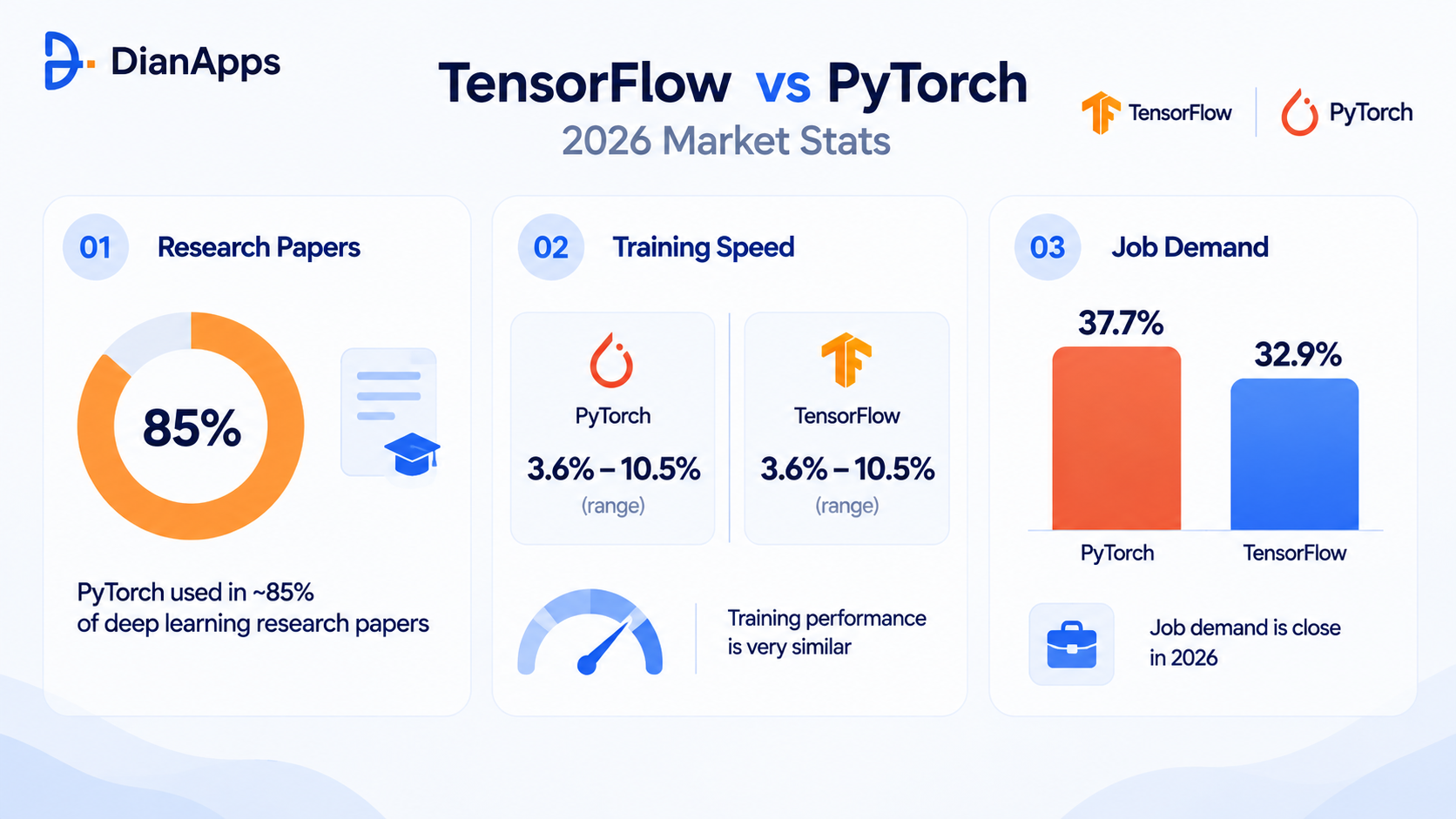
- PyTorch is used in about 85% of deep learning research papers published at top research venues, according to JetBrains’ May 2026 analysis.
- The training speed difference is not so huge and ranges between 3.6% to 10.5% in standardized 2026 tests. JetBrains found that for most real-world workloads the training performance of PyTorch and TensorFlow is very similar.
- Job demand is also fairly close in 2026 with PyTorch appearing in 37.7% of job postings compared with 32.9% for TensorFlow, this shows that while PyTorch leads in research, the job market is much more evenly divided.
What Differentiates TensorFlow and PyTorch?
The two widely used frameworks for developing and training deep learning models are TensorFlow and PyTorch but they are completely different in how they approach model development, experimentation, deployment and performance optimization. Both TensorFlow and PyTorch provide the required tools for building neural networks and supporting AI applications but their design lets developers experience development differently.
TensorFlow
One of the main things that sets TensorFlow apart is the infrastructure available around the model. This becomes useful when the project requires large datasets, distributed training, optimization and deployment rather than stopping after a model has been trained successfully. With tf.keras, developers can define anything from a simple sequential network to a more complicated model with custom layers, while tf.data provides a way to build input pipelines that can load, transform, batch and prefetch data during training. The execution model is also worth understanding as TensorFlow can run operations during development but can trace functions with tf.function and execute them as graphs when that is beneficial for optimization.
Training can be distributed through tf.distribute and the resulting model can then be served through TensorFlow Serving or adapted for constrained environments with TensorFlow Lite.
In other words, TensorFlow’s advantage is not necessarily a particular layer or algorithm but the fact that many of the pieces required to take a deep learning model from experimentation to production are available within the same ecosystem.
Strength and Weakness Of TensorFlow
TensorFlow starts to make more sense when you look at what happens after a model has been written. The framework gives developers a collection of tools for the parts that usually surround model training, including preparing datasets, handling large workloads, distributing computation resources and getting a trained model ready for use outside the development environment. A project can use tf.keras for defining the network, tf.data for feeding and transforming data and tf.distribute when training needs to run across more than one device.
There are also separate options for serving models and running them on smaller devices, which means the framework can continue to be useful as a project moves from experimentation toward production.
That wider scope is useful but it also changes the learning experience, someone building a straightforward neural network may only touch a small part of TensorFlow, while a developer working on a larger system eventually has to understand how its different execution modes and APIs fit together. Concepts such as tf.function, graph execution, input pipelines and distributed training can take some time to become familiar, particularly when something does not behave as expected.
TensorFlow Strengths
- Ecosystem Benefits: Data pipelines, model APIs, distributed training, optimization and deployment are all covered by the TensorFlow ecosystem, which can save engineering time as a project grows.
- Production Deployment: TensorFlow Serving provides a route for serving trained models, while TensorFlow Lite is designed for situations where the model needs to run on mobile or resource-constrained hardware.
- Works With Serious Computing Workloads: GPU and TPU support gives TensorFlow room to handle models that would be impractical to train efficiently on a CPU alone, particularly when combined with distributed training.
- Execution: Eager execution is convenient while developing and debugging, whereas tf.function can be used when converting suitable code into an optimized graph is worth it.
TensorFlow Weaknesses
- Framework Knowledge: Getting a basic model running is not especially difficult but things become less obvious when tf.data, custom training loops, graph execution and distributed training start appearing in the same project.
- Graph-Based Execution: A problem inside code wrapped with tf.function may require you to understand what TensorFlow traced and optimized rather than looking only at the Python code that was originally written.
- Custom Implementations: tf.keras makes standard architectures convenient but developers working on unusual layers, loss functions or training procedures may eventually need to work directly with TensorFlow operations.
- Un-Optimized Size For Small Projects: If the project only requires a straightforward model and a short training script, a large production-oriented ecosystem may introduce concepts and configuration that the project does not really need.
PyTorch
With PyTorch, the development experience tends to revolve more around the model and the code controlling it, which is particularly useful when the architecture or training procedure is still being changed and tested. A neural network is normally represented through torch.nn.Module, where the layers are declared and the computation performed in forward() can contain ordinary Python logic alongside tensor operations. Because execution happens eagerly an intermediate tensor can be inspected at the point where it is created and a debugger can step through the forward pass in much the same way it would with other Python programs.
PyTorch’s autograd system records the operations performed on tensors that require gradients and uses that recorded computation to calculate derivatives during backpropagation removing the need to manually derive and implement gradients for each layer. Device management is also explicit, so code commonly selects a CPU or CUDA device and moves the model and input tensors accordingly with .to(device). When a working model needs faster execution, torch.compile() can optimize supported workloads, while DistributedDataParallel provides the machinery needed to train across multiple GPUs.
The result is a framework that gives developers a fairly direct view of what their training code is doing while still providing the tools required for much larger workloads.
Strength and Weakness Of PyTorch
The advantage becomes obvious when the model is still experimental but there is another side to it. PyTorch gives developers a lot of control over the training process, which means they also have to make decisions about data loading, device placement, optimization and the way the finished model will be deployed. For a research project, that flexibility can save time for a production application, it can mean more work outside the model itself.
PyTorch Strengths
- Works Naturally With Python: A model is written with familiar Python classes and functions, so custom logic can be added without having to work around a separate model-definition system.
- Debugging Is Easier: Tensor values, shapes, gradients and layer outputs can be checked while the program is running, which is useful when tracking down a problem inside a training loop.
- Custom Training: The developer controls the training loop, making it possible to change how losses are calculated, gradients are handled or optimization steps are performed.
- Scaling Options: CUDA support handles GPU computation, while torch.compile() and DistributedDataParallel provide ways to improve execution and move training across multiple GPUs when required.
PyTorch Weaknesses
- Workflow: PyTorch provides the core pieces for deep learning but decisions around datasets, training pipelines, device management and experiment management are often left to the team.
- Best Performance Takes Work: A model running on a GPU is not necessarily an efficient model, since batch size, precision, data loading, memory consumption and the architecture itself all affect performance.
- Deployment Depends On The Application: A model intended for an API server has different requirements from one running on an edge device, so the deployment approach has to be selected around the actual inference environment.
- Surrounding Stack Can Grow: Once a project involves distributed training, experiment tracking, monitoring, model serving and orchestration, PyTorch usually becomes one component of a broader machine learning stack rather than the complete solution.
TensorFlow vs PyTorch: Model Definition
PyTorch Code :
|
1 2 3 4 5 6 7 8 9 10 11 12 13 14 15 16 17 18 19 20 21 22 23 24 25 26 27 28 29 30 31 32 33 |
import torch import torch.nn as nn class NeuralNetwork(nn.Module): def __init__(self): super().__init__() self.layers = nn.Sequential( nn.Linear(784, 128), nn.ReLU(), nn.Linear(128, 10) ) def forward(self, x): return self.layers(x) model = NeuralNetwork() print(model) |
TensorFlow Code :
|
1 2 3 4 5 6 7 8 9 10 11 12 13 14 |
import tensorflow as tf model = tf.keras.Sequential([ tf.keras.layers.Dense(128, activation="relu", input_shape=(784,)), tf.keras.layers.Dense(10) ]) model.summary() |
TensorFlow’s Sequential/Keras approach is more declarative for this simple architecture. PyTorch explicitly defines the model class and forward() method, giving more control over the computation flow.
Comparing PyTorch vs TensorFlow
When we look at TensorFlow and PyTorch separately we get a clear idea of what each framework offers but choosing between them becomes more difficult when both are used for the same type of deep learning project. Performance, accuracy, training time, memory consumption and ease of development can vary depending on the model, dataset, hardware and way the framework is configured, so comparing them on a single factor would not give a complete picture.
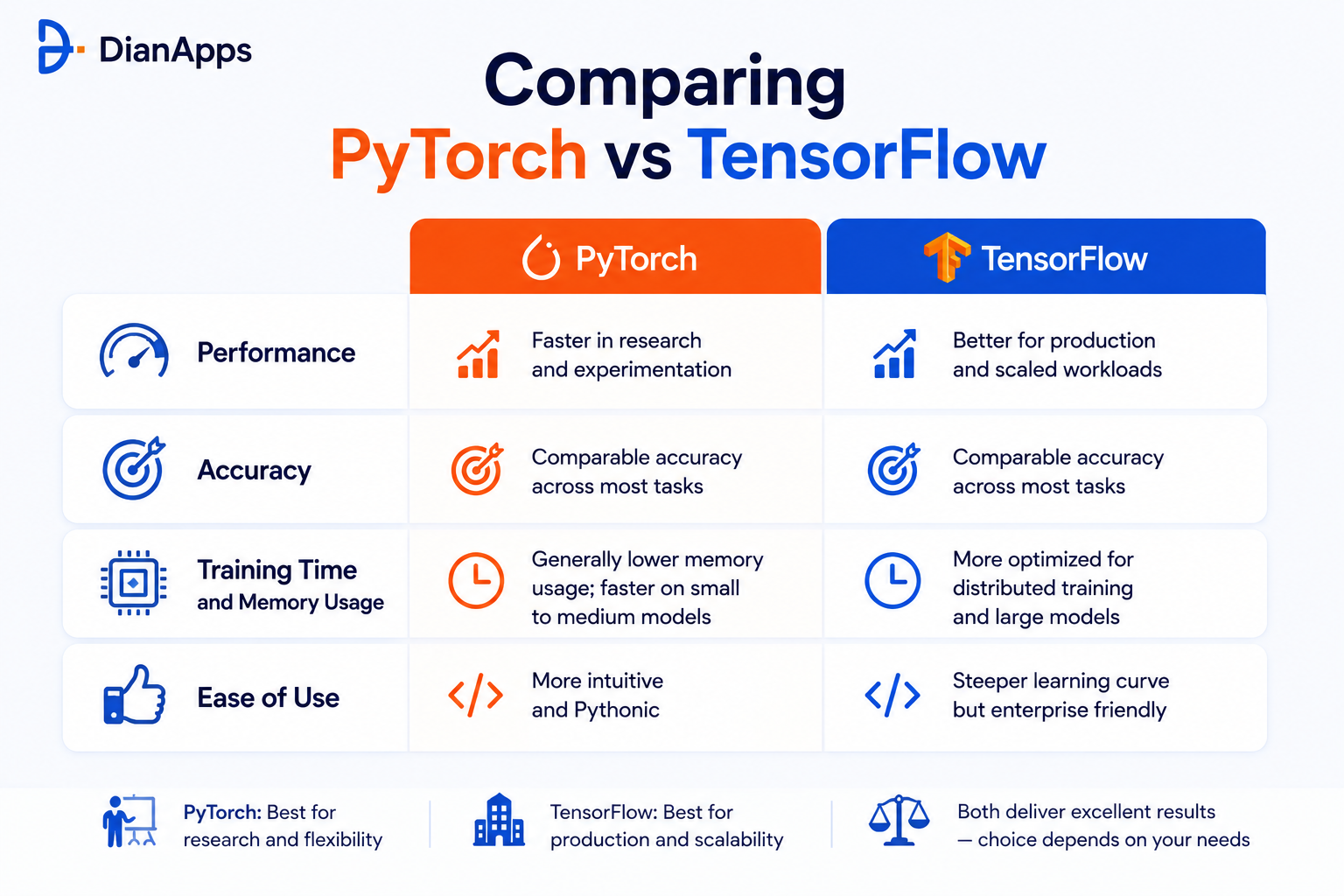
In this section, we will compare PyTorch vs TensorFlow across the areas that can have the biggest impact on real-world deep learning development.
| Comparison area | PyTorch | TensorFlow |
| Model development | Flexible model definition through torch.nn.Module and standard Python code | High-level development through tf.keras with access to lower-level TensorFlow APIs |
| Execution model | Eager execution by default, with torch.compile() available for optimization | Eager execution with graph-based execution available through tf.function |
| Automatic differentiation | torch.autograd tracks operations and calculates gradients automatically | tf.GradientTape records operations for automatic gradient calculation |
| Data handling | Dataset and DataLoader provide control over loading and batching | tf.data provides pipelines with batching, mapping, caching and prefetching |
| GPU acceleration | CUDA support with explicit device management through torch.device and .to(device) | GPU support with TensorFlow handling device placement and execution |
| Distributed training | DistributedDataParallel and torch.distributed for multi-GPU and multi-node training | tf.distribute for distributing training across GPUs, machines and TPUs |
| Optimization | torch.compile() can optimize supported models and workloads | tf.function and graph execution can optimize suitable workloads |
| Debugging | Direct tensor inspection and standard Python debugging work naturally with eager execution | Eager execution simplifies debugging, while graph tracing can add complexity |
| Deployment | Deployment approach depends on the target runtime, hardware and application requirements | Dedicated options include TensorFlow Serving and TensorFlow Lite |
| Best suited for | Research, experimentation, custom architectures and flexible training workflows | Production pipelines, large-scale workloads and applications requiring an established deployment |
Performance
Performance is one of the areas where the PyTorch vs TensorFlow comparison becomes interesting because neither framework stays ahead in every situation. The result can change depending on the model being trained, the hardware being used, the batch size, the amount of data and whether you are measuring training or inference. Both frameworks can use GPU acceleration but the way they optimize execution is different. PyTorch uses torch.compile() to optimize supported models, while TensorFlow can use tf.function to trace Python functions and run them through its graph-based execution.
Because of this, a useful benchmark needs to keep the model, dataset, hardware and training configuration the same on both sides rather than comparing numbers taken from unrelated tests.
Accuracy
It would be misleading to say that PyTorch produces more accurate models than TensorFlow, because the framework is only one part of what determines the final result. The architecture, quality of the dataset, preprocessing, optimizer, learning rate, batch size and number of training steps usually have a much larger effect on accuracy. Even when the same model is implemented in both frameworks, the final numbers may not be exactly identical because initialization, numerical precision and individual operator implementations can differ.
For that reason, accuracy is better compared through a controlled experiment where both frameworks are given the same conditions rather than treated as a built-in advantage of either one.
Training Time and Memory Usage
Training time and memory usage can change quite a bit once the model and dataset become larger. A bigger batch may improve throughput but consume more VRAM, while a smaller batch reduces memory pressure at the cost of processing fewer samples at once. The optimizer also matters because it needs to maintain additional information for the parameters and activations from the forward pass have to remain available when gradients are calculated. Both PyTorch and TensorFlow support GPU acceleration and mixed-precision training but the actual memory footprint will depend on how the model and training pipeline are implemented.
In PyTorch, for example, torch.cuda.memory_allocated() and torch.cuda.memory_reserved() can be used to inspect CUDA memory during training, while nvidia-smi gives a broader view of GPU usage.
Ease of Use
Ease of use depends on what the developer needs from the framework rather than which framework has fewer APIs. PyTorch tends to be straightforward when the work involves custom models or an experimental training process because the model, tensors and training loop can be written using normal Python code and inspected while they execute. TensorFlow has a similar starting point through tf.keras, where common architectures can be built without working directly with low-level operations but the learning curve changes when the project starts using tf.data, tf.function, distributed training or TensorFlow’s deployment tools.
Someone experimenting with a new architecture may therefore prefer the directness of PyTorch, while a team building a larger machine learning pipeline may find TensorFlow’s wider ecosystem more useful.
Need Help Building an AI Solution?
If you need help turning an AI idea into a production-ready solution, our AI development team can help
Applications And Use Cases Of PyTorch vs TensorFlow
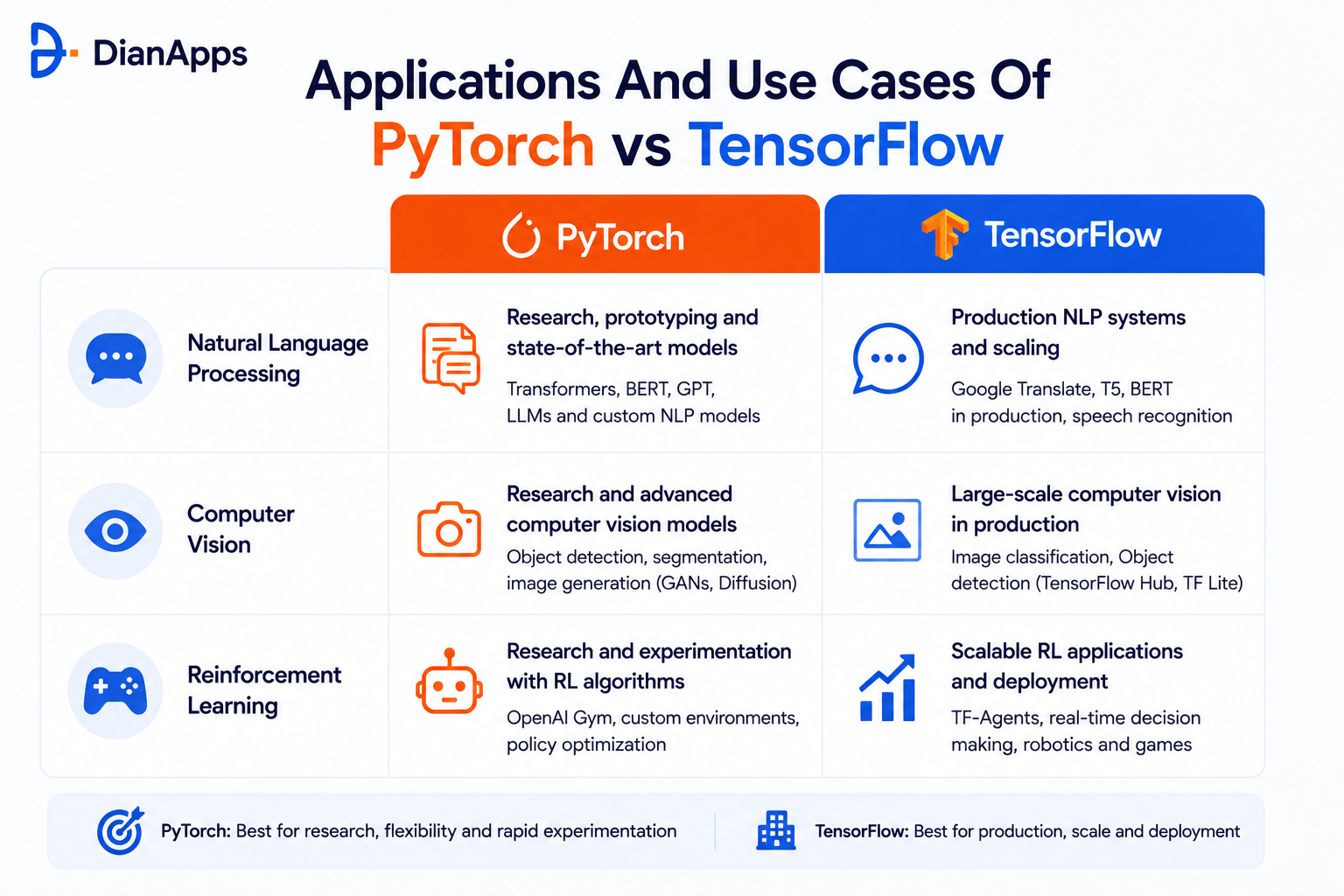
Both frameworks can be used across a wide range of AI applications, so the decision is usually not about whether PyTorch or TensorFlow can handle a particular workload. The more useful question is how the framework fits the way the model will be developed, trained and deployed.
Natural Language Processing
Natural Language Processing has become heavily focused on transformer-based models where training can involve large datasets and substantial GPU resources. PyTorch is widely used for this kind of work and fits naturally with libraries such as Hugging Face Transformers, making it convenient to fine-tune existing language models or experiment with new architectures. TensorFlow can handle the same type of models through Keras and its wider training ecosystem, including distributed training when the workload needs to scale. For teams spending more time experimenting with language models, PyTorch is often a practical choice, while TensorFlow can fit well when NLP models need to connect with an existing production setup.
Computer Vision
Object detection, segmentation, image generation, image classification and vision transformers can all involve different model architectures and training requirements. PyTorch makes it relatively easy to modify these architectures and build custom training pipelines, which is useful when experimenting with a new computer vision model. TensorFlow provides similar capabilities through Keras and its supporting ecosystem, with an additional advantage when a trained model needs to move toward mobile or edge deployment.
Reinforcement Learning
Reinforcement learning works differently because the model learns by interacting with an environment rather than simply learning from a fixed collection of labelled examples. This means writing custom logic around policy networks, value functions, rewards and environment interactions. PyTorch’s flexible training workflow fits this style of development well, particularly when the algorithm is still being experimented with. TensorFlow can also train the neural networks used in reinforcement learning but the surrounding RL library and environment can have a greater influence on the overall development experience than the choice of framework alone.
PyTorch vs TensorFlow: What’s Best For You?
Picking up the best framework between PyTorch vs TensorFlow is easier when you have the actual requirements of the project, instead of trying to decide which framework is better you must choose the one that will fit your needs the most. The type of model you are developing , experiments involved, available GPU/TPU resources, your development team’s experience, existing machine learning stack and the environment where the model being trained will run decides which framework would work the best for you.
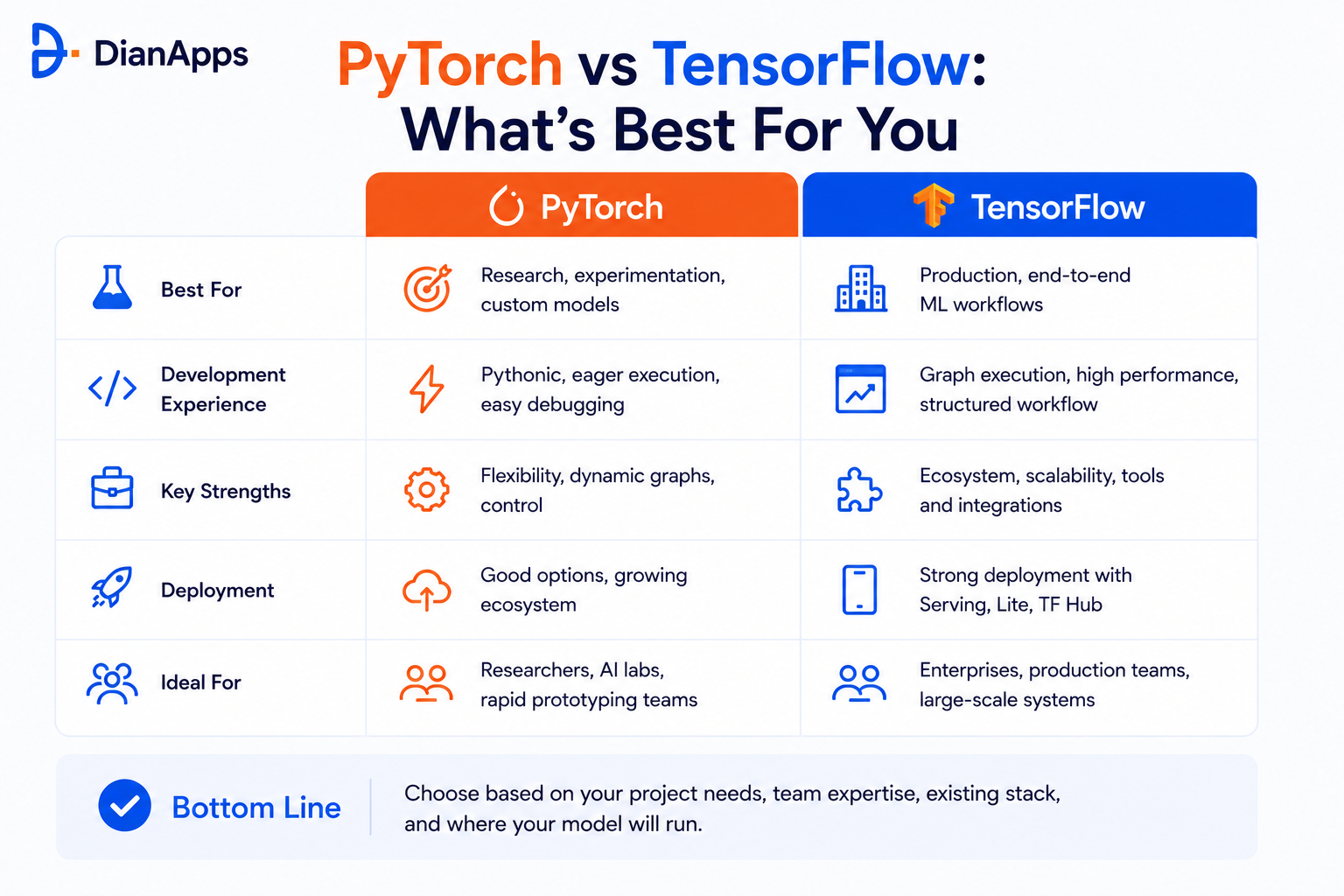
You must go for PyTorch if the development process includes custom architectures, experimental models or training process that needs to be changed regularly since Python based API, eager execution and automatic differentiation allows the developers to work directly with the model and inspect what is actually happening during the execution. Features such as torch.nnModule, torch.Autograd, CUDA support, torch.compile() and DistributedDataParallel provides enough control to move from a small experiment to larger training workloads without changing the basic development approach.
TensorFlow becomes more appealing when the project needs a wider set of tools around the model, particularly when data processing, distributed training, optimization and deployment are all part of the same workflow. Components such as tf.data, tf.distribute and tf.function cover important parts of the training process, while TensorFlow Serving and TensorFlow Lite provide established options when the trained model needs to be served through an application or deployed to mobile and edge hardware.
The existing AI development tech stack should also be considered before making the final choice, because moving to another framework can introduce unnecessary work when the team already has working models, libraries, deployment processes and infrastructure built around one of them. A research team experimenting with a new transformer architecture may get more value from PyTorch’s flexible development workflow, while a team maintaining a large production pipeline may have stronger reasons to stay with TensorFlow, making the requirements of the project a more useful deciding factor than a general claim about which framework is better.
Have an AI Project in Mind?
Planning a new AI product, improving an existing application or looking to integrate AI into your business workflow, our team can help you turn the idea into reality.
Final Thoughts
The PyTorch vs TensorFlow comparison completely depends on the project and its requirements. PyTorch offers flexibility for experimentation, custom architectures and changing training workflows, while TensorFlow provides a broader ecosystem for structured pipelines, distributed training and deployment. Both can handle demanding deep learning workloads so the practical choice should come from the model requirements, available hardware, development team’s experience and how the trained model will be used in production.
Contact DianApps for AI Development Services
FAQs
Is PyTorch better than TensorFlow in 2026?
- PyTorch is known to be better than TensorFlow for research, generative AI and prototyping while TensorFlow remains superior for large scale enterprise production, remote deployment and memory limited environment.
Which is easier to learn, PyTorch or TensorFlow?
- New learners say PyTorch has an easier learning curve because it is similar to Native Python and also allows step-by-step debugging while TensorFlow is easier to build standard routine models very quickly if high quality Keras APIs are used.
Do companies use PyTorch or TensorFlow in production?
- Both PyTorch and TensorFlow are heavily used in production by companies with both dominating different sectors and types of enterprise applications.
Is TensorFlow dying?
- TensorFlow is not dead but it is no longer a dominant force in machine learning as majority of new research papers and LLMs are built and released in PyTorch however TensorFlow still is heavily entrenched in enterprise production.
Which is faster, TensorFlow or PyTorch?
- None of the TensorFlow or PyTorch is faster than one another as performance depends on the models used, hardware and workflow phase. PyTorch usually wins on raw developer iteration speed and single-CPU training while TensorFlow performs well in large Scale, multi-GPU/TPU infrastructure.
 0 comments













Leave a Comment
Your email address will not be published. Required fields are marked *