














 0 comments





Key Takeaways:
- Salesforce’s Education Data Architecture (EDA) already covers much of the core student data model, so rebuilding it is usually unnecessary.
- Custom development is most valuable for student portals, fee calculators, timetabling, advising workflows, regulatory reporting and SIS integrations.
- The SIS should generally remain the system of record, while Salesforce manages relationships, applications, engagement and support.
- Accessibility, particularly WCAG, needs to be included from the beginning rather than retrofitted later.
- Education projects must account for FERPA, data protection, SEVIS and accessibility requirements.
- Academic deadlines create major traffic spikes, so portals should be designed for peak application and enrollment periods rather than average usage.
- Consider EDA’s BSD-3 licensing and “as is” status when deciding how much custom functionality to build around it.
Quick Answer: EDA already has the student data model; extend it, don’t rebuild it. But know that EDA is an open-source package with no warranty, not a supported product – and Salesforce has newer native models arriving. Real custom development here is applicant portals, fee calculators, timetabling logic, and SIS integration. The SIS stays the system of record; Salesforce rarely replaces it.
Education has one of the most complete data models Salesforce offers and one of the least understood licensing arrangements.
The Education Data Architecture (EDA) provides Contact and Administrative Account, Affiliation, Application, Program Enrollment, Course Connection, Term, Academic Certification, and more. It’s the backbone of Education Cloud, and it covers the full K-20 student journey.
It’s also an open-source package licensed under BSD-3 and provided “as is,” which means your Salesforce Master Subscription Agreement doesn’t apply to it. That’s a genuine consideration when you’re deciding how much to build on top, and it appears in almost no agency content.
Where Standard Salesforce Stops for Education
Sales Cloud assumes a customer and a deal; education assumes something structurally different: a person with many roles over decades – enquirer, applicant, student, alumnus, donor, sometimes parent of the next student – connected to departments, programmes, courses and other people.
- EDA Closes Most Of That Gap: Its Contact-and-Administrative-Account model, Affiliations and Relationships handle exactly that: who someone is, which organisations they’re connected to, and how they relate to other people.
- What It Doesn’t Close: Is your admissions process, your fee structure, your regulator’s reporting format, and the Student Information System that actually holds the enrolment record. That’s where development starts.
Don’t Rebuild What EDA Gives You
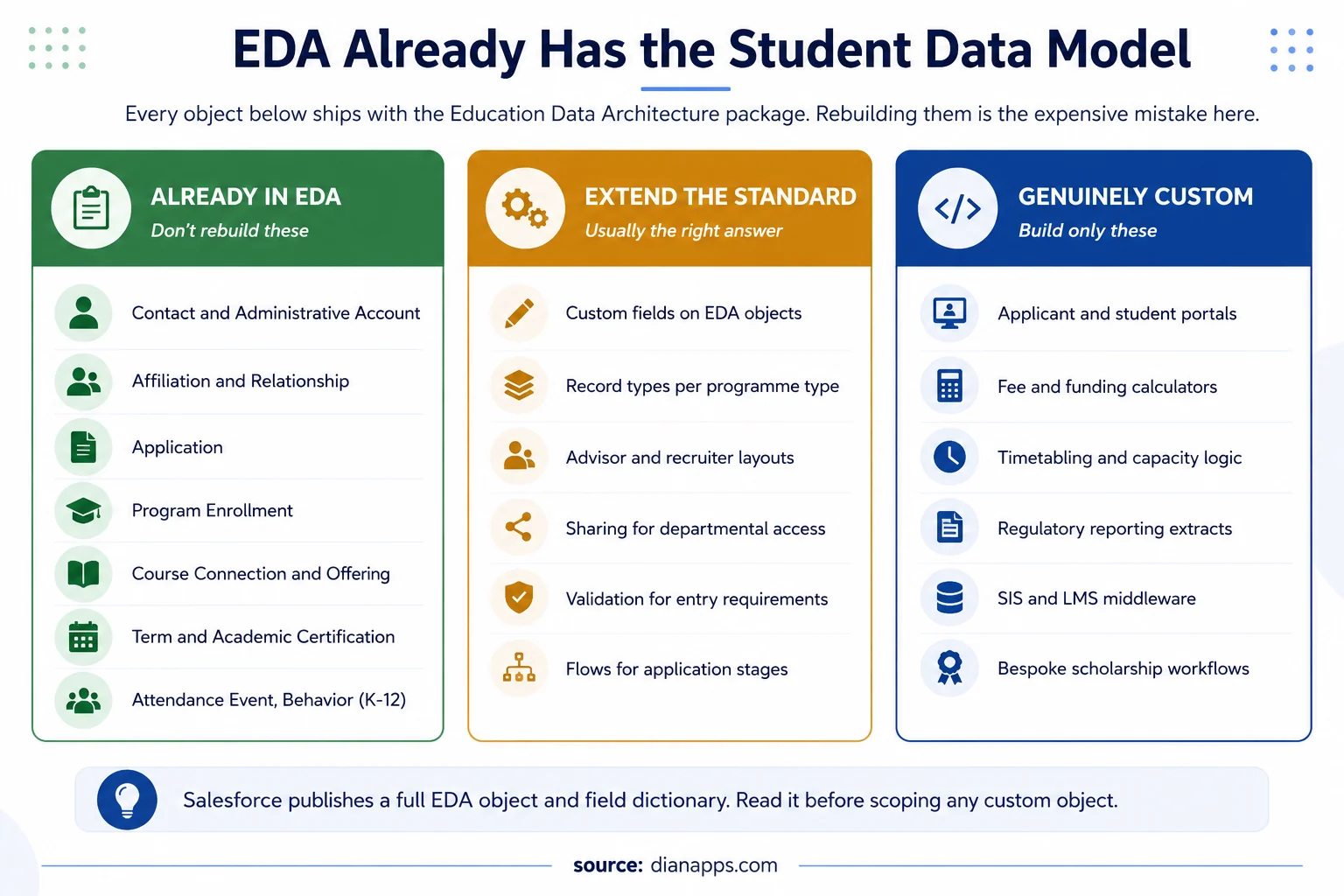
Three-column comparison showing what is already in the Education Data Architecture, what should be extended, and what genuinely needs custom building
Salesforce publishes a full EDA object and field dictionary. Read it before scoping a single custom object – the model is more complete than most people expect, particularly around relationships and affiliations.
- K-12 Institutions Get More. The K-12 Architecture Kit adds Attendance Event, Behavior Involvement and Behavior Response, plus school-specific page layouts.
- The Honest Exception: Genuinely unusual structures – non-standard academic calendars, complex partner-delivery models, or vocational qualification frameworks that don’t map to terms and courses. Architect conversations, not assumptions.
EDA already covers much of the core student data model, so the better approach is to use Salesforce low-code development for configuration and standard workflows, reserving custom development for genuinely unusual academic structures.
Related: The Salesforce data model explained · Configuration vs customization
The EDA Licensing Caveat Nobody Mentions
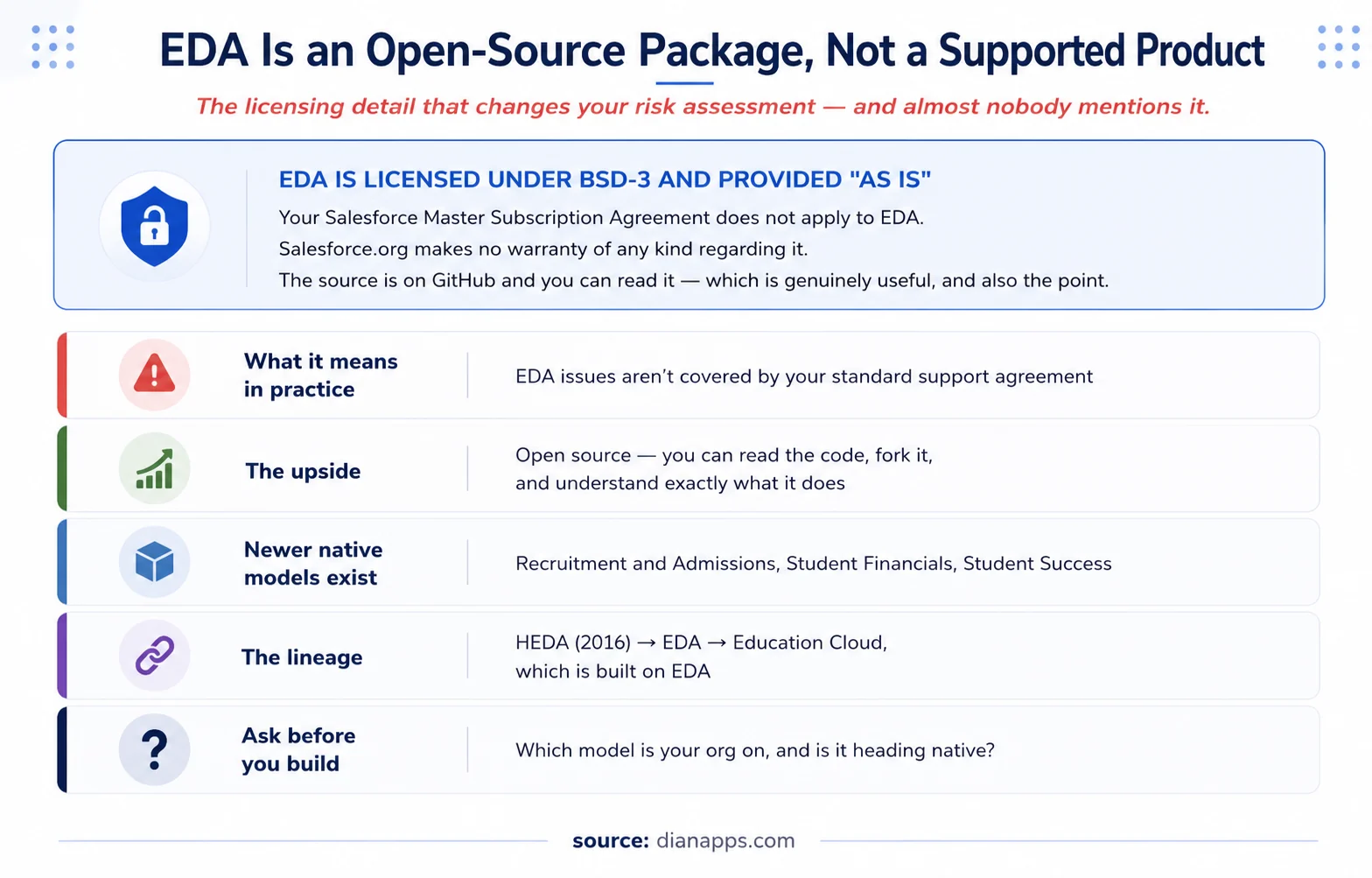
Diagram explaining that EDA is licensed under BSD-3 and provided as is, with the practical implications and the lineage from HEDA to Education Cloud
EDA is open source, licensed under BSD-3, and explicitly provided “as is.” Salesforce.org states that your Master Subscription Agreement does not apply to it and makes no warranty of any kind.
What That Means Practically:
- EDA-specific Issues Aren’t Covered By Your Standard Salesforce Support Agreement: Community and partner support carries more weight here than in other industry clouds.
- The Upside Is Real Too: The source is on GitHub. You can read exactly what the automation does, which is more than you can say for most managed packages – and genuinely useful when debugging.
- Newer Native Models Are Appearing: Recruitment and Admissions, Student Financials and Student Success now sit in Salesforce’s data model gallery alongside EDA.
The Lineage Matters When Reading Older Content: HEDA (2016) → EDA → Education Cloud, which is built on EDA. Anything referencing HEDA is at least two generations behind.
- Ask Before You Build: Which model is your org on, and is Salesforce moving that capability native? Same question we’d ask about Financial Services Cloud, and for the same reason – building against a package that’s being superseded creates rework.
Education Cloud or Build on Core?
| Education Cloud / EDA | Sales Cloud + custom | |
|---|---|---|
| Student relationship model | Standard, purpose-built | Custom objects and junction design |
| Applications and enrolments | Standard | You build and maintain them |
| Affiliations and relationships | Standard | Complex custom modelling |
| Community and partner support | Large, active | Yours alone |
| Warranty and support | EDA is “as is” | Same as any custom build |
| Build cost | Lower - configuration over construction | Substantially higher |
- Where Core Salesforce Is Genuinely Fine: An education business with a straightforward commercial model – corporate training providers selling courses transactionally, for instance. If there’s no complex student journey, EDA adds structure you don’t need. If you’re still deciding whether your institution has enough complexity to justify custom work, these signs your business needs Salesforce development help provide a useful diagnostic before committing to a build.
- One Thing Worth Knowing About Cost: Eligible nonprofit and education institutions can access ten Enterprise Edition licences at no cost through Salesforce’s Power of Us programme, with discounted pricing beyond that. That changes the economics considerably for smaller institutions, and it’s frequently missed in budget conversations.
Need to Decide What to Build on Salesforce?
Map your EDA, custom workflows, SIS integrations, accessibility requirements, and data boundaries before committing to an education Salesforce build.
Related: Salesforce customization cost
The Integration Surface
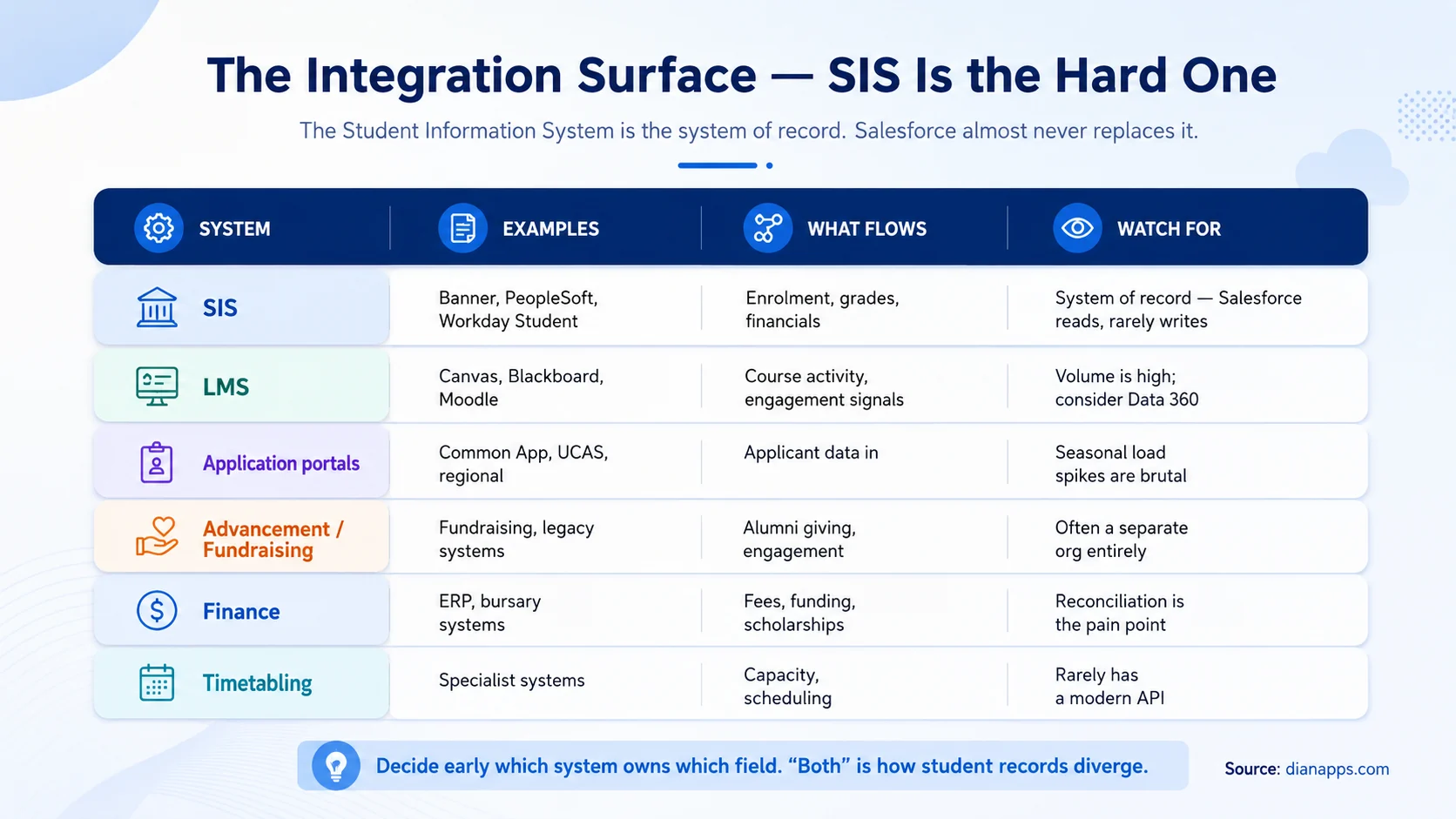
Table of education integration systems including SIS, LMS, application portals, advancement, finance and timetabling with what flows and what to watch for
The SIS is the system of record, and Salesforce rarely replaces it.
Banner, PeopleSoft and Workday Student hold the authoritative enrolment, grades and academic record. Salesforce holds the relationship – enquiry, application, engagement, support, alumni. The integration between them is the project.
- The Decision That Prevents Most Problems: Agree early on which system owns which field. “Both” is how student records diverge, and reconciling them afterwards is painful.
Two More Things Worth Planning For:
- Seasonal load: Application deadlines create spikes that would be unremarkable in other industries and are brutal here. A portal that handles fifty concurrent users comfortably may face five thousand on a single evening in January. Design for the peak, not the average.
- LMS engagement volume: Course activity data from Canvas or Blackboard is high-volume and mostly signal rather than record. That’s a Data 360 conversation rather than a custom object one.
Related: Salesforce integration guide · Salesforce API integration
Integrating Salesforce with Banner, PeopleSoft or Workday Student?
The field ownership question decides whether records stay consistent. We’ll map it before anyone writes an integration.
Compliance Constraints
- FERPA: US student education records are protected, and the practical constraints are about access – who can see which student’s record, and can you evidence it. That’s a sharing model design decision, and record-triggered Flows and Apex running in system mode bypass it entirely. See Salesforce Flow.
- Accessibility: WCAG conformance is a legal requirement for public-sector and most publicly-funded institutions. This constrains custom development directly – any portal or Lightning Web Component you build must meet the standard. Retrofitting accessibility is far more expensive than building to it, and it’s the most commonly under-scoped requirement in education projects.
- International Student Reporting: SEVIS in the US, and equivalents elsewhere, impose specific reporting obligations with real consequences for non-compliance.
- Data Protection: GDPR, and increasingly US state privacy laws, apply to prospect and student data – with the added complication that some records involve minors.
Related: Salesforce compliance and data security
What Education Institutions Actually Build
- Applicant and Student Portal: Application submission, document upload, offer response, enrolment. Experience Cloud, almost always custom, and where the accessibility requirement bites hardest.
- Fee And Funding Calculators: Tuition, scholarships, bursaries, loan eligibility. Business logic no standard object encodes, and it changes every academic year.
- Timetabling And Capacity Logic: Course availability, prerequisites, room and cohort capacity. Frequently the piece that turns out to be harder than expected.
- Advising And Intervention Workflows: Early-alert triggers, caseload management and intervention tracking can use Salesforce Flow Orchestration for processes that span multiple users, stages and approvals. Student Success Hub covers some of this; the intervention model is usually institution-specific.
- Regulatory Reporting Extracts: Whatever your regulator or funding body requires, in whatever format.
- SIS Integration Middleware: The largest line item, consistently.
Need Salesforce Developers for Your Education Build?
Add Salesforce development expertise for student portals, fee calculators, SIS integrations, advising workflows, reporting, and accessibility-focused builds.
What It Costs
Indicative bands, excluding licences:
| Build | Typical range |
|---|---|
| EDA configuration - fields, layouts, record types | $8,000 – $25,000 |
| Fee or funding calculator | $12,000 – $35,000 |
| Advising and early-alert workflow | $20,000 – $55,000 |
| Applicant or student portal (WCAG-conformant) | $40,000 – $120,000 |
| SIS integration | $50,000 – $160,000 |
| Regulatory reporting suite | $15,000 – $50,000 |
Two Things That Shift These Numbers:
- Accessibility adds roughly 15–25% to any user-facing build, and it isn’t optional for most institutions. Budget it explicitly rather than discovering it at UAT.
- The academic calendar constrains delivery the way peak trading does in retail. Go-live during clearing, enrolment, or the start of term is unwise, which compresses the delivery year into specific windows. Plan the roadmap around the academic year rather than the financial one.
The Mistakes That Cost Most
- Rebuilding the EDA data model, the expensive one.
- Not deciding which system owns which field, how student records diverge.
- Under-scoping accessibility, retrofitting WCAG conformance costs multiples of building to it.
- Designing portals for average load rather than deadline peaks.
- Treating FERPA as a policy rather than a sharing model design.
- Ignoring the Power of Us discount in budget planning.
- Building against EDA without knowing whether that capability is going native.
Where to Go Next
For the build decision, configuration vs customization and custom Salesforce development.
For designing the model properly, the Salesforce data model explained.
For integration, Salesforce integration and Salesforce API integration.
For high-volume engagement data, Data 360.
For access and privacy obligations, Salesforce compliance and data security.
The complete Salesforce development guide is the hub.
Before You Scope an Education Build
Three questions change the shape of most education Salesforce projects, and all three take minutes.
What’s already in EDA? More than most scopes assume.
Which system owns which field? The SIS is the record; decide the boundary before anyone integrates.
What’s the accessibility standard, and is it in the estimate? It usually isn’t.
We’re a certified Salesforce Consulting Partner with developers, architects, and consultants across the US, UK, Australia, Canada, UAE, and India.
Ready to Scope Your Education Salesforce Build?
Share your EDA boundaries, SIS requirements, accessibility standards, and custom workflows with our Salesforce team before development begins.
 0 comments





Leave a Comment
Your email address will not be published. Required fields are marked *