















 0 comments





Key Takeaways
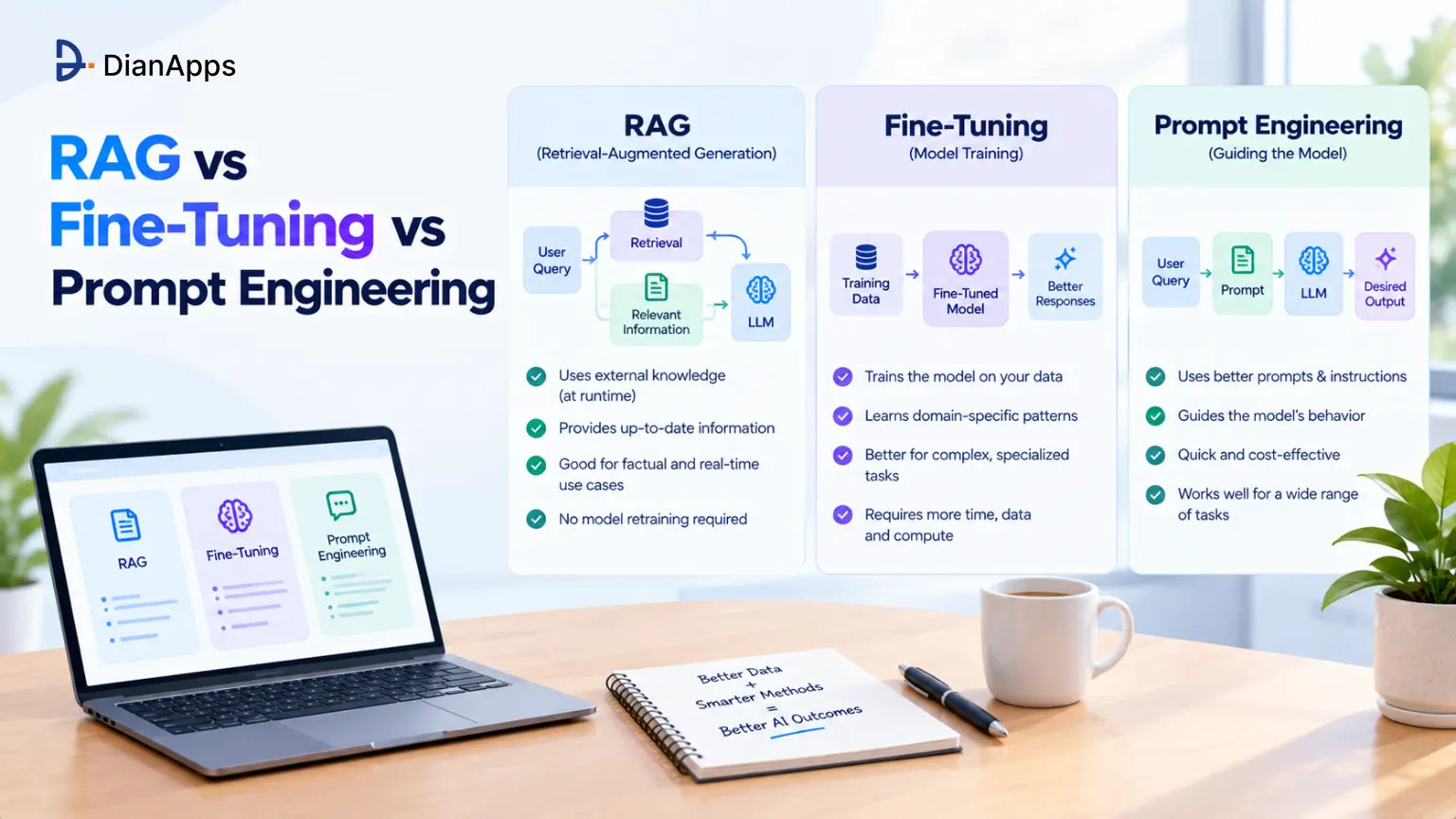
- Choosing between prompt engineering, retrieval-augmented generation and fine-tuning depends entirely on whether your core bottleneck is knowledge access or behavioral adaptation.
- Prompt engineering delivers immediate operational velocity with zero training compute but encounters hard boundaries around context window saturation and token economics.
- In modern system design, comparing RAG vs fine-tuning reveals that dynamic external data demands retrieval pipelines while deterministic task formatting demands weight adaptation.
- Parameter-efficient fine-tuning via LoRA and QLoRA allows engineering teams to teach foundational models domain-specific syntax and reasoning styles on accessible consumer GPUs.
- Enterprise production systems frequently implement hybrid architectures that unite prompt guardrails, semantic vector retrieval and specialized fine-tuned models into cohesive workflows.
Quick Answer: Choose prompt engineering for rapid prototyping and general reasoning, retrieval-augmented generation for dynamic proprietary data access with direct source attribution and fine-tuning for permanent stylistic, structural and domain-specific behavioral alignment.
Building high-quality generative AI at the enterprise level necessitates overcoming challenges associated with data volatility, lag, regulatory oversight and infrastructure costs. Engineering management teams in many companies find it hard to make decisions regarding prompt engineering, retrieval augmented generation (RAG) and model fine-tuning. Choosing the wrong technology can cost months of development time as well as millions of dollars in cloud computing fees and result in the advent of erratic models not able to successfully cite current market data reference.
To avoid such missteps, tech advancement teams need to look at RAG, fine-tuning and prompt engineering with respect to architecture in order to complete the project successfully and gain the necessary representations on the market.
Evaluating RAG vs Fine-Tuning Across the Customization Spectrum
Prior to making an assessment of the various trade-offs associated with RAG and fine-tuning, the engineers ought to understand that prompt engineering, retrieval-augmented generation and model training are technologies that can co-exist, albeit they are entirely different technologies that function on their own level on the continuum of model adaptation. The distinctions between them are based on the levels of the artificial intelligence system they target and the tendencies in terms of costs, effectiveness and complexity.
- Varying levels of engineering effort, ranging from minutes spent adjusting system instructions to months spent preparing training datasets.
- Divergent financial models, shifting between recurring per-token inference charges and upfront GPU cluster reservations.
- Distinct operational failure modes, alternating between context window overflows and catastrophic model forgetting.
- Contrasting compliance profiles, moving between auditable document retrieval logs and opaque neural network weight updates.
- Varying performance characteristics, balancing millisecond vector database lookups against direct model token generation.
The use of inappropriate techniques leads to inefficiencies and poor designs. For instance, if a model is trained on new medical information just through prompt engineering, it will be very expensive in terms of tokens used and will have exhausted its contexts. In other words, if the model is meant to speak in the voice of the business and it has been trained only through basic vector search methods, it will be difficult for the client.
In order to understand the generative AI customization portfolio, one can think about the experience of hiring a senior consultant and training them. In this case, prompt engineering means giving the consultant a structured task specification each time before concluding a meeting. On the other hand, retrieval-augmented generation provides the consultant with a manual, private organizational database and tools to do a real-time search in order to give answers to various questions.
Fine-tuning, by contrast, is sending that consultant to medical school, law school or an intensive corporate fellowship to permanently alter how they think, analyze data and format deliverables. Understanding these distinctions helps clarify how AI agents vs agentic AI vs generative AI operate across different customization layers. When you view the landscape through this lens, the boundaries between RAG vs fine-tuning become remarkably crisp, helping technology leaders understand when RAG vs fine-tuning delivers the greatest architectural impact.
Prompt Engineering: Architecture, Capabilities and Operational Limits
The designing, structuring and optimizing of the directives, context-providing samples and limitations given to a base model in the course of its operation, come under the ambit of prompt engineering. Prompt engineering offers the quickest feedback mechanism in newer software development.
In the context of RAG as compared to fine-tuning, the evolution of formalized prompt engineering has progressed significantly beyond informal conversation prompts. Prompt engineering has turned into a rigorous discipline in the field of software engineering with structured strategies and principles:
- System Prompt Optimization: Establishing immutable behavioral personas, operational constraints, output formatting rules and defensive guardrails that dictate how the model interprets all downstream user queries.
- In-Context Learning (Few-Shot Prompting): Injecting two to ten curated input-output demonstrations directly into the prompt buffer, allowing the model to infer formatting requirements and stylistic nuances purely through self-attention mechanisms without altering underlying weights.
- Chain-of-Thought (CoT) and Self-Consistency: Forcing the model to generate intermediate reasoning tokens, step-by-step mathematical calculations or logical verification assertions before outputting its final conclusion, dramatically improving accuracy on multi-step reasoning problems.
- ReAct (Reasoning and Acting) Frameworks: Structuring prompts so that models alternate between reasoning about an environment, emitting structured tool-calling payloads and parsing environment feedback to solve complex business operations.
When Prompt Engineering Excels?
Prompt engineering is the unquestioned champion of rapid prototyping, proof-of-concept validation and general-purpose reasoning. If your business objective relies on general world knowledge, standard coding languages, common document formats or public business data that already exists inside the pre-training corpus of frontier models like Claude 3.5 Sonnet, GPT-4o or Gemini 1.5 Pro, sophisticated prompt engineering is often all you need. It requires zero cloud infrastructure, incurs zero upfront training capital expenditure and allows product teams to iterate on business logic in minutes rather than weeks.
The Hard Operational Limits of Prompt Engineering
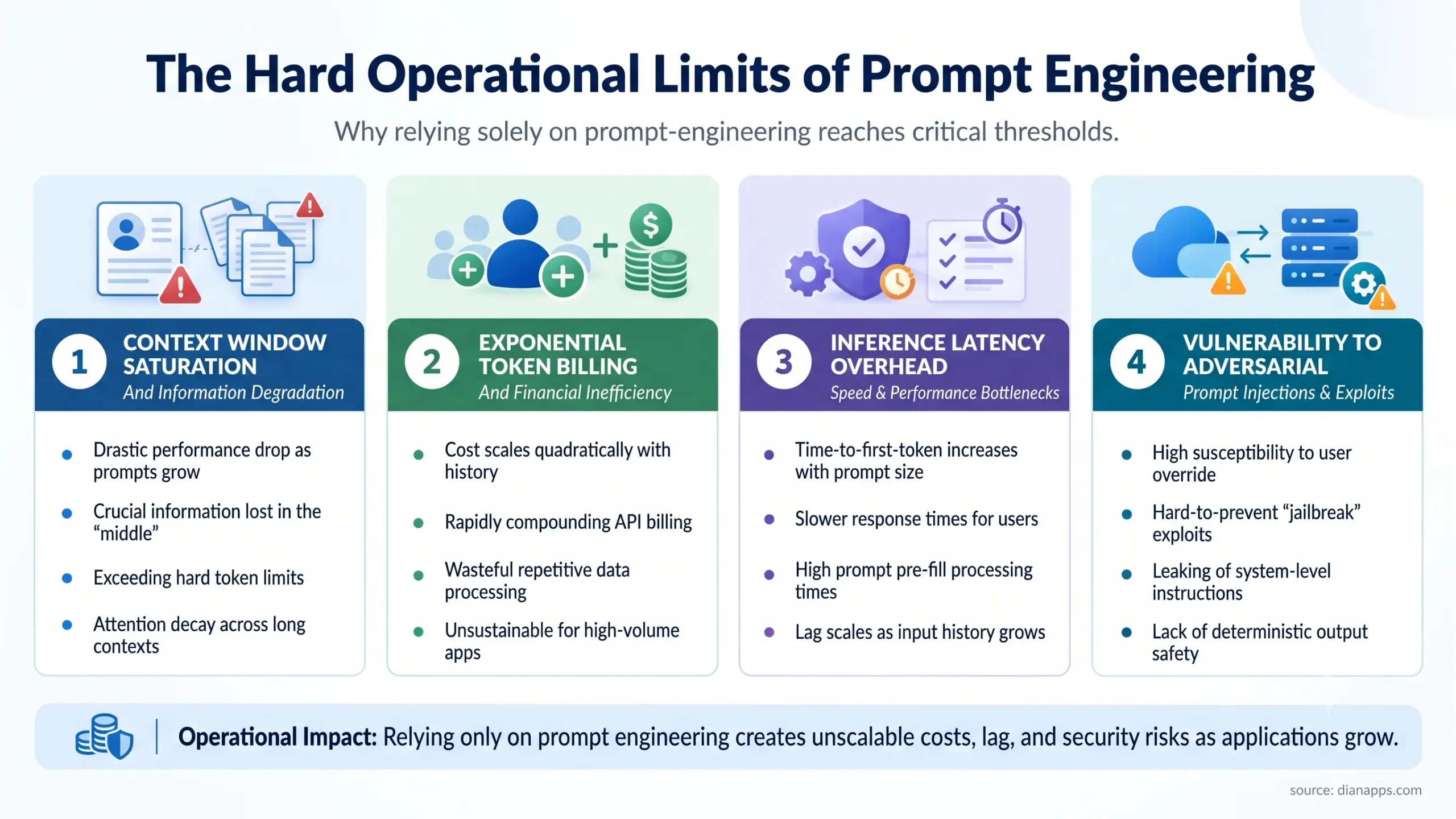
Despite its initial convenience, relying solely on prompt engineering eventually hits insurmountable architectural barriers that push teams toward RAG vs fine-tuning evaluations, let us break it down.
Context Window Saturation and Information Degradation
While modern models boast massive theoretical context windows spanning hundreds of thousands or even millions of tokens, real-world inference tells a different story. In-context retrieval accuracy degrades noticeably as token volume climbs, a phenomenon known in machine learning research as the lost-in-the-middle problem. When critical instructions or facts are buried deep within a massive prompt buffer, models frequently suffer from attention dispersion and fail to recall essential details.
Exponential Token Billing and Financial Inefficiency
Prompt engineering is not free; it simply converts capital expenditures into ongoing operational costs. If your application injects a twenty-thousand-token company handbook, style guide and product catalog into every single user query, you pay foundational model providers for processing those twenty thousand tokens repeatedly on every API call. At ten thousand user requests per day, that unnecessary prompt bloat translates into thousands of dollars in wasted cloud spend every month.
Inference Latency Overhead
Time-to-first-token (TTFT) scales directly with the length of the input prompt. Pre-filling large context buffers forces cloud inference engines to compute extensive key-value (KV) attention caches before generating the very first output token. In interactive consumer applications, automated voice bots or high-frequency customer support systems, a multi-second latency penalty caused by bloated prompt engineering is completely unacceptable.
Vulnerability to Adversarial Prompt Injections
System instructions and user queries share the exact same input stream. Malicious users can easily craft adversarial prompt injections that instruct the model to ignore earlier system rules, leak confidential corporate context or generate unauthorized commitments. Securing pure prompt engineering implementations against jailbreaks requires layered defensive guardrails, particularly when evaluating AI voice agents for business or automated customer-facing bots.
Retrieval-Augmented Generation (RAG): Mechanics, Advanced Pipelines and Trade-offs
When organizations realize that prompt engineering cannot hold their entire corporate data repository, they inevitably look toward retrieval-augmented generation. First formalized in machine learning literature published on ArXiv, retrieval-augmented generation decouples an artificial intelligence model’s reasoning capabilities from its static parametric memory. Instead of forcing a foundation model to memorize enterprise records during training, a RAG system fetches precise, relevant information from dynamic external storage systems and injects those retrieved snippets into the model’s context window at runtime.
The Mechanical Anatomy of an Enterprise RAG Pipeline
A production-grade RAG architecture is far more sophisticated than a basic script connecting a language model to a vector database. A robust retrieval pipeline encompasses multiple distinct stages:
- Document Ingestion and Semantic Chunking: Raw business data, including PDFs, Notion workspaces, Confluence pages, Salesforce tickets and SQL databases, is extracted, cleaned and partitioned into discrete semantic chunks. Mature teams avoid naive fixed-character chunking, utilizing semantic boundary detection, recursive chunking or hierarchical parent-child partitioning that preserves complete logical paragraphs.
- Embedding Generation: Text chunks are processed by high-performance embedding models (such as modern BGE or OpenAI text-embedding-3 models) to generate dense vector representations that capture semantic meaning in high-dimensional vector spaces.
- Vector and Hybrid Indexing: Vectors are indexed inside specialized vector search databases like Pinecone, Qdrant, Milvus or PostgreSQL with pgvector. State-of-the-art enterprise pipelines implement hybrid search, fusing dense semantic vector retrieval with sparse keyword indexing (such as BM25) to catch both conceptual relationships and exact technical part numbers.
- Contextual Retrieval and Cross-Encoder Reranking: When a user submits a query, the system generates a search vector, retrieves top candidate documents using reciprocal rank fusion (RRF) and passes those candidates through a cross-encoder reranker. The reranker scores each document’s direct relevance to the user’s specific question, filtering out irrelevant chunks.
- Context Synthesis and Source Attribution: The highest-scoring text chunks are structured alongside the user query into an optimized prompt. The model generates a comprehensive response while embedding verifiable citations pointing directly to source documents.
Key Architectural Advantages of RAG
Evaluating RAG vs fine-tuning highlights why retrieval systems have become the default operational standard for enterprise data architectures, establishing clear criteria when weighing RAG vs fine-tuning for proprietary knowledge workflows:
- Real-Time Dynamic Knowledge Updates: Modifying, updating or deleting business information in a RAG pipeline takes seconds. When a product price changes, an engineer simply updates a database record or re-embeds a single document. There is zero need to retrain neural network weights.
- Elimination of Knowledge Hallucinations: Grounding generation in retrieved reference text dramatically reduces ungrounded hallucinations. Models can be explicitly instructed to answer strictly based on provided snippets and state “I do not have access to that information” when retrieved context is insufficient.
- Granular Role-Based Access Control (RBAC): In enterprise settings, sensitive documents must only be visible to authorized personnel. RAG systems can enforce document-level metadata filtering, ensuring that an employee querying internal benefits never retrieves executive compensation documents stored in the same vector database.
- Complete Source Transparency and Auditability: Regulatory compliance across finance, healthcare and legal sectors demands auditable evidence. RAG systems provide exact document URLs, page numbers and snippet offsets for every claim generated.
Build Scalable Generative AI Systems
Connect with our dedicated engineering teams to evaluate model customization and launch production architectures.
The Engineering Bottlenecks and Trade-offs of RAG
While retrieval pipelines solve knowledge freshness, they introduce distinct engineering challenges that technology leaders must budget for:
- Retrieval Failure Modes: If the retrieval pipeline fetches irrelevant chunks, the model will generate incomplete or misleading answers, regardless of how capable the underlying LLM is. Common retrieval failures include semantic mismatch, poor chunk boundaries and query ambiguity.
- Substantial Latency Overhead: An enterprise RAG pipeline executes embedding generation, vector similarity searches, keyword queries, cross-encoder reranking and context synthesis sequentially. This complex multi-stage pipeline easily adds 400 to 1,500 milliseconds of latency to every interaction.
- Infrastructure Complexity and Operational Surface Area: Maintaining vector databases, chunking workers, embedding microservices and sync connectors between enterprise repositories and vector stores requires dedicated DevOps and data engineering resources. For teams considering whether to build or buy these pipelines, reviewing an AI agent builder build vs buy framework can clarify resource allocations.
LLM Fine-Tuning and LoRA Fine-Tuning: Deep Model Adaptation and Behavioral Control
Where retrieval-augmented generation provides an external knowledge library, LLM fine-tuning alters the internal neural network weights of the model itself. Fine-tuning takes a pre-trained foundation model that already possesses strong broad linguistic reasoning and continues its gradient descent training on a specialized, curated dataset.
Understanding Full Parameter Fine-Tuning vs PEFT
Historically, executing LLM fine-tuning required full parameter adaptation. In this approach, every single weight matrix across dozens of transformer layers is updated during backpropagation. For modern 7B, 13B or 70B parameter models, full parameter fine-tuning is exceptionally demanding. It requires massive GPU clusters equipped with hundreds of gigabytes of high-bandwidth vRAM to store optimizer states, gradients and model weights, making it economically unfeasible for most mid-market enterprises.
To solve this computational bottleneck, AI researchers developed Parameter-Efficient Fine-Tuning (PEFT). Rather than modifying all billions of parameters, PEFT techniques freeze the pre-trained model weights entirely and introduce a tiny fraction of trainable parameters, often less than 1% of the original model size, into specific layers of the transformer architecture.
The Mechanics of LoRA Fine-Tuning
The most influential PEFT technique used across modern software engineering is Low-Rank Adaptation, commonly known as LoRA fine-tuning. Transformer models rely heavily on dense weight matrices to compute query, key, value and output projections across self-attention blocks. LoRA fine-tuning hypothesizes that the weight updates during domain adaptation possess a low intrinsic dimension.
Mathematically, instead of updating an existing weight matrix directly, LoRA decomposes the weight update into two low-rank matrices, A and B. If a dense weight matrix has dimensions d by k, updating it directly requires computing d times k parameters. By inserting two small matrices with an intrinsic rank r (where r is typically 8, 16 or 64), the number of trainable parameters shrinks from millions down to thousands. During forward passes, the original frozen weight and the scaled low-rank update are computed in parallel:
The Breakthrough of QLoRA Fine-Tuning
Taking parameter efficiency a step further, QLoRA (Quantized Low-Rank Adaptation) quantizes the base foundation model down to 4-bit precision using a specialized NormalFloat (NF4) data type while preserving 16-bit brain floating-point precision for the active LoRA adapter weights. By combining 4-bit base model quantization, double quantization and paged optimizers to manage memory spikes, QLoRA allows engineers to execute high-grade LLM fine-tuning on a 70-billion-parameter open-source model using a single commercial workstation equipped with accessible GPUs.
What LLM Fine-Tuning Solves That RAG Cannot?
Evaluating RAG vs fine-tuning reveals areas where weight modification is fundamentally superior to external context retrieval, clarifying how RAG vs fine-tuning resolves behavioral challenges:
- Deterministic Formatting and Schema Compliance: If your application requires a model to consistently output complex, deeply nested JSON structures, domain-specific XML tags or strict code syntax without deviating, fine-tuning teaches that structural pattern directly into the model’s behavioral weights.
- Nuanced Stylistic Alignment and Tone: Vector retrieval cannot easily alter a model’s intrinsic vocabulary, cadence, empathy or conversational persona. Fine-tuning conditions the model to naturally adopt your brand’s unique communication style across every single generation.
- Complex Multi-Step Cognitive Tasks: When tasks require specialized analytical logic, medical diagnosis workflows or multi-step code translation, fine-tuning conditions the model’s self-attention layers to prioritize relevant internal reasoning paths without requiring sprawling few-shot prompt examples.
- Inference Speed and Token Cost Reductions: Fine-tuned models eliminate the need for massive system prompts and in-context examples. By baking instructions directly into model weights, engineering teams can shrink input prompts from thousands of tokens down to a single concise query, slashing inference latency and per-token cloud costs.
The Risks and Downsides of Fine-Tuning
Weight adaptation introduces serious engineering risks that must be carefully managed:
- Static Parametric Knowledge: Fine-tuning is completely unsuitable for dynamic, frequently changing facts. Retraining a model every time a product price or company policy updates is economically absurd and technically unviable.
- Catastrophic Forgetting: During training, an open-source model can easily overwrite its foundational reasoning capabilities. A model fine-tuned too aggressively on legal contracts might become exceptional at parsing clauses while losing its ability to write clean Python code or perform basic arithmetic.
- Steep Dataset Preparation Burden: Successful LLM fine-tuning demands thousands of rigorously cleaned, verified and deduplicated instruction-response pairs. Garbage in yields garbage out; training a model on low-quality synthetic data permanently degrades generation quality.
Domain Adaptation and Custom LLM Development: When to Build Domain-Specific Models
When comparing RAG vs fine-tuning in specialized industries like legal analysis, biopharmaceuticals, quantitative finance and healthcare, where specialized workflows like those described in our guide on AI agents in healthcare demand extreme precision, standard foundation models frequently stumble over esoteric vocabularies, complex clinical protocols and dense regulatory frameworks. In these scenarios, engineering teams must evaluate domain adaptation and custom LLM development.
Understanding the Mechanics of Domain Adaptation
Domain adaptation sits between standard instruction fine-tuning and building a model completely from scratch. It addresses a fundamental architectural limitation: foundational language models are trained primarily on broad internet text. As a result, standard subword tokenizers (like Byte-Pair Encoding) split specialized domain terminology into fragmented, meaningless sub-tokens. For example, a complex oncology drug name or proprietary financial instrument might be split into six separate tokens, increasing inference cost and degrading semantic comprehension.
Domain adaptation typically follows a two-stage training methodology:
- Continued Pre-Training on Unlabeled Domain Corpora: The engineering team takes a capable open-source base model (such as Llama 3 or Mistral) and continues its unsupervised pre-training across tens of billions of tokens of domain-specific text, such as medical case files, clinical trial protocols, court filings or SEC disclosures. During this stage, the model absorbs the deep semantic relationships, jargon and syntax of the industry.
- Domain Instruction Tuning and Alignment: Once the model internalizes the foundational concepts of the domain, engineers apply supervised fine-tuning (SFT) and Direct Preference Optimization (DPO) using high-quality prompt-response pairs to condition the model into an interactive, task-oriented assistant.
The Realities of Custom LLM Development
In advanced RAG vs fine-tuning discussions, building a custom LLM from scratch, training a multi-billion parameter model starting from randomly initialized weights, is a massive undertaking reserved for sovereign state initiatives, hyperscale technology companies or heavily funded specialized research organizations. Pre-training a frontier-grade model demands thousands of high-performance GPUs running continuously for months, petabytes of meticulously scrubbed training data and millions of dollars in electricity and infrastructure capital.
For 99% of enterprise applications, true custom LLM development does not mean pre-training from scratch. Instead, it means engineering domain-adapted Small Language Models (SLMs). By adapting high-performance 7B or 8B parameter models through domain adaptation and LoRA fine-tuning organizations can build custom proprietary models that match or outperform massive 70B+ commercial models on their specific business tasks while running privately inside their own secure cloud VPCs.
RAG vs Fine-Tuning: Detailed Multi-Dimensional Architectural Comparison
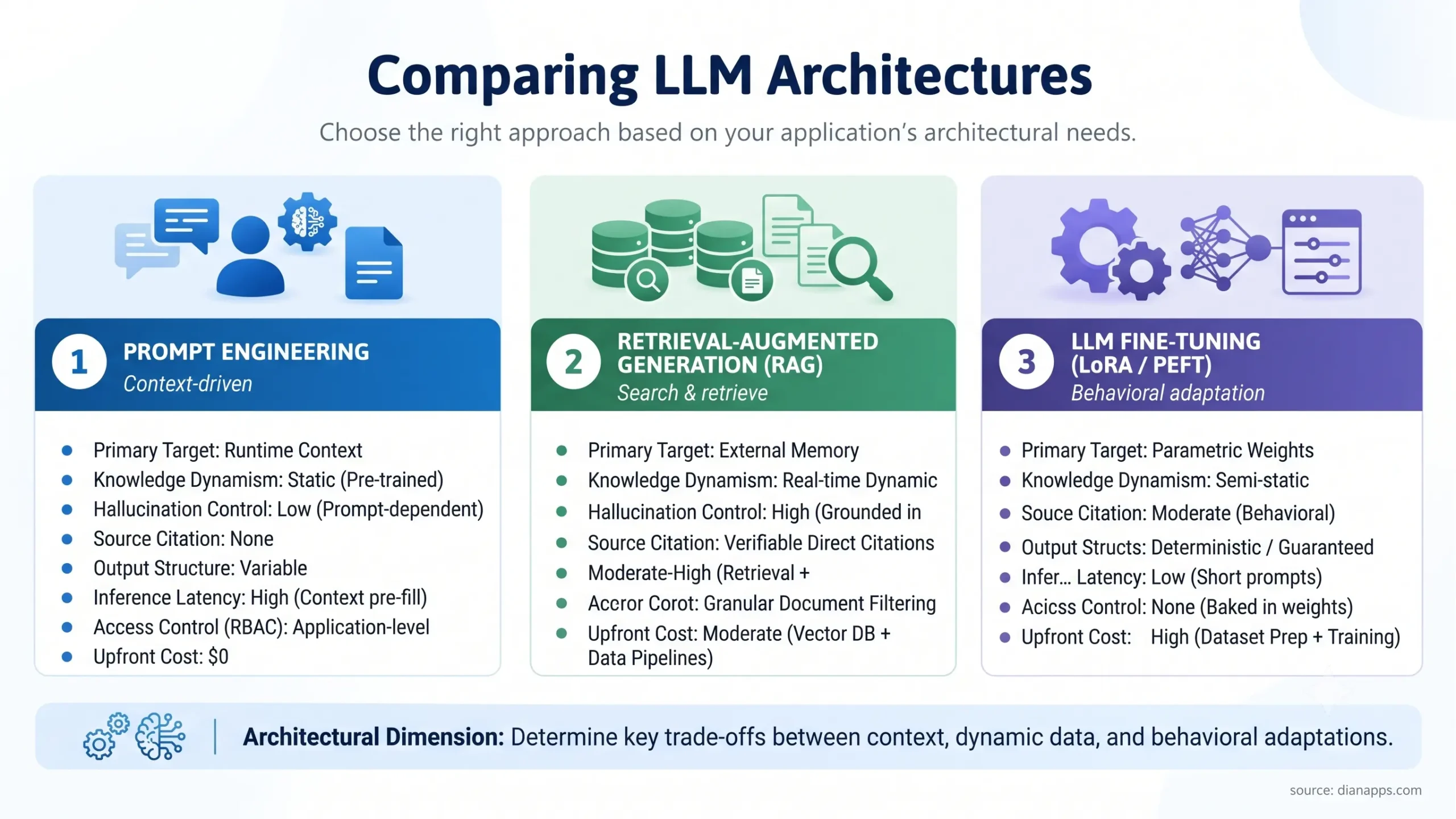
To provide technology leaders with absolute clarity when architecting generative systems, comparing RAG vs fine-tuning requires evaluating how each approach behaves across critical operational dimensions, guiding teams through complex RAG vs fine-tuning trade-offs, let us break it down.
Dimension 1: Knowledge Freshness and Update Agility
In the debate of RAG vs fine-tuning, RAG is the definitive winner for dynamic, rapidly evolving data. When corporate policies change, product lines expand or market prices fluctuate, a RAG pipeline reflects those updates in milliseconds by refreshing vector database records. Fine-tuning, by contrast, permanently bakes knowledge into neural network weights. Updating parametric knowledge requires collecting new datasets, running training epochs, evaluating against benchmark suites to prevent regressions and redeploying model checkpoints. Attempting to use fine-tuning to store volatile business facts is an anti-pattern that guarantees stale data and ballooning operational expenses.
Dimension 2: Hallucination Mitigation and Source Attribution
Across the spectrum of RAG vs fine-tuning, RAG provides complete evidentiary transparency. Because every generated sentence is grounded in explicitly retrieved reference documents, the system can output exact hyperlinks, file paths and quoted paragraphs. If an executive or auditor questions a generated figure, the system can instantly produce the source document. Fine-tuning cannot provide source attribution. When a fine-tuned model emits a fact, that fact emerges probabilistically from billions of mathematical matrix multiplications. There is zero verifiable paper trail and fine-tuned models can hallucinate with extreme linguistic confidence, presenting fabricated facts in an authoritative corporate tone.
Dimension 3: Data Privacy, Security and Access Governance
Examining security in RAG vs fine-tuning demonstrates that RAG integrates naturally into established enterprise access control architectures. Organizations can enforce row-level security, tenant isolation and role-based permissions directly within the search retrieval layer. An intern and a chief financial officer can query the exact same RAG endpoint, yet the intern will never retrieve confidential financial ledgers because the retrieval filter prunes those records before the prompt reaches the model. Fine-tuning provides zero access control. Once confidential data is trained into a model’s weights, that data is permanently embedded across the network. Prompt engineering cannot reliably prevent a fine-tuned model from leaking sensitive training data when probed by clever users.
Dimension 4: Latency, Throughput and Inference Economics
Analyzing latency in RAG vs fine-tuning proves that fine-tuned models offer superior inference speed and throughput for specialized tasks. Because behavioral instructions, output schemas and domain syntax are internalized within the weights, user queries can be exceptionally short. A fine-tuned model might require a fifty-token prompt to generate a perfectly formatted medical summary. A RAG pipeline, by contrast, must inject thousands of tokens of retrieved context chunks into every request, resulting in extended pre-fill compute times and higher latency. Furthermore, running multi-stage retrieval pipelines, involving embedding calls, vector index lookups and cross-encoder rerankers, adds hundreds of milliseconds of network overhead before token generation even begins.
Dimension 5: Deterministic Formatting and Stylistic Control
Assessing formatting consistency in RAG vs fine-tuning reveals that fine-tuning is unmatched when it comes to enforcing strict output structures, domain grammar and brand persona. While prompt engineering and RAG can suggest formatting rules, complex models frequently drift, occasionally emitting conversational pleasantries or subtle syntax errors that break downstream automated parsers. Fine-tuning conditions the model’s token distribution so thoroughly that outputting valid, deeply nested JSON or specialized code structures becomes an intrinsic, deterministic behavior.
The Decision Framework: Choosing RAG vs Fine-Tuning for Your Use Case
Navigating the architectural choices between prompt engineering, RAG and fine-tuning does not require guesswork. By evaluating your project across two fundamental axes, Knowledge Dynamism (how frequently your data changes) and Task Specificity (how specialized the desired style, structure or reasoning is), engineering teams can select the optimal approach immediately.
The Two-by-Two Architectural Matrix
- Quadrant 1: Low Task Specificity + Static General Knowledge
- Strategy: Pure Prompt Engineering
- Use Cases: General document summarization, drafting standard marketing copy, brainstorming product features or basic translation across common languages. Foundation models already understand these domains and system prompts provide ample guidance.
- Quadrant 2: Low Task Specificity + Dynamic Proprietary Knowledge
- Strategy: Retrieval-Augmented Generation (RAG)
- Use Cases: Internal employee knowledge bases, customer support agents querying dynamic product catalogs, enterprise search across Google Drive or Confluence and regulatory compliance lookup tools. The core challenge is real-time information retrieval with verifiable citations.
- Quadrant 3: High Task Specificity + Static General Knowledge
- Strategy: LoRA Fine-Tuning or PEFT
- Use Cases: Converting natural language into specialized database queries (Text-to-SQL), extracting entities into strict proprietary JSON schemas, teaching models to write code adhering to internal engineering conventions or aligning conversational agents with a distinct corporate brand voice.
- Quadrant 4: High Task Specificity + Dynamic Proprietary Knowledge
- Strategy: Hybrid Architecture (Fine-Tuning + RAG)
- Use Cases: Specialized clinical decision support systems, legal contract analysis platforms, automated financial risk auditing, autonomous multi-agent operational workflows and complex sector solutions like AI agents in ecommerce.
The Five-Question Architectural Diagnostic
Before committing engineering resources to a specific implementation, answer these five diagnostic questions:
- Does the application require data that changes daily, hourly or in real time? If yes, RAG is non-negotiable.
- Does the business demand auditable, click-through source citations for every factual claim? If yes, RAG is required.
- Does the system require strict, 100% reliable adherence to a complex output format that prompt instructions frequently fail to maintain? If yes, invest in LoRA fine-tuning.
- Is your primary bottleneck high inference latency or excessive token costs caused by bloated system prompts? If yes, fine-tune a compact model to internalize those instructions.
- Does the task involve esoteric vocabularies and syntax that standard models consistently misunderstand? If yes, pursue domain adaptation with specialized continued pre-training or explore different types of AI agents tailored for structured tasks.
Need Custom AI Architecture Guidance?
Partner with our senior machine learning engineers to design and deploy resilient enterprise systems.
Hybrid Architectures: Uniting RAG vs Fine-Tuning and Prompting in Production
In modern enterprise software engineering, the debate between RAG vs fine-tuning is rapidly dissolving into a consensus around hybrid system architectures where RAG vs fine-tuning trade-offs are reconciled in code. To understand the broader structural components required for production systems, explore our guide on AI agent architecture. The most resilient, high-performing generative applications in production today do not choose between these technologies in isolation; they integrate prompt engineering, retrieval pipelines and fine-tuned models into unified, multi-tiered workflows.
Pattern 1: Fine-Tuning the Generator for RAG Synthesis (RA-FT)
Standard foundation models are trained to be helpful conversational assistants, not disciplined retrieval synthesizers. When presented with five retrieved document chunks, an off-the-shelf model often ignores subtle contradictions between chunks, incorporates outside training knowledge that contradicts the retrieved documents or fails to cite specific paragraphs accurately.
In a Retrieval-Augmented Fine-Tuning (RAFT) pipeline, engineers fine-tune the generator model specifically on retrieval-synthesis tasks. The model is trained on curated datasets that include relevant context chunks, distractor (irrelevant) chunks and user queries. Through this fine-tuning, the model learns two vital behaviors:
- It learns to ignore irrelevant distractor chunks completely.
- It learns to extract factual answers exclusively from relevant context while outputting verbatim citations.
The result is an exceptional RAG engine that resists context poisoning and achieves near-zero hallucination rates.
Pattern 2: Fine-Tuning the Embedding and Reranking Models
While most teams focus on fine-tuning generative models, fine-tuning the retrieval components of a RAG pipeline often yields vastly superior business ROI. Off-the-shelf embedding models struggle with specialized internal acronyms, technical part numbers and industry jargon. By fine-tuning a compact bi-encoder embedding model or cross-encoder reranker on proprietary domain queries and document pairs organizations can improve retrieval recall and precision by 20% to 35% without altering the generative LLM.
Pattern 3: Multi-Tiered Routing with Specialized Fine-Tuned SLMs
High-volume enterprise applications frequently process a wide mix of queries, ranging from simple transactional requests to complex multi-step analytical problems. Routing every single query to an expensive frontier model like GPT-4o burns unnecessary capital.
Modern production architectures implement an intelligent routing layer:
- Tier 1 (Prompt-Engineered SLM): Lightweight queries are handled by a fast, compact model guided by concise system prompts.
- Tier 2 (Domain-Specific LoRA Adapter): Structural tasks, such as translating natural language into complex SQL or validating incoming payloads against strict Pydantic schemas, are routed to a self-hosted 8B parameter model fine-tuned via LoRA.
- Tier 3 (Enterprise RAG Pipeline + Frontier Model): Highly complex queries requiring multi-source document synthesis, legal analysis or multi-agent planning are routed to an advanced RAG pipeline backed by a frontier model.
For organizations looking to implement multi-tier AI architectures and integrate robust testing protocols into their continuous delivery pipelines, exploring our detailed guide on how to test and evaluate AI agents provides practical frameworks for benchmarking model accuracy and trajectory reliability before shipping to users. Furthermore, reviewing the capabilities of top AI agent development companies in the USA offers valuable perspectives on how leading engineering firms structure scalable enterprise AI systems.
Total Cost of Ownership (TCO) and Resource Planning
Evaluating RAG vs fine-tuning requires looking past simple API pricing calculators to analyze the total cost of ownership across infrastructure, engineering salaries, ongoing maintenance and cloud compute, ensuring that RAG vs fine-tuning budget allocations reflect production scale.
The Financial Profile of Prompt Engineering
Prompt engineering carries minimal upfront costs. Development consists primarily of engineering hours spent testing prompts, setting up evaluation harnesses and configuring API keys. However, recurring operational costs scale linearly with user volume. When prompts are bloated with extensive in-context examples, per-token API charges accumulate rapidly. For a detailed breakdown of financial projections across model architectures, refer to our analysis on AI agent development cost. Prompt engineering is financially optimal for low-to-medium volume applications or experimental product phases where query volumes remain unpredictable.
The Financial Profile of Retrieval-Augmented Generation (RAG)
A production RAG architecture introduces moderate upfront development costs and recurring multi-component operational expenses:
- Upfront Costs: Designing document ingestion pipelines, parsing unstructured documents, generating initial vector embeddings and establishing hybrid search indexes typically requires four to eight weeks of data engineering effort.
- Recurring Operational Costs: Vector database hosting (ranging from $50 to $1,500+ per month depending on index size and query throughput), document re-indexing pipelines, embedding API calls and generative model inference charges.
- TCO Summary: RAG delivers outstanding cost-efficiency for knowledge-intensive applications where business data changes frequently, as it avoids the continuous retraining expenses associated with model weights.
The Financial Profile of LLM Fine-Tuning and LoRA Adaptation
Fine-tuning reverses the cost curve, demanding significant upfront investment while offering dramatically lower recurring inference expenses:
- Upfront Costs: Collecting, cleaning, deduplicating and formatting thousands of high-quality instruction-response pairs is the most expensive component of fine-tuning, often requiring hundreds of hours of senior domain expert review. Compute costs for PEFT and LoRA fine-tuning are modest (ranging from $50 to $500 on rented cloud GPUs like NVIDIA A100s or H100s), while full parameter fine-tuning runs into thousands of dollars.
- Recurring Operational Costs: Hosting a fine-tuned open-source model (such as Llama 3 8B or 70B) requires dedicated GPU cloud instances (e.g., AWS EC2 g5 or p4d instances), incurring fixed hourly hosting fees regardless of query volume. However, because input prompts are compact and per-token API fees are eliminated, fine-tuning becomes vastly more economical than commercial APIs at high query volumes (exceeding hundreds of thousands of requests per month).
To integrate intelligent capabilities into your software ecosystem while balancing long-term infrastructure expenses, engaging experienced engineering teams through dedicated AI development services ensures that architectural decisions align with your organizational scale and budgetary constraints.
Launch Your Enterprise AI Roadmap
Connect with specialized AI architects to evaluate customization options and optimize cloud costs.
Final Thoughts
The architectural choice of RAG vs fine-tuning vs prompt engineering is not a matter of picking the most sophisticated machine learning technique but mastering RAG vs fine-tuning alignment; it is a matter of aligning technical infrastructure with specific operational constraints. Prompt engineering provides unmatched development speed for general reasoning. Retrieval-augmented generation provides essential real-time knowledge access, granular role-based security and verifiable source attribution for dynamic business data. Fine-tuning provides deterministic structural adherence, nuanced stylistic control and significant token cost reductions for specialized repetitive tasks.
Engineering leaders who succeed in the generative AI era avoid dogmatic adherence to a single methodology. By understanding the mechanical realities of RAG vs fine-tuning, evaluating key AI agent use cases and building modular architectures that combine prompting, retrieval and targeted fine-tuning organizations construct resilient, cost-effective artificial intelligence platforms that scale smoothly in demanding production environments. For those looking to implement these systems from scratch, our step-by-step guide on how to build an AI agent provides a practical roadmap.
 0 comments











Leave a Comment
Your email address will not be published. Required fields are marked *