















 0 comments





Key Takeaways:
- AI is helping to simplify documentation in clinics, paving the way for telemedicine as well as making healthcare recordkeeping easier.
- HIPAA’s requirements for basic security measures include encryption, restricted access, and audit logs.
- Those engagements where AI minimizes administrative processes are the most effective.
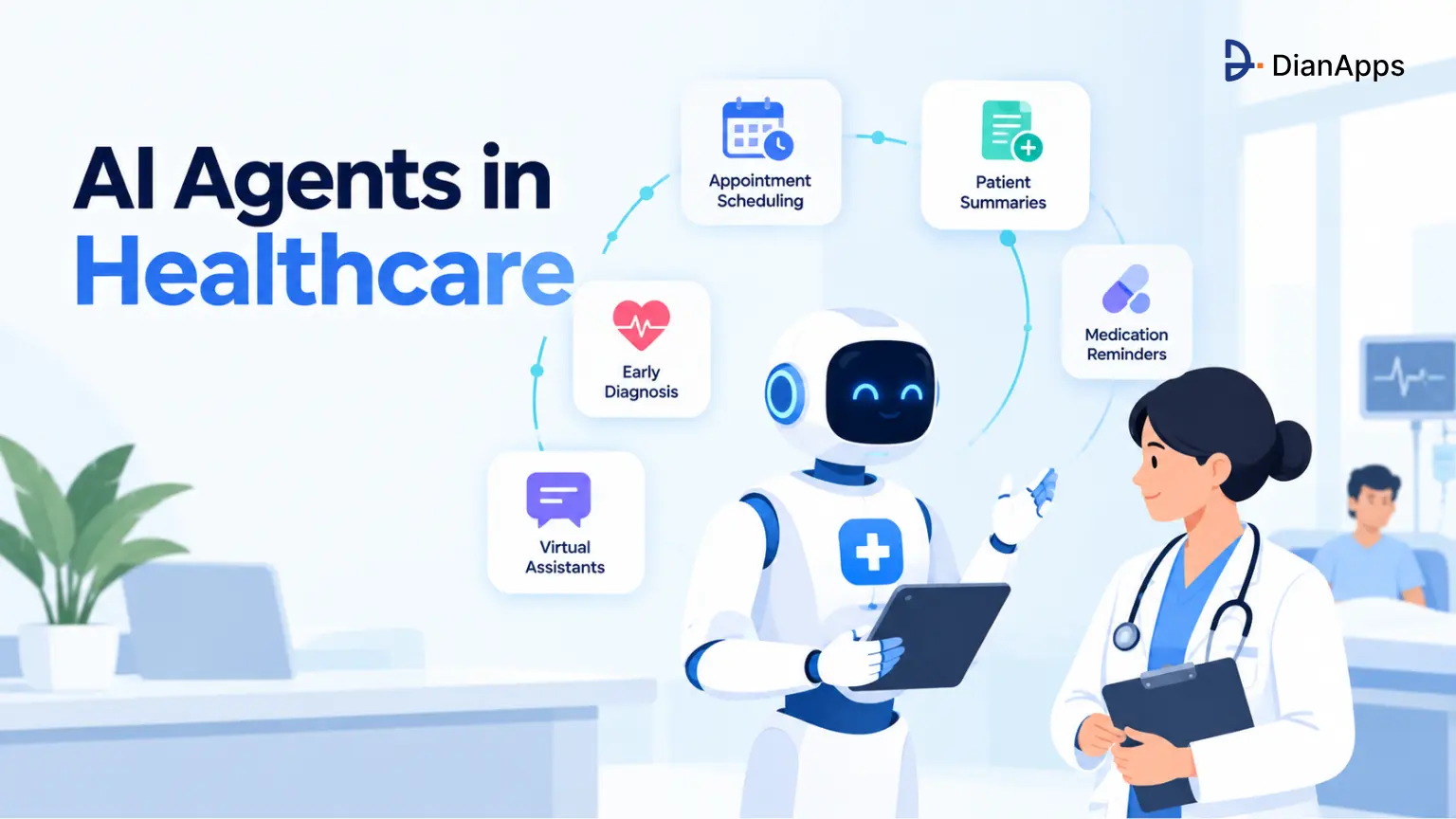
Quick Answer: AI agents in healthcare are being used to automate repetitive clinical and administrative workflows, including medical scribing, prior authorization, patient scheduling, coding, care coordination and follow-up. Their main value is reducing administrative workload while helping healthcare teams respond faster and keep clinical decisions with qualified professionals.
According to Fortune Business Insights, it is expected that artificial intelligence agents will eventually occupy a larger share of the healthcare sector than any other industry, as by the year 2030, the total value of the global market for artificial intelligence in healthcare will have reached an impressive $188 billion. For instance, Bristol Myers Squibb made the decision to expand Claude AI to more than 30,000 employees engaged in research, clinical development, and corporate operations. Clinical documentation AI alone is saving individual providers an estimated 2 to 3 hours per day of documentation time, returning meaningful capacity to patient care rather than administrative work.
The healthcare industry presents both the strongest use case for AI agents and the strictest requirements for deploying them responsibly. HIPAA governs all systems handling protected health information. Clinical workflows have error tolerances that consumer applications don’t. The stakes of an AI system getting something wrong in healthcare, a missed diagnosis flag, an incorrect prior authorization, a misfiled medication record, are categorically different from the stakes of a retail recommendation or an email classification error.
This guide covers the most important healthcare AI agent use cases in 2026, how they work, what outcomes organizations have documented and what HIPAA and compliance requirements govern their deployment. It also addresses the specific use cases for dental practices, home health care agencies and patient scheduling.
How Agentic AI Is Transforming Patient Care in Healthcare?
Healthcare has historically been one of the most labor-intensive industries in existence. Effective healthcare workflow management helps organizations coordinate tasks, reduce administrative delays, and improve overall process efficiency.Every patient encounter generates clinical documentation. Every treatment requiring insurance coverage generates a prior authorization request. Every new patient requires intake, verification and coordination across multiple systems. Every appointment requires scheduling, reminders, confirmations and follow-up.
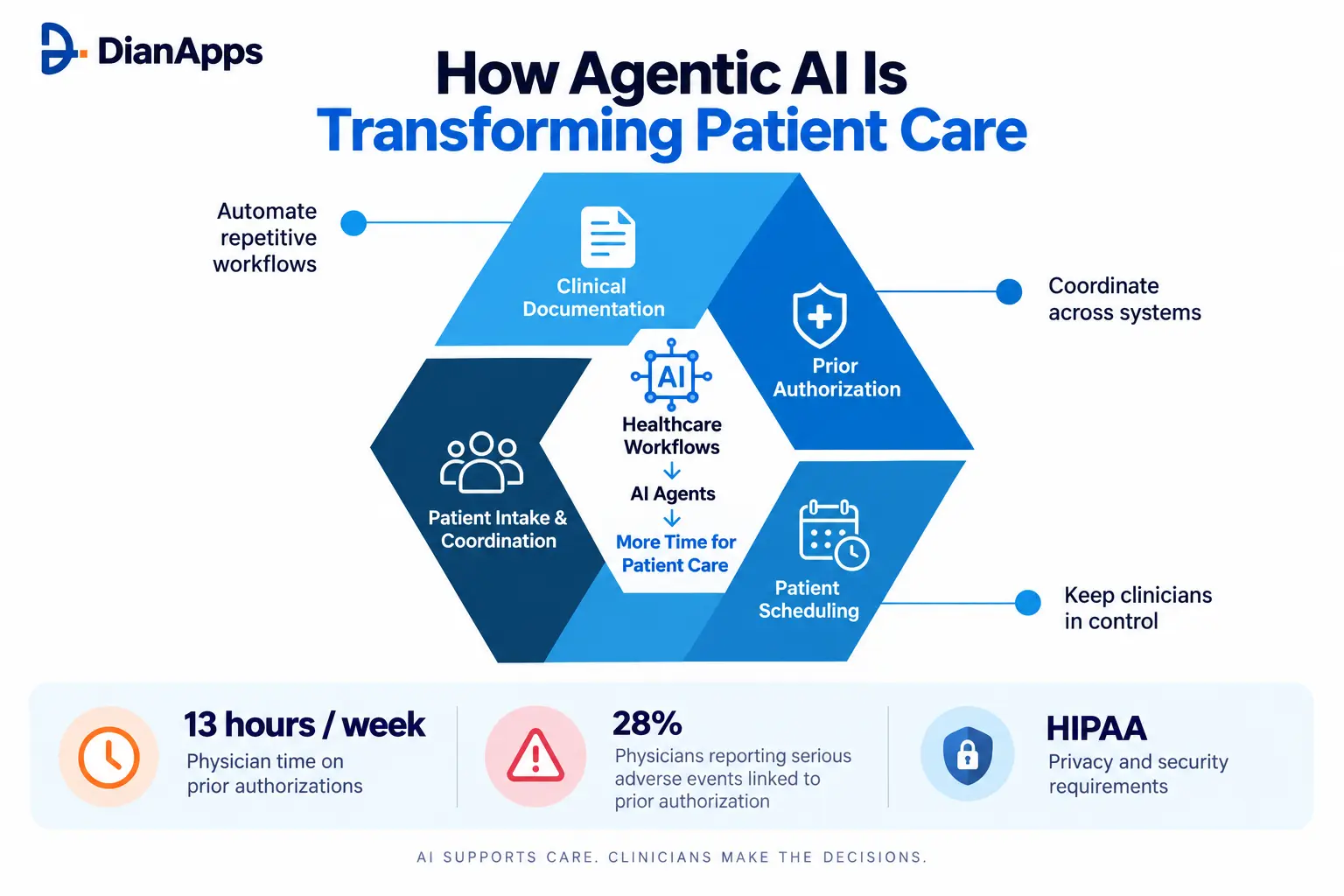
AI systems effectively handle these laborious workflows using automated systems of many operations, and understanding the different types of AI agents helps healthcare organizations identify which approach fits a particular workflow. This explains why the provision of AI development services is extremely important for healthcare institutions that need their systems to integrate with existing clinical and administrative workflows without taking control away from physicians.
The result is not replacing clinical judgment: AI agents in healthcare are deployed on the administrative and coordination workflows surrounding care, freeing clinicians to focus on the patient interaction itself. This distinction also helps clarify the difference between AI agents vs. agentic AI, particularly when deciding how much autonomy a healthcare workflow should have.
The American Medical Association reports that physicians spend on average 13 hours per week on prior authorizations alone. A 2024 survey found that 28% of physicians said prior authorization led to a serious adverse event for a patient in their care, because delays in authorization cause delays in treatment. AI agents that handle prior authorization automation address both the administrative burden and the patient safety dimension of that workflow failure.
The healthcare industry presents both the strongest use case for AI Agent Development Services and the strictest requirements for deploying them responsibly. HIPAA governs all systems handling protected health information. Clinical workflows have error tolerances that consumer applications don’t. The stakes of an AI system getting something wrong in healthcare, a missed diagnosis flag, an incorrect prior authorization, a misfiled medication record, are categorically different from the stakes of a retail recommendation or an email classification error.
Ready to Automate Healthcare Workflows?
Discuss your documentation, scheduling, authorization, or care coordination needs with our AI specialists.
AI Agent Use Cases in Healthcare: 10 High-Impact Deployments
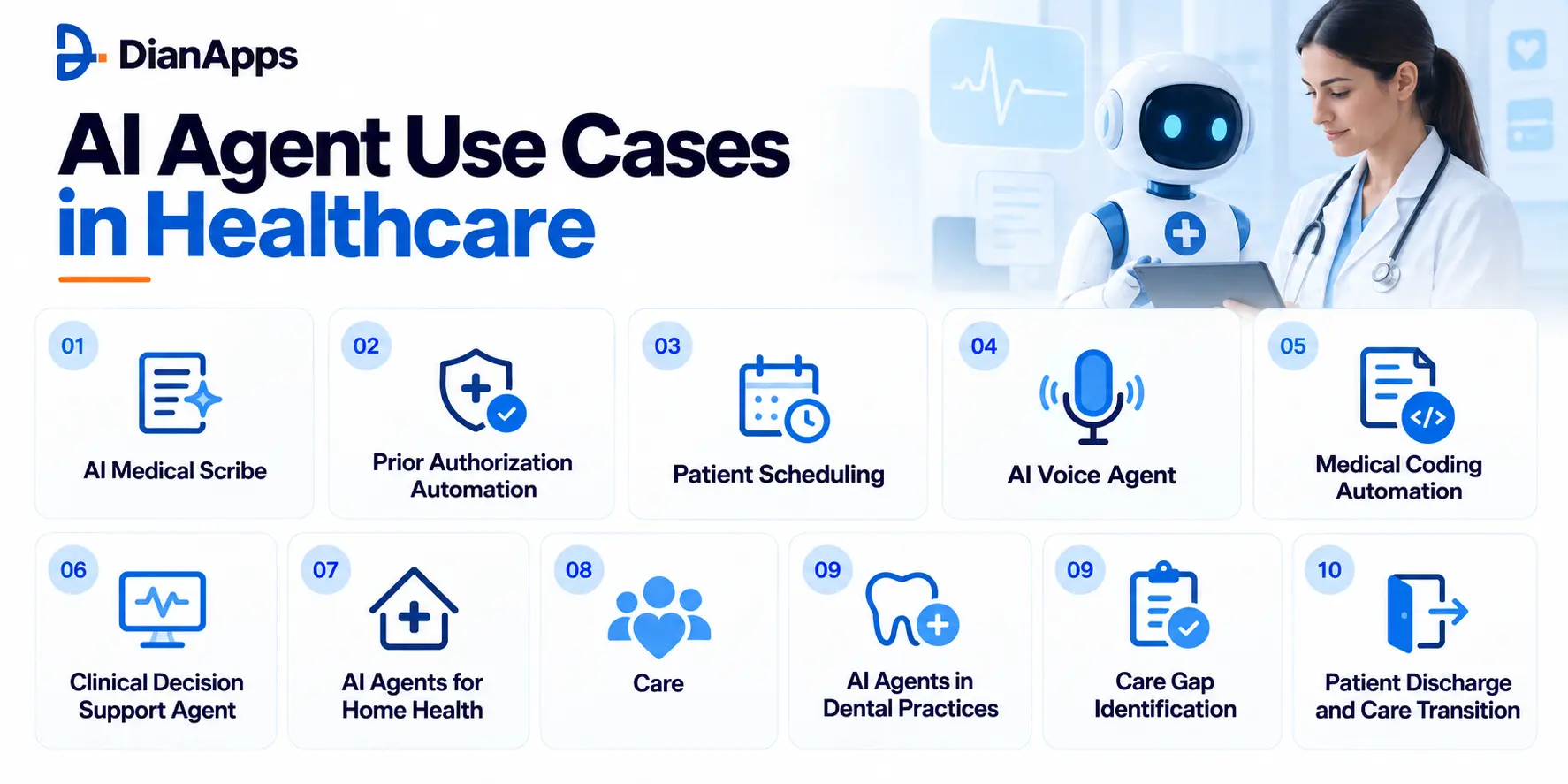
1. AI Medical Scribe: Clinical Documentation
The AI medical scribe is the most widely adopted healthcare AI agent category in 2026. An AI scribe agent attends the patient-provider encounter (with patient consent), transcribes the conversation in real time, extracts clinically relevant information and generates a structured clinical note drafted in the provider’s EHR, ready for the provider to review, edit and sign.
The impact is significant: providers using AI scribes report recovering 2–3 hours per day of documentation time that was previously spent on after-hours charting. Sully AI’s documented outcome at one health system: 11% revenue lift in a single month from improved documentation quality and faster billing cycle times, a direct consequence of clinical notes being completed faster and more accurately when AI assists the documentation rather than leaving it entirely to the physician after clinic hours.
- How It Works: Encounter audio (consented) → real-time transcription → clinical concept extraction (diagnoses, medications, procedures, follow-up plans) → structured SOAP or encounter note draft in EHR → provider review and attestation.
- Compliance Requirements: HIPAA BAA with the AI scribe vendor; patient consent for audio recording (state-specific requirements vary); PHI encryption in transit and at rest; access controls limiting note access to authorized care team members.
2. Prior Authorization Automation
Prior authorization is healthcare’s most documented administrative burden. The American Medical Association reports 13 hours per week per physician practice consumed by PA processes. An AI agent for prior authorization: reads the treatment or medication order, retrieves the patient’s clinical history and diagnosis coding, checks payer-specific PA criteria against clinical documentation, prepares the authorization request with supporting clinical evidence, submits to the payer portal, monitors status and prepares appeals with supporting documentation if denied.
AI agents handle routine prior authorizations, those that clearly meet standard clinical criteria, autonomously. Complex cases and denials route to human clinical staff with full preparation. Organizations using PA automation report 70–85% reductions in manual PA processing time for standard requests.
- How It Works: Order trigger → patient record pull → payer PA criteria check → clinical documentation review → request preparation → portal submission → status monitoring → denial → appeal documentation preparation.
3. Patient Scheduling and Appointment Management
Can AI agents handle patient scheduling? Yes, across multiple channels, phone, web, patient portal and SMS. An AI scheduling agent for healthcare checks provider availability across specialties and locations, matches appointment type to the appropriate provider, collects necessary intake information, sends confirmation and reminder sequences, processes cancellations, fills open slots from waitlists and updates the EHR appointment system throughout.
Healthcare organizations using AI scheduling agents report 40–60% reductions in scheduling staff workload for routine appointments and 30–50% reductions in no-show rates from automated reminder sequences. The AI voice agent variant handles inbound scheduling calls, recognizing the caller’s need, checking availability, booking the appointment and handling all confirmation steps verbally without a human scheduler.
- How It Works: Scheduling request received (phone/web/portal/SMS) → intent recognition → provider availability check → appointment type matching → intake information collection → confirmation send → reminder sequence → cancellation/reschedule handling → waitlist fill → EHR update.
For organizations moving from individual automation workflows to a production system, knowing how to build an AI agent around existing healthcare systems, permissions and review processes becomes equally important.
Checking out AI Agents for Healthcare?
Talk to our AI team about building healthcare workflows that reduce administrative work while keeping clinicians in control.
4. AI Voice Agent for Healthcare, Inbound Call Handling
Healthcare organizations receive high volumes of inbound calls for scheduling, prescription refills, lab result queries, insurance verification and general information. An AI voice agent for healthcare handles these calls with natural conversational language, asking appropriate follow-up questions, retrieving patient information from the EHR (with authentication), booking appointments, routing clinical questions to nursing staff and logging all interactions.
The deployment ROI is well-documented: AI voice agents handling scheduling and FAQ calls typically absorb 50–70% of inbound call volume, reducing hold times, extending effective service hours and freeing clinical staff from administrative call handling. The AI customer service market in healthcare specifically is growing at 31% CAGR, per 2026 market data.
These integrations also show why organizations evaluating AI automation platforms for enterprises need to consider workflow orchestration, security and system connectivity rather than the AI model alone.
- HIPAA Compliance For Voice Agents: AI voice agents handling PHI require voice data encryption, HIPAA BAA with the voice AI vendor, patient authentication before PHI disclosure and secure logging of call content and PHI accessed.
Have a Healthcare AI Use Case in Mind?
Let’s discuss your workflow, compliance requirements, and the right AI agent architecture for your organization.
5. Medical Coding Automation
AI medical coding agents read clinical documentation and assign ICD-10-CM/PCS, CPT and HCPCS codes automatically, with accuracy benchmarks of 98%+ first-pass on production charts (Medicodio CODIO, 2026), compared to 75–85% for experienced human coders. The top platforms in 2026: Medicodio CODIO (ISO/IEC 27001:2022, Veradigm certified, 35+ specialties), CodaMetrix CMX CARE (KLAS #1 Autonomous Medical Coding 2026), Fathom (API-first outpatient) and Sully AI Coder Agent (continuous learning, verified revenue lift).
- The Downstream Financial Impact: Moving from 75% to 98% first-pass acceptance on a $5 million annual revenue practice reduces uncollected claims from approximately $450,000 to approximately $150,000. The ROI of AI coding in most healthcare settings makes investment recovery within 6–18 months standard.
6. Clinical Decision Support Agent
A clinical decision support AI agent monitors patient records for specific patterns, lab value combinations, medication interactions, care gap triggers, alert conditions and surfaces relevant clinical guidance at the point of care. Unlike passive alerts that fire indiscriminately, an AI-powered CDS agent contextualizes its recommendations to the specific patient’s full clinical picture, reducing alert fatigue while improving actionability.
Organizations using contextual AI clinical decision support report 40–60% reductions in alert override rates compared to traditional rule-based CDS systems, indicating that clinicians are seeing fewer irrelevant alerts and responding to more relevant ones. The agent doesn’t make clinical decisions; it ensures clinicians have the right information, at the right time, in the right context.
7. AI Agents for Home Health Care Agencies
Home health care agencies face specific operational challenges: coordinating visit schedules across a distributed caregiver workforce, tracking compliance documentation, managing care plan updates and handling billing across multiple payers. AI agents address all four:
- Visit Scheduling And Optimization: AI scheduling agents match caregiver skills, geography, patient preferences and certification requirements to create optimized visit schedules, reducing drive time and improving caregiver utilization
- Visit Documentation Assistance: AI scribe agents assist caregivers in documenting visit outcomes on mobile devices, prompting for required OASIS assessment fields, flagging clinical changes that require supervisory notification
- Care Plan Update Monitoring: An AI agent monitors incoming physician orders, identifies required care plan updates, drafts the updates for clinical review and routes for sign-off
- Billing And Authorization Tracking: An AI agent monitors authorization expiration dates, tracks visits against authorized units and triggers renewal requests before authorization lapses
Home health agencies using AI scheduling and documentation agents report 25–40% reductions in administrative time per caregiver per week and significant improvements in documentation compliance rates for value-based care quality metrics.
8. How to Use AI Agents in Dental Practices
Dental practices are particularly well-suited for AI agent deployment because their workflows are highly repetitive, high-volume and administratively intensive relative to practice size. The four highest-ROI AI agent deployments for dental practices:
- Insurance Verification And Benefit Explanation: An AI agent verifies insurance coverage before appointments, calculates estimated patient responsibility and prepares the treatment coordinator with benefit summaries, eliminating manual verification calls that typically take 10–20 minutes each.
- Treatment Plan Follow-Up: Patients who leave without scheduling recommended treatment represent significant lost revenue for dental practices. An AI agent monitors unscheduled treatment plans, reaches out via text or email at defined intervals with personalized messages and routes interested patients to scheduling, recovering a meaningful portion of unscheduled case revenue without front desk staff making cold calls.
- Recall And Reactivation Campaigns: An AI agent sends recall reminders to patients due for cleanings and exams at the right intervals, using personalized messaging based on their treatment history and communication preferences. For lapsed patients (12+ months since last visit), a reactivation sequence can recover 10–20% of the lapsed patient pool.
- New Patient Intake And Pre-Visit Communication: An AI agent sends new patient intake forms, answers FAQ questions via chat, confirms appointments and collects insurance information, handling all pre-visit communication that currently requires front desk staff time.
A general dental practice with 2 dentists and 3 front desk staff can recover 8–12 front desk hours per week by deploying AI agents across these four workflows, while improving recall rates and reducing no-shows.
9. Care Gap Identification and Outreach
A care gap AI agent monitors patient populations against preventive care guidelines and chronic disease management protocols, identifying patients due for screenings, vaccinations, medication refills or follow-up appointments. The agent prioritizes the list by clinical urgency and risk stratification, drafts personalized outreach messages and routes high-risk patients to clinical staff for direct outreach.
Health systems using AI-driven care gap management report 15–25% improvements in preventive care completion rates and meaningful improvements in HEDIS quality scores, which directly affect value-based care contract performance and financial incentive payments.
10. Patient Discharge and Care Transition Follow-Up
Care transitions, hospital discharge to home or to post-acute care, are one of healthcare’s highest-risk periods. An AI agent monitors discharged patients through a defined follow-up protocol: initiating post-discharge contact within 24–48 hours, checking on symptom status and medication adherence, identifying warning signs that may indicate complications and escalating to clinical staff when responses indicate concern. Organizations implementing AI-assisted care transition programs report 15–25% reductions in 30-day readmission rates for targeted patient populations.
Are AI Agents HIPAA Compliant? What Healthcare Organizations Need to Know?
HIPAA compliance for AI agents is not a product feature, it is an architecture requirement. Any AI agent that receives, stores, processes or transmits Protected Health Information (PHI) is subject to HIPAA’s Security Rule and Privacy Rule. Here is what that means in practice:
| HIPAA Requirement | What It Means for AI Agents | How to Verify |
| Business Associate Agreement (BAA) | Any vendor whose AI agent handles PHI is a Business Associate under HIPAA and must sign a BAA before PHI is shared | Request BAA before contract signature; any vendor refusing is not appropriate for healthcare deployment |
| PHI encryption | PHI must be encrypted at rest (AES-256 minimum) and in transit (TLS 1.2 or higher) in all AI agent systems handling clinical data | Ask specifically: what encryption standard is used at rest and in transit? Request documentation. |
| Audit logging | All PHI access by AI agent systems must be logged with timestamps, user/system identity and action type, to support HIPAA audit requirements | Ask: what are the audit log contents and retention period? Can logs be exported for your internal compliance review? |
| Access controls | AI agent systems must implement role-based access controls, only authorized users and systems can access PHI, with minimum necessary access | Ask: how is access to clinical data scoped? Can you restrict what patient data the agent accesses to what the task actually requires? |
| Data training restrictions | PHI cannot be used to train general AI models serving other clients without explicit HIPAA-compliant authorization | Ask: does our PHI train any model that serves other customers? This should be explicitly prohibited in the BAA. |
| Breach notification procedures | Business Associates must notify covered entities of PHI breaches within 60 days of discovery | Confirm breach notification terms are in the BAA and match HIPAA’s 60-day timeline requirement |
- The Strongest Compliance Signal: ISO/IEC 27001:2022 certification (held by Medicodio, for example) provides independent third-party verification that a vendor’s information security management system meets internationally recognized standards for protecting sensitive data. This is the most rigorous available validation beyond the minimum BAA requirement.
DianApps’ healthtech development practice builds HIPAA and GDPR compliant AI architecture from sprint one, including Sinch, where billions of interactions are processed annually under HIPAA and GDPR compliant design. HIPAA compliance is treated as a design input in the architecture phase not a review item at deployment.
Benefits of AI Agents in Healthcare: What Organizations Are Documenting?
| Benefit Category | Documented Outcome | Source |
| Documentation time reduction | 2–3 hours/day recovered per provider using AI scribe | Sully AI 2026; multiple health system pilot data |
| Prior authorization efficiency | 70–85% reduction in manual PA processing time for standard requests | AMA PA survey data 2026; vendor outcome reports |
| Medical coding accuracy | 98%+ first-pass vs. 75–85% manual; 11% revenue lift documented at one health system | Medicodio 2026; Sully AI 2026 |
| Scheduling efficiency | 40–60% reduction in scheduling staff workload; 30–50% reduction in no-show rates | Healthcare AI scheduling vendor data 2026 |
| Readmission reduction | 15–25% reduction in 30-day readmissions with AI-assisted care transition programs | Health system outcomes data; care transition AI pilots |
| Inbound call handling | 50–70% of inbound calls handled by AI voice agents; 24/7 coverage for scheduling and FAQ | AI voice agent deployment data; Ringly.io 2026 |
| Preventive care improvement | 15–25% improvement in preventive care completion rates with AI-driven care gap outreach | Value-based care program outcomes data |
Conclusion
AI agents in healthcare are transforming the way healthcare providers, medical professionals, and patients access and manage healthcare services. From automating administrative tasks and supporting clinical decision-making to enabling personalized patient care and improving operational efficiency, AI agents offer significant opportunities to enhance the healthcare industry. Real-world applications demonstrate how these intelligent systems can reduce manual workloads, streamline workflows, and support better patient experiences.
Whether you are exploring AI-powered healthcare automation or planning a custom AI solution, partnering with an experienced AI development company can help you identify relevant use cases, integrate intelligent agents, and develop scalable solutions tailored to your healthcare needs.
 0 comments





Your email address will not be published. Required fields are marked *