














 0 comments





Key Takeaways:
- No-code AI agents can start around $500, while custom builds cost significantly more.
- Single-workflow agents typically cost $18,000 to $64,000 to build.
- Multi-agent enterprise systems can reach $86,000 to $310,000+.
- Integrations, compliance, model choice and ongoing usage largely determine the final cost.
Quick Answer: AI agent development can cost anywhere from $500 for a simple no-code agent to $310,000+ for a multi-agent enterprise system. Custom single-workflow agents generally fall around $18,000 to $64,000, with monthly costs depending on infrastructure, model usage, monitoring and maintenance.
The most common question anyone asks before committing to an AI agent project is how to build an AI Agent and more importantly, how much will this cost? The problem is that most answers are either too vague (“it depends”) or too generic to be useful (“$10,000 to $500,000”).
This guide provides actual cost ranges for specific AI agent types, organized by use case, build path, and deployment model so you can budget before a vendor call, not after a proposal.
The global AI agent market hit $10.9 billion in 2026. 51% of enterprises run AI agents in production. Average ROI on AI automation is 250% within 18 months, per McKinsey and AdAI News. But knowing the ROI potential doesn’t help if you can’t estimate the cost side of the equation. What follows is the most detailed publicly available breakdown of AI agent development and deployment costs in 2026.
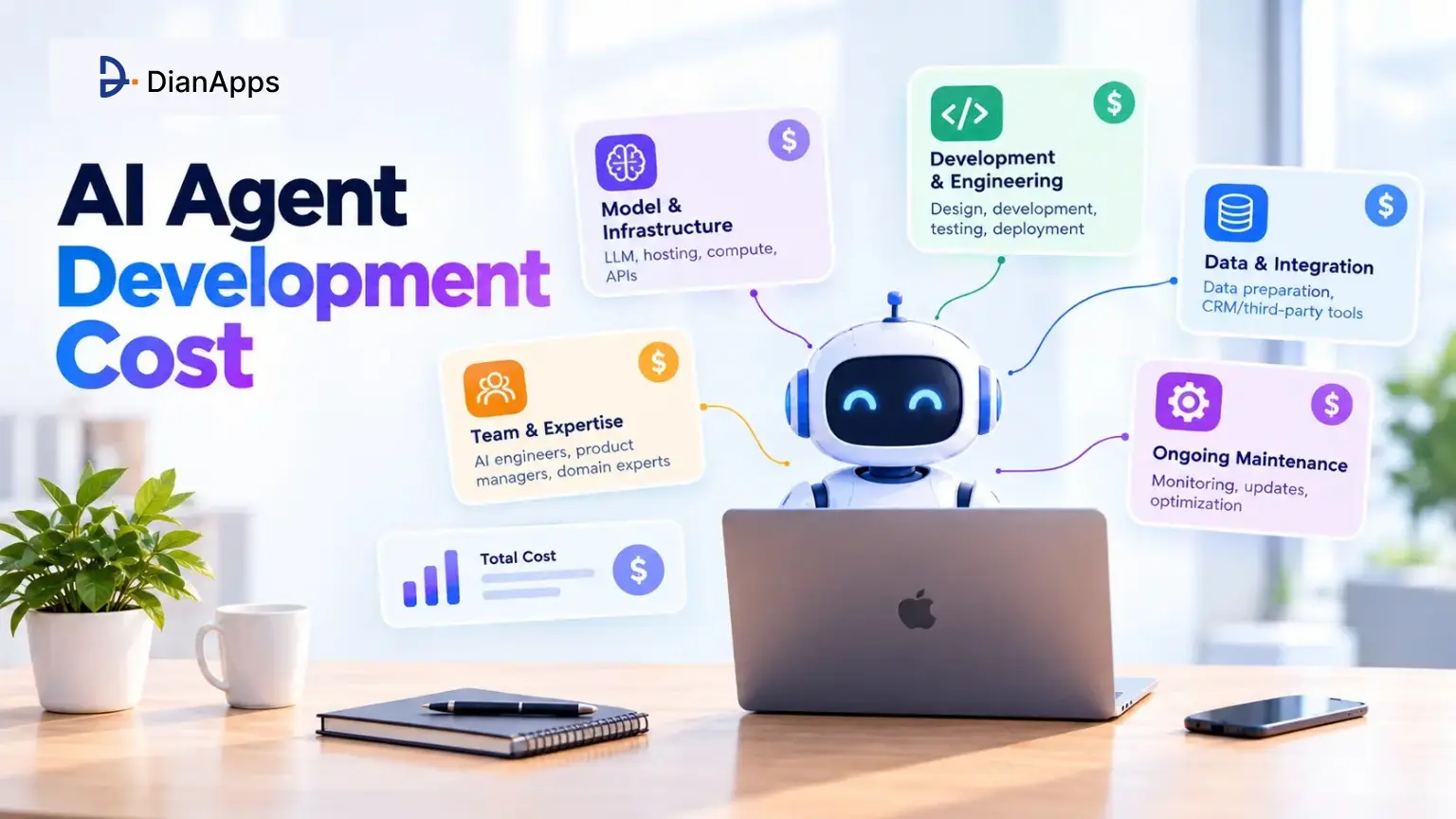
What Drives AI Agent Development Cost?
Before the numbers, the cost drivers, because the same use case can cost $5,000 or $500,000 depending on these variables.
| Cost Driver | Low-Cost Scenario | High-Cost Scenario |
| Build path | No-code platform (Zapier, Make, n8n), hours to deploy | Custom code (LangGraph, CrewAI – weeks to months |
| System integrations | 1-2 tools with standard APIs (email, CRM) | 5-10+ systems including legacy, proprietary, or complex APIs |
| Compliance requirements | No regulated data, standard security | HIPAA, SOC 2, GDPR, FedRAMP – adds 20-40% to build cost |
| Model choice | API model (GPT-4o mini, Claude Haiku, Gemini Flash) | Frontier model (GPT-4o, Claude Opus) or custom fine-tuned model |
| Volume | Low volume, hundreds of tasks per month | High volume, hundreds of thousands of tasks per month |
| Number of agents | Single agent, narrow task scope | Multi-agent system with orchestration layer |
| Human oversight design | Simple escalation queue, no custom review UI | Custom review dashboard, approval workflows, audit logging interface |
| Geographic rate | Global delivery partner ($25-$49/hr, DianApps model) | US in-house or boutique agency ($150-$350/hr) |
Planning Your AI Agent Budget?
Share your use case, integrations, and technical requirements with our AI team to understand what your project could cost.
AI Agent Development Cost by Build Path
Path 1: No-Code Agent (Zapier, Make, n8n)
| Initial build cost | $500-$5,000 (configuration time; $0 if built internally by your team) |
| Platform subscription | $0-$100/month (Zapier, Make, n8n free tiers available) |
| LLM inference cost | $10-$100/month for typical small business volumes |
| Maintenance | Low, platform handles updates; budget 1-2 hours/month for adjustments |
| Year 1 total (est.) | $1,000-$7,000 |
No-code agents on platforms like Zapier, Make, or n8n are the most cost-effective entry point for AI agent deployment. A simple email triage agent, appointment scheduling agent, or customer FAQ agent can be operational in hours with no engineering resources and minimal ongoing cost.
The limitation is capability ceiling, complex workflows, custom business logic, data sovereignty requirements, or integrations with systems not in the platform’s connector library require moving to a code-based approach. Understanding the types of AI agents involved can also help determine which architecture fits the workflow and budget.
Path 2: Code-Based Single – Workflow Agent (CrewAI, OpenAI Agents SDK)
| Discovery and scoping | $3,000-$8,000 · 1-2 weeks |
| Development | $12,000-$45,000 · 3-6 weeks |
| Testing and QA | $2,000-$8,000 · 1-2 weeks |
| Infrastructure setup | $1,000-$3,000 one-time |
| Total initial build | $18,000-$64,000 |
| Monthly ongoing (infra + inference + maintenance) | $500-$3,000/month depending on volume |
| Year 1 total (est.) | $24,000-$100,000 |
A code-based single-workflow agent, a customer support triage agent, a lead qualification agent, a document processing agent, is the most common enterprise AI agent deployment. This range reflects DianApps’ delivery model at $25-$49/hr for a team of 2-3 engineers over 4-8 weeks. AI development services can cover the broader engineering work around these deployments, including model integration, backend development, API connections, data pipelines, testing, and production infrastructure. US-based agencies at $150-$350/hr for the same scope would range from $60,000 to $250,000+.
Path 3: Multi-Agent Enterprise System (LangGraph + orchestration)
| Discovery, architecture, and scoping | $8,000-$20,000 · 2-4 weeks |
| Development (3-6 agents + orchestration) | $50,000-$200,000 · 2-4 months |
| Integration work (legacy + enterprise systems) | $10,000-$40,000 |
| Compliance architecture (HIPAA / SOC 2 / GDPR) | $10,000-$30,000 additional |
| Testing, QA, and evaluation framework | $8,000-$20,000 |
| Total initial build | $86,000-$310,000 |
| Monthly ongoing | $3,000-$15,000/month (inference + infra + monitoring + maintenance) |
| Year 1 total (est.) | $122,000-$490,000 |
AI Agent Development Cost by Use Case
Costs vary considerably for different AI agent use cases because the complexity of the workflow, integrations, data requirements and level of human oversight can differ significantly.
| Use Case | Complexity | Build Cost Range | Monthly Ongoing | Timeline |
| Email triage and routing | Low | $500-$8,000 | $50-$300 | Hours-1 week |
| Appointment scheduling | Low | $1,000-$10,000 | $100-$500 | 1-5 days |
| Customer support (single channel) | Medium | $15,000-$45,000 | $500-$2,000 | 3-6 weeks |
| Lead qualification and enrichment | Medium | $12,000-$35,000 | $400-$1,500 | 2-5 weeks |
| Document processing (invoice, contracts) | Medium | $20,000-$60,000 | $600-$2,500 | 4-8 weeks |
| AI voice agent (inbound calls) | Medium-High | $25,000-$80,000 | $1,000-$5,000 | 5-10 weeks |
| Healthcare prior authorization | High (HIPAA) | $40,000-$120,000 | $2,000-$8,000 | 8-16 weeks |
| Multi-agent sales + CRM orchestration | High | $60,000-$180,000 | $3,000-$10,000 | 3-5 months |
| Full AI-native product (mobile + agents) | Very High | $200,000-$600,000+ | $5,000-$25,000 | 6-12 months |
Have an AI Agent in Mind?
Tell us what you want to automate and get guidance on the right development approach, timeline, and cost.
AI Agent Deployment Cost for Small Businesses
Small businesses, the teams under 50 people, annual revenue under $10 million can deploy productive AI agents for far less than the enterprise numbers above. The key is matching the build path to the actual capability required.
What Small Businesses Can Deploy for Under $5,000?
- Email Triage Agent: $0-$2,000 setup using n8n or Make; $50-$200/month ongoing. Sorts, classifies, and routes incoming email without writing code.
- Appointment Scheduling Agent: $500-$3,000 setup; $100-$300/month. Handles bookings, confirmations, reminders, cancellations.
- Faq And Support Chat Agent: $1,000-$4,000 setup using Voiceflow or a similar no-code chatbot platform with LLM integration; $150-$500/month.
- Invoice And Ar Tracking Agent: $500-$2,500 setup via Make or Zapier; $100-$300/month.
- Social Media Monitoring And Response Drafting: $1,000-$3,500 setup; $100-$400/month.
What Small Businesses Typically Spend in Year 1?
| One simple no-code agent (e.g., email triage) | $1,200-$4,400 Year 1 total |
| Two-three no-code agents (scheduling + FAQ + email) | $3,000-$12,000 Year 1 total |
| One code-based agent (custom CRM or support integration) | $18,000-$40,000 Year 1 total |
How Much Does an AI Agent Cost Per Month?
Monthly costs have two components: infrastructure and inference. Understanding both prevents budget surprises at scale.
Infrastructure Costs (Monthly)
- Hosting: $20-$500/month (cloud compute for the agent runtime; scales with request volume)
- Vector Database: $0-$200/month (Pinecone free tier up to 100K vectors; Chroma self-hosted is free; Weaviate from $25/month)
- Observability / Monitoring: $0-$200/month (LangSmith free tier available; Langfuse open source option)
- Platform Subscription (If No-Code): $0-$100/month
LLM Inference Costs (Monthly) | Per 1 Million Tokens
| Model | Input Cost / 1M tokens | Output Cost / 1M tokens | Best For |
| GPT-4o mini | $0.15 | $0.60 | High-volume routine tasks (classification, extraction) |
| Claude Haiku 3.5 | $0.80 | $4.00 | High-volume tasks requiring better reasoning |
| Gemini Flash 2.0 | $0.075 | $0.30 | Latency-sensitive high-volume tasks |
| GPT-4o | $2.50 | $10.00 | Complex reasoning, multi-step tasks |
| Claude Sonnet 4.6 | $3.00 | $15.00 | Enterprise-grade reasoning, long context |
Real monthly inference cost examples:
- Email Triage Agent, 1,000 Emails/Month At ~500 Tokens Each On GPT-4o Mini: Approximately $0.38/month in inference costs.
- Customer Support agent, 5,000 Contacts/Month At ~2,000 Tokens Each On GPT-4o: Approximately $100/month in inference costs.
- Research Agent, 500 Multi-Step Research Tasks/Month At ~20,000 Tokens Each On Claude Sonnet: Approximately $150/month in inference costs.
The cost-reduction lever with the highest ROI: Model routing, route simple subtasks (classification, extraction, formatting, typically 70–80% of agent token volume) to small, cheap models (GPT-4o mini at $0.15/M, Gemini Flash at $0.075/M) and reserve frontier models only for the complex reasoning steps. This reduces inference costs by 60–70% with minimal quality impact on routine tasks.
Does Using an API Model Make AI Agent Development Cheaper?
Yes, substantially, training your own LLM from scratch is prohibitively expensive for virtually all organizations outside of foundation model labs: training a frontier-quality LLM costs $500,000 to $100 million+ in compute, plus the engineering cost of data collection, training infrastructure, and evaluation. For business AI agent use cases, this is never the right path.
Using an API model (calling GPT-4o, Claude, or Gemini via their APIs) eliminates the training cost entirely. It is also useful to distinguish agentic AI vs generative AI when estimating development requirements, since a generative model that produces content does not necessarily require the same orchestration, tool use, memory, or workflow logic as an AI agent.
Fine-tuning an existing model on your own domain data is occasionally worth the investment, when the base model consistently underperforms on your specific content type after prompt optimization, and when you have enough high-quality labeled examples (typically 1,000 to 10,000 labeled pairs minimum).
Fine-tuning on GPT-4o mini costs approximately $8 per 1 million training tokens; on Claude, fine-tuning pricing varies by model. For most use cases, a well-crafted system prompt and few-shot examples outperform fine-tuning at a fraction of the cost, so exhaust prompt optimization before considering fine-tuning.
Proof of Concept (PoC) vs. Full Build: When to Do Each?
| Stage | Cost | Timeline | What You Get | When to Use |
| PoC / Discovery | $3,000–$15,000 | 2–4 weeks | Working prototype on a subset of real data; accuracy assessment; architecture recommendation; ROI estimate | Before committing to a full build; when the use case is unproven; when stakeholders need evidence before budget approval |
| MVP Build | $15,000–$80,000 | 4–10 weeks | Production-ready agent for one workflow; integrated with core systems; human oversight built in; monitoring live | After PoC proves the concept; when there’s one clear high-value workflow to automate |
| Full Platform Build | $80,000–$500,000+ | 3–12 months | Multi-agent system; full integration suite; compliance architecture; custom review UI; analytics dashboard | After MVP proves ROI; when the use case spans multiple departments or complex integrations |
Organizations utilizing AI agents for the first time should generally take the PoC-first approach. After all, committing $100,000 to a build for which there is no proof of its viability with their particular data, processes and integrations is much riskier than investing $5,000 to $15,000 in a PoC that would verify whether the main idea works with real data. AI Agent Development Services can support this progression from proof of concept to production by helping define the agent architecture, connect required business systems, build human oversight into workflows, and scale validated use cases into reliable production environments.
 0 comments





Leave a Comment
Your email address will not be published. Required fields are marked *