















 0 comments





Key Takeaways:
- AI agents handle fraud detection, loan processing, healthcare, scheduling and customer support.
- Businesses use agents for code review, testing, lead qualification and campaign optimization.
- Small businesses can automate scheduling, invoices, emails and social media with AI agents.
- The best use cases involve high-volume, repetitive workflows with multiple systems.
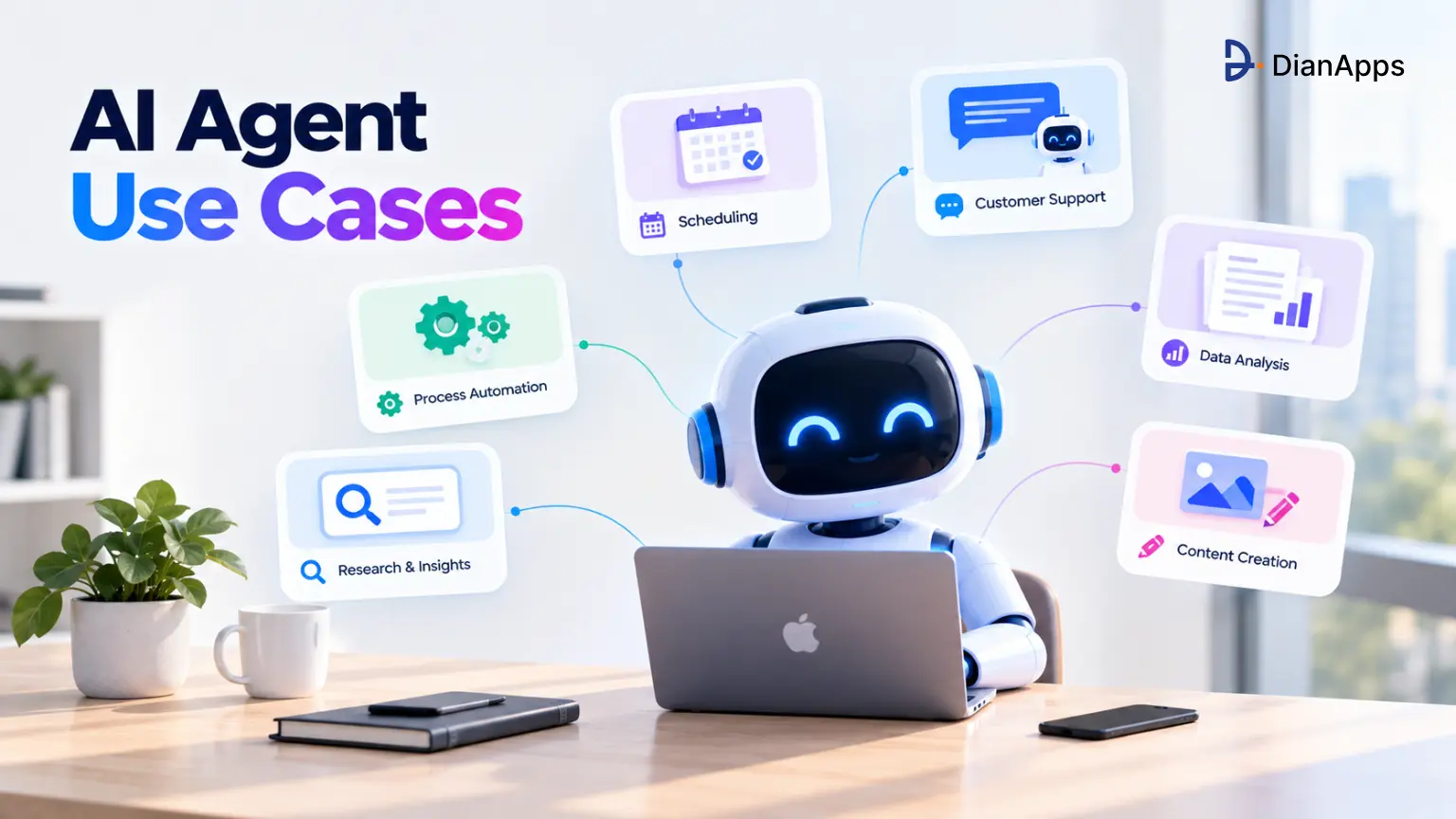
Quick Answer: AI agent use cases range from customer support and fraud detection to software development, healthcare administration, sales, marketing, HR and nonprofit operations. The most practical applications are usually repetitive, high-volume workflows where an agent can gather information, reason through variable inputs, use connected tools, complete routine actions and escalate exceptions to people. Examples include AI medical scribes, loan processing agents, code review agents, lead qualification agents, employee onboarding agents and invoice management agents.
51% of enterprises now run AI agents in production, with another 23% actively scaling them, according to Ringly.io’s 2026 AI agent statistics report. The top use cases by function are data analysis and reporting at 60%, code generation and testing at 59%, and internal process automation at 48%, per Anthropic’s 2026 enterprise report. McKinsey finds that companies implementing AI agents report revenue increases of 3 – 15% and a 10 – 20% boost in sales ROI.
But aggregate statistics don’t tell you which use cases actually work in your industry, what the workflow looks like when an AI agent handles it, or what measurable outcomes organizations have seen in production. This guide does. Below are 25 real AI agent use cases organized by industry and function, with workflow breakdowns, verified outcomes where available, and honest guidance on what each use case requires to work reliably.
Have an AI Agent Idea?
Tell us what you want to automate, and we’ll help you plan the right AI agent solution.
AI Agent Use Cases in Financial Services
The platform you choose also matters when these workflows move into production. For larger organizations, our guide to AI automation platforms for enterprises compares the options across integrations, governance, and scalability.
1. Fraud Detection and Transaction Monitoring
An AI agent observes transaction streams in real-time, identifies suspicious activity (out of region, larger-than-normal amount, out of sequence transactions), compares to historical fraud patterns, performs risk scoring, and then either blocks the transaction automatically or forwards it to a human investigator with a pre-written brief of why the transaction was flagged 43% of financial services companies use AI agents for fraud detection, the most popular industry-specific use case in financial services (Salesforce State of Service: AI Agents Edition, May 2026).
- Workflow: Transaction event → risk scoring agent → threshold check → auto-block or analyst escalation with context summary.
2. Loan Application Processing
An AI agent for loan processing takes an application, retrieves credit bureau data, confirms income documents, assesses debt-to-income ratio, matches it with the lending policy, and summarizes the case and results in a written report. Typical applications are completed in minutes, not days. Human loan officers focus on abnormal cases, not all cases. Banks say using AI agents to automate loan processing saves 60 – 80% of time on average applications.
- Workflow: Application intake → document extraction → credit pull → policy check → decision recommendation with evidence → human review queue for exceptions.
3. Regulatory Compliance Monitoring
Provides an agent empowered by AI to monitor, block, and disclose regulatory compliance risks in transcripts, internal files, data, and transactions (FINRA, SEC, AML/KYC, GDPR). The agent flags potential violations, delivers audited summaries, oversees remediation, and generates regular compliance reports. Not an alternative to compliance officers, but the agent takes on the live monitoring that was prohibitive in terms of time and costs.
- Workflow: Continuous data monitoring → rule application → violation flagging → evidence packaging → compliance officer notification → remediation tracking.
The same document-focused approach can be applied beyond compliance monitoring, including AI contract review software that helps teams analyze agreements, identify relevant clauses, and surface issues for human review.
4. Client Portfolio Reporting
An AI agent pulls portfolio performance data, market data, and client-specific benchmarks on schedule, generates personalized performance summaries, highlights positions that have shifted significantly relative to the client’s risk profile, and drafts a client-ready report. Wealth management firms using this pattern report advisor capacity increases of 30 – 40% as portfolio reporting labor moves to the agent.
- Workflow: Scheduled trigger → data pull (portfolio system + market data APIs) → analysis → personalized report generation → advisor review → client delivery.
Need AI Developers?
Hire experienced AI developers to build and deploy production-ready AI agents.
AI Agent Use Cases in Healthcare
These applications also sit within the wider generative AI ecosystem, so it is worth understanding which generative AI platforms are available before choosing the technology behind a specific workflow.
5. Clinical Documentation (AI Medical Scribe)
An AI agent listens to a patient-provider encounter (with consent), transcribes the conversation, extracts clinically relevant information, and drafts a structured clinical note in the provider’s EHR, reducing documentation time by 50 – 75% per visit. Providers using AI scribes report getting back 2 – 3 hours per day previously spent on documentation after hours. Sully AI’s documented outcome: 11% revenue lift at one health system in a single month from improved documentation quality and faster billing.
- Workflow: Encounter audio (consented) → transcription → clinical concept extraction → structured note draft in EHR → provider review and sign.
6. Prior Authorization Processing
Prior authorizations are among the most time-consuming administrative functions in healthcare, with the AMA estimating 13 hours of physician and staff time per week, for each physician’s practice. An AI agent reads the treatment request, pulls the patient’s clinical record, verifies payer-specific PA criteria, generates the authorization request, submits it in the payer portal, tracks the approval status, and creates the appeal by generating the clinical documentation. AI agents can process standard PA submissions with 85 – 95% accuracy, and escalate only the cases that do not meet the criteria.
- Workflow: PA request trigger → patient record pull → payer criteria check → request preparation → portal submission → status monitoring → appeal preparation if denied.
7. Patient Scheduling and Appointment Management
What does an AI scheduling agent do? Processes inbound scheduling requests from (phone/web/patient portal) through the scheduling request flow – confirms provider availability, links provider speciality to appointment type, sends appointment confirmation, makes reminder call/text, accepts cancellation, auto fills available appointment times from waitlist, adds data to EHR. Healthcare organizations utilizing AI scheduling agents report 40 – 60% decrease in staff time on scheduling staff and 30 – 50% no-show decrease from auto reminder texts.
- Workflow: Scheduling request → availability check → appointment matching → confirmation send → reminder sequence → cancellation/reschedule handling → waitlist management.
8. AI Agents in Dental Practices
Dental offices are a natural fit for AI agents because they have high volume, repetitive workflows and schedulers, recall campaigns, insurance checks, working down treatment plans post-appointment are all very high volume and repetitive. An AI agent in a dental practice: completes new patient intake forms, verifies insurance coverage prior to appointments, schedules recall reminders at appropriate frequencies based on the last patient visit, completes treatment plans when the patient is in the chair but not receiving treatment, and handles common front desk requests and questions through chat. Small dental groups that deploy AI agents on the front desk for these workflows experience a 4 – 6 hour / week reduction in admin front-desk work per agent.
- Workflow: Patient intake → insurance verification → appointment confirmation → recall scheduling → treatment plan follow-up → routine FAQ handling.
AI Agent Use Cases in Customer Service and Support
Another area where AI agents can free up a significant amount of time for your customer service teams is by automating most of the mundane tasks including answering frequently asked questions, managing incoming e-mails and handling calls that can be handled at a basic level. The AI can retrieve customer data, understand the intent, perform the action, and escalate to an agent with all context needed.
9. End-to-End Customer Support Resolution
Customer support AI agent (for email, chat, web form inbound support contacts): read inbound customer support contact and classify type of problem, look up customer account data, query knowledgebase, compose and send resolution (for simple) or send to human agent with ready-made context (for complex). Documented outcome at Ringly.io: AI support agents auto-resolve 73% of inbound contact requests without any human contact at all. ~30% of customer support cases are resolved without a human touching them across deployments: data from Ringly.io in 2026.
- Workflow: Contact received → issue classification → account history pull → knowledge base search → resolution send (routine) or escalation with context (complex).
10. Email Sorting and Triage Agent
Typical use cases Any team that gets too much email – including sales, support, HR, exec assistants – plus an AI agent that reads in email ideally through its own agent email address rather than a person’s mailbox, sorts by topic and urgency, forwards to the right person or team, writes drafts for common questions, and tags the urgent issues. The agent can have custom class categories, routing rules and draft responses set. This for a team on Zapier Agents, n8n or Make takes hours for minimum viable, and 1 – 2 days for a production version with custom routing logic and CRM integrations.
- Workflow: Email received → classification → urgency scoring → routing → draft response (routine) → flag for human review (complex or high-stakes).
11. AI Voice Agent for Inbound Calls
AI voice agents handle inbound phone calls including common tasks like hours of operation, confirming appointments, checking on orders, and answering FAQs. They also escalate challenging calls to an appropriate department along with necessary customer information. For low-friction, or low complexity, tasks like booking appointments or updating order status, verbal transaction processing by an AI voice agent may be an option. Businesses in healthcare and service industries commonly using AI voice agents claim that AI agents deflect 50 to 70% of their total inbound calls.
- Workflow: Inbound call → intent recognition → routine handling or intelligent transfer → transaction execution → call summary logged.
Ready to Build AI Agents?
Turn your AI ideas into reliable, production-ready agentic solutions.
AI Agent Use Cases in Software Engineering
AI agents can support software teams across the development cycle by taking on repetitive coding tasks, reviewing changes, finding bugs, and generating tests. They can work directly with codebases and development tools, helping engineers catch issues earlier and spend more time on complex development and architecture work.
12. Automated Code Review Agent
A code review AI agent tracks pull requests, scans code diffs for style rule violations and pattern deviations, finds bugs, security issues and performance problems, provides comments with structure and context, and flags PRs requiring senior human review. Customer teams using AI code review agents see 40 – 60% less time spent on everyday review, enabling senior engineers to focus on architectural reviews and complex logic, rather than style and rule checking.
- Workflow: PR opened → code change analysis → style/convention check → security scan → performance pattern check → structured comments posted → human review flag (if needed).
13. Bug Detection and Fix Agent
A bug-fixing agent: receives a bug report; locates the failing code; diagnoses the failure; generates a fix; executes the full test suite; opens a PR if it passes, or generates a human review comment if it doesn’t. GitHub Copilot Workspace and other agentic coding tools operationalize this pattern. AI currently writes 41% of all code globally in 2026: bug detection & fixing is among the highest-ROI use cases.
- Workflow: Bug report received → code localization → root cause analysis → fix written → test run → PR opened (pass) or human escalation (fail/uncertain).
14. Test Generation Agent
Test generation agent: consumes new or modified code, determines which paths and edge cases are untested, generates new unit tests and integration tests, executes the tests, and notes the coverage gaps. Customer teams that operate a test generation agent side-by-side with development see 20 – 40% increase in test coverage without requiring developer time.
- Workflow: Code change detected → coverage analysis → test case identification → test generation → test run → coverage report → PR update.
AI Agent Use Cases for Marketing and Sales
AI agents can help marketing and sales teams manage the repetitive work involved in finding, qualifying, and engaging prospects while keeping an eye on campaign performance. They can pull information from different sources, identify useful patterns, prepare personalized outreach, and flag areas that need attention so teams can spend more time on strategy and actual conversations.
15. Lead Qualification and Enrichment Agent
For example, a lead qualification AI agent receives a new inbound lead, searches for your company online, pulls funding data, number of employees, and technology stack, compares the lead to the ideal customer profile, scores the lead, writes a tailored outbound email to the prospect, then submits the lead to an appropriately matching account executive with all of the enrichment context included. Your salespeople experience a 50 – 70% decrease in the amount of time they spend on manual research for each lead.
- Workflow: New lead event → web research → data enrichment → ICP scoring → personalized email draft → AE routing with context.
16. Content Performance Monitoring Agent
An agentic content-monitoring AI: pulls performance data from across SEO, social, email channels on a schedule, identifies high and low performers, surfaces content gaps from competitor intelligence, creates a weekly content performance report with recommendations, and pushes 1-2 items to the content team’s project management system. 82% of marketing teams use AI to generate content in 2026. Agentic AI for continuous content performance management will be the next phase of maturity.
- Workflow: Scheduled trigger → analytics pull (SEO + social + email) → performance comparison → competitor gap analysis → summary report → task creation in PM tool.
17. Campaign Optimization Agent
A campaign optimization AI agent actively watches ad campaigns in real-time for under-performance (drop in CTR, increase in CPA, reach capping), diagnoses probable reason, adjusts budget within specified parameters, and warns marketing managers of larger required interventions. Paid media teams with ad campaign optimization AI agents experience 25 – 35% savings in wasted ad spend on underperforming campaigns.
- Workflow: Continuous campaign monitoring → performance alert trigger → cause analysis → automated adjustment (within limits) → human notification for out-of-bounds changes.
AI Agent Use Cases in HR and People Operations
AI agents can take care of many of the repetitive tasks involved in managing employees and recruitment, from collecting onboarding documents to screening incoming applications.
By handling routine coordination, communication, and follow-ups, they can reduce the administrative load on HR teams while keeping important processes moving.
18. Employee Onboarding Agent
An onboarding AI agent is responsible for the new hire’s admin workflow: collecting documentation, creating and forwarding service desk requests for system access, organising an orientation meeting, sending IT hardware requests, deflecting FAQs on benefits and policies, and monitoring completion of onboarding tasks. HR teams leveraging AI onboarding agents see a 60 – 70% reduction in admin time spent on onboarding per new hire, and an improved NPS score from new hires.
- Workflow: New hire event → documentation collection → system access requests → orientation scheduling → equipment request → FAQ handling → task completion tracking → exception escalation.
19. Recruiting Screening Agent
A recruiting AI agent is added to read through incoming applications, evaluate and score them to the role requirements, select the leading candidates, create personalized outreach to the best scorers and automatically email rejects to the type of candidates most unlikely to get a callback. Recruiters using an AI screening agent have reported working through 3 – 5x the application volume with their existing team, and decreasing time-to-first-contact on best candidates from days to hours.
- Workflow: Application received → scoring against role criteria → top candidate identification → personalized outreach draft → rejection communication → recruiter queue for shortlist review.
AI Agent Use Cases for Small Businesses
AI agents can take over many of the repetitive tasks that keep small business owners tied up with day-to-day administration. From scheduling appointments and following up on invoices to managing social media activity, these agents can handle routine workflows while leaving business owners more time for customers and growth.
20. Appointment and Calendar Management
Booking for service Business owners, like trainers, therapists, salons, and others in the service industry, can automate appointment booking, rescheduling, and reminders with a scheduling AI agent. The bot checks your availability, manages booking requests through email or chat, confirms booking, makes reminder calls, cancels, and fills gaps. Small business owners using AI agents save 5 – 10 hours a week just on scheduling administration.
- Workflow: Booking request → availability check → confirmation → reminder sequence → cancellation/reschedule → waitlist fill.
21. Invoice and Accounts Receivable Agent
An AR AI agent creates invoices based on fulfilled work orders, sends invoices out to clients, tracks the payment status, reminders clients at regular intervals, flags overdue accounts, and creates collections escalation reports. SMBs using AI for AR management are averaging a DSO (days sales outstanding) reduction of 8 – 15 days.
- Workflow: Work order complete → invoice generation → send to client → payment monitoring → reminder sequence → overdue flag → collections summary.
22. Social Media Management Agent
Social media AI agents track brand mentions on all channels, write replies to comments and messages, research hot topics for the brand, come up with ideas for content to share, and schedule approved posts. It’s especially useful for small companies that lack a social media person-grow your presence without growing the time you need.
- Workflow: Mention monitoring → response drafting → trend analysis → content suggestion → scheduling approved posts → performance tracking.
AI Agents for Nonprofit Operations
AI agents can help nonprofit teams manage repetitive administrative and communication work without taking away from the relationship-driven nature of their work. From keeping donors engaged to finding relevant grant opportunities and tracking deadlines, these workflows can help small teams stay organized while spending more time on their core mission.
23. Donor Communication and Stewardship Agent
Small teams of non-profits maintain deep relationships with individual donors and engagement tasks are extremely relationship-intensive and repetitive. An AI agent manages donor acknowledgement letters, thank-you emails, grant reporting reminders, anniversary and milestone stewardship, and donation impact updates. Nonprofits report that with an AI donor stewardship agent their engagement with donors increased, with the same number of engagement staff, with their major gift officers able to focus on relationship-building instead of rote correspondence.
- Workflow: Donation event → acknowledgment send → impact update schedule → milestone recognition → grant deadline monitoring → lapsed donor re-engagement.
24. Grant Research and Tracking Agent
A grant research AI agent searches across grant databases, government funding sites, foundation websites and more for relevant opportunities for the organization, compiles opportunity summaries, manages submission deadlines, tracks the status of submitted applications, and produces reporting reminders. Grant development staff who use AI research agents report discovering 30 – 50% more pertinent funding opportunities than manual searches.
- Workflow: Scheduled database monitoring → opportunity matching → summary preparation → deadline tracking → application status monitoring → reporting reminder generation.
Applied Agentic AI for Organizational Transformation
Larger organizations can use agentic AI to coordinate workflows that span multiple teams, systems, and approval stages. These agents can track progress across departments, identify bottlenecks, follow up on delayed tasks, and keep leadership updated without requiring someone to manually coordinate every step.
25. Cross-Departmental Operations Orchestration Agent
Most Valuable Agentic AI Use Cases Larger Companies The most valuable agentic AI use case for larger organizations is cross-departmental orchestration: a coordinating AI agent that keeps track of the status of processes that run through several departments (such as the delivery of a new enterprise contract through sales, legal, finance, and operations), detects bottlenecks, sends reminders to those involved, escalates any delays past threshold time limits, and produces live status reports for executive teams. Companies that deploy cross-departmental AIs to manage complex processes see 20 – 35% reductions in cycle time for these end-to-end workflows.
- Workflow: Process initiation → multi-department task tracking → bottleneck detection → automated reminders → escalation triggers → status dashboard update → leadership summary generation.
What Is AI Agent Workflow Automation?
Automation of End-to-End Business Processes with AI Agent Any business process where an AI agent operates, from trigger to result without human intervention at every step. How this differs from workflow automation (such as Zapier, Make, and rule-based RPA), is that the variable inputs are not mapped to rules, but are reasoned about instead by an AI agent. A customer email does not match any help desk template; a rule-based automation system breaks or responds with a generic message. An AI agent understands the content of the email, contextualizes it, and generates a relevant reply.
The standard AI agent workflow pattern:
- Trigger: An event initiates the agent (new email, new record in CRM, scheduled time, API call, user request)
- Context Gathering: The agent retrieves relevant information from connected systems
- Reasoning: The LLM analyzes the situation and plans the next action
- Action Execution: The agent calls tools, and APIs, databases, communication systems, and to take action
- Result Observation: The agent reads the outcome and determines the next step
- Loop Or Complete: Steps 3 – 5 repeat until the task is complete or an escalation condition is triggered
- Escalation Or Logging: Completed tasks are logged; exceptions route to human review with full context.
The organizations generating the strongest ROI from agentic AI workflows are those who start with one high-value, high-volume workflow, instrument it thoroughly to measure outcomes, and expand from there, and rather than attempting to automate everything at once. The integration of agentic AI into enterprise applications follows this disciplined path in every high-ROI deployment DianApps has observed.
How Should Employees Think About an AI Agent-Enhanced Workplace?
The best framing for the employee is not “AI is replacing my job,” but “AI is taking the boring tasks off my plate so I can focus on the work that requires judgment, relationships, and creativity.” The evidence suggests this. AI’s role is growing in the decisions knowledge workers make every day-at least 15% by 2028 (up from zero in 2024), per Gartner-and this refers to decision-making, not for judgment calls, relationships, or strategic thinking.
From healthcare and finance to retail and customer support, businesses can leverage our AI Agent Development Services to develop tailored AI solutions that automate tasks and enhance operational efficiency.
Customer support agents previously managing 60 basic tickets a day are doing 20 complex ones, because an AI agent handled the other 40. Recruiters that spent 40% of their time reviewing applications are now using that time to build candidate relationships. Finance analysts that used to generate 15 routine reports each week now devote that time to analyze data and draw insights. In 2029, at least half of knowledge workers will be acquiring new skills to work with, oversee, or create AI agents, according to Gartner. The practical translation for the individual worker: the biggest skills development occurs when you learn to define and measure workflows, and design systems to execute them.
 0 comments





Leave a Comment
Your email address will not be published. Required fields are marked *