















 0 comments





Key Takeaways:
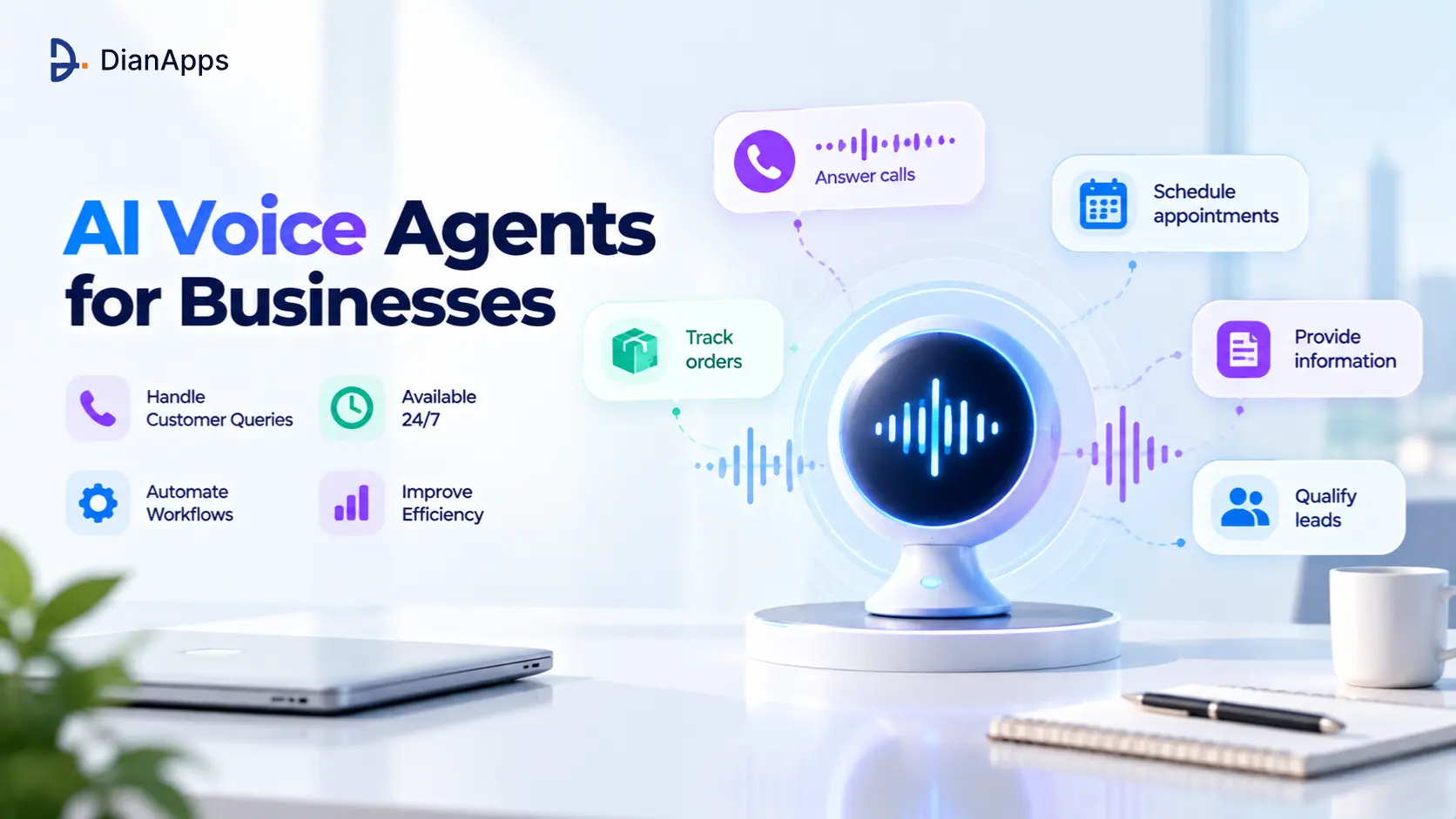
- AI voice agents handle calls, understand requests, use business tools, and complete tasks.
- They work well for healthcare, real estate, customer service, bookings, and lead qualification.
- Costs typically depend on call volume, integrations, models, voice quality, and compliance needs.
- Outbound AI calls require consent, disclosures, opt-outs, and compliance with local laws.
- Start with one repetitive workflow, measure results, and expand after the pilot.
Quick Answer: An AI voice agent uses speech recognition, AI models, business integrations, and text-to-speech to handle phone conversations and complete tasks. Businesses can use them for bookings, support, lead qualification, reminders, and other repetitive calls, with costs depending on usage and complexity.
Your phone rings at 7:52 p.m. Nobody picks up, because the office closes at six. The caller, a patient, a buyer, a customer with a broken thing, tries your competitor next. An AI voice agent exists to make that exact scenario stop happening.
This guide covers what an AI voice agent is, how it works under the hood, which businesses already use one, what it really costs, and where the legal landmines sit, especially around outbound calling. You’ll leave knowing whether to buy, build, or wait.
What Is an AI Voice Agent?
An AI voice agent is software that holds a spoken conversation over a phone line or app, understands what the caller wants, and completes the task, such as booking an appointment, qualifying a lead, or updating a record. An AI agent listens, reasons, talks back, and acts, all in real time and without a human on the line.
That last part separates it from older tools. A classic phone menu (“press 1 for billing”) only routes calls. A chatbot handles text. An AI voice agent combines the reach of a phone call with the judgment of a language model, so the caller can speak normally, interrupt mid-sentence, change their mind, and still get the job done.
Three traits define a real one:
- It converses in natural speech, not menu options.
- It uses tools. It checks your calendar, CRM, or patient system and writes back to them.
- It knows when to stop. When a call gets sensitive or confusing, it hands off to a person with the context attached.
If a product only does the first, it’s a talking FAQ. Not a bad thing, just not an agent.
How Does an AI Voice Agent Work?
An AI voice agent works by chaining four technologies into one fast loop: speech recognition turns the caller’s voice into text, a language model decides what to say and do, tools carry out the actions, and text-to-speech turns the reply back into a natural voice. The whole round trip has to finish in a second or two, or the call feels broken.
Here’s the loop in order:
- Telephony connects the call: A phone number (or SIP trunk) routes the call into the system.
- Speech-to-text transcribes: The caller’s audio streams in and becomes text, word by word, while they’re still talking.
- The language model reasons: It reads the transcript, your instructions, and any stored context, then decides the next move.
- Tools fire: The model calls your systems through APIs: check availability, look up an order, create a lead.
- Text-to-speech replies: The answer becomes spoken audio in a chosen voice.
- The loop repeats: With turn-taking logic deciding when the caller has finished speaking, and when they’ve interrupted.
Latency is the quiet killer. Humans expect a reply within roughly a second. Past two, callers start talking over the agent or hanging up. That’s why serious builds put real effort into streaming audio, short model prompts, and caching common answers.
Interruptions matter just as much. People don’t wait politely. A good AI voice agent stops talking when you cut in, keeps the thread, and doesn’t restart its sentence.
For a broader look at how these systems are structured, see our guide to AI agent architecture.
Build Smarter Voice Experiences
Have a use case in mind for an AI voice agent? Talk to our team about your workflows, integrations, and the right way to get started.
AI Voice Agent vs IVR vs Chatbot
People mix these up constantly, so here’s the quick sort.
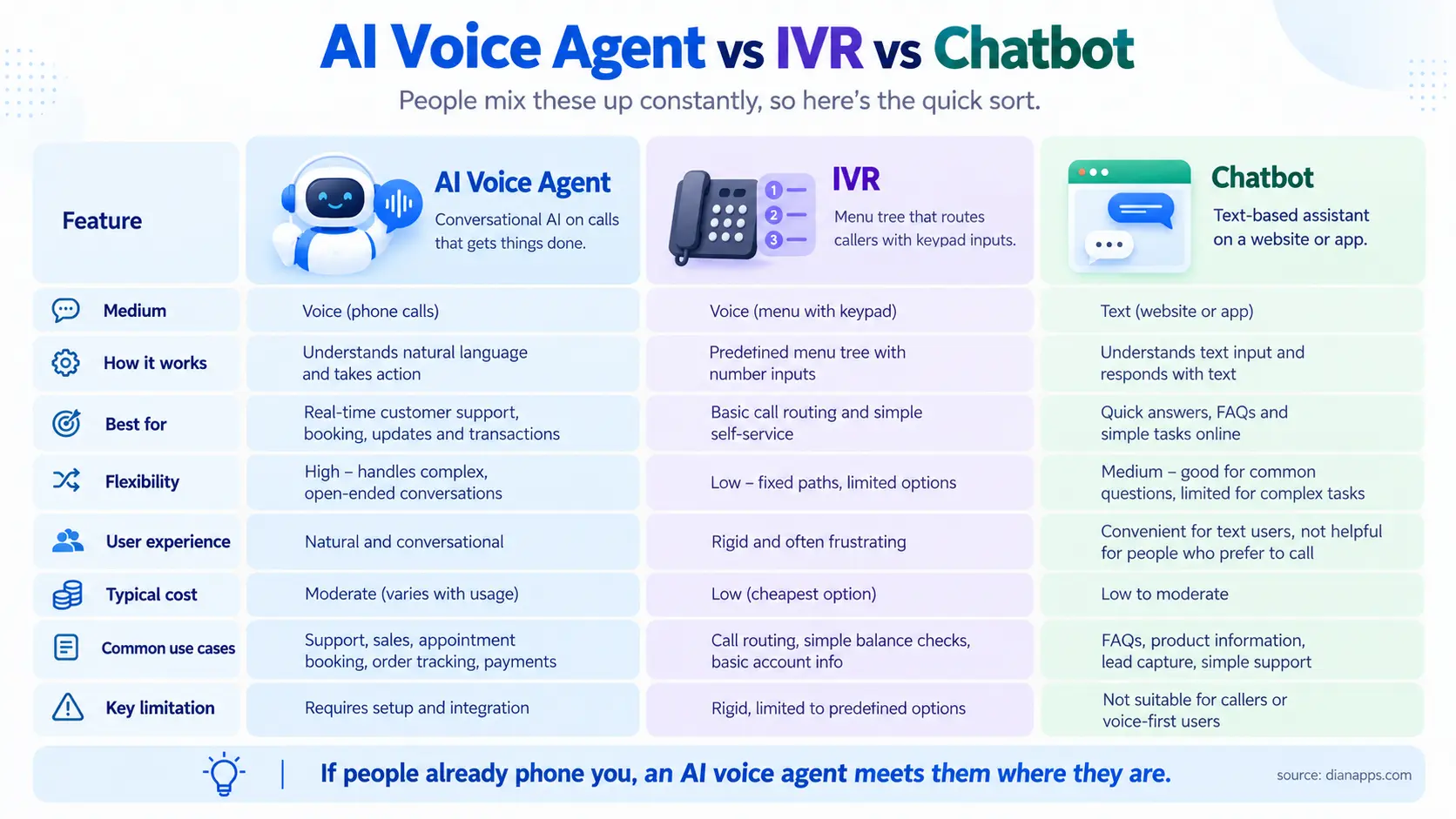
An IVR is a menu tree. It’s cheap, rigid, and callers hate it. A chatbot is text on a website or app, which is useful but doesn’t help someone driving or someone who simply prefers to call. An AI voice agent replaces the menu with conversation and reaches the callers the other two miss.
If you’re deciding between a voice agent and a text-based one, our guide on AI agent vs chatbot walks through the same autonomy question from the chat side.
The short rule: if people already phone you, an AI voice agent meets them where they are.
AI Voice Agent Services for Businesses: What You Can Actually Buy?
AI voice agent services for businesses fall into three buckets, and picking the wrong bucket is the most common early mistake.
- Platform subscriptions: You rent a voice agent builder, set up prompts and integrations yourself, and pay per minute. Fastest to launch, least control. Fits simple inbound use cases.
- Managed services: A vendor configures, tunes, and monitors the agent for you, usually for a monthly fee plus usage. Good if you don’t want to hire AI engineers but you do want someone accountable.
- Custom builds: A development partner designs the agent around your workflows, data, and compliance needs. Slower and pricier up front. Worth it when calls trigger complex actions in internal systems, or when data can’t leave your environment.
Most buyers of AI voice agent services for businesses start with a platform or managed option to prove value, then move to a custom build for the one or two workflows that truly differ from everyone else’s. This is where AI agent development services can help businesses build custom voice workflows around their specific integrations, data, and operational requirements. AI voice agent services for businesses are easiest to judge by one question: who owns the call logs, the prompts, and the integrations if you ever leave?
Can AI Agents Make Outbound Calls?
Yes. Can AI agents make outbound calls at scale? Absolutely, and many already do: appointment reminders, payment nudges, lead follow-up, survey calls, and re-booking missed visits. Technology is the easy part. An AI voice agent dials a number, waits for a human, identifies itself, runs the conversation, and logs the result, exactly like an inbound call in reverse.
Two things make outbound harder than inbound.
- First, detecting what was picked up: Voicemail, a gatekeeper, or an actual person each need a different response. Good systems detect voicemail and either leave a short compliant message or hang up cleanly.
- Second, the law: Which brings us to the question that should come before any dialer gets switched on.
Are AI Agent Outbound Calls Legal?
Often yes, but only with the right consent and disclosures, and the rules depend on where you call. In the United States, the FCC ruled in February 2024 that AI-generated voices count as “artificial” voices under the Telephone Consumer Protection Act (TCPA). According to Mayer Brown’s analysis of the ruling, callers need prior express consent before making these calls, and must identify who is calling. Marketing calls carry opt-out requirements on top.
Here’s the practical translation for any AI voice agent doing outbound work:
- Get documented consent first: For marketing or sales calls in the US, that generally means prior express written consent. Keep the record.
- Disclose the caller: Say who’s calling and on whose behalf, early in the call.
- Honor opt-outs immediately: and scrub against do-not-call lists.
- Respect calling hours: in the recipient’s local time zone.
- Don’t pretend to be human: when asked directly. It’s both a trust problem and, in a growing number of places, a legal one.
- Check local law: The UK, EU, India, Canada, and individual US states each add their own rules.
This isn’t legal advice, and the rules keep moving. Have counsel review your consent flow and call scripts before launch. We’ve seen more projects stall on compliance review than on technology, so start that conversation in week one, not week ten.
AI Voice Agent for Healthcare
An AI voice agent for healthcare handles the phone work that buries front-desk staff: scheduling and rescheduling visits, appointment reminders, refill requests, insurance questions, after-hours triage routing, and post-visit follow-ups. Clinics lose real revenue to unanswered calls and no-shows, and both are problems a voice agent attacks directly.
The AI voice agent for healthcare use cases that work best share a pattern: high volume, repetitive, and well-defined.
- Appointment booking and reminders: The agent checks the scheduling system, offers slots, confirms, and sends a text.
- No-show recovery: An outbound call (with consent) to rebook missed visits.
- Pre-visit intake: Collect demographics and reason for visit before the appointment.
- After-hours routing: Capture the issue, flag urgent symptoms, and escalate to on-call staff.
- Prescription refill requests: routed into the right queue.
- Billing questions: answered from account data.
Compliance comes first. In the US, a vendor that creates, receives, maintains, or transmits electronic protected health information for a covered entity is a business associate, and HHS guidance on cloud computing says a business associate agreement is required. Every layer of your voice stack that touches patient data, including telephony, speech recognition, the language model, and call recordings, needs to be covered. Ask vendors for a signed BAA, not a marketing page that says “HIPAA-ready.”
Two design rules for any AI voice agent for healthcare: never let it give medical advice, and always give a fast path to a human for anything that sounds like an emergency.
AI Voice Agent for Real Estate
An AI voice agent for real estate answers every inquiry instantly, qualifies the lead, and books the showing, around the clock. Property leads are impatient. A buyer who submits a listing inquiry at 9 p.m. and hears nothing until the next afternoon has often talked to three other agents by then.
The AI voice agent for real estate playbook looks like this, whether you run a brokerage or a rental portfolio:
- Instant inbound answers: Callers asking about a listing get details, availability, and pricing from your property data.
- Lead qualification: Budget, timeline, pre-approval status, and neighborhood preferences, captured in a normal conversation and written to the CRM.
- Showing scheduling: The agent checks agent calendars and books the visit.
- Speed-to-lead callbacks: When an online lead arrives, the agent calls within moments (where the lead consented to contact).
- Old-lead reactivation: Gentle outbound follow-up to past inquiries, again only with valid consent.
- Property management calls: Maintenance requests, rent questions, and after-hours emergencies for rental portfolios.
- Open-house follow-up: Call attendees the same evening while the visit is fresh.
The human agent’s job shifts to what only humans do well: walking the property, negotiating, and building trust. The voice agent handles the first thirty seconds of every relationship, which is where many leads quietly die.
Which Businesses Use AI Voice Agents?
Which businesses use an AI voice agent today? Any business that takes or makes many repetitive phone calls. Healthcare practices and real estate firms are the headline cases, but the list is much longer:
- Dental and medical clinics for scheduling and recalls
- Real estate agencies and property managers, where an AI voice agent for real estate handles inquiries and showings
- Home services (plumbing, HVAC, electrical) for emergency dispatch and quotes
- Restaurants and hospitality for reservations and order questions
- Insurance and financial services for claims intake, payment reminders, and policy questions
- Logistics and delivery for status calls and address confirmation
- E-commerce and retail for order tracking and returns
- Education for admissions inquiries and fee reminders
- Banks and lenders for collections reminders and application follow-ups
On the macro side, Gartner predicted back in 2022 that conversational AI in contact centers would reduce agent labor costs by $80 billion in 2026 and that one in ten agent interactions would be automated by then. Treat it as a forecast from before the current voice models arrived, but it shows how long analysts have expected phones to be the next big automation target. Gartner also noted labor can represent up to 95% of contact center costs, which explains the appetite.
How Much Does an AI Voice Agent Cost?
Pricing for AI voice agent services for businesses varies widely, but an AI voice agent typically costs somewhere between $0.08 and $0.40 per minute of conversation on a platform, plus setup and integration work, with custom builds and enterprise contracts running far higher. The honest answer depends on call volume, voice quality, model choice, and how deep the integrations go.
Here are the pieces that make up the per-minute price, based on one 2026 pricing breakdown:
- Speech-to-text: roughly $0.005 to $0.02 per minute
- Language model: roughly $0.02 to $0.10 per minute
- Text-to-speech: roughly $0.05 to $0.18 per minute
- Telephony: roughly $0.005 to $0.03 per minute in the US
Published platform rates sit inside that range. As of a September 2026 comparison, Retell AI listed $0.07 per minute, Vapi $0.05 per minute plus model provider costs, and Synthflow $0.09 per minute for the voice engine plus separate model charges. Enterprise vendors such as PolyAI are reported to run at 150,000 or more per year under custom contracts. These are vendor-reported figures and they change often, so confirm on the vendor’s own pricing page.
Quick math: at 10,000 minutes a month and an all-in cost between $0.10 and $0.30 per minute, usage runs about $1,000 to $3,000 monthly. Add setup, integrations, monitoring, and a human review process.
What pushes cost up:
- Premium, more natural voices
- Larger language models and longer prompts
- Many integrations with legacy systems
- Compliance work (HIPAA, call recording, consent capture)
- Multilingual support
- Heavy outbound volume with retries
What keeps it down: narrow scope, shorter calls, caching, and a clear handoff rule so the agent doesn’t burn minutes on calls it can’t solve.
Judge cost by one number: cost per resolved call. Add up platform fees, usage, engineering, and oversight, then divide by calls the agent actually completes. Compare that to your current cost per handled call. That comparison decides the budget, not the per-minute sticker price.
Planning Your AI Voice Agent?
Get a clearer idea of the technology, integrations, and development scope your voice agent project will need.
Voice Agents Conversational AI Products Development: How a Build Actually Goes?
Voice agents conversational AI products development is not just wiring a speech API to a chatbot. The work that decides success happens in conversation design, integrations, and testing with real callers.These considerations are part of the broader shift toward AI development in 2026, where agents are increasingly moving from demos into production workflows. Here’s the sequence we’d follow for any voice agents conversational AI products development project.
- Pick one call type. Booking, qualification, reminders. Not “all calls.”
- Collect real call recordings and transcripts. They show how people actually talk, including the messy parts.
- Map the actions. Which systems must the agent read from and write to?
- Design the conversation. Greetings, disclosure, core flow, fallback, handoff.
- Build the stack. Telephony, speech recognition, model, voice, and integrations.
- Test with adversarial callers. Accents, background noise, interruptions, angry people, silence.
- Pilot on a slice of traffic with human review of every call.
- Tune, then widen. Expand only when error rates are low and stable.
Voice agents conversational AI products development also needs ongoing care after launch. Models change, policies change, and callers find edge cases you didn’t imagine. Budget for monitoring, not just the build.
Seven Mistakes That Sink Voice Agent Projects
Watch for these.
- Launching with no human fallback: One bad call with no escape route can undo months of goodwill.
- Ignoring latency: A brilliant agent that pauses three seconds before every reply feels broken.
- Skipping consent design on outbound: Teams ask “can AI agents make outbound calls?” and stop at the technology. The better question is whether you hold the consent to make them. The fines and complaints aren’t worth it.
- Buying on a polished demo: Test on your own call recordings, with your own accents and noise.
- Overpromising scope: A narrow agent that works beats a broad one that doesn’t.
- No call review process: Someone should listen to a sample every week.
- Forgetting the staff: Front-desk teams who weren’t involved will work around the system. Bring them in early.
How to Measure Whether Your AI Voice Agent Is Working?
Pick metrics before launch. For an AI voice agent, the useful ones are:
- Containment rate
- Task completion rate
- Average handling time
- Handoff quality
- Caller satisfaction
- Error and complaint rate
- Cost per resolved call
Listen to calls. Dashboards lie by omission. Twenty minutes with a dozen real recordings every week will tell you more than any chart.
What to Do Now?
Here’s the opinionated version. Don’t start by choosing a vendor. Pull a week of call logs, tag each call by type, and find the one repetitive, high-volume call that always follows the same pattern. That’s your first AI voice agent.
Build it narrow. The question isn’t only “can AI agents make outbound calls?” It’s whether your consent records and disclosures are in place before any outbound dialing. Pilot with human review, measure cost per resolved call, then expand.
Whether it’s an AI voice agent for real estate, an AI voice agent for healthcare, or something else entirely, the first step is the same. If you’re comparing AI voice agent services for businesses, ask each vendor to run a live call on your own data. And if you’d like help sorting your call types or scoping a pilot, the DianApps provides AI Agent Development Services. Our team builds voice agents conversational AI products development from design to deployment.
Ready to Put AI Voice Agents to Work?
Whether you need an inbound assistant, outbound calling solution, or a custom voice workflow, let’s discuss what makes sense for your business.
 0 comments











Leave a Comment
Your email address will not be published. Required fields are marked *