















 0 comments





Key Takeaways:
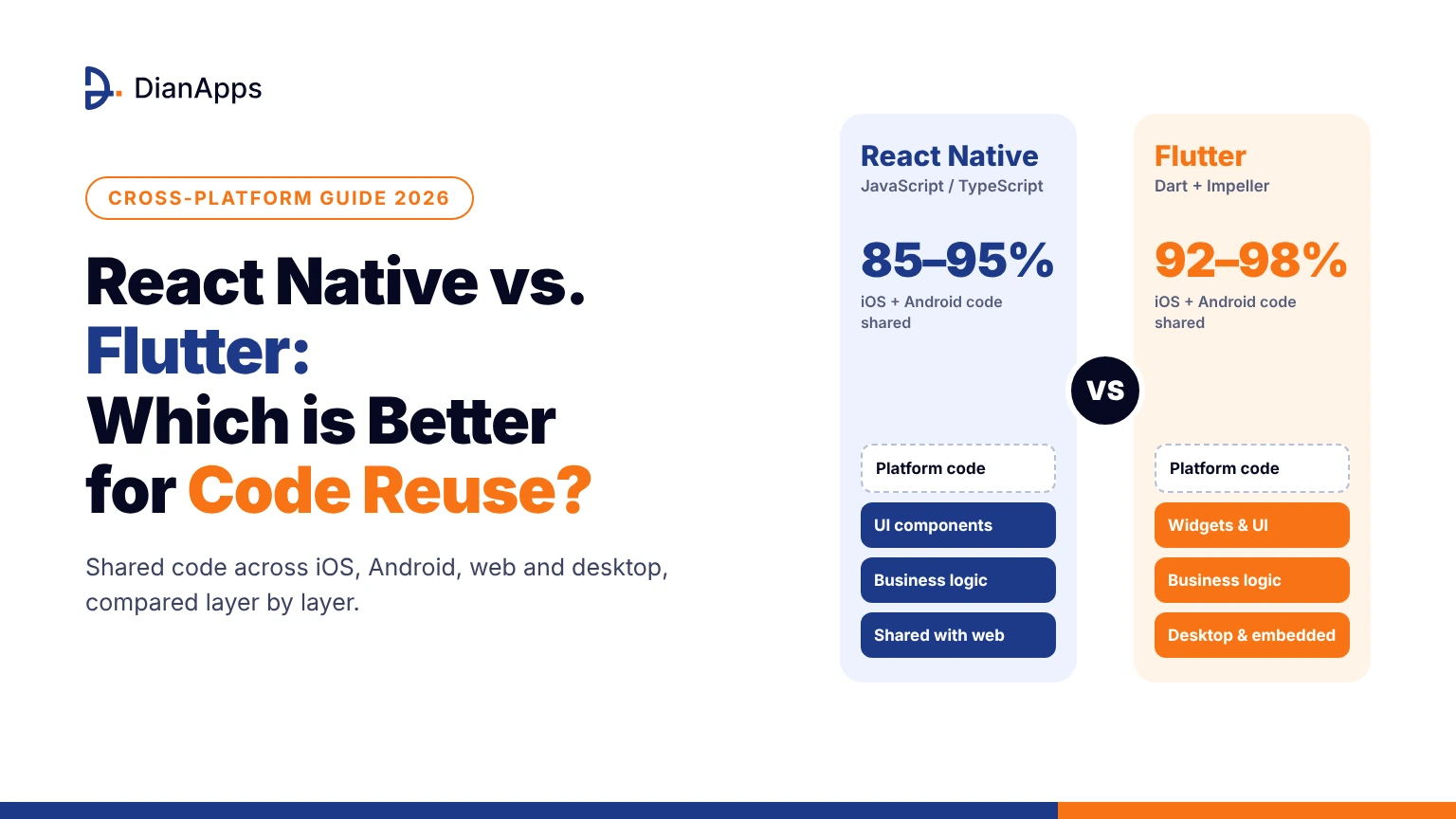
- React Native offers stronger code reuse when an existing React web app or TypeScript backend is part of the technology stack.
- Flutter typically shares more code between iOS and Android through its unified Dart codebase and rendering engine.
- React Native is better suited to mobile and web products, while Flutter has an advantage across mobile, desktop and embedded platforms.
- Native integrations, platform-specific UI requirements and performance demands reduce code reuse in both frameworks.
- Monorepos, shared business logic, reusable design tokens and clean platform boundaries help maintain code reuse over time.
Quick Answer: React Native is better for code reuse when your organisation already uses React, JavaScript or TypeScript and needs to share logic with a web application. Flutter typically offers higher code reuse between iOS and Android and is better suited to products targeting mobile, desktop and embedded devices from one codebase. The right choice depends on your existing technology stack, target platforms, UI requirements, native integrations and available engineering skills.
The promise of writing an app once and running it everywhere has been sold so many times that most engineering leaders have stopped believing it, and yet the two frameworks dominating Mobile App Development in 2026 are both delivering a large share of that promise in very different ways. React Native is reusing code by borrowing the web’s language and ecosystem, while Flutter is reusing code by bringing its own rendering engine to every screen, and the choice between them is deciding what you can share, with whom and for how long.
If you’re still deciding whether cross platform is even the right route, our guide on react native vs. flutter which is better for app development is covering the wider options.
What Code Reuse Really Means in Mobile App Development
Code reuse is a slippery phrase, because a vendor’s ninety percent figure and your team’s experience of it are rarely describing the same thing, and the gap is where disappointment lives. Before comparing frameworks, it is worth separating the layers that can actually be shared, since each framework is strong in some and weak in others:
- Business logic, meaning validation, data models, API clients, state management and domain rules, which is the most portable layer in any stack.
- UI components and screens, which is where frameworks differ most, since some are rendering their own pixels and others are mapping to platform widgets.
- Navigation, theming and design tokens, which can be shared on paper and often diverge in practice because platforms have different conventions.
- Platform integrations such as camera, payments, notifications and background work, which are always needing some native code however good the framework.
- Tooling, tests and CI pipelines, which are a hidden but large source of reuse when one language serves every target.
With those layers named, the reasons for each framework’s strengths are not hard to see, so let’s start with the overview.
React Native vs. Flutter at a Glance for Code Reuse
The two frameworks have matured considerably in the last two years, and a comparison written in 2024 is already out of date on several rows.
A November 2026 comparison by Tapptic is noting that React Native has been governed by the React Foundation under the Linux Foundation since February 2026 with Meta, Microsoft, Amazon and Expo among its members, that Flutter’s desktop support is now maintained with Canonical, and that code sharing with a web app is high for React Native and low for Flutter because Dart is rarely used on the web side.
| Reuse Dimension | React Native | Flutter |
| Language | JavaScript or TypeScript with React | Dart |
| iOS and Android from one codebase | Yes, typically 85 to 95 percent shared | Yes, typically 90 to 98 percent shared |
| Rendering approach | Maps to native platform views | Draws every pixel with its own engine (Impeller) |
| Sharing with a web app | High, through React and React Native Web | Low, Flutter web is a separate canvas based target |
| Desktop targets | Windows and macOS via Microsoft maintained projects | Windows, macOS and Linux as first class targets |
| Embedded and automotive | Limited | Supported, used in vehicle and appliance screens |
| Shared logic with backend | High when the backend is Node or TypeScript | Possible with Dart on the server, rarely done |
| Over the air updates | Yes, through Expo Updates and similar | Limited by store policy, not a core feature |
| Governance | React Foundation, multi vendor | Google, with Canonical on desktop |
Those rows are pointing in different directions, and the next two sections are explaining why each framework shares code the way it does.
How React Native Shares Code: JavaScript, React and the Web Ecosystem
React Native’s reuse story is really the web’s reuse story, because the framework is built on the language, the component model and the package ecosystem that most product companies already have. A React Native screen is a React component written in TypeScript, so a team that is maintaining a Next.js web app is finding the mental model identical, the state management libraries identical and a large share of the business logic directly importable, which is why React Native is winning almost every comparison where an existing React web product is in the picture.
Under the hood, the framework is mapping components to real platform views, which is giving apps the native look of each operating system but is also meaning that UI code is sharing behaviour rather than pixels, and platform differences in scrolling, text input and navigation are showing through. The New Architecture, now the default, has replaced the old asynchronous bridge with synchronous JavaScript Interface calls, which is closing much of the historic performance gap, and the Expo toolchain has become the standard way to build, with over the air updates letting teams ship JavaScript changes without a store release. The reuse ceiling is set by the web, which is both its strength and its limit.
How Flutter Shares Code: One Engine, One Widget Tree, Six Targets
Flutter is taking the opposite bet, which is that the surest way to run the same code everywhere is to stop depending on each platform’s UI toolkit entirely and to draw every pixel yourself. A Flutter app is a tree of Dart widgets rendered by the Impeller engine, which is the same engine on iOS, Android, Windows, macOS, Linux and the web, so a screen is looking and behaving identically on every target because nothing beneath it is changing. That design is producing the highest mobile to mobile reuse of any mainstream framework, often above ninety five percent, and it is extending naturally to desktop and embedded screens where React Native is weaker.
The cost is Dart, which almost no web team is already using, so sharing with an existing web product is meaning either a rewrite in Flutter web, which compiles to WebAssembly and performs well for app-like experiences but poorly for content sites and SEO, or no sharing at all. Flutter is therefore the stronger choice when the question is how many screens can one team ship from one codebase, and the weaker one when the question is how much can we share with what we already have.
Mobile to Mobile Reuse: iOS and Android From One Codebase
For the core case of one app on both phones, both frameworks are delivering most of what they promise, and the differences are living in the last five to ten percent. When we’re estimating a cross platform build, the places where the two diverge on mobile reuse are these:
- Flutter is sharing UI pixel for pixel, so a designer’s single mockup is becoming one implementation, while React Native is often needing small per platform adjustments to match each OS.
- React Native is giving platform native components such as pickers, switches and navigation transitions for free, which Flutter is imitating through Cupertino and Material widget sets that occasionally lag platform changes.
- Both are needing native code for deep integrations, but Flutter’s platform channels and React Native’s Turbo Modules are both now mature enough that this is a few percent of the codebase.
- Flutter’s single rendering engine is removing a whole category of platform specific UI bugs, while React Native’s reliance on platform views is reintroducing them at the edges.
- Fragmentation on Android affects React Native more, since it is depending on the device’s own view implementations.
On mobile alone, Flutter is edging ahead on raw reuse percentage, and React Native is edging ahead on native feel, which is a trade that each product has to make for itself.
Not Sure Which Framework Fits Your Existing Codebase?
Our mobile architects are auditing what you already have and showing you how much of it each framework can reuse.
Mobile to Web Reuse: Where the Two Frameworks Diverge Most
The web is where the comparison stops being close, and it is the single most important factor for any company that already has a web product or plans one. The practical picture in 2026 is looking like this:
- React Native is sharing business logic, types, hooks, state management and API clients with a React web app almost without modification, because they’re the same language and the same component model.
- React Native Web is rendering React Native components in the browser, which is working well for app-like interfaces and dashboards and is letting teams share a meaningful share of UI as well.
- The most common React pattern is keeping separate web and mobile apps that share a logic and design token package in a monorepo, which is reusing forty to seventy percent of code without forcing web and mobile UI to be identical.
- Flutter web is a single codebase target, so the same app runs in the browser with no extra code, but it is rendering to a canvas, which is weak for SEO, accessibility and content heavy sites.
- Flutter is sharing nothing with an existing React or Vue web app, so a company with a web product is maintaining two languages and two teams.
If a web product exists or is planned as a content or marketing experience, React Native is winning this dimension decisively, and if the web target is an internal tool or an app like dashboard, Flutter web is a credible single codebase answer.
Desktop and Beyond: Windows, macOS, Linux and Embedded
Desktop is where the balance tips back toward Flutter, because its engine is treating a Windows window or a Linux kiosk screen as just another surface to draw on. Flutter’s desktop targets are stable, are maintained with Canonical for Linux, and are being used in production for point of sale systems, internal tools, automotive displays and embedded appliances, where the ability to ship the exact same UI from the mobile codebase is removing an entire platform team. React Native for Windows and macOS exist and are maintained by Microsoft, which is using them inside its own products, but adoption outside Microsoft is small, the component ecosystem is thinner and most React teams needing desktop are reaching for a web based shell instead.
For companies whose roadmap genuinely includes mobile, desktop and embedded screens from a single team, Flutter is the only mainstream framework delivering that from one codebase today. It is also worth noting that platform specific intelligence features are living outside both frameworks on every target, so an app that wants to use the capabilities in our guide to building AI features into iOS apps with Apple Intelligence is writing that integration natively whichever framework it chooses.
Sharing Business Logic vs Sharing UI
The most useful reframing of the whole debate is noticing that business logic and UI are different kinds of code with different reuse economics, and the two frameworks are optimising for different ones. Business logic is cheap to share and expensive to duplicate, because a validation rule or a pricing calculation that exists twice will eventually disagree, and here React Native’s TypeScript is reaching further, since it can share with web and often with a Node backend, while Flutter’s Dart is sharing only within Flutter.
UI is the opposite, because sharing it is saving effort but is also forcing platforms to look alike, and whether that is a feature or a bug is depending on the product, with consumer apps often wanting native conventions and branded or enterprise apps often wanting consistency. Flutter is sharing UI more completely and more faithfully, and React Native is sharing it more loosely with more platform flavour. A team that is clear about which layer matters most to them is usually finding the framework choice making itself, and a team that is chasing a single reuse percentage is usually choosing for the wrong reason.
Monorepos, Packages and the Architecture of Reuse
Whichever framework you pick, the reuse you actually achieve is depending more on how the code is organised than on the framework’s theoretical ceiling, and the teams reporting the highest figures are the ones that have invested in structure. The practices that are turning potential reuse into real reuse are these:
- A monorepo with separate packages for domain logic, API clients, design tokens and UI, so the boundary between shared and platform specific code is a folder rather than a convention.
- Business logic that is free of framework imports, meaning no React hooks or Flutter widgets inside the domain package, so it can be tested and reused anywhere.
- Design tokens expressed as plain data, which both React Native and Flutter can consume and which a web app can consume too.
- Platform specific files isolated by naming or by folder, such as a payments module with a shared interface and native implementations behind it.
- Shared tests for the logic layer and separate UI tests per platform, which is keeping the shared code honest without forcing identical screens.
A React Native monorepo might hold a shared package, a web app and a mobile app side by side, while a Flutter project is more often a single app with packages for logic, and both patterns are working when the boundaries are kept clean.
Native Modules: Where Reuse Stops and Platform Code Begins
Every cross platform app is eventually touching something the framework doesn’t cover, and the honest reuse figure is depending on how much of that platform code the product needs. Both frameworks have good answers now, with React Native’s Turbo Modules and Fabric components giving typed, synchronous access to native code and Flutter’s platform channels and federated plugins doing the same with a slightly more ceremonial setup. The ecosystem is the differentiator, because React Native’s npm packages and Expo modules are covering most integrations with a single install, while Flutter’s pub.dev packages are nearly as broad and are often better maintained for desktop.
Where products are needing heavy native work, such as running machine learning models on the device the way we describe in deploying on device AI models in iOS apps, the framework is becoming a thin shell around native code on both sides, and reuse is dropping toward sixty or seventy percent whichever one you chose. Plan the native surface area early, because it is the number that turns a marketing percentage into a budget.
Want a Reuse Estimate for Your Specific App?
We’ll map your feature list to shared and platform specific code and give you a realistic percentage for each framework.
Performance Trade Offs of Reusing More Code
Reuse is never free, and both frameworks are paying for it in different currencies that are worth understanding before promising a number to stakeholders. Flutter’s approach of drawing everything itself is producing consistent sixty frames per second animation and predictable rendering across devices, with the Impeller engine having removed the shader compilation jank that plagued earlier versions, but it is also producing larger binaries and a canvas based web target that is slow to load and awkward for text heavy pages.
React Native’s approach of mapping to native views is giving platform native scrolling and text rendering with smaller binaries, and the New Architecture has made most business apps indistinguishable from native in everyday use, but complex animations are still benefiting from native driver libraries and the JavaScript thread can become a bottleneck in data heavy screens.
For the majority of products, which are forms, lists, media and commerce, neither framework’s performance cost is noticeable to users, and the choice is safely made on reuse and team grounds. For animation heavy, graphics heavy or embedded products, Flutter’s consistency is worth its binary size, and for content heavy products with a web presence, React Native’s native rendering and web alignment are worth the occasional tuning.
Team Skills, Hiring and the Reuse You Can Actually Realise
The reuse a framework allows and the reuse your organisation can realise are different numbers, and the difference is mostly people. When we’re advising on this, the human factors that are deciding the realised figure are these:
- A team already fluent in React and TypeScript is productive in React Native within weeks and is reusing web code from day one, while the same team is spending two to three months learning Dart and Flutter’s widget model.
- Hiring pools favour React Native heavily in most markets, since JavaScript developers outnumber Dart developers many times over, which is affecting how quickly a team can grow.
- Flutter’s single language and single rendering model are making onboarding simpler for teams with no web background, and mobile first developers often prefer it.
- Shared ownership matters, because reuse between web and mobile only happens if one team owns both, and separate teams are duplicating logic however shareable it is.
- Design discipline matters too, since Flutter’s pixel identical UI is only an advantage if the design team is producing one design rather than two.
A company with a strong React web team is realising far more reuse with React Native than the framework comparison alone would predict, and a mobile first product company with no web product is realising more with Flutter.
Code Reuse Percentages by Scenario
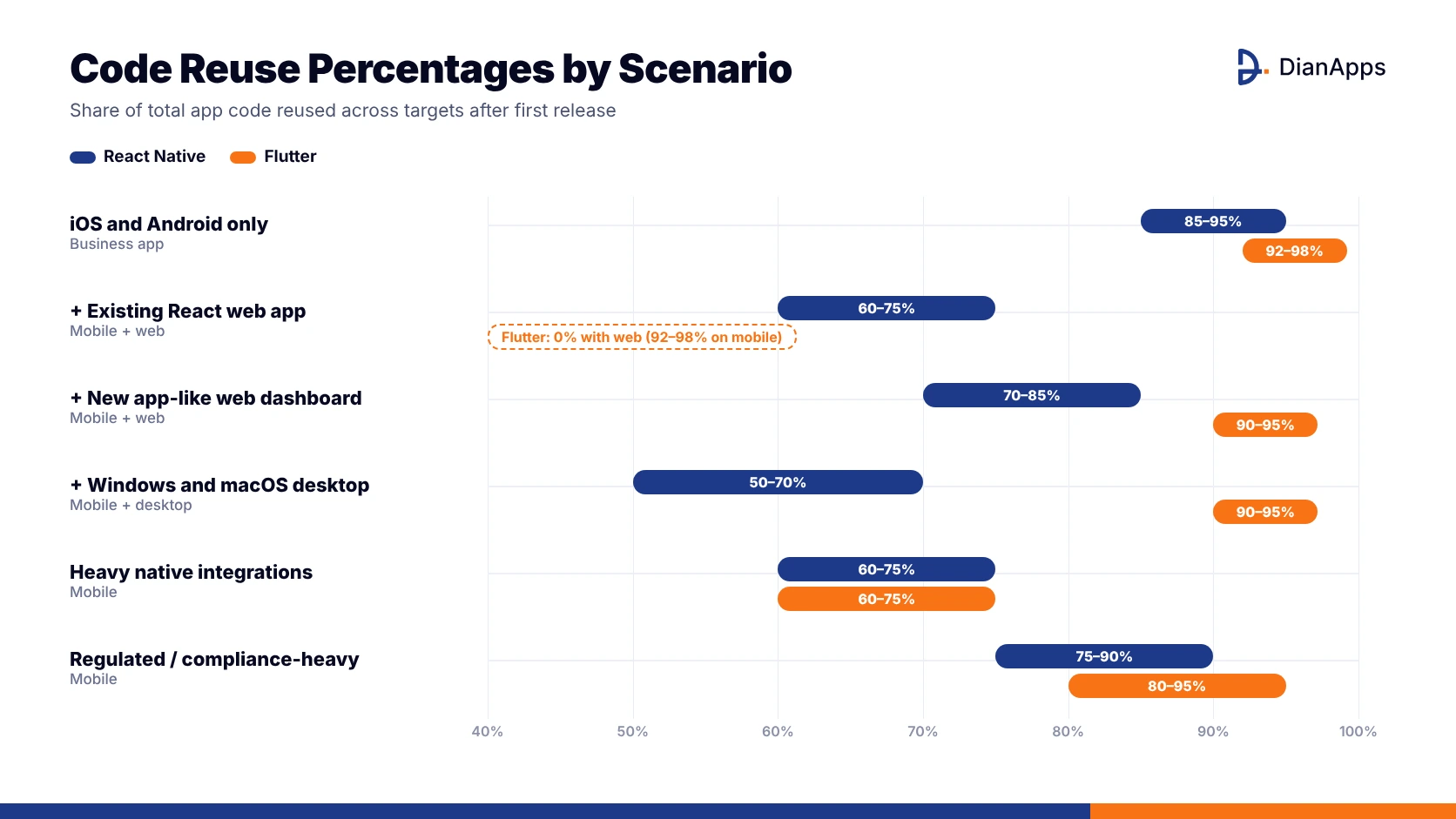
Averages are hiding the real picture, so the table below is giving the ranges we’re seeing across scenarios, with the caveat that the native surface area of the specific product is moving every figure. These are measured as the share of total application code shared across the listed targets after the first release.
| Scenario | React Native | Flutter | Notes |
| iOS and Android only, business app | 85 to 95 percent | 92 to 98 percent | Flutter edges ahead on UI sharing |
| iOS, Android and existing React web app | 60 to 75 percent across all three | 0 percent with web, 92 to 98 percent on mobile | React Native’s decisive case |
| iOS, Android and a new app like web dashboard | 70 to 85 percent with React Native Web | 90 to 95 percent with Flutter web | Flutter web viable for app like targets |
| Mobile plus Windows and macOS desktop | 50 to 70 percent | 90 to 95 percent | Flutter’s desktop maturity shows |
| Mobile with heavy native integrations | 60 to 75 percent | 60 to 75 percent | Native code dominates both |
| Regulated or compliance heavy app | 75 to 90 percent | 80 to 95 percent | Audit and security code adds native work |
Regulated products such as those in our telemedicine app development cost breakdown are sitting in that last row, where platform security features are pulling reuse down on both frameworks regardless of the marketing figure.
Maintenance, Upgrades and Long Term Reuse
Reuse is also a question of time, because a codebase that is ninety percent shared on launch day and sixty percent shared after three years of patches has lost most of the benefit. React Native’s history of painful upgrades has improved markedly with the New Architecture and the Expo managed workflow, and the move to the React Foundation is giving enterprises confidence that governance no longer depends on a single company, but the framework is still moving quickly and third party packages are occasionally lagging, which is creating upgrade work that lands on the shared code.
Flutter’s upgrades have generally been smoother because the framework is owning the whole stack, and its 2026 releases have stabilised Material 3 theming and the Impeller engine on both mobile platforms, though breaking changes in Dart and in widely used packages are still arriving. Over the air updates are a maintenance advantage for React Native, since JavaScript fixes can reach users without a store release within the limits of store policy.
Keeping reuse high over years is coming down to the same discipline on both sides, which is isolating platform code, pinning and upgrading dependencies on a schedule and refusing to let quick platform fixes leak into the shared packages.
A Decision Framework: Choosing by What You Need to Reuse
The framework choice is becoming clear once a team is specific about what it needs to share, and the sequence below is the one we’re using to settle it in a single workshop. Work through it in order:
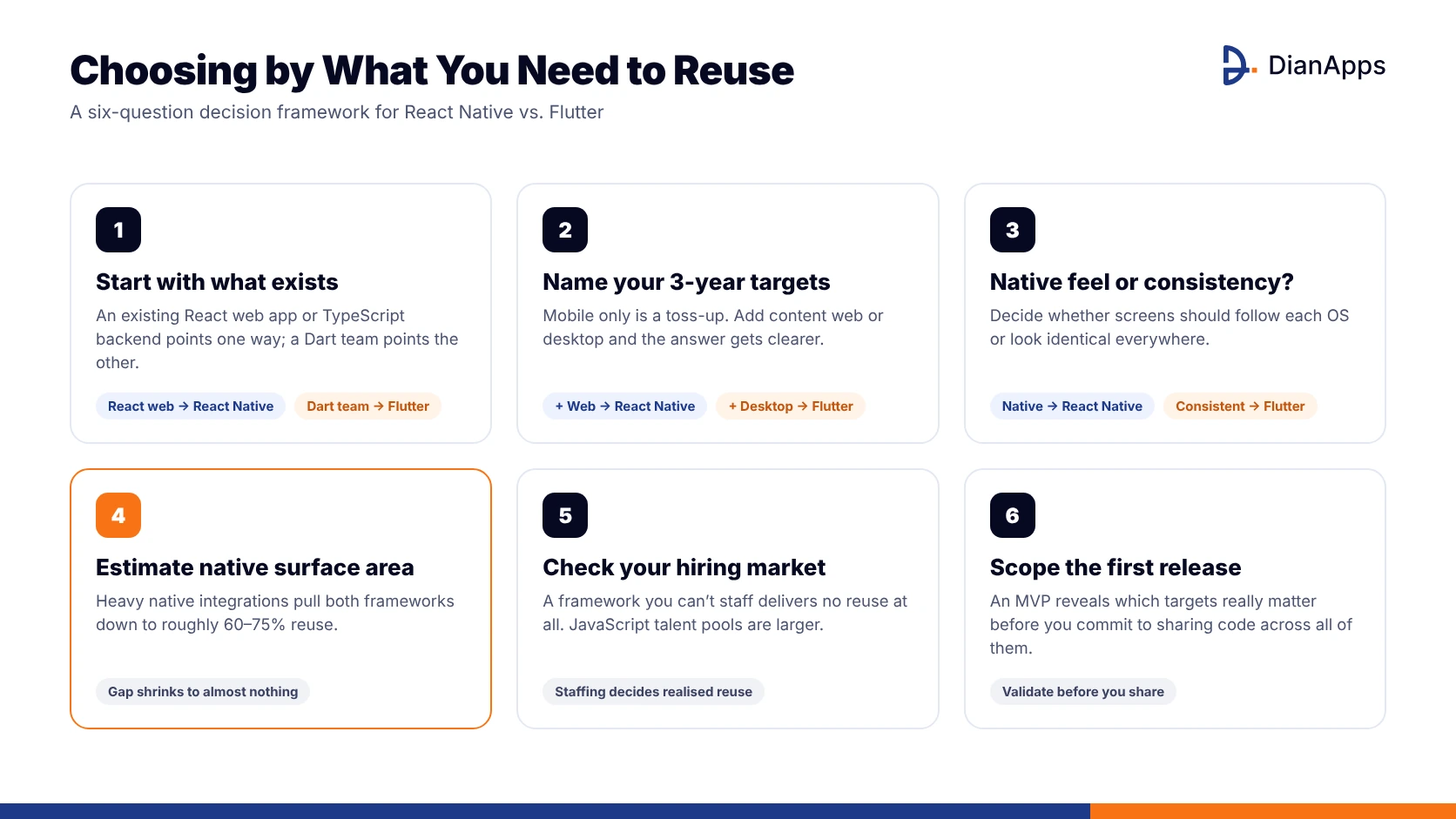
- Start with what exists, because an existing React web product or a TypeScript backend is tilting the decision firmly toward React Native, and an existing Flutter app or a Dart team is tilting it the other way.
- Name the targets for the next three years, since mobile only is a toss up, mobile plus content web is React Native, and mobile plus desktop or embedded is Flutter.
- Decide whether UI should be platform native or brand consistent, with the former favouring React Native and the latter favouring Flutter.
- Estimate the native surface area honestly, because heavy native integrations are compressing the reuse difference to almost nothing.
- Check the hiring market you’re in, since a framework you can’t staff is delivering no reuse at all.
- Scope the first release tightly, which our guide to what an MVP is in app development is covering, because an early product is revealing which targets actually matter before you commit to sharing code across all of them.
Teams answering these six questions are rarely needing a benchmark to decide, because the framework that fits their reuse goals is usually obvious by the fourth one.
Ready to Build a Cross Platform App That Stays Shareable?
Our React Native and Flutter teams are structuring codebases for maximum reuse across every platform you’ll need.
Hybrid Strategies: Kotlin Multiplatform and Mixing Frameworks
The choice isn’t always binary, and two hybrid strategies are worth knowing about because they’re reframing reuse in useful ways. Kotlin Multiplatform is sharing business logic between fully native iOS and Android apps, typically forty to sixty percent of the code, while leaving every screen native, which is the right answer for teams that want maximum platform fidelity and already have strong Kotlin skills.
The second strategy is mixing, where a React Native or Flutter app is embedded inside an existing native app a screen at a time, or where a React web team is building mobile in React Native while a Flutter team is building a kiosk or desktop product that shares the same backend, each framework being used where its reuse is strongest.
Conversational features are a good example of logic that belongs in a shared layer regardless of framework, as our comparison of a mobile AI agent vs an AI chatbot is showing, because the agent logic is living on the server and every client is reusing it. The lesson of these hybrids is that reuse is a design goal for the whole system, and the framework is one tool among several for achieving it.
Final Thoughts
React Native vs. Flutter for code reuse isn’t a contest with a single winner, because React Native is reusing the most when a web product or a TypeScript stack already exists, and Flutter is reusing the most when one team needs to ship identical screens across mobile, desktop and embedded targets from a single codebase.
Teams that are naming the layers they need to share, counting the targets on a three year roadmap, estimating the native surface area honestly, structuring the codebase as packages with clean boundaries and matching the framework to the people they can hire are consistently realising reuse figures close to the ceiling, and teams chasing a headline percentage are consistently disappointed whichever framework they choose.
Both frameworks are mature, well governed and fast enough in 2026 for the vast majority of products, and if you’d rather have a team that has shipped production apps in both help you decide and build, we’ve got you covered.
 0 comments










Your email address will not be published. Required fields are marked *