













 0 comments





Key Takeaways:
- Telemedicine app development costs range from $30,000 to $300,000+, depending on complexity and features.
- MVPs take around 3 to 6 months, while enterprise platforms may require 12-18 months.
- HIPAA and GDPR compliance, EHR integrations and advanced features can significantly increase costs.
- Offshore teams and cross platform frameworks like Flutter can help reduce development expenses.
- Budget an additional 20 to 30% for ongoing hosting, APIs, compliance and support costs.
Quick Answer: Telemedicine app development in 2027 costs around $30,000 to $60,000 for an MVP, $60,000 to $150,000 for a mid-level app and $150,000 up to $300,000 and more for an enterprise project. The final costs depend on the features, integrations, compliance needs, team location and ongoing maintenance that is required to smoothly run the app.
Visiting a doctor has always been a tiring process, patients waiting for days to get a slot while sitting in crowded clinics for hours and travelling long distances for a consultation which hardly lasts ten minutes. This is not manageable nor practical for the clinics and hospitals handling hundreds of patients every day, and to deal with it, healthcare providers and startups are now opting for telemedicine apps that are secure, quick and easier to run. This also is helping the patients to get treated from their home itself and improving the overall patient experience.
But how much does it cost to build a telemedicine app in 2027? The healthcare app development cost is ranging anywhere from $30,000 to $300,000+ in late 2026 and early 2027 and it all depends on what is being built, who is building it and where the team is based, let’s take a look.
Why the Demand for Telemedicine Apps Is Growing
Telemedicine was started as a quick fix during the pandemic times, however, now it has become a regular part of healthcare that patients and doctors both are depending on. Grand View Research valued the global telemedicine market at USD 141.19 billion in 2024, and it is expected to reach USD 380.33 billion by 2030. In the US itself, the market was at USD 35.51 billion in 2024 and is expected to be touching USD 88.16 billion by 2030.
The policy side is also looking positive for the healthcare businesses that are planning to build for the US market. In February 2026, Congress passed H.R. 7148 which extended key Medicare telehealth flexibilities through December 31, 2027, and with this, providers are now having more confidence in investing on telemedicine platforms.
Telemedicine App Cost Based on Type of App
Each and every telemedicine app is not built in the same way, and the cost is changing a lot depending on how big and how advanced the app is needed to be.
| MVP / Basic | Mid-Level | Enterprise | |
| Best For | Startups testing an idea | Growing clinics and funded startups | Hospitals and large health networks |
| Build Cost | $30,000 – $60,000 | $60,000 – $150,000 | $150,000 – $300,000+ |
| Timeline | 3-5 months | 6-9 months | 12-18 months |
| Yearly Maintenance | $8,000 – $15,000 | $15,000 – $30,000 | $30,000 – $60,000+ |
These numbers are for the offshore or hybrid teams, in case the whole team is in the US or Western Europe, around 60 to 80 percent more is to be added in each tier.
A startup which only wants to test the idea with real patients should be going with the MVP, where the video calls, scheduling, basic panels and payments are covered without going over the budget. Clinics that are already having patients and want something more refined are mostly settling with the mid-level app, while the hospitals or multi-specialty networks with complex workflows are needing the enterprise level, where the security, integrations and compliance all are much deeper.
What Is Affecting the Cost of a Telemedicine App?
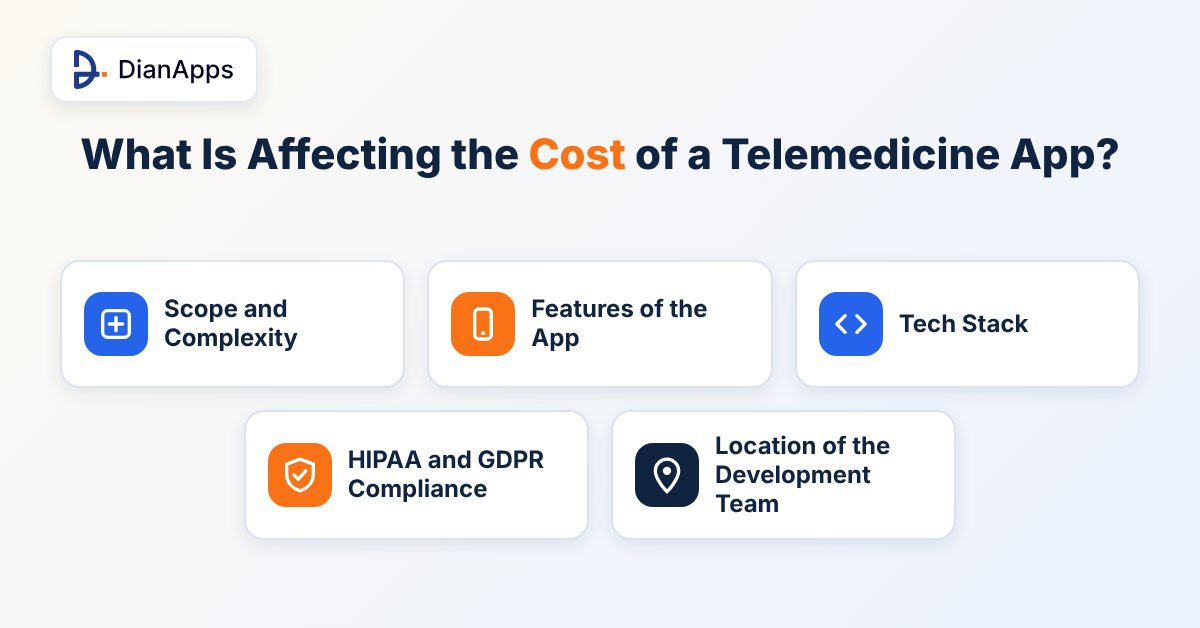
Almost every development company is calculating the cost on the same set of factors, and once these are understood, it gets much simpler to compare two quotes that are looking very different.
Scope and Complexity
The gap between a basic app and an enterprise platform is not really about the number of screens, it is about how much work the app is doing behind those screens. An MVP is able to work with video calls, appointment booking and a simple dashboard, whereas an enterprise platform is also needing role-based access, insurance billing, EHR integration and detailed analytics. With every addition, the telemedicine mobile app development, testing as well as compliance work is going up, and this is the exact reason the cost is jumping so much from one level to the next.
Features of the App
Every feature, be it real-time chat, e-prescriptions, multilingual support or wearable integration, is adding more hours to the development. Some of the features are also coming with monthly charges like the video minutes and SMS reminders which keep on running even after the app is launched. So in order to plan the budget properly, the cost of building the feature and the cost of running it both are needed to be checked together.
Tech Stack
Making two separate native apps for iOS and Android is almost always costing more than making one app with Flutter or React Native development that runs on both. With cross-platform development, a single team can launch the app on both the app stores together, and this saves a good amount of time as well as money. The backend setup, cloud provider like AWS, Azure or Google Cloud and how many third-party APIs are used, all these are also playing their part in the final cost.
HIPAA and GDPR Compliance
In compliance, there is really no space for any shortcuts, and it is needed to be planned right from the very first day of the project. For the US market, the app requires encrypted data storage, secure video, audit logs, access controls and signed Business Associate Agreements with each and every vendor handling the patients data. For the European patients, GDPR is also coming in the picture with its own set of rules on consent and data handling. Around $10,000 to $30,000 is to be kept aside just for the compliance related work.
Location of the Development Team
The location of the team is one of the biggest things which is deciding the final telemedicine app development cost. A senior developer in the US is usually charging between $100 and $200 per hour, whereas a developer with the same experience in India is charging between $25 and $50 per hour.
To make it easier to understand, take an MVP that is needing around 1,200 hours of development, resulting in:
- At $35 Per Hour in India: The complete build is coming to around $42,000 for all the 1,200 hours of work.
- At $150 Per Hour in the US: The same app with same features is ending up somewhere around $180,000 in total.
Nothing in the app is different in both of these cases, it is only the hourly rate that is changing the final cost. This is why a lot of healthcare businesses are keeping the product side in the US and working with an experienced offshore team for the development part. fcost
Where the Budget Is Actually Going
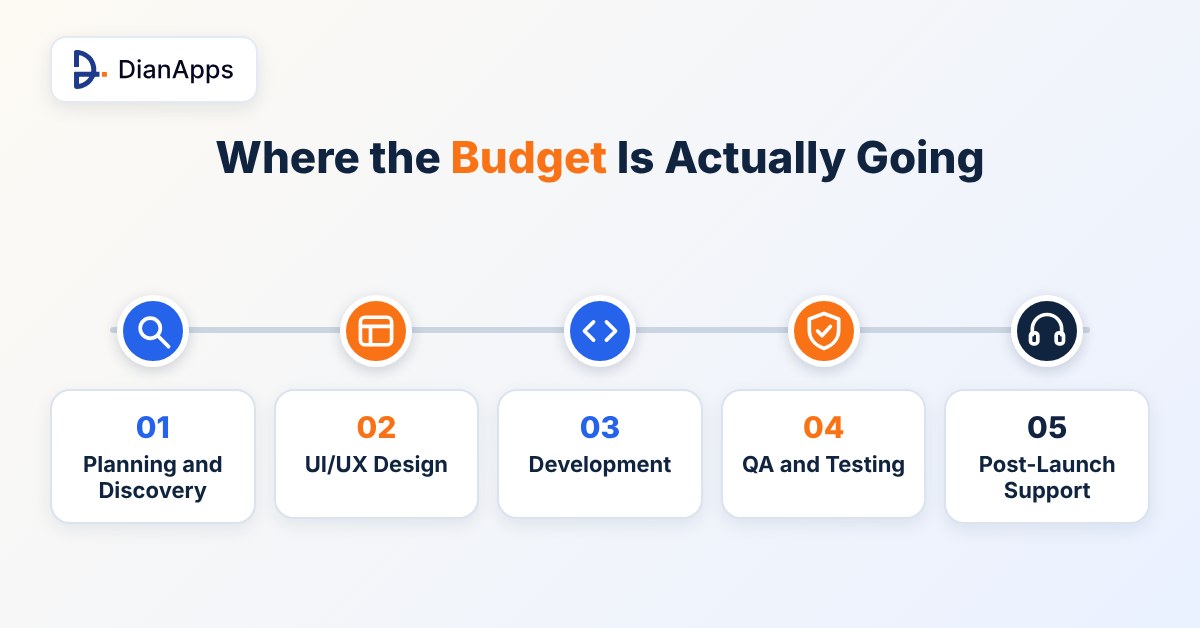
The budget of a telemedicine app is not only going into the development, it gets divided in different stages and each one of them is important, let’s break it down.
Planning and Discovery
This is the stage where the users are understood, features are mapped, technical specs are prepared and the roadmap is set for the whole project. It is usually costing around $3,000 to $8,000 and takes two to four weeks, and skipping this is one of the costliest mistakes which a business can make.
UI/UX Design
The patients who are using a telemedicine app are often unwell, worried or older in age, so the design is needed to be simple, clear and easy to follow. A good design is directly affecting whether the patients are completing their consultation or leaving in between, and this stage is costing around $5,000 to $15,000.
Development
This is the biggest portion of the budget, where the frontend, backend, database, video calling, chat and all the integrations are built. Depending on the size of the app, it can cost anywhere between $20,000 to $150,000+, and it is taking three to six months for an MVP itself.
QA and Testing
There is no room for errors in a healthcare app, a dropped video call in the middle of consultation or a prescription reaching the wrong patient is a real risk. The functional testing, load testing, security checks and compliance verification all are covered here, and it costs around $5,000 to $20,000.
Post-Launch Support
The work is not stopping once the app is live, there are bug fixes, OS updates, security patches and new features that keep on coming. This is usually costing $10,000 to $40,000+ every year, and many providers are also having a support team for appointment help and after-hours queries that automation is not able to handle.
Ready to Get an Accurate Quote for Your Telemedicine App?
Stop guessing your development costs. Talk to our healthcare technology experts to get a transparent, step-by-step cost breakdown tailored to your project scope.
Features That Are Shaping the Telemedicine App Budget
The features that are going into the app are directly deciding the cost, and these can be divided in two groups.
Core Features
Every telemedicine app, small or big, is needing these features in order to work properly:
- Patient Panel: Patients are able to sign up, book appointments, check medical history and access the prescriptions and reports easily.
- Doctor Panel: Doctors can manage the schedule, look into patient records, write notes and send e-prescriptions after each consultation.
- Admin Panel: The admin team is handling users, payments, content, analytics and support requests all from one single place.
- Video Consultation: This is the main part of any telemedicine app, and it is mostly built with WebRTC or SDKs like Twilio or Agora.
- Appointment Scheduling: Patients are seeing the available slots in real time, cancelling when needed and getting reminders through SMS, email or push notifications.
- Payment Integration: Stripe, PayPal or local payment gateways are taking care of payments, and refunds are also needed to work smoothly.
Only building and testing these core features can take around three to six months of time.
Advanced Features
These are the features that are taking the app from a basic consultation tool to a complete healthcare platform, however, they are also increasing the cost quite a lot:
- AI Symptom Checker: It is giving patients an early assessment before consultation, and can add $15,000 to $50,000 to the build.
- Remote Patient Monitoring: The app gets connected with wearables and devices for tracking blood pressure, glucose and heart rate in real time.
- EHR Integration: Connecting with systems like Epic or Cerner is technically difficult, but hospitals are rarely going ahead with an app without it.
- AI Chatbot: It is answering common patient questions and booking appointments, which takes a lot of load off from the front desk.
Telemedicine App Development Cost by Region
Choosing where to hire the team from is one of the easiest ways for controlling the budget, and the difference between regions is quite big.
| Region | Hourly Rate | Mid-Level App Cost |
| USA and Canada | $100 – $200 | $120,000 – $250,000 |
| Western Europe | $80 – $150 | $120,000 – $250,000 |
| Eastern Europe | $40 – $80 | $60,000 – $120,000 |
| India | $25 – $50 | $30,000 – $80,000 |
India is the most cost-effective option with a huge pool of healthcare IT talent, and this is the reason it is a popular choice for telemedicine projects. Eastern Europe, mainly Poland and Romania, is offering good technical talent at mid-range prices where the teams are also understanding the EU regulations well. The US is the most expensive one, but it does make sense when face-to-face collaboration or a US-based compliance team is required for the project.
Custom Build or White-Label, What Is Making More Sense?
Before going ahead with a full custom build, each healthcare startup should be asking this question at least once. White-label telemedicine platforms are the ready-made apps that can be rebranded and set up in a few weeks, and the monthly cost is usually somewhere around $500 to $5,000.
White-label is working fine for small clinics or solo doctors who are only needing video calls and scheduling and want to launch within a couple of months. But the customization is very limited, the data is shared with the vendor, and if the competitors are also using the same platform, standing out is becoming really hard. And that is not all, as the number of patients is growing, the per-user fees also keep on going up, and after a few years it can cost more than what a custom app would have cost.
Custom development is taking four to eighteen months and costs $30,000 to $300,000+, but the app is fully owned, the data is staying with the business and features can be built exactly around how the clinic is working. Some businesses are also starting with white-label for checking the demand, and once they are having real patients and funding, they are moving to a custom platform, which is a smart way of not putting $150,000 on an idea that is not proven yet.
How Long Is It Taking to Build a Telemedicine App?
A basic MVP is taking around four to six months, and a full telemedicine platform can take anywhere between nine to eighteen months. New features getting added amid development, slow feedback and approvals, and waiting on EHR vendors for access are the most common reasons for the timeline getting stretched.
Hidden Costs That Are Easy to Miss
The development quote is only covering the building of the app, and there are a lot of other costs which are showing up once the app goes live:
- Third-Party APIs: Video SDKs, SMS services, push notifications and payment gateways all have monthly or usage-based charges.
- Cloud Hosting: The server bill keeps on increasing as more patients and doctors are starting to use the app daily.
- Compliance Costs: Yearly security audits, vendor agreements and legal advice all are costs that keep on coming back again.
- App Store Fees: Apple and Google both are charging a yearly developer fee and also taking a cut from in-app purchases.
- Support Tools: CRM software, live chat and ticketing tools are also adding up to the monthly running cost of the app.
It is always better to add 20 to 30 percent on top of the development quote, just to be on the safer side from these hidden costs.
There is one more thing which is to be kept in mind for 2027, the Medicare telehealth extension is currently only till December 31, 2027. CMS has said that without any further action, most of these rules will be going back to how they were before the pandemic. So for the apps that are serving Medicare patients, it is better to build the billing rules and visit types in such a way that they can be changed easily, whichever way the policy goes.
How to Reduce the Telemedicine App Development Cost?
Building a telemedicine app is not needed to break the bank, and here is how the smart healthcare businesses are keeping their costs in control:
- Start With an MVP: Launch with the main features first, see how the patients are using the app, and then build more.
- Go With Cross-Platform: Using Flutter or React Native can bring the cost down by around 30 to 40 percent compared to native apps.
- Use Ready SDKs and APIs: There is no need of building video, payments or notifications from scratch when good options already exist.
- Work With an Offshore Partner: The same quality is available at a fraction of US rates when the team has proper healthcare experience.
- Fix the Scope Before Starting: Changing the requirements in middle of the development is one of the biggest reasons for budgets going out of hand.
Build Your Compliant Telemedicine Platform with DianApps
From HIPAA-compliant MVPs to enterprise EHR integrations, we turn complex healthcare ideas into seamless digital experiences. Let’s build your app together.
Conclusion
Telemedicine is no more a backup option for healthcare businesses, it has now become a standard that patients are expecting from their doctors and clinics. Knowing the telemedicine app development cost in advance is helping in planning better, avoiding overspending and making decisions that are good for both the business and the patients. The key is to plan for the complete journey of the app and not only the launch day, starting small with an MVP and choosing the right development partner from the very beginning until completion.
If building a secure, compliant and easy to use telemedicine app is something your healthcare business has been thinking about, then it is the right time to get started. Get in touch with DianApps today and our team will handle the rest for you!
 0 comments












Your email address will not be published. Required fields are marked *