












 0 comments



Key Takeaways:
- Understanding what is MVP in app development is helping founders launch a basic version of the app with only its core features.
- An MVP is letting you test your idea with real users before spending the full budget on development.
- Most MVPs are taking around two to four months to build and costing somewhere between $15,000 and $60,000.
- An MVP is not the same as a prototype, as an MVP is a working app that real users are downloading and using.
- Big names like Airbnb, Uber and Instagram all started with really simple first versions before growing into what they are today.
Quick Answer:
If you are wondering what is MVP in app development, it is the simplest working version of an app, built with only the core features needed to solve the main problem, so real users can test it before full development begins.
Before Airbnb became a name everyone is familiar with, it started in 2007 as a simple website where the founders were renting out air mattresses in their San Francisco apartment to visitors coming in for a design conference. There was no fancy app or smart search, just a basic idea being tested with real people, and this is also why how hard is it to make an app is not as scary a question as it is sounding, because most successful apps are starting small and simple. But what is MVP in app development, and why is each and every startup advisor/investor suggesting it before building the full app?
Well, an MVP is exactly what Airbnb did, launching the most basic version of a product that is solving the main problem, and then improving it based on what real users are saying, instead of guessing what they want.
And this approach is making even more sense today, as Sensor Tower’s State of Mobile 2026 report is showing that app downloads will reach nearly 150 billion in 2025, which means users are having plenty of choices, and an app that is not solving a real problem just cannot survive for long.
In this guide, we are covering what an MVP really is, how it is different from a prototype, the different types of MVP, how to build one and how much it is costing, so let’s take a look.
What Is an MVP in App Development?
So, what is an MVP development in simple words? Well, an MVP (Minimum Viable Product) is the first working version of an app that is carrying only the features needed to solve the main problem for its users, nothing more and nothing less.
The word “minimum” is not meaning cheap or half-done, it is meaning focused, and the word “viable” is meaning that the app is still working properly and giving real value to users, even with fewer features.
For example, if you are building a food delivery app, the MVP is not needing loyalty points, live chat and ten payment options, it is needing users to browse restaurants, place an order and pay for it, and this is enough to see whether people are actually using the app.
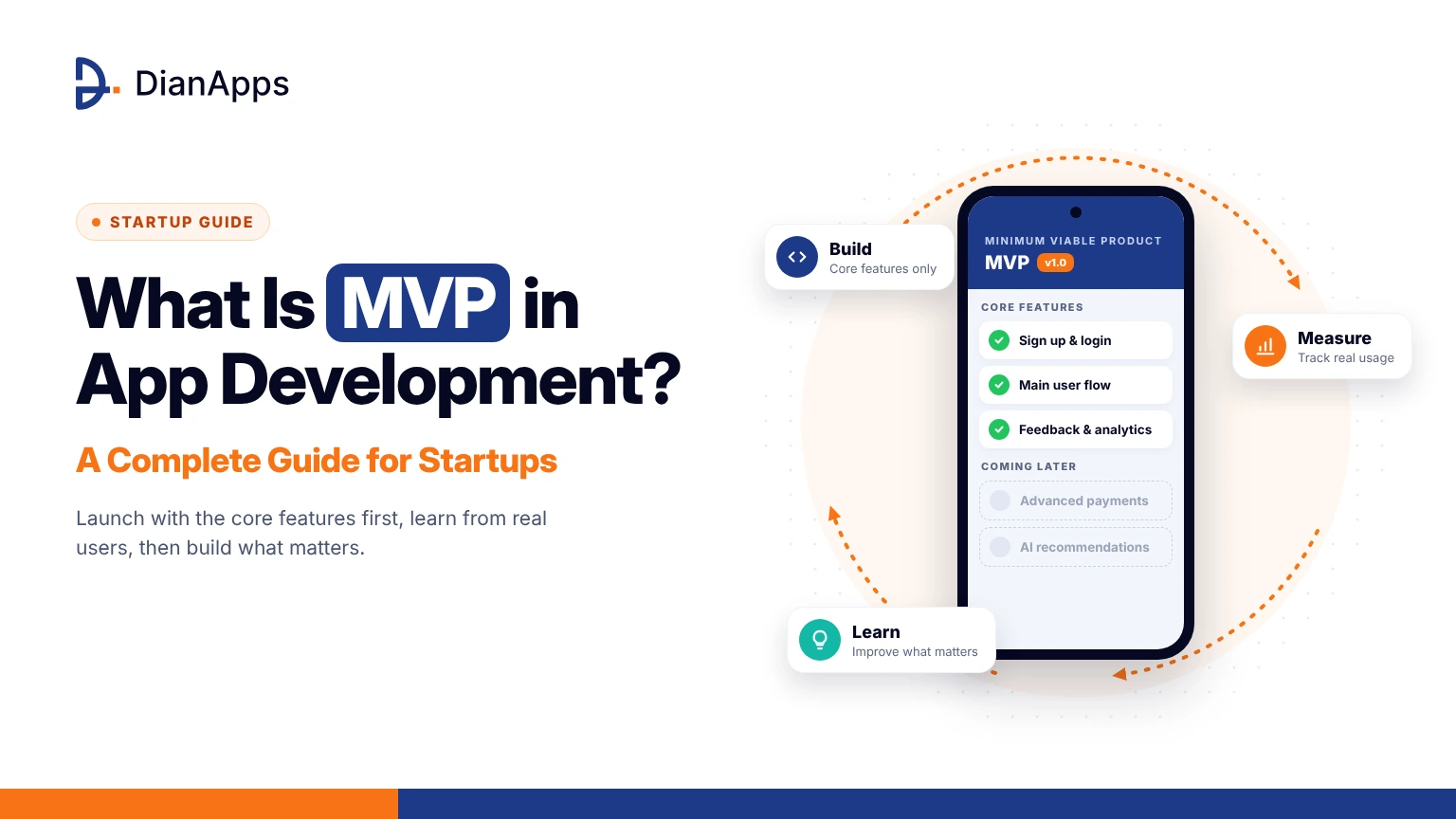
The idea behind an MVP is coming from the Lean Startup approach, which is following a simple and repeatable loop, resulting in:
- Building the most basic version of the product.
- Measuring how real users are using it.
- Learning from the feedback and data.
- Improving the app and repeating the cycle.
This is why an MVP is not the end goal, it is the starting point that is making sure the full app is being built on what users really want and not on assumptions, and the reasons why startups are choosing it first are not hard to see.
Why Startups and Businesses Are Building an MVP First
Building a full app in one go is sounding exciting, but spending months and a big budget on an app that users are not even wanting is one of the main reasons why so many apps are failing after launch. This is where an MVP is stepping in, helping founders/business owners test the idea with real users early, while keeping the cost and risk under control, resulting in:
- Lower development cost in the early stage.
- Faster launch and quicker entry into the market.
- Real user feedback instead of guesswork.
- Early users who can turn into loyal customers.
- Proof of demand that is attracting investors.
And that is not all, an MVP is also helping your team understand which features users are really using and which ones they are ignoring, so the next round of development is going into the right places.
This is why most investors are now asking for an MVP with some real traction before funding, as numbers from real users are always speaking louder than any pitch deck, and this is also where the confusion with prototypes is coming in.
Ready to Turn Your Idea Into an MVP?
DianApps helps startups and businesses plan, design and launch their MVP on iOS and Android, so you are testing your idea with real users in just a few months.
MVP vs Prototype vs Full Product: What Is the Difference?
A lot of founders are mixing up an MVP with a prototype, and while both are coming early in the process, they are serving very different purposes, so let’s take a look at how they compare with a full product.
| Feature | Prototype | MVP | Full Product |
|---|---|---|---|
| Purpose | Testing design and flow | Testing the idea with real users | Serving the full market |
| Working App | No, clickable screens only | Yes, functional | Yes, fully functional |
| Features | Visual only | Core features only | Complete feature set |
| Users | Internal team and test groups | Early adopters | All target users |
| Time to Build | 1–3 weeks | 2–4 months | 6–12+ months |
| Cost | Low | Moderate | High |
So when someone is asking what is MVP in app development, the easiest way to explain it is that a prototype is showing how the app is going to look, an MVP is showing whether people are really wanting it, and the full product is what comes after the MVP proves itself.
Types of MVP in App Development
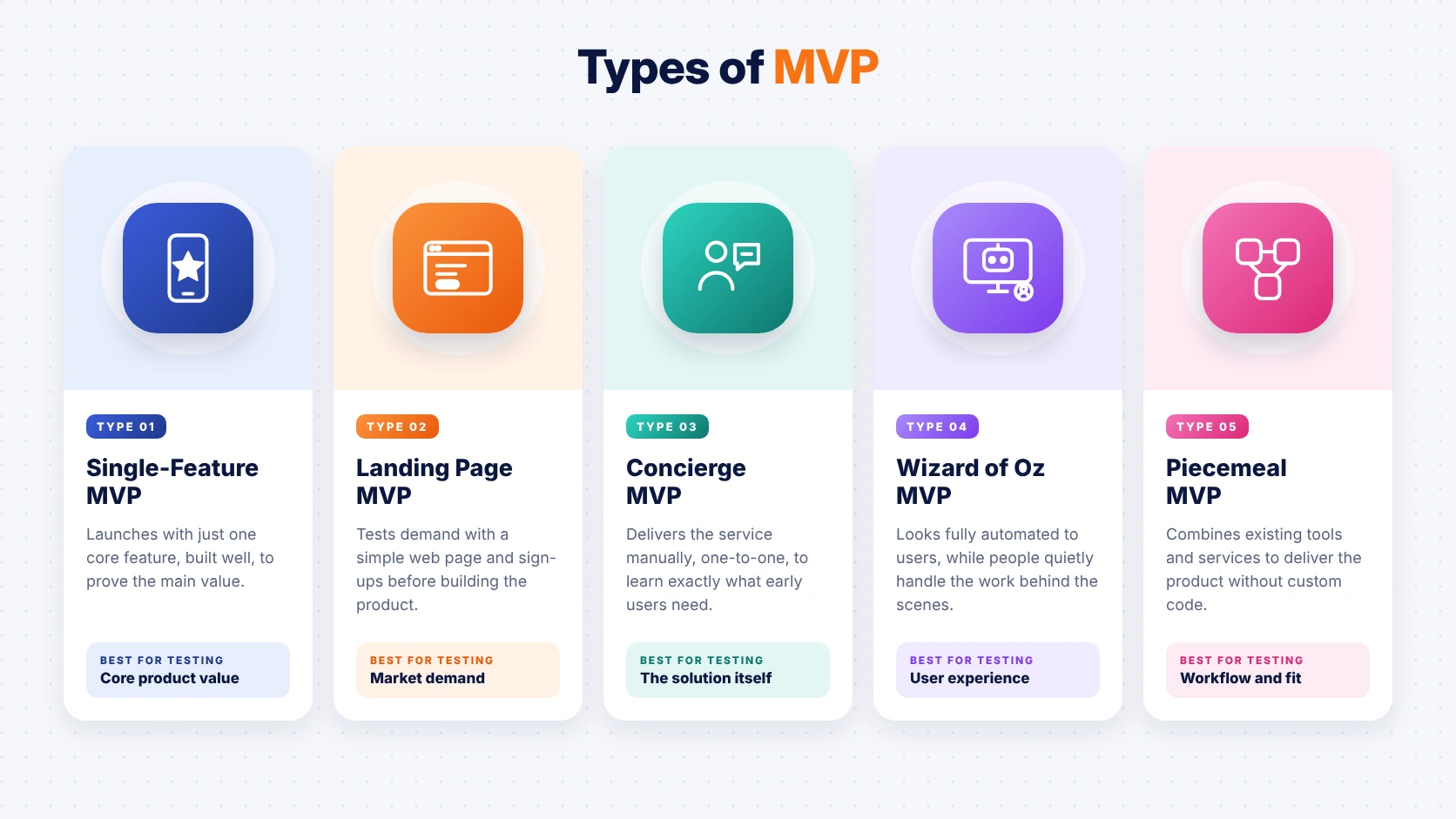
Not every MVP is needing to be a fully coded app, and depending on your idea, budget and timeline, there are a few different types of MVP that startups are using, and the table below is explaining them in a simple way.
| Type of MVP | How It Works | Best For |
|---|---|---|
| Single-Feature MVP | An app with only one core feature | Apps solving one clear main problem |
| Landing Page MVP | A page explaining the app and collecting sign-ups | Testing demand before building |
| Concierge MVP | The service is delivered manually to early users | Service-based app ideas |
| Wizard of Oz MVP | Users see an app, but tasks are done manually behind it | Testing automation ideas |
| Piecemeal MVP | Built by joining existing tools and platforms together | Quick launch on a small budget |
For most mobile apps, the single-feature MVP is the most common choice, as it is giving users a real app experience while still keeping the scope and cost really limited, but mobile apps are also coming with a few extra things to think about.
What Is MVP in Mobile App Development and How Is It Different?
The basic idea of an MVP is the same everywhere, but what is MVP in mobile app development is having a few extra points to consider, as mobile apps are going through app store reviews, running on different devices and depending a lot on first impressions.
Users are deciding within a few seconds whether they are keeping an app or deleting it, so even a mobile MVP is needing a clean design, quick loading and zero crashes, otherwise it is giving a poor impression before the user has even explored the main feature. A few things that are making a mobile MVP different are:
- App Store and Google Play approval before launch.
- Testing on different screen sizes and OS versions.
- Push notifications for bringing users back to the app.
- Choosing between native and cross-platform development.
This is why most startups are building their mobile MVP with cross-platform frameworks like Flutter or React Native, as one codebase is covering both iOS and Android, saving a lot of time and cost in the early stage.
And if your target users are mostly working on laptops and office systems instead of phones, starting with desktop app development for the MVP is sometimes the better choice, as a mobile MVP is not suitable nor suggested for each and every product.
How to Build an MVP for Your App: Step-by-Step
Knowing the meaning of an MVP is one thing, but actually building one is needing a proper plan, otherwise it is very easy to keep adding features and end up building the full app anyway, so let’s break it down step by step.
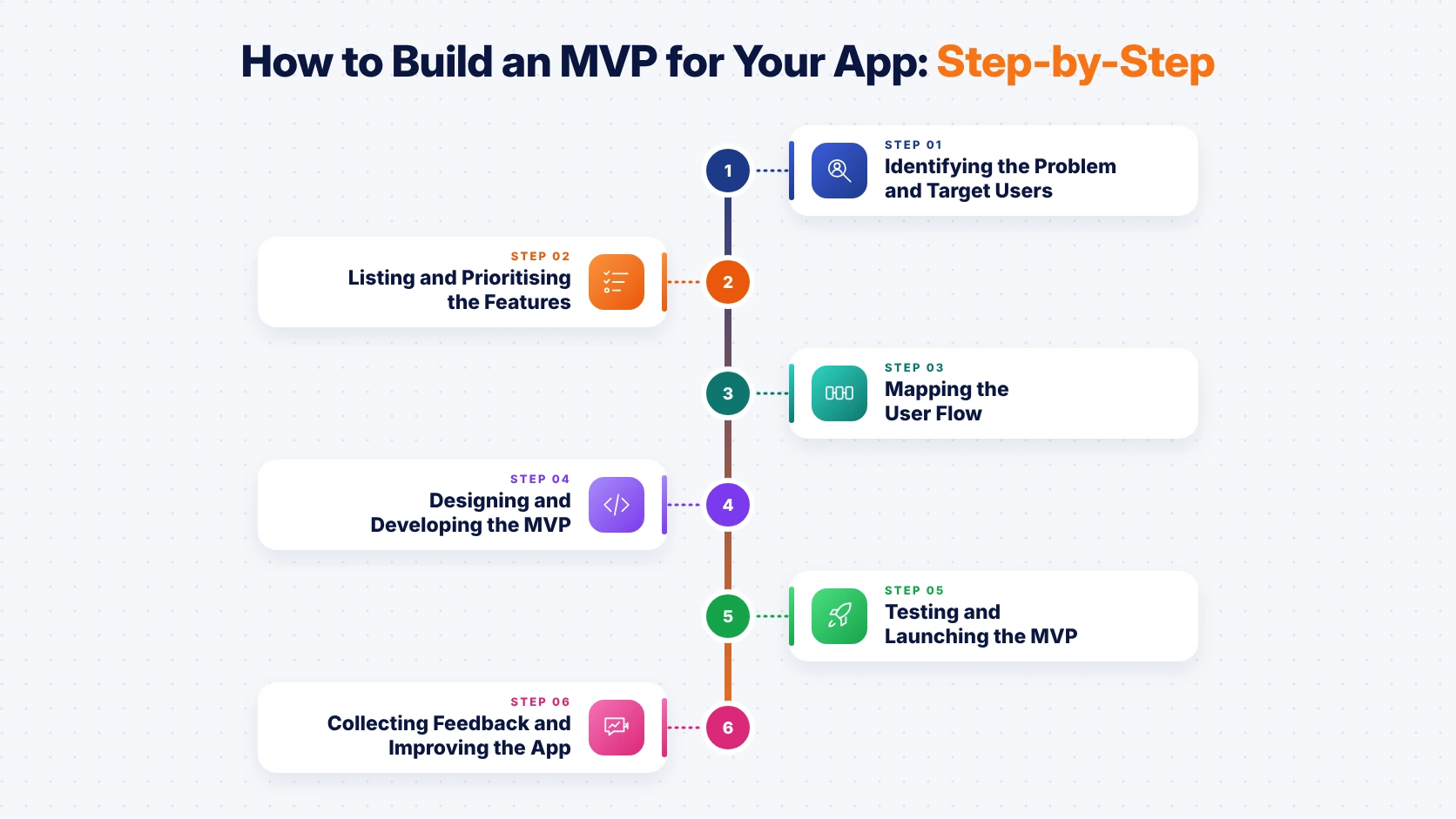
1. Identifying the Problem and Target Users
Every good MVP is starting with a clear problem, and this is meaning you are needing to know exactly who your users are, what they are struggling with and how they are solving it today. Talking to potential users, reading competitor app reviews and checking online forums is really helping you understand whether the problem is big enough for people to download an app for it.
2. Listing and Prioritising the Features
Once the problem is clear, list each and every feature you are imagining for the app, and then divide them into must-have, nice-to-have and future features, keeping only the must-have ones for the MVP. A simple question that is helping here is asking whether the app can still solve the main problem without a feature, and if the answer is yes, that feature is not belonging in the MVP.
3. Mapping the User Flow
The user flow is showing the path a user is taking from opening the app until completing the main action, like signing up, searching and placing an order. Keeping this flow short and simple is extremely crucial, because every extra screen in an MVP is adding development time and also giving users one more reason to drop off.
4. Designing and Developing the MVP
With the flow ready, designers are creating wireframes and a simple UI, and then developers are building the frontend and backend, usually in two-week sprints so the progress is visible regularly. For the backend, many teams are using platforms like Firebase or Supabase in the MVP stage, as these are offering ready-made features like login, database and notifications, saving a lot of development time.
5. Testing and Launching the MVP
Before launch, the MVP is needing proper testing on real devices to make sure the core feature is working smoothly, because users are not forgiving crashes just because it is a first version. Once it is stable, the app is going live on the App Store and Google Play, or sometimes to a smaller group of beta users first through TestFlight or Google Play’s testing tracks.
6. Collecting Feedback and Improving the App
This is where the real value of an MVP is starting, as user feedback, reviews and analytics are showing what is working, what is confusing and what users are asking for next. Tools like Firebase Analytics or Mixpanel are helping you track how users are behaving inside the app, and these insights are deciding which features are going into the next version.
How Much Does an MVP Cost and How Long Does It Take?
Cost and time are usually the first two things any founder is asking about, and the good news is that an MVP is costing a lot less and launching a lot faster than a full app. The table below is giving a rough idea based on common industry estimates, depending on how complex the MVP is.
| MVP Complexity | Example | Estimated Cost | Estimated Timeline |
|---|---|---|---|
| Simple MVP | Single-feature app, basic booking or listing | $15,000 – $30,000 | 6–10 weeks |
| Medium MVP | User accounts, payments, basic admin panel | $30,000 – $60,000 | 2–4 months |
| Complex MVP | Real-time features, AI, integrations, compliance | $60,000 – $100,000+ | 4–6 months |
Note: These are estimated ranges, and the final cost is depending on the features, the platforms and where the development team is based.
For apps in regulated industries like healthcare, the MVP is still needing proper security and compliance from day one, and this healthcare app development cost and HIPAA compliance guide is explaining how these requirements are affecting the budget. And if you are wanting a deeper look at timelines, this guide on how long it takes to develop an app is breaking down what is speeding up or slowing down each stage.
Real-World MVP Examples That Became Big Apps
Some of the biggest apps people are using every day started as really simple MVPs, and their stories are showing how much a small first version can grow, so here are a few of them.
Airbnb started in 2007 with a basic website where the founders were renting out air mattresses in their own apartment, and this tiny test was proving that people were willing to stay in a stranger’s home.
Uber was first launched in San Francisco as UberCab, an app that was only letting users book black cars, long before ride-sharing, food delivery and the many other services it is offering today.
Instagram was actually starting as a check-in app called Burbn, and when the founders noticed users were mostly using the photo-sharing feature, they removed everything else and relaunched it as Instagram in 2010.
Dropbox was testing demand with just a short demo video explaining how the product would work, and the sign-ups that came in were proving the idea before the full product was even ready.
This is why an MVP is not about launching something small forever, it is about launching something focused, learning quickly and then growing the app in the direction users are really wanting.
Let’s Build Your MVP the Right Way
From the first idea until the App Store launch and the updates after it, our team is helping you build an MVP that users are really enjoying and investors are taking seriously.
Common MVP Mistakes to Avoid
An MVP is meant to save time and money, but a few mistakes are turning it into a slow and costly project, and these are coming up again and again, such as:
- Adding too many features and still calling it an MVP.
- Launching with a poor design or frequent crashes.
- Ignoring user feedback after the launch.
- Skipping market research and building on assumptions.
- Not planning a backend that can grow with the users.
Mistakes like these don’t just waste the budget, they also affect the brand perception before the app has had a fair chance, and understanding what is MVP in app development properly is the best way of avoiding them.
Final Thoughts
An MVP is one of the smartest ways of turning an app idea into a real product, as it is helping you launch faster, spend less and learn directly from the users who are going to use the app every day. Instead of guessing what the market is wanting, you are building on real feedback, and this is exactly how apps like Airbnb, Uber and Instagram were growing from simple first versions into the names everyone is knowing today.
So whether you are still trying to understand what is MVP in app development or you are already planning your first version, having the right team is making the whole journey a lot smoother, and if you are looking for one that is handling it from beginning until completion, we’ve got you covered.
 0 comments







Your email address will not be published. Required fields are marked *