














 0 comments





Key Takeaways:
- NPSP is still supported and has no announced end-of-life date, but feature development ended in March 2023.
- Since December 2025, new nonprofits applying through Power of Us receive Agentforce Nonprofit rather than NPSP.
- Both platforms already provide substantial nonprofit data models, so organizations should extend rather than rebuild standard functionality.
- NPSP and Agentforce Nonprofit use different data models, meaning existing NPSP code does not simply transfer during migration.
- Migration should be driven by a real capability or business need, not fear of an immediate NPSP shutdown.
- Donor portals, impact dashboards, restricted-fund logic, grant reporting, and payment integrations are common areas where custom development adds value.
- A failed recurring-payment recovery workflow can deliver a measurable return by recovering otherwise lost donations.
Quick Answer: NPSP is not being retired, but Agentforce Nonprofit is now the direction for new nonprofit Salesforce deployments. Existing NPSP organizations do not have to migrate immediately because there is no announced end-of-life date or forced migration. The better approach is to audit the current org, identify genuine capability gaps, and migrate when the business case is strong.
Most nonprofits on Salesforce are running NPSP, and most of them have heard something worrying about it.
NPSP has no end-of-life date and remains fully supported; it’s also received no new features since March 2023, and in December 2025 Salesforce removed it from the Power of Us programme; new nonprofits applying for donated licences now receive Agentforce Nonprofit instead.
That’s drift, not a deadline, but it’s real, and it changes how you should think about building anything substantial on NPSP today.
What Actually Changed
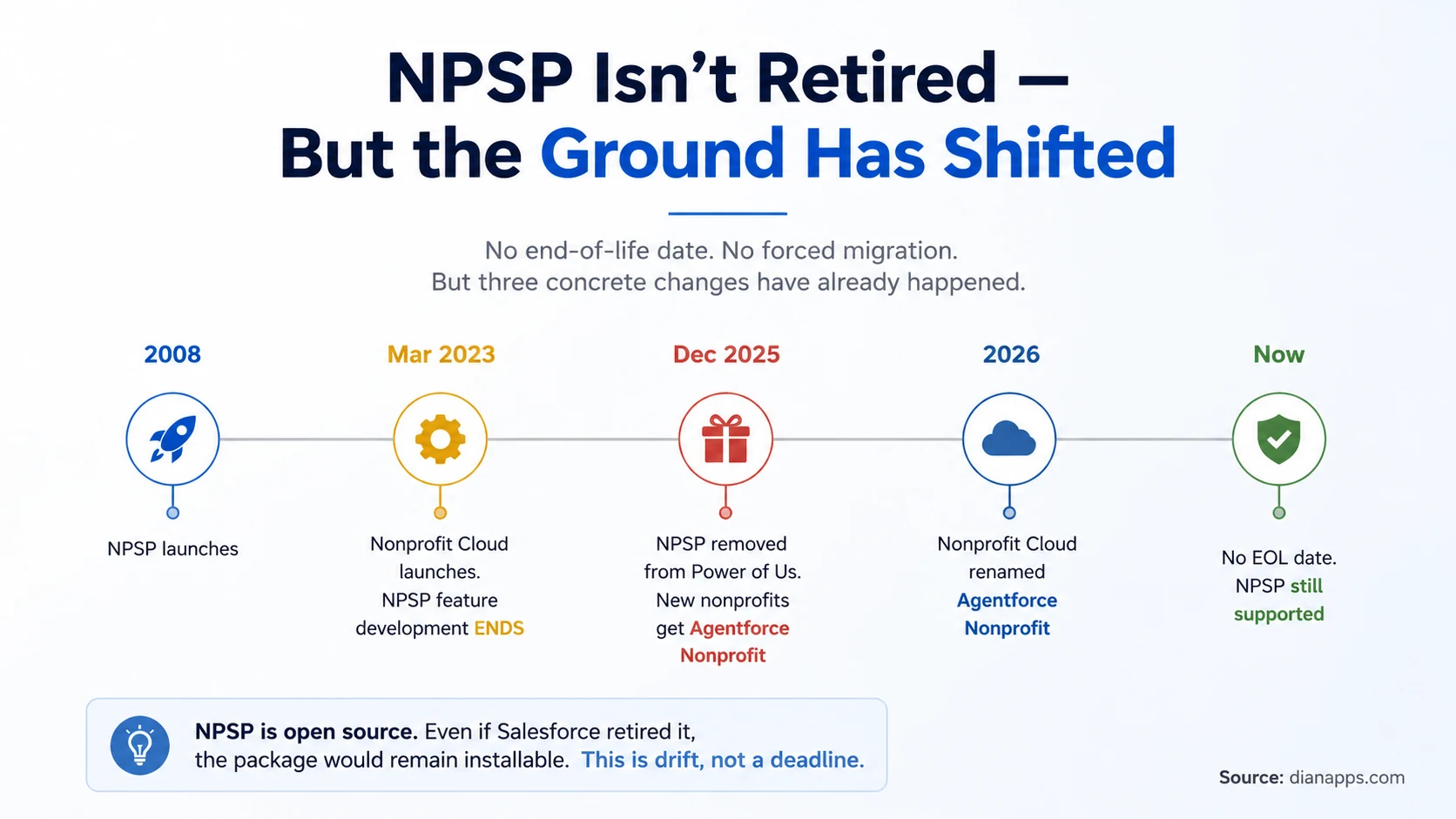
Timeline showing NPSP launching in 2008, feature development ending March 2023, removal from Power of Us in December 2025, and the rename to Agentforce Nonprofit in 2026
Three Concrete Facts, And One Non-Fact:
- NPSP Feature Development Ended in March 2023: when Salesforce launched Nonprofit Cloud. Support isn’t the same as actively developed; no new features in three years, and none planned.
- In December 2025, NPSP Was Removed From The Power of US Programme: New nonprofits applying for donated licences now receive ten free Agentforce Nonprofit licences instead. Existing users keep what they have.
- Nonprofit Cloud Has Been Renamed Agentforce Nonprofit: Sitting under the broader “Agentforce 360 for Nonprofits” umbrella. If you’re reading content from 2024 or earlier, it’s the same product.
- And the Non-Fact: There is no announced end-of-life date, no forced migration, and NPSP is open source, so even if it were retired, the package would remain installable.
- What This Means For Development Specifically: Building something substantial and long-lived on NPSP today means building on a foundation that won’t gain new capability. That’s a legitimate choice, but it should be a deliberate one.
Don’t Rebuild What’s Already There
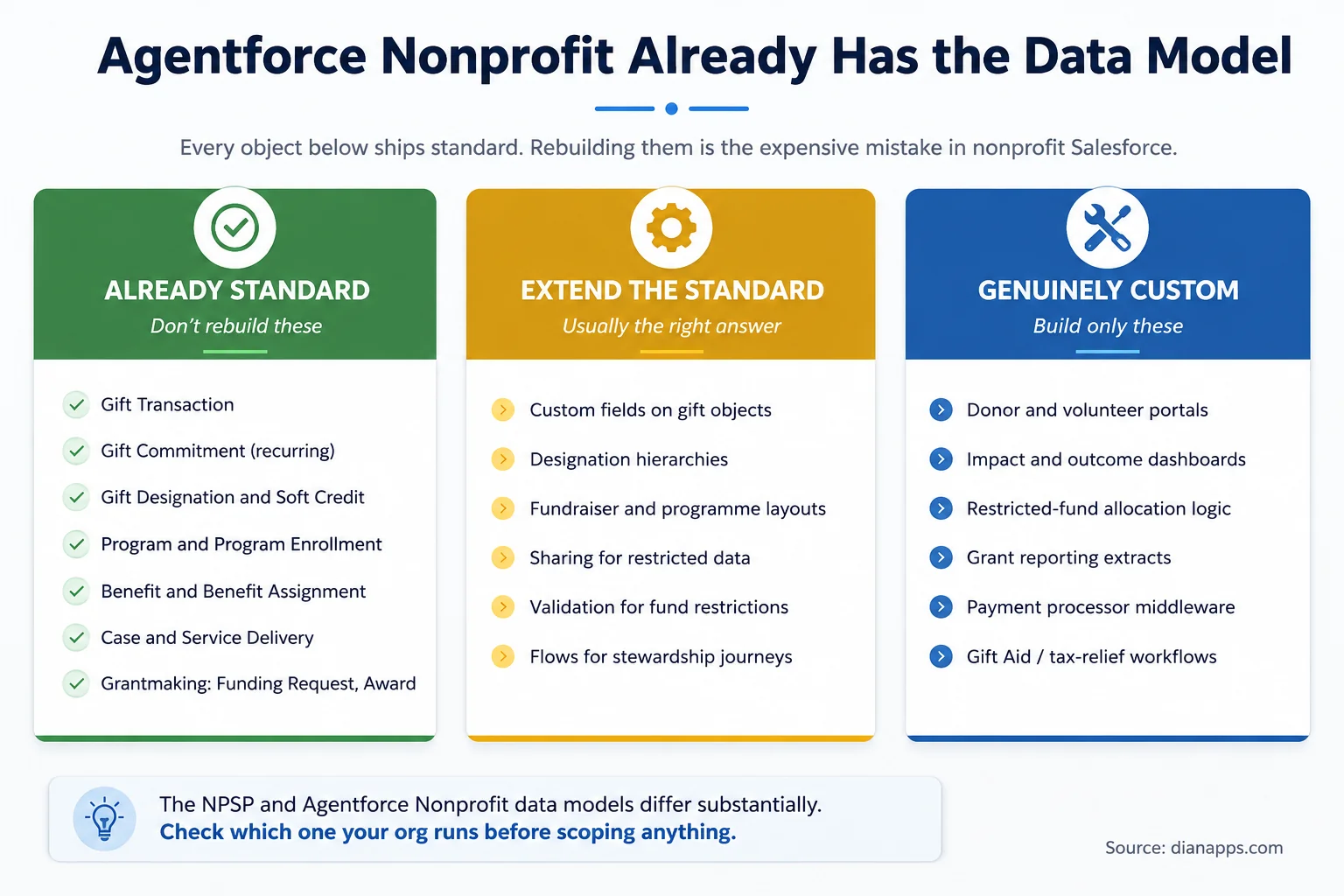
Three-column comparison showing what is standard in Agentforce Nonprofit, what should be extended, and what genuinely needs custom building
- Both Models Are Complete: Agentforce Nonprofit provides Gift Transaction, Gift Commitment for recurring giving, Gift Designation, Soft Credit, Program and Program Enrollment, Benefit and Benefit Assignment, plus a full Grantmaking model with Funding Requests and Awards.
- NPSP Has Equivalents: Opportunity-based donations, Recurring Donations, General Accounting Units, Program Management Module – but they’re structured differently. The data models are genuinely different, which matters enormously if you’re writing code, and is the main reason migration is a real project rather than an upgrade.
Check which model your org runs before scoping anything. Code written against NPSP’s Opportunity-based gift model doesn’t transfer to Gift Transaction.
Related: The Salesforce data model explained · Configuration vs customization
Migrate, or Stay Put?
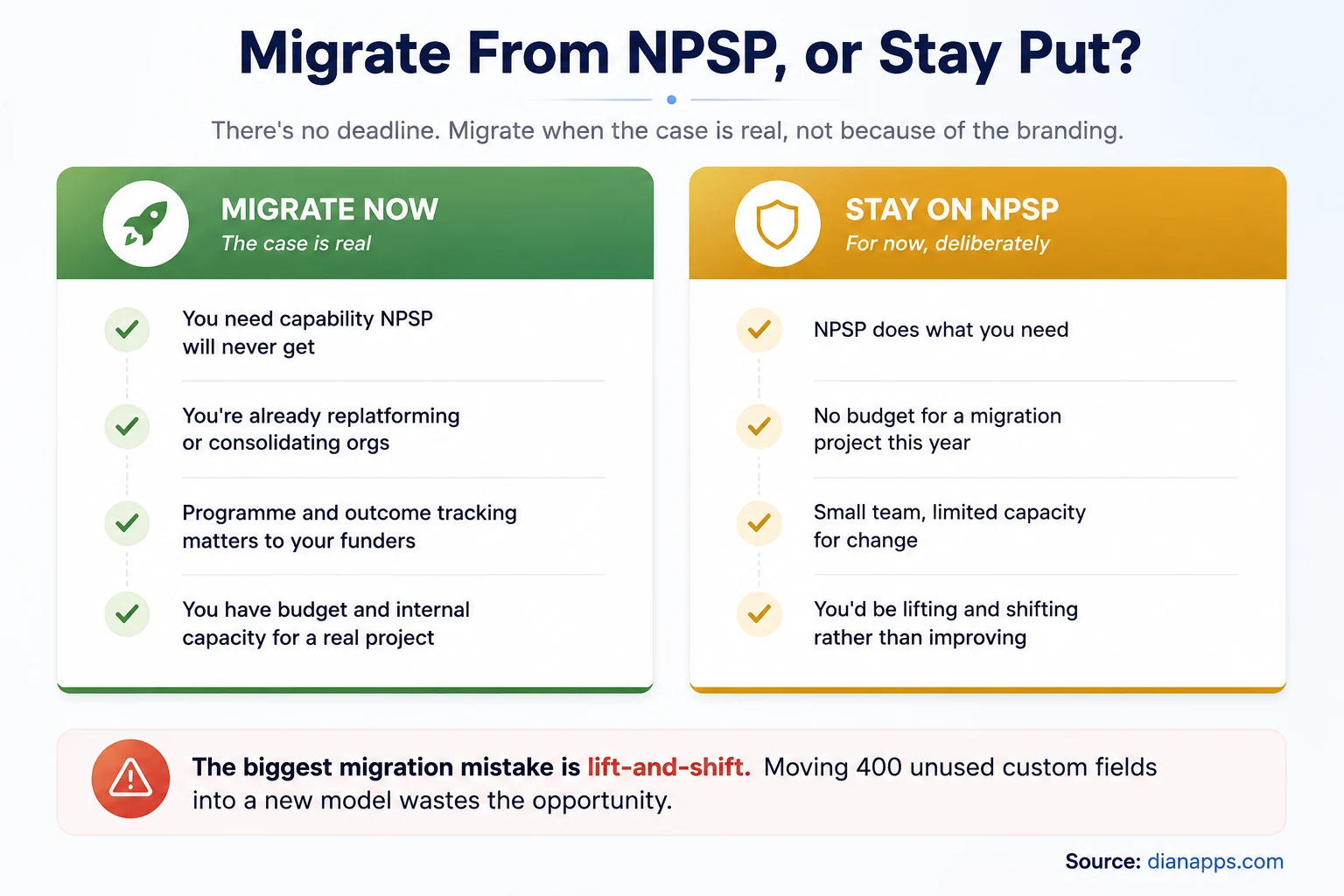
Comparison of when to migrate from NPSP now versus when staying is the deliberate choice
The Honest Position: There’s no deadline, so migrate when the case is real.
The strongest argument for migrating isn’t the branding – it’s that programme and outcome tracking in Agentforce Nonprofit is genuinely better, and increasingly what funders ask for. If you’re being asked to evidence impact rather than just report income, that’s a real capability gap.
If you’re still trying to determine whether the accumulated problems justify custom work, these signs your business needs Salesforce development help provide a useful diagnostic before committing to development.
The strongest argument for waiting is capacity; migration is a project, not an upgrade, and a small team mid-year with no budget will do it badly.
The mistake that wastes the opportunity: lift and shift. Moving 400 custom fields nobody has used since 2018 into a new data model recreates the mess in a cleaner container. A migration is the one moment you can legitimately delete the clutter, standardise how addresses are entered, and reset data-entry culture. Teams that treat it as a data project rather than a technical one get far more from it.
Practical Sequencing If You’re Migrating:
- Audit What’s Actually Used: Field usage, automation, reports. Most orgs are shocked.
- Decide What Doesn’t Come: This is the valuable part.
- Map the Data Model Properly: Opportunity-based gifts to Gift Transaction is not a rename.
- Rebuild Automation Rather Than Porting It: Much of it will be better as Flow, and longer-running nonprofit processes can benefit from Salesforce Flow Orchestration rather than reproducing legacy automation one-for-one.
- Train As A Relaunch: Not a patch.
Related: Salesforce customization cost
Weighing an NPSP migration this year?
The audit comes first – and it frequently shrinks the scope considerably. We’ll tell you honestly whether the case stacks up yet.
What It Costs
Licences first, because this is where nonprofits get the best deal in software.
Eligible nonprofits receive ten free licences through the Power of Us programme – now Agentforce Nonprofit rather than NPSP. Beyond that, Agentforce Nonprofit runs from roughly $60 per user per month for Enterprise and $100 for Unlimited, with deep nonprofit discounting.
Implementation And Development, Indicative:
| Build | Typical range |
|---|---|
| Quickstart implementation | $8,000 – $25,000 |
| Configuration - fields, layouts, record types | $6,000 – $20,000 |
| Restricted-fund allocation logic | $12,000 – $35,000 |
| Donor or volunteer portal | $30,000 – $85,000 |
| Grant reporting extract suite | $15,000 – $45,000 |
| Payment processor integration | $15,000 – $50,000 |
| NPSP to Agentforce Nonprofit migration | $30,000 – $150,000+ |
- That Last Range Is Wide For A Reason: A clean 5,000-contact org with light customisation is at the bottom. A twelve-year-old org with 400 custom fields, three payment integrations, and undocumented automation is at the top – and the audit is what tells you which you are.
- A Note On Budget Reality: Nonprofit projects are frequently funded by a specific grant or restricted gift, which means the scope is fixed before the discovery. If that’s your situation, say so early – a good partner will phase the work to fit rather than pretending the constraint doesn’t exist.
What Nonprofits Actually Build
- Donor and Volunteer Portals: Self-service giving history, recurring gift management, volunteer shift signup, tax receipts. Experience Cloud, almost always custom.
- Impact and Outcome Dashboards: Increasingly what funders require – not income reported, but outcomes evidenced. Programme data exists in the standard model; the reporting layer is usually bespoke.
- Restricted-Fund Allocation Logic: Which gift can be spent on what, and proving it. This is the piece with the most financial and regulatory consequence, and it’s frequently under-designed.
- Grant Reporting Extracts: Every funder wants a different format on a different cadence.
- Gift Aid and Tax-Relief Workflows: UK Gift Aid, US receipting rules, and local equivalents each have specific evidence requirements.
- Payment Processor Integration: Stripe, PayPal, regional processors, and the reconciliation behind them.
This is where Salesforce Development Services can be useful, extending the standard nonprofit data model with the donor experiences, fund controls, reporting, integrations, and workflows that are specific to the organisation.
The Integration Surface
| System | What flows | Watch for |
|---|---|---|
| Payment processors | Transactions, recurring schedules, failures | Failed recurring payments need a real recovery workflow |
| Email and fundraising platforms | Campaigns, engagement, consent | Consent state must flow both ways |
| Grant portals | Applications, awards, reporting | Rarely modern APIs; often manual |
| Volunteer systems | Shifts, hours, credentials | Sometimes replaceable with Salesforce entirely |
| Finance/accounting | Gifts to ledger, fund accounting | Restricted funds complicate reconciliation |
| Event platforms | Registrations, attendance | Duplicate contact creation is the usual problem |
The recurring-payment failure workflow is the one most often missing; a failed recurring gift that nobody follows up is lost income, and it happens quietly. It’s a small piece of development with a directly measurable return – usually the easiest business case in a nonprofit Salesforce project.
Related: Salesforce integration guide
Compliance Constraints
- Donor Privacy: GDPR, state privacy laws, and sector-specific fundraising regulation. Anonymous giving and “do not solicit” flags need to be honoured by every automation, which makes them a sharing and validation design decision rather than a policy note.
- Restricted-Fund Accounting: Money given for a specific purpose must be spent on that purpose and evidenced. Getting the data model wrong here has financial consequences, not just reporting ones.
- Grant Reporting: Funders set the requirements, and they vary. Design for extract flexibility rather than one funder’s current template.
- Gift Aid and Equivalents: Declaration capture, eligibility, evidence retention – with real financial consequences if audited.
- And the Platform Detail That Matters: Record-triggered Flows and Apex run in system mode, ignoring sharing entirely. In an org holding anonymous-donor flags and restricted data, that’s a genuine exposure route. See Salesforce Flow.
Related: Salesforce compliance and data security
The Mistakes That Cost Most
- Rebuilding The Gift Data Model: Both NPSP and Agentforce Nonprofit already have one.
- Lift-And-Shift Migration: Recreates the mess in a cleaner container.
- Building long-lived custom work on NPSP without acknowledging the roadmap.
- Under-Designing Restricted-Fund Logic: Financial consequence, not reporting inconvenience.
- No Recovery Workflow For Failed Recurring Payments: Quietly lost income.
- Assuming NPSP Code Transfers To Agentforce Nonprofit: Different data models.
- Not Claiming the Power of US Licences: Genuinely happens.
Where to Go Next
For the build decision, Configuration vs customization and Custom Salesforce development.
For designing the model, the Salesforce data model explained.
For integration, Salesforce integration and Salesforce API integration.
For privacy and access obligations, Salesforce compliance and data security.
For budgeting, Salesforce customization cost.
The Complete Salesforce development guide is the hub.
Before You Scope a Nonprofit Build
Nonprofit budgets are usually restricted, often grant-funded, and always accountable to someone. That changes how scoping conversations should work.
We start with an audit of what’s actually used, because it frequently shrinks the scope – and telling a charity to spend less is a better use of an hour than telling them to spend more.
If you’re on NPSP and wondering whether this is the year, the honest answer is usually “not yet, and here’s what would change that.”
We’re a certified Salesforce Consulting Partner with developers, architects, and consultants across the US, UK, Australia, Canada, UAE, and India.
Because nonprofit projects are often grant-funded and tied to fixed budgets, an Agile methodology in Salesforce can also help break migration, integrations, workflows, and reporting into manageable releases rather than treating the entire programme as one large delivery.
 0 comments





Leave a Comment
Your email address will not be published. Required fields are marked *