















 0 comments





Two years ago, an AI agent was a research concept most engineers had read about but few had shipped to production. Today, 80% of enterprises report at least one production application that embeds an AI agent, up from 33% in 2024, according to Gartner’s Q1 2026 survey. That two-year jump is steeper than any comparable enterprise software adoption curve since cloud computing in 2010 to 2012.
The global AI agents market hit approximately $10.9 to $12.1 billion in 2026, up from $7.6 billion in 2025. That near-50% annual jump is not driven by hype. It is driven by businesses discovering that AI agents do something genuinely useful that nothing else could do before: they receive a goal, work through the steps needed to achieve it, call the tools required at each step, recover when something goes wrong, and deliver a result without a human directing every action.
If you have heard the term and are still not sure exactly what it means, or if you want a clear technical picture before making a decision about building one, this guide covers everything in plain terms. What an AI agent is, how it works mechanically, the different types that exist, what they are actually being used for in business, the genuine limitations you need to understand, and what building one actually costs.
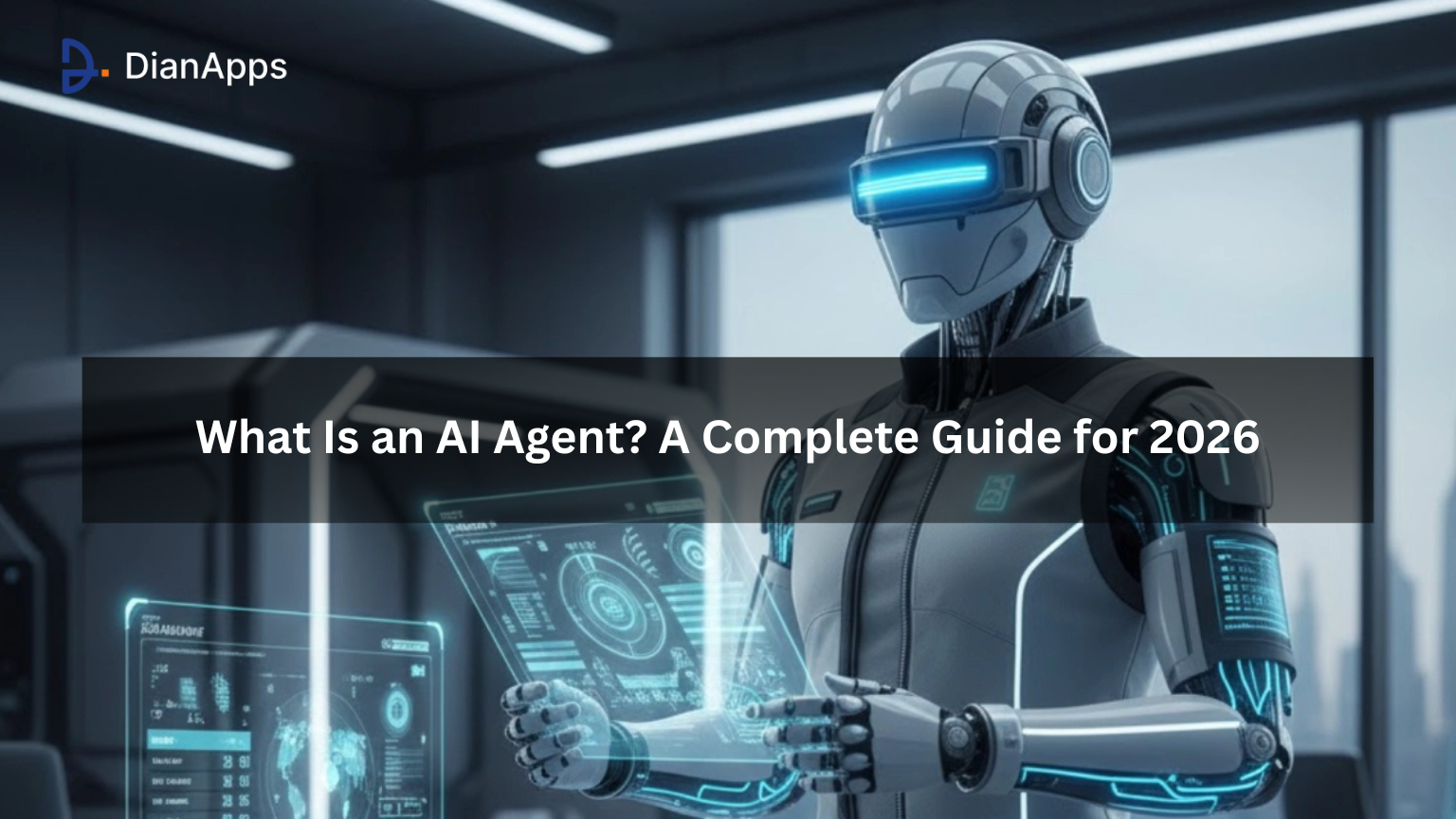
Direct Answer: An AI agent is an autonomous software system that perceives information from its environment, reasons about what to do with that information, executes a sequence of actions using external tools, and works toward a defined goal without requiring human approval at each step. The key word is autonomous. A chatbot waits for a prompt. An AI agent receives a goal and figures out the steps itself.
The Clearest Way to Understand What an AI Agent Is?
The word “agent” gets applied loosely to a wide range of AI products in 2026. AI-powered chatbots, simple automated workflows, and genuine autonomous agents all get lumped under the same label in marketing materials. The distinction matters because these are fundamentally different systems with different capabilities, different costs to build, and different risk profiles.
The clearest way to understand the difference is through what a system does when it hits a situation it was not explicitly programmed to handle:
- A traditional chatbot produces an output and stops. It has no memory of what it said before, no ability to use external tools, and no concept of whether its answer accomplished anything.
- A RAG (Retrieval-Augmented Generation) system retrieves relevant documents, generates an answer grounded in them, and stops. More accurate than a plain chatbot, but still single-step and read-only.
- An AI agent receives a goal, breaks it into steps, selects and calls the tools needed for each step, observes the results, adjusts its plan if needed, and continues until the goal is reached. It takes action in the world, not just words about the world.
That last property, taking action rather than generating text, is what makes agents categorically different from the AI tools that came before them.
| System | Takes a Goal? | Multi-Step? | Uses External Tools? | Takes Real-World Action? | Adapts to Results? |
|---|---|---|---|---|---|
| Traditional software | No | Fixed only | Predefined only | If programmed | No |
| Chatbot | No | No | Sometimes | No | No |
| RAG system | No | No | Vector DB only | No | No |
| AI Agent | Yes | Yes | Yes, dynamically | Yes | Yes |
This distinction shapes everything about how these systems are built, governed, and what they should and should not be trusted to do unsupervised. Understanding it clearly is the foundation for every useful decision about AI agents, whether you are evaluating one, building one, or deploying one in a business context.
How an AI Agent Actually Works: The Core Loop?
At its operational core, an AI agent runs a loop. It does not run once and stop. It perceives, reasons, acts, and observes the result of that action, then loops back to perceive again with the new information.
This is called the perceive-reason-act-observe loop, and it is what enables an agent to handle multi-step tasks that a single LLM call could never complete. Here is what each component means in practice:
Perceive
The agent takes in information about the current state of the world relevant to its goal. This might mean reading an email inbox, querying a database, calling an external API, checking a web page, or reading from a sensor. The perception layer converts raw data from multiple sources into a form the agent’s reasoning model can process.
Reason
The agent’s reasoning model (usually an LLM) processes the perceived information, considers the goal, and decides what to do next. This is not a single inference call. For complex goals, the agent uses structured reasoning patterns such as ReAct (Reason + Act), chain-of-thought, or Plan-Execute frameworks that break the problem into explicit steps before acting on any of them.
Act
The agent executes the chosen action by calling a tool. Tools are the agent’s hands: they might be search engines, APIs, databases, code interpreters, file systems, browser automation, email senders, calendar systems, or any other capability connected to the agent’s tool registry. The agent selects the appropriate tool, provides the right inputs, and triggers the execution.
Observe
The agent receives the result of its action and updates its understanding of the current state. If the result advances progress toward the goal, it plans the next step. If something failed or returned an unexpected result, it adjusts its plan. This observe phase is what gives agents the ability to recover from partial failures rather than failing silently or requiring human restart.
The loop continues until the agent determines the goal has been achieved, encounters an error it cannot resolve and escalates to a human, or reaches a defined boundary condition such as a maximum number of steps or a time limit.
The Five Core Components of an AI Agent
Every production AI agent, regardless of what it does or which framework it is built on, contains five core components. Understanding each one is important for both evaluating agents and understanding what makes some agents far more reliable than others.
| Component | What It Does | Common Implementation |
|---|---|---|
| Perception layer | Ingests information from APIs, databases, sensors, documents, and other data sources; converts it into a form the reasoning model can process | REST/GraphQL connections, vector embeddings for RAG retrieval, file parsers, web scrapers |
| Reasoning engine | Interprets goals, plans action sequences, selects tools, and decides what to do next based on observations; this is the “brain” of the agent | LLM (GPT-4o, Claude 3.5, Gemini 1.5 Pro) with structured prompting; ReAct or Plan-Execute frameworks |
| Memory system | Stores context so the agent can maintain awareness across a multi-step workflow and across separate sessions; prevents it from forgetting what it has already done | In-context window (short-term), vector database such as Pinecone or Weaviate (long-term), structured logs (episodic) |
| Tool registry | The set of actions the agent can take in the world; each tool has a defined input format, output format, and error behavior that the agent learns through its system prompt | Function calling via OpenAI, Anthropic, or Gemini APIs; Model Context Protocol (MCP) for standardized tool integration |
| Orchestration layer | Controls the perceive-reason-act-observe loop; manages state across steps, handles errors and retries, coordinates multiple agents when more than one is involved, and enforces the boundaries of what the agent is allowed to do | LangGraph, CrewAI, AutoGen, LangChain, or custom orchestration code |
The reasoning engine gets most of the attention in discussions about AI agents. The orchestration layer is where most production failures actually occur. An agent with a powerful LLM and a poorly designed orchestration layer will fail under real workloads. An agent with a mid-tier model and robust orchestration consistently outperforms it. This is one of the most important practical insights for anyone building agents in 2026.
The question of which LLM model is best for an agent’s reasoning engine is genuinely secondary to how well the overall system is designed. As the comparison between private and public LLMs shows, the architecture and data strategy around the model matter more than the model itself in most production contexts.
Types of AI Agents: From Simple to Complex
AI agents are not all the same level of sophistication. They exist on a spectrum from simple reflex systems to multi-agent networks handling enterprise-scale workflows. Understanding the taxonomy helps you match the right agent type to the right use case rather than over-engineering a simple problem or under-building a complex one.
1. Simple Reflex Agents
The most basic agent type. Perceives the current state of the environment and acts based on a fixed set of if-then rules. No memory, no learning, no planning. If the inbox contains an email with subject line “Urgent,” move it to the priority folder. Predictable and fast but brittle outside its programmed conditions.
When to use: High-frequency, low-variability tasks where the rules are genuinely fixed and exhaustive.
2. Model-Based Reflex Agents
An improvement on simple reflex agents. Maintains an internal model of the world so it can handle situations where the environment is not fully observable at a single moment. The agent tracks how the world changes over time and acts based on both current perception and its internal state model.
When to use: Environments that change between observations, such as inventory management where stock levels shift continuously.
3. Goal-Based Agents
These agents receive a goal rather than a fixed rule set, and plan the sequence of actions most likely to achieve that goal. This is where LLM-powered agents begin. The agent uses its reasoning model to decide not just what situation it is in but what it needs to do to reach a specified outcome.
When to use: Tasks with variable paths to a defined outcome, such as researching a topic and producing a summary, or booking a meeting that satisfies a set of constraints.
4. Learning Agents
Go beyond fixed programming by improving their behavior based on feedback from past actions. A learning agent that books travel notices which routes the user prefers, which times they always reject, and which hotels have been given positive feedback. It updates its behavior accordingly, becoming more useful over time without being explicitly reprogrammed.
When to use: Tasks with repeating patterns where individual user preferences matter, and where sufficient feedback data accumulates to improve the model meaningfully.
5. Multi-Agent Systems
Multiple specialized agents working in coordination, each handling a defined role within a larger workflow. A supervisor agent decomposes a complex goal and assigns subtasks to specialist agents (a research agent, a writing agent, a review agent). The specialists report results back to the supervisor, which synthesizes them into a final output.
This architecture consistently outperforms single-agent systems on complex tasks. KuCoin Research found that multi-agent architectures in crypto trading (Bull agent, Bear agent, Risk Supervisor) outperformed single-model LLM approaches across standard benchmarks. The pattern holds across domains: competing specialist perspectives caught by a supervisor produce more reliable results than a single reasoning chain.
When to use: Complex enterprise workflows where parallel specialization, internal quality checking, or competing perspectives improve output quality. Also where tasks exceed what fits in a single agent’s context window.
| Agent Type | Memory | Goal-Directed | Learns | Complexity | Example Use Case |
|---|---|---|---|---|---|
| Simple reflex | None | No | No | Low | Email routing, alert triggering |
| Model-based reflex | World model | No | No | Medium | Inventory management, sensor monitoring |
| Goal-based | Context window | Yes | No | Medium-High | Research assistant, scheduling agent |
| Learning | Episodic + vector | Yes | Yes | High | Personalized recommendations, adaptive workflows |
| Multi-agent | Shared + individual | Yes | Can | Very High | Enterprise process automation, content pipelines |
DianApps AI Agent Development
Ready to Build an AI Agent That Works in Production?
DianApps builds AI agents with the orchestration depth, memory architecture, and failure handling that production workloads require. Clutch #1 Premier Verified with 200+ engineers across the USA, Australia, UAE, and India.
★ Clutch #1 Premier Verified | 4.9/5 (79+ reviews) | 150+ Engineers
Real-World AI Agent Use Cases in 2026
The adoption statistics are more credible when you can see specifically what agents are doing in production. Banking and insurance currently lead sectoral deployment at 47%, with healthcare at 18% and government at 14%, per 2026 Gartner data. These are the use cases driving those numbers.
Software Engineering
This is where AI agent adoption is most mature. Coding agents write functions, identify bugs, run tests, suggest refactors, and open pull requests without a developer directing every step. 84% of developers now use AI tools in their workflow, and AI writes 41% of all code globally in 2026. Claude Code holds over 50% of the enterprise AI coding market. The agent pattern here is not one LLM generating code. It is an agent loop that writes, tests, reads the test output, fixes what broke, and iterates.
Customer Service and Support
Customer service is the largest single deployment category for AI agents in 2026, according to Grand View Research. An agent handling customer support queries does not just generate a response. It reads the customer’s history in the CRM, checks the current order status in the fulfillment system, retrieves the relevant policy from the knowledge base, crafts a specific response grounded in those facts, and either resolves the issue or escalates with a full summary prepared for the human agent who takes over. Companies deploying agents broadly in customer service report 3 to 15% revenue growth and 10 to 20% improvement in sales ROI.
Research and Intelligence
Research agents receive a topic or question, search multiple sources autonomously, evaluate source credibility, synthesize findings, identify gaps, follow up on those gaps with additional searches, and produce a structured report. Tasks that took a human analyst half a day to complete are compressed into minutes. These agents are widely deployed in financial services for market intelligence, in legal for case research, and in life sciences for literature review.
Healthcare
Clinical documentation agents process patient notes, extract structured clinical data, update EHR records, and flag anomalies for physician review. Patient coordination agents schedule follow-ups, send reminders, and manage referral workflows. Diagnostic support agents cross-reference symptoms with clinical literature and surface relevant considerations for reviewing clinicians. Healthcare AI agent deployment sits at 18% in 2026, lower than BFSI but growing faster given the documentation burden that drives adoption.
Supply Chain and Logistics
Logistics agents monitoring supply chain conditions report 15% lower costs and 35% better inventory accuracy in 2026, per a global enterprise survey. These agents watch demand signals, inventory levels, and supplier status simultaneously, trigger reorder workflows before stockouts occur, reroute shipments around disruptions, and update downstream systems with the new plan. Companies using AI for supply chain coordination report 25% faster response to disruptions and 30% fewer manual interventions.
Finance and Trading
Autonomous trading agents, fraud detection agents monitoring transactions in real time, and compliance agents watching for regulatory violations represent the fintech AI agent landscape. The intersection of DeFi and AI agents in particular has become one of the most active areas of deployment in 2026, with agents managing portfolio rebalancing, yield optimization, and governance voting across blockchain protocols.
For a detailed look at the most impactful AI application ideas being built in 2026, the pattern across industries is consistent: agents handling the multi-step, tool-using, decision-making tasks that previously required human attention at each step are where the highest ROI is materializing.
Agent Architecture Patterns: Which One to Use?
The architecture of an AI agent determines how it reasons, at what computational cost, and how reliably it handles complex or ambiguous situations. Five canonical architectures dominate production deployments in 2026.
| Architecture | How It Works | Best For | Tradeoff |
|---|---|---|---|
| ReAct (Reason + Act) | Interleaves reasoning steps and tool calls in a tight loop; the agent reasons about what to do, does it, observes the result, reasons again | Tasks requiring dynamic response to changing information; the most widely deployed pattern | Can get stuck in loops on ambiguous goals; requires strong prompt design |
| Plan-Execute | Generates a full step-by-step plan before executing any action; executes steps in sequence without replanning unless explicitly triggered | Well-defined tasks with predictable steps; faster and cheaper than ReAct for structured workflows | Less adaptive to unexpected results during execution; brittle if the plan hits an unanticipated state |
| Reflexion | After completing a task, the agent reflects on what went wrong and generates a revised strategy for the next attempt; learns within a session | Tasks where first-attempt success is less important than eventual correctness; research and analysis tasks | Higher latency; multiple full task cycles before reaching the best result |
| Tree of Thoughts | Generates multiple candidate reasoning paths in parallel, evaluates each, selects the most promising, and continues branching; treats reasoning as a search problem | High-stakes decisions where exploring alternatives before committing is worth the cost | Computationally expensive; LLM inference costs multiply with each branch explored |
| Multi-Agent Orchestration | A supervisor agent decomposes a goal into subtasks, assigns each to a specialist agent, collects results, and synthesizes them into a final output | Complex workflows exceeding a single agent’s context window; tasks benefiting from parallel execution or competing perspectives | Higher infrastructure complexity; inter-agent communication design requires careful architecture |
The generative AI capabilities underlying these architectures are reshaping enterprise product development far beyond standalone agent deployments. As the integration of generative AI into enterprise application development shows, the most impactful deployments in 2026 are the ones where AI agent capabilities are embedded into the products themselves, not added as separate tools alongside them.
The Technology Stack: What AI Agents Are Built With?
A production AI agent requires components at several layers of the stack, not just an LLM API connection.
| Stack Layer | Leading Options (2026) | What It Handles |
|---|---|---|
| Reasoning model (LLM) | GPT-4o, Claude 3.5/4, Gemini 1.5 Pro, Llama 3 (self-hosted) | Goal interpretation, step planning, tool selection, output generation |
| Agent framework | LangGraph, LangChain, CrewAI, AutoGen, OpenAI Agents SDK | Loop management, state tracking, tool calling, multi-agent coordination |
| Tool integration | Model Context Protocol (MCP), custom REST/GraphQL integrations, function calling | Standardized connections to external APIs, databases, and services the agent can call |
| Memory and knowledge | Pinecone, Weaviate, pgvector, Chroma (vector stores); PostgreSQL/MongoDB (structured memory) | Long-term knowledge retrieval via RAG, episodic memory of past sessions, semantic search |
| Backend runtime | Python (FastAPI, Flask), Node.js/TypeScript | Agent process lifecycle, API endpoint serving, background task management |
| Infrastructure | AWS, Azure, Google Cloud; Docker, Kubernetes for containerized agent processes | Always-on agent processes, scaling, reliability, cloud AI service access |
| Observability | LangSmith, Datadog, custom trace logging | Agent step tracing, performance monitoring, error detection, hallucination flagging |
The observability stack deserves more attention than it typically gets in technology selections. A production agent that cannot be inspected is a liability. You need to know what the agent perceived at each step, what it decided, what tools it called, what those tools returned, and what it did with that information. Without this visibility, debugging failures is guesswork and auditing the agent’s behavior for compliance purposes is impossible.
AI Agents and Mobile Apps: The Connection Most Builders Miss
For businesses building mobile products, AI agents represent one of the highest-value opportunities in 2026. Not as standalone backend systems, but as the intelligence layer embedded inside mobile experiences that makes them adaptive in ways that fixed-logic apps cannot match.
A mobile fitness app that uses an AI agent can adapt a user’s training plan in real time based on their actual workout performance, fatigue signals from wearable sensors, and schedule changes pulled from their calendar, without any human coach involvement. A mobile banking app with an embedded agent can detect anomalous spending patterns, surface the relevant insight at the right moment, and take a predefined protective action before the user even knows there is a problem.
The critical infrastructure consideration for mobile AI agents is whether inference runs on-device or in the cloud. As the comparison between on-device AI and cloud AI makes clear, the multi-step orchestration that defines genuine agentic behavior is almost exclusively a cloud capability. On-device inference handles single-step, real-time, latency-sensitive tasks well. Cloud handles the multi-step reasoning chains, tool calling, and memory management that agents require. Designing the right split between the two is a mobile architecture decision that shapes what the AI features can do.
Our AI/ML development services at DianApps address this split as a primary architecture decision before any code is written. Whether the mobile product is built on Flutter or React Native, the AI agent layer underneath it is designed to make the economics work at scale.
What AI Agents Cannot Do: The Honest Limitations?
The production failure rate for AI agents is meaningfully higher than most vendor marketing suggests. Understanding the genuine limitations is not optional context. It is the information that determines whether your agent deployment succeeds.
They hallucinate with confidence. The LLMs powering agent reasoning generate text that sounds authoritative whether or not the underlying claim is accurate. In a single-inference chatbot, a hallucination produces a wrong answer. In an agent, a hallucination at step 2 of a 10-step workflow can propagate through every subsequent step, compounding the error before anyone notices. Grounding the agent’s reasoning in retrieved, verified data via RAG and adding validation steps at decision points addresses this, but does not eliminate it.
They get stuck in loops. Without well-designed loop termination conditions, agents can cycle through the same steps repeatedly when they encounter an ambiguous state. Early agentic frameworks saw this frequently. Well-designed orchestration layers define maximum step counts, time limits, and condition-based termination to prevent runaway loops. Poorly designed ones discover the problem in production.
They are only as good as their tools. An agent without the right tools for a task will either fail or attempt to substitute inadequate tools. The quality of the agent’s tool registry and the reliability of each tool’s behavior under edge cases determine a large part of the agent’s overall reliability. Tools that return inconsistent formats, error silently, or behave differently under load will produce agent failures that look like AI reasoning failures.
Context window limitations affect long workflows. LLMs have finite context windows. For long-running multi-step workflows, the agent’s working memory fills up. Without proper context management, the agent loses track of decisions made earlier in the workflow. Long-term memory systems using vector databases address this, but require deliberate design rather than emerging naturally from the LLM.
Human oversight is not optional for high-stakes decisions. An agent operating in an environment where its mistakes are costly, irreversible, or affect real people requires human-in-the-loop checkpoints at decision points of appropriate consequence. Full autonomy is appropriate for low-stakes, reversible, well-understood tasks. For anything else, the agent architecture must include defined escalation points where a human reviews and approves before the agent continues.
The question of what AI agents can and cannot replace is genuinely important for organizations building AI strategy. As the analysis of where AI assists versus replaces human roles shows consistently, the answer is nuanced. Agents are highly effective at the mechanical, repetitive, data-retrieval, and rule-application parts of complex workflows. They are not effective substitutes for the judgment, ethical reasoning, and contextual awareness that human decision-making provides.
What It Costs to Build an AI Agent in 2026?
Cost varies considerably by agent type, complexity of the workflow, number of tools required, and how much custom model work is involved. Here is a realistic breakdown.
| Agent Type | Build Cost Range | Timeline | Key Cost Drivers |
|---|---|---|---|
| Single-task conversational agent | $15,000 to $40,000 | 3 to 6 weeks | Prompt design, tool integrations, basic RAG knowledge base |
| Multi-step workflow agent | $40,000 to $100,000 | 6 to 12 weeks | Orchestration framework, memory system, multiple tool integrations, failure handling |
| Enterprise integration agent | $80,000 to $200,000 | 10 to 20 weeks | CRM, ERP, ITSM integrations; compliance requirements; audit logging infrastructure |
| Multi-agent system | $120,000 to $350,000 | 14 to 28 weeks | Multi-agent orchestration design, inter-agent communication, supervisor logic, shared memory |
| AI-native product (agent embedded in app) | $150,000 to $500,000+ | 16 to 40 weeks | Custom model training, full mobile/web product delivery, on-device/cloud AI split design |
Monthly Operational Costs to Factor In
- LLM API inference (scales with usage): $300 to $15,000+/month
- Vector database and memory storage: $100 to $2,000/month
- Cloud infrastructure for agent processes: $500 to $8,000/month
- Observability and monitoring tools: $200 to $2,000/month
- Ongoing maintenance and model updates: 15 to 20% of build cost annually
The economics improve significantly at scale. LLM API costs per query decrease with volume commitments, and the human labor costs avoided by a well-functioning agent typically dwarf the infrastructure costs within the first year of deployment for any workflow that previously required meaningful staff time.
How DianApps Builds AI Agents?
At DianApps, AI agent development is not a specialist service separate from product development. It is integrated into how we build mobile and enterprise products from the first architecture conversation. As a Clutch #1 Premier Verified mobile app development company with 200+ engineers across the USA, Australia, UAE, and India, our engineering teams build the agent layer and the product layer together rather than passing a finished app to an AI team to “add agents.”
That integration matters because the most common failure mode in AI agent projects is a disconnect between the product experience and the agent’s capabilities. When the mobile product is designed with the agent architecture in mind, the user experience around what the agent can and cannot do is coherent. When the agent is added later, the friction is visible in every interaction.
Our production work includes RAG-grounded agents for enterprise knowledge retrieval, multi-step workflow agents for operational automation, learning agents embedded in mobile products for personalized experiences, and multi-agent systems for complex business processes that exceed what any single agent can handle. Verified outcomes include Khatabook (50M+ users), Airblack (98% uptime, 50% monthly active user growth, 30% subscription revenue increase), and Uber Eats (45% service cost reduction, 35% retention improvement).
Frequently Asked Questions
What is an AI agent in simple terms?
An AI agent is a software system that can receive a goal in natural language, break it into steps, use external tools to carry out each step, observe the results, and adjust its plan if needed, all without a human approving every action. The key difference from a chatbot is that a chatbot answers a question and stops. An agent works through a multi-step task and delivers a result.
What is the difference between an AI agent and a chatbot?
A chatbot takes a single input and produces a single output. It has no persistent memory, no ability to take actions in external systems, and no multi-step planning capability. An AI agent takes a goal, plans the steps to achieve it, calls external tools at each step, observes what happens, adjusts its plan when results are unexpected, and continues until the goal is reached or it needs to escalate. The difference is not cosmetic. It is architectural.
What are the main types of AI agents?
The five main types are simple reflex agents (fixed if-then rules, no memory), model-based reflex agents (maintain a world model to handle partial observability), goal-based agents (receive high-level goals and plan how to achieve them using LLM reasoning), learning agents (improve behavior over time based on feedback), and multi-agent systems (multiple specialized agents working in coordination under a supervisor). Most production business AI agents in 2026 are goal-based or multi-agent systems.
How does an AI agent work?
An AI agent runs a continuous loop: it perceives information from its environment (APIs, databases, documents, sensor data), reasons about what to do next using an LLM (deciding which tool to call, what action to take), executes that action through a connected tool, observes the result, and loops back to perceive the updated state. This loop continues until the goal is achieved, a boundary condition is hit, or the agent determines it needs human input.
What is a multi-agent system?
A multi-agent system involves multiple specialized AI agents working together under a coordinator or supervisor agent. The supervisor receives a complex goal, decomposes it into subtasks, assigns each subtask to a specialist agent, collects the results, and synthesizes them into a final output. This architecture handles tasks too complex or large for a single agent’s context window and consistently outperforms single-agent approaches on tasks where parallel specialization or competing perspectives improve output quality.
What can AI agents actually do for a business?
In 2026, enterprises are using AI agents for customer service and support ticket resolution, software development and code review, research and competitive intelligence, clinical documentation and patient coordination in healthcare, supply chain monitoring and reorder automation, fraud detection in financial services, and compliance monitoring. Companies deploying agents broadly report 3 to 15% revenue growth and 10 to 20% improvements in sales ROI. Supply chain agents specifically show 15% lower logistics costs and 35% better inventory accuracy.
What are the risks of using AI agents?
The main risks are LLM hallucination propagating through multi-step workflows (a wrong assumption at step 2 affects every subsequent step), loop failures where agents cycle indefinitely without reaching a goal, tool failures producing silent errors the agent misinterprets, and context window exhaustion causing the agent to lose track of earlier decisions. All of these are manageable with proper architecture: RAG grounding, validation steps, loop limits, and long-term memory systems. They are not manageable without deliberate design.
How much does it cost to build an AI agent in 2026?
A simple single-task conversational agent costs $15,000 to $40,000. A multi-step workflow agent with several tool integrations and proper memory architecture runs $40,000 to $100,000. Enterprise-grade agents integrated with CRM, ERP, and compliance systems cost $80,000 to $200,000. Multi-agent systems for complex enterprise workflows run $120,000 to $350,000. An AI-native product where the agent is embedded in a mobile or web application starts around $150,000. Monthly operational costs add $1,000 to $25,000 depending on inference volume and infrastructure requirements.
The Bottom Line
An AI agent is not a more sophisticated chatbot. It is a different class of system entirely, one that takes a goal, works through the steps to achieve it, uses external tools to take real-world actions, and adapts when those actions produce unexpected results. That capability profile is why 80% of enterprises have at least one production agent in 2026 when that number was 33% just two years ago.
The maturity of agent frameworks, the reliability of frontier LLMs for multi-step reasoning, and the standardization of tool integration through Model Context Protocol have collectively made agents a tractable engineering problem rather than a research project. Building them well still requires careful decisions at the orchestration layer, the memory architecture, the tool design, and the failure handling strategy. Those decisions separate production-ready agents from impressive demos.
For businesses ready to move from understanding what an AI agent is to actually building one, the direction that software development is heading in 2026 is clear: agentic AI handling complex workflows with minimal human intervention is no longer an advantage for early movers. It is rapidly becoming table stakes in the industries where deployment is already at scale.
 0 comments











Leave a Comment
Your email address will not be published. Required fields are marked *