












 0 comments
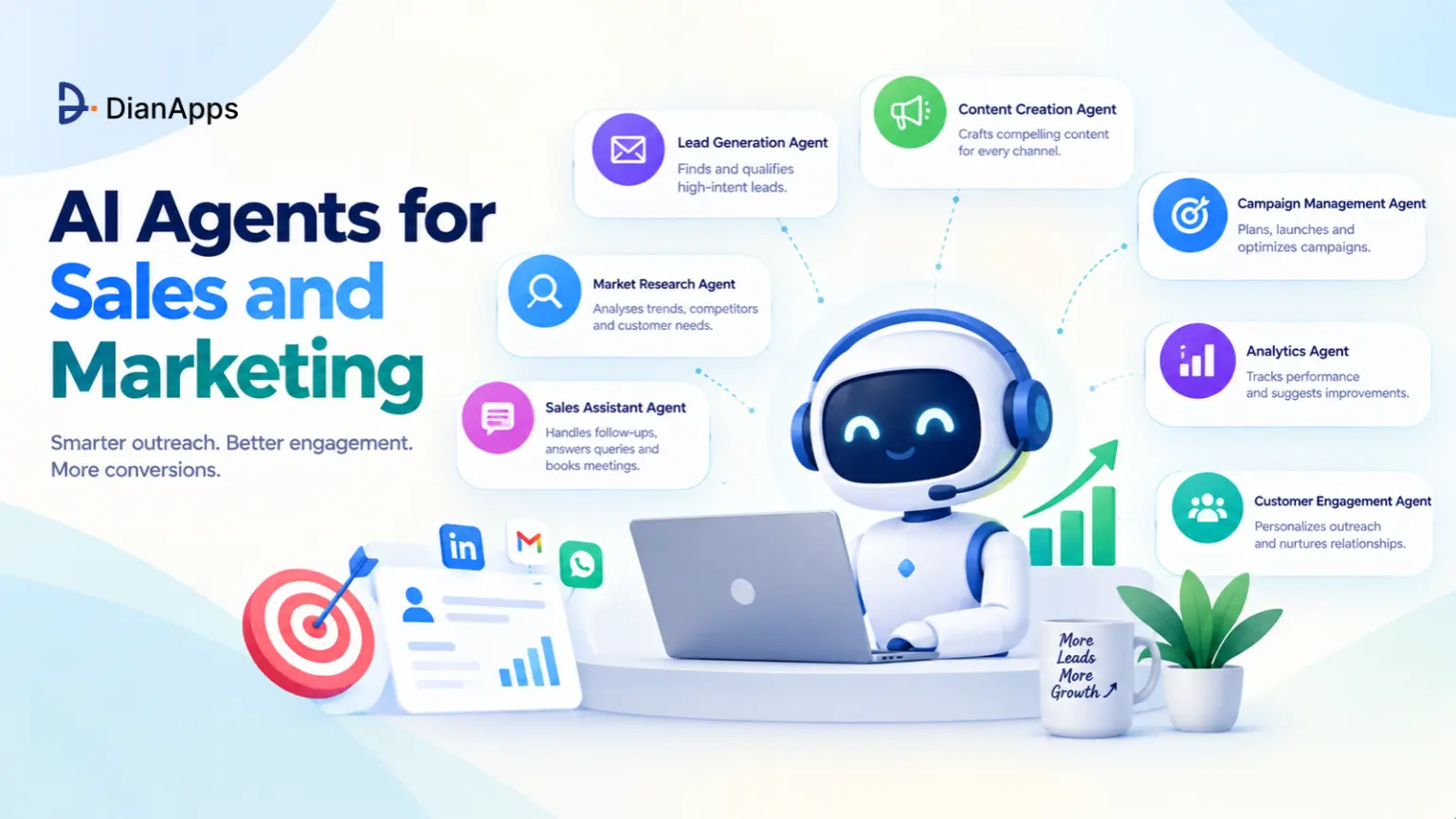





Key Takeaways
- More than half of sales organisations are already running AI agents across their sales cycle as per Salesforce’s 2026 State of Sales report, so the question is no longer whether to use them but how.
- AI agents for sales are researching accounts, enriching contact data and scoring leads/prospects round the clock, which is really giving reps a cleaner pipeline to work from each and every morning.
- An AI sales agent is writing, sending and following up on outbound messages that are actually speaking to each prospect’s role, company and recent activity.
- AI agents for marketing and AI agents for content creation are taking care of segmentation, campaign variants and content briefs, while marketers/editors are keeping full control over the brand voice.
- Clean data, proper CRM integration, guardrails and human review are what is really deciding whether an agent is bringing in revenue or just ending up as another cancelled pilot.
Quick Answer: AI agents for sales and marketing are autonomous software systems that are finding and qualifying leads, running personalised outbound outreach, updating the CRM and creating campaign content without teams having to do each and every step by hand. Unlike rule-based automation, they are reading CRM, intent and engagement data, deciding the next best action and handing the deal over to a human when judgement is needed, which is helping teams grow pipeline without growing headcount at the same pace.
Generating quality leads is one of the main reasons why sales and marketing teams are spending so many hours on research, but scrolling through LinkedIn profiles, copying details into spreadsheets and sending follow-ups that end up lost in someone’s inbox is not making it easy for anyone. This is where AI agents for sales are stepping in, helping teams find the right leads/prospects, reach out to them at the right time and personalise each and every message, while giving sales leaders a clear view of what is really happening in the pipeline.
And this is not just a sales problem either, because marketing teams are also struggling with the same thing, building campaign after campaign, segment after segment and still not getting the kind of engagement they were hoping for.
But what is the need for AI agents when there are already so many sales and marketing automation tools available in the market today? Well, those tools are following fixed rules that somebody has set up in advance, whereas an agent is reading the context, deciding what to do next and acting on its own across the CRM, email, LinkedIn and marketing platforms, and that is making all the difference.
In this blog, we are going to cover how AI agents for sales and marketing are handling lead generation, outreach and personalisation, how AI agents for content creation are fitting into the bigger picture and how to build AI marketing agent system architecture that is really holding up in production, so let’s take a look.
What Are AI Agents for Sales and Marketing?
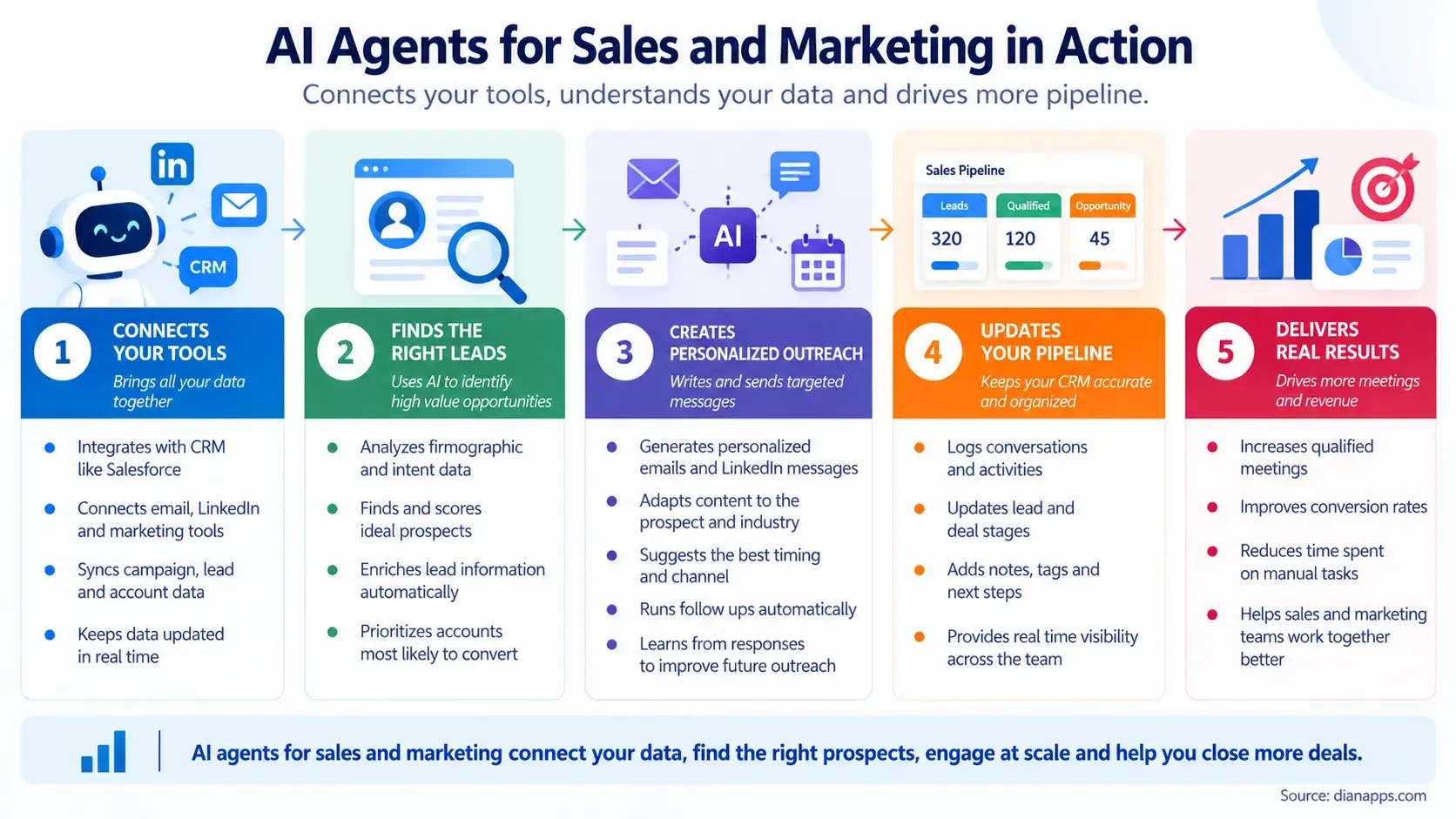
AI agents for sales and marketing are software systems built on large language models (LLMs) that are understanding data, planning out a set of steps, using different tools and learning from the results, all with the aim of reaching a business goal like booking a meeting or turning a lead into a paying customer.
A regular workflow tool is sending the exact same email on day three to each and every person on a list, whereas an AI sales agent is first checking whether the prospect opened the last email, visited the pricing page or recently changed jobs, and only then deciding what to send, when to send it or whether the lead should go straight to a human rep.
There are several types of AI agents being used by businesses today, from simple reflex agents to goal-based and learning agents, and most sales and marketing teams are combining a few of these inside one connected system rather than relying on just one.
To understand how an AI agent is really different from the chatbots and rule-based automation that most sales/marketing teams are already using, let’s break it down:
| Capability | Rule-Based Automation | Chatbot | AI Agent |
| Decision Making | Fixed if/then rules | Scripted or intent-based replies | Plans and adapts steps toward a goal |
| Data Access | Single platform | Conversation history only | CRM, intent, web, email and calendar |
| Actions Taken | Sends pre-set messages | Answers questions | Researches, writes, books and updates records |
| Personalisation | Merge fields | Limited to the session | Role, company and behavioural context |
| Human Handoff | Manual | On request | Triggered by confidence and deal rules |
If you are still confused between the two, our detailed comparison of an AI agent vs chatbot is explaining where each one is fitting best, but in short, agents are definitely the better choice wherever a task is needing multiple steps and some real judgement.
Now that the basics are clear, the next question that is naturally coming to mind is how these agents are actually helping a sales team on a day-to-day basis, so let’s take a look.
How Do AI Agents Help With Sales?
AI agents for sales are helping across the entire sales cycle, from the very first touch with an unknown account until the moment a signed contract is handed over to the customer success team, and the reasons are not hard to see.
As per Salesforce’s 2026 State of Sales report, 87% of sales organisations are using AI in some form and 54% are already using AI agents, while 85% of reps working with agents are saying that AI is freeing them up for more valuable work, which is really showing how quickly things are changing.
In day-to-day practice, an AI sales agent is taking a lot of the routine work off the team’s plate, resulting in:
- Accounts being researched with funding news, hiring signals and tech stack details before each and every first touch.
- Inbound and outbound leads being scored against your ideal customer profile, so only the qualified ones are reaching the reps.
- Meetings being scheduled, invites being sent and attendance being confirmed without the rep having to chase anyone over email.
- CRM records being updated automatically after every call and email, so the pipeline is always showing what is really happening.
- Stalled deals, missing stakeholders and competitor mentions being flagged well before the weekly forecast meeting has even started.
This is why sales leaders/managers are treating agents less like a tool and more like an extra member of the team, one that is working round the clock and never skipping the boring parts of the job.
If you are looking for a wider view across departments, our blog on AI agent use cases is covering how the same capabilities are being used in customer support, finance and operations as well.
And the biggest impact of all is showing up right at the top of the funnel, where lead generation is eating up most of the team’s time and energy, so let’s break it down.
AI Agents for Sales in Lead Generation: Finding and Qualifying Prospects
Lead generation is where most businesses are seeing the earliest results, and this is mainly because AI agents for sales are able to keep an eye on far more buying signals than any SDR team could ever track manually.
A lead generation agent is usually watching website visits, content downloads, job changes, funding announcements and product usage data, then matching each of these signals against your ideal customer profile and deciding whether the account is worth reaching out to today or can wait until next quarter.
Intent-Based Prospecting
Instead of buying a static list and sending the same message to everyone on it, the agent is building lists on the go from accounts that are already showing buying intent, which is keeping the pipeline fresh and the bounce rates much lower.
Lead Enrichment and Scoring
Once a lead is captured, the agent is filling in the missing details like verified emails, company size, tech stack and seniority, and then giving the lead a score that is actually explaining why it qualifies rather than just showing a random number on a dashboard.
Inbound Lead Response
Speed is extremely crucial when it comes to inbound leads, and an AI sales agent is replying to form fills within minutes, asking the right qualifying questions and booking a demo directly on the rep’s calendar while the buyer’s interest is still high.
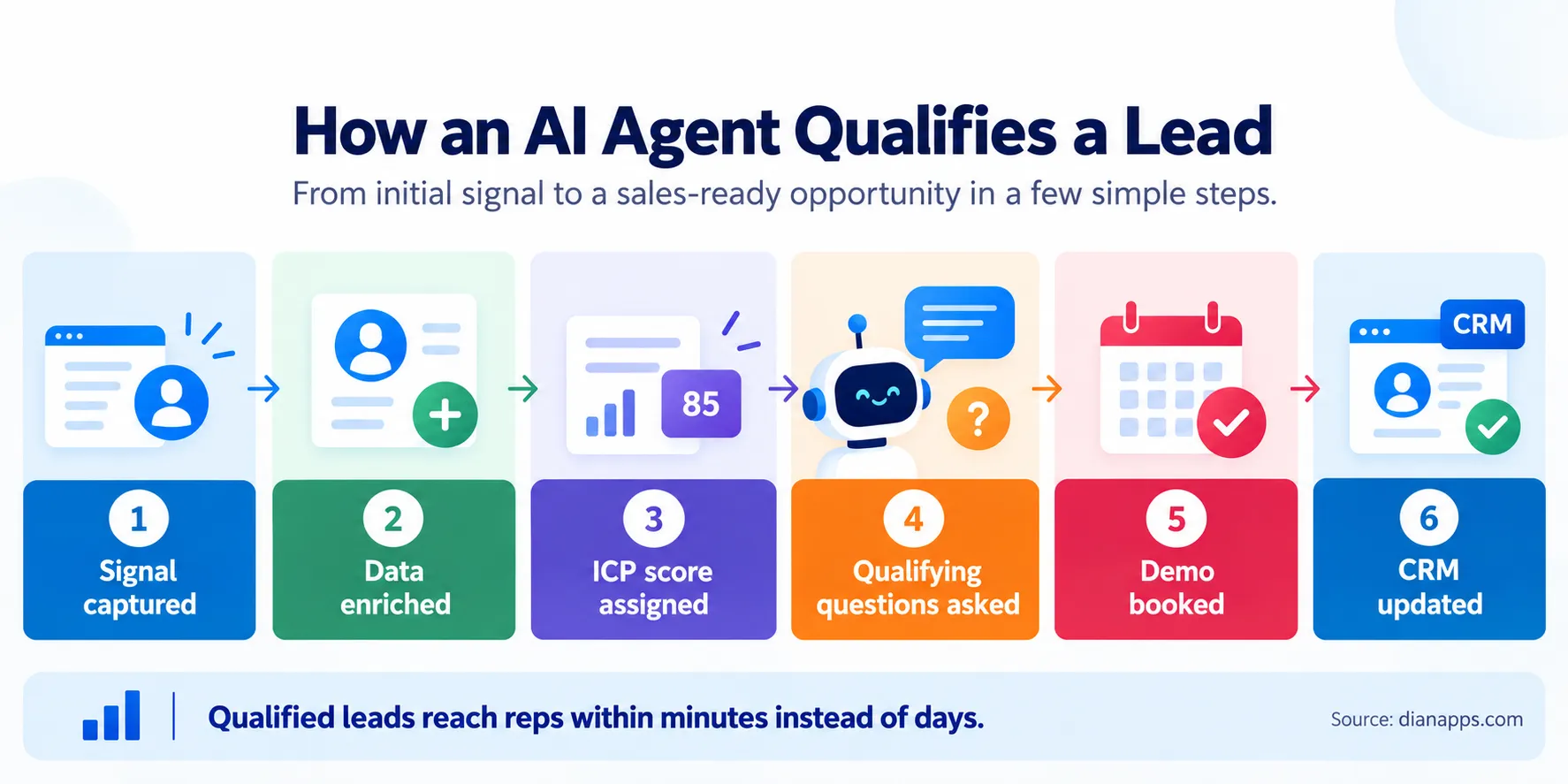
This also is helping the prospect, because nobody is enjoying waiting two days for a reply after showing interest, and a slow response is giving a poor impression before the sales conversation has even started.
Finding the right leads is only half of the job though, because somebody still has to reach out to them and start the conversation, and this is where outbound agents are coming in.
Can AI Agents Do Outbound Sales Outreach?
Well, yes, AI agents can handle outbound sales outreach from beginning until completion, and this is definitely the use case that is getting the most attention from founders and sales leaders right now.
An outbound AI sales agent is researching each prospect, writing a first message that is mentioning something specific about their business, sending it from a warmed-up mailbox, reading the reply and then deciding whether to follow up, answer an objection or pass the conversation over to a human.
A well-built outbound agent is usually going through the following steps for each and every prospect in the campaign:
- Prospect Research: The agent is going through the prospect’s company website, recent news and LinkedIn activity to find a genuine reason to reach out.
- Message Writing: It is writing a short and specific first email or LinkedIn note that is connecting that reason to a problem your product is solving.
- Multichannel Follow-Up: It is following up across email, LinkedIn and, where allowed, voice, changing the angle based on engagement rather than repeating the same message.
- Reply Handling: It is sorting replies into interested, not now, wrong person or unsubscribe, and then responding or updating the CRM accordingly.
- Human Handoff: It is passing warm conversations over to an account executive along with a summary of everything the prospect has said so far.
Voice is also becoming a serious outreach channel, and our guide on AI voice agents for business is explaining how teams are using them for qualification calls and appointment setting.
Poorly timed or generic cold emails don’t just get ignored, they also affect the brand perception of your company in front of the exact buyers you are trying to win over.
And that is not all, outbound agents are also protecting your sender reputation by controlling sending volumes, rotating mailboxes and stopping a sequence the moment a prospect is asking to be removed, which is extremely important for staying compliant with GDPR, CAN-SPAM and India’s DPDP Act.
Reaching out is one thing, but making each and every message feel like it was written just for that one person is a completely different thing, and that is where personalisation is coming in.
Ready to Put AI to Work on Your Sales Pipeline?
DianApps, an AI-first product development company, is designing and deploying custom AI agents for sales that are researching prospects, running outreach and updating your CRM, all while following your brand and compliance rules.
How Do AI Agents Personalise Marketing?
AI agents for marketing are personalising campaigns by bringing customer data from the CRM, website, email platform and product into one single view, and then deciding what each person should be seeing next, on which channel and at what time.
HubSpot’s 2026 State of Marketing report is showing that 49% of marketers are already using AI to tailor their content, while around 19% are using AI agents to run marketing initiatives end to end, so there is definitely a lot of room left to grow.
An AI agent for marketing is going much further than just adding a first name to an email, it is changing the offer, the case study, the subject line and even the landing page copy based on the industry, funnel stage and past behaviour of each contact.
The personalisation work that marketers/growth teams are handing over to AI agents for marketing is covering a lot of ground, resulting in:
- Segments updating in real time as customer behaviour is changing, instead of being rebuilt manually before every campaign.
- Each contact getting the right next step, whether that is a nurture email, a retargeting ad or a call from sales.
- Website headlines, proof points and calls to action changing for each visiting account based on their industry and intent.
- Emails going out at the time when each contact is most likely to open them and actually engage with the content.
This is why personalisation is no longer feeling like a once-a-quarter project, it is becoming something that is happening in real time for each and every contact in the database.
Retail and D2C brands are taking this the furthest, and our blog on AI agents in eCommerce is showing how product recommendations and cart recovery are being personalised for each individual shopper.
That being said, the quality of personalisation is always depending on the data behind it, and the Martech for 2026 report is pointing out that 56.3% of marketing organisations are struggling with poor data quality, so cleaning up customer records is usually the very first project before AI agents for marketing go live.
And personalisation at this level is needing a lot of content behind it to keep things running, which is bringing us to the next part, so let’s take a look.
AI Agents for Content Creation: Scaling Campaigns Without Losing Brand Voice
AI agents for content creation are solving the volume problem that each and every marketing team is facing, where a single campaign is needing dozens of variations for different segments, channels and formats.
Unlike a one-off prompt typed into a chat tool, a content agent is working from a proper brief, pulling product details and brand guidelines from a knowledge base, writing the drafts, checking them against your rules and then sending them to a human editor for approval.
In a typical campaign, a single AI agent for marketing is producing a whole range of assets for both the marketing and sales teams, such as:
- Email nurture and outbound sequences written in multiple variations for testing across different segments and funnel stages.
- Ad headlines and descriptions for paid search and social media, matched closely to each audience and landing page.
- One-pagers, battle cards and follow-up summaries for the sales team, drafted directly from call notes and product documents.
- Blog briefs, outlines and first drafts for editors to refine with real expertise, original insight and proper fact-checking.
As per Salesforce’s marketing research, marketers are expecting to get back around eight hours a week by letting agents take care of content variations and data analysis, and that time is much better spent on strategy, creative direction and quality checks.
The thing to remember here is that content agents are working best as a support layer under human editors/writers, because brand voice, accuracy and original thinking are still needing a person who really understands the market and the buyer.
To make it all a bit easier to picture, here is a quick summary of where these agents are fitting across the different sales and marketing functions.
Turn Your Sales and Marketing Workflows Into Agent-Driven Growth
Share your goals with our team and we will recommend the right agent use case, architecture and rollout plan for your business, along with a clear estimate and timeline.
AI Agents for Sales and Marketing Use Cases by Function
The table below is summarising where AI agents for sales and marketing are adding value today, which type of agent is usually involved and the metric that teams are tracking to measure the impact:
| Function | Agent Role | Primary Data Sources | Key Metric |
| Lead Generation | Prospecting and enrichment agent | Intent data, CRM, firmographic databases | Qualified leads per week |
| Inbound Qualification | Conversational qualification agent | Web forms, chat, calendar | Speed to lead |
| Outbound Outreach | SDR outreach agent | CRM, email, LinkedIn, news | Positive reply rate |
| Personalisation | Next-best-action agent | CDP, product usage, email engagement | Conversion rate by segment |
| Content Production | Content generation agent | Brand guidelines, product docs, past campaigns | Assets produced per campaign |
| Sales Operations | CRM and forecasting agent | Call transcripts, pipeline data | Forecast accuracy |
Most businesses are starting with just one row from this table, proving the value within a quarter and then connecting the next AI agent for marketing or sales to the same data, rather than buying a separate tool for each and every job.
If you are thinking about building one of these agents for your own team, the process is not as complicated as it might sound, so let’s break it down.
How to Build an AI Marketing Agent?
Building an AI agent for marketing is less about picking the right model and more about defining the job clearly, connecting the right data and setting limits on what the agent is allowed to do on its own.
Our step-by-step guide on how to build an AI agent is covering the full process in detail, but for sales and marketing teams the steps are usually looking something like this:
- Define the Goal: Pick one measurable outcome, like booked meetings or MQL-to-SQL conversion, and write down exactly what success is going to look like.
- Map the Workflow: Note down each and every step a human is currently taking, including the tools they are opening and the decisions they are making.
- Prepare the Data: Clean up the CRM, merge duplicate customer records and build a knowledge base with product details, pricing rules and brand guidelines.
- Choose the Framework: Select an orchestration framework and model that is fitting your tech stack, budget, speed requirements and data storage needs.
- Add Guardrails: Set approval limits, sending caps, restricted topics and escalation rules before the agent is getting access to a single customer record.
- Pilot and Measure: Run the agent on a small segment first, compare the results against a control group and expand only when the numbers are holding up.
The framework you choose is affecting speed, cost and flexibility, so it is definitely worth going through the best AI agent frameworks like LangGraph, CrewAI and AutoGen before committing your development team to one of them.
How to Build AI Marketing Agent System Architecture?
Understanding how to build AI marketing agent system architecture is what is really separating a demo that looks impressive in a meeting from a system that is running smoothly across thousands of contacts each and every day.
A production-ready architecture is usually divided into layers, with each layer doing its own specific job and talking to the others through APIs and event triggers, let’s take a look:
| Layer | What It Does | Typical Components |
| Data Layer | Stores and unifies customer, product and campaign data | CRM, CDP, data warehouse |
| Knowledge Layer | Supplies accurate, current context through retrieval | Vector database, RAG (Retrieval-Augmented Generation) pipeline |
| Reasoning Layer | Plans steps, makes decisions and generates content | LLMs such as GPT-4o, Claude or Gemini |
| Orchestration Layer | Coordinates multiple agents, tools and memory | LangGraph, CrewAI, AutoGen |
| Action Layer | Executes tasks inside external systems | Email, LinkedIn, ad platforms, calendar APIs |
| Governance Layer | Monitors, logs, approves and restricts actions | Human review queues, audit logs, evaluation tools |
When businesses are planning how to build AI marketing agent system architecture, the orchestration and governance layers are the ones that are most often overlooked, and our detailed guide on AI agent architecture is explaining how memory, tool calling and multi-agent setups are working together.
But as useful as these agents are, there are a few risks that each and every team should be aware of before going live, and the reasons are not hard to see.
Planning to Build an AI Agent for Marketing That Fits Your Stack?
Our engineers are mapping your workflow, preparing your data and building secure, production-ready AI agents for marketing that are working smoothly with your CRM, automation and analytics tools.
Challenges and Governance Risks of AI Agents for Sales
The benefits of AI agents for sales are definitely real, but so are the risks, and Gartner is expecting more than 40% of agentic AI projects to be cancelled by the end of 2027, which is a clear sign that launching agents without a proper plan is not suitable nor suggested.
Before an agent goes live, these are the most common risks that teams are needing to plan for:
- Brand Risk: Wrong or tone-deaf messages sent at scale don’t just embarrass the sales team, they also affect the brand perception faster than any single rep ever could.
- Data Privacy: Prospect and customer data has to be handled lawfully under GDPR, CCPA and the DPDP Act, with clear consent and opt-out options in place.
- Made-Up Information: Without pulling from verified sources, an agent may end up inventing product features, pricing details or case study results in its messages.
- Deliverability Damage: Sending too many emails to poor-quality lists can push your domain into spam folders for each and every team in the company.
- Over-Automation: Taking humans out of late-stage deals is often costing relationships that took months or even years to build with key accounts.
This is why governance is being planned from day one instead of being added later, and our guide on AI agent security and governance is covering access controls, audit trails and approval workflows in much more detail.
Once the risks are clear, the next big decision that businesses are facing is whether to buy a ready-made agent or build a custom one, so let’s take a look.
Custom vs Off-the-Shelf: Choosing the Right AI Sales Agent Approach
Off-the-shelf AI sales agent platforms are getting teams up and running quickly, but they are often limited to their own data, fixed workflows and a per-seat or per-contact pricing model that is becoming expensive as you grow.
Custom AI agents for sales are taking a little longer to build, but they are fitting your exact process, connecting with your internal systems and keeping sensitive data within your own infrastructure, which really matters in industries like finance and healthcare.
Here is how both of these options are comparing on the factors that matter the most to sales and marketing leaders:
| Factor | Off-the-Shelf Agent | Custom AI Agent |
| Time to Launch | Days to a few weeks | Several weeks to a few months |
| Workflow Fit | Defined by the vendor | Built around your process |
| Data Control | Stored with the vendor | Stays in your environment |
| Integrations | Popular tools only | Any internal or legacy system |
| Cost Over Time | Rises with seats and volume | Higher upfront, lower at scale |
| Differentiation | Same as your competitors | Unique to your business |
Our comparison of custom AI agent development vs off-the-shelf agents is going deeper into this decision, including the hybrid route where teams are starting on a platform and then moving to custom once the use case is proven.
So which one is the right fit for you? Well, it is really depending on your process, your data and how much control you are wanting over the final outcome.
Final Thoughts
AI agents for sales and marketing are slowly moving from small experiments to everyday tools, and the teams that are seeing real results are the ones starting with a clear goal, clean data and sensible guardrails instead of chasing each and every new tool that is coming into the market.
To unlock these benefits for your business, explore our AI Agent Development Services to build intelligent, scalable AI agents that automate lead generation, streamline outreach, and deliver personalised customer experiences.
Whether it is an AI sales agent taking care of outbound, AI agents for marketing personalising every touchpoint or AI agents for content creation keeping campaigns supplied, the real value is coming from how well each agent is fitting into your process and how closely your team is staying involved where judgement matters.
So if you are planning your very first agent or looking to scale an existing pilot, DianApps is helping businesses design, build and manage custom agents from beginning until completion, and if you are thinking about building an in-house team instead, our guide on how to hire AI agent developers is a good place to start. Whichever route you are choosing for your sales and marketing teams, we’ve got you covered.
 0 comments







Your email address will not be published. Required fields are marked *