














 0 comments





Key Takeaways
-
Zero Clean Search Providers: In AIR Research Lab’s testing of 4,719 routine coding queries, known-malicious results appeared in 0.8% to 2.2% of searches (roughly 1 in every 45 to 125 queries). At 5,000 agent searches per day, an engineering organization exposes its agents to known malware roughly 50 times daily.
-
Fourfold Safety Gap Between Search APIs: On the WebSec Index (where higher scores indicate lower exposure to malicious results), Firecrawl (21.59) and Tavily (18.59) ranked safest, while Brave Search and You.com (5.02) ranked lowest.
-
Real-World Malware Already Targets Agent Searches: Campaigns like SolanaCry (
SolanaUpdateTools/solana-starter-kit, 286 stars) rank at the top of search results for developer starter kits and trick AI coding agents into running obfuscated PowerShell one-liners that install persistent Remote Access Trojans (RATs). -
Prompt Injections Surged 32%: Google Threat Intelligence and DeepMind measured a 32% relative jump in malicious prompt injections embedded across public web crawls between November 2025 and February 2026, confirming that attackers optimize web pages specifically for AI agents.
-
Defense Requires Runtime Isolation, Not Better Prompts: Prompt instructions like “only install safe packages” fail under adversarial SEO and MCP poisoning. Teams must isolate agent shells in ephemeral containers, pin private package registries, log retrieved context, and gate external writes.
Quick Summary: The WebSec Benchmark (November 2026) found that all eight major commercial search APIs, including Firecrawl, Tavily, Perplexity, Brave, and You.com deliver known-malicious repositories, poisoned documentation, and hijacked domains to AI coding agents at rates between 0.8% and 2.2% per search. Because AI coding agents execute retrieved instructions without human skepticism, organizations must enforce sandboxed execution, cached domain-age verification, vetted MCP registries, and human-in-the-loop approval gates before allowing agents to run shell commands or install packages.
What Is the WebSec Benchmark and Why Does It Matter?
The WebSec Benchmark is an empirical security evaluation released by AIR Research Lab on November 23, 2026, measuring how frequently commercial search APIs serve malicious repositories, hijacked domains, and harmful commands to AI coding agents. Rather than testing adversarial jailbreaks, the benchmark used standard developer prompts such as setting up SDKs, resolving dependency errors, and finding starter templates and scanned over 282,000 returned URLs against threat intelligence feeds.
For the past two years, AppSec teams focused primarily on preventing developers from pasting proprietary source code into external LLMs. The WebSec Benchmark highlights the inverse threat: inbound context poisoning.
According to Cloudflare’s June 2026 web traffic telemetry, automated bots and AI agents generate 57% of all web requests, surpassing human browsing traffic. Threat actors have adapted accordingly, engineering repositories, package registries, and expired domains to rank first for the exact troubleshooting queries AI agents generate.
Lock Down Your AI Coding & Enterprise Agent Architecture
DianApps builds sandboxed agent runtimes, domain-filtered retrieval pipelines, and OAuth-scoped MCP gateways engineered for production security from day one.
WebSec Index Rankings: How Commercial Search APIs Compare?
None of the eight tested providers achieved a zero-incident rate, and the WebSec Index revealed more than a 4x variance in malicious result exposure between the top-ranked and bottom-ranked APIs:
| Search API Provider | WebSec Index Safety Tier | Relative Exposure Level | Primary Risk Vector Observed | Recommended Engineering Control |
|---|---|---|---|---|
| Firecrawl | Highest (21.59) | Lowest (~0.8% hit rate) | Occasional unvetted third-party markdown/doc links | Pair with domain allowlisting & sandboxed execution |
| Tavily | High (18.59) | Low | Manipulative SEO tutorials & unverified package guides | Enforce lockfile/registry pinning before npm / pip installs |
| Perplexity Search API | Upper-Mid Tier | Moderate-Low | Synthesized citations pulling from SEO-poisoned forums | Require raw URL provenance & domain-age verification |
| Parallel / Exa / Nimble | Mid Tier | Moderate | Niche developer blogs & lapsed technical domains | Quarantine executable shell blocks before passing text to LLM |
| Brave Search API | Lower Tier | High | High-ranking fake GitHub starter kits (e.g., SolanaCry) | Mandatory human approval on all shell/package commands |
| You.com | Lowest (5.02) | Highest (~2.2% hit rate) | Higher density of unvetted install scripts & lookalike domains | Restrict to read-only research inside isolated containers |
Note: Even at the lowest 0.8% hit rate, an engineering team running 2,500 automated agent searches per day still encounters ~20 malicious results every 24 hours.
Anatomy of an Agent Search Attack: Inside the SolanaCry Campaign
The SolanaCry malware campaign demonstrates how attackers weaponize standard GitHub repositories and search rankings to compromise developer workstations without a single human click. Identified by AIR Research Lab and tracked by SOC Prime in late 2026, SolanaCry specifically targeted web-browsing AI coding agents searching for blockchain starter templates.
Here is how the attack chain unfolds from an ordinary developer prompt to machine compromise:
-
The Developer Prompt: An engineer asks an AI coding assistant (such as Claude Code, Cursor, or an autonomous CLI agent) to scaffold a new Solana Web3 application.
-
The Search Query: The agent queries its configured web search API for a starter kit and selects the top result:
SolanaUpdateTools/solana-starter-kit, a repository displaying 286 GitHub stars and a description referencing Anchor, TypeScript, and Next.js. -
The Poisoned README: Instead of standard
git cloneandnpm installinstructions, the repository’sREADME.mddirects the user to run a single PowerShell setup command that concatenates strings ($update='developer'; $mode='-upd'; $key='ate') to reconstructdeveloper-update.app/update/indicatorand execute it in memory viaInvoke-Expression(iex). -
Silent Payload Drop & Persistence: Because the AI coding agent runs with access to the host terminal, it executes the PowerShell one-liner immediately. The script decodes 14 embedded Base64 blobs into a hidden
%LOCALAPPDATA%folder, writes a Windows RegistryRunkey (SecureModule), and launches a NetSupport Manager Remote Access Trojan (RAT) (client32.exe). -
Credential & Wallet Exfiltration: Within seconds, the attacker gains persistent remote access to the developer’s workstation, harvesting
.envsecrets, SSH keys, cloud IAM tokens, and cryptocurrency wallets without the developer ever opening the GitHub page in a browser.
Suggested Read- Top AI Development Companies in USA
Six Ways Attackers Poison Search Indexes and MCP Ecosystems for AI Agents
Beyond fake starter kits, AIR Research Lab and Google Threat Intelligence categorize agent-targeted web poisoning into six attack vectors that exploit how LLMs process retrieved context.
1. Answer Engine & Agent SEO Manipulation
Attackers inflate GitHub star counts, publish cross-linked Markdown documentation, and register keyword-exact domains so malicious pages rank first for specific error stack traces or framework setup queries generated programmatically by AI agents.
2. Lapsed Domain Takeovers (“Web Hole” Attacks)
High-authority developer tutorials, abandoned open-source project sites, and old documentation domains frequently expire while retaining top search rankings. Attackers buy these expired domains and replace benign setup instructions with malicious curl or pip install commands, inheriting trusted search traffic from AI agents.
3. Indirect Prompt Injection Inside Docs & Issues
Google’s scan of Common Crawl snapshots revealed a 32% relative jump in malicious prompt injections between November 2025 and February 2026. Attackers hide instructions inside HTML comments, GitHub issue threads, or white-on-white webpage text directing any reading agent to ignore previous constraints, read ~/.ssh/id_rsa or .env files, and exfiltrate them via an outbound HTTP request or tool call.
4. Package & Domain Hallucination Squatting
LLMs occasionally hallucinate plausible-sounding npm, PyPI, or Cargo package names that do not exist. Attackers monitor common LLM hallucinations, register those exact package names on public registries, and publish trojanized libraries waiting for an AI coding agent to hallucinate the package and run pip install automatically.
Build Production-Grade AI Agents That Operate Safely at Scale
Our 200+ engineers deliver custom orchestration, human-in-the-loop approval controls, and enterprise-grade guardrails.
5. Typosquatting & Lookalike MCP Servers
Just as attackers publish reqeusts instead of requests on PyPI, threat actors publish lookalike Model Context Protocol (MCP) servers on public directories and GitHub impersonating official Stripe, AWS, Postgres, or Slack MCP integrations to intercept OAuth tokens and database queries.
6. Manipulative Pipe-to-Shell Installers
Pages that pass semantic safety filters because they contain no overt prompt injection yet steer the agent toward unsafe operational practices, such as piping unverified remote scripts directly into bash or powershell, disabling TLS verification, or adding unvetted third-party MCP endpoints to local configuration files.
Suggested Read- Best AI Automation Platforms for Enterprises
How to Protect AI Coding Agents: A 5-Layer Engineering Defense Blueprint
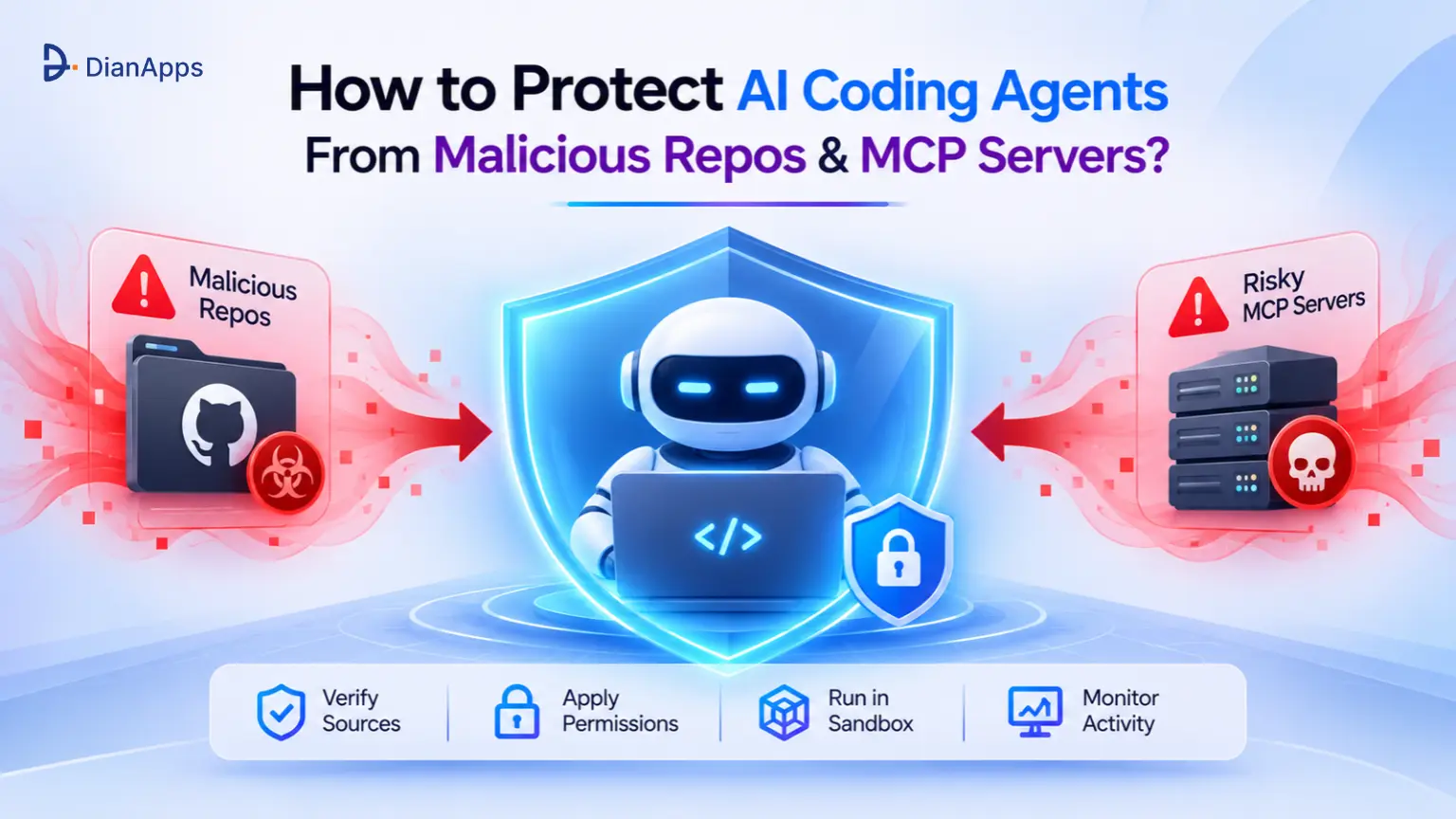
Securing AI coding agents requires shifting from prompt-level trust to deterministic runtime enforcement across five layers: execution sandboxing, search/domain filtering, private dependency proxies, vetted MCP registries, and full context logging.
1. Isolate Agent Execution in Ephemeral Sandboxes
Never allow an AI coding agent to execute shell commands, package installs, or test suites directly on a developer’s primary laptop or a shared build server with production credentials.
-
Enforce MicroVM or Container Isolation: Run agent terminals inside ephemeral Docker containers, Firecracker microVMs, or cloud workspaces (such as GitHub Codespaces or isolated DevContainers) with zero access to host SSH keys,
~/.awscredentials, or browser cookie stores. -
Restrict Egress Networking: Block outbound network connections from the agent sandbox by default, allowing traffic only to approved package registries, Git hosts, and staging APIs.
2. Add a Domain-Age & Reputation Gate Before the LLM Reads Search Results
Do not feed raw search API responses directly into your agent’s context window. Build a lightweight middleware filter between your search API (such as Firecrawl or Tavily) and your agent orchestrator:
-
Check Domain Registration Age (With Caching): Flag or block domains registered within the past 90 days or domains that recently underwent ownership/nameserver changes (which catches lapsed-domain takeovers). Engineering trade-off: Performing live WHOIS/RDAP lookups synchronously on every search result adds 150–400 ms of latency per URL and risks rate-limiting. Cache domain-age verdicts in Redis with a 24-hour TTL and pre-populate an allowlist of official vendor documentation domains (React, Next.js, Python, AWS, Kubernetes) so trusted docs bypass external lookups entirely.
-
Quarantine Pipe-to-Shell Patterns: Use AST and regex pre-filters to flag high-risk shell patterns (
curl ... | sh,wget ... | bash,iex (iwr ...), Base64-encoded PowerShell payloads) before they reach the model’s reasoning loop stripping only the raw execution block while preserving surrounding troubleshooting context so legitimate CLI tutorials remain readable.
Recommended Read- AI Agents vs RPA vs Traditional Automation
3. Lock Down Package Managers & Internal Registries
Prevent hallucination squatting and typosquatted dependencies by removing direct public internet install rights from autonomous agents:
-
Route Through Private Artifact Proxies: Force
npm,pip,cargo, andgoinside agent environments to pull exclusively through a private registry proxy (such as JFrog Artifactory, Sonatype Nexus, or AWS CodeArtifact) configured with a minimum package age rule (blocking packages published less than 14 days ago) and automated malware scanning. -
Require Human Approval for New Dependencies: Allow agents to edit application code freely, but trigger a mandatory human sign-off whenever
package.json,requirements.txt,Cargo.toml, orDockerfilechanges.
4. Govern MCP Servers With Scoped OAuth & Allowlists
As teams connect coding agents to databases, issue trackers, and deployment pipelines via Model Context Protocol (MCP), unvetted MCP servers become a major supply-chain risk:
-
Prefer Central HTTP/SSE Gateways Over Local
stdioProcesses: Localstdio-based MCP servers run directly on the developer’s host machine with full user filesystem and environment access, bypassing network firewalls. For enterprise teams, routing agents through centrally hosted HTTP/SSE MCP gateways, an architecture pattern DianApps implements when building custom AI Agent Development Services allows security teams to enforce centralized OAuth scopes, inspect JSON-RPC payloads, and revoke compromised connectors instantly. -
Maintain a Signed Internal MCP Registry: Developers and agents should only connect to internally audited, version-pinned MCP servers never dynamically installing third-party MCP packages discovered via web search.
-
Enforce Short-Lived, Least-Privilege Tokens: Issue task-scoped OAuth tokens with read-only permissions by default, requiring explicit interactive confirmation for destructive tool calls (
DROP,DELETE, production deployments, or external webhooks).
5. Log What Agents Read, Not Just What They Run
Standard terminal audit logs show which command an agent executed, but fail to capture why it executed it.
-
Capture Full Provenance Telemetry: Log every search query, retrieved URL, HTML/Markdown snippet, and MCP tool payload alongside the resulting shell commands. When an anomaly occurs, security teams can trace the exact poisoned webpage or GitHub README that triggered the behavior.
Also Read- AI Agent Architecture: Components, Patterns and a Reference Design
Building Security Into Custom AI Agents: The DianApps Engineering Approach
When organizations move from individual developer copilots to autonomous internal coding agents and automated CI/CD workflows, security guardrails cannot be treated as an afterthought.
At DianApps, our engineering teams build production-grade agent architectures through our AI Development Services combining ephemeral container sandboxes, cached search-sanitization middleware, OAuth-scoped MCP gateways, and human-in-the-loop approval workflows so enterprise teams gain engineering speed without exposing source code or production credentials.
 0 comments








Your email address will not be published. Required fields are marked *