















 0 comments





Key Takeaways:
- Product labels prove very little because marketing teams frequently attach agentic buzzwords to basic chatbots and scripted workflows.
- Rebranded wrappers pass rehearsed demos easily yet break down when APIs fail, inputs conflict, or permissions get tested.
- Per-action permissions, immutable audit trails, approval gates, and spend limits must be demonstrated during the pilot phase.
- Deterministic automation and basic assistants remain cheaper and safer choices whenever tasks follow fixed, predictable rules.
- True platform control requires inspecting orchestration logic, exporting evaluation traces, and adding custom internal business tools.
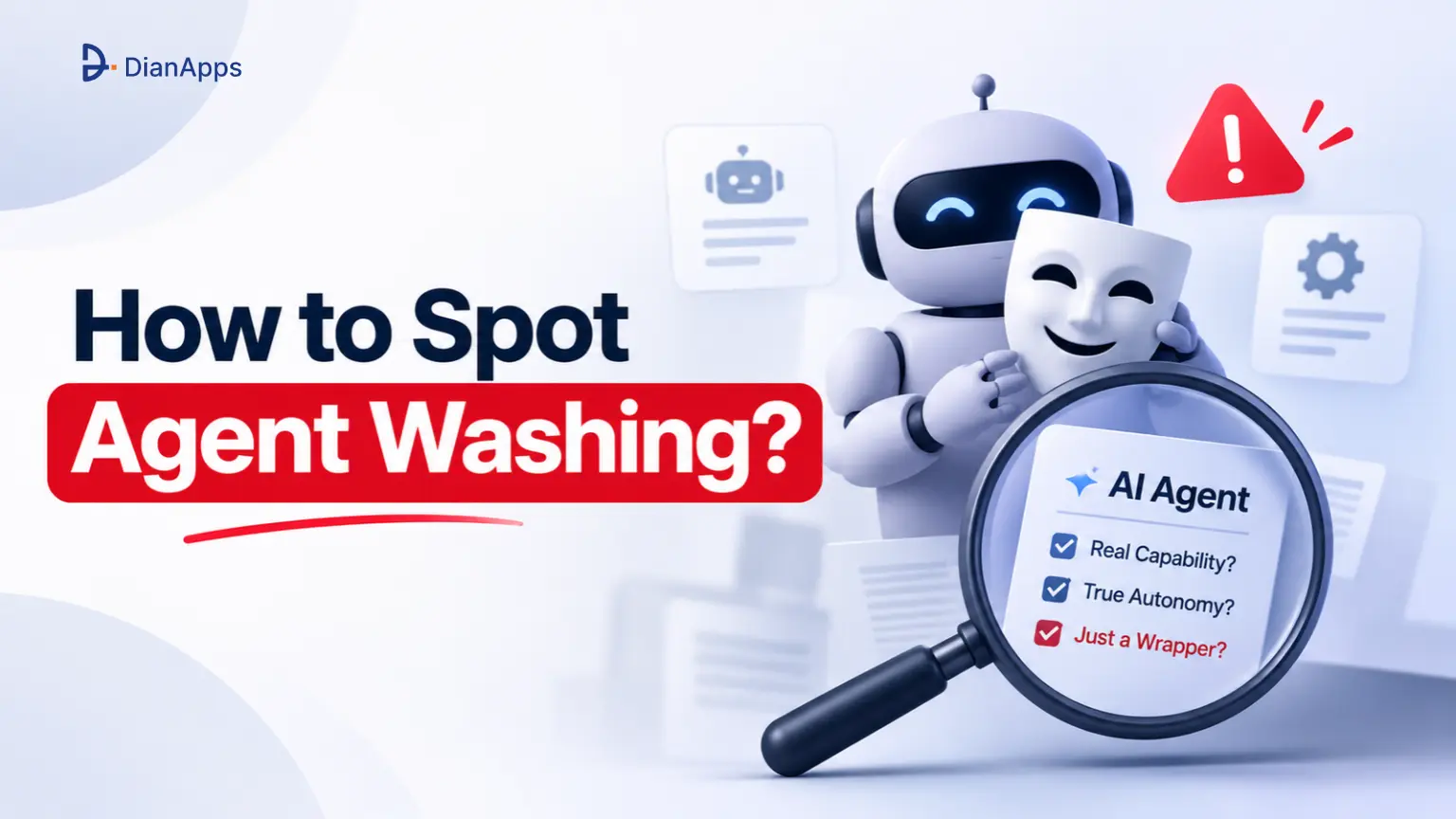
Quick Answer: Agent washing is the vendor practice of rebranding basic chatbots, prompt wrappers, or robotic process automation scripts as autonomous AI agents. CTOs and buyers can spot agent washing by testing whether a system selects tools dynamically at runtime, preserves durable task state across steps, recovers from partial API failures, enforces scoped permissions, and logs every action outside the model’s reach.
Visualize yourself sitting through a vendor pitch where an autonomous assistant resolves a customer refund in seconds, only to watch it crash on your first messy support ticket during testing. That exact gap between polished demos and live reality is why agent washing has become a major budget trap for enterprise buyers. According to Gartner, only about 130 of the thousands of agentic AI vendors offer genuine agent capabilities, while over 40% of agentic projects face cancellation by 2027.
This guide walks through seven red flags, a technical comparison table, and a stress-test checklist for evaluating Model Context Protocol and architecture. Mastering how to spot agent washing protects engineering teams from paying agent prices for fragile software wrappers.
What Is Agent Washing in Enterprise AI?
Agent washing is the marketing practice of relabeling standard chatbots, prompt wrappers, or fixed automation scripts as autonomous AI agents without adding real runtime reasoning or recovery capabilities. While vendors are slapping agentic labels onto legacy software, buyers often inherit brittle workflows that fail under real production conditions.
Why are technology leaders scrutinizing these claims so closely right now? Well, Gartner’s June 2025 forecast warns that rising costs, unclear business value, and weak risk controls will cancel over 40% of agentic AI projects by the end of 2027. In April 2026, Gartner’s standalone Hype Cycle for Agentic AI also placed the category at the Peak of Inflated Expectations and flagged vendor rebranding as a primary market risk. Teams partnering with AI agent development services are cutting through marketing hype by verifying runtime architecture before signing contracts.
What Separates a Real AI Agent From a Script, Chatbot, or Wrapper?
A real AI agent selects tools dynamically at runtime, maintains durable state across multi-step tasks, observes tool outputs, and recovers when individual steps fail. By contrast, a fixed script follows predefined branches, a chatbot generates conversational text, and a prompt wrapper simply forwards user inputs to a language model.
To operate reliably inside enterprise environments, genuine autonomous software must be built around four core engineering properties, resulting in:
- Durable state tracking that lets workflows resume after interruptions without repeating completed database writes.
- Complete run observability capturing inputs, retrieved records, tool parameters, and final outcomes in replayable logs.
- Rollback and compensation logic that undoes partial changes whenever a downstream API call fails mid-task.
- Strict runtime guardrails enforcing scoped permissions, human approval gates, step ceilings, and daily spend caps.
These four capabilities are helping engineering leaders separate adaptive agents from static scripts. Deterministic automation still works well for predictable tasks, yet paying agent prices for a hidden script creates unnecessary cost and operational risk.
How Do You Spot Agent Washing in Vendor Demos and RFPs?
You can spot agent washing in demos and RFPs by testing how the system reacts when business rules change live, inputs contain conflicting data, or downstream APIs fail mid-run. Rebranded wrappers rely on rehearsed happy paths and lack durable state, scoped permissions, or exportable execution traces.
Seven recurring warning signs expose disguised chatbots and scripts during vendor evaluations, let’s take a look.
1. Hardcoded Decision Trees Presented As Reasoning
Rehearsed demos look intelligent because the vendor already knows which workflow branch will execute. When a live business rule like a refund threshold changes during the meeting, rebranded tools require manual flowchart edits. Buyers should request an execution trace showing which alternative tools were evaluated and why one path was chosen.
2. Single-Prompt Demos That Collapse On Messy Edge Cases
Clean sample inputs hide how easily a thin prompt wrapper breaks under real operational noise. Testing the pilot with contradictory support tickets, incomplete invoices, or long multi-reply email threads quickly reveals brittle parsing. Rebranded chatbots hold up on curated scripts and stumble on everyday customer variations.
3. No Recovery From Partial Tool Failures
Production APIs regularly time out, return error codes, and leave half-written records behind. Disabling a downstream endpoint mid-run shows whether the system retries safely with idempotent calls, compensates for earlier steps, or falsely reports success. A wrapper that claims a task finished after a failed database write creates severe data corruption risks.
Audit Your Vendor’s Agent Architecture
Have our engineers inspect vendor demos, tool failure handling, and orchestration depth before you sign.
4. Missing Task State Beyond The Chat Window
Enterprise workflows frequently span several hours, wait on manager approvals, and coordinate updates across multiple internal platforms. If restarting a background process forces the employee to re-enter the original prompt, state only lives inside chat history. Genuine workflow agents checkpoint progress persistently so tasks resume cleanly from the last completed step.
5. Missing Permission Boundaries And Audit Trails
Security reviewers must verify whether the agent runs under its own scoped identity or a shared administrator key. Whether teams are automating internal tickets or scaling agentic commerce workflows, every tool call must respect the requesting user’s exact permissions. Vague claims about enterprise security usually hide missing approval logs and unmonitored data access.
6. Autonomy Without Approval Tiers Or Spend Caps
Autonomous software needs clear boundaries defining when actions require human sign-off before execution. Buyers should inspect whether high-impact writes, external emails, and financial refunds are gated behind parameter-bound approvals. Without hard ceilings on execution steps, tool calls, and token spend, a stuck loop can drain monthly budgets in minutes.
7. Vendor Lock-In That Blocks Custom Logic
Closed platforms that prevent teams from adding custom APIs, swapping foundation models, or exporting evaluation traces create steep switching risks. Engineering leaders should confirm on day one how prompts, test datasets, and run logs are exported. Teams comparing proprietary platforms with open-source agent frameworks prioritize transparent orchestration over black-box licensing.
How Does an Agent-Washed Wrapper Compare to Production Agent Architecture?
An agent-washed wrapper runs linear prompts inside a single chat session with shared credentials, minimal error handling, and locked vendor orchestration. A true production agent architecture uses checkpointed state, runtime tool selection, idempotent retries, scoped agent identities, and bounded execution costs.
Comparing both architectures side by side clarifies what engineering teams actually receive before approving a contract, let’s break it down.
| Dimension | Agent-Washed Wrapper | True Production Agent Architecture |
| Workflow and state handling | Linear script or single prompt where state lives in chat history and restarts force users to begin again. | Durable task state with checkpoints so runs resume after interruption without repeating side effects. |
| Tool use and error recovery | Fixed tool order where failures halt execution silently or duplicate database writes during retries. | Runtime tool selection with timeouts, idempotent retries, compensating actions, and human escalation. |
| Security and auditability | Shared service token with logs capturing only chat text and no parameter-bound approval gates. | Distinct agent identity with scoped credentials, per-action permission checks, and immutable run traces. |
| Customization and system fit | Closed orchestration offering read-only SaaS connectors where custom logic requires vendor tickets. | Open tool interfaces for legacy APIs and scoped write-backs with portable models, prompts, and evals. |
| Scaling and total cost risk | Low demo cost followed by unpredictable per-token bills, manual exception handling, and lock-in fees. | Higher upfront engineering balanced by hard step caps, observable task costs, and portable components. |
Note: Architecture comparison reflects the DianApps engineering evaluation framework, informed by Gartner’s published distinction between scripted automation, assistants, and agentic systems.
Validate Your Agent Governance Controls
Talk with our architects about scoped agent identities, approval gates, and spend limits.
How Do You Stress-Test AI Agents Before Committing a Budget?
You stress-test AI agents before committing budget by running time-boxed pilots on messy historical company data, injecting mid-run API failures, probing low-privilege user permissions, and measuring total cost per completed task. Requiring documented pass criteria prevents vendors from hiding weaknesses behind curated demos.
At DianApps, our engineering teams run five practical verification drills across both vendor pilots and internal prototypes, resulting in:
Building An Adversarial Test Set From Real Company Data
Engineering teams should pull dozens of historical tickets, invoices, or claims containing missing fields and conflicting instructions. Hostile prompt-injection text should also be embedded inside test documents to verify whether the agent ignores untrusted instructions. Scoring runs against pre-written outcome rules ensures vendors cannot tune prompts around known answers.
Running Tool Failure And Rollback Drills
Reviewers must simulate real production outages by timing out APIs and cutting connections after partial writes. The system should retry safely, execute compensating rollbacks, or escalate clearly without reporting false completion. Teams building with lightweight agent SDKs also verify checkpoint recovery and measure how fast kill switches halt active runs.
Verifying Permission Boundaries And Audit Trails
Pilots must be tested using low-privilege employee accounts requesting restricted files and cross-department records. Auditors should inspect whether the agent operates under a dedicated identity whose logs and backups sit outside model write access. Picking a random test run and reconstructing every tool call from logs proves real observability.
Modeling Total Cost Of Ownership Per Completed Task
True production cost includes model tokens, retry overhead, evaluation runs, monitoring infrastructure, and human review of escalated exceptions. Calculating cost per completed task across both successful and failed runs exposes hidden unit-economics flaws early. Buyers should also request pricing protections before usage scales across departments.
Defining Pilot Pass Marks And Exit Criteria Upfront
Written pass thresholds, data ownership terms, and walk-away conditions must be agreed upon before testing starts. When evaluating platforms versus custom AI agents, teams retain full ownership of evaluation datasets and orchestration logic. For rigid, rule-based back-office tasks, proven RPA use cases often deliver lower cost and simpler audits.
Scope a Custom Auditable AI Agent
Partner with DianApps to build transparent, governed workflows tailored to your internal systems.
Conclusion
Spotting agent washing early saves engineering organizations from locking critical workflows into fragile chatbots and overpriced prompt wrappers. When leaders verify runtime tool selection, checkpointed state, scoped identities, approval gates, and failure recovery before signing contracts, autonomous software scales safely across production systems.
DianApps, a mobile and AI app development company with 150+ engineers, 450+ clients served across 25+ countries, and a 4.8/5 Clutch rating across 81+ reviews, builds auditable agent architectures across web, mobile, and enterprise platforms. Our engineers design custom orchestration layers, scoped permissions, and evaluation pipelines alongside your internal team, much like our approach to AWS AI and machine learning consulting.
If you are ready to move past vendor hype and deploy governed automation, partner with our AI development services team to architect transparent agents from day one.
 0 comments











Your email address will not be published. Required fields are marked *