













 0 comments
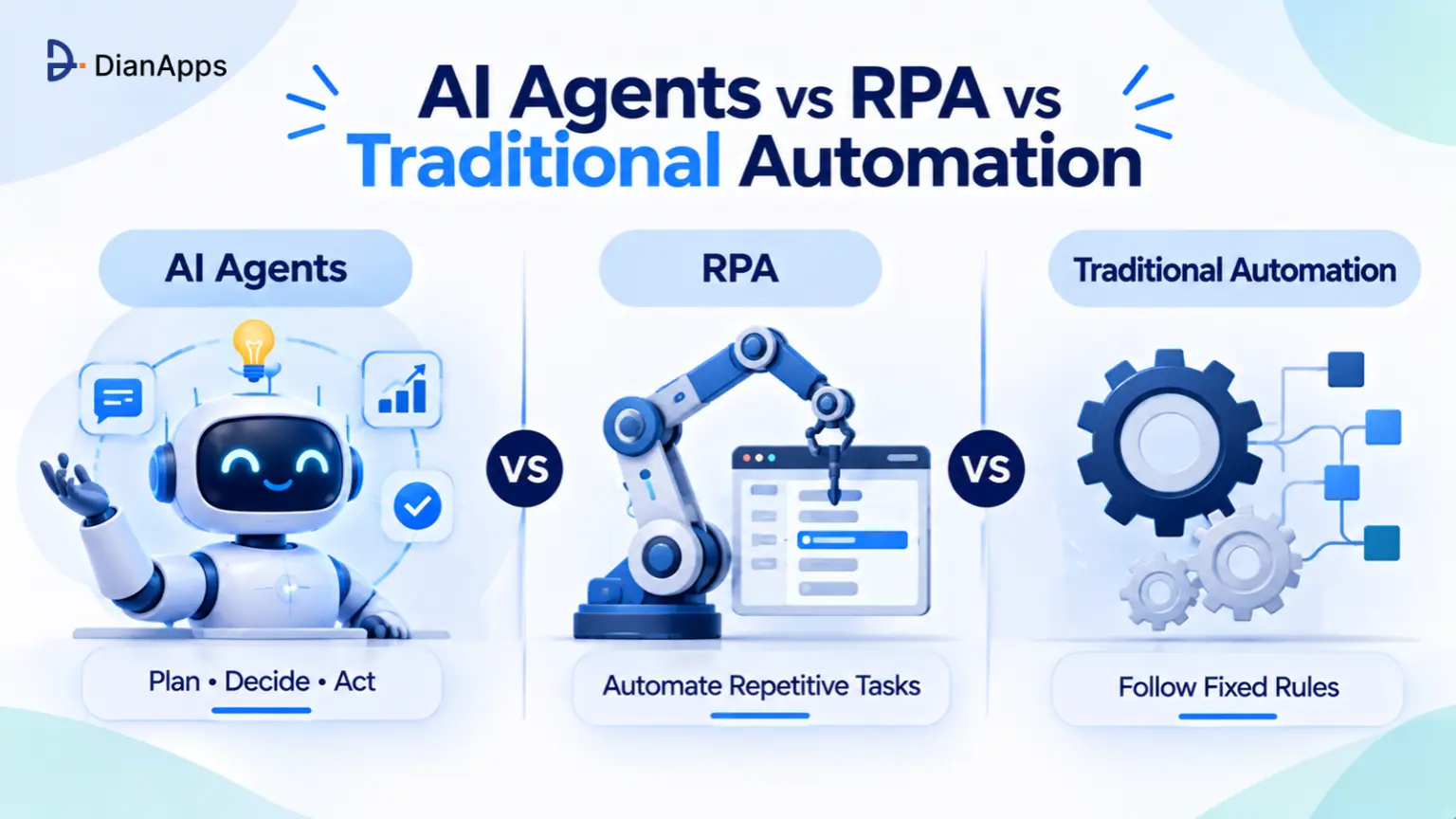





Quick answer: Use traditional automation (scripts, APIs, workflow engines) when the process is fixed and the systems expose clean interfaces. Use RPA when you must drive a legacy UI with stable, rule-based steps. Use AI agents when the work involves unstructured inputs, judgment calls, or frequent exceptions. Most enterprises in 2026 run all three, with agents deciding and bots executing.
Every major RPA vendor spent 2025 repositioning around agents. UiPath launched Agent Builder and Maestro, Automation Anywhere acquired Aisera, and Microsoft rebuilt Power Automate around agentic workflows. At the same time, Gartner predicts more than 40% of agentic AI projects will be canceled by the end of 2027 because of rising costs, unclear value, or weak risk controls.
So the real question for operations and IT leaders is not which technology wins. It is which layer each process belongs in, and how to move the right workflows off brittle bots without breaking what already works. This guide covers both, using what analysts, vendors, and practitioners on Reddit are actually saying.
Key Takeaways
- RPA vs AI agents in one line: RPA follows a script; an AI agent pursues a goal and decides the steps.
- Traditional automation (APIs, scripts, workflow engines) is still the cheapest and most predictable choice for stable, API-connected processes.
- RPA is not dead. It is narrowing into the execution layer for legacy user interfaces that have no API.
- AI agents fit processes with unstructured inputs, frequent exceptions, or judgment calls, such as email triage, document intake, and case resolution.
- The 2026 default is hybrid: agents interpret and decide, while bots and APIs execute and stay auditable.
- Migration is augmentation, not rip-and-replace. Classify every bot as keep, modernize, migrate, or retire, then pilot one workflow in shadow mode.
- Governance decides success. Gartner expects over 40% of agentic AI projects to be canceled by 2027, mostly from unclear value and weak risk controls.
Read More- How to Build an AI Agent: Step-by-Step Guide for Businesses
AI Agents vs RPA: Key Statistics for 2026
Agent adoption is accelerating fast, but most organizations are still early and many projects stall before production. RPA spending keeps growing too, as vendors repackage it as the execution layer for agents.
| Statistic | Figure | Source |
|---|---|---|
| Enterprise apps with task-specific AI agents | 40% by end of 2026, up from under 5% in 2025 | Gartner, Aug 2025 |
| Agentic AI projects expected to be canceled | Over 40% by end of 2027 | Gartner, Jun 2025 |
| Vendors offering genuine agentic AI | About 130 of thousands claiming it | Gartner, Jun 2025 |
| Organizations with significant agentic AI investment | 19% (42% conservative, 8% none, 31% wait-and-see; 3,412 respondents) | Gartner poll, Jan 2025 |
| Day-to-day work decisions made autonomously | 15% by 2028, up from 0% in 2024 | Gartner, Jun 2025 |
| Enterprise software including agentic AI | 33% by 2028, up from under 1% in 2024 | Gartner, Jun 2025 |
| Agentic AI share of enterprise app software revenue | ~30% by 2035 (over $450B) in Gartner’s best case | Gartner, Aug 2025 |
| Organizations expecting moderate or greater agent use | 74% by 2027; about 80% lack mature agent governance | Deloitte |
| RPA users with broken automations weekly | 69% | Robocorp survey (via TechCrunch) |
| Global RPA market | $4.68B (2025) to $35.84B (2033), 29.0% CAGR | Grand View Research |
| Enterprises that scaled early RPA programs | About 13% | Gartner 2019 (via TechTarget) |
RPA market estimates vary widely, from about $3.6B to $22.6B for 2025, because research firms define the category differently. Quote one source consistently rather than mixing figures.
Ready to build AI Automation?
DianApps, a mobile and AI app development company, is designing and building AI follow-up, scheduling and voice agents that are connecting with your CRM, MLS and calendar, so each and every inquiry is getting a reply within seconds, day or night.
What Are Traditional Automation, RPA, and AI Agents?
Traditional automation and RPA execute predefined steps; AI agents pursue a goal and decide the steps. That single difference determines cost, reliability, and which processes each one should own.
Traditional automation
Traditional automation is any deterministic logic that runs a fixed sequence: scheduled scripts, API integrations, ETL jobs, iPaaS flows, BPM and workflow engines, and ERP batch jobs. It is the cheapest, fastest, and most auditable option when systems expose clean APIs and the rules never change. Its weakness is that every new scenario needs a developer to code it.
Robotic Process Automation (RPA)
RPA uses software bots that mimic a person clicking through a user interface, typically in tools such as UiPath, Automation Anywhere, Blue Prism, or Power Automate. RPA earned its place by connecting legacy applications that have no API, without touching core systems. Classic RPA uses no machine learning; it is scripted. That is also why it is brittle: bots depend on UI selectors, so a renamed button or a layout change can stop a workflow. A Robocorp survey found that 69% of organizations using RPA experience broken automations at least once a week.
AI agents (agentic AI)
An AI agent uses a large language model to interpret a goal, plan steps, call tools (APIs, databases, RPA bots), and adjust when conditions change. Agents read unstructured inputs such as emails, PDFs, chats, and images, and they can handle exceptions a rule list never anticipated. The trade-off is that their behavior is probabilistic, so they need guardrails, observability, and human approval for high-stakes actions.
A useful mental model from IBM Consulting: RPA executes decisions; agents decide what should happen.
How AI Agents Relate to Other Automation Terms?
Most automation buzzwords describe a combination of the same three building blocks: deterministic logic, RPA, and AI. Knowing which block each term adds makes vendor claims easier to evaluate.
| Term | What it means | How it relates to AI agents |
|---|---|---|
| Intelligent automation (IA) / intelligent process automation (IPA) | RPA combined with AI such as OCR, NLP, and machine learning | AI assists the bot inside fixed steps; the bot still follows a script |
| Hyperautomation | Gartner’s 2019 term for a business-driven approach to automate as many processes as possible by combining RPA, AI, process mining, iBPMS, iPaaS, and low-code | A strategy, not a product; agents are now one of its components |
| Intelligent document processing (IDP) | AI extraction and classification of data from documents | Often a tool an agent calls; LLMs now handle many layouts without templates |
| Agentic process automation (APA) | Vendor term for agents, bots, APIs, and humans orchestrated in one workflow | The hybrid model described in this guide |
| Workflow automation (Zapier, Make, n8n) | Trigger-action flows across SaaS apps | Deterministic like traditional automation; many now add AI steps or agent nodes |
| Agentic workflow | A fixed workflow in which some steps call an LLM to classify, extract, or draft | Sits between automation and agents: the path is fixed, but individual steps reason |
| Chatbot | Conversational interface that answers or routes questions | Responds to a person; an agent pursues a goal and takes actions across systems |
| AI copilot / assistant | AI embedded in an app that suggests and drafts for a user | Assists a human who acts; an agent acts itself within guardrails |
| Computer-use agent | An AI agent that operates software through the screen like a person | A possible successor to UI-based RPA, but slower and costlier per action than APIs |
| Multi-agent system | Several specialized agents coordinated by an orchestrator | The architecture most enterprise agent platforms use for end-to-end processes |
A simple test for any “agent” claim: who decides the next step? If a human or a fixed rule decides, it is automation or an assistant. If the model decides within guardrails, it is an agent.
AI Agents vs RPA vs Traditional Automation: Side-by-Side Comparison
Traditional automation wins on cost and predictability, RPA wins on reaching legacy UIs without APIs, and AI agents win on unstructured data and exceptions. The table below compares them on the dimensions that decide which one a process belongs to.
| Dimension | Traditional automation | RPA | AI agents |
|---|---|---|---|
| How it works | Code, APIs, workflow rules | Bots replay UI clicks and keystrokes | LLM plans steps and calls tools toward a goal |
| Input data | Structured only | Structured, fixed-format screens and files | Structured and unstructured (email, PDF, chat, images) |
| Decision-making | If-then rules | If-then rules | Contextual reasoning within guardrails |
| Handling exceptions | Fails or routes to a human | Fails or routes to a human | Attempts resolution, escalates with reasoning |
| Change tolerance | Breaks when APIs or rules change | Breaks when UI selectors change | Adapts to minor UI and format changes |
| Predictability and audit | Fully deterministic | Fully deterministic | Probabilistic; needs logging, evals, approvals |
| Typical build effort | Developer-heavy per scenario | Analyst-friendly, low-code | Prompt, tool, and guardrail design; evaluation |
| Running cost model | Compute, near-zero marginal | Bot licenses and VMs | Model tokens plus platform fees |
| Best for | Stable, API-connected, high-volume flows | Legacy apps with no API, stable steps | Judgment-heavy, document- and language-heavy work |
One nuance practitioners raise often: an agent that is 85% accurate per step completes a 10-step chain only about 20% of the time, because errors compound. That is why production agents are usually kept to short, scoped tasks, with deterministic steps handling the rest.
Read More- AI Agents vs Agentic AI vs Generative AI: What’s the Difference?
Worked Example: Invoice Processing Three Ways
The same accounts payable process shows where each approach succeeds and where it breaks. Traditional automation handles clean e-invoices, RPA handles a fixed-format portal, and an agent handles the messy variety in between.
Scenario: A company receives 5,000 supplier invoices a month. 40% arrive as structured e-invoices, 35% as PDFs in many layouts, and 25% as email bodies or scans, some with missing PO numbers.
| Step | Traditional automation | RPA | AI agent (hybrid) |
|---|---|---|---|
| Receive invoice | API or EDI feed picks up e-invoices only | Bot downloads PDFs from a supplier portal on a schedule | Agent monitors the AP inbox, portal, and feeds |
| Extract data | Reads structured fields | Template OCR per supplier layout; new layouts fail | LLM extraction across layouts, with confidence scores |
| Match to PO | Exact-match rule | Exact-match rule through ERP screens | Fuzzy match, finds missing PO numbers from context, flags partial deliveries |
| Handle exceptions | Route everything else to a person | Route everything else to a person | Emails the supplier for missing data, drafts a dispute, or escalates with a summary |
| Post to ERP | API call | Bot types into the ERP screen | Calls the existing API or RPA bot to post |
| Approve payment | Rule-based threshold | Rule-based threshold | Rule-based threshold plus human approval above a set amount |
| Straight-through coverage | ~40% (structured only) | ~40–60%, falling as layouts change | Highest, limited by the exception policy you set |
The coverage figures are illustrative, not benchmarks. The pattern is the point: the agent extends automation into the 60% of invoices that rules cannot handle, while the deterministic posting and payment steps stay unchanged.
When to Use Each: A Practical Decision Framework?
Choose by the process, not the tool: stable and API-ready goes to traditional automation, stable but UI-only goes to RPA, and variable or judgment-heavy goes to AI agents. If a workflow needs a human judgment call more than once a week, it is an agent candidate.
Ask four questions about each process, in this order:
- Are the inputs structured? If every input arrives in a fixed format, stay deterministic. If inputs are emails, scanned documents, or free text, an agent is likely needed for at least the interpretation step.
- Do the target systems have APIs? If yes, use API-based traditional automation; it is faster and far less brittle than RPA. If the only way in is the UI of a legacy app, RPA (or an agent with computer-use ability) is the bridge.
- How often do exceptions occur? Low exception rates suit rules. If staff spend hours each week clearing an exception queue, that queue is the best place to start with agents.
- What does an error cost? For irreversible, regulated actions such as payments, filings, and payroll, keep the final step deterministic and add human approval, even if an agent prepares the work.
Read More- AI Agent Use Cases: 25 Real Examples Across Industries
Best-fit use cases
| Choose | Typical processes |
|---|---|
| Traditional automation | Nightly ERP-to-data-warehouse syncs, order status webhooks, report generation, user provisioning via APIs |
| RPA | Copying data between legacy desktop apps, mainframe screen entry, portal uploads with no API, scheduled reconciliations with fixed formats |
| AI agents | Email triage and response drafting, invoice and claims intake from PDFs, customer onboarding with varied documents, IT and HR ticket resolution, exception handling across systems |
| Hybrid (agent + bot) | Accounts payable, insurance claims, logistics exception management, KYC and onboarding, procure-to-pay |
AI Agents vs RPA by Industry: Use Cases
In every industry, RPA keeps the high-volume structured transactions while AI agents take the document-heavy and judgment-heavy work around them. The split below shows where each typically fits.
| Industry | Keep on RPA / traditional automation | Move to AI agents |
|---|---|---|
| Banking and financial services | Account opening data entry, statement reconciliation, regulatory report generation | KYC document review, fraud alert triage, loan file completeness checks, customer dispute handling |
| Insurance | Policy issuance, premium posting, renewals | First notice of loss intake from emails and photos, claims triage, subrogation research |
| Healthcare | Eligibility checks, claims submission, appointment reminders | Prior authorization packets, clinical document summarization for coders, denial appeals drafting |
| Logistics and supply chain | Shipment status updates, EDI processing, rate table uploads | Freight invoice audit, exception management for delays, carrier email handling, customs document review |
| Retail and e-commerce | Order sync, inventory updates, price feeds | Customer service resolution, returns and refund decisions, supplier onboarding |
| HR | Payroll inputs, onboarding account creation | Candidate screening summaries, employee query resolution, policy Q&A |
| IT operations | Scheduled jobs, user provisioning via APIs | Ticket triage and resolution, incident summarization, root-cause research |
| Finance and accounting | Journal postings, bank feeds, intercompany matching | Invoice exception handling, expense audit, month-end variance explanations |
Regulated steps such as payments, policy binding, and clinical decisions should keep a deterministic or human-approved final action, whichever layer prepares the work.
Are you ready to move from bots to AI Agents?
DianApps, a mobile and AI app development company, is designing and building AI follow-up, scheduling and ai agents that are connecting with your CRM, MLS and calendar, so each and every inquiry is getting a reply within seconds, day or night.
The Hybrid Model: AI Agents Orchestrating RPA Bots
The most common 2026 architecture layers AI agents on top of existing automation instead of replacing it. Agents interpret inputs and decide; RPA bots and APIs execute the deterministic, auditable steps.
Think of the stack as three layers:
- Reasoning layer (AI agents): reads the email or PDF, classifies intent, extracts fields, decides the next action, and escalates edge cases.
- Execution layer (RPA bots, APIs, workflow engines): performs the system updates exactly as specified, with the same audit trail you have today.
- Governance layer: identity and access controls, human approval for high-stakes actions, logging of every agent decision, and evaluation of agent accuracy over time.
In practice, an existing bot becomes a tool the agent can call. For example, an accounts payable agent reads an invoice in any format, matches it to the purchase order, and flags anomalies. It then hands clean, structured data to the existing RPA bot that posts the invoice in SAP, with payment release still governed by fixed approval thresholds.
The RPA vendors have moved this way too. UiPath Maestro coordinates agents and bots in one workflow, and Forrester’s Craig Le Clair has argued that RPA platforms already have the architecture to manage thousands of automations, which makes them natural control points for agents. The practical result: your RPA investment is not wasted; it becomes the agent’s hands.
Platform Landscape: Where RPA Vendors and Agent Frameworks Fit
Every major RPA vendor now sells an agentic orchestration layer, so existing RPA customers can add agents without changing platforms. Custom agent frameworks suit teams that need full control or are building agents into their own products.
RPA vendors’ agentic platforms (2026)
| Vendor | Agentic offering | Typical fit |
|---|---|---|
| UiPath | Agent Builder, plus Maestro to orchestrate robots, people, and agents in one process | Broad enterprise estates already on UiPath |
| Automation Anywhere | Agentic Process Automation platform; Agent Studio exposes existing bots as tools for LLMs; acquired Aisera | Cloud-first enterprises scaling bots, documents, and agents |
| SS&C Blue Prism | WorkHQ (launched April 2026) to coordinate AI agents, software robots, and people | Regulated, governance-heavy industries such as banking |
| Microsoft Power Automate | Agentic workflows with Copilot Studio and AI Builder; desktop flows for RPA | Organizations standardized on Microsoft 365 |
Custom agent stacks
Teams building their own agents typically combine an LLM with an orchestration framework such as LangGraph, CrewAI, or AutoGen, plus tool connections to internal systems. The Model Context Protocol (MCP) has become the common standard for exposing APIs, databases, and even existing automations as tools an agent can call with scoped permissions.
Buy or build? Extend your RPA vendor’s agent layer when most processes already run there and governance is centralized. Build custom agents, usually with an AI agent development services partner, when the workflow is core to your product, spans systems your RPA vendor does not reach, or needs specific models, data residency, or cost control.
How to Migrate from RPA to AI Agents: A 6-Step Roadmap
Migrate by augmentation, not rip-and-replace: audit your bots, sort them into keep, modernize, migrate, or retire, then prove one agent pilot in shadow mode before scaling. Stable bots stay; brittle, exception-heavy ones move first.
- Audit the automation estate. List every bot and scripted flow with its owner, systems touched, run volume, failure rate, maintenance hours, and input types. Flag any bot that needs manual intervention more than once every 20 runs or fails more than 5% of the time.
- Classify each automation.
- Keep: stable, structured, high-volume bots that rarely break.
- Modernize: bots that should call APIs instead of the UI, or need OCR and document processing added.
- Migrate: workflows full of unstructured inputs, exceptions, or judgment calls.
- Retire: bots whose value no longer covers their upkeep.
- Score and pick one pilot. Rank migration candidates on value, complexity, risk, data readiness, and economics. Good first pilots: invoice intake, claims intake, customer or employee onboarding, and support ticket triage.
- Design the control model before building. Define what the agent may decide alone, which actions need human approval, which tools and data it can access, and how every action is logged. Start the agent with read-only permissions.
- Run in shadow mode, then cut over. Let the agent process live work in parallel with the existing bot or team, compare accuracy, cycle time, and exception rates, and switch over only when it beats the baseline.
- Scale through a center of excellence. Turn your RPA CoE into an automation CoE that owns reusable tools, prompt and policy libraries, evaluation tests, observability, and cost monitoring.
Most teams find the migration is led by the same business analysts who ran the RPA program, because the core skill is still process mapping. What changes is that they describe rules and outcomes in plain language instead of scripting every branch.
How long does an RPA-to-agent migration take?
Timelines depend on estate size and data readiness. The ranges below are typical planning assumptions, not benchmarks:
| Phase | Typical duration | Output |
|---|---|---|
| Audit and classification | 2–4 weeks | Bot inventory with keep, modernize, migrate, retire decisions |
| Pilot design and controls | 2–4 weeks | Control model, success metrics, baseline |
| Pilot build and shadow run | 6–12 weeks | Agent running in parallel with measured results |
| Cutover and first scale wave | 1–3 months | 3–5 workflows in production |
| Ongoing CoE scaling | Continuous | Reusable tools, policies, evaluations |
Team and skills
- Process owner: defines outcomes, exception policy, and approval thresholds.
- Automation or RPA developer: reuses bots as tools and builds API integrations.
- AI engineer: designs prompts, tool schemas, retrieval, and evaluation tests.
- Security and compliance lead: sets permissions, logging, and data handling rules.
- Business analyst: maps the process and documents edge cases.
KPIs to measure before and after
| KPI | What it shows |
|---|---|
| Straight-through processing rate | Share of cases completed with no human touch |
| Exception rate and exception handling time | Whether the agent is actually absorbing the hard cases |
| Accuracy or error rate versus human baseline | Quality, measured on a sampled audit |
| Cycle time per case | Speed from intake to completion |
| Bot breakages and maintenance hours per month | The fragility tax you are removing |
| Cost per transaction (licenses, tokens, people) | True unit economics |
| Human escalation rate and override rate | Trust and calibration of the agent |
Costs, Risks, and Governance
AI agents shift spending from bot licenses and break-fix maintenance to model usage and governance. They can lower total cost of ownership, but only when the use case is chosen for clear ROI and controls are designed in from day one.
Read More- AI Agent Development Cost: Pricing Breakdown by Use Case
What the cost comparisons say?
- Maintenance: vendor estimates put annual RPA maintenance at 15–30% of initial build cost, versus roughly 5–15% for agent-based automation. These figures come from automation vendors, so treat them as directional and measure your own.
- Cost model: RPA charges for bot licenses and virtual machines whether they are busy or idle. Agents charge per token, so cost scales with volume and complexity. A long reasoning chain on every transaction can cost more than a bot, so keep deterministic steps deterministic.
- Hidden RPA cost: the “fragility tax.” Every UI update in a target system can generate an emergency ticket for the automation team.
What can go wrong with agents?
Gartner predicts over 40% of agentic AI projects will be canceled by the end of 2027, citing escalating costs, unclear business value, and inadequate risk controls. It also warns of “agent washing”: it estimates only about 130 of the thousands of vendors claiming agentic AI offer real agentic capabilities. Practitioners on Reddit’s r/AI_Agents report the same pattern: demos work, production rollouts stall, and some teams have even replaced agents with rules because users trusted predictable errors more than higher but uneven accuracy.
Governance checklist
- Scoped, least-privilege access per agent, tied to a logged service identity
- Human approval for payments, filings, external communications, and data deletion
- Full trace of every agent decision and tool call
- Evaluation tests that run on every prompt, model, or tool change
- Fallback path to the existing bot or a human queue
- Cost limits and alerts per workflow
The governance gap is real: Deloitte reports about 80% of organizations lack mature governance for agentic AI, even as 74% expect to use agents at least moderately by 2027.
Security and Compliance: What Changes When Bots Become Agents
RPA’s main security risks are stored credentials and over-privileged service accounts; agents add prompt injection and excessive agency. Regulation also tightens: EU AI Act high-risk rules now apply from December 2027 for many HR, credit, and critical-infrastructure uses.
New risks agents introduce
- Prompt injection: malicious instructions hidden in an email, document, or web page that the agent reads. It remains the No. 1 risk in the OWASP Top 10 for LLM Applications.
- Excessive agency: an agent with more tools, permissions, or autonomy than the task needs. OWASP moved it from sixth to third in its 2026 list, reflecting the shift to agents that act.
- Agent goal hijack and tool misuse: the first two entries in the OWASP Top 10 for Agentic Applications, released in late 2025.
- Unbounded consumption: runaway loops or retries that burn tokens and budget.
Controls that work
- Separate trusted instructions from untrusted content, and treat model output as untrusted input to validate.
- Give each agent its own identity with least-privilege, task-scoped permissions.
- Keep irreversible actions behind deterministic rules or human approval.
- Log every prompt, tool call, and decision for audit.
- Red-team agents for injection and tool misuse before go-live and after every major change.
Read More- AI Agent Security and Governance: Risks, Guardrails and Controls
EU AI Act dates to plan around
| Obligation | Applies from |
|---|---|
| Prohibited AI practices and AI literacy duties | 2 February 2025 |
| General-purpose AI model obligations | 2 August 2025 |
| Stand-alone high-risk systems (Annex III, e.g. employment, credit scoring, critical infrastructure) | 2 December 2027 (moved from 2 August 2026 by the Digital Omnibus) |
| High-risk AI embedded in regulated products (Annex I) | 2 August 2028 |
If an agent screens candidates, assesses creditworthiness, or supports critical infrastructure in the EU, plan now for risk management, human oversight, logging, and documentation requirements. This is general information, not legal advice.
The Future of Automation: 2027–2029 Trends
Automation is moving from single bots to coordinated multi-agent systems governed from one control plane. RPA will persist as the execution layer, but new automation spend will increasingly start with agents.
- From task agents to agent ecosystems. Gartner expects AI assistants to become task-specific agents in 2026, collaborating agents inside applications in 2027, agent ecosystems across applications by 2028, and multi-agent ecosystems by 2029.
- Agentic front ends. Gartner estimates that by 2028 a third of user experiences will shift from native application screens to agentic interfaces, reducing the need for bots that click through UIs.
- Automation CoEs become agent operations teams. Expect roles focused on agent evaluation, policy design, and cost management alongside bot maintenance.
- Standards-based tool access. Protocols such as MCP make it easier to expose APIs and existing bots as governed tools, which shortens integration work.
- Outcome-based pricing. Vendors are shifting from per-bot licenses toward pricing per task or per outcome, mirroring how agents consume resources.
- Consolidation and agent washing shake-out. With Gartner counting only about 130 genuine agentic vendors, expect acquisitions and failures among tools that only rebrand RPA or chatbots.
- Skills shift. Gartner projects at least 50% of knowledge workers will develop skills to work with, govern, or create AI agents by 2029.
Conclusion: Use All Three, in the Right Layer
Traditional automation, RPA, and AI agents are layers, not rivals. Keep deterministic automation for stable work, use RPA where only a UI exists, and bring in AI agents where inputs vary and judgment is required.
The winning migration strategy is selective. Audit your bots, move the brittle and exception-heavy workflows first, prove value in shadow mode, and keep humans in control of irreversible decisions. Teams that do this avoid becoming part of Gartner’s 40% and turn their RPA estate into the execution layer for intelligent automation.
Planning your move from bots to agents? Our AI agent development services help you audit your existing RPA estate, design a governed hybrid architecture, and launch a measurable pilot without disrupting live operations. Book a free automation assessment
 0 comments







Your email address will not be published. Required fields are marked *