















 0 comments





Key Takeaways:
- Seven of the ten common CRM problems are usually fixable without migration.
- Automation limits, compliance gaps, and hard platform caps can justify switching.
- CRM reconfiguration typically costs $5,000 to $25,000, while migration can exceed $250,000.
- Poor data quality, weak adoption, and broken workflows often follow you to a new CRM.
- Diagnose the root cause before deciding whether to fix, integrate, or replace your CRM.
Quick Answer: You may have outgrown your CRM if automation reaches hard limits, required compliance features are missing, or your platform cannot support your business’s scale. However, spreadsheet workarounds, poor reporting, unreliable forecasting, and rising costs are often fixable through better configuration or integration. Diagnose the problem first because fixing an existing CRM typically costs far less than migrating to a new platform.
Reps keeping a side spreadsheet. Reports that take three days. Automation that fires at the wrong time, or not at all.
These are the familiar symptoms, and every article listing them concludes the same way: you’ve outgrown your CRM; time to switch.
That conclusion is wrong about seven times out of ten, and the reason is that the same symptom can have three completely different causes: a misconfigured system, an isolated one, or a genuinely wrong platform. Each costs a different amount to fix, and getting the diagnosis wrong is expensive.
This guide covers the ten signs and, for each, what it usually indicates.
The Ten Signs, Diagnosed
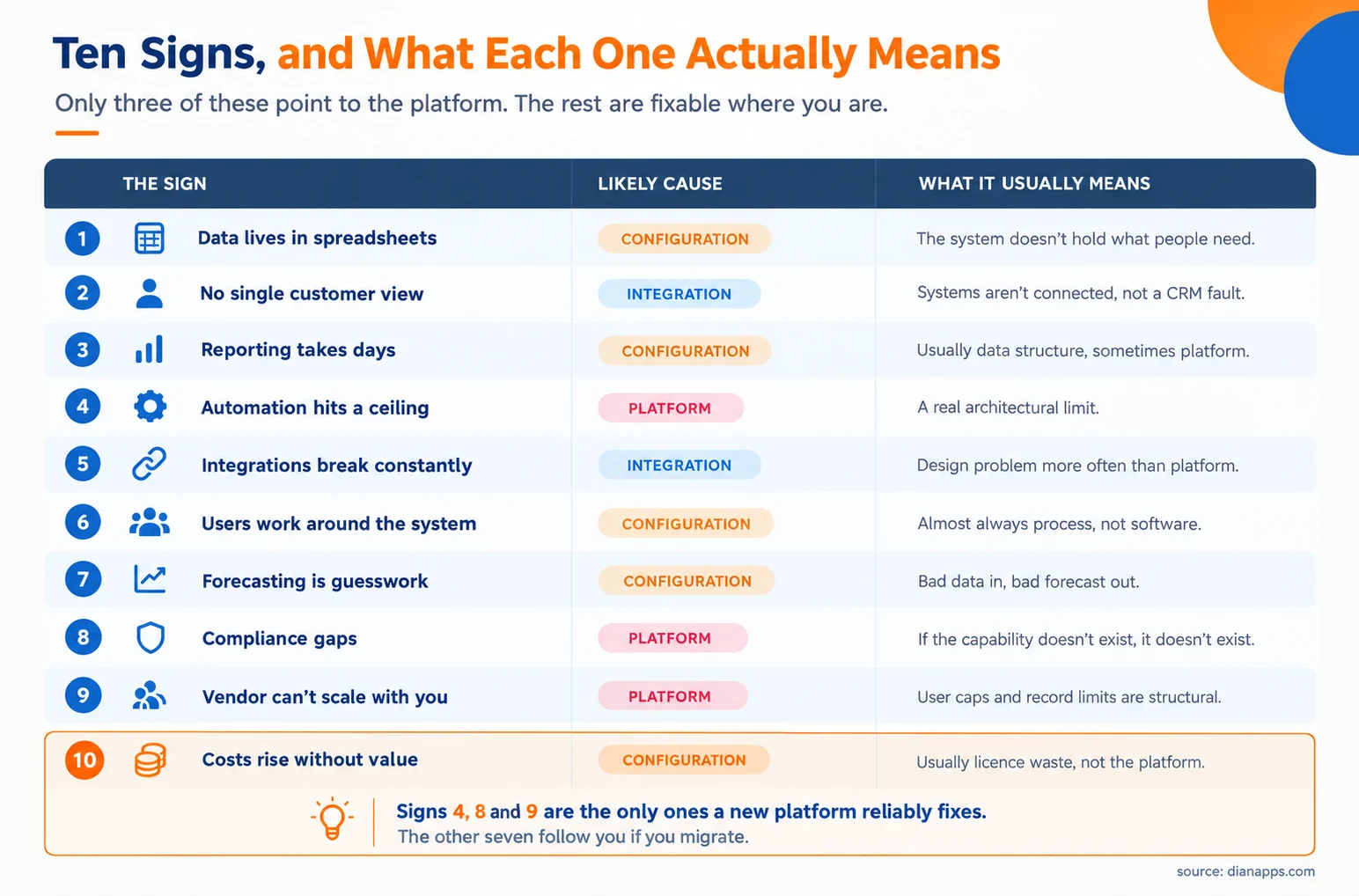
| # | The sign | Likely cause | Fixable in place? |
|---|---|---|---|
| 1 | Data lives in spreadsheets | Configuration | Yes |
| 2 | No single customer view | Integration | Yes |
| 3 | Reporting takes days | Configuration | Usually |
| 4 | Automation hits a ceiling | Platform | No |
| 5 | Integrations break constantly | Integration | Yes |
| 6 | Users work around the system | Configuration | Yes |
| 7 | Forecasting is guesswork | Configuration | Yes |
| 8 | Compliance gaps | Platform | No |
| 9 | Vendor can’t scale with you | Platform | No |
| 10 | Costs rise without value | Configuration | Yes |
Signs 4, 8, and 9 are structural. The rest come with you.
The Seven That Are Usually Fixable
- Data lives in spreadsheets: People export because the system doesn’t hold what they need, or holds it somewhere inconvenient. That’s a fields-and-layout problem. Ask what’s in the spreadsheet that isn’t in the CRM; the answer is almost always a short list.
- No single customer view: Usually your systems aren’t connected rather than your CRM being incapable. Finance, support, and marketing hold pieces, and nobody joined them up. That’s integration work, not a replacement.
- Reporting takes days: Occasionally a genuine platform limit, cross-object reporting is a real ceiling on some systems. More often it’s data structure: inconsistent picklists, records in the wrong place, fields that mean different things to different teams.
- Integrations break constantly. Point-to-point connections built ad hoc break. That’s a design problem, and rebuilding them properly is cheaper than migrating.
- Users work around the system. Almost always process rather than software. Somebody designed a workflow that doesn’t match how people actually work, and nobody has revisited it since.
- Forecasting is guesswork. Bad data in, bad forecast out. If stages aren’t defined consistently or reps close deals late, no platform fixes that.
Costs rise without value. Usually licence waste rather than the platform. Unused seats, users on full licences who need cheaper ones, add-ons nobody opens.
The pattern: Every one of these arrives in the new system alongside your data.
The Three That Are Real
- Automation hits a ceiling: Not “automation is complicated”, an actual limit. Your platform caps workflows, can’t express the logic, or won’t run what you need. Check the documentation rather than assuming; the limit is often further away than the frustration suggests.
- Compliance gaps: If your platform can’t provide field-level encryption, audit trails, or the retention you’re required to hold, that isn’t configurable. Capability that doesn’t exist can’t be enabled.
- The vendor can’t scale with you: Hard user caps, record limits, or pricing that jumps sharply per seat. Structural, and worth checking the actual published limits, several platforms cap at a few hundred users in ways that only become visible on approach.
One Honest Addition: If the vendor’s roadmap has clearly moved away from what you need, that’s a fourth structural reason. It’s harder to evidence, and it’s real.
Three Causes, Three Very Different Bills
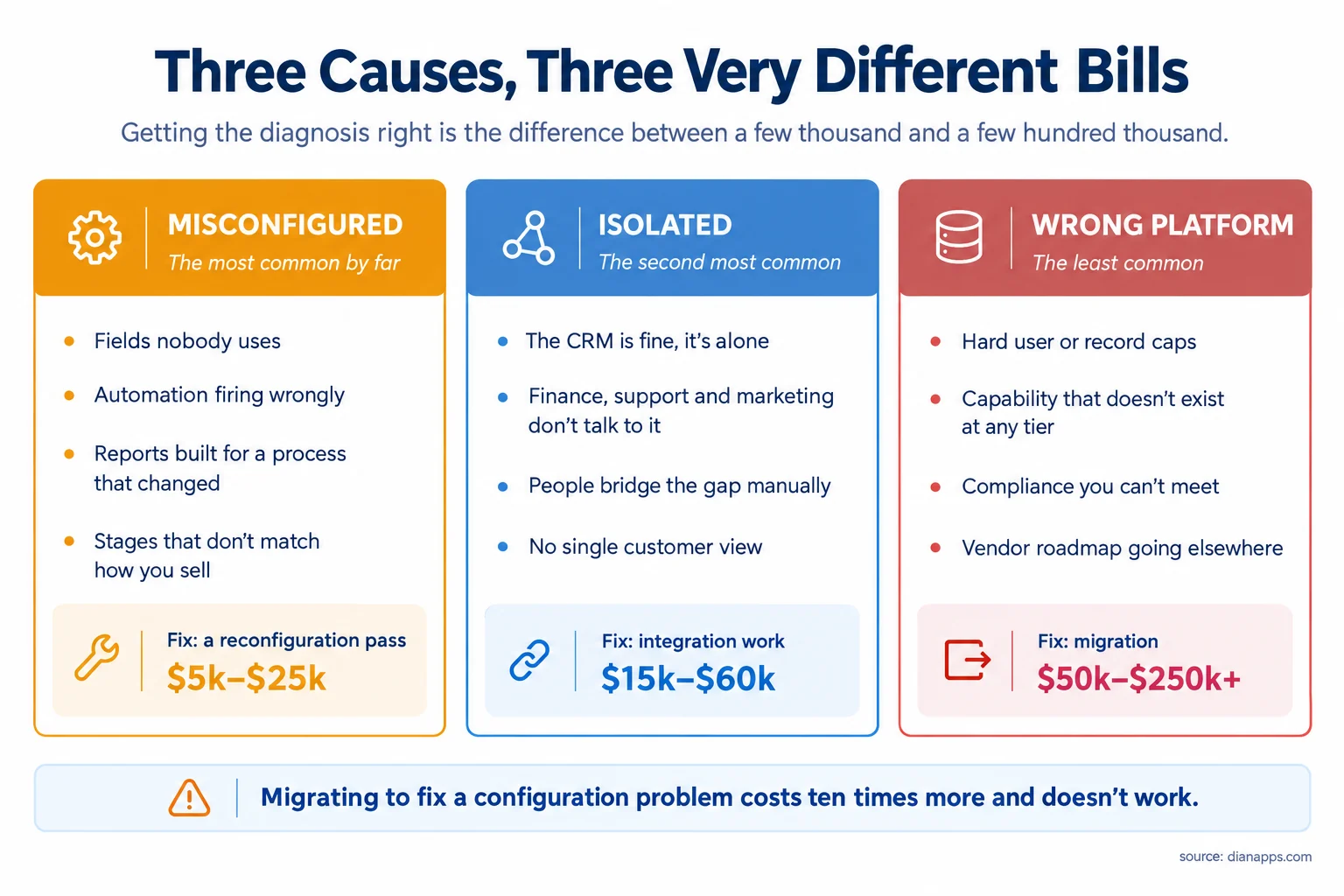
| Cause | How common | What it looks like | Typical fix cost |
|---|---|---|---|
| Misconfigured | Most common | Unused fields, wrong automation, stale reports | $5,000 – $25,000 |
| Isolated | Second | CRM is fine but disconnected from other systems | $15,000 – $60,000 |
| Wrong platform | Least common | Hard caps, missing capability, compliance gaps | $50,000 – $250,000+ |
- This is the diagnosis that matters, and it’s why “you’ve outgrown your CRM” is unhelpful advice.
- Misconfiguration is by far the most common. Fields nobody uses, automation firing at the wrong time, reports built for a process that changed two years ago, stages that don’t match how you sell. A reconfiguration pass buys real runway for a fraction of migration cost.
- Isolation is second. The CRM is fine; it’s alone. People bridge the gap manually, which is where the spreadsheets come from.
- Wrong platform is the least common and the most expensive. It’s also the only one a migration fixes.
- Migrating to solve a configuration problem costs roughly ten times more and doesn’t work; you rebuild the same bad process in a cleaner container.
This is where Salesforce consulting services can help businesses identify whether the problem comes from poor configuration, disconnected systems, or an actual platform limitation. A proper assessment of the existing setup can clarify what needs fixing and whether investing in a new CRM is justified.
Score Yourself
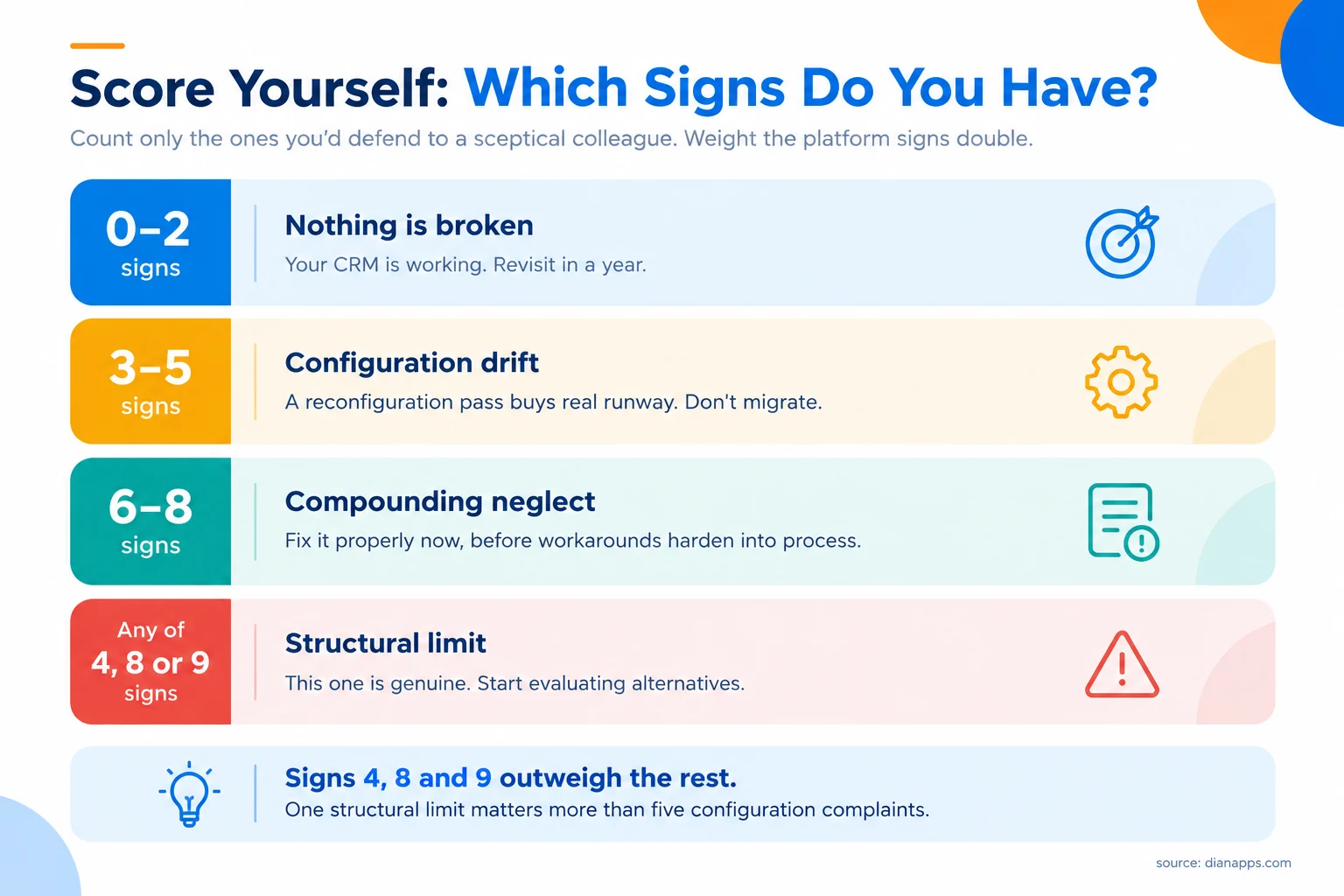
| Your score | What it means | What to do |
|---|---|---|
| 0–2 signs | Nothing is broken | Revisit in a year |
| 3–5 signs | Configuration drift | A reconfiguration pass. Don’t migrate |
| 6–8, none structural | Compounding neglect | Fix it properly now, before workarounds harden |
| Any of 4, 8 or 9 | Structural limit | Genuine. Start evaluating alternatives |
Count only the signs you’d defend to a sceptical colleague, not the mildly annoying ones.
And weight signs 4, 8 and 9 heavily. One genuine structural limit matters more than five configuration complaints, because the structural one has no cheaper fix.
- A Practical Test For Each Sign You Counted: Can you name the specific limit, error message, or missing capability? If yes, it’s probably structural. If the answer is “it just doesn’t work well”, it’s probably configuration.
The Cost of Waiting
- There’s a genuine argument against doing nothing, and it isn’t the one vendors usually make.
- Workarounds harden into process. The longer a team works around a system, the more institutional knowledge lives in one person’s spreadsheet rather than the CRM. Recognising the problem early, while it’s still a configuration fix, is what keeps it cheap.
- Data quality degrades measurably. One survey found 37% of CRM users lost revenue directly because of poor data quality. That’s not a hypothetical cost.
And the Sunk-Cost Trap Runs Both Ways: You’ve invested in licences, training and migration, so changing feels like admitting a mistake. It isn’t, but neither is fixing what you have. Both are legitimate, and the sunk cost shouldn’t decide either.
What to Do About Each Cause
If it’s configuration:
Audit what’s actually used: fields, automations, reports. Most orgs are surprised. Then rebuild the pieces that no longer match how the business runs, and delete the rest. This is the one moment you can legitimately remove clutter.
If it’s integration:
Map which system owns which data before connecting anything. “Both” is how records diverge. Then build the connections deliberately rather than point-to-point as needs arise. See Salesforce integration.
If it’s the platform:
If it’s the platform, evaluate your options properly, budget for migration honestly, and audit before you move. Migrate what you use, not everything you have. Our guide to Salesforce alternatives and their switching costs explains what to consider before committing to another platform.
In all three cases, fix data quality first. It’s the only work that pays off regardless of which path you take.
If You’re Still on Spreadsheets
A different situation, and worth addressing separately: you don’t have a CRM at all.
- The Signals That You Need One: You can’t answer “what’s in the pipeline” without asking three people, deals get forgotten, nobody knows what was promised to whom, and handovers lose information.
- The Honest Advice: If you’re deciding which platform to start with, our Salesforce vs Pipedrive vs Monday CRM comparison explains how their setup requirements, pricing, and capabilities compare for smaller teams.
Related: Salesforce for startups and SMBs
Where to Go Next
For evaluating alternatives properly, 12 Salesforce alternatives compared, including the switching cost most comparisons omit.
For head-to-heads, Salesforce vs HubSpot · Salesforce vs Zoho · Salesforce vs Pipedrive and Monday · Salesforce vs custom CRM
For fixing rather than replacing, how to reduce Salesforce licence costs and Salesforce editions compared.
For the integration cause specifically, Salesforce integration.
For compliance limits, Salesforce compliance and Salesforce Shield.
For the data behind CRM failure rates, CRM statistics 2026.
For smaller organisations, Salesforce for startups and SMBs.
The Diagnosis Is the Whole Decision
Every vendor answers “we’ve outgrown our CRM” the same way, and it’s the answer that suits them.
The useful answer is narrower: which of three problems do you actually have, and what does each cost to fix? Seven of the ten signs above have a cheaper answer than migration, and getting that wrong is a six-figure mistake.
Tell us what’s actually going wrong
We’ll tell you whether it’s configuration, integration, or the platform, and if it’s one of the first two, migrating won’t help, and we’ll say so.
 0 comments











Leave a Comment
Your email address will not be published. Required fields are marked *