















 0 comments





Key Takeaways:
- Financial Services Cloud already provides the core financial data model, so firms should extend it rather than rebuild financial accounts, households, policies, holdings, and related objects.
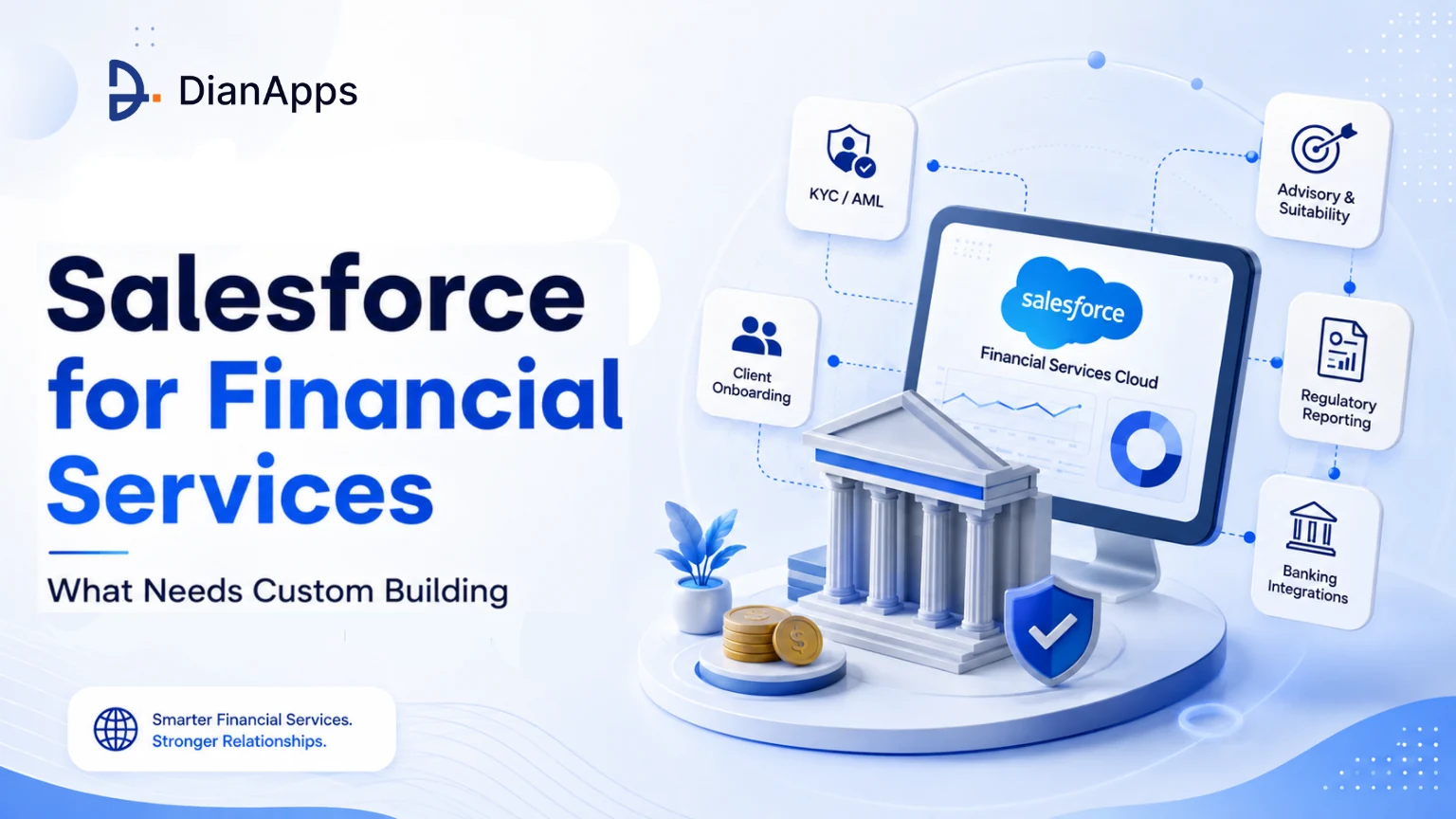
- Custom development is most valuable for client and advisor portals, suitability calculators, KYC/AML orchestration, onboarding, regulatory reporting, and core banking integrations.
- Financial services compliance should be treated as a design constraint from the beginning, not something added during final testing.
- Teams should confirm which FSC object model their org uses before writing Apex, SOQL, or metadata because Salesforce is shifting from managed-package objects toward native Data Model Objects.
- Core banking integrations are often the most difficult part of the project because legacy systems may rely on batch processing rather than real-time APIs.
- Market-data licensing can affect what information may be stored or cached in Salesforce, making it both a technical and contractual consideration.
- Regulated financial services development typically carries a 25–40% premium over comparable unregulated work because of testing, documentation, security review, and evidence requirements.
Quick Answer: Salesforce for financial services works best when firms extend Financial Services Cloud instead of rebuilding its existing data model. FSC already covers core concepts such as households, financial accounts, policies, goals and holdings, while custom development is better suited to portals, suitability and risk calculations, KYC/AML workflows, regulatory reporting, onboarding and core-system integrations. Compliance, evidence retention and security controls should shape the architecture from the start rather than being added after development.
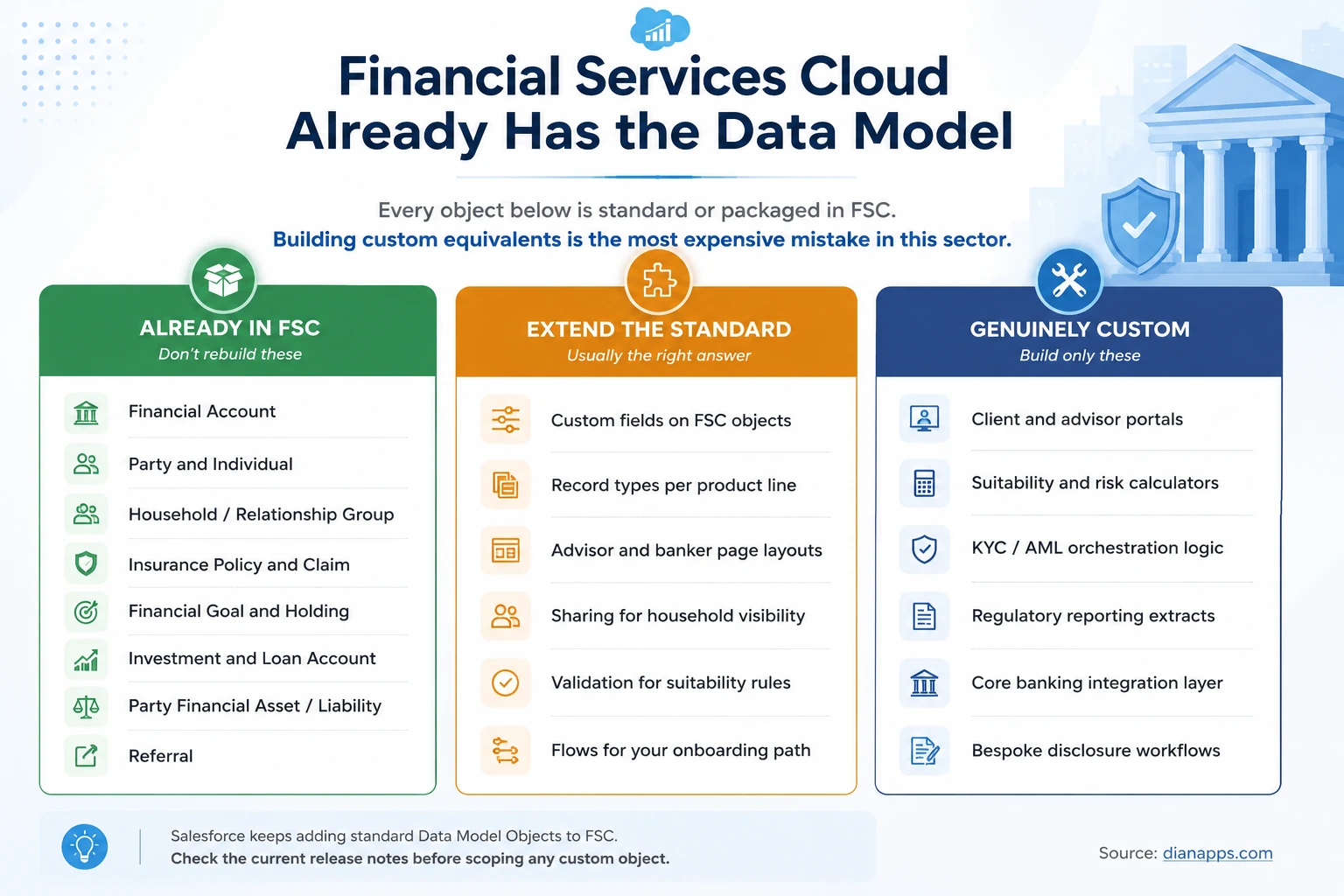
Financial Services Cloud already contains the data model most firms start by scoping as custom development.
Financial Account, Party, Household, Insurance Policy, Financial Goal, Financial Holding, Investment Account, Loan Account – these exist as standard or packaged objects, maintained by Salesforce, with the relationships and user interface components already built. Teams that rebuild them spend six figures recreating something that ships in the box, and inherit a maintenance obligation Salesforce would otherwise carry.
This guide covers what genuinely needs building, what only needs extending, and the compliance constraints that shape both.
Where Standard Salesforce Stops for Financial Services
Sales Cloud assumes a customer and an opportunity. Financial Services assumes something structurally different: a household rather than an individual, financial accounts held across institutions, relationships between parties that matter as much as the parties themselves, and every interaction subject to evidential requirements.
- Financial Services Cloud Closes Most Of That Gap: It provides the household and relationship model, financial accounts, policies and claims, goals and holdings, plus interface components built for advisors and bankers rather than sales reps.
- What It Doesn’t Close: Is your onboarding process, your suitability framework, your regulator’s reporting format, and the core banking or policy administration system you happen to run. That’s where development starts.
Don’t Rebuild What FSC Already Gives You
Two Things Make This More Urgent Than It Looks.
- The Standard Model Keeps Expanding. Salesforce has been adding Data Model Objects release by release: Investment Account, Loan Account, Party Financial Asset, Party Financial Liability, Financial Goal, Interest Tag. Guidance from two years ago that said “use custom objects for assets, liabilities and goals” is now out of date, and following it builds something Salesforce has since shipped.
- Check The Current Release Notes Before Scoping Any Custom Object. This is the single cheapest step in a financial services Salesforce project.
- The Honest Exception: Genuinely unusual entity structures – some institutional, trust, and intermediary models don’t map cleanly. That’s an architect’s conversation, not an assumption. Genuinely unusual institutional, trust, or intermediary models should be evaluated by the right technical role. Understanding the difference between a Salesforce admin, developer, and architect helps determine whether the requirement needs configuration, custom code, or architectural design.
Related: The Salesforce data model explained · Configuration vs customization
The Managed Package Shift Nobody Warns You About
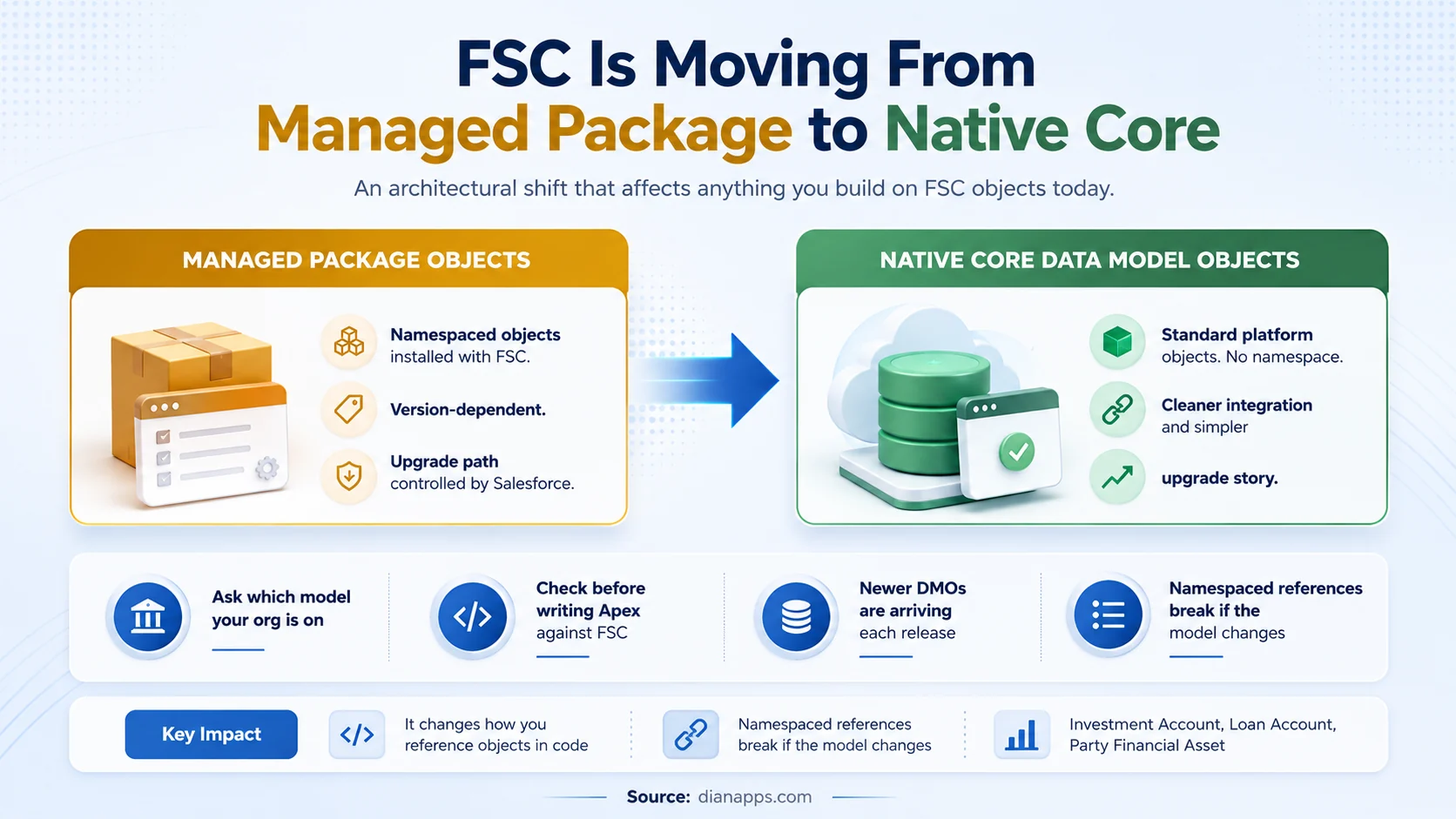
FSC’s data model has historically been a combination of standard objects and managed-package objects – the latter namespaced, versioned, and upgraded on Salesforce’s schedule.
Salesforce is shifting toward native core Data Model Objects with cleaner integration, no namespace, and a simpler upgrade story.
Why This Matters If You’re Writing Code:
- Namespaced References Behave Differently: From standard object references in Apex, SOQL, and metadata.
- Ask Which Model Your Org Is On: Before anyone writes a line against FSC objects.
- Integration Mappings: Built against packaged objects may need revisiting as the shift progresses.
This is exactly the kind of detail that doesn’t surface in a sales conversation and costs a fortnight of rework mid-project.
Related: Apex programming guide · Salesforce DevOps
FSC or Build on Core?
The decision most financial services buyers actually face.
| Financial Services Cloud | Sales/Service Cloud + custom | |
|---|---|---|
| Household and relationship model | Standard | Custom objects and junction design |
| Financial accounts, policies, claims | Standard | You build and maintain them |
| Advisor and banker UI components | Built in | You build them |
| Data model maintenance | Salesforce’s problem | Yours, permanently |
| Licence cost | Higher per seat | Lower per seat |
| Build cost | Lower - configuration over construction | Substantially higher |
| Time to first value | Faster | Slower |
- Where the Maths Lands: FSC costs more per seat and less in total for anything genuinely wealth, banking, or insurance-shaped, because you’re buying a maintained data model rather than building one. Building the equivalent on Sales Cloud is usually cheaper in year one and more expensive by year three – and every Salesforce release becomes your regression testing problem rather than theirs.
- Where Core Salesforce Is Genuinely Fine: Administrative use cases with no financial data model – internal IT requests, supplier management, HR processes. Don’t pay FSC licence rates for those.
Need to Build Salesforce for Financial Services?
Map your FSC data model, integrations, compliance requirements, and custom workflows before deciding what to configure, extend, or build.
Related: Salesforce customization cost
What Compliance Actually Changes About the Build
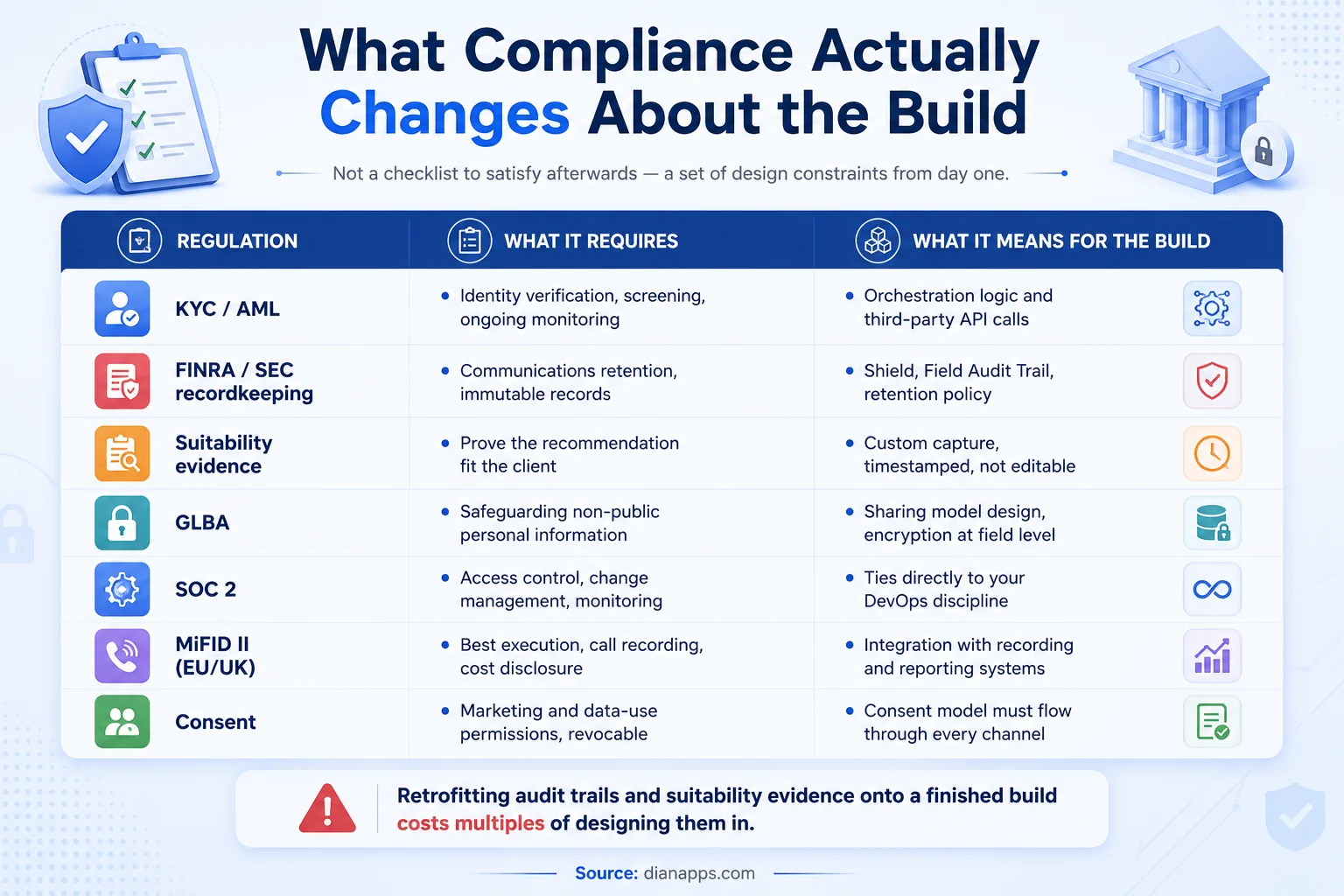
- The Pattern Across All Of Them: Compliance is a design constraint, not a phase. Retrofitting audit trails, suitability evidence, and retention policy onto a finished system costs multiples of building them in.
The Three That Most Affect Development Specifically:
- Immutable Evidence: Suitability records, disclosures and communications need to be provably unedited. That usually means Field Audit Trail, Shield, or a custom object designed to be write-once – and it’s a data model decision, not a reporting one.
- Access Control At Field Level: GLBA and equivalent regimes make over-exposed non-public personal information a compliance failure, not just untidiness. Enforce FLS in every Apex class and Flow – WITH USER_MODE rather than manual checks. See the Apex guide.
- System Mode As An Exposure Route: Record-triggered Flows and Apex run in system mode and ignore sharing entirely. In a regulated org, that’s a genuine control gap, and it’s rarely on anyone’s audit checklist. See Salesforce Flow.
Related: Salesforce compliance and data security · Salesforce sandboxes
Building on Salesforce under FINRA, SEC or FCA scrutiny?
The evidence and retention design has to happen alongside the build. We’ll map what your regulator needs against what the platform provides.
What Financial Services Firms Actually Build
The custom work that genuinely earns its cost:
- Client and Advisor Portals: Experience Cloud sites for statements, document exchange, secure messaging, and self-service. Almost always custom, because client experience is the differentiator.
- Suitability and Risk Calculators: Risk tolerance scoring, product suitability matching, affordability assessment. Business logic no standard object encodes, and usually the piece with the most regulatory scrutiny.
- KYC and AML Orchestration: Identity verification, sanctions and PEP screening, ongoing monitoring, and the case management around exceptions. Heavy on third-party API integration and error handling.
- Onboarding Workflows: Multi-step, multi-party, document-dependent processes spanning days or weeks, increasingly a Salesforce Flow Orchestration rather than a chain of separate flows.
- Regulatory Reporting Extracts: Whatever format your regulator specifies, on whatever cadence. Rarely glamorous, always required.
- Core System Integration: The largest line item, covered next.
This is where Salesforce Development Services become valuable, extending FSC with the client experiences, suitability logic, compliance workflows, integrations, and reporting requirements that are specific to each financial services organisation.
Need Salesforce Developers for Financial Services?
Add experienced Salesforce developers for client portals, suitability logic, KYC/AML workflows, regulatory reporting, and core-system integrations.
The Integration Surface
| System type | Typical examples | Notes |
|---|---|---|
| Core banking | Temenos, FIS, Fiserv, Finacle | Often batch-oriented; real-time is the hard part |
| Custodians and clearing | Various | Positions and transactions, usually file-based |
| Policy administration | Insurance-specific platforms | Frequently legacy, frequently proprietary |
| Market data | Bloomberg, Refinitiv, others | Licensing terms constrain what you can store |
| Document and e-signature | DocuSign, Adobe | Evidence chain matters more than convenience |
| Screening and verification | KYC/AML vendors | Latency and failure handling are the design problem |
The Two That Consistently Cost More Than Expected:
- Core Banking: Most cores were not designed for real-time API access. Expect middleware, expect batch windows, and expect the bank’s own team to be the constraint on timeline rather than the Salesforce work.
- Market Data Licensing: Data vendors restrict redistribution and storage. What you may cache in Salesforce is a contractual question before it’s a technical one – and it has caught out projects late.
Related: Salesforce integration guide · Salesforce API integration
What It Costs
Indicative bands for financial services builds, excluding FSC licences:
| Build | Typical range |
|---|---|
| Custom fields, record types, page layouts per persona | $5,000 – $18,000 |
| Suitability or risk scoring calculator | $12,000 – $40,000 |
| KYC/AML orchestration with vendor integration | $30,000 – $90,000 |
| Client or advisor portal (Experience Cloud) | $35,000 – $110,000 |
| Regulatory reporting extract suite | $20,000 – $60,000 |
| Core banking integration | $60,000 – $200,000+ |
- The Regulated Premium Is Real: Roughly 25–40% above comparable unregulated work. It isn’t the code; it’s the test evidence, the documentation, the security review, and the change-control rigour that auditors expect.
- Discovery Is Heavier Here Too: A proper financial services discovery produces a data model, an integration architecture, a compliance control matrix, a persona matrix, and agreement on what constitutes evidence. Cutting it is a false economy, particularly where a regulator will eventually ask how a recommendation was reached.
The Mistakes That Cost Most
- Rebuilding The FSC Data Model: Covered above. The expensive one.
- Treating Compliance As A Testing Phase: It’s a design constraint. See above.
- Assuming The Core Banking Team Can Move At Your Pace: They usually can’t, and it’s rarely their fault.
- Developing Against Unmasked Production Data: Non-public personal information in a sandbox is the same problem as PHI in healthcare. Mask it.
- Building A Portal Before Agreeing The Evidence Model: What the client sees and what you must retain are different questions, and the second constrains the first.
- Not Asking Which FSC Object Model You’re On: Fortnight of rework, avoidable in a five-minute conversation.
Where to Go Next
For the compliance framework in more depth, Salesforce compliance and data security.
For the integration surface, Salesforce integration and Salesforce API integration.
For multi-step onboarding processes, Flow Orchestration.
For the build decision, configuration vs customization and custom Salesforce development.
For budgeting, Salesforce customization cost.
The complete Salesforce development guide is the hub.
Before You Scope a Financial Services Build
The first thing we check on a financial services Salesforce enquiry is what’s already standard in FSC – and which object model the org is running.
Both questions take minutes, and both routinely change the scope. Rebuilding a data model Salesforce maintains, or writing Apex against the wrong object references, are the two most expensive avoidable mistakes in this sector.
We’re a certified Salesforce Consulting Partner with developers, architects, and consultants across the US, UK, Australia, Canada, UAE, and India.
On a scoping call, we’ll tell you which requirements are configuration, which genuinely need code, and where your compliance obligations have to shape the design rather than the testing.
Given the combination of regulatory controls, integration dependencies, and evidence requirements, an Agile methodology in Salesforce can help break the implementation into controlled releases rather than treating the entire programme as one deployment.
Ready to Scope Your Financial Services Build?
Share your FSC object model, integration requirements, regulatory obligations, and custom workflows with our Salesforce team before development begins.
 0 comments











Leave a Comment
Your email address will not be published. Required fields are marked *