















 0 comments





What This Guide Covers
- What AI/ML development services actually are
- What is included in a modern engagement
- Cost ranges and what drives them
- Enterprise use cases that deliver ROI
- How to choose the right partner
- Common pitfalls to avoid
- Frequently asked questions
Enterprise buying patterns for AI/ML development have changed dramatically in the last twelve months. Gartner reports that 40% of enterprise applications will include task-specific AI agents by the end of 2026, up from under 5% in 2024. IBM’s 2025 Cost of a Data Breach Report puts the global average breach cost at $4.88 million, which is pushing enterprises to build compliance and security into AI systems from day one, not as an afterthought.
We work with mid-market and enterprise clients across the United States, Australia, and Dubai, and the questions we get most often are the same three: what do these services actually include in 2026, what should a realistic project cost, and how do you pick a partner without getting burned. This guide answers all three based on verified project data from the past twelve months. If you are still deciding between AI and ML services, our companion post on on-device AI vs cloud AI may help clarify the architectural choice.
What Are AI/ML Development Services?
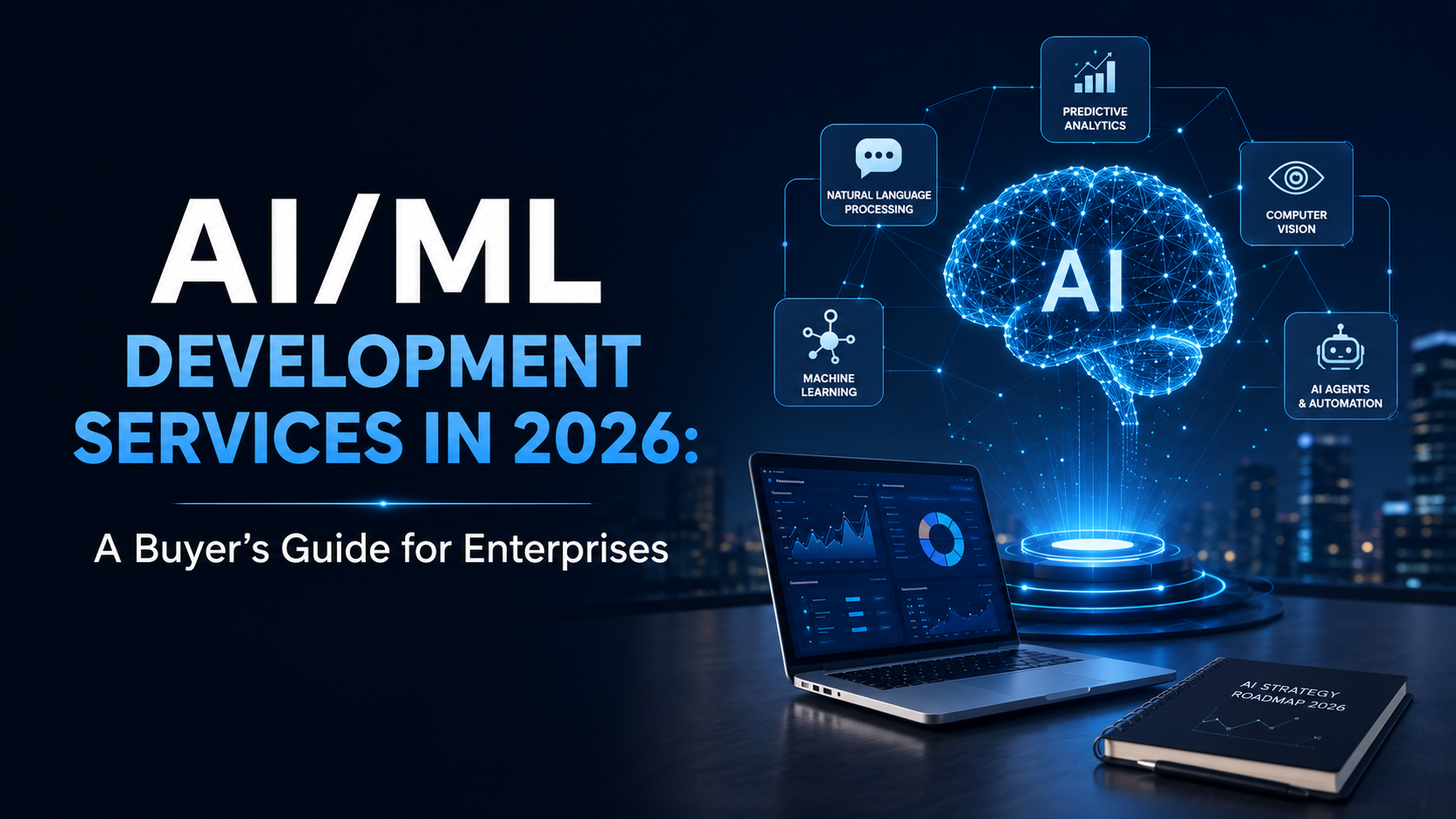
AI/ML development services cover the design, engineering, and deployment of software systems that use artificial intelligence and machine learning models to automate decisions, generate content, or predict outcomes. In 2026, this typically includes one or more of the following: custom model training, large language model integration (Claude, GPT-5, Gemini), retrieval-augmented generation systems, autonomous agent deployment, computer vision, natural language processing, recommender systems, and predictive analytics.
The category has broadened significantly. Two years ago, “AI/ML services” often meant either a data science team doing custom model work or a chatbot integration. Today, most enterprise projects involve orchestrating multiple AI capabilities, third-party APIs, and custom code into a cohesive product experience. Our team also handles related work such as generative AI development, AI chatbot development, and AI agent development when the engagement calls for it.
What Is Actually Included in Modern AI/ML Development Services
Real 2026 engagements typically span six functional areas. Understanding this helps you scope your own project accurately.
1. Discovery and Use Case Definition
Serious partners start with a discovery sprint of one to three weeks. The goal is turning a business problem into a technical specification with measurable success criteria. Deloitte’s 2026 Enterprise AI Survey found that 67% of AI project failures traced back to weak initial scoping. Skipping discovery is the most common source of budget overruns. Our how to evaluate AI/ML development partners guide covers the questions worth asking during this stage.
2. Data Preparation and Pipeline Engineering
Machine learning outputs are only as good as the data feeding them. Data engineering typically consumes 40% to 60% of total project time in enterprise builds. This work includes data extraction from CRMs and ERPs, cleaning and normalization, labeling for supervised learning tasks, and pipeline automation. If your partner underscopes this stage, expect delays. For teams already invested in Salesforce, our Salesforce Heroku integration guide shows how a proper pipeline architecture supports AI features downstream.
3. Model Selection or Custom Training
The default choice in 2026 is API-first: use Claude Sonnet 5, GPT-5, or Gemini 2 Pro through their production APIs rather than train from scratch. Custom training still matters for domain-specific tasks such as medical imaging, industrial defect detection, and specialized document processing where general-purpose models underperform. See top frameworks for AI-native mobile apps for the technical stack decisions that follow model selection.
4. Integration and Application Layer
This is where AI capabilities meet real user workflows. Common integrations include Salesforce Einstein and Agentforce platforms, Microsoft Copilot Studio, mobile app SDKs for on-device inference (Apple Intelligence, Gemini Nano), Slack and Teams bot frameworks, and internal ERP or CRM automation. The application layer often accounts for more engineering effort than the model work itself.
5. Testing, Evaluation, and Guardrails
Generative AI needs different testing than traditional software. Serious teams build evaluation harnesses with red-team prompts, prompt injection tests, hallucination detection, output quality scoring, and cost/latency benchmarks. This layer becomes critical for customer-facing systems where a bad output means reputation damage or compliance risk.
6. Deployment, Monitoring, and Ongoing Optimization
Post-launch, AI systems need continuous evaluation because underlying model APIs evolve. Anthropic and OpenAI shipped major model updates in early 2026 that changed both output quality and pricing. Systems left unmonitored can degrade or become more expensive without anyone noticing. A production-grade partner includes monitoring dashboards and quarterly optimization reviews.
How Much Do AI/ML Development Services Cost in 2026?
Cost varies widely based on scope. Based on 27 client engagements DianApps has delivered since 2024, here are honest ranges you can plan against.
| Engagement Type | Cost Range | Timeline | Best For |
|---|---|---|---|
| Proof of concept | $15,000 to $40,000 | 4 to 8 weeks | Validating a single use case before committing |
| Production MVP | $40,000 to $120,000 | 8 to 16 weeks | Limited launch with guardrails and evaluation |
| Enterprise system | $150,000 to $500,000 | 6 to 12 months | Multi-capability, compliance-grade deployments |
| Managed services | $5,000 to $25,000 per month | Ongoing | Post-launch monitoring, optimization, updates |
These ranges reflect actual DianApps invoices from 2024 through mid-2026, not theoretical rate cards. Two variables shift cost most: data complexity (unstructured, PII-heavy data pushes the budget up) and compliance requirements (HIPAA, GDPR, EU AI Act adds 15% to 30% to timeline and cost). For a broader view on AI app development cost for US businesses, see our detailed breakdown by feature category.
Enterprise Use Cases That Actually Work in 2026
Not every AI project pays back. The use cases that consistently deliver measurable ROI in our client portfolio share a common pattern: they automate specific, high-volume, rule-driven work where the cost of errors is bounded.
Sales and Customer Success
Salesforce Agentforce SDR agents that qualify inbound leads, route them to human reps, and draft first-touch outreach. Zendesk reports that LLM-powered chatbots handle 60% of Level-1 customer support tickets on average across their 2026 customer base. Revenue impact is measurable in reduced response times and higher lead-to-meeting conversion. Our top Salesforce AI consulting partners list breaks down the vendor landscape for this specific use case.
Software Engineering Productivity
GitHub’s 2026 Copilot Impact Report shows AI-assisted coding tools cut frontend project timelines by 22% on average. This is the most consistently ROI-positive AI investment we see in enterprise engineering teams. Related engineering work often benefits from our custom software development approach where AI is treated as a first-class engineering tool.
Fintech Fraud Detection
ACI Worldwide’s 2025 study found that banking apps with real-time AI fraud detection saw 67% fewer disputed transactions. The unit economics are compelling: a single prevented fraud incident can pay for months of AI monitoring costs. See our hire fintech developers guide for how the talent side of fintech AI builds is priced.
Healthcare Clinical Decision Support
Custom-trained models that help clinicians triage cases, flag risk factors, and draft notes. IBM’s 2025 breach cost data shows healthcare data breaches averaging $10.93 million per incident, so serious healthcare AI investments must include HIPAA-compliant infrastructure and audit logging from the beginning. Our HIPAA-compliant email guide is a good primer on healthcare compliance basics.
Mobile App Personalization
Sensor Tower’s 2026 State of Mobile shows over 80% of mobile apps will integrate AI features by the end of 2026. The winners we see are apps using on-device AI (Apple Intelligence, Gemini Nano) for privacy-preserving personalization rather than round-tripping user data to server-side inference. The full landscape is covered in mobile app development trends 2026.
How to Choose the Right AI/ML Development Partner
The partner selection process matters more than most enterprise buyers realize. A wrong choice can turn a six-month project into an eighteen-month rescue effort. Here is the framework we recommend to prospects, even when they choose a competitor.
1. Verify Real Delivery Track Record
Ask for three specific AI/ML projects the partner has shipped to production in the last twelve months. Ask what went wrong on each. Partners who claim perfect delivery are either misleading you or have not shipped enough work to know where failure points hide.
2. Look for Domain Depth, Not Just Tool Familiarity
API access is universal now. Any competent team can call Claude or GPT-5. What separates good partners is understanding your domain deeply enough to know which use cases will work and which will fail. Ask specifically about their experience in your industry. Our team, for example, has published depth work like mobile app development companies leading AI integration because we ship those exact projects.
3. Confirm Their Evaluation Discipline
Ask how they measure model quality post-launch. If the answer is “we test it before deployment,” walk away. Serious teams describe evaluation harnesses, ongoing quality benchmarks, and drift detection. This is a strong signal of engineering maturity.
4. Check Compliance Preparedness
The EU AI Act took effect in phases starting 2025, and enforcement is increasing. If your product touches European users, or handles healthcare or financial data, your partner needs to demonstrate compliance experience. Vague reassurances are a red flag.
5. Understand Their Post-Launch Operating Model
The build is one third of the total cost of AI ownership over three years. The other two thirds is operations, model updates, and optimization. A partner who has not thought carefully about the post-launch chapter is planning to hand you problems.
Common Pitfalls to Avoid
- Underinvesting in data preparation. The most common budget overrun cause. Insist on realistic time budget for data cleanup and pipeline engineering.
- Buying model breadth instead of business fit. Enterprises often overspend on multi-model setups when a single well-integrated model would deliver 90% of the value at 40% of the cost.
- Skipping evaluation infrastructure. Testing quality before launch and never again means slow degradation you will not catch until customers complain.
- Ignoring token economics. Model pricing has shifted twice in 2026 already. Systems that ignore per-request cost end up 3x to 5x more expensive than the original quote after twelve months.
- Treating AI as a project instead of a product. AI systems require quarterly optimization, not one-shot delivery. Structure your engagement to reflect this reality.
Frequently Asked Questions
Q1. What is the difference between AI development and ML development services?
Q2. How long does an enterprise AI/ML project typically take?
Q3. Do we need in-house AI/ML talent alongside external services?
Q4. What is the biggest risk in AI/ML projects in 2026?
Q5. Should we use Claude, GPT-5, or Gemini for our AI project?
Q6. How much of AI/ML development cost is model API fees vs custom engineering?
Q7. Can AI/ML systems built today survive future model changes?
Final Word
AI/ML development services in 2026 are less about picking the right model and more about disciplined engineering, honest scoping, and operational maturity. The enterprises we see winning have moved past the “let us try AI” mindset and treat AI systems as products with product-quality investment behind them. If you would like to discuss whether your specific use case is a fit for our team, our AI/ML development services page includes recent case studies, or reach out through our contact form.
 0 comments







Leave a Comment
Your email address will not be published. Required fields are marked *