















 0 comments





| Quick Summary: AI agents are autonomous software systems that perceive their environment, plan, act using tools, and iterate toward a goal without constant human input. Unlike basic chatbots, they execute multi-step tasks across real systems. Tools like MuleSoft Agent Fabric for AI agent orchestration coordinate AI agents across enterprise systems with secure orchestration and governance. According to Grand View Research, the global AI agents market size was estimated at USD 7.63 billion in 2025 and is projected to reach USD 182.97 billion by 2033, growing at a CAGR of 49.6% from 2026 to 2033. Right now, 51% of enterprises have AI agents running in production (2026), 40% of enterprise apps already embed task-specific agents, and 70% of North American companies are actively using agentic AI. This guide covers: what they are, how they work, types, use cases, top platforms, real ROI data, risks, and a milestone-by-milestone future roadmap through 2030. |
Not long ago, interacting with AI meant typing a question and reading an answer. That era is over. Today, AI agents are browsing the web, writing and executing code, managing customer support queues, and making real-time business decisions all without a human pressing a single button. The term “AI agent” has exploded in usage, but it’s often misunderstood. Is it just a smarter chatbot? A robot? A fully sentient system? None of the above. An AI agent is a purposeful, tool-using, goal-directed software system, and it represents the most significant leap in how artificial intelligence is applied to the real world. In this blog, we break down exactly what AI agents are, how they work, why businesses are investing billions into them, and what the future looks like. Whether you’re a business owner, developer, AI-first development company, or curious professional, this is the only AI agent blog you need in 2026.
What Are AI Agents?
An AI agent is an autonomous software system powered by a large language model (LLM) that can perceive inputs, reason through goals, use tools, and take multi-step actions in the real world with minimal human intervention. Unlike a chatbot that only responds to single prompts, an AI agent plans, acts, observes results, and iterates until the task is complete. Think of a traditional AI chatbot as a very smart librarian; it answers your question and hands you a book. An AI agent is more like a personal assistant: you tell it “plan my product launch,” and it drafts emails, schedules meetings, researches competitors, and creates a timeline all by itself. The key distinction is agency the capacity to take action in pursuit of a goal without being told each step. The Formula: AI Agent = LLM Brain + Memory + Tools + Planning + Action Loop
How Do AI Agents Work? The ReAct Loop Explained
At the core of every AI agent is a continuous reasoning-action loop. The most widely adopted framework is called ReAct (Reason + Act), which interleaves thinking and doing:
| Step | What Happens | Example |
| Perceive | Agent receives an input or goal | “Find the top 5 competitors and summarize pricing.” |
| Reason / Plan | LLM breaks the goal into sub-tasks | “Search web → extract data → compare → write summary” |
| Act | Calls tools: search, code, APIs, databases | Executes web search, runs Python data script |
| Observe | Reads the tool output | Gets competitor pricing pages back |
| Iterate | Loops until task is complete or goal is met | Refines, re-searches, writes final output |
This loop is what separates agents from simple LLM calls. A single-turn LLM call ends after one response. An agent runs for as many iterations as needed sometimes dozens to accomplish complex goals.
Key Components Inside Every AI Agent
- LLM Core (Brain): The reasoning engine Claude, GPT-4, Gemini, or open-source models like LLaMA.
- Memory: Short-term (context window) + Long-term (vector databases, file stores).
- Tool Access: Web search, code execution, API calls, file I/O, and database queries.
- Planning Module: Decomposes complex tasks into ordered sub-tasks.
- Action Space: The set of tools and operations the agent is permitted to use.
Types of AI Agents
Not all AI agents are the same. Here’s a breakdown of the main categories, from simple to sophisticated:
| Agent Type | How it Works | Best For | Example |
| Simple Reflex Agent | Reacts to current input only, no memory | Rule-based triggers | Spam filters, thermostats |
| Model-Based Agent | Maintains an internal model of the world | Dynamic environments | Inventory management bots |
| Goal-Based Agent | Plans that actions achieve a stated goal | Task Automation | Travel booking agents |
| Utility-Based Agent | Maximizes a reward/utility function | Optimization tasks | Ad bidding agents |
| Learning Agent | Improves via feedback over time | Adaptive Workflows | Personalized recommendation engines |
| Multi-Agent System | Multiple agents collaborate, specialize, and compete | Complex enterprise tasks | AutoGen, CrewAI orchestration |
Multi-agent systems are increasingly dominant. According to market data, 66.4% of the AI agents market focuses on coordinated, multi-agent architectures not single-agent solutions.
AI Agent vs. Chatbot vs. Copilot: What’s the Difference?
This is the most-searched comparison on Reddit and Google. Here’s the definitive breakdown:
| Feature | Chatbot | Copilot | AI Agent |
| Autonomy | Low- responds only | Medium- suggests actions | High- executes actions |
| Multi-step tasks | No | Partial | Yes |
| Tool use | Rarely | Limited (1-2 tools) | Extensive (many tools) |
| Memory | Session only | Limited context | Short term + Long term |
| Goal-directed | No | No | Yes |
| Iteration | Single-turn | Single-turn | Multi-turn loop |
| Human input needed | Every step | Frequently | Initial goal only |
| Example | FAQ bot on a website | GitHub Copilot | Claude Code, AutoGPT |
AI Agents Market Size & Growth Stats (2026)
2026 has officially been called ‘The Year of AI Agents’ by global leaders at the World Economic Forum in Davos and the numbers prove it. Here’s the full, up-to-date picture:
Market Size & Growth
- Global AI agents market: $10.91-$15 billion in 2026, up from $7.63 billion in 2025 nearly 43% YoY growth.
- 2030 & beyond: $50–52 billion by 2030, reaching $221-251 billion by 2034-35 at a CAGR of 45.8%-49.6%.
- US market alone: projected to hit $69 billion by 2034, with North America holding 39.6%-41% of global share.
- Multi-agent system platforms: set to reach $391.94 billion by 2035 the fastest-growing sub-segment.
- Enterprise agentic AI: growing from $2.58 billion in 2024 to $24.5 billion by 2030 at a 46.2% CAGR.
Enterprise Adoption Right Now
- 51% of enterprises already have AI agents running in production as of 2026, with another 23% actively scaling.
- 70% of North American companies are now using agentic AI, with larger enterprises leading the wave.
- 40% of enterprise applications now feature task-specific AI agents up from less than 5% in 2025.
- 43% of enterprises are planning new agentic AI adoption in 2026, backed by NVIDIA survey data.
- 70% of business leaders say agentic AI is both strategically vital and market-ready today.
- 48% of EY technology specialists are already adopting or fully deploying agentic AI in their organizations.
- Intelligence-infused business processes are on track to reach 25% of all enterprise workflows by end of 2026 an 8x increase in just two years.
Real-World ROI & Business Impact
- JPMorgan Chase saved 360,000 hours of manual work annually through AI agent automation.
- Coupa achieved a 276% return on investment from agentic AI deployment.
- Suzano (world’s largest pulp manufacturer) cut query handling time by 95% for 50,000 employees using a Gemini-powered AI agent.
- Unilever improved inventory forecast accuracy from 67% to 92%, saving €300 million in excess inventory.
- 62% of companies investing in agentic AI expect to exceed 100% ROI on their deployments.
- AI-mature firms report 25-30% higher process efficiency vs. peers on legacy tools a gap that widens every year.
Recommended Read: Agentforce Development Services in Australia: The 2026 Enterprise Playbook (Build, Cost & Partner Guide)
Real-World AI Agent Use Cases by Industry
AI agents are not theoretical they are deployed right now across nearly every major industry. Here’s where they’re delivering the most measurable impact:
Customer Service & Support
By 2028, Cisco projects that AI agents will handle 68% of all customer service interactions. Companies deploying AI agents in support report 54% improvement in customer experience and dramatic reductions in ticket resolution time.
- Auto-resolve Tier 1 and Tier 2 tickets 24/7
- Route complex issues to human agents with full context
- Personalize responses based on customer history and sentiment
Software Development & DevOps
Tools like Claude Code represent a new class of coding agents that don’t just suggest code, but write, test, debug, and deploy entire features autonomously.
- Code generation and multi-file editing
- Automated test writing and bug detection
- CI/CD pipeline management and deployment
Healthcare
Healthcare is the fastest-growing segment for AI agents, projected at a 48.4% CAGR. Use cases include:
- Summarizing patient records and clinical notes
- Assisting with diagnostic reasoning and literature review
- Automating insurance pre-authorization workflows
- Monitoring patients and flagging anomalies in real time
Finance & Fintech
The financial services AI agent market is projected to grow from $8 Billion in 2025 to $48.3 Billion by 2030.
- Fraud detection and real-time anomaly alerts
- Automated loan processing and credit scoring
- Portfolio monitoring and risk analysis
- Regulatory compliance reporting
Sales, Marketing & CRM
- Autonomous lead qualification and outreach sequencing
- Personalized email and content generation at scale
- CRM data enrichment and deal progress tracking
- Competitive intelligence gathering and summary reports
Legal
Active generative AI integration in law firms nearly doubled in one year, from 14% in 2024 to 26% in 2025, with 45% of firms planning to make it core to their workflow.
- Contract review and clause extraction
- Legal research and case precedent summarization
- Document drafting and compliance checking
Recommended Read: AI vs Machine Learning: What’s the Difference in 2026?
Top AI Agent Platforms & Frameworks in 2026
The AI agent ecosystem has exploded with both commercial platforms and open-source frameworks. Here’s what’s leading the market:
| Platform / Framework | Type | Best For | Notable Feature |
| Claude Code (Anthropic) | Commercial | Software development | Full agentic coding, file/terminal access |
| OpenAI Operator | Commercial | Web task automation | Browser control, web navigation |
| Microsoft Copilot Studio | Commercial | Enterprise workflows | Deep Microsoft 365 integration |
| Salesforce Agentforce | Commercial | CRM and sales automation | Native CRM data access |
| LangGraph / LangChain | Open Source | Custom agent pipelines | Graph-based multi-agent orchestration |
| CrewAI | Open Source | Multi-agent team | Role-based agent collaboration |
| AutoGen (Microsoft) | Open Source | Research & multi-agents | Conversation-based agent coordination |
| Amazon Bedrock Agents | Commercial | AWS-native deployment | Managed infrastructure, guardrails |
Challenges, Risks & Limitations of AI Agents
Despite the excitement, AI agents come with real limitations that businesses must plan for:
| Challenge | Description | Mitigation Strategy |
| Hallucination | 47% of enterprise AI users made decisions based on hallucinated content in 2025 | Add verification layers, use retrieval-augmented generation (RAG) |
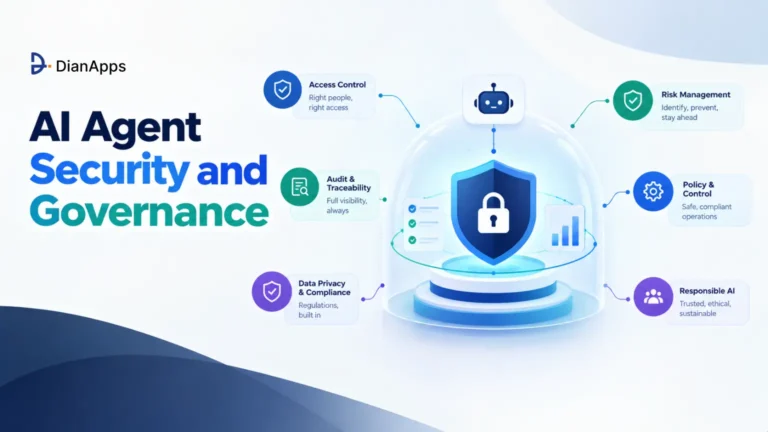
| Security Threats | Top barrier for 35% of organizations; 15 unique agentic threat categories | Implement scoped permissions, audit logs, human-in-the-loop gates |
| Governance Gap | Only 1 in 5 companies has mature governance for autonomous agents | Build oversight frameworks before scaling deployment |
| Project Failure | 40% of AI agent projects fail due to inadequate infrastructure | Start with single-function pilots; validate before expanding |
| Cost & Latency | Multi-turn LLM loops can be expensive and slow for real-time needs | Cache intermediate results; use smaller models for subtasks |
| Data Privacy | 30% of orgs cite data privacy as a top adoption barrier | Enforce data minimization, on-premise deployment options |
| Trust Deficit | Only 25% of US adults trust AI for accurate info | Transparency in agent actions, explainability dashboards |
The Future of AI Agents: What’s Coming Next
The trajectory of AI agents is steep and accelerating. Here’s what the next 2–5 years look like:
- 33% of enterprise software applications will have agentic AI built in by 2028, up from less than 1% in 2024.
- At least 15% of daily business decisions will be made autonomously by AI agents by 2028.
- 80% of common customer service issues will be resolved autonomously by agentic AI by 2029, reducing operational costs by 30%.
- Multi-agent collaboration will become the dominant architecture, with specialized agents delegating tasks to one another, like a digital workforce.
- Physical AI agents combining robotics and LLMs will begin handling real-world tasks in warehouses, hospitals, and logistics.
- Persistent memory will allow agents to learn and personalize over months-long relationships with users and businesses.
- Agent marketplaces will emerge, with businesses subscribing to pre-built, certified agents for specific functions.
The companies investing in AI agent infrastructure today in architecture, governance, and talent will hold a decisive competitive advantage within 24 months.
Final Words
AI agents are not the future; they’re the present. With 79% of enterprises already adopting them, $3.8 billion raised by AI agent startups in 2024 alone, and a market racing toward $200 billion by 2034, the question is no longer “should we use AI agents?” It’s “how fast can we deploy them safely?” The businesses winning with AI agents right now share three traits: they started with a focused, high-value use case; they built proper governance from day one; and they treat AI agents not as a replacement for people, but as a force multiplier for their teams. Whether you’re a startup exploring your first agent workflow through AI Agent development services or an enterprise ready to scale across departments, the infrastructure, frameworks, and expertise to deploy AI agents effectively exist today, and the ROI data backs it up at 171% average returns.
 0 comments









Leave a Comment
Your email address will not be published. Required fields are marked *