















 0 comments





| Quick Summary:
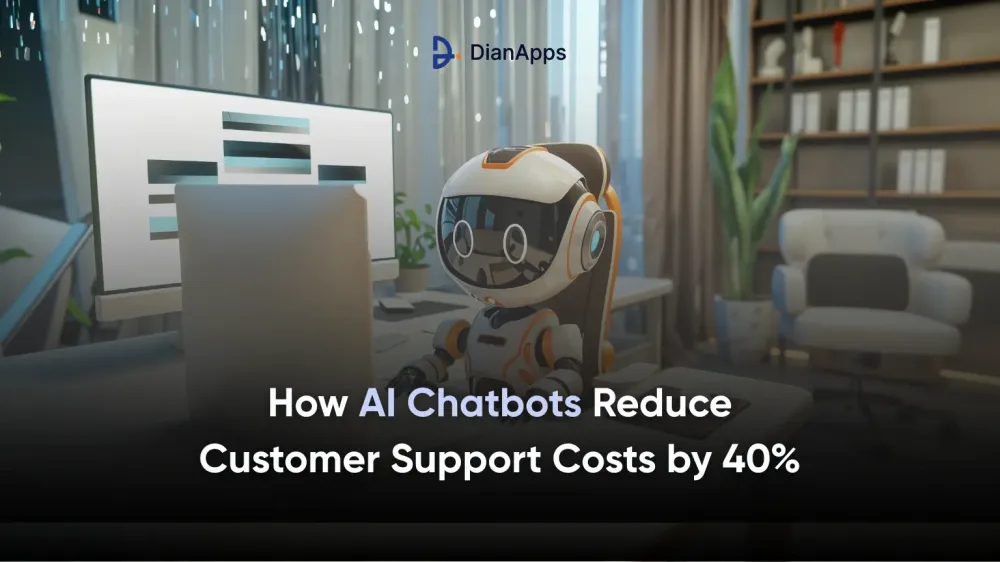
Customer support costs are increasing day by day due to an increasing user base of the applications. It has reached a point that is difficult to anticipate by most businesses, especially in mobile application domains with an expanding user base. Here, the AI chatbot plays a major role in automating repetitive queries, improving response times without expanding support teams, and reducing agent workload. When implemented correctly, AI chatbots can cut customer support costs by up to 40% while still delivering faster and more consistent customer experiences. |
Customer support used to be a backend function. Today, it’s a frontline cost center.
Mobile applications are not relevant anymore. If you are not providing instant solutions to user queries, showcase around the clock to support users, and also deliver frictionless solutions. Brands that are winning today work on eliminating features such as business hours and long queues to support users with their problems. However, in earlier days, meeting these expectations often came with hiring more agents, expanding shifts, or investing heavily in training. It leads to results where support costs quietly spiral out of control.
This is where AI chatbot customer service changes the equation.
AI chatbots are not about replacing people. They’re about redesigning how support works, especially inside mobile apps, where context, speed, and scale matter more than long conversations. By handling repetitive queries, reducing response times, and absorbing volume spikes, AI chatbot mobile apps help businesses deliver better support at a significantly lower cost. This is where the need for AI/ML development services comes into play.
Support costs don’t increase overnight. They grow over time, often ignored by businesses until they become unsustainable or unbearable.
Repetition Is the Real Cost Driver
Across industries, a majority of support tickets fall into predictable categories:
- “Where is my order?”
- “How do I reset my password?”
- “Why did my payment fail?”
- “How do I use this feature?”
These queries don’t require problem-solving or empathy, yet they consume most agent hours. Every repeated answer is a recurring cost.
Mobile Apps Multiply Expectations
Mobile users interact more frequently than web users. Each app update, new feature, or promotional campaign generates questions. Push notifications drive engagement, but also confusion when users need clarification.
More engagement = more support touchpoints.
Human Support Scales Linearly
Human-led support scales in straight lines:
- More users → more tickets
- More tickets → more agents
- More agents → higher fixed costs
Training, quality control, attrition, and burnout further inflate expenses. This model simply doesn’t work long-term for fast-growing apps.
Recommended Read: How to Create an AI Chatbot like Grok
How AI Chatbots Actually Cut Customer Support Costs?
The promise of “40% cost reduction” isn’t marketing hype; it’s the result of multiple small efficiencies adding up.
Ticket Deflection Is the Biggest Lever
In the first stage, AI chatbots are considered highly efficient and effective. These tools have the capability of answering questions instantly, resolving common issues without escalations, and guiding users through basic flows.
Well-implemented AI chatbot mobile apps can automatically resolve 60–80% of incoming queries, meaning those tickets never reach human agents.
Cost per Interaction Drops Drastically
Human support has a high marginal cost. Every time you start a new conversation, it requires more time, focus, and compensation. This process makes human support quite expensive in the long run.
However, on the other hand, AI chatbot customer support interactions might sound quite expensive on the first stage, but in the long run, it’s highly affordable and budget-friendly for businesses. However, a chatbot only requires one-time effort and cost in training and deployment. Moving forward, it becomes capable of handling thousands of conversations simultaneously without hiring an additional team or incurring any additional cost.
This difference alone makes a significant impact on the customer support costs, which is around 40% savings.
Faster Responses Reduce Ticket Volume
Instant replies prevent users from:
- Submitting duplicate tickets
- Escalating unnecessarily
- Abandoning the app out of frustration
Faster resolution leads to fewer follow-ups, which directly reduces total support workload.
Always-On Support Without Operational Overhead
Just like the human workforce, AI chatbots never ask for shift alignment, holidays, or overtime payment. They are always available to provide consistent support across different time zones, which is definitely valuable for global applications. The operational cost stays stable even as usage grows.
Real Examples: Where Businesses See the Biggest Savings
AI chatbot customer service delivers the highest ROI in environments with high volume and predictable interactions.
E-commerce Mobile Apps
E-commerce applications such as Amazon, Flipkart, and more hold a larger share of post-purchase queries related to delivery delays, return policies, and order tracking. AI chatbots ensure to handle these instantly, eliminating the need for agents to focus on edge cases and customer retention.
Fintech and Banking Apps
Users frequently ask about balances, transactions, verification, and payment issues. AI chatbots manage these securely while maintaining compliance, significantly reducing call-center dependency.
SaaS and Subscription Platforms
Onboarding questions, feature navigation, and billing queries are repetitive by nature. AI chatbots smooth early user experiences and reduce churn-triggering frustration.
Healthcare and Appointment-Based Apps
Scheduling, reminders, and report access generate high query volumes. Chatbots streamline these workflows while reducing administrative overhead.
Recommended Read: What Are the Benefits of Using AI Chatbots in Edtech?
List of the Affordable AI Chatbot Mobile Apps for Small Businesses
AI chatbots are no longer considered a solution for enterprises. As of today, in this expanding marketplace, there are multiple mobile apps that are specifically built for small businesses. Chatbots built for small businesses mainly focus on quick setup, predictable pricing, and faster return on investment. These tools are developed with an aim to reduce workload without needing large technical teams or long implementation cycles.
The given section showcases certain important factors that make the AI chatbot truly affordable and efficient for small-scale businesses:
- An AI chatbot can now be developed with a no-code and low-code setup without developer dependency.
- Pre-built customer support templates allow users to handle FAQs, order status, onboarding, and payment-related queries instantly.
- It follows a unique pricing model where businesses are only required to pay for conversations that resolve any user queries.
- Chatbots deliver mobile-first compatibility, including support services for Android and iOS apps with smooth in-app chat experiences.
- Basic API access, enabling integration with CRMs, helpdesk tools, and order management systems
Most small businesses start seeing value when these chatbots automate repetitive, high-volume queries. Instead of scaling support teams early, affordable AI chatbot mobile apps help small teams maintain response speed, improve customer satisfaction, and keep support costs under control as their user base grows.
Features That are Often Overlooked Can Lead to Cost Savings
A lot of organizations simply use AI chatbots for simple question and answer assistance. However, complex functions that gently lessen workload, mistakes, and repeated events account for some of the biggest cost savings.
Push Notifications for Proactive Support
Push notifications help resolve issues before users even reach out. Automated updates to customers regarding order status, service disruptions, or payment confirmations significantly reduce questions or queries related to “Where is my order?” and “Is my payment successful?”. Automated notifications related to common user queries alone can cut inbound queries by a noticeable margin.
API Access for Deeper Workflow Automation
Mobile AI chatbot apps offering API access allow real-time data exchange with CRMs, helpdesk systems, and backend databases. This enables chatbots to fetch live order details, account information, or subscription status, eliminating manual checks and reducing agent intervention.
Intelligent Escalation to Human Agents
Smart escalation ensures that only complex or high-empathy issues reach human agents. By filtering routine queries, AI chatbots reduce agent fatigue and improve resolution quality while keeping support teams lean.
Multilingual Support Without Additional Hiring
AI chatbots can instantly support multiple languages, allowing businesses to serve global users without hiring multilingual agents or outsourcing support. This dramatically lowers regional expansion costs.
Conversation Analytics and Insights
Teams could identify knowledge gaps, product irritation points, and frequent issues with the help of built-in analytics. Solving issues lowers long-term expenses and future support volume.
Security and Compliance Automation
AI chatbots also require high security features such as access restrictions, data encryption, and compliance-ready frameworks, especially for financial and healthcare-related applications. However, compliance-ready frameworks aim to lower human tracking, risk audit costs, and audits.
When these features are completely integrated, you can transform AI chatbots from simple responders into cost-friendly engines, providing savings far beyond basic ticket automations.
Final Words
Reduction of the customer support costs by 40% isn’t about cutting down important factors, but it’s more about cutting out waste.
AI chatbot mobile apps allow businesses to support more users, more efficiently, without sacrificing speed or quality. They transform customer support from a reactive cost center into a scalable, automated system that grows alongside the product.
As AI-powered mobile app development becomes the standard, with this expansion, chatbots no longer remain an optional feature. However, they are now considered the backbone of sustainable, cost-effective customer experience strategies.
 0 comments










Leave a Comment
Your email address will not be published. Required fields are marked *