















 0 comments





What Changed in 2026
The market shifted meaningfully in the last twelve months. Here are the verified data points that shape the guidance below:
- AI market projected at $407 billion in 2026 (IDC AI Software Market).
- Global machine learning market projected at $209 billion in 2026 (Grand View Research ML Report).
- 72 percent of enterprises will run at least one AI-augmented workflow by end of 2026 (Gartner AI Adoption 2026).
- Generative AI adoption grew 273 percent year over year in mobile apps in 2025 (Sensor Tower Gen AI Report).
- DianApps sees 60 percent of new client requests including at least one AI feature in 2026 (DianApps client benchmarks).
Related Reading From Our 2026 Guides
For deeper context on adjacent topics, see these companion guides:
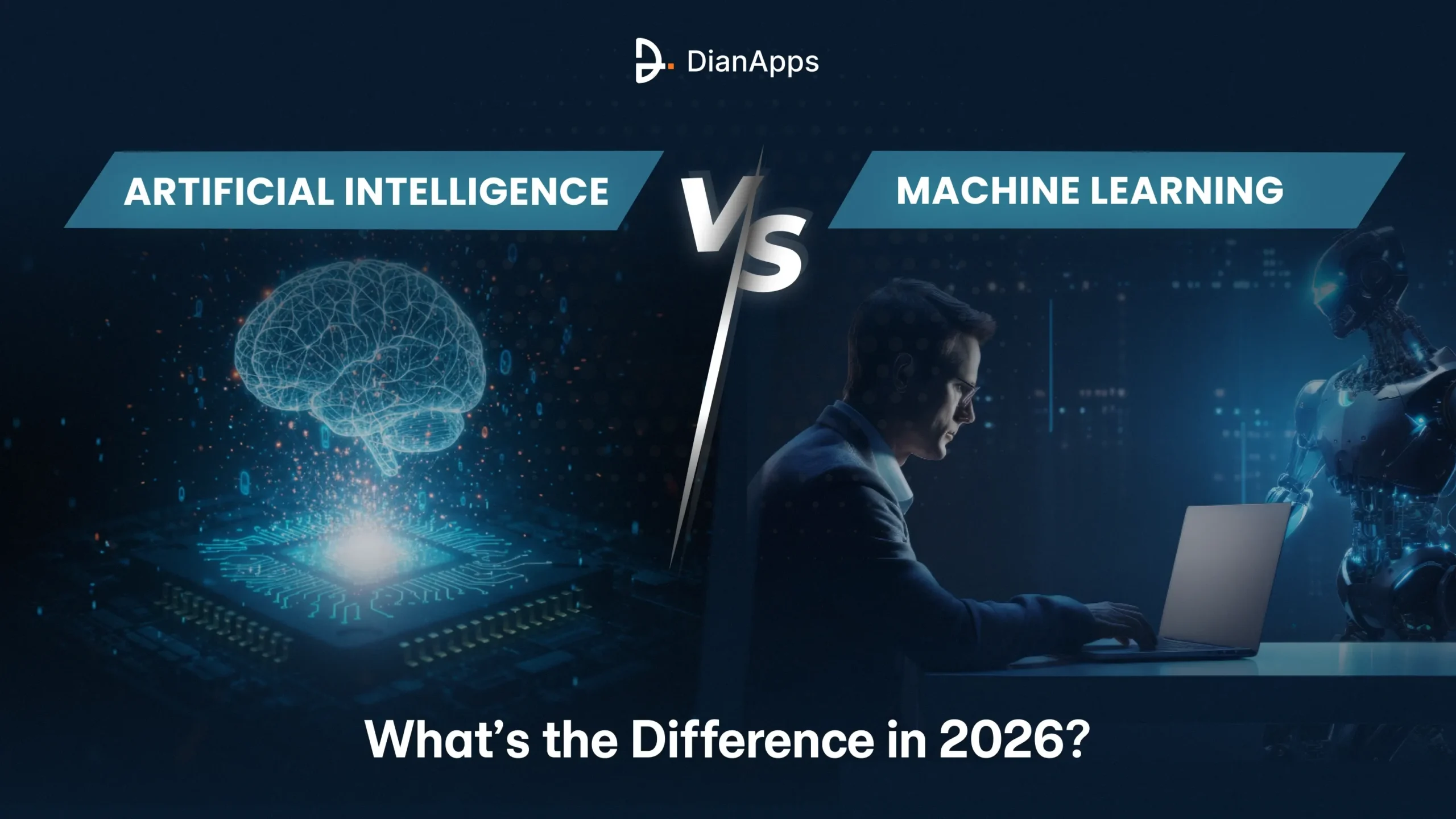
If you’ve typed “AI vs machine learning” into Google today, you’ve probably found the same recycled definitions that don’t really help you understand either, let alone decide which one your business needs. This blog is different.
We’re going to break down what AI and ML actually mean in 2026, show you where they overlap and where they part ways, look at what the industry trends are telling us, what it realistically costs to build with them, and how DianApps helps businesses across the USA, UK, Australia, UAE, Canada, and India build AI and ML systems that work, without burning through budget.
The confusion is understandable. Every software vendor, every news headline, and half of LinkedIn calls everything “AI” whether it’s a simple recommendation engine or a fully autonomous system. The terms have been used so interchangeably that even decision-makers inside tech companies sometimes pause when asked to explain the difference clearly.
The short answer: Machine learning is a part of AI. Not the same thing. Not a synonym. One is the big house, and the other is one of the rooms inside it. Once you see it that way, everything else clicks.
What Is Artificial Intelligence, Really?
Quick Answer: Artificial Intelligence is the broad field of building computer systems that can perform tasks that normally require human intelligence, such as reasoning, understanding language, recognizing images, making decisions, and solving problems. It is not a single technology. It is a category that includes many approaches, with machine learning being one of them.
Think of AI as the goal, not the method. The goal is to make machines that can think and act intelligently. How you get there, rule-based logic, neural networks, language models, computer vision, reinforcement learning, all of those are different tools used to reach that goal.
Know top 7 conversational AI trends today.
In 2026, AI shows up in ways that most people interact with daily without realizing it. It’s the reason your email client filters spam before you see it. It’s how your bank flags a suspicious transaction. It’s what powers the voice assistant on your phone and the product recommendations on e-commerce platforms.
None of these feels like “rocket science AI” but they all involve a system performing a task that once required human judgment.
The subfields of AI include
- Machine Learning
- Natural Language Processing (NLP)
- Computer Vision
- Robotics
- Expert Systems
- Large Language Models (LLMs)
- Agentic AI.
Each one solves a different type of problem, and they can be combined depending on the application.
What Is Machine Learning and How Does It Work?
Quick Answer: Machine learning is a subset of AI where a system learns patterns from data instead of being explicitly programmed with rules. The more relevant data you feed it, the better it gets at making predictions, recognizing patterns, and improving its output over time, without being told exactly what to look for.
Traditional software runs on rules that a developer writes. You write: “if X, then do Y.” Machine learning flips that. You give the system thousands of examples of X and Y, and it figures out the relationship on its own.
A classic example: a spam filter built with traditional rules would check for specific words or sender addresses. An ML-based spam filter learns what spam looks like across millions of emails, picks up on subtle patterns that no human would think to code, and keeps getting sharper as it sees more examples. That’s the power of learning from data.
There are three main types of machine learning:
- Supervised Learning: The model trains on labeled data (input + correct output). Used in fraud detection, image classification, and medical diagnosis.
- Unsupervised Learning: No labels. The model finds patterns and groupings on its own. Used in customer segmentation, anomaly detection, and recommendation systems.
- Reinforcement Learning: The model learns by trial and error, getting rewarded for correct decisions. Used in robotics, gaming AI, and logistics optimization.
There’s also deep learning, a subfield of ML that uses neural networks with many layers. This is what powers modern image recognition, speech-to-text systems, and large language models like ChatGPT. Deep learning is a specific technique within machine learning, not a separate category entirely.
AI vs Machine Learning: The Core Difference Explained
AI is the broader concept of building intelligent machines. Machine learning is one specific method of achieving AI by training systems on data instead of programming them with fixed rules. All machine learning is AI, but not all AI is machine learning.
| Factor | Artificial Intelligence (AI) | Machine Learning (ML) |
|---|---|---|
| Definition | Systems designed to simulate human intelligence and decision-making | A subset of AI where systems learn from data without explicit programming |
| Scope | Broad — includes ML, NLP, computer vision, robotics, expert systems | Narrower — focused on learning from data and pattern recognition |
| Goal | Build machines that can think, reason, and act intelligently | Enable systems to learn and improve accuracy from experience |
| Needs big data? | Not always — rule-based AI can work with little data | Yes — more quality data typically means better performance |
| Examples | Self-driving cars, AI assistants, expert systems, chatbots | Recommendation engines, fraud detection, predictive analytics |
| Decision-making | Can use logic, rules, or learned models | Strictly based on patterns found in training data |
| Human-like reasoning? | Goal is to simulate it | Not the goal — focus is on accuracy, not reasoning |
A helpful way to think about it: when a company says “we use AI,” they could mean anything, from a simple rule-based chatbot to a neural network trained on millions of records. When a company says “we use machine learning,” they’re being more specific; there’s a model, training data, and a learning process involved. The latter is always inside the former.
Real-World Examples That Show the Difference Clearly
Abstract explanations only go so far. Here are four scenarios that make the distinction concrete:
1. Healthcare
An AI system in a hospital might flag patients at risk of readmission, route them to the right specialist, and even schedule follow-ups, all without a doctor initiating each step. The ML component inside that system is the model trained on historical patient data that learned which symptoms and demographics predict readmission risk. The broader AI system acts on that prediction.
2. E-Commerce
When you browse a product and the platform immediately shows you “people also bought…”, that’s a machine learning recommendation model at work. The AI layer around it decides how and when to surface those recommendations, tests different placements, and personalizes the full shopping experience.
3. Finance
A bank’s fraud detection system uses ML to spot unusual transaction patterns based on thousands of past fraud cases. The AI platform manages the entire workflow, alerting the customer, temporarily freezing the card, logging the event, and routing it to a human agent if needed.
4. Customer Support
A machine learning model classifies incoming support tickets by topic and urgency. The AI-powered support system then routes each ticket to the right team, auto-generates a first-response draft, and escalates based on tone analysis. The ML does the categorization; the AI does the workflow.
Top AI and Machine Learning Trends Shaping 2026
This is where things get genuinely interesting. The AI and ML landscape in 2026 looks quite different from even two years ago. The technology has moved from research and experimentation into production, quietly powering real business operations at scale.
- $2.52T Global AI spending projected by the end of 2026 (McKinsey Global AI Report)
- 78% Organizations now use AI in at least one business function (McKinsey, 2026)
- 40% Enterprise apps expected to embed AI agents by the end of 2026, up from less than 5% in 2025 (Gartner)
- $263B Projected autonomous AI market size by 2035, growing at ~40% CAGR (Research Nester)
01. Agentic AI Is Moving from Pilot to Production
AI agents in 2026 don’t just answer questions; they plan, decide, and execute multi-step tasks with minimal human input. Gartner reported a 1,445% surge in multi-agent system inquiries between Q1 2024 and Q2 2025. Organizations that deploy agents well are cutting operational costs by up to 30% and reducing human task time by up to 86% in structured workflows.
02. Smaller, Specialized ML Models Are Winning
The race to build the biggest model is cooling down. In 2026, smaller domain-specific models, trained on focused, high-quality datasets, are outperforming general-purpose giants on targeted tasks, at a fraction of the cost. A 7B parameter model today can match results that required 70B+ parameters just two years ago.
03. Generative AI Is Now Business Infrastructure
Generative AI has moved beyond the chatbot phase. In 2026, it’s embedded into product workflows, generating code, customer communications, product descriptions, financial summaries, and synthetic training data. Businesses are using it not as a demo, but as a productivity layer running quietly in the background.
04. MLOps and AgentOps Are Now Non-Negotiable
Deploying an ML model is one thing. Keeping it performing well in production with drift detection, retraining pipelines, and monitoring is another. MLOps has matured into a standard practice in 2026. AgentOps, its equivalent for autonomous AI agents, is fast following. Companies that skip this infrastructure are the ones paying for expensive emergency fixes post-launch.
05. Edge AI Is Becoming Real
Running ML models directly on devices, phones, sensors, and industrial equipment, rather than routing data to the cloud, is gaining ground fast. It reduces latency, protects sensitive data, and lowers cloud compute costs. IBM publicly notes that edge AI will shift from hype to genuine enterprise deployment in 2026.
06. AI Governance Is Becoming Mandatory
Regulators are catching up. The AI governance market is projected to surpass $1.42 billion by the end of the decade (Grand View Research). In 2026, industries like healthcare, finance, and legal are seeing governance frameworks move from “best practice” to compliance requirement, especially in the US, EU, and UK.
07. AI-Driven Cybersecurity Is Accelerating
Cyber threats are now AI-generated, deepfakes, automated phishing, voice cloning. The defense is also becoming AI-driven. In 2026, agentic cybersecurity systems can autonomously detect anomalies, simulate attacks, and respond to incidents before they escalate. This arms race is one of the fastest-moving AI application areas right now.
How AI and Machine Learning Work Together in 2026
One of the most important things to understand is that AI and ML are not competing technologies. They work together, almost always. Machine learning gives AI systems the ability to learn and improve. AI gives ML models a broader context to operate within.
In 2026, the most effective intelligent systems combine both. A modern customer service platform might use ML to classify tickets, NLP (a form of AI) to understand tone and intent, a generative model to draft responses, and an agentic AI layer to route, escalate, and close issues end-to-end. The ML is doing the heavy lifting on data patterns. The AI system is orchestrating the outcome.
If you’re a business evaluating where to start, the real question isn’t “do I need AI or ML?”, it’s “what business problem am I trying to solve, and what’s the right combination of tools to solve it?” That’s exactly the kind of conversation DianApps has with clients before writing a single line of code. Explore our AI & ML Development Services to see how we approach this.
How Much Does AI and ML Development Actually Cost in 2026?
This is the question most businesses hesitate to ask, either because they’re afraid the answer is “millions of dollars,” or because previous estimates they’ve seen vary wildly. The truth is, AI and ML development costs in 2026 depend almost entirely on what you’re building and how complex that problem actually is.
Here’s a realistic breakdown based on current industry benchmarks:
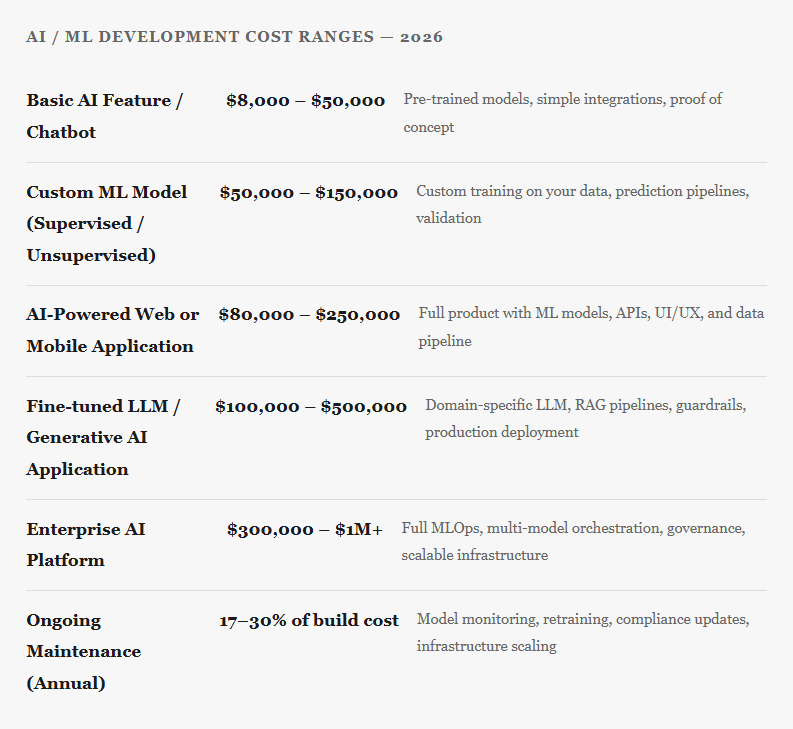
Learn more about the AI/ML app development cost via this complete cost breakdown guide.
Model monitoring, retraining, compliance updates, and infrastructure scaling
A few things drive costs up faster than anything else: poor data readiness (the most common issue), skipping MLOps architecture early on, scope creep in generative AI projects (which inflates budgets by 60–150% on average), and choosing cloud infrastructure only after development starts instead of from day one.
One trend making AI more accessible in 2026: API costs have dropped dramatically. GPT-4-level performance that cost $30 per million tokens in 2023 now runs at under $1 per million. That’s roughly a 30x reduction. For businesses starting out, this means a well-scoped MVP that uses existing foundation models can be built fast and affordably, and only scaled to custom training when the use case genuinely demands it.
For independent consultants, US-based AI engineers currently charge $150–$300 per hour, with full-time ML engineers earning $134,000–$193,000 annually.
Offshore AI development teams in regions like India offer comparable technical quality at significantly lower rates, which is where a partner like DianApps creates real cost efficiency for clients in Western markets. Explore our ML Development Services to see engagement models and pricing options.
How DianApps Delivers AI and ML Development at a Cost-Effective Scale
DianApps works with businesses across the USA, UK, Australia, UAE, Canada, and India, and one of the most consistent feedback points from clients is that they got more for their AI investment than they expected. That’s not a marketing claim. It’s a result of how we structure every engagement.
We Start with Discovery, Not Code
Before any development starts, we run a structured discovery phase, auditing your data readiness, mapping integration dependencies, identifying the simplest viable model that actually solves your problem, and setting clear KPIs. This alone prevents the budget overruns that kill most AI projects. The 11% of organizations that reach production successfully all share this trait: they scope before they build.
We Match the Right Model to the Right Problem
Most companies don’t need to train a model from scratch. They need a well-scoped ML model, a fine-tuned foundation model, or a smart integration of existing AI APIs, depending on the use case. DianApps engineers know the difference and won’t upsell complexity you don’t need. Using pre-trained models and transfer learning reduces development costs by 60–70% compared to building from scratch, and we apply this approach wherever it genuinely fits.
Offshore Expertise, Western-Standard Delivery
Our core AI and ML engineering teams are based in India, one of the world’s largest talent hubs for data scientists and ML engineers. This gives clients in the US, UK, Australia, and Canada access to senior-level AI expertise at 40–60% lower cost than hiring locally, with no compromise on code quality, communication, or delivery timelines. We work in your time zone, follow your processes, and deliver documentation you can actually maintain internally.
MLOps Built In from Day One
We don’t deploy models and disappear. Every AI system DianApps builds includes monitoring, drift detection, and a retraining plan. This is not optional; it’s part of every engagement. Clients who partner with us don’t find themselves paying $40,000–$100,000 in emergency MLOps rebuilds six months after launch. We build it right the first time.
- 40–60% Typical cost savings vs. hiring locally in the US, UK, or Australia for equivalent AI talent
- 60–70% Reduction in training costs using transfer learning vs. building from scratch
- 25%+ Average efficiency improvement reported by clients post-deployment (per industry benchmarks)
- 49% Enterprises reporting measurable cost savings from AI in service operations (McKinsey)
Whether you’re a startup building your first ML feature, a mid-market company looking to automate a workflow, or an enterprise evaluating a full AI platform, DianApps structures the engagement to fit your stage and budget. Visit our AI Development Services page to see how we approach specific industries and use cases.
AI vs ML: Which One Does Your Business Actually Need?
This is the practical question that matters most once you understand the difference. Here’s a straightforward way to think about it:
You probably need Machine Learning if you have a large amount of data and want to extract predictions, find patterns, automate classifications, or build recommendation systems. Examples include predicting churn, scoring leads, detecting anomalies, or personalizing content.
You probably need broader AI if: you want to build a system that can reason, understand language, process images, respond to users conversationally, or operate autonomously across multiple steps. Examples include intelligent assistants, document processing systems, visual inspection tools, or agentic workflows.
You likely need both if you’re building a product or platform where ML models power the intelligence, but a broader AI system orchestrates the user experience, workflow, and outcomes. This is the most common scenario for companies building serious software products today.
If you’re not sure which bucket your project falls into, that’s exactly what DianApps discovery process is designed to answer, before any budget is committed. Reach out via our AI & ML Development Services page, and we’ll map it out with you.
Final Thoughts: The Difference Matters More Now Than Ever
In 2026, AI and machine learning are no longer optional add-ons or experiments for large enterprises with deep pockets. They’re becoming standard parts of how competitive businesses operate, from automating workflows to improving customer experiences, from making faster decisions to building products that learn and improve over time.
Understanding the difference between AI and ML isn’t just an intellectual exercise. It changes how you plan a project, set a budget, choose a partner, and set realistic expectations for what the technology can actually deliver. A business that knows the difference asks better questions. And better questions lead to better outcomes.
The companies that will lead in their industries over the next five years aren’t necessarily the ones with the biggest AI budgets. They’re the ones that make smart, well-scoped investments in the right tools and build with partners who understand both the technology and the business problem it’s meant to solve.
Frequently Asked Questions
 0 comments









Leave a Comment
Your email address will not be published. Required fields are marked *