















 0 comments
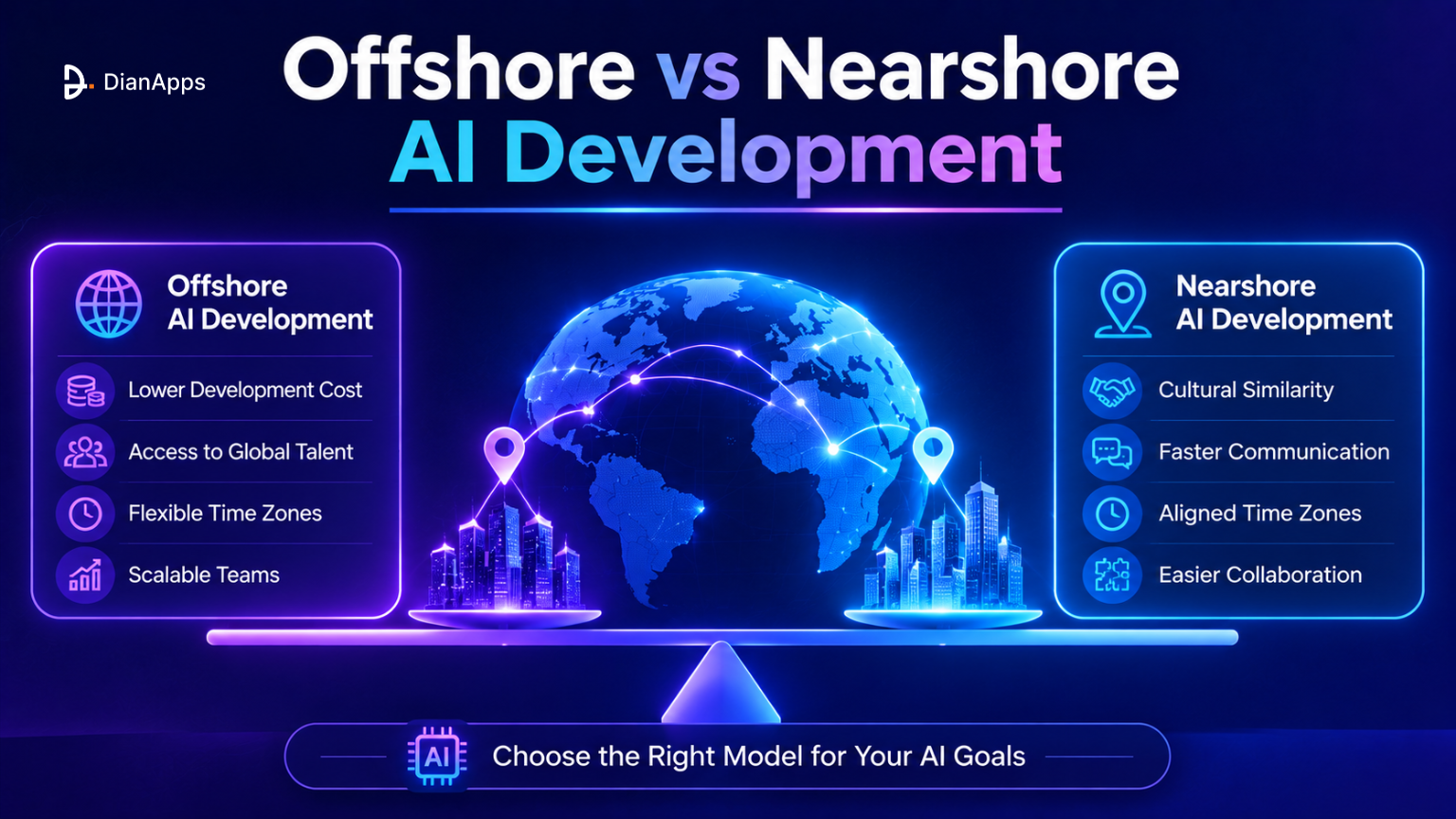





Key Takeaways:
- The Trade Is Overlap Versus Depth: Nearshore (Latin America for U.S. buyers) is giving 5 to 8 hours of daily timezone overlap, offshore (India, Southeast Asia, Eastern Europe) is giving deeper talent pools and lower rates with 0 to 4 hours of overlap (Hire in South, 2026).
- The Rate Gap Is Real But Narrowing At Seniority: Senior offshore AI engineers are running USD 28 to 55 per hour in India versus USD 50 to 85 nearshore in Latin America and at staff or ML-research level the two markets are nearly comparable.
- Async-Friendly Work Is Favouring Offshore: Model training, data pipelines and well-specified builds are tolerating low overlap, agent iteration and product discovery are needing real-time collaboration.
- Hybrid Is Winning In Practice: U.S.-facing leadership with offshore engineering benches is capturing both economics and accountability and it is the model most 2026 engagements are converging on.
Quick Answer: Offshore vs nearshore AI development is a trade between cost and collaboration. Offshore (India, Vietnam, Eastern Europe) is offering senior AI engineers from USD 28 to 55 per hour with the deepest talent pools, nearshore (Mexico, Brazil, Colombia) is offering USD 50 to 85 with full U.S. timezone overlap. Hybrid setups with U.S. leadership, such as DianApps’ AI development services, are combining both.
The offshore vs nearshore AI development question is deciding more budgets in 2026 than any framework or model choice, because geography is setting your rate band, your meeting hours and your access to scarce AI talent all at once. 57% of enterprises are seeking new outsourcing partners for AI needs and most of them are asking this exact question first.
This guide is comparing the two models head to head, pricing them by country, listing the honest pros and cons and ending with a decision framework you can apply to your own project.
Build AI With the Right Delivery Model
Get AI engineering support matched to your project’s complexity, collaboration needs, timezone requirements, and production goals.
What Do Offshore and Nearshore Mean in AI Development?
Offshore AI development is placing your engineering team in a distant, low-cost region, typically India, Southeast Asia or Eastern Europe for U.S. buyers, while nearshore AI development is placing it in an adjacent timezone, typically Mexico, Colombia, Brazil or Argentina, trading some cost savings for real-time collaboration.
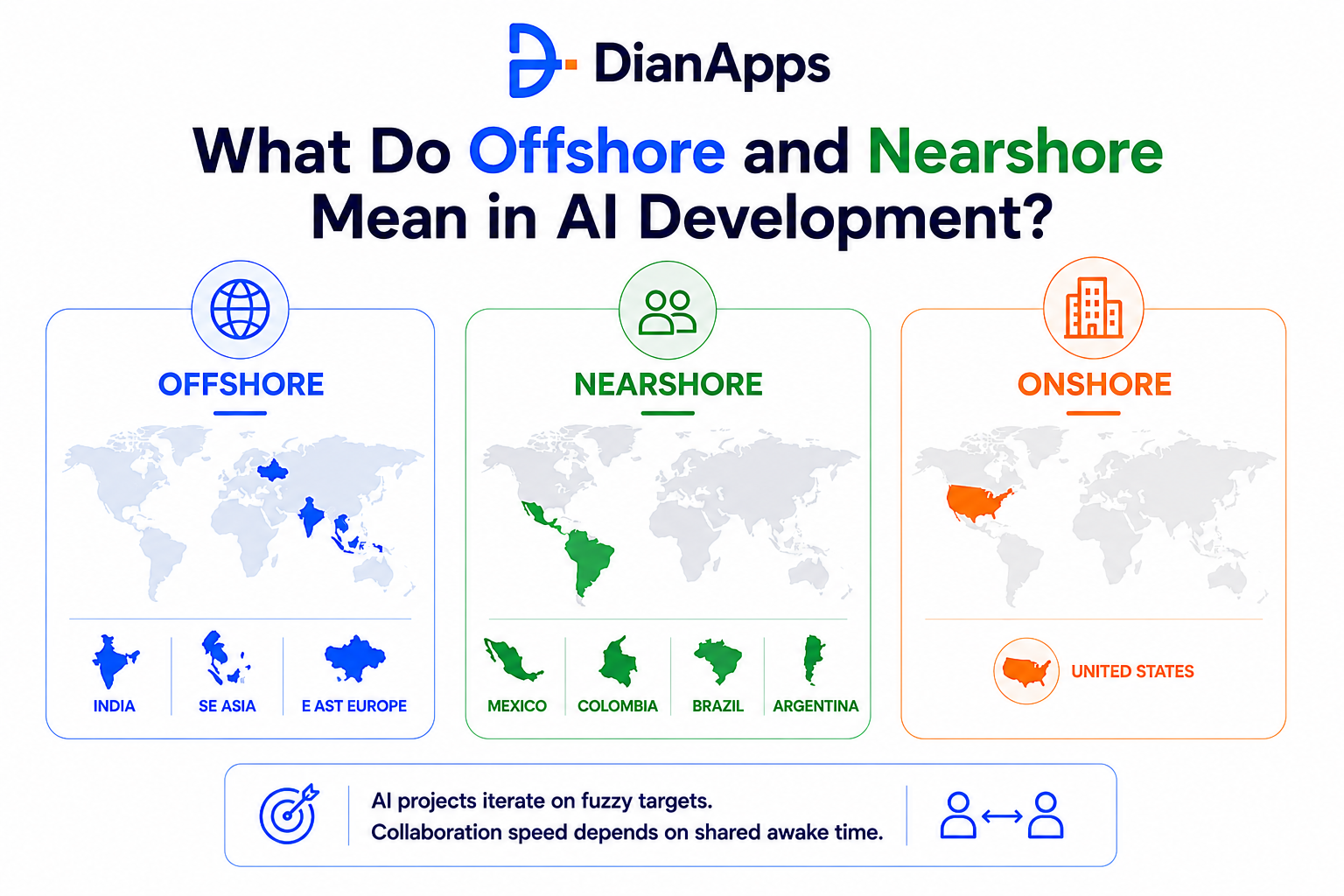
The distinction matters more for AI work than for general software. AI projects are iterating on fuzzy targets, prompts, evals, agent behaviours and iteration speed is depending on how often your product owner and the engineers are awake at the same time.
A third option, onshore (U.S.-based teams at USD 75 to 135+ per hour), is remaining the choice for classified, heavily regulated or discovery-heavy work and it is the benchmark both models are being measured against.
The distinction matters because AI development involves more than conventional application coding, covering model integration, data pipelines, evaluation, deployment, and ongoing optimization. A clear understanding of what is AI development helps buyers judge which delivery model their project requires.
Offshore vs Nearshore AI Development: Head-to-Head
The table below is comparing the two models on the factors that are actually deciding engagements.
| Factor | Offshore (India, SE Asia, E. Europe) | Nearshore (Latin America) |
| Senior AI rate (USD/hr) | 28-55 (India), 22-48 (SE Asia), 45-75 (E. Europe) | 50-85 |
| U.S. timezone overlap | 0-4 hours | 5-8 hours |
| Talent pool depth | Deepest globally, especially India | Growing fast, smaller absolute pool |
| Best-fit work | Well-specified builds, data pipelines, ML training, maintenance | Agent iteration, product discovery, pair-style collaboration |
| Annual AI-role turnover | 25-40% in hot markets | Lower, less local competition |
| Typical savings vs U.S. | 55-70% | 30-50% |
The pattern to remember is that offshore is winning on unit cost and depth, nearshore is winning on iteration speed and the more experimental your AI project is, the more those overlap hours are worth.
Offshore AI Rates by Country in 2026
For buyers pricing offshore AI development rates, the senior-engineer bands are holding steady across sources this year.
| Country | Senior AI rate (USD/hr) | Notes |
| India | 28-55 | Largest AI talent pool, strong LLM and ML depth |
| Vietnam | 25-45 | Fast-growing, strong for well-specified builds |
| Philippines | 22-40 | Strength in support-adjacent AI and QA |
| Ukraine | 30-55 | Senior density, wartime resilience proven |
| Poland | 40-65 | EU compliance comfort, high English proficiency |
| Mexico (nearshore) | 50-75 | Full U.S. overlap, USMCA data comfort |
| Brazil (nearshore) | 60-85 | Largest LatAm pool, strong data engineering |
| Colombia (nearshore) | 45-65 | Best LatAm value, growing AI scene |
Source: Geniusee outsourcing rate research, 2026.
Total cost of engagement is the number that is mattering, management overhead, rework and communication lag are routinely adding 20 to 40% to a low sticker rate, which is why the cheapest hour is not always the cheapest project.
That is why buyers should evaluate AI development cost as a total engagement rather than comparing hourly rates alone, especially when management, rework, infrastructure, and ongoing engineering are included.
Offshore vs Nearshore AI Development: Monthly Cost Comparison
If you are wondering on the monthly cost of such development teams, here is a clear breakdown for you.
| Cost Factor | Offshore AI Development | Nearshore AI Development | Hybrid AI Development |
| Senior AI Engineer Rate | $28–$55/hr | $50–$85/hr | $35–$70/hr blended |
| Monthly Cost per Engineer | $4,500–$8,800 | $8,000–$13,600 | $5,600–$11,200 |
| 4-Engineer Team / Month | $18,000–$35,200 | $32,000–$54,400 | $22,400–$44,800 |
| 6-Month Engineering Cost | $108K–$211K | $192K–$326K | $134K–$269K |
| Management Overhead | 10–20% | 8–15% | 8–15% |
| Communication / Rework Risk | Higher | Lower | Moderate |
| U.S. Timezone Overlap | 0–4 hours | 5–8 hours | 3–8 hours |
| Best For | Defined builds, ML pipelines, RAG, maintenance | Discovery, agents, iterative AI products | Complex production AI projects |
| Potential Savings vs U.S. Teams | 55–70% | 30–50% | 40–60% |
Offshore vs Nearshore by AI Project Type
Since you now know the detailed cost breakdown by time constraints, here is a detailed breakdown on the basis of AI project types:
| AI Project | Best Model | Why |
| RAG chatbot | Offshore | Well-defined architecture and async-friendly |
| AI agents | Nearshore / Hybrid | Frequent behavior and prompt iteration |
| Computer vision | Offshore | Specialist talent and longer development cycles |
| Predictive ML | Offshore | Data and model work can be structured |
| AI SaaS MVP | Nearshore / Hybrid | High product-owner interaction |
| LLM integration | Offshore | Easier to specify and hand off |
| AI product discovery | Nearshore | Requires frequent collaboration |
| MLOps & maintenance | Offshore | Ongoing, process-driven work |
Pros and Cons of Offshore AI Development
The pros and cons of offshore AI development are worth stating plainly, because most vendor content is hiding half of them.
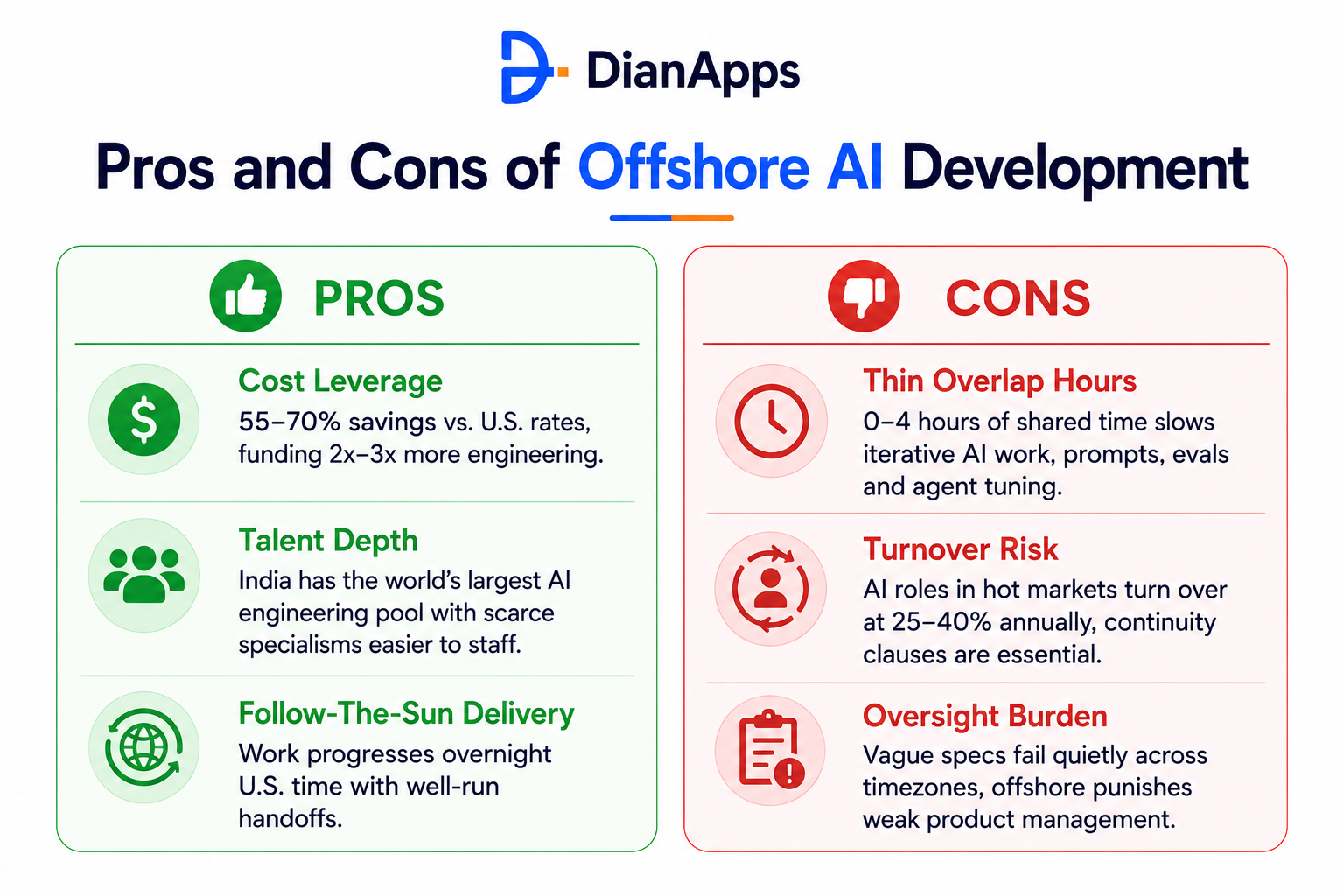
Pros:
- Cost Leverage: 55 to 70% savings versus U.S. rates, which is funding 2x to 3x more engineering per dollar.
- Talent Depth: India alone is holding the world’s largest AI engineering pool, scarce specialisms (MLOps, computer vision, LLM evals) are easier to staff. That depth also matters when projects require experience across different model-development frameworks and orchestration approaches. Buyers comparing technical capability can use the top LLM frameworks as a useful reference point when evaluating a vendor’s engineering bench.
- Follow-The-Sun Delivery: Work is progressing overnight U.S. time when handoffs are well run.
Cons:
- Thin Overlap Hours: 0 to 4 hours of shared time is slowing iterative AI work, prompts, evals and agent behaviour tuning are suffering most.
- Turnover Risk: AI roles in hot offshore markets are turning over at 25 to 40% annually, continuity clauses are essential (Hire in South, 2026).
- Oversight Burden: Vague specs are failing quietly across timezones, offshore is punishing weak product management.
Nearshore is mirroring the list, stronger collaboration and retention, smaller pool and a 30 to 50% saving instead of 55 to 70%.
Nearshore vs Offshore ML and AI Work: Match the Model to the Task
The nearshore vs offshore ML decision is cleanest when it is made per work-type rather than per company and it is where the offshore vs nearshore AI development trade-off is turning practical.
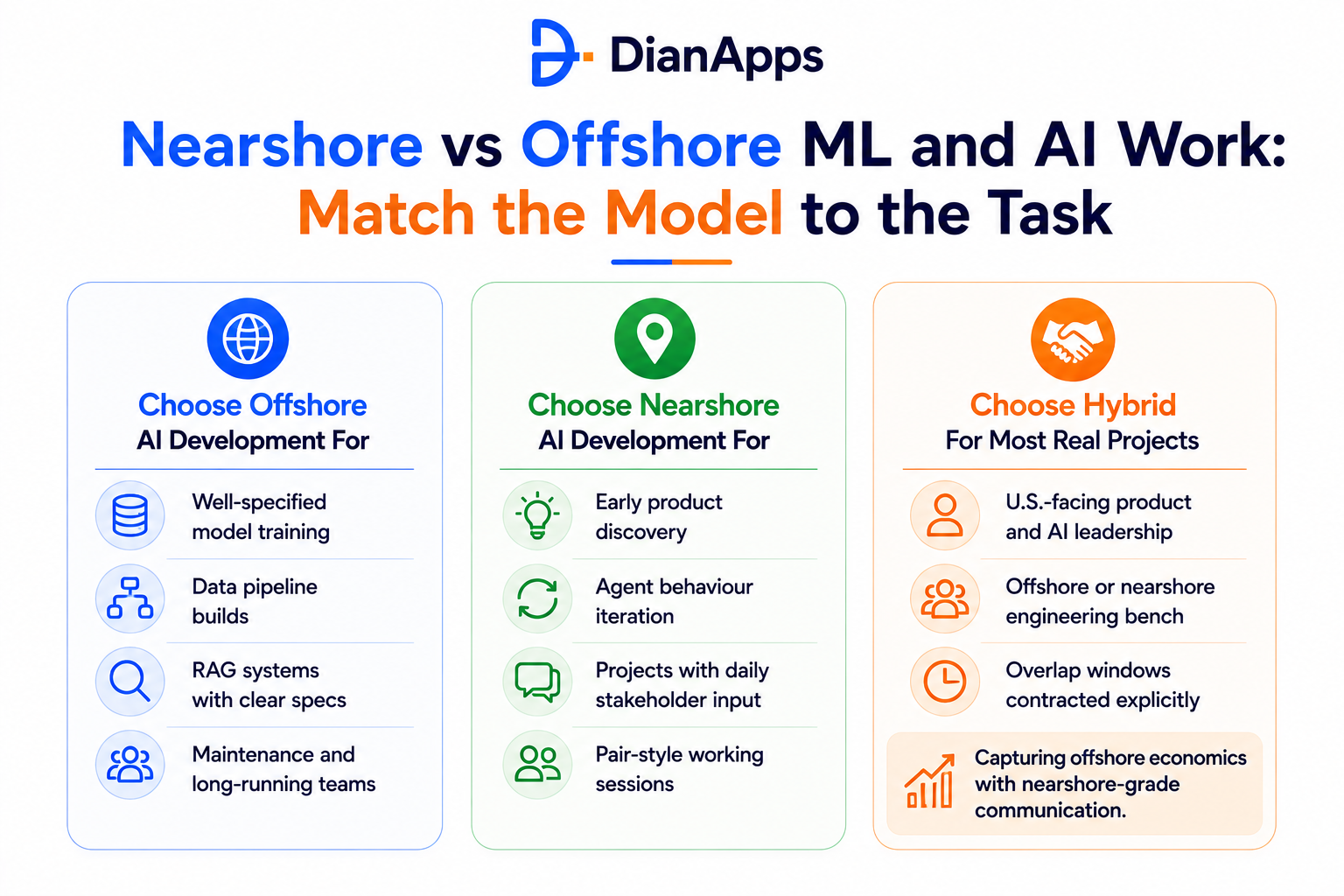
- Choose Offshore AI Development For: Well-specified model training, data pipeline builds, RAG (Retrieval-Augmented Generation) systems with clear specs, maintenance and long-running dedicated teams.
- Choose Nearshore AI Development For: Early product discovery, agent behaviour iteration, projects with daily stakeholder input and teams doing pair-style working sessions.
- Choose Hybrid For Most Real Projects: U.S.-facing product and AI leadership, an offshore or nearshore engineering bench and overlap windows contracted explicitly, this is capturing offshore economics with nearshore-grade communication.
The decision also depends on the underlying AI development tech stack, since model infrastructure, data pipelines, APIs, evaluation, observability, and deployment can require different levels of specialist expertise.
The best region to outsource AI is the one matching your project’s iteration tempo, not the one with the lowest hourly rate.
Need AI Talent That Fits Your Workflow?
Add experienced AI developers for model development, RAG, agents, ML pipelines, and production engineering without building the entire team in-house.
A 5-Step Framework for the Offshore vs Nearshore AI Development Decision
Applying the offshore vs nearshore AI development comparison to your own project is coming down to five questions, answered in order.
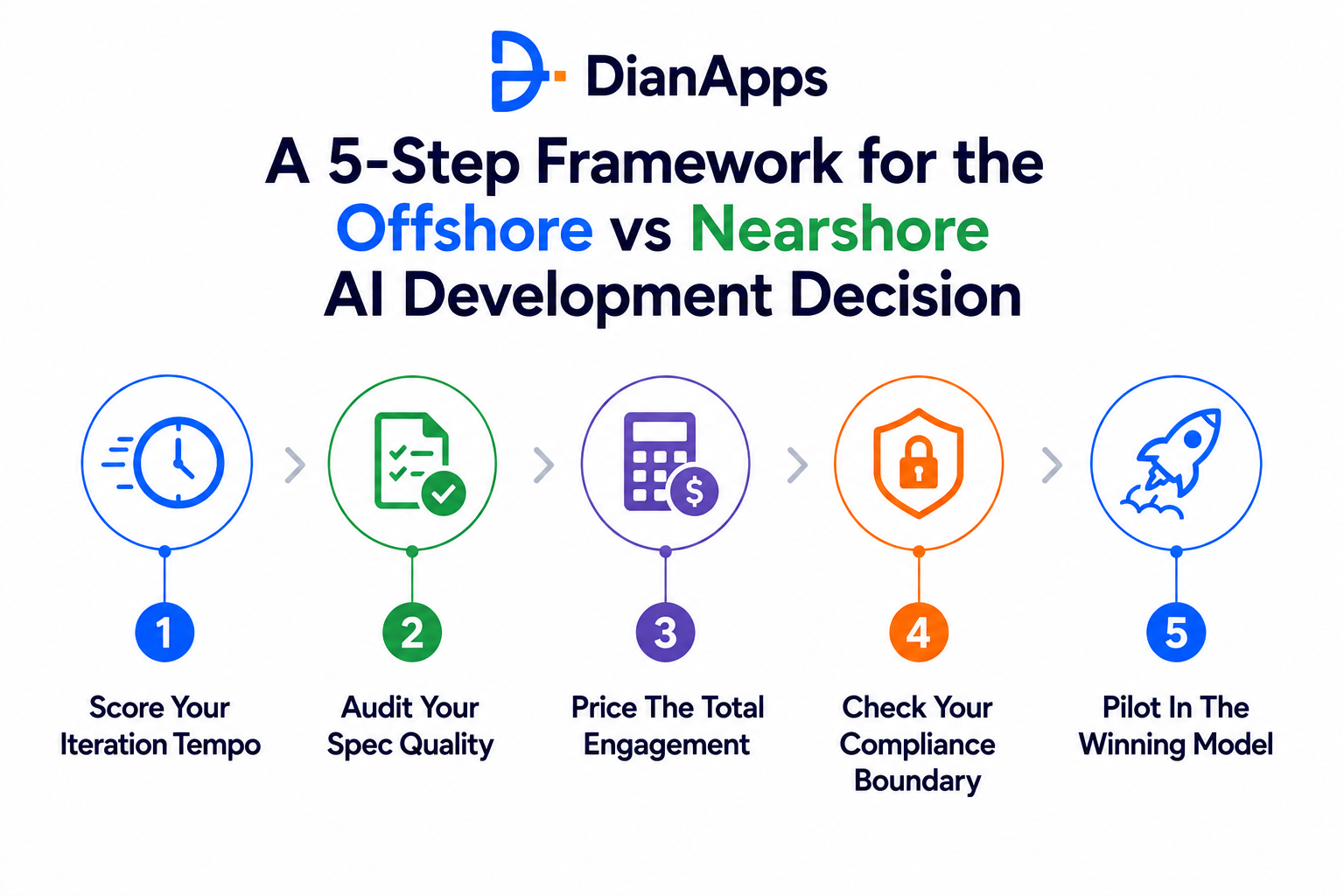
- Score Your Iteration Tempo: Count the decisions per week that are needing stakeholder input. More than three are pointing nearshore or hybrid, fewer are pointing offshore.
- Audit Your Spec Quality: A written spec with acceptance criteria and an eval set is travelling across timezones safely, a vision in a founder’s head is not.
- Price The Total Engagement: Take the sticker rate, add 20 to 40% for management overhead and rework, then compare, the offshore vs nearshore AI development gap is often halving at total cost.
- Check Your Compliance Boundary: Data residency, HIPAA or defence constraints are ruling regions out before rates are entering the conversation.
- Pilot In The Winning Model: A paid four-to-eight-week pilot with evals as deliverables is settling the question with evidence instead of opinion.
Run the five steps honestly and the offshore vs nearshore AI development debate is usually resolving itself, the project’s shape is choosing the region for you.
For buyers without an established AI engineering team, AI Development Services can also provide a way to compare delivery models against the actual technical and operational requirements of the project.
How DianApps Runs the Hybrid Model?
DianApps, an AI-first product development company with 150+ engineers, 450+ clients across 25+ countries and a 4.8/5 Clutch rating from 84+ reviews, is built on the hybrid answer to the offshore vs nearshore AI development question, U.S. presence for discovery, product leadership and accountability, with a global engineering bench keeping senior AI rates in the USD 25 to 49 band.
Engagements are contracting overlap windows explicitly, daily standups in U.S. hours, async documentation between them and evals and tracing as named deliverables, so the offshore economics are arriving without the offshore communication tax. The AI practice is spanning LLM development, generative AI, AI agents, conversational AI, ML, NLP and computer vision, delivered with the mobile, web, backend and DevOps around them.
The candid note is the same one we are giving every buyer, if your project is classified, heavily regulated or needing daily in-person discovery, onshore is the right call and we are saying so at scoping.
Not Sure Which AI Delivery Model Fits?
Share your project scope, collaboration needs, and target outcomes, and our AI team can help determine whether offshore, nearshore, or hybrid makes the most sense.
Conclusion
The offshore vs nearshore AI development decision is really a decision about your project’s tempo, offshore is buying depth and 55 to 70% savings for work that specs cleanly, nearshore is buying 5 to 8 daily overlap hours for work that iterates and hybrid is capturing both when the contract is naming overlap windows, engineers and eval deliverables.
Price the total cost of engagement not the hourly rate, pilot before you commit and match the region to the work. If a hybrid model with U.S. leadership fits your project, talk to DianApps’ AI development team about a fixed-scope pilot.
 0 comments










Your email address will not be published. Required fields are marked *