















 0 comments





Key Takeaways :
- AI contract review software can identify clauses, extract key terms, flag risks, compare agreements, and summarize contracts.
- The article compares Spellbook, Luminance, Ironclad, LegalOn, Juro, and Kira by Litera.
- AI performs best on repetitive, high-volume contract review tasks, but legal professionals should make final decisions.
- Accuracy depends on contract complexity, review instructions, playbooks, data quality, and the AI system itself.
- Security checks should include encryption, access controls, retention policies, audit logs, and model-training practices.
- Pricing varies based on users, contract volume, AI capabilities, integrations, security, and customization.
- Off-the-shelf tools suit standardized workflows, while custom AI can support proprietary playbooks, custom risk scoring, private infrastructure, and specialized integrations.
- Custom solutions can include document intelligence, legal playbooks, risk scoring, knowledge retrieval, workflow automation, and enterprise integrations.
Quick Answer: AI contract review software helps legal teams analyze contracts faster by identifying clauses, extracting key information, comparing agreements against playbooks, and flagging potential risks. The six tools covered are Spellbook, Luminance, Ironclad, LegalOn, Juro, and Kira by Litera. For specialized workflows, proprietary legal rules, strict security requirements, or complex integrations, a custom AI contract review solution may be a better fit.
Contract review is one of the time-consuming tasks for legal teams. A single agreement can have dozens of clauses, obligations, exceptions, definitions and risks that must be checked carefully. When the number of contracts goes up, looking at every document by hand can slow down business and lead to problems.
That is why AI contract review software is becoming a part of modern legal work.
AI contract review tools can look at documents, find important parts, point out possible problems, check agreements against set rules and explain complicated details. They do not take the place of lawyers. They can cut down on repeated tasks and let legal teams focus on choices that need expert thinking. Mordor Intelligence’s report, updated July 30, 2026, estimates that the global generative AI market for legal contract drafting and review will be worth $4.21 billion in 2026, growing from $3.34 billion in 2025. It projects the market to reach $14.76 billion by 2031, representing a 28.52% CAGR.
This guide explains how AI contract review software works, the top tools, in 2026, how accurate and safe they are, how much they cost and when companies should think about making their legal AI system.
What Is AI Contract Review Software?
AI contract review software uses intelligence to look at contracts and other legal documents. By reading every page by hand legal professionals can use AI to find important details and possible problems more quickly. Depending on the platform the software can help with:
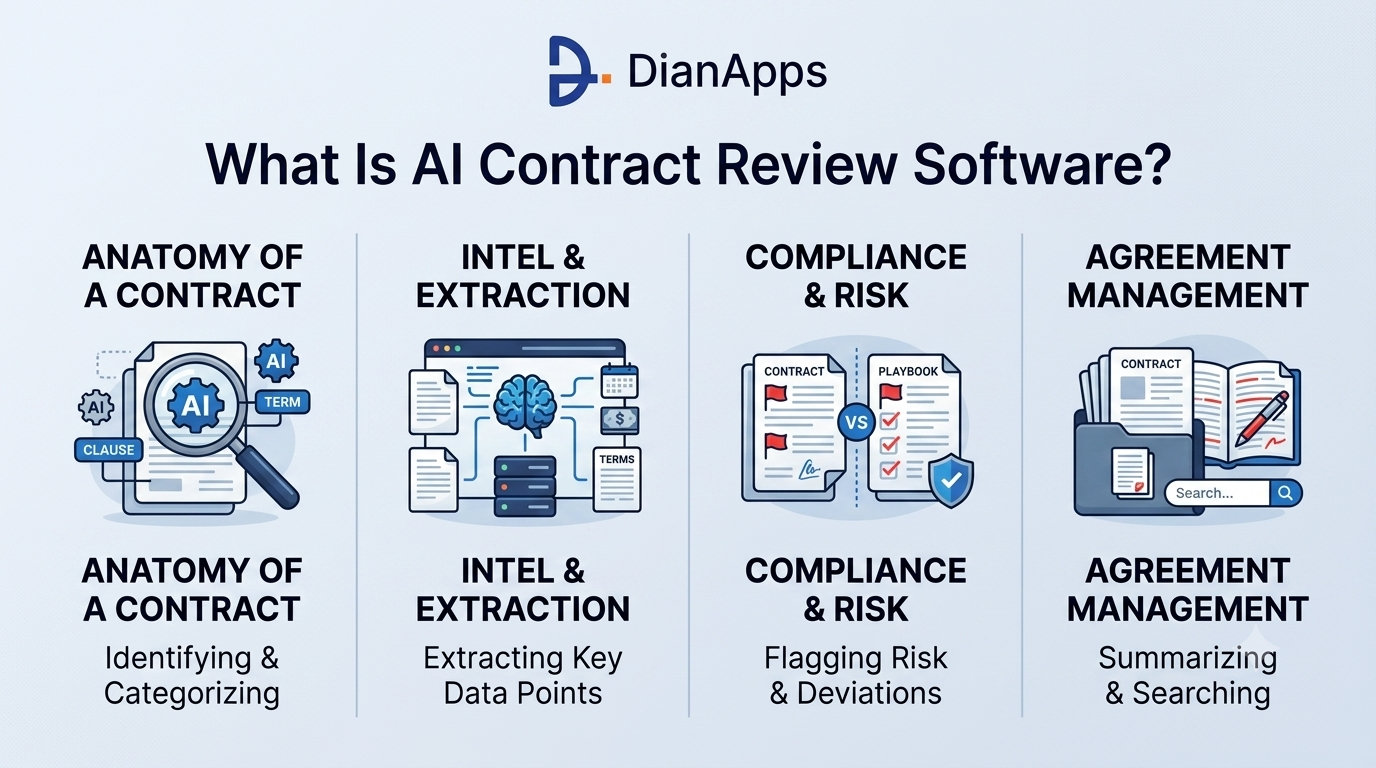
- Identifying clauses
- Extracting dates, obligations and key terms
- Flagging unusual or risky language
- Comparing contracts against legal playbooks
- Detecting missing provisions
- Summarizing agreements
- Suggesting revisions or redlines
- Searching large contract repositories
AI contract analysis works especially well for repetitive and high-volume contracts, such as NDAs, vendor agreements, employment contracts, MSAs and procurement agreements.
The goal is not to replace decision-making completely. Instead AI serves as a first step in the review process. It helps lawyers spot what needs their attention so they can focus on the important parts.
How Does AI Review Contracts?
AI contract review tools use a mix of document processing, machine learning, natural language processing and large language models.
Even though each platform may work differently the overall process usually follows four steps:
1. The AI Processes the Document
The software takes the contract that is uploaded and looks at its structure.
It can spot sections, clauses, definitions, dates the people involved what each side is expected to do. Other key details.
2. It Identifies Relevant Clauses
Next the system finds parts of the contract that match topics.
These include things like:
- Liability
- Indemnification
- Confidentiality
- Intellectual property
- Payment terms
- Termination
- Data protection
- Governing law
- Renewal
This helps legal teams quickly find what matters by reading every page by hand.
3. It Compares Language Against Standards
One of the parts of using AI for contract review is the ability to check language against known rules.
AI can compare a contract to:
- Internal legal playbooks
- Approved contract templates
- Clause libraries
- agreements
- Preferred negotiation positions
For example if a company has a standard liability clause the AI can notice when a new contract uses different words.
4. It Flags Risks
The system points out parts that could be risky.
This might include things like liability unusual termination rules, missing data protection or very strong indemnification terms.
A lawyer then checks these flagged items and decides what to do.
This human-in-the-loop method is the realistic way to use AI in legal document review today.
Does AI Contract Review Actually Work?
AI shines in repetitive and high-volume legal work.
AI performs well when legal teams need to identify clauses, pull out information, compare documents and spot changes that break set rules.
For example an in‑house legal team that looks over hundreds of vendor agreements can use AI to spot contracts that have odd payment terms or liability clauses.
However AI does have limits.
A clause cannot always be judged on its own. The business relationship, negotiation context, jurisdiction and commercial priorities all influence whether a provision is acceptable.
The effectiveness of AI contract review depends on:
- The quality of the AI system
- The complexity of the contract
- The review instructions
- The organizations playbooks
- The quality of the underlying data
The best approach is to use AI to speed up the first review while keeping lawyers in charge of final legal decisions.
Ready to Build AI Into Your Contract Review Process?
Build AI solutions that can analyze contracts, identify clauses, compare agreements against legal playbooks, flag risks, and integrate with your existing legal workflows.
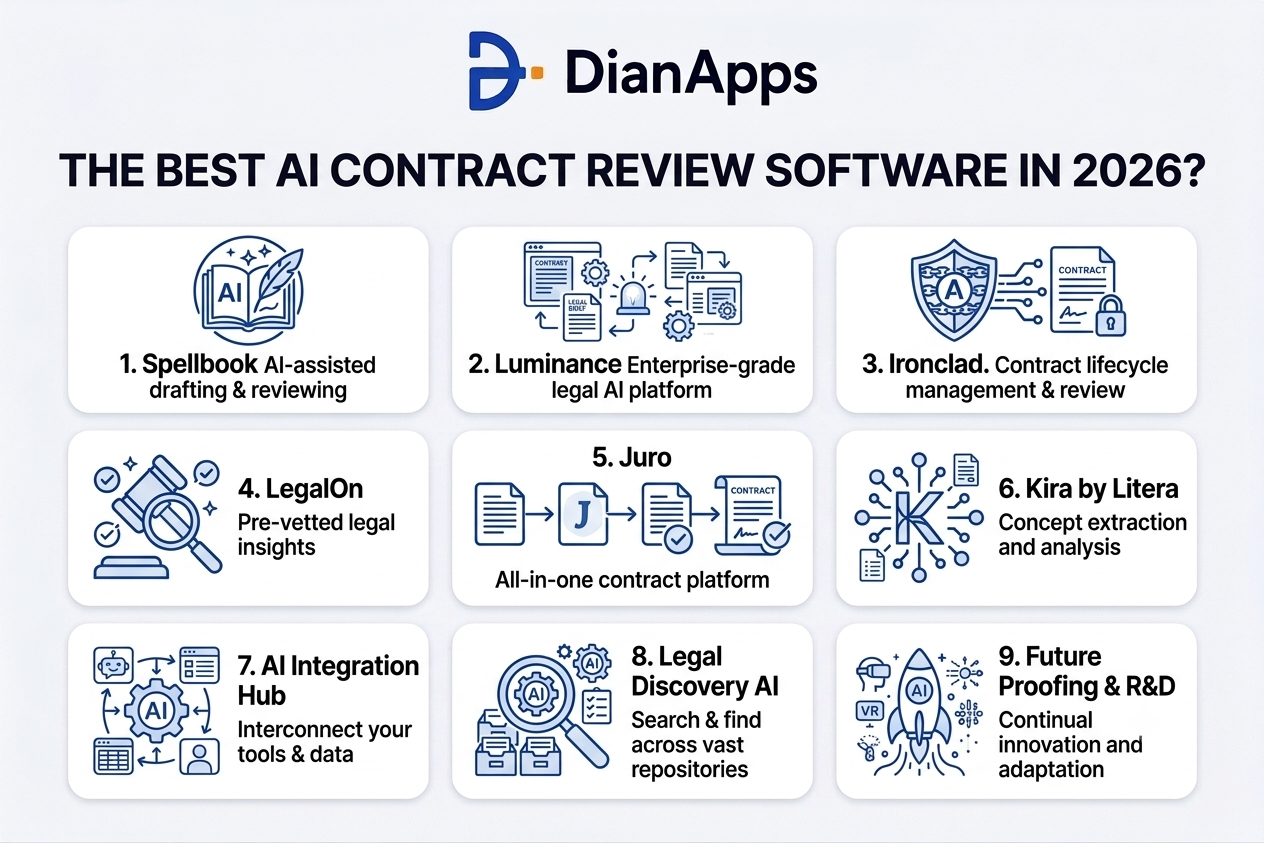
What Is the Best AI Contract Review Software in 2026?
The best AI contract review software depends on your organization’s workflow, contract volume and legal requirements.
Here are some notable options.
1. Spellbook
Spellbook is designed for lawyers and legal teams involved in contract work. It is particularly useful for professionals who work extensively in Microsoft Word.
The platform can assist with contract review, redlining, risk identification and playbook-based reviews.
Spellbook may be an option for:
- Law firms
- Transactional lawyers
- In-house legal teams
- Teams that primarily work in Microsoft Word
2. Luminance
Luminance offers AI-powered capabilities across contract review, negotiation, analysis and legal operations.
It can help identify -standard clauses, analyze contractual language and provide broader insights across legal documents.
The platform is better suited to larger organizations looking for enterprise-level legal AI capabilities.
3. Ironclad
Ironclad is known for contract lifecycle management.
While AI contract review is important some organizations need support across the contract process—from creation and approvals to negotiation, signing and storage.
Ironclad can be a choice for businesses looking for broader contract management workflows.
4. LegalOn
LegalOn focuses on AI-powered contract review and legal playbooks.
It can help legal teams standardize contract reviews by comparing agreements against requirements and identifying areas that need attention.
This makes it useful for companies dealing with recurring contract types.
5. Juro
Juro combines contract creation, collaboration and management.
It is designed to help legal and business teams work together efficiently throughout the contract process.
It may be useful for organizations looking to reduce bottlenecks between departments and other business functions.
6. Kira by Litera
Kira is particularly useful for large-scale document analysis.
It can support workflows involving:
- Mergers and acquisitions
- Due diligence
- Audits
- Regulatory reviews
- Contract repositories
For teams analyzing hundreds or thousands of documents bulk document intelligence can be more valuable than contract redlining.
How to Choose AI Contract Review Tools?
Before choosing an AI contract review platform think about these things:
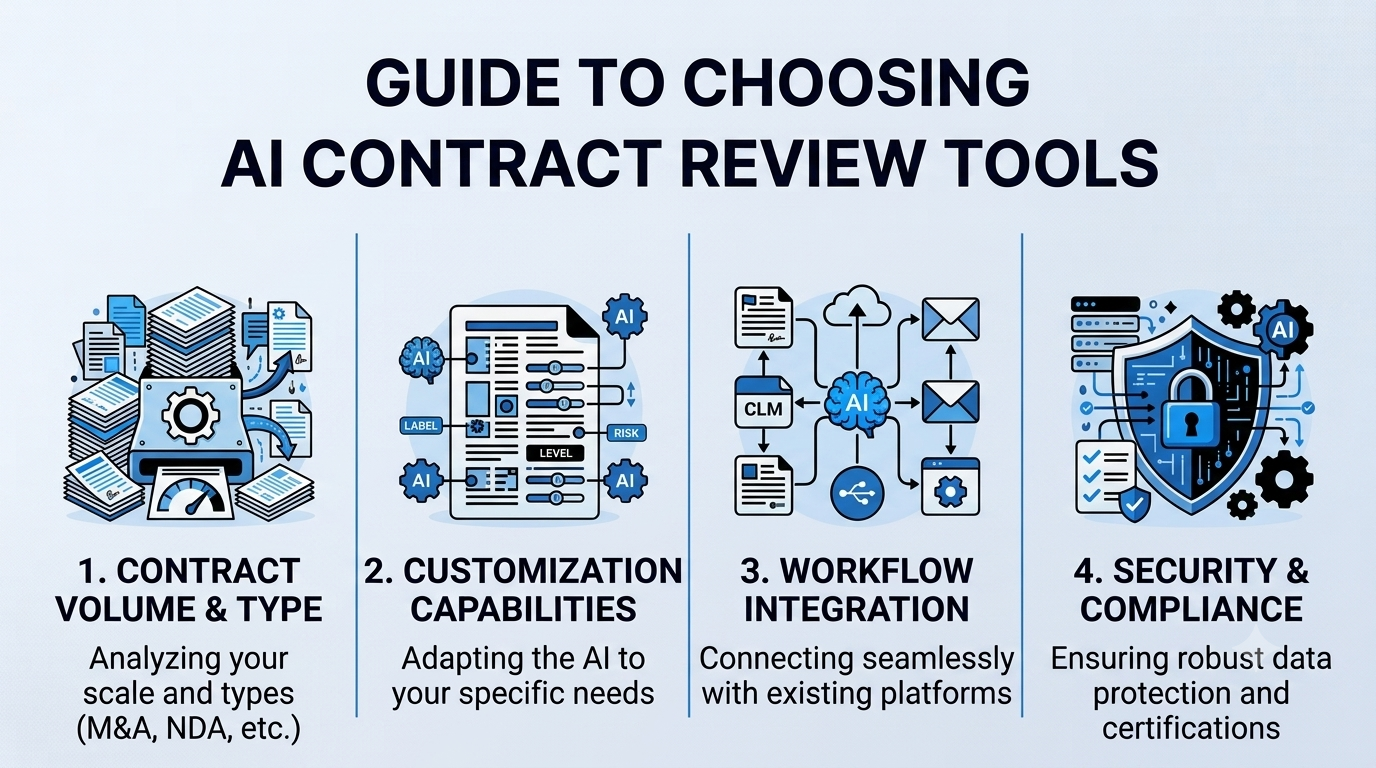
Contract Volume and Type
A small legal team that looks at a few contracts every week will need something different than an enterprise that handles thousands of agreements.
Also think about whether the contracts you deal with’re the same every time or very different and specific.
Customization
Your AI needs to know what your organization considers acceptable and what is risky in contract language.
Look for platforms that offer:
- Custom playbooks
- Approved clause libraries
- Internal policies
- Risk thresholds
- Review workflows
If your requirements go beyond what an off-the-shelf platform provides, knowing how to choose the right AI development company for business can help you evaluate technical expertise, customization capabilities, security practices, and long-term support.
Workflow Integration
Think about where your legal team works now.
Some teams want Microsoft Word integration while others want links, with CLM, CRM, document management or big company systems.
Security
Contracts have details so security is very important.
Check:
- Data encryption
- Access controls
- Data retention policies
- Audit logs
- Compliance requirements
- If customer data is used to train the models
Is AI Contract Review Accurate?
AI contract review can be highly effective. It is not perfect.
It generally performs well when:
- Finding clauses
- Pulling out key information
- Comparing documents
- Finding deviations
- Noting missing provisions
However AI contract review may struggle with legal reasoning, ambiguous language, unusual negotiations and jurisdiction-specific issues.
AI contract review can also generate suggestions or miss important context.
That is why legal teams should use a human-in-the-loop model.
A typical workflow looks, like this:
- AI contract review reviews the contract.
- The system identifies clauses and risks.
- The lawyer reviews the findings.
- The lawyer makes the decision.
This provides the speed of automation without removing oversight.
Is AI Contract Review Safe and Confidential?
AI contract review can be safe. Businesses must look closely at the AI contract review platform they choose.
Before uploading sensitive contracts ask:
- Is the data encrypted?
- Who can see the documents you upload?
- How long will the data be kept?
- Is customer data used to teach the AI models?
- Does the platform give access levels for different people?
- Are there audit logs that show what has happened?
Security matters a lot for law firms, banks, hospitals and other industries with rules.
Sometimes public or generic AI tools do not meet a company’s need for secrecy.
Companies with security rules might need their own private AI system or a custom solution.
How Much Does an AI Contract Review Software Cost?
I think the cost changes based on the platform and business needs.
Smaller teams might choose subscription tools while larger enterprises can get custom pricing from platforms.
The total cost can vary because of:
- Number of users
- Contract volume
- AI capabilities
- Integrations
- Security requirements
- Customization
Businesses should also think about implementation, training and integration costs.
For companies that follow workflows buying an existing platform is often the quickest way.
For organizations that need very specific features, building a custom solution can give better long‑term value.
Build vs. Buy: When Should You Develop Custom AI Contract Review Software?
Off‑the‑shelf software works well when the contract review process follows workflows. However I think businesses may need AI software development when they have specialized requirements.
A custom AI solution can be useful when contract analysis is industry specific, proprietary legal playbooks are needed, risk scoring must be custom private AI infrastructure is required, approval workflows are specialized internal system integrations are needed or greater control over data and AI models is desired.
For example I know that a healthcare organization may need AI contract analysis that follows compliance requirements. I also know that a financial institution may require the system to identify risks that match regulatory policies.
Generic tools may not fully support these requirements. Custom AI development allows businesses to build AI software around their existing processes instead of changing their workflows to fit a third‑party platform. Businesses that do not want to build an internal AI team can also consider working with AI outsourcing companies to handle development while retaining control over their legal workflows and requirements.
For organizations considering external development, the choice between offshore vs. nearshore AI development can also affect communication, delivery models, costs, and access to specialized technical talent.
Need AI Developers for Your Legal AI Solution?
Work with AI developers who can build custom contract analysis, legal playbooks, risk scoring, knowledge retrieval, workflow automation, and secure enterprise integrations.
What Can Custom AI Contract Review Software Include?
A custom solution can combine features:
- Document Intelligence: The system automatically reads contracts. Pulls out clauses, parties, obligations, dates and other key details.
- AI Contract Analysis: The system looks for wording, missing clauses and any parts that stray from your company rules.
- Custom Legal Playbooks: Your company can set its rules for how contracts should be checked.
- Risk Scoring: The system rates contracts, by risk level based on your business priorities.
- Knowledge Retrieval: The system can look up approved contracts, internal policies and legal documents whenever it needs to.
- Workflow Automation: Contracts are sent to the reviewers automatically depending on contract type or risk level.
- Enterprise Integrations: The platform connects to your CRM, CLM, document management and other internal business systems.
The development cost will depend on how complex these features are.
A business that wants a custom solution should first decide what it needs and what it wants to use it for.
Can AI Replace Contract Lawyers?
No, AI can automate parts of contract review yet it cannot replace legal expertise.
Lawyers evaluate more than individual clauses; Lawyers look at business goals, negotiation plans, legal outcomes, rules that must be followed and places where law applies.
AI can help lawyers:
- Review contracts faster
- Identify potential risks
- Compare agreements
- Extract information
- Maintain consistency
But professional legal judgment remains essential. The future of AI is not about AI replacing lawyers.
It is lawyers using AI to spend time on repetitive work and more time on complex legal decisions.
Conclusion
AI contract review software is changing how legal teams manage volumes of contract work. The best AI contract review tools can spot clauses, pull out details, flag risks, compare agreements to playbooks and speed up the review process. Platforms like Spellbook, Luminance, Ironclad, LegalOn, Juro and Kira provide ways depending on whether a business needs document review, contract intelligence or complete lifecycle management.
However AI should not be seen as a legal decision-maker. The best approach is to combine AI-powered automation, with legal expertise.
For businesses that have needs buying an existing platform may be the best choice.. For organizations that have special workflows, strict security needs, proprietary legal standards or complex integrations a custom AI solution may be better. The right choice depends on your contracts, processes and long-term business goals. These developments also reflect broader AI development trends, including more specialized AI applications, workflow automation, and systems designed to work alongside professionals rather than simply replace manual tasks.
Have a Custom Contract AI Project?
Tell us about your contract workflows, legal playbooks, security requirements, and integration needs. We’ll help you determine the right AI approach for your business.
FAQs
What is the best AI contract review software?
- The best option depends on your workflow. Spellbook is useful for Word-based contract review, while Luminance supports broader enterprise legal AI capabilities. Ironclad may be suitable for businesses needing contract lifecycle management.
Is AI contract review accurate?
- AI can effectively identify clauses, extract information, compare contracts, and flag deviations. However, lawyers should review AI findings before making final legal decisions.
Is AI contract review safe?
- It can be safe when businesses use platforms with strong encryption, access controls, and appropriate data policies. Organizations should always evaluate how vendors store and use contract data.
How much does AI contract review software cost?
- Pricing varies based on users, contract volume, features, integrations, and security requirements. Smaller teams may use subscriptions, while enterprise platforms often use custom pricing.
Can AI review legal documents?
- Yes, AI can analyze legal documents, identify clauses, extract key information, summarize contracts, and flag potential risks.
Can AI replace contract lawyers?
- No, AI can automate repetitive tasks, but legal professionals are still needed for judgment, negotiation, context, and final decisions.
 0 comments











Leave a Comment
Your email address will not be published. Required fields are marked *