















 0 comments
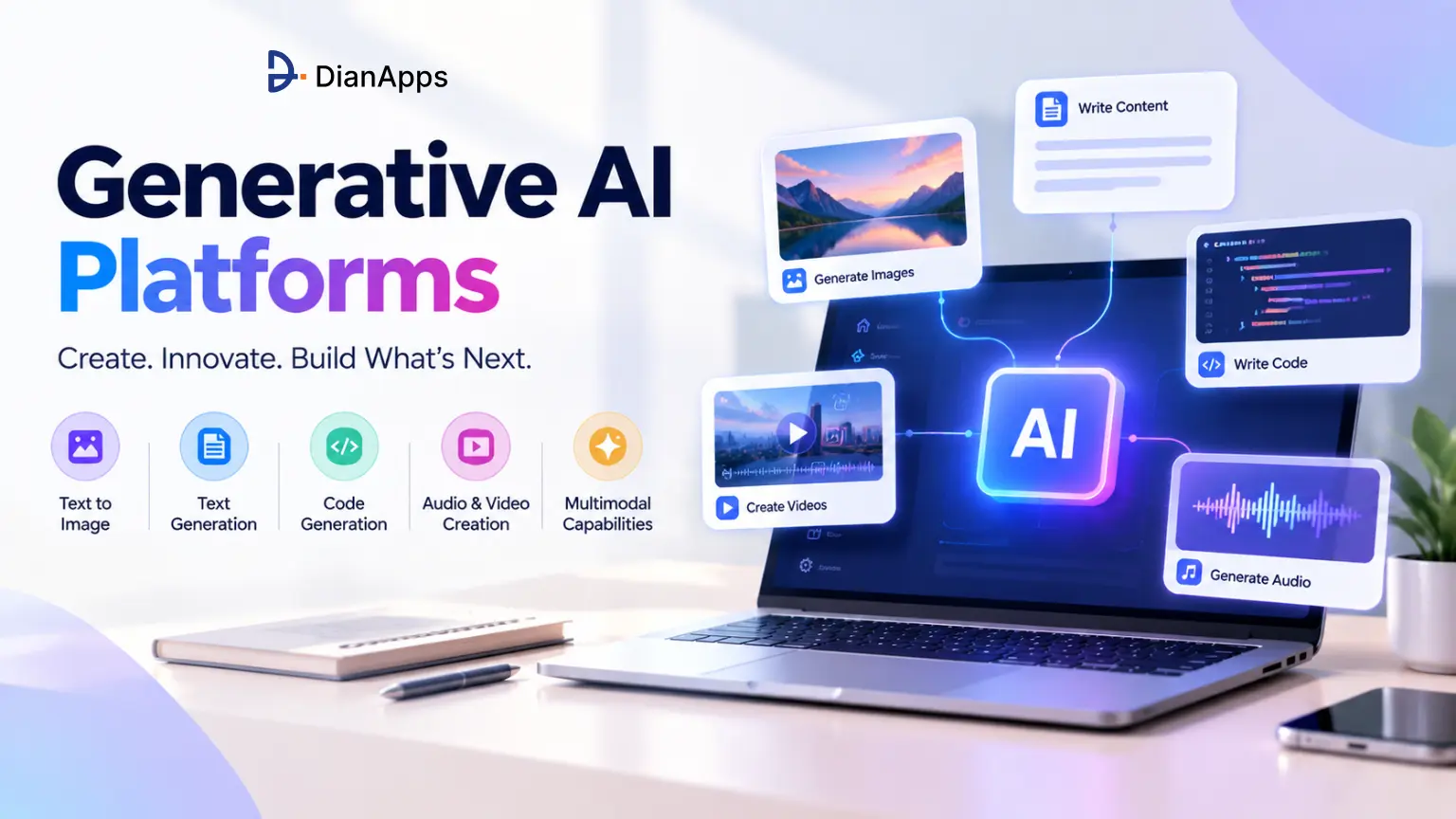





Key Takeaways:
- Generative AI platforms now cover text, code, images, video, audio, research, marketing and enterprise productivity.
- There is no single best generative AI platform for every workflow. The right choice depends on the output, use case, ecosystem and governance requirements.
- ChatGPT is positioned as the strongest general-purpose platform for knowledge work, drafting, analysis, coding and multimodal tasks.
- Claude stands out for long-document analysis, enterprise coding and context-heavy workflows.
- Gemini is particularly suited to organizations already using Google Workspace, while Microsoft 365 Copilot fits Microsoft-based enterprises.
- GitHub Copilot is focused on AI-assisted software development, while Perplexity is designed around research and cited answers.
- Midjourney and Adobe Firefly serve different image-generation needs with Firefly emphasizing commercial safety.
- Runway focuses on professional AI video, Jasper on marketing operations, ElevenLabs on voice generation and Canva Magic Studio on accessible AI-powered design.
- Enterprise buyers should evaluate data governance, compliance controls, cost predictability and integration with existing systems.
- A live pilot using a real workflow is one of the best ways to determine whether a generative AI platform delivers useful results beyond controlled demonstrations.
Quick Answer: The best generative AI platform depends on what you need it to do. ChatGPT is a strong all-purpose option, Claude works well for long documents and coding, Gemini fits Google Workspace environments, Copilot suits Microsoft 365 users and GitHub Copilot is built for developers. For specialized work, platforms such as Perplexity, Midjourney, Firefly, Runway, Jasper, ElevenLabs and Canva offer more focused capabilities. For enterprise adoption, workflow fit, governance, security and integration should matter as much as model performance.
The generative AI market reached $91.57 billion in 2026, up 45% from $63 billion in 2025, according to IDC data compiled by AI Business Weekly. Global spending on AI models and platforms hit $64.25 billion in 2026 alone, up 63.4% from 2025 with spending on foundation model APIs more than doubling to $23.36 billion. McKinsey’s Q1 2026 survey found that organizations now use generative AI in at least one business function.
The market has moved from novelty to infrastructure in less than three years. The main challenge in 2026 is no longer whether generative AI works. It’s which platform actually fits the workflow you’re trying to improve, at what cost with what governance controls and with enough reliability that you can depend on it in production rather than demo conditions.
This guide covers the complete list of generative AI tools in 2026 organized by use case rather than hype level. Each platform is evaluated on verified usage scale, real-world business fit, enterprise governance capability and honest limitations.
What Generative AI Platforms Actually Are?
Generative AI platforms are systems that create new content in text, code, images, video, audio or structured data by learning statistical patterns from training data and generating outputs that match those patterns for new inputs. The category spans a wide range of technical architectures and product types that get grouped together because they share the “generative” property.
The main components of a generative AI platform may include:
-
Foundation models: AI models that generate or transform content based on user inputs and system instructions.
-
Application interfaces: Chat interfaces, creative workspaces, developer tools, or business software through which users interact with AI.
-
APIs and integrations: Interfaces that allow developers to embed generative AI capabilities into websites, applications, and internal workflows.
-
Knowledge and retrieval features: Capabilities that connect AI systems with approved documents, databases, or external information sources.
-
Governance and monitoring: Controls for managing access, security, usage, costs, and system performance
Understanding the categories within generative AI platforms is important because choosing between them isn’t a single decision. Most organizations in 2026 use multiple genAI platforms simultaneously for different functions:
| Platform Category | What It Generates | Primary Use Case | Leading Tools |
| LLM assistants | Text, analysis, code, reasoning | General knowledge work, research, drafting | ChatGPT, Claude, Gemini |
| Enterprise productivity suites | Documents, emails, summaries, meeting notes | Internal productivity across office workflows | Microsoft 365 Copilot, Gemini for Google Workspace |
| Coding assistants | Code, tests, documentation, reviews | Software development acceleration | GitHub Copilot, Cursor, Claude Code |
| Research and search | Cited answers, source synthesis | Research requiring source verification | Perplexity, Google AI Overviews |
| Image generation | Images, artwork, product visuals | Creative work, marketing visuals, design ideation | Midjourney, Adobe Firefly, DALL-E 3 |
| Video generation | Video clips, product demos, training content | Content production, training, marketing video | Runway, Google Veo 3.1, Synthesia |
| Marketing and content platforms | Marketing copy, campaigns, brand content | End-to-end marketing operations | Jasper, Copy.ai, Canva Magic Studio |
| Voice and audio | Synthetic voice, audio content, voice cloning | Localization, video narration, audio production | ElevenLabs, Murf, Google NotebookLM |
Inference costs for foundation models have decreased by 85% over three years, according to Hashmeta’s 2026 generative AI statistics report, making adoption economically viable for organizations that couldn’t afford it in 2023. The combination of lower inference costs, better model quality and mature developer tooling is why enterprise adoption has accelerated so sharply.
Need AI Developers for Your Gen AI Solution?
Work with AI developers who can build custom Gen AI Tools, workflow automation, and secure enterprise integrations.
Complete List of Generative AI Tools in 2026: Platform by Platform
1. ChatGPT (OpenAI) – The Market-Leading General LLM Platform
| Active users | 900M weekly active (February 2026); 1B+ reported July 2026 |
| Market share | ~80% of generative AI application market; ~53% of genAI website traffic (down from 76% in June 2025) |
| Revenue | $25B+ annualized as of February 2026 |
| Business clients | 2M+ businesses; BBVA deployed to 100,000+ employees |
| Pricing | Free (GPT-4o mini); $20/mo (Plus); $25/user/mo (Team); $30/user/mo (Enterprise) |
ChatGPT is the world’s most-used generative AI platform by a wide margin. With 900 million weekly active users, 2 billion daily queries and 80% market share across generative AI applications, it functions as the default starting point for most individuals and organizations beginning their AI adoption. BBVA’s enterprise deployment to over 100,000 employees, resulting in roughly three hours saved per employee per week, is one of the most cited enterprise productivity benchmarks in the category.
ChatGPT’s main strengths are its reasoning breadth, document analysis capability, code assistance and the Custom GPTs ecosystem that lets organizations build task-specific AI tools without engineering resources. OpenAI’s o1 and o3 reasoning models have extended its capability for complex multi-step problems that earlier versions couldn’t handle reliably.
The main limitations are context window management (very long documents or complex multi-session workflows require careful structuring), the declining website traffic share as Gemini absorbs a large portion of its former users and the reality that its broad generality means it’s rarely the best specialized tool in any single domain. ChatGPT’s share of generative AI website visits fell from 76% in June 2025 to 53% by May 2026, according to Similarweb’s worldwide traffic panel.
Best for: General knowledge work, drafting, analysis, coding assistance, multi-modal tasks and any workflow that needs a reliable, broadly capable AI platform with the deepest ecosystem of integrations and third-party tools.
2. Claude (Anthropic) – Fastest-Growing Platform, Strongest for Long Documents
| Traffic share growth | ~2% to ~9% of genAI website traffic in 12 months, largest proportional gain of any platform (Similarweb, May 2026) |
| Revenue (Anthropic) | $3B+ annualized; raised $30B in February 2026 |
| Context window | 200,000 tokens (Claude 3.5/4 family) |
| Pricing | Free (Claude.ai); $20/mo (Pro); API from $3/M tokens (Haiku) to $75/M (Opus) |
| Enterprise clients | Bristol Myers Squibb (30,000+ employees); enterprise AI coding market leader |
Claude has the largest proportional traffic share gain of any generative AI platform in 2026, growing from roughly 2% to 9% of genAI website visits in twelve months, according to Similarweb. Anthropic’s $30 billion February 2026 raise, one of the four largest venture rounds ever recorded, signals the scale of institutional conviction in Claude’s trajectory.
Claude’s technical differentiation is its 200,000-token context window, which allows it to process genuinely long documents (legal contracts, research papers, codebases, financial reports) without the truncation and summarization loss that affects shorter-context models. Its safety-focused training approach produces outputs that enterprise legal and compliance teams are more comfortable with than some alternatives. Bristol Myers Squibb deployed Claude to 30,000+ employees across research and clinical operations in 2026. Claude Code holds over 50% of the enterprise AI coding market.
Best for: Long document analysis, legal review, enterprise coding via Claude Code, compliance-sensitive workflows and any task where context continuity across a large document is more important than speed.
3. Google Gemini – Deepest Google Workspace Integration, Fastest Video AI
| Traffic share | ~27–28% of genAI website traffic (May 2026), up from 9% (June 2025) absorbing most of ChatGPT’s lost share |
| Video capability | Google Veo 3.1 leads on ultra-high-definition output with native audio generation |
| Pricing | Free (Gemini); $19.99/mo (Advanced); API from $0.075/M tokens (Flash) to $7/M (Pro) |
| Integration | Native across Gmail, Docs, Sheets, Meet, Search, YouTube |
Gemini’s traffic share growth from 9% to 28% in twelve months is the biggest absolute gain of any platform in the generative AI market, absorbing the majority of the share that ChatGPT lost. This growth is driven by two factors: native integration across Google’s product suite (Gmail, Docs, Sheets, Meet, Search, YouTube), which exposes Gemini to Google’s enormous existing user base and Google’s video AI leadership via Veo 3.1, which leads the market on ultra-high-definition output with native audio generation.
For organizations already operating primarily in Google Workspace, Gemini offers the most seamless enterprise integration of any AI platform. The intelligence is embedded directly into the tools employees already use, which drives adoption in ways that standalone AI assistants don’t. Google’s AI Overviews integration also makes Gemini the default AI layer for billions of daily search queries.
Best for: Organizations running on Google Workspace, teams that need AI integrated directly into Gmail and Docs workflows and any use case involving video generation where Veo 3.1’s quality leads the market.
4. Microsoft 365 Copilot – Enterprise Productivity Standard
| Powered by | GPT-4o via Microsoft’s OpenAI partnership |
| Integration | Native across Word, Excel, Outlook, Teams, PowerPoint, SharePoint |
| Pricing | $30/user/month (on top of Microsoft 365 subscription) |
| Enterprise controls | Audit trails, data residency, role-based access, compliance certifications |
Microsoft 365 Copilot is the genAI platform that enterprises with existing Microsoft investments should evaluate first. It operates natively inside Word, Excel, Outlook, Teams, PowerPoint and SharePoint, the tools where most knowledge workers already spend their time. Rather than requiring employees to learn a separate AI interface, Copilot brings AI to where work already happens.
Azure’s cloud AI growth of 40% year-over-year in 2026 reflects the commercial momentum of Microsoft’s AI strategy, which bundles Copilot across its enterprise software stack. For enterprises that have negotiated Microsoft Enterprise Agreements, Copilot access is often negotiable as part of renewal rather than a standalone procurement decision. The governance capabilities, audit trails, data residency controls, role-based access, meet the compliance requirements most regulated enterprises need from a productivity AI tool.
Best for: Organizations with existing Microsoft 365 deployments where the primary use case is productivity across email, document creation, meeting summarization and spreadsheet analysis. Not appropriate as a standalone AI development or coding platform.
5. GitHub Copilot – The Developer Standard for AI-Assisted Coding
| Enterprise reach | 90% of Fortune 100 companies use GitHub Copilot |
| Code share | AI writes 41% of all code globally in 2026; 84% of developers use AI tools in their workflow |
| Pricing | $10/mo (Individual); $19/user/mo (Business); $39/user/mo (Enterprise) |
| Models | GPT-4o, Claude 3.5 Sonnet, Gemini 1.5 Pro (selectable) |
GitHub Copilot reached 90% of Fortune 100 companies in 2026, making it the most widely deployed AI tool in software engineering. AI now writes 41% of all code globally; 84% of developers use AI tools in their daily workflow. Copilot’s context-aware code completion, which understands the full codebase rather than just the current file, produces completion suggestions that match the style and patterns of existing code rather than generating generic boilerplate.
GitHub Copilot Enterprise adds features specifically for large engineering organizations: organizational knowledge retrieval (so the AI can answer questions about internal codebases and documentation), PR summarization and security-focused review capabilities. The ability to select between GPT-4o, Claude 3.5 or Gemini 1.5 as the underlying model lets engineering teams choose based on their specific language and task requirements.
Best for: Software engineering teams across any size organization, enterprise development shops that need AI coding assistance with organizational context awareness and security controls and any developer who writes code more than a few hours per week.
6. Perplexity AI – Cited Research and Verified Search Answers
| Differentiation | Every response cites sources with direct links; real-time web access on all queries |
| Pricing | Free; $20/mo (Pro); Enterprise pricing available |
| Best feature | Source-grounded answers for research tasks where verifiability matters |
Perplexity’s core distinction from other generative AI platforms is its commitment to cited, verifiable outputs. Every answer includes direct source links that users can follow to verify claims. For research tasks, analyst work, due diligence and any workflow where “where did this come from?” is an important question, Perplexity’s citation-first approach addresses the hallucination problem more practically than prompt engineering tricks on non-citation-native platforms.
Perplexity Enterprise adds organizational data connectivity, team workspaces and access controls that make it viable as a research platform for knowledge-intensive businesses. Its real-time web access means it doesn’t have the knowledge cutoff limitations that affect pure LLM platforms without web access enabled.
Best for: Research-heavy workflows, analysts, due diligence teams, journalists and anyone who needs AI-generated answers with verifiable sources they can cite in downstream documents.
7. Midjourney – The Reference Standard for Image Generation
| Revenue | $500M+ with no venture funding |
| Community | 21M+ member Discord community; standalone web app launched |
| Pricing | $10/mo (Basic); $30/mo (Standard); $60/mo (Pro) |
| New capability | V1 image-to-video generation added in 2026 |
Midjourney reached $500 million in annual revenue with no venture funding, proof that a single-modality generative AI platform can scale on creator demand without the broad assistant features that define ChatGPT or Gemini. That independence reflects the quality of its output: Midjourney’s image generation remains the reference point for stylistic control and output quality across creative industries.
Its 21 million-member Discord community has functioned as both a distribution channel and a product feedback loop, producing a platform that understands the specific prompting patterns of creative professionals in a way that general-purpose image generators don’t replicate. The V1 image-to-video capability added in 2026 extends the platform without abandoning its creator-first focus. For brand work, concept visualization, marketing creative and creative direction, Midjourney’s output quality per prompt remains unmatched in the image generation category.
Best for: Creative professionals, marketing teams, product designers and any workflow that requires high-quality image generation with stylistic control. Not appropriate for photorealistic product photography or applications requiring image editing rather than generation.
8. Adobe Firefly – Brand-Safe Creative AI for Enterprise
| Key advantage | Trained exclusively on licensed content, commercially safe for enterprise use |
| Integration | Native in Photoshop, Illustrator, Premiere Pro, Express |
| Pricing | Included in Creative Cloud plans; Enterprise licensing available |
Adobe Firefly’s critical differentiator from other image generation platforms is its training data. Firefly was trained exclusively on licensed Adobe Stock content and public domain material, which makes its outputs commercially safe to use without copyright risk. For enterprise marketing teams, brand managers and agencies creating content for commercial use, this is not a minor distinction, it eliminates the legal exposure that using unlicensed training data creates for commercial applications.
Native integration into Photoshop, Illustrator and Premiere Pro means designers use Firefly inside the tools they already work with rather than switching contexts. Generative Fill, the feature that lets designers extend or replace image elements with AI-generated content, has become one of the most widely adopted AI features in creative professional workflows.
Best for: Enterprise marketing teams, creative agencies and any organization creating AI-generated visual content for commercial use where copyright safety is a non-negotiable requirement.
9. Runway – AI Video Generation for Professional Production
| Primary use | Cinematic AI video generation, text-to-video, image-to-video |
| Pricing | $15/mo (Standard); $35/mo (Pro); $95/mo (Unlimited) |
| User base | Used by 87% of creative professionals incorporating AI into video workflows |
Runway’s position in the generative AI platform landscape is the video equivalent of Midjourney’s image position, the professional standard for cinematic AI video generation. Text-to-video, image-to-video, video editing with AI and style transfer all run on Runway’s Gen-3 Alpha model. The AI video generator market grew from $788.5 million in 2025 to an estimated $946.4 million in 2026, according to 2026 AI market data with enterprise adoption projections reaching $18.6 billion as production use cases mature.
87% of creative professionals incorporate AI tools into their video creation workflow, cutting production time by up to 70% while delivering increasingly cinematic quality. Runway serves the creative professional end of this market, where stylistic control and output quality take priority over speed and simplicity.
Best for: Film and video production teams, marketing agencies producing video content, brand teams needing short-form video for campaigns and any workflow where cinematic video quality takes priority over simple text-to-video output.
10. Jasper AI – Marketing Operations GenAI Platform
| Focus | End-to-end AI marketing, copy, campaigns, brand voice |
| Pricing | $49/mo (Creator); $69/mo (Teams); Enterprise custom pricing |
| Key feature | Brand Voice training, the AI learns and maintains your specific brand tone |
Jasper is the generative AI platform built specifically for marketing operations at scale. While general-purpose LLMs can produce marketing copy, Jasper’s Brand Voice feature trains on your existing content to generate new material that matches your established tone, vocabulary and style consistently without the drift that occurs when a general model generates brand content without organizational context.
Its campaign template system, multi-channel content generation and team collaboration features make it more suitable for marketing operations teams than a general LLM prompt interface. For organizations running high-volume content marketing with a consistent brand voice requirement, Jasper’s marketing-specific workflow design reduces the review-and-edit cycles that general platforms require.
Best for: Marketing teams producing consistent brand content at volume, content agencies managing multiple brand voices simultaneously and organizations where maintaining brand consistency in AI-generated content is as important as the content quality itself.
11. ElevenLabs – Voice Generation and Audio AI
| Capability | Voice cloning, multilingual voice generation, audiobook and podcast production |
| Pricing | Free (10K chars/mo); $5/mo (Starter); $22/mo (Creator); $99/mo (Pro) |
| Recognition | Added to DataNorth’s Q3 2026 top AI tools ranking, replacing Midjourney in the voice category |
ElevenLabs leads the voice generation segment of the generative AI platform market in 2026. Its voice cloning technology creates synthetic voices that maintain emotional nuance, pacing and naturalness across 29 languages, capabilities that separate it from the robotic-sounding text-to-speech that earlier generation tools produced. For organizations producing localized content at scale, video narration without recording sessions or internal audio communications, ElevenLabs reduces production cost by eliminating voice talent and studio time for content that doesn’t require on-camera presence.
Best for: Video production teams needing narration without recording sessions organizations localizing content across multiple languages, L&D teams producing audio training content and any workflow that requires high-quality synthetic voice at volume.
12. Canva Magic Studio – Design-First GenAI for Non-Designers
| User base | 200M+ Canva users with AI features embedded throughout |
| Pricing | Free (limited); $15/mo (Pro); $30/user/mo (Teams) |
| Key feature | AI image generation, background removal, text-to-design, Magic Write all inside Canva’s design environment |
Canva Magic Studio democratizes design AI for the 200 million non-designers who use Canva. AI image generation, one-click background removal, text-to-design templates and Magic Write (AI copywriting inside the design tool) all operate within an interface that doesn’t require design training. For marketing teams, social media managers and small business owners creating visual content without dedicated design resources, Canva Magic Studio delivers genAI capability at a fraction of the complexity of professional creative tools.
Best for: Non-designers creating social media content, presentations and marketing materials, small business owners who can’t justify dedicated design software and teams needing fast design iteration without professional design skills.
What Are the Best Generative AI Platforms for Developers?
The best generative AI platform for developers depends on the development workflow and the type of AI application being built. Coding assistants such as GitHub Copilot can support software development tasks, while model API and cloud AI platforms can help developers integrate generative AI capabilities into custom applications.
When comparing developer-focused platforms, consider:
-
Programming language and framework support.
-
Code completion, generation, and review capabilities.
-
API and SDK availability.
-
Integration with development environments.
-
Model selection and customization options.
-
Security, access controls, and source-code handling.
-
Pricing and usage limits.
Developers should test the tools with real project requirements and review the generated code before incorporating it into production systems. AI-assisted development can accelerate some tasks, but it does not eliminate the need for testing, code review, and security validation.
What Are the Best Generative AI Platforms for Digital Solutions?
Generative AI platforms enable businesses to integrate artificial intelligence into digital products, enterprise applications, and customer-facing experiences. The most suitable platform depends on the type of solution being developed, the required AI capabilities, integration requirements, and deployment environment.
Businesses developing digital solutions can evaluate platforms such as: OpenAI, Microsoft Azure AI Foundry, Google Cloud’s AI platform, Amazon Bedrock, and Anthropic Claude.
These platforms offer different approaches to model access, application development, and enterprise integration.
Some platforms focus on providing AI models through APIs, while others offer managed cloud environments with tools for building, deploying, and governing AI applications. The right choice depends on the technical and business requirements of the project.
GenAI Platforms for Enterprise: What Differentiates Production-Grade Tools?
The evaluation criteria for generative AI platforms change significantly when moving from individual use to enterprise deployment. Four dimensions separate platforms that work well in enterprise environments from those that create governance, compliance and cost management problems at scale.
| Enterprise Criterion | Why It Matters | Best Platform |
| Data governance | 80% of organizations worry about data leakage through genAI solutions (SeoProfy 2026). Enterprise platforms must guarantee that your data doesn’t train the vendor’s models. | ChatGPT Enterprise, Azure OpenAI, Claude API (no training on API data by policy) |
| Audit and compliance controls | Regulated industries (healthcare, finance, government) need audit trails, user access controls and compliance certification for every tool in the AI stack | Microsoft 365 Copilot, ChatGPT Enterprise, Claude for Enterprise |
| Cost predictability | Token-based API pricing scales non-linearly with usage, making cost modeling difficult without usage caps and budget controls | Per-seat enterprise licenses (Copilot, GitHub Copilot) are more predictable than API token billing |
| Integration with existing systems | The most valuable enterprise AI is embedded in existing workflows not accessed through a separate interface that requires behavior change | Microsoft 365 Copilot (Microsoft ecosystem), Gemini (Google Workspace), GitHub Copilot (development environments) |
The decision between private and public LLMs is particularly important for enterprises where proprietary data is central to the AI use case. A custom RAG system trained on your internal knowledge base frequently outperforms a general-purpose platform for domain-specific queries, which is why the most sophisticated enterprise AI deployments in 2026 use foundation model APIs as components of custom-built systems rather than deploying off-the-shelf genAI platforms as complete solutions.
The role of generative AI in enterprise application development has evolved beyond standalone tools. The organizations generating the most measurable ROI from generative AI in 2026 are embedding model capabilities into their own products and workflows using APIs, rather than simply purchasing access to consumer-facing platforms.
Don’t Just Use GenAI Platforms. Build Products Powered by Them.
DianApps builds custom AI systems using ChatGPT, Claude, Gemini and the full generative AI stack, RAG pipelines, LLM integration, agentic workflows and mobile AI products.
Turn Generative AI Into a Business Advantage
Build intelligent, scalable GenAI solutions tailored to your workflows, data, and business goals. From LLMs and RAG to AI agents and multimodal applications, our experts can help you move from idea to production.
What Is the Difference Between Open-Source and Proprietary Generative AI Platforms?
Open-source and proprietary generative AI platforms differ in how their software, models, or supporting components are distributed, licensed, and controlled. The exact distinction depends on the specific project and its licensing terms.
Open or openly available model ecosystems may offer organizations greater flexibility to inspect, customize, or deploy certain components, subject to the relevant license. Proprietary platforms are generally controlled by a provider and may offer managed access, hosted infrastructure, enterprise support, and integrated product features.
Organizations should evaluate the actual license, model weights availability, commercial-use permissions, infrastructure requirements, security responsibilities, and ongoing maintenance needs before selecting either approach.
The choice is not simply between flexibility and convenience. The right option depends on the organization’s technical expertise, compliance requirements, deployment preferences, and total cost of ownership.
How to Choose the Right Generative AI Platform for Your Use Case?
The most common mistake in generative AI platform selection is picking a platform based on general reputation rather than specific workflow fit. Here’s a practical decision framework.
Step 1: Define the Output Type First
You can’t evaluate generative AI platforms without first specifying what the AI needs to generate. Text and reasoning → LLM assistant. Code → coding assistant. Images → image generator. Video → video platform. Marketing copy at scale → marketing-specific genAI. Mixing these categories in a single platform evaluation produces a confused comparison that no clear answer comes from.
Step 2: Assess Enterprise vs. Individual Needs
Individual use has different requirements from team or enterprise use. An individual user can tolerate a platform with no audit logging, no usage controls and token-based billing. An enterprise deploying the same platform to 5,000 employees cannot. 89% of Fortune 500 companies are actively deploying generative AI solutions but 80% of organizations worry about data leakage, a gap that only closes when platforms with enterprise governance controls are selected rather than consumer tools scaled to organizational use.
Step 3: Match Existing Ecosystem Investments
The generative AI platform that integrates most naturally with your existing tools will drive the highest adoption. Google Workspace organizations should evaluate Gemini first. Microsoft 365 organizations should evaluate Copilot first. GitHub-dependent development teams should evaluate GitHub Copilot first. Platform switching costs compound with organizational scale; the platform that meets your functional requirements while requiring the least workflow change produces the best ROI fastest.
Step 4: Run a One-Week Pilot on a Real Workflow
No evaluation framework substitutes for a live pilot on your actual use case. The goal is to test whether the platform gets from brief to usable output faster than your current method in conditions that represent real production requirements. A platform that works perfectly on carefully constructed test prompts but fails on the messy, ambiguous inputs your team actually produces will never deliver its promised productivity gains.
Need AI Expertise to Bring Your Idea to Life?
Hire skilled AI developers to build, integrate, and scale intelligent solutions for your business. Get the right expertise for LLM development, RAG, AI agents, machine learning, and custom AI applications.
What Is the Best GenAI Platform for Large Enterprises?
There is no single generative AI platform that is the best fit for every large enterprise. The right choice depends on the organization’s existing technology ecosystem, security requirements, business objectives, model capabilities, and deployment needs. Enterprise AI platforms from providers such as Microsoft Azure, Google Cloud, OpenAI, and Anthropic offer different combinations of models, application development tools, integrations, and governance capabilities.
Large organizations should evaluate platforms based on how well they support their specific workflows rather than selecting one solely because of brand recognition or model popularity.
Key Factors to Consider When Choosing an Enterprise GenAI Platform
1. Security and Data Governance
Enterprise platforms should be evaluated for identity management, access controls, data handling policies, audit capabilities, and available security features. Organizations handling confidential customer, financial, or business information should review provider-specific terms and technical controls before deployment.
2. Integration With Existing Business Systems
A platform should support integration with the systems an enterprise already uses, such as CRM platforms, ERP software, cloud infrastructure, data warehouses, and internal applications. APIs, SDKs, and connectors can influence the effort required to build and maintain AI-powered workflows.
3. Model Capabilities and Flexibility
Organizations should assess the models available for their use cases, including text generation, reasoning, coding, document processing, and multimodal tasks. Some enterprises may also require access to multiple models or the ability to evaluate alternative providers.
4. Scalability and Reliability
Enterprise deployments may require support for large numbers of users, high request volumes, predictable latency, and operational monitoring. Evaluation should include service availability, performance under representative workloads, and documented service commitments where applicable.
5. Cost and Total Ownership
Platform costs can include model usage, subscriptions, infrastructure, integration, monitoring, and ongoing maintenance. Enterprises should estimate costs using their expected usage patterns and evaluate the quality of outputs against the expense of operating the system.
Generative AI Platform Comparison: Features, Use Cases, and Enterprise Considerations
Generative AI platforms vary in their underlying models, application development tools, deployment options, integrations, and enterprise management features. Comparing platforms requires looking beyond model performance and considering how each solution fits into an organization’s technology environment.
The following comparison provides a practical framework for evaluating major enterprise-oriented GenAI platform options.
| Evaluation Factor | Microsoft Azure AI / Foundry | Google Cloud Vertex AI / Gemini Enterprise Agent Platform | OpenAI Platform | Anthropic |
|---|---|---|---|---|
| Primary Focus | Enterprise AI applications, agents, and cloud-based AI services. | AI application development, model access, and cloud AI infrastructure. | Generative AI models and application development through APIs. | Claude models and enterprise AI workflows. |
| Integration Considerations | Azure services, Microsoft ecosystem, and supported integrations. | Google Cloud services, data infrastructure, and supported integrations. | API-based application integration. | API-based application integration and enterprise offerings. |
| Model Evaluation | Assess available models against the specific business use case. | Assess available models and supported deployment options. | Evaluate available models for task performance and cost. | Evaluate Claude models for task performance and cost. |
| Enterprise Governance | Review security, access, and governance features available for selected services. | Review security, access, and governance features available for selected services. | Review organization-level controls and applicable enterprise terms. | Review organization-level controls and applicable enterprise terms. |
| Best Fit Assessment | Enterprises with relevant Azure ecosystem requirements. | Enterprises with relevant Google Cloud ecosystem requirements. | Organizations seeking API-based AI application development. | Organizations evaluating Claude-based workflows and integrations. |
Quick-Reference: Best Gen AI Tool by Use Case
| Use Case | Best Gen AI Tool | Runner-Up |
| General knowledge work and drafting | ChatGPT | Claude |
| Long document analysis | Claude | ChatGPT (o1) |
| Google Workspace productivity | Gemini | ChatGPT |
| Microsoft 365 productivity | Microsoft 365 Copilot | ChatGPT Enterprise |
| Software development and coding | GitHub Copilot | Claude Code, Cursor |
| Research with citations | Perplexity | ChatGPT (with browsing) |
| Image generation (creative) | Midjourney | DALL-E 3 via ChatGPT |
| Image generation (commercial-safe) | Adobe Firefly | Canva Magic Studio |
| AI video (cinematic) | Runway | Google Veo 3.1 |
| Marketing copy at scale | Jasper | Copy.ai |
| Voice and audio generation | ElevenLabs | Murf |
| Design for non-designers | Canva Magic Studio | Adobe Express |
| Custom AI product development | API (OpenAI / Anthropic / Google) | Azure OpenAI Service |
The Bottom Line
The generative AI platform market in 2026 has matured from a single-tool conversation to a multi-platform decision. ChatGPT leads on breadth and user scale. Claude leads on document depth and enterprise coding. Gemini leads on workspace integration and video AI. GitHub Copilot leads on software development. Midjourney and Adobe Firefly lead in image generation for different buyer segments. Runway and Veo 3.1 lead on AI video. Jasper and ElevenLabs lead in their specialized categories.
The organizations generating the strongest ROI from generative AI in 2026 are not those who picked the “best” platform. They’re the ones who matched platforms to specific use cases, governed them properly for their industry and built custom AI layers on top of foundation model APIs for the workflows where a general-purpose platform’s output quality doesn’t meet production requirements.
Understanding the technology trends shaping software development in 2026 makes clear why this matters: AI has stopped being a tool you use occasionally and started being infrastructure you depend on. Choosing that infrastructure with the same rigor you’d apply to any other enterprise technology decision is the difference between AI that compounds value and AI that costs more than it delivers.
Have an AI Project in Mind?
Tell us what you’re looking to build, improve, or automate. Our AI experts will help you identify the right approach, technology, and next steps for your project.
 0 comments









Leave a Comment
Your email address will not be published. Required fields are marked *