













 0 comments




Most finance teams can pull the annual hosting invoice and maintenance contract for their aging software in five minutes. Almost none can pull the true annual cost of keeping those systems alive.
The compounding costs sit beneath the surface: engineering sprints burned patching fragile codebases, revenue delayed because pricing or checkout updates require three teams and a weekend maintenance window, security exposure from unsupported runtimes, and AI initiatives stalled because operational data stays trapped in 20-year-old silos.
Industry research confirms how widespread this drain has become. Enterprises routinely allocate 60% to 80% of their total IT budgets simply to maintain existing systems, leaving a fraction for product growth. According to Mordor Intelligence, the global legacy modernization market reached $29.39 billion in 2026 and is expanding at a 17.64% compound annual growth rate as organizations confront technical debt head-on. Meanwhile, Forrester reports that 70% of digital transformation programs are slowed directly by legacy infrastructure.
The math is straightforward, spending the majority of your technology budget to keep aging software running starves the initiatives that actually differentiate your business.
This guide breaks down what legacy app modernization services actually cover, how to choose the right strategy across your application portfolio, what realistic ROI and budgets look like, and how to evaluate a modernization partner without getting locked into an open-ended rewrite.
What Legacy Application Modernization Actually Covers (And How It Differs From Cloud Migration)
Legacy application modernization is frequently conflated with cloud migration or routine version upgrades. Treating them as interchangeable is one of the fastest ways to overspend without fixing operational bottlenecks.
Cloud migration is a change of address. You move existing virtual machines, codebases, and databases from an on-premises data center to cloud infrastructure. The hosting environment changes, but the rigid deployment cycles, tightly coupled modules, and scaling ceilings come along for the ride.
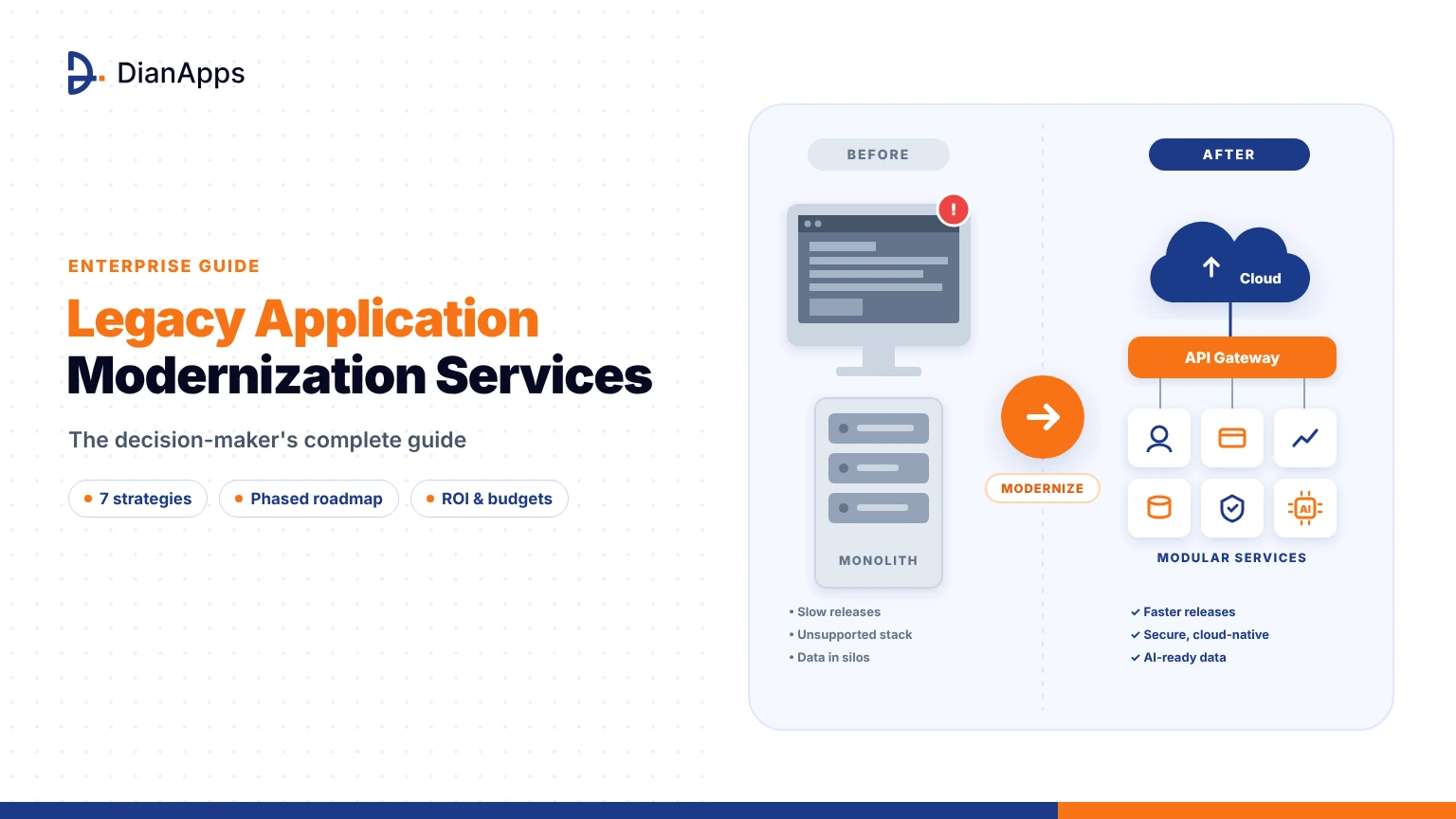
Legacy application modernization is a structural change. It restructures how software is architected, deployed, integrated, secured, and experienced by end users so the system can support current business operations and future product releases. Depending on a system’s commercial value and technical condition, modernization may mean wrapping stable core logic in modern Application Programming Interfaces (APIs), decomposing a monolith into modular services, redesigning outdated interfaces, or retiring redundant software altogether.
Comprehensive legacy app modernization development services typically span seven core engineering disciplines:
- Portfolio Assessment and Roadmapping: Auditing every application, batch job, integration, and shadow database in your estate, then scoring each against business criticality, technical debt, and risk. Not every system warrants the same investment, and a credible assessment proves where to spend and where to hold back.
- Application Architecture Modernization: Restructuring tightly coupled monoliths into modular architectures or microservices so teams can build, test, and deploy business capabilities independently.
- Cloud Replatforming and Containerization: Packaging workloads into portable containers and migrating them to managed cloud services (such as AWS Elastic Kubernetes Service or managed relational databases) to eliminate hardware dependencies and manual provisioning.
- API Modernization and Enterprise Integration: Exposing core legacy transactions and records through documented, secure REST or GraphQL APIs so mobile apps, web portals, Customer Relationship Management (CRM) tools like Salesforce, and analytics pipelines can consume live data without brittle direct database reads.
- Database Modernization: Refactoring aging schemas, eliminating stored-procedure bottlenecks, and migrating legacy data stores to modern relational, NoSQL, or cloud-native databases capable of supporting real-time reporting and AI workloads.
- User Experience (UX) and Interface Redesign: Rebuilding dated desktop, web, and mobile interfaces around current user workflows, accessibility standards, and responsive performance.
- DevOps and CI/CD Automation: Implementing automated test suites, Infrastructure as Code (IaC), and Continuous Integration and Continuous Deployment (CI/CD) pipelines so modernized applications stay maintainable long after cutover.
Diagnostic Signals: How to Know When a Legacy System Requires Action
Software age alone is never a valid reason to launch a modernization program. A fifteen-year-old order-processing engine that runs reliably, passes security audits, and costs little to operate may be better left untouched.
The real triggers are compounding operational friction and measurable business risk. Commission a structured architectural assessment when several of these six warning signs show up across your organization:
- Routine changes take weeks instead of days: Updating a tax calculation, adding a checkout field, or modifying a report requires cross-team coordination, manual database scripts, and scheduled weekend downtime. Engineers hesitate to touch core modules because side effects are unpredictable.
- Critical knowledge sits in one or two heads: Undocumented business rules governing pricing, reconciliations, or regulatory exceptions live only in the memory of veteran developers. Industry surveys show that 60% of organizations running older languages like COBOL cite talent scarcity as their primary operational risk, with roughly 10% of that workforce retiring each year.
- Core dependencies have reached End-of-Life (EOL): Operating systems, frameworks, database engines, or third-party libraries no longer receive vendor security patches. Every unpatched component expands your attack surface and complicates cyber-insurance renewals.
- Integrations rely on fragile workarounds: Teams move data between core systems using overnight CSV exports, manual spreadsheets, or undocumented batch scripts that break whenever an upstream vendor updates a schema.
- Performance ceilings disrupt daily operations: Batch jobs overrun their overnight windows, analytical queries lock transactional tables during peak business hours, and the system cannot autoscale for seasonal spikes or geographic expansion.
- Compliance and audit preparation consume engineering capacity: Incomplete audit trails, shared service credentials, and unencrypted internal traffic turn routine SOC 2, HIPAA, PCI-DSS, or regional data-residency reviews into manual fire drills.
Diagnostic heuristic: If three or more of these friction points affect a revenue-generating or mission-critical workflow, fund a time-boxed discovery assessment before approving any code rewrite.
The Seven Modernization Strategies: Choosing the Right Approach
There is no single blueprint for modernizing an enterprise application estate. Selecting the right strategy depends on four variables: business criticality, architectural complexity, regulatory risk tolerance, and expected system lifespan.
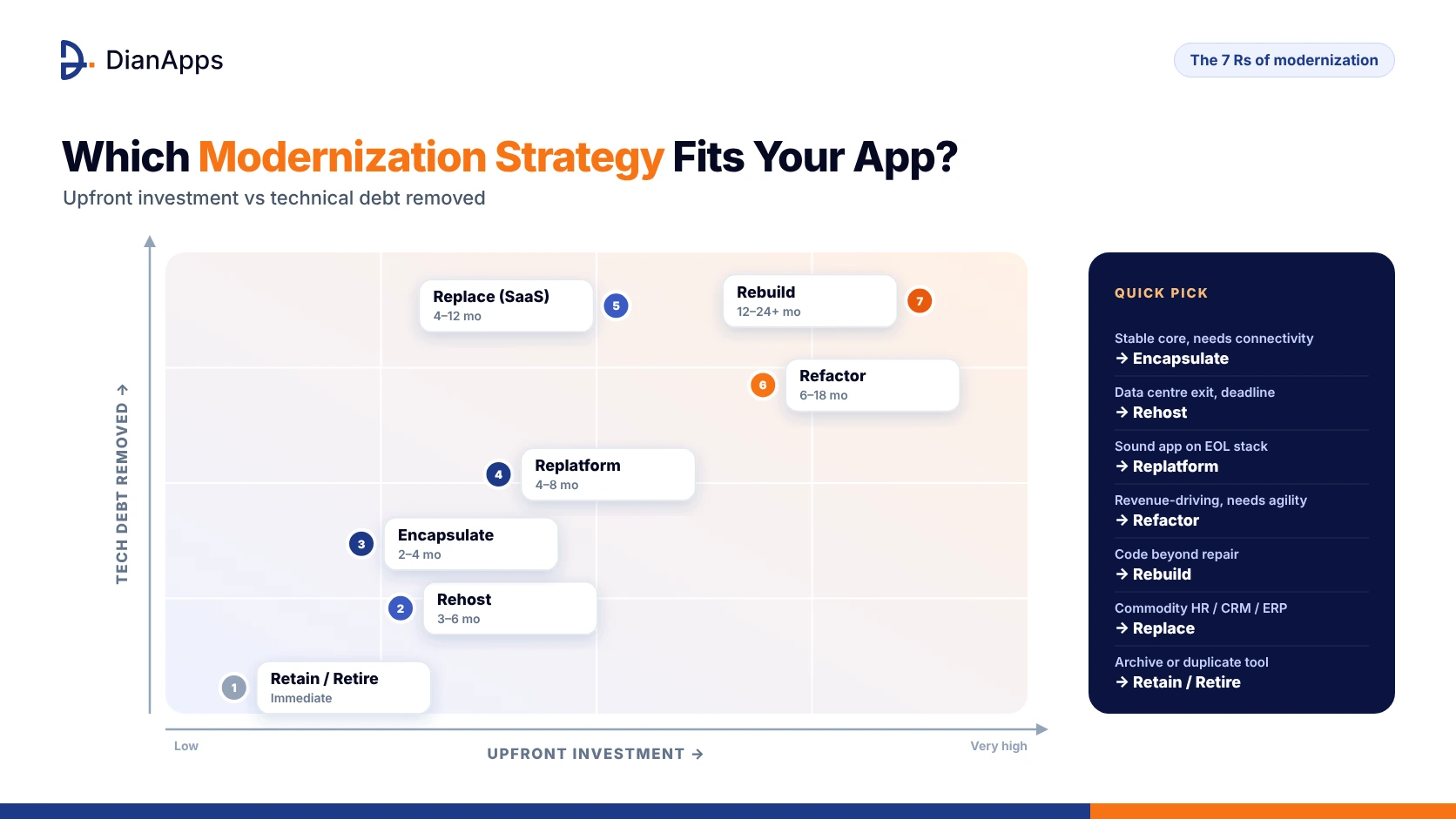
The table below compares the seven established modernization strategies, commonly known as the 7 Rs, across delivery speed, upfront investment, architectural impact, and ideal use cases.
| Strategy | Technical Scope | Relative Speed | Upfront Investment | Architectural Debt Removed | Best-Fit Scenario |
|---|---|---|---|---|---|
| 1. Encapsulate (API-Enable) | Wrap existing system in modern APIs | Fast (2–4 months) | Low | Low | Stable core systems needing external connectivity |
| 2. Rehost (Lift & Shift) | Move unchanged workloads to cloud IaaS | Fast (3–6 months) | Low | None | Data center exits and non-critical workloads |
| 3. Replatform | Upgrade runtime, OS, or managed DB | Moderate (4–8 months) | Low–Medium | Moderate | Sound apps on EOL infrastructure or databases |
| 4. Refactor / Rearchitect | Restructure code into modular services | Medium–Long (6–18 months) | High | High | Core differentiating apps requiring agility |
| 5. Rebuild | Rewrite from scratch on modern stack | Long (12–24+ months) | Very High | Complete | Compromised cores where refactoring costs more |
| 6. Replace (Repurchase) | Swap custom app for commercial SaaS | Moderate (4–12 months) | Medium | Complete | Commodity functions (HR, CRM, standard ERP) |
| 7. Retain or Retire | Keep as-is or decommission safely | Immediate | Minimal | N/A | Static compliance archives or redundant tools |
1. Encapsulate (API-Enable)
- What it is: The underlying legacy system stays intact, while an API layer exposes its data and business functions to modern web portals, mobile apps, and partner platforms.
- Best for: High-reliability transaction engines, common in banking, insurance, and logistics, where core logic works well and replacement risk is unacceptably high.
- Trade-off: You gain integration speed quickly, but underlying maintenance costs, licensing fees, and technical debt remain unchanged.
2. Rehost (Lift and Shift)
- What it is: Applications move to cloud infrastructure with minimal or zero code edits. Same architecture, different hosting provider.
- Best for: Organizations facing an expiring data center lease or hardware refresh deadline that need immediate infrastructure relief for secondary applications.
- Trade-off: You capture basic cloud elasticity, but you miss cloud-native cost optimization and carry every architectural flaw into a pay-as-you-go billing model.
3. Replatform
- What it is: Teams make targeted adjustments, such as containerizing the application, upgrading the runtime, or switching to a managed cloud database, without altering core application architecture.
- Best for: Functionally solid systems running on EOL middleware or expensive self-managed database licenses.
- Trade-off: Delivers stronger stability and lower infrastructure overhead than rehosting, but does not resolve tangled internal codebases.
4. Refactor / Rearchitect
- What it is: Engineers systematically restructure code and domain boundaries, often decomposing a monolith into modular services or microservices while preserving external business behavior.
- Best for: Revenue-generating and customer-facing systems where deployment speed, scalability, and AI integration directly affect market competitiveness.
- Trade-off: Requires higher upfront investment, strong automated testing discipline, and experienced solution architects.
5. Rebuild
- What it is: The application is written from the ground up using modern frameworks and cloud-native patterns while retaining verified business rules.
- Best for: Severely degraded systems where untangling existing code would cost more than building a clean replacement.
- Trade-off: Carries the longest time-to-value and highest delivery risk if undocumented edge cases are missed during discovery.
6. Replace (Repurchase)
- What it is: Retiring custom-built legacy software in favor of a commercial Software-as-a-Service (SaaS) platform.
- Best for: Non-differentiating back-office tools, such as ticketing, payroll, expense management, or basic CRM, where commercial vendors ship continuous compliance and feature updates.
- Trade-off: Lower customization flexibility; requires disciplined change management and data migration planning.
7. Retain or Retire
- What it is: Deliberately keeping stable, low-change systems untouched (or archiving them to low-cost storage) and shutting down duplicate applications that no longer justify their maintenance spend.
- Best for: Static regulatory archive systems and overlapping tools inherited through mergers and acquisitions.
- Trade-off: Retaining defers modernization rather than eliminating it, so teams must still monitor security boundaries.
A practical note on hybrid portfolios: Most successful enterprise programs combine multiple strategies rather than forcing one pattern across every system. A common portfolio split is to retire redundant tools immediately, rehost or replatform secondary back-office workloads to cut hosting costs within two quarters, and allocate refactoring budgets to the three or four core applications that directly drive customer retention and revenue.
Ready to Assess Your Legacy Application Estate?
Review your current web, mobile, and cloud systems with DianApps to identify your highest-ROI modernization strategy and leave with a clear phased roadmap.
Specialized Modernization Tracks: Web, Mobile, Design, and Public Sector
Enterprise modernization rarely stops at backend servers. When architecture changes without updating how employees, customers, or citizens interact with the software, adoption stalls and ROI underperforms. Four specialized tracks require distinct engineering and design decisions.
Legacy Web Application Modernization (Development and UX Design)
Browser-based enterprise portals built a decade ago, often powered by server-rendered monoliths, outdated JavaScript libraries, or rigid session models, struggle with mobile responsiveness, slow page loads, and high abandonment rates.
Legacy web app modernization development services address this by decoupling the presentation layer from backend business logic. Teams migrate monolithic frontends to component-based frameworks (such as React, Next.js, or Angular) backed by API gateways, enabling faster page rendering, independent frontend releases, and unified authentication across web and mobile channels. For retail and B2B commerce enterprises, modernizing storefront architecture and checkout pipelines often mirrors the engineering patterns behind modern e-commerce app workflows, where low-latency catalog search, resilient payment gateways, and real-time inventory sync directly lift conversion rates.
Code modernization must move in lockstep with legacy web app modernization design services and broader legacy app modernization design services. Simply reskinning an aging interface with new colors preserves decades of accumulated workflow clutter. Effective design modernization audits real user tasks, strips out redundant multi-screen forms, establishes a reusable component design system, and builds WCAG accessibility compliance directly into frontend templates. The result is measurable: shorter onboarding times for internal staff, fewer support tickets, and higher task completion rates for external customers.
Legacy Mobile Application Modernization
Enterprise field apps, customer loyalty apps, and B2B ordering platforms built years ago on outdated Objective-C, Java, or abandoned hybrid frameworks frequently break during annual iOS and Android OS updates. Maintaining two separate aging native codebases doubles QA overhead and slows feature parity.
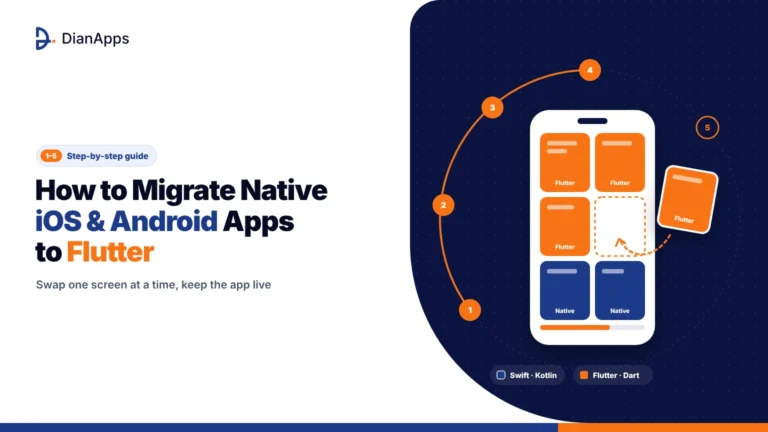
Legacy mobile app modernization development services tackle both architectural debt and user retention. Engineering teams audit crash telemetry, offline-sync reliability, API payload efficiency, and app-store compliance before deciding whether to refactor native modules or consolidate onto a cross-platform architecture. For organizations maintaining parallel iOS and Android estates with high UI parity, migrating native iOS and Android apps to Flutter allows teams to unify business logic, accelerate release cycles, and preserve smooth native-grade performance across devices.
When legacy mobile products require deeper architectural overhauls, such as offline-first local storage, biometric authentication, or real-time push orchestration, partnering with an experienced provider of mobile app development services ensures the modernized app aligns cleanly with backend APIs and long-term product roadmaps rather than recreating past technical debt on a newer framework.
Public Sector Legacy Application Modernization
Government agencies, municipal utilities, public healthcare networks, and state registries operate under constraints that private enterprises rarely face at the same scale. Systems often span decades, serve millions of citizens simultaneously, and run on strict statutory mandates where unplanned downtime is unacceptable.
Public sector legacy app modernization services require specialized delivery governance:
- Zero-Disruption Citizen Continuity: Tax portals, licensing systems, and benefits distribution platforms cannot go offline during cutover. Phased parallel runs and shadow traffic verification are mandatory.
- Strict Regulatory and Sovereign-Cloud Compliance: Data residency rules, accessibility mandates (Section 508 / WCAG 2.1 AA), and multi-layered security frameworks dictate cloud architecture choices from day one.
- Procurement-Aligned Phased Delivery: Rather than committing to high-risk multi-year waterfall contracts, public sector leaders increasingly structure modernization into modular, milestone-based increments that demonstrate verifiable public value every quarter.
- Institutional Knowledge Extraction: Because public-sector mainframes frequently hold decades of statutory edge cases, automated code-discovery tools paired with structured subject-matter-expert interviews protect policy accuracy during migration.
A Phased Modernization Roadmap That Protects Live Operations
High-profile modernization failures almost always share one root cause: the big-bang cutover. Teams spend 18 months building a replacement in isolation, flip the switch over a holiday weekend, and discover hundreds of undocumented edge cases in live production.
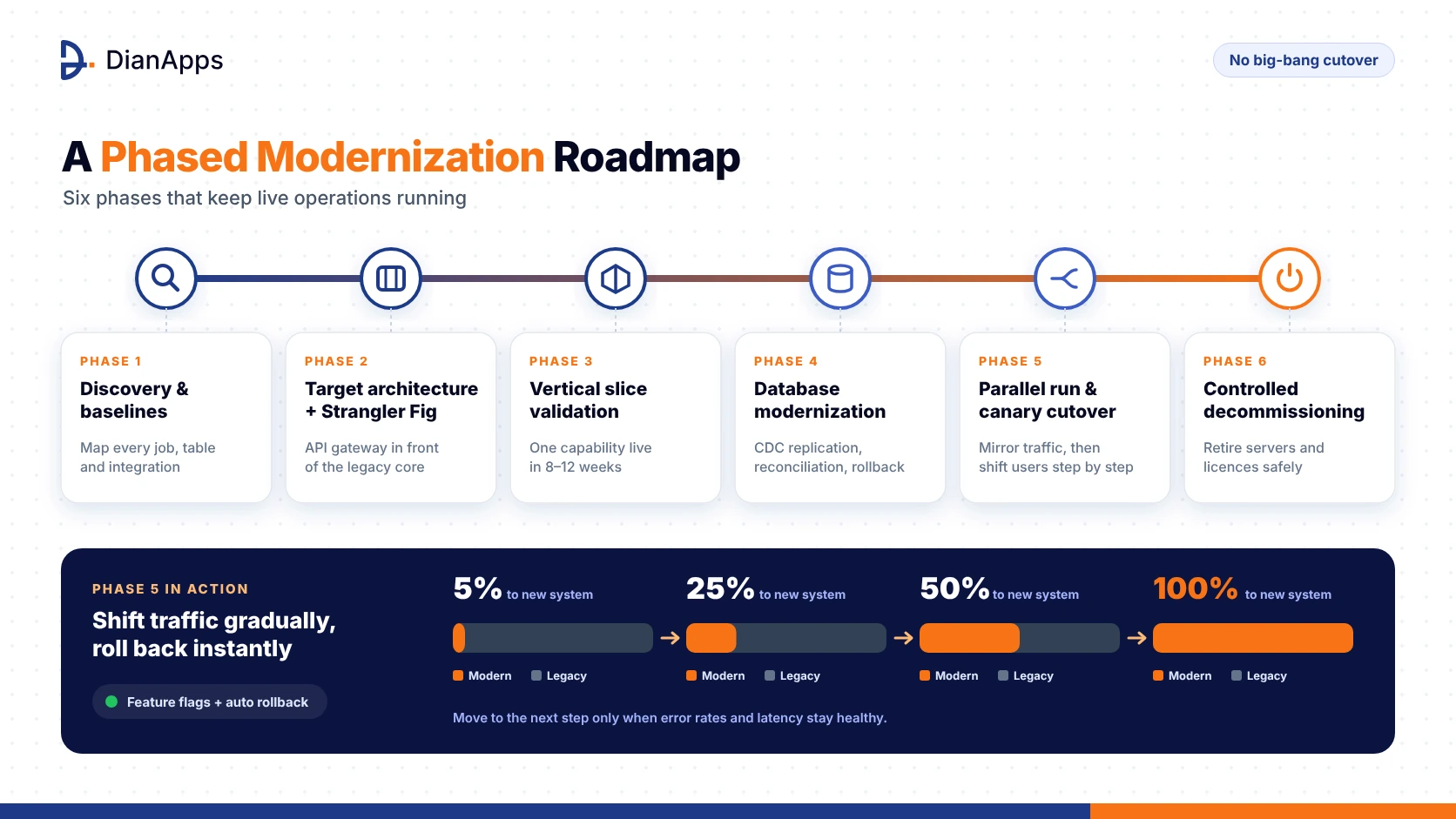
Reliable enterprise programs eliminate that gamble through six sequential phases:
Phase 1: Empirical Discovery and Baseline Measurement
Before selecting cloud services or frameworks, map every service, scheduled job, database table, and external integration. Extract undocumented business rules by interviewing daily operators and profiling live traffic logs. Establish hard baselines for change lead time, Mean Time to Recovery (MTTR), incident frequency, and monthly infrastructure spend so post-modernization ROI can be verified objectively.
Phase 2: Target Architecture and Strangler Fig Setup
Define standardized API contracts, centralized logging, observability, and identity protocols across the target environment. Instead of rewriting a monolith in one leap, apply the Strangler Fig pattern: deploy an API gateway or reverse proxy in front of the legacy application to intercept incoming requests. As new modular services are built and validated, the gateway gradually routes traffic away from the legacy core until the old system can be safely retired.
Do not default automatically to dozens of fine-grained microservices on day one. For mid-sized engineering teams, a modular monolith with strict domain boundaries often delivers faster iteration without distributed-network overhead. When scale, independent deployment, and multi-domain resilience genuinely demand distributed services, following proven patterns for building a secure microservices backend prevents service sprawl, cascading failures, and authentication gaps.
Phase 3: Vertical Slice Validation
Select one high-value, relatively self-contained business capability, such as user authentication, billing notifications, or order tracking, and modernize it end-to-end across UI, API, database, and CI/CD pipelines. Shipping one vertical slice into production within 8 to 12 weeks proves the target architecture, exposes integration friction early, and gives executive stakeholders tangible progress.
Phase 4: Dedicated Database Modernization Workstream
Application code can be rolled back in minutes; corrupted transactional data cannot. Treat database modernization as a distinct engineering track with seven non-negotiable controls:
- Data profiling and hygiene to isolate orphan records, duplicate keys, and inconsistent date or currency formats before migration.
- Schema transformation mapping legacy tables to normalized relational or event-driven schemas.
- Dependency mapping across every stored procedure, reporting query, and ETL pipeline touching the legacy store.
- Zero-downtime replication using Change Data Capture (CDC) pipelines to stream live deltas during transition windows.
- Deep financial and relational reconciliation validating checksums, primary-foreign key integrity, and transaction totals, never relying on surface row counts alone.
- Resilient dual-write fallback queues if legacy and modern systems must coexist temporarily.
- Rehearsed rollback runbooks tested against production-scale snapshots prior to go-live.
Phase 5: Parallel Verification and Canary Cutover
Run the legacy and modernized services concurrently using mirrored production traffic to compare outputs automatically. Once discrepancy rates hit zero, shift live user traffic incrementally (5%, 25%, 50%, 100%) using feature flags and canary routing, backed by automated latency and error-rate rollback triggers.
Phase 6: Controlled Decommissioning
Retire legacy servers and software licenses only after verifying statutory archive retention requirements, downstream BI reporting feeds, and disaster-recovery access. Turning off old infrastructure is where promised infrastructure savings finally hit the balance sheet.
Security, Compliance, and AI Readiness in Modernized Systems
Moving an application to modern cloud infrastructure does not automatically make it secure. In fact, decomposing a closed monolith into distributed APIs, containers, and cloud Identity and Access Management (IAM) roles introduces new attack surfaces that require deliberate architecture.
Build four security controls into the modernization blueprint from the start:
- Zero-Trust Identity and Access: Replace legacy hardcoded credentials, shared service accounts, and perimeter-only firewalls with short-lived tokens, Role-Based Access Control (RBAC), and mutual TLS between internal services.
- Automated Security Gates (DevSecOps): Embed static application security testing (SAST), dependency vulnerability scanning, and container image signing directly into CI/CD pipelines so vulnerable builds never reach production.
- End-to-End Encryption and Audit Logging: Enforce TLS 1.3 in transit, KMS-managed encryption at rest, and immutable audit trails for every privileged action and data access event.
- Domain-Specific Threat Controls: Regulated sectors such as financial services, healthcare, and payments face strict real-time monitoring expectations. Reviewing a structured fintech app security checklist and AI fraud detection framework illustrates how modern enterprises pair compliance controls with automated anomaly detection during system upgrades.
Using AI Responsibly During and After Modernization
AI plays two distinct roles in 2026 modernization programs:
- AI-Assisted Engineering: Coding assistants and static-analysis agents accelerate legacy code comprehension, generate documentation for undocumented modules, and scaffold unit test suites before refactoring begins. However, McKinsey research notes that 51% of enterprises using AI in IT workflows still encounter accuracy issues. AI speeds up analysis and boilerplate conversion, but human architects must own domain modeling, security boundaries, and production sign-off.
- Preparing Systems for Enterprise AI Workloads: Deloitte reports that nearly 60% of AI leaders identify legacy-system integration as the top barrier to scaling agentic AI and Retrieval-Augmented Generation (RAG). Batch-oriented legacy databases cannot feed real-time AI workflows. Modernizing into clean APIs and event-driven data stores removes that bottleneck permanently.
Ready to Modernize Without Downtime or Security Gaps?
Plan a phased Strangler Fig migration with zero-downtime database replication, DevSecOps controls, and API layers built for enterprise AI workloads.
Cost Drivers, ROI Benchmarks, and Budget Planning
Modernization proposals stall in boardrooms when presented strictly as technical cleanup. Grounding the business case in verified operational metrics shifts the conversation from IT expense to capital efficiency.
Documented enterprise benchmarks from 2025–2026 show consistent financial returns:
- Infrastructure and Maintenance Savings: Accenture reports 30% to 40% infrastructure cost reductions in financial-services cloud modernizations, while phased enterprise programs typically achieve breakeven in 12 to 18 months (and 18 to 30 months for large-scale core rewrites).
- Multi-Year ROI: Kyndryl’s State of Mainframe Modernization research documents three-year ROI between 288% (modernizing in place) and 362% (migrating workloads off legacy mainframes).
- Delivery Velocity and Growth: Organizations with high API interoperability grow revenue 2.5x faster than low-interoperability peers (Accenture), and teams shifting from monolithic releases to automated CI/CD cut unproductive maintenance work by up to 50% (Forrester).
Typical Enterprise Budget Ranges by Modernization Scope
Actual costs vary by codebase size, regulatory complexity, and data volume, but enterprise decision-makers can use the tiers below to frame initial budgets:
| Modernization Tier | Typical Scope | Estimated Timeline | Indicative Budget Range (USD) |
|---|---|---|---|
| Tier 1: Encapsulate & Rehost | API wrapping, cloud lift-and-shift, basic observability | 2–5 months | $50,000 – $150,000 |
| Tier 2: Replatform & UX Redesign | Containerization, managed DB migration, frontend/mobile UI overhaul | 4–9 months | $150,000 – $400,000 |
| Tier 3: Modular Refactoring | Strangler Fig decomposition, core API/DB modernization, CI/CD automation | 9–18 months | $400,000 – $1,200,000 |
| Tier 4: Enterprise Core Rebuild | Ground-up replacement of multi-module ERP, banking, or public-sector cores | 15–24+ months | $1,000,000 – $3,000,000+ |
When modeling three-year Total Cost of Ownership (TCO), factor in post-launch maintenance, not just build cost. For mobile-heavy enterprises, comparing Flutter and native app maintenance costs helps clarify how architectural choices reduce ongoing QA, OS upgrade, and staffing expenses. Similarly, if your modernization roadmap includes embedding custom generative AI agents, predictive analytics, or RAG workflows into the new platform, budgeting for complex AI products separately from core infrastructure refactoring keeps financial projections transparent and prevents scope creep.
Five Mistakes That Derail Enterprise Modernization Programs
Post-mortems of stalled modernization initiatives reveal the same five avoidable errors:
- Equating lift-and-shift with modernization: Moving an unoptimized monolith onto cloud instances often increases monthly spend because legacy apps cannot scale down during off-peak hours.
- Skipping portfolio-level prioritization: Treating every aging application as an isolated project creates fragmented tech stacks, duplicated integration work, and wasted licensing fees.
- Underestimating undocumented business logic: Rewriting code without extracting hidden pricing rules, tax overrides, and exception handlers guarantees production regressions during cutover.
- Choosing big-bang releases over vertical slices: Multi-year dark periods with zero production releases erode executive confidence and hide architectural flaws until the most expensive moment to fix them.
- Neglecting end-user workflow design and training: Rebuilding the backend while ignoring daily usability frustrates internal teams and drives employees back to shadow spreadsheets.
How to Evaluate a Legacy Application Modernization Partner
Selecting a modernization partner is a risk-management decision. Beyond hourly rates and slide decks, evaluate shortlisted vendors against five concrete criteria:
- Discovery before prescription: Do they insist on a structured technical and business-rule discovery phase before quoting a full rewrite, or do they pitch a generic cloud migration immediately?
- Proven database and zero-downtime methodology: Can their architects walk you through exact CDC replication, financial reconciliation, and rollback runbooks they have executed in production?
- Full-stack delivery capability: Can one integrated team handle cloud architecture (AWS/Azure), backend refactoring, web and mobile engineering, UX design, CRM/ERP integration, and security hardening or will you be stuck coordinating four separate agencies?
- Transparent milestone governance: Do they commit to vertical-slice production releases, shared KPIs (deployment frequency, latency, MTTR, cloud unit cost), and clean code handover so your internal team owns the platform afterward?
- Honest scoping: Will they tell you when to retain, encapsulate, or replace a system with SaaS rather than billing you for unnecessary custom development?
How DianApps Approaches Legacy Modernization
DianApps works with CTOs, founders, and enterprise product teams to modernize aging web, mobile, and cloud systems without halting live operations. Our engagements start with an empirical architecture and portfolio assessment, mapping dependencies, identifying quick infrastructure wins, and defining a phased vertical-slice roadmap across AWS cloud modernization, modular web and mobile development, UI/UX redesign, Salesforce integration, and production AI enablement.
Every milestone is tied to measurable operational improvements: faster release cycles, lower maintenance overhead, verifiable security posture, and full knowledge transfer to your internal engineering team.
 0 comments







Your email address will not be published. Required fields are marked *