















 0 comments





Key Takeaways:
- Hardening a fintech app in 2027 requires combining strict device encryption with real time behavioral fraud scoring.
- Fraud and risk management already accounts for over 30% of AI adoption across the global fintech sector.
- Adding machine learning fraud detection to an existing app starts with streaming clean transaction and device telemetry events.
- Meeting PCI DSS, SOC 2, and GDPR rules works best when compliance controls are automated inside your CI pipeline.
- Shadow testing new fraud models against live traffic prevents false declines from blocking legitimate paying customers.
Quick Answer: Securing a fintech app in 2027 requires encrypting local storage, enforcing biometric authentication, pinning SSL certificates, and adding real time AI fraud scoring. Teams connect transaction streams to machine learning models that flag suspicious device or behavioral anomalies before funds settle.
One leaked API token or a single unmonitored account takeover attack can wipe out years of customer trust in a financial product overnight. As mobile payment volumes climb, static password rules and manual fraud reviews simply can’t keep up with automated credential stuffing or synthetic identity rings. According to Mordor Intelligence, fraud and risk management held 30.55% of the global AI in fintech market share in 2025, making it the single largest investment priority for financial builders. Product leaders turning to Mobile App Development Services now treat this fintech app security checklist as core architecture rather than a pre launch checkbox.
Why Static Security Rules Fail Modern FinTech Apps
Legacy fraud filters built around rigid thresholds like blocking foreign IP addresses or flagging transfers above five hundred dollars create constant friction for good customers. Meanwhile, organized fraud rings test stolen cards in tiny two dollar increments specifically to slip right underneath those static limits.
- Automated bots rotate residential proxies continuously so simple IP blocklists stop working within hours.
- Social engineering scams trick genuine users into approving transfers from their own phones, bypassing basic password checks.
- High false positive decline rates push frustrated cardholders to switch permanently to a competitor’s wallet app.
Replacing brittle rule tables with adaptive behavioral intelligence lets your security stack spot subtle anomalies without punishing everyday shoppers.
How Do You Secure a FinTech App?
Securing a financial application means assuming that attackers will inspect your mobile binary, intercept local network traffic, and test stolen credentials against your login endpoints. Strong mobile banking app security layers defenses across the device, the network pipe, and your cloud APIs so no single weakness exposes customer funds.
- Enforce TLS 1.3 with strict certificate pinning so proxy tools can’t intercept sensitive payment payloads.
- Store session tokens exclusively inside iOS Keychain or Android Keystore rather than plain local preferences.
- Obfuscate compiled mobile code and add runtime checks that detect rooted or jailbroken devices automatically.
If you’re planning how to develop a fintech app from scratch, baking these controls into your foundation costs far less than retrofitting them after a penetration test fails.
What Security Features Must a FinTech App Have?
Every consumer and B2B finance product needs baseline safeguards before handling card numbers, ACH transfers, or wallet balances. Missing even one of these fintech app security best practices creates an opening for account takeover scripts.
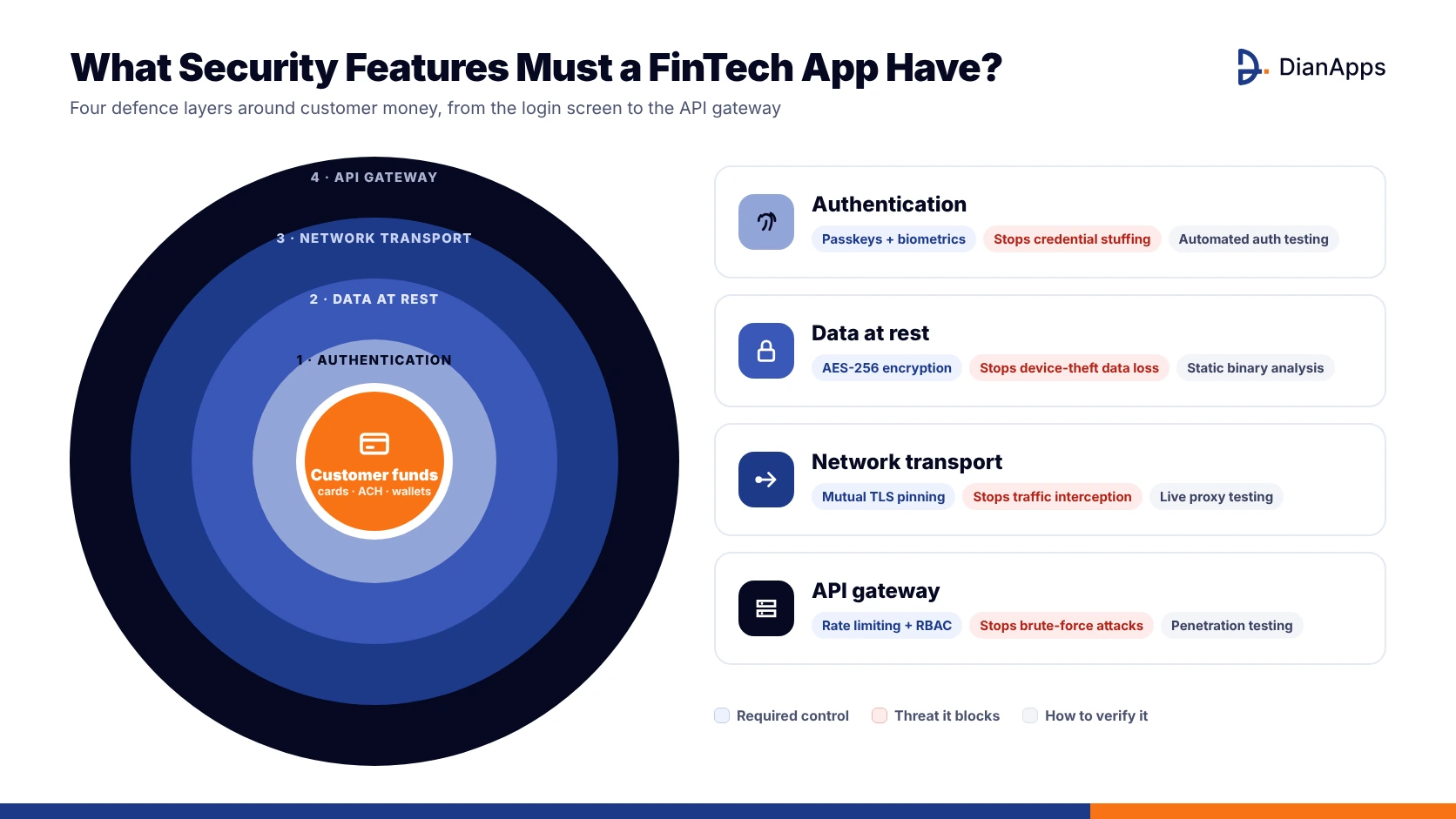
| Security Layer | Required Control | Primary Threat Blocked | Verification Method |
|---|---|---|---|
| Authentication | Passkeys and biometrics | Credential stuffing | Automated auth testing |
| Data at rest | AES 256 encryption | Physical device theft | Static binary analysis |
| Network transport | Mutual TLS pinning | Traffic interception | Live proxy testing |
| API gateway | Rate limiting and RBAC | Brute force attacks | Penetration testing |
Pairing these controls with short lived OAuth tokens keeps stolen sessions useless within minutes while giving users smooth biometric logins.
Audit Your FinTech Security Posture
Have our security engineers review your auth, encryption, and API controls.
Hardening Client Storage, Keys, and Mobile Binaries
Attackers routinely decompile Android APK and iOS IPA packages within minutes of an app store release looking for hardcoded API keys or weak encryption logic. Client side hardening ensures reverse engineering yields nothing useful even if someone steals a physical phone.
- Never embed third party secret keys, Stripe private tokens, or database credentials directly inside mobile client builds.
- Use Android Keystore and iOS Secure Enclave hardware chips to wrap local encryption keys away from user space.
- Disable screenshots, clipboard caching, and OS background preview thumbnails on screens displaying balances or card numbers.
Running automated binary scanners inside your CI pipeline catches accidental secret leaks before any release candidate reaches TestFlight or internal testers.
Securing API Gateways, OAuth Tokens, and Session Lifecycles
Mobile apps are only as safe as the backend APIs they call, because attackers routinely bypass your app UI entirely and hit REST or GraphQL endpoints directly with scripts. Strict gateway enforcement stops unauthorized data scraping and privilege escalation cold.
- Issue short lived JWT access tokens paired with rotating refresh tokens bound tightly to a specific device fingerprint.
- Validate object level ownership on every single request so user A can never fetch user B’s statements by incrementing an ID.
- Enforce strict per IP and per account rate limits on login, OTP verification, and password reset routes.
Implementing idempotency keys on payment endpoints also prevents malicious double spend retries during unstable cellular network drops.
Protecting Network Traffic Against Interception
Public cafe WiFi networks and compromised mobile routers make unpinned HTTPS connections vulnerable to man in the middle proxies holding forged root certificates. Securing transport layers ensures sensitive banking payloads travel cleanly from phone to cloud server.
- Enforce TLS 1.3 across all API subdomains while disabling legacy TLS 1.0 and 1.1 ciphers completely.
- Pin your server’s public key hashes inside the mobile client with backup pins ready for smooth certificate rotation.
- Sign critical money movement payloads with HMAC headers so tampered amounts get rejected immediately at the API gateway.
Properly configured certificate pinning stops casual traffic inspection tools cold while keeping legitimate certificate renewals safe from accidental app lockouts.
How Does AI Detect Fraud in FinTech Apps?
Traditional rule engines rely on rigid thresholds like blocking any card charge over five hundred dollars, which frustrates legitimate travelers while missing clever micro transactions. AI fraud detection in fintech studies hundreds of subtle signals together in milliseconds to spot anomalies that static rules completely miss.
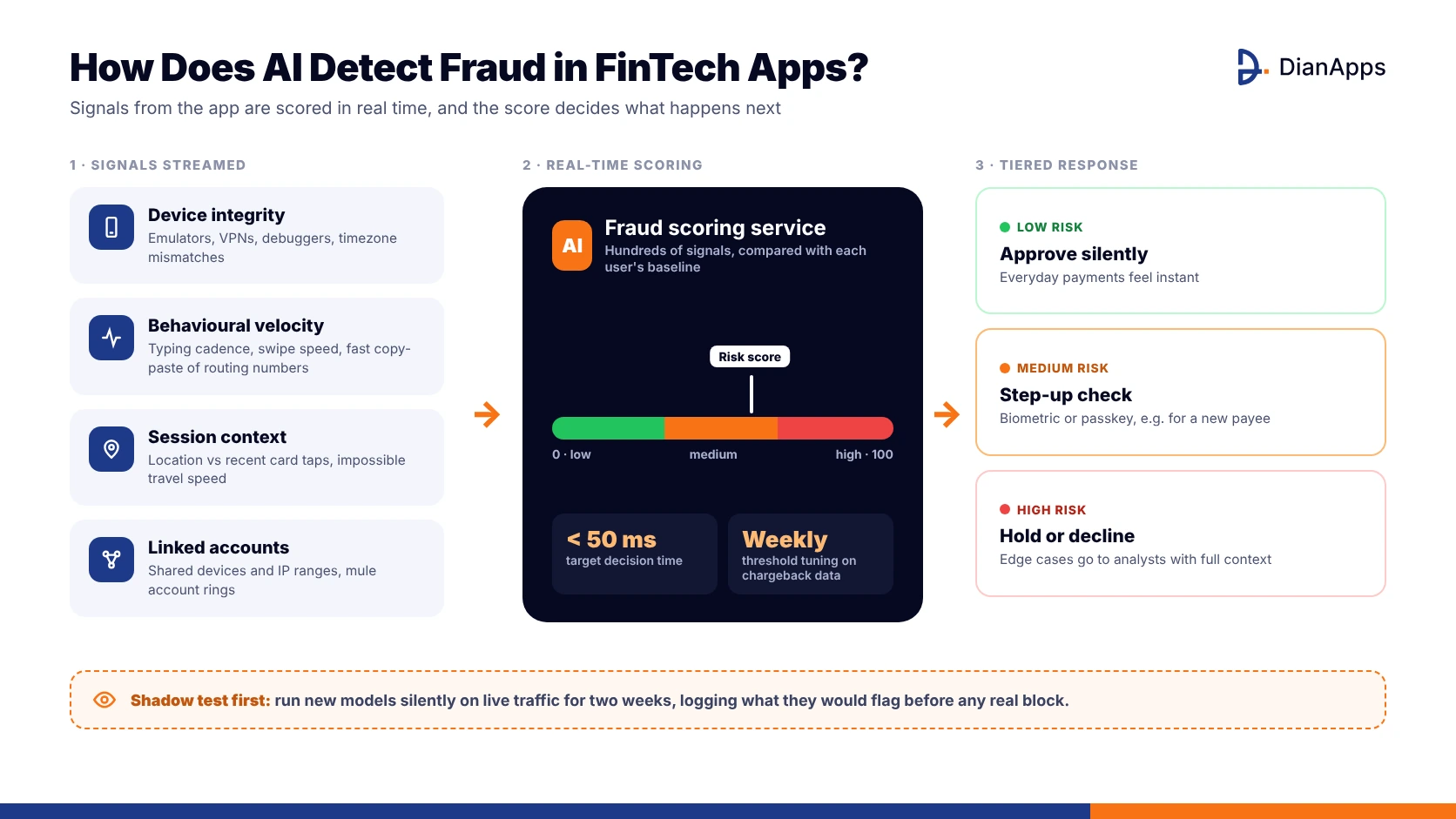
- Models compare current swipe speed, typing cadence, and navigation patterns against a user’s historical baseline.
- Graph algorithms flag linked devices, shared IP subnets, and mule accounts moving money in coordinated rings.
- Real time fraud detection assigns a risk score between zero and one hundred before approving any transfer.
When a score crosses your risk threshold, the app can trigger a quick biometric step up challenge instead of blindly blocking a good customer. Choosing the right tech stack for fintech software makes streaming these telemetry signals straightforward.
Telemetry Signals That Power Real Time Fraud Scoring
Machine learning fraud models are only as accurate as the behavioral and device signals your mobile SDK streams into the scoring pipeline. Collecting rich, privacy safe context lets classifiers distinguish real account owners from remote access trojans or emulators.
- Track device integrity signals including emulator flags, VPN usage, debugger attachment, and sudden timezone mismatches.
- Monitor behavioral velocity such as rapid copy paste of bank routing numbers or unusually fast form completion.
- Capture session context comparing current geolocation against recent card tap locations to spot impossible travel speeds.
Filtering out noisy raw signals early keeps inference payloads lightweight so fraud scoring never adds noticeable lag to normal checkout taps.
Balancing Fraud Prevention With False Decline Rates
Blocking every slightly unusual transaction might drop fraud losses to zero on paper, yet it destroys customer loyalty when legitimate buyers get declined at dinner. Smart risk orchestration uses tiered responses rather than treating fraud like a binary switch.
- Approve low risk scores silently in under fifty milliseconds so everyday payments feel instantaneous.
- Trigger step up biometric or passkey verification strictly on medium risk scores such as new recipient transfers.
- Hold or decline high risk transactions automatically while routing edge cases to fraud analysts with full context summaries.
Tuning these score thresholds weekly against actual chargeback data keeps false declines low while protecting your loss ratio.
Which Compliance Standards Apply to FinTech Apps?
Handling customer money pulls your engineering roadmap directly under strict regional and payment network regulations that carry heavy fines for sloppy data handling. Understanding which rules govern your exact product prevents painful legal delays right before launch.
- PCI DSS compliance for apps applies whenever your mobile client or backend processes, stores, or transmits cardholder data.
- SOC 2 Type II audits verify that your cloud infrastructure, access controls, and incident response processes stay consistently documented.
- GDPR and regional privacy laws require explicit user consent, data minimization, and clean deletion workflows for personal records.
Automating infrastructure checks and audit logging inside your deployment pipeline keeps compliance evidence ready year round. That discipline saves engineering teams weeks of manual screenshot gathering during annual audits.
Build Compliant Payment Infrastructure
Ship PCI DSS and SOC 2 ready financial apps with experienced fintech mobile architects.
How Do You Add Fraud Detection to an Existing App?
You don’t need to rebuild your core banking ledger just to introduce machine learning fraud prevention into a live product. Most teams layer intelligence onto their existing API gateway using asynchronous event streams that never slow down normal checkout screens.
- Instrument your mobile SDK to capture anonymized device fingerprints, session duration, and geolocation context safely.
- Stream login, password reset, and payment initiation events into a low latency message broker like Kafka.
- Route those events to a scoring microservice that returns an approve, challenge, or block decision under fifty milliseconds.
Working with a specialized fintech mobile app development team lets you shadow test new models against live traffic before enforcing automatic blocks. Shadow mode proves accuracy without risking false declines on real customers.
Shadow Testing and Model Retraining Workflows
Fraud tactics evolve monthly as attackers test new scripts against your defenses, which means a static machine learning model trained last year slowly loses accuracy. Continuous shadow evaluation keeps your detection rates sharp without breaking live payments.
- Run new model versions in silent shadow mode for two weeks to log what they would have flagged without blocking users.
- Feed confirmed chargebacks, support fraud tickets, and verified false positives back into weekly training datasets automatically.
- Monitor model drift dashboards daily so sudden shifts in user behavior trigger alerts before fraud spikes hit revenue.
Treating fraud models as living production services ensures your defenses adapt just as fast as organized attackers do.
Incident Response and Automated Account Recovery
Even heavily fortified financial apps occasionally face leaked user passwords from unrelated third party breaches or targeted phishing campaigns. Having fast, automated containment workflows limits financial damage when an account compromise occurs.
- Provide a one tap freeze account button inside push alerts whenever suspicious new device logins happen.
- Revoke all active refresh tokens and require fresh biometric plus government ID verification before unlocking frozen wallets.
- Maintain immutable audit trails capturing every IP address, device ID, and ledger mutation for rapid forensic investigation.
Practicing tabletop breach simulations twice a year ensures your engineering and support teams act calmly under real pressure.
Biometric Authentication and Passkey Implementation
Passwords remain the weakest link in mobile finance because customers reuse credentials across dozens of unrelated retail websites. Modern passkeys and hardware backed biometrics eliminate credential stuffing while speeding up daily logins.
- Bind Face ID, Touch ID, and Android BiometricPrompt directly to cryptographic keys stored inside secure hardware enclaves.
- Require fresh biometric confirmation before adding new external bank accounts, changing phone numbers, or raising wire limits.
- Fall back cleanly to strong hardware backed PINs only after verifying secondary out of band identity signals.
Passwordless passkeys cut support tickets for locked accounts while closing off phishing attacks that target SMS one time codes.
Securing Third Party Banking Aggregators and Webhooks
Most fintech apps connect to external card issuers, KYC identity vendors, and open banking aggregators through REST webhooks and SDKs. Every external integration introduces another potential entry point if signatures and permissions go unchecked.
- Verify cryptographic webhook signatures on every incoming settlement or identity status callback before updating user ledgers.
- Restrict aggregator API keys using IP allowlists and separate sandbox credentials strictly from production environments.
- Tokenize raw bank account numbers and card PANs at the edge so core analytics tables never touch sensitive strings.
Treating partner webhooks with the exact same zero trust scrutiny as public mobile endpoints protects your entire financial ledger.
Continuous Penetration Testing and DevSecOps Automation
Annual manual security audits aren’t enough when mobile teams ship new features and dependency updates every two weeks. Embedding automated security gates directly into your CI/CD workflow catches vulnerabilities before code ever reaches production.
- Run static application security testing and dependency vulnerability scans on every single pull request automatically.
- Schedule quarterly third party penetration tests targeting API authorization bypasses, deep link hijacking, and runtime tampering.
- Maintain a private bug bounty program so ethical researchers report edge case flaws responsibly before criminals exploit them.
Consistent DevSecOps habits turn security from a stressful pre launch scramble into a predictable part of weekly engineering delivery.
Add AI Fraud Detection Safely
Integrate real time behavioral scoring into your live app without disrupting legitimate user checkouts.
Final Thoughts
Strong fintech security in 2027 pairs disciplined mobile hardening with adaptive machine learning that spots bad actors before money leaves the account. When you encrypt local keys, enforce strict API gateway scopes, automate compliance checks, and shadow test real time fraud models, your product earns lasting customer trust and scales smoothly without regulatory surprises.
 0 comments










Your email address will not be published. Required fields are marked *