











 0 comments



Key Takeaways:
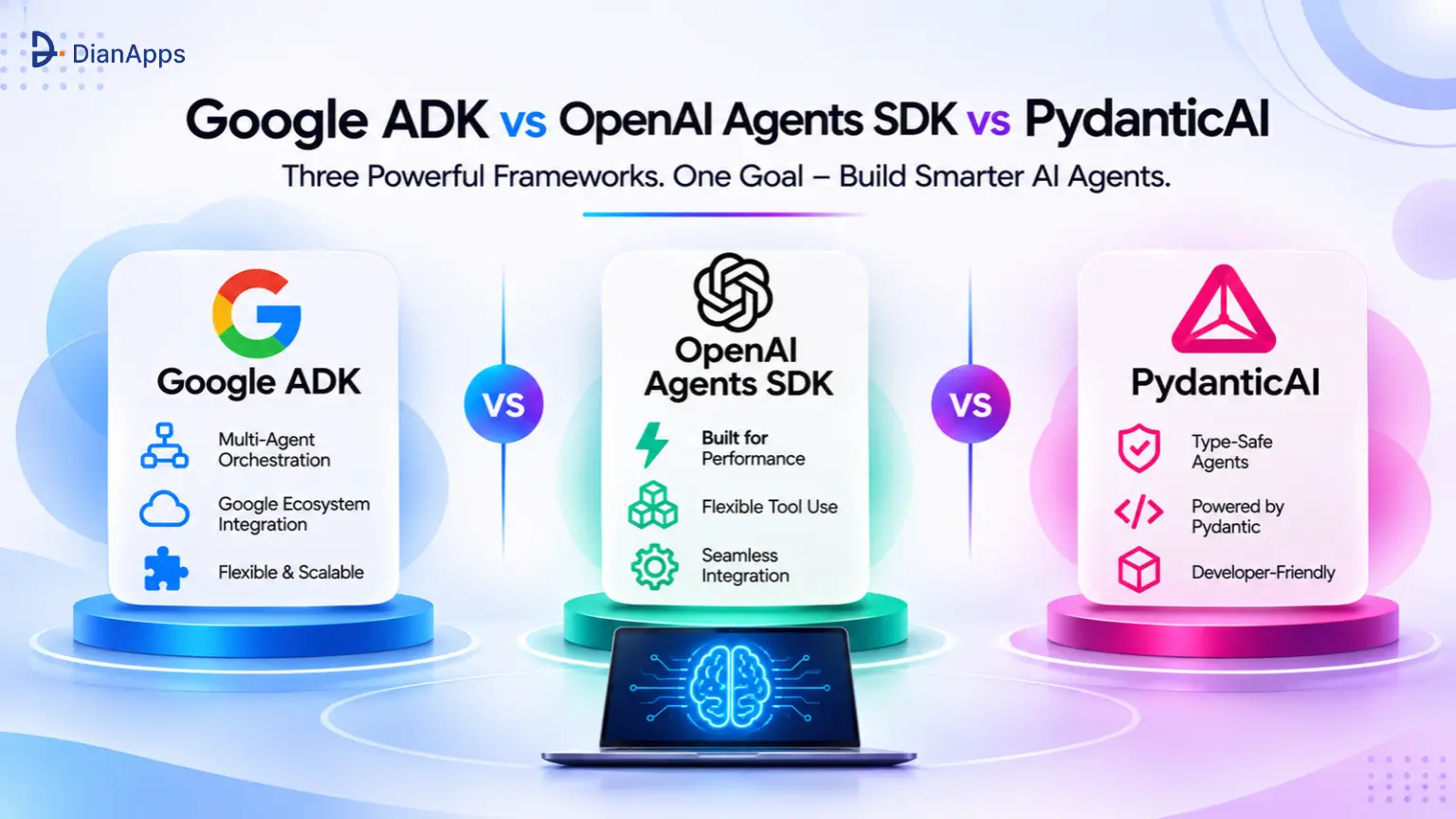
- Google ADK bets on explicit workflow structure, OpenAI Agents SDK relies on minimal primitives in your code, and PydanticAI enforces type safety at write time and runtime.
- ADK 2.0 ships sequential, parallel, loop, and graph workflows, OpenAI uses Handoffs and Agents-as-Tools, and PydanticAI pairs dependency injection with typed graphs.
- PydanticAI instruments with native OpenTelemetry, ADK provides a local web UI with bounded session rewind, and OpenAI relies on a hosted tracing dashboard.
- Out of the three SDKs, Google ADK is the only option supporting both Model Context Protocol (MCP) and Agent-to-Agent (A2A) protocols natively.
- ADK stays Gemini-first while remaining model-agnostic, OpenAI’s SDK supports external providers through LiteLLM, and PydanticAI stays provider-neutral under an MIT license.
Quick Answer: PydanticAI is the best lightweight agent SDK for teams that want FastAPI-style type safety, native OpenTelemetry, and provider neutrality, Google ADK leads for structured multi-agent workflows with built-in MCP and A2A, and OpenAI Agents SDK fits low-boilerplate agents in an OpenAI-centric stack.
Teams are moving away from the first generation of heavy agent frameworks because six layers of abstraction between application code and the model call turn every production incident into a slow debugging exercise. Engineers and AI agent development services providers now want SDKs that stay thin enough to read, typed enough to catch mistakes before deployment, and instrumented enough to diagnose failures at 3 a.m.
This Google ADK vs OpenAI Agents SDK vs PydanticAI guide compares the three leading lightweight options on the primitives that matter in production: state management, graph workflows, OpenTelemetry tracing, MCP and A2A support, and retry behavior.
Which SDK Fits Which Team?
Google ADK fits platform teams needing deterministic multi-agent workflows and interoperability, OpenAI Agents SDK fits product teams embedding agents into existing code with minimal ceremony, and PydanticAI fits backend teams already using Pydantic and FastAPI who refuse to ship untyped code. Each option works well for its target team and feels awkward when forced onto the other two, unlike broader multi-agent frameworks that bundle heavier abstractions.
- Google ADK (v2.0+): Choose it when you need structured workflows, session and artifact persistence, Gemini and Vertex AI alignment, and native MCP plus A2A support.
- OpenAI Agents SDK: Choose it for Agents, Handoffs, Guardrails, and Tools with almost no boilerplate in Python or TypeScript when OpenAI serves as your primary model and tracing platform.
- PydanticAI (v2.x): Choose it when strict type safety, dependency injection, native OpenTelemetry, durable execution, and broad provider portability top your engineering checklist.
- Honest caveat: All three SDKs ship updates on a weeks-long cadence, and ADK Python 2.0 only reached general availability on 19 May 2026 (ADK release notes, 2026), so verify exact APIs against current documentation before committing.
Side-by-Side Production Matrix
PydanticAI leads on type safety and observability, Google ADK leads on workflow structure and protocol support, and OpenAI Agents SDK keeps its surface area minimal. These seven technical properties decide production readiness across real deployments.
| Property | Google ADK (2.0+) | OpenAI Agents SDK | PydanticAI (2.x) |
|---|---|---|---|
| Primary philosophy | Software-component multi-agent workflows | Minimal primitives in your own app code | FastAPI-style typed agent engineering |
| Orchestration pattern | Sequential, parallel, loop, graph/dynamic workflows, sub-agent hierarchy | Handoffs (decentralized) and Agents-as-Tools (centralized) | Dependency injection, agent delegation, pydantic-graph typed graphs |
| Type safety and validation | Schema-based tool declarations, output schemas | Pydantic models for tool args and output_type | Validated at write time and runtime: inputs, deps, tool signatures, outputs |
| State and durability | Session service, scoped state, persisted artifacts, bounded session rewind | Sessions for history, state in app code | Durable execution across API failures, message history as typed objects |
| Observability and tracing | Built-in CLI and local web UI with trace view | Hosted tracing UI on OpenAI platform, processors for third parties | Native OpenTelemetry, Logfire, Langfuse, Arize |
| MCP and A2A support | Native MCP and native A2A | MCP servers supported, no native A2A | MCP client and server support, A2A via community |
| Cloud and model portability | Gemini and Vertex AI first, model-agnostic via LiteLLM and provider classes | OpenAI first, other providers via LiteLLM or custom model interface | Provider-neutral: OpenAI, Anthropic, Gemini, DeepSeek, Grok, Mistral and more |
| Language and license | Python, TypeScript, Go, Java, Apache-2.0 | Python, TypeScript, MIT | Python, MIT |
Sources: official documentation for each SDK, reviewed November 2026. A2A note: ADK has the most mature A2A implementation of mainstream frameworks (Fast.io, May 2026).
If your team spends code reviews debating strict types, PydanticAI will feel natural right away, whereas teams that design around explicit workflow diagrams will gravitate toward Google ADK.
Architectural Deep Dive: How Do the Three SDKs Differ Under the Hood?
Google ADK externalizes control flow into dedicated workflow agents, OpenAI Agents SDK keeps control flow in plain Python with Handoffs as its main new construct, and PydanticAI pushes correctness into the type system so orchestration code stays ordinary.
Those three designs reflect different answers to who decides what runs next: the model or the engineer.
Orchestration and Control Flow
Google ADK
- Graph and workflow state.
- ADK 2.0 separates deterministic workflow agents (SequentialAgent, ParallelAgent, LoopAgent, and graph/dynamic workflows) from LLM agents that handle reasoning. State stays scoped at the session, user, or app level while persisted artifacts survive across turns, giving you a business process that never depends on a model guessing the next step (ADK docs, 2026).
OpenAI Agents SDK
- Handoffs.
- A Handoff transfers control to a specialist agent much like a support desk transfers a caller, while Agents-as-Tools keeps the orchestrator in charge and invokes specialists as functions. You choose the right pattern per use case while the underlying runner loop stays mostly out of sight (OpenAI docs, 2026), making it straightforward to build OpenAI AI agents quickly.
PydanticAI
- Dependency injection and typed graphs.
- Dependencies such as database pools, HTTP clients, and user context enter tools through a typed RunContext so unit tests can swap them cleanly. For explicit state machines, pydantic-graph defines nodes as typed classes whose return type annotations act as edges, turning an invalid transition into a static type error instead of a runtime surprise.
Type Safety, Structured Outputs and Guardrails
Cascading failures in multi-agent systems usually begin when a malformed payload slips silently from one agent to the next, making boundary validation essential.
- PydanticAI: Tool signatures, dependencies, and outputs all use Pydantic models, so your type checker catches wrong fields before deployment while runtime validation catches model slips and feeds errors back for automatic retries.
- OpenAI Agents SDK: Setting output_type enforces Pydantic models on responses, while Guardrails run input and output checks in parallel with the agent and trip a circuit breaker when rules fail.
- Google ADK: Output schemas and callbacks around model or tool calls give you clean enforcement hooks alongside strict scoping over what each agent can read and write in session state.
Validating every agent boundary matters across all three SDKs because the language model generating the payload remains the least predictable component in your entire chain.
Observability, Tracing and Debugging in Production
- PydanticAI: Native OpenTelemetry instrumentation means calling Agent.instrument_all() emits standard spans directly to your existing collector, Pydantic Logfire, Langfuse, or Arize without custom adapters.
- Google ADK: Its CLI and local web UI display every session event, and bounded session rewind lets you step back to an earlier turn and replay it, making workflow bugs fast to isolate.
- OpenAI Agents SDK: Tracing comes enabled by default inside the OpenAI dashboard with export processors for external backends, which feels seamless on OpenAI’s stack and adds an extra integration step elsewhere.
Interoperability Standards: MCP and A2A
Model Context Protocol (MCP) standardizes how agents invoke external tools, while Agent-to-Agent (A2A) standardizes how separate agents discover and delegate tasks to one another, with MCP now governed under the Linux Foundation’s Agentic AI Foundation (Linux Foundation, December 2025).
- ADK: Supports both standards natively, letting agents expose AgentCards, coordinate through A2A task lifecycles, and attach MCP toolsets as first-class components.
- OpenAI Agents SDK: Supports attaching MCP servers to agents out of the box, though it currently lacks native A2A protocol support.
- PydanticAI: Ships built-in MCP client and server support while relying on community packages for teams that need A2A integration.
When your agents have to coordinate with services built by other teams on different frameworks, ADK’s mature A2A implementation becomes the deciding capability today, especially when comparing standalone vs platform agents.
Need Help Choosing or Scaling Your Production Agent SDK?
Connect with our backend and AI architects to review your multi-agent orchestration, observability stack, and type-safety requirements before locking in your framework.
Minimal Code Pattern Comparison: What Does a Typed Tool and Handoff Look Like?
Implementing a triage agent that calls a typed lookup tool and delegates to a specialist takes roughly 12 lines in each SDK, yet those lines highlight completely different priorities: ADK declares pipeline structure, OpenAI declares handoffs, and PydanticAI declares types. Compare these snippets for developer ergonomics rather than raw line count.
Google ADK
|
1 2 3 4 5 6 7 8 9 10 11 12 13 14 15 16 17 18 19 |
from google.adk.agents import LlmAgent, SequentialAgent def lookup_order(order_id: str) -> dict: """Return order status for a given order id.""" return {"order_id": order_id, "status": "shipped"} triage = LlmAgent(name="triage", model="gemini-2.5-flash", instruction="Classify the request and extract order_id.", tools=[lookup_order], output_key="triage_result") refunds = LlmAgent(name="refunds", model="gemini-2.5-flash", instruction="Handle refunds using {triage_result}.") pipeline = SequentialAgent(name="support", sub_agents=[triage, refunds]) |
OpenAI Agents SDK
|
1 2 3 4 5 6 7 8 9 10 11 12 13 14 15 16 17 18 19 20 21 22 23 |
from pydantic import BaseModel from agents import Agent, Runner, function_tool class Order(BaseModel): order_id: str status: str @function_tool def lookup_order(order_id: str) -> Order: return Order(order_id=order_id, status="shipped") refunds = Agent(name="Refunds", instructions="Process refund requests.") triage = Agent(name="Triage", instructions="Route the customer.", tools=[lookup_order], handoffs=[refunds]) result = Runner.run_sync(triage, "Where is order 8812?") |
PydanticAI
|
1 2 3 4 5 6 7 8 9 10 11 12 13 14 15 16 17 18 19 |
from dataclasses import dataclass from pydantic import BaseModel from pydantic_ai import Agent, RunContext @dataclass class Deps: db: OrderRepo # injected, swappable in tests class Order(BaseModel): order_id: str status: str triage = Agent("anthropic:claude-sonnet-4-5", deps_type=Deps, output_type=Order) |
|
1 2 3 4 5 |
@triage.tool async def lookup_order(ctx: RunContext[Deps], order_id: str) -> Order: return await ctx.deps.db.get(order_id) |
PydanticAI is the only snippet where both dependencies and outputs are type-checked before execution, ADK makes pipeline order explicit, and OpenAI handles delegation with a single keyword argument.
Production Pitfalls and Best Practices
Most production outages in agent systems trace back to three mistakes: mixing workflow state with chat history, retrying non-idempotent tools, and coupling domain logic to one SDK’s primitives. Each SDK gives you clean ways to avoid those traps, though none of them forces you to follow good hygiene.
- Separate workflow state from chat history: Chat history gives the model conversational context while workflow state holds your application’s source of truth, and mixing them inflates prompts while making bugs harder to reproduce across ADK’s scoped state, PydanticAI’s typed deps, and OpenAI’s sessions.
- Make tool retries idempotent: Because all three SDKs retry on validation or transient errors, a charge_card tool lacking an idempotency key can bill a customer twice unless you pass and deduplicate on a request ID.
- Treat durability explicitly: Decide where a crashed run should resume before your first outage, whether you rely on PydanticAI’s durable execution across API failures, ADK’s persisted sessions, or custom persistence around OpenAI’s SDK.
- Avoid SDK lock-in in the domain layer: Keep tools as plain Python functions backed by Pydantic models, store prompts separately, and keep orchestration thin so any SDK stays a replaceable adapter rather than a permanent dependency, whether you are automating internal ops or mortgage broker workflows.
- Measure latency overhead: Each framework adds only single-digit milliseconds per step compared to the model call itself, so real latency spikes come from extra validation retries and verbose tracing that you should budget upfront when calculating AI agent ROI.
Build Observable, Portable Multi-Agent Systems With DianApps
Share your cloud environment and reliability targets with our engineers to design typed, traceable agent workflows customized to your production stack.
How DianApps Builds Production Multi-Agent Systems?
DianApps, a mobile and AI app development company, helps enterprises and scaling startups across 25+ countries design and run agent systems through 150+ engineers, 350+ clients served, and a U.S. delivery presence backed by a 4.8/5 Clutch rating across 81+ reviews with Premier Verified status.
Our engineering teams stay implementation-neutral across all three SDKs so we choose based on your cloud infrastructure, typing discipline, and observability stack rather than vendor preference. Our AI development services span LLM development, generative AI, AI agents and multi-agent systems, conversational AI, NLP, computer vision, and machine learning.
A simple single-agent chatbot rarely needs any of these SDKs because a direct API call stays faster to maintain, just as self-hosted personal agents suit individual workflows better. We bring real value when teams build multi-agent systems that must stay observable, durable, and portable, covering the same production concerns explored in our guide to Model Context Protocol.
Conclusion
Deciding between Google ADK, OpenAI Agents SDK, and PydanticAI comes down to where your team wants correctness enforced. ADK enforces rules in explicit workflow structure, OpenAI trusts your application code to stay clean, and PydanticAI enforces contracts inside Python’s type system.
Default to PydanticAI for typed, observable, portable Python agents, move to Google ADK when you need A2A interoperability, multi-language teams, or Vertex AI, and pick OpenAI Agents SDK when you are all-in on OpenAI with minimal boilerplate. Whatever you select, keep tools as plain typed functions, separate workflow state from chat history, and make every side effect idempotent.
If you want a second pair of eyes on your agent architecture before your first production incident, DianApps can review your design with your engineering team.
Review Your Multi-Agent Architecture With Our Engineers
Book a technical consultation with DianApps to validate your SDK choice, harden tool boundaries, and set up end-to-end production observability.
 0 comments





Your email address will not be published. Required fields are marked *