















 0 comments





What Changed in 2026
The market landscape shifted meaningfully in the last twelve months. Here are the verified data points that shape the guidance below:
- Over 80% of mobile apps will integrate AI features by end of 2026 (Sensor Tower State of Mobile 2026).
- Generative AI mobile apps generated $3 billion in revenue in 2025 (273% YoY growth) (Sensor Tower, 2025).
- Gen AI apps projected to reach $10 billion in consumer spending in 2026 (Sensor Tower, 2026).
- Apple Intelligence + Gemini Nano make on-device AI standard on flagship phones in 2026 (Apple + Google I/O 2025).
- AI-integrated feature builds cost $25K-$80K over 6-12 weeks (down 60% from 2023) (DianApps 2026 project benchmarks).
Related Reading From Our 2026 Guides
For deeper context, see these companion guides:
- Mobile App Development Trends 2026
- On-Device AI vs Cloud AI
- AI-Leading Mobile App Companies USA 2026
- Top Frameworks for AI-Native Mobile Apps
TL;DR
- Agentic web applications go beyond traditional AI by reasoning, planning, and autonomously executing tasks to achieve business goals.
- Unlike AI-powered applications that primarily generate insights, agentic systems can interact with APIs, tools, databases, and enterprise software to perform actions.
- A production-ready agentic architecture consists of seven key layers: Agent Layer, LLM Layer, Memory Layer, RAG Layer, Tool Layer, Orchestration Layer, and Governance Layer.
- Popular frameworks for agentic AI development include LangGraph, CrewAI, AutoGen, Semantic Kernel, and OpenAI Agents SDK.
- Advanced AI/ML development services like predictive analytics, recommendation engines, computer vision, speech intelligence, and anomaly detection significantly enhance agent performance.
- Multi-agent architectures improve scalability by assigning specialized responsibilities to research, analytics, compliance, execution, and monitoring agents.
- Development costs typically range from $25,000 for MVPs to $1M+ for enterprise-scale multi-agent ecosystems.
- The future of software is shifting from interface-driven applications to AI-native, outcome-driven systems powered by autonomous agents.
Artificial intelligence is entering a new phase, one where systems no longer stop at generating content, answering questions, or assisting users.
Instead, they are beginning to plan, reason, make decisions, and execute tasks autonomously.
This evolution is driving the rise of Agentic AI, a technology paradigm that is rapidly reshaping how modern web applications are designed, deployed, and scaled.
Over the past two years, enterprises have invested heavily in generative AI solutions, from customer support chatbots and coding assistants to intelligent search engines and recommendation systems.
However, as organizations push beyond experimentation, a new challenge has emerged: users no longer want AI that simply responds. They want AI that acts.
According to Gartner, nearly 40% of enterprise applications are expected to incorporate task-specific AI agents by the end of 2026, compared to less than 5% in 2025. At the same time, industry analysts project the global AI agents market to exceed $50 billion by 2030, growing at a compound annual growth rate of more than 45%.
These numbers signal a fundamental shift from AI-assisted software to AI-driven software ecosystems.
The transition is already visible across industries:
- Financial institutions are deploying autonomous agents to monitor transactions and detect anomalies.
- Healthcare platforms are using AI-powered systems to coordinate patient workflows.
- Ecommerce businesses are building intelligent shopping assistants capable of researching products, comparing options, and completing purchasing journeys with minimal human input.
- Enterprise software providers are embedding AI agents directly into business workflows to automate repetitive operations and accelerate decision-making.
Also read: Generative AI in enterprise app development.
What makes this transformation particularly significant is the convergence of several technological breakthroughs:
- Large Language Models (LLMs) have become more capable of reasoning through complex tasks.
- Retrieval-Augmented Generation (RAG) systems can now access proprietary enterprise knowledge in real time.
- Advanced AI/ML development services enable prediction, classification, recommendation, and computer vision at production scale.
Meanwhile, orchestration frameworks such as multi-agent architectures allow specialized AI systems to collaborate toward shared objectives rather than operate as isolated assistants.
The result is a new generation of web applications that behave less like traditional software and more like autonomous digital teammates. These applications can understand goals, create execution plans, interact with external APIs, retrieve organizational knowledge, learn from historical interactions, and continuously optimize outcomes.
For technology leaders, startup founders, product teams, and enterprise architects, this shift presents both an opportunity and a challenge. Building agentic web applications requires far more than integrating a large language model into an existing product. It demands a carefully designed architecture that combines reasoning engines, memory systems, AI/ML services, orchestration frameworks, security controls, and real-time decision-making capabilities into a unified ecosystem.
In this technical guide, we’ll explore how to build production-ready agentic web applications using advanced AI/ML services. You’ll learn the architecture patterns behind modern AI agents, the technologies powering autonomous workflows, the frameworks enabling multi-agent collaboration, and the best practices required to deploy secure, scalable, enterprise-grade agentic systems in 2026 and beyond.
Must read: Understand the difference between AI and machine learning.
Traditional Web Applications vs AI-Powered Applications vs Agentic Web Applications
The evolution of web applications has followed a clear progression over the last two decades. Traditional applications introduced digital workflows. AI-powered applications added intelligence and automation. Today, agentic web applications are taking the next step by combining reasoning, planning, decision-making, and autonomous execution into a single system.
At a high level, the difference comes down to one critical factor: autonomy.
Traditional applications execute predefined instructions. AI-powered applications generate insights and recommendations. Agentic applications can understand goals, create plans, interact with tools, and execute multi-step workflows with minimal human intervention.
Quick Comparison: Traditional vs AI-Powered vs Agentic Applications
| Capability | Traditional Web Apps | AI-Powered Apps | Agentic Web Apps |
|---|---|---|---|
| User Interaction | Rule-based | Intelligent responses | Goal-oriented collaboration |
| Decision Making | Human-driven | AI-assisted | AI-driven with human oversight |
| Workflow Execution | Manual | Partially automated | Autonomous and adaptive |
| Learning Capability | None | Model-based learning | Continuous contextual learning |
| Memory | Database records only | Limited contextual memory | Persistent long-term memory |
| Tool Usage | User performs actions | Limited integrations | Autonomous tool and API execution |
| Adaptability | Fixed workflows | Dynamic responses | Dynamic planning and execution |
| Multi-Step Reasoning | Not supported | Limited | Core capability |
| Business Outcome | Task completion | Decision support | Goal achievement |
Traditional Web Applications: Built Around Fixed Logic
Traditional web applications operate through predefined workflows and deterministic business rules. Whether it’s an ecommerce platform, CRM dashboard, banking portal, or project management system, every action follows a sequence explicitly programmed by developers.
While traditional architectures offer reliability and predictability, they struggle with complex decision-making, unstructured data processing, personalized experiences at scale, dynamic workflow optimization, and autonomous task execution.
AI-Powered Applications: Intelligence Without True Autonomy
AI-powered applications introduced a significant leap forward by embedding machine learning models and Large Language Models (LLMs) into software systems. Instead of merely processing inputs, these systems can predict outcomes, classify information, generate content, recommend products, detect anomalies, and analyze customer behavior.
Read: Top AI chatbot platforms of 2026.
However, despite their intelligence, most AI-powered applications remain reactive. They can answer questions, generate content, or provide recommendations, but they typically cannot execute complete business workflows independently.
Agentic Web Applications: From Intelligence to Autonomous Action
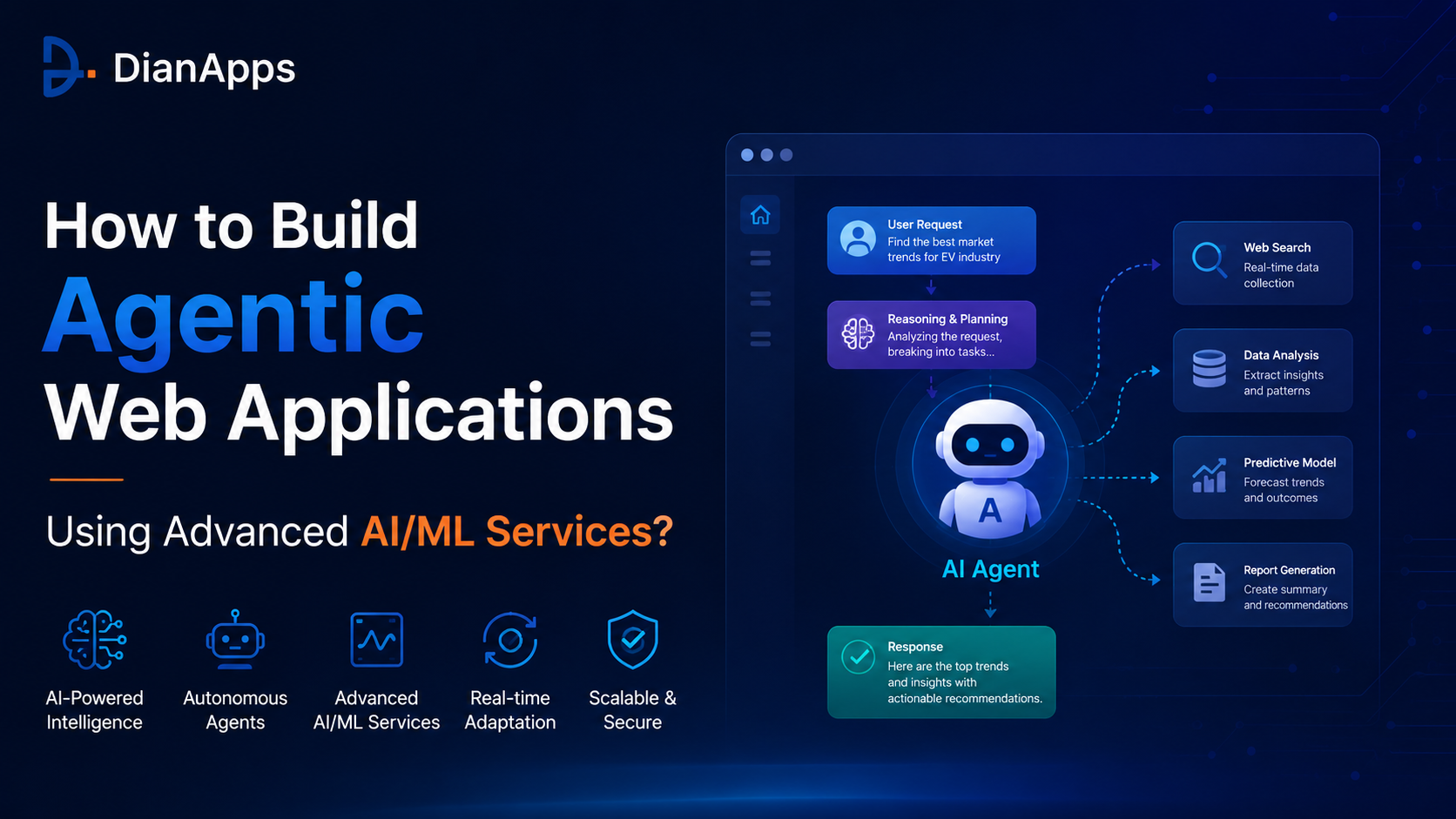
Agentic web applications are designed to close the gap between understanding and execution. Rather than responding to individual prompts, these systems work toward objectives. A user provides a goal, and the application determines how to achieve it.
Example Goal: “Identify our top 20 enterprise prospects, prioritize them by conversion probability, schedule discovery meetings, and generate personalized outreach emails.”
An agentic application can analyze CRM data, identify high-value prospects, score opportunities using machine learning models, access calendar systems, schedule meetings, generate outreach messages, track responses, and adjust strategies based on outcomes, autonomously.
The Shift from Prompt-Driven to Goal-Driven Computing
Traditional AI follows a prompt-response pattern: Prompt → Response
Agentic AI follows a goal-execution pattern: Goal → Planning → Reasoning → Action → Learning → Optimization
The future of software is increasingly centered around outcomes rather than interfaces. Gartner predicts that agentic AI will become deeply embedded within enterprise software development ecosystems over the next several years.
Core Components of an Agentic Web Application Architecture
At a high level, a production-grade agentic architecture consists of seven foundational components:
- Agent Layer
- Reasoning Layer (LLM Layer)
- Memory Layer
- Retrieval-Augmented Generation (RAG) Layer
- Tool and Action Layer
- Orchestration Layer
- Observability and Governance Layer
Read: How AI in SaaS has transformed content marketing?
1. Agent Layer: The Autonomous Decision-Maker
The agent layer acts as the operational brain of the application. An AI agent is a software entity capable of perceiving information, making decisions, creating plans, and executing actions to achieve a defined objective with limited supervision.
Typical Responsibilities:
- Goal interpretation
- Task decomposition
- Action selection
- Context management
- Workflow execution
2. Reasoning Layer: The Cognitive Engine
The reasoning layer is typically powered by Large Language Models (LLMs) such as GPT, Claude, Gemini, or enterprise-specific foundation models. Its core responsibility is determining what should happen next, which tool to use, which information is missing, and what sequence of actions will achieve the goal, a process known as agentic reasoning.
3. Memory Layer: Enabling Contextual Intelligence
Memory enables agents to remember user preferences, track historical interactions, store workflow outcomes, learn organizational context, and maintain continuity across sessions.
| Memory Type | Purpose |
|---|---|
| Short-Term Memory | Current session context |
| Long-Term Memory | Persistent user information |
| Semantic Memory | Organizational knowledge |
| Episodic Memory | Historical actions and outcomes |
4. Retrieval-Augmented Generation (RAG) Layer
The RAG layer enables agents to retrieve information from internal documents, knowledge bases, product catalogs, support tickets, databases, and compliance documentation. Without RAG, responses may be outdated, hallucination risks increase, and business accuracy decreases. With RAG, responses become grounded in enterprise knowledge.
5. Tool and Action Layer
This layer provides controlled access to external systems and APIs, including CRM platforms, payment gateways, ERP systems, email providers, calendar applications, analytics tools, and internal databases. Read: 7 things to keep in mind when investing in API development.
6. Orchestration Layer: Coordinating Intelligence at Scale
The orchestration layer coordinates communication and collaboration between specialized agents, Research Agent, Analytics Agent, Compliance Agent, Customer Support Agent, Workflow Execution Agent. According to IBM, AI agent orchestration enables specialized agents to work together toward shared objectives while managing workflows, dependencies, and task allocation.
7. Observability, Security, and Governance Layer
Key capabilities include agent monitoring, workflow tracing, audit logging, prompt security, access control, compliance validation, and human approval workflows. Without governance, agentic systems introduce risks such as unauthorized actions, data leakage, prompt injection attacks, and compliance violations.
Step-by-Step Process to Build an Agentic Web Application Using Advanced AI/ML Services
Step 1: Define the Business Goal and Agent Scope
Before selecting models, frameworks, or cloud infrastructure, define the exact problem the agent will solve.
❌ Poor Objective
“Build an AI customer support chatbot.”
✅ Well-Defined Objective
“Reduce Level-1 support ticket volume by 60% by allowing an AI agent to diagnose issues, retrieve documentation, create tickets, and escalate complex cases automatically.”
Step 2: Select the Right Foundation Model
| Evaluation Criteria | Why It Matters |
|---|---|
| Reasoning Capability | Complex decision-making |
| Context Window | Long workflow execution |
| Tool Calling Support | API interactions |
| Cost Efficiency | Production scalability |
| Latency | User experience |
| Fine-Tuning Options | Domain specialization |
| Security Controls | Enterprise compliance |
Read: Unexpected ways AI has transformed the modern business model.
Step 3: Design the Agent Workflow
Traditional Workflow: Input → Business Rules → Output
Agentic Workflow: Goal → Planning → Tool Selection → Execution → Validation → Learning
Workflow Design Principles:
- Break large goals into smaller tasks
- Validate outputs at each stage
- Introduce fallback mechanisms
- Add retry logic
- Define approval checkpoints
Step 4: Build a Memory Architecture
Recommended Memory Architecture:
- Session Memory: Stores active conversations and current workflow state.
- Long-Term Memory: Stores persistent user preferences and business context.
- Semantic Memory: Contains organizational knowledge and domain expertise.
- Episodic Memory: Records previous actions and outcomes.
Step 5: Implement Retrieval-Augmented Generation (RAG)
RAG Pipeline:
Data Sources → Document Processing → Embedding Models → Vector Database → Semantic Retrieval → Agent Reasoning → Response Generation
Best Practices:
- Use metadata filtering
- Implement document versioning
- Track citation sources
- Continuously update embeddings
- Monitor retrieval accuracy
Step 6: Connect External Tools and APIs
Common integrations: Salesforce, HubSpot, Stripe, Jira, Slack, Microsoft Teams, Google Workspace, SAP, and internal APIs. This capability transforms AI from an information provider into an operational participant.
Step 7: Integrate Advanced AI/ML Services
- Predictive Analytics: Churn prediction, revenue forecasting, demand planning, risk assessment
- Recommendation Systems: Product suggestions, personalized experiences, content ranking
- Computer Vision: Image recognition, quality inspections, document processing
- Speech Intelligence: Voice assistants, call analytics, speech-to-text workflows
- Anomaly Detection: Fraud prevention, cybersecurity monitoring, system health analysis
Step 8: Implement Multi-Agent Orchestration
Example Multi-Agent Workflow:
User Goal → Supervisor Agent → Research Agent → Analytics Agent → Compliance Agent → Execution Agent → Final Result
This approach improves accuracy, scalability, reliability, and explainability.
Step 9: Establish Security, Governance, and Human Oversight
Essential Controls:
- Role-based access control
- Prompt injection protection
- Audit logging
- Permission management
- Approval workflows
- Data masking
- Action restrictions
Require human approval for: Financial transactions, contract modifications, regulatory decisions, customer refunds.
Step 10: Deploy, Monitor, and Continuously Optimize
| Metric | Purpose |
|---|---|
| Task Success Rate | Measures effectiveness |
| Hallucination Rate | Measures reliability |
| Tool Success Rate | Measures execution quality |
| Response Latency | Measures performance |
| User Satisfaction | Measures business value |
| Cost per Task | Measures ROI |
See: Navigating the software development life cycle.
Best Technology Stack for Agentic Web Application Development in 2026
| Layer | Recommended Technologies |
|---|---|
| Frontend | React, Next.js, Angular, Vue.js |
| Backend | Python, FastAPI, Node.js, NestJS |
| AI Models | GPT, Claude, Gemini, Llama |
| Agent Frameworks | LangGraph, CrewAI, OpenAI Agents SDK, AutoGen |
| Vector Databases | Pinecone, Weaviate, Milvus, Chroma |
| Memory Storage | PostgreSQL, MongoDB, Redis |
| Workflow Orchestration | Temporal, LangGraph, Apache Airflow |
| AI/ML Frameworks | PyTorch, TensorFlow, Scikit-learn |
| Cloud Infrastructure | AWS, Azure, Google Cloud |
| Monitoring & Observability | LangSmith, Arize AI, Datadog, OpenTelemetry |
| Security & Governance | IAM, Vault, Azure AI Content Safety |
Foundation Models for Agentic AI
| Model | Strengths | Ideal For |
|---|---|---|
| GPT Models | Advanced reasoning, Tool calling, Multi-step planning, Large ecosystem | Enterprise automation, Customer-facing agents, Multi-agent systems |
| Claude | Long-context reasoning, Document analysis, Safety-focused architecture | Legal workflows, Research applications, Knowledge management |
| Gemini | Multimodal processing, Google ecosystem integration, Search-enhanced reasoning | Enterprise productivity, Data-heavy applications |
Have a quick comparison on Grok vs Llama vs Gemini vs ChatGPT.
Recommended Technology Stack by Business Stage
| Business Stage | Recommended Stack |
|---|---|
| MVP Startup | Next.js + FastAPI + GPT + Chroma |
| Growth Stage SaaS | Next.js + LangGraph + Pinecone + PostgreSQL |
| Enterprise Platform | React + FastAPI + LangGraph + Pinecone + AWS |
| Regulated Industries | Angular + Azure + Llama + Weaviate |
| Large-Scale Multi-Agent Systems | LangGraph + CrewAI + Pinecone + Kubernetes |
We offer the best AWS Cloud Consulting services, check it out for more information.
Continue reading: Top frameworks for web app development.
How Advanced AI/ML Services Power Agentic Web Applications?
The most successful agentic web applications combine LLM reasoning with specialized AI/ML services that provide predictive intelligence, pattern recognition, anomaly detection, personalization, forecasting, and computer vision capabilities.
Predictive Analytics
Predictive models help agents anticipate future outcomes, customer churn prediction, revenue forecasting, demand planning, lead scoring, and risk assessment. For example, an ecommerce agent can identify customers with a high likelihood of churn and automatically launch retention campaigns before revenue is lost.
Recommendation Engines
Recommendation systems enhance personalization through product recommendations, content suggestions, dynamic pricing, and cross-selling opportunities. Instead of offering generic responses, agents can tailor actions based on historical behavior and contextual signals.
Computer Vision
Computer vision enables agents to understand visual information, image classification, product recognition, defect detection, identity verification, and document processing. For example, an insurance claims agent can analyze uploaded damage photos and automatically initiate claim assessment workflows.
Natural Language Processing (NLP)
Beyond LLMs, NLP models support sentiment analysis, intent classification, entity extraction, topic detection, and language translation. These capabilities improve an agent’s ability to understand user requests and business context.
Speech Intelligence
Voice-enabled agentic systems rely on speech-to-text, text-to-speech, call analytics, and voice biometrics, allowing organizations to build AI-powered customer service experiences across both voice and digital channels.
Anomaly Detection
Anomaly detection models help agents identify unusual behavior, fraud prevention, cybersecurity monitoring, financial risk management, and system health monitoring.
Building Multi-Agent Systems for Enterprise Applications
Typical Multi-Agent Architecture
- Supervisor Agent: Coordinates workflows and assigns tasks.
- Research Agent: Collects relevant information from internal and external sources.
- Analytics Agent: Processes datasets and generates insights.
- Compliance Agent: Ensures outputs meet regulatory requirements.
- Execution Agent: Performs actions across business systems.
- Monitoring Agent: Tracks outcomes and continuously evaluates performance.
Benefits of Multi-Agent Systems: Improved accuracy, better fault tolerance, specialized expertise, greater scalability, and reduced operational complexity.
Security Challenges in Agentic AI Systems
Major Security Risks
- Prompt Injection Attacks: Malicious instructions embedded within external data sources may manipulate agent behavior.
- Unauthorized Tool Access: Agents with excessive permissions can perform unintended actions.
- Memory Poisoning: Attackers may attempt to corrupt long-term memory systems.
- Data Leakage: Sensitive business information may be exposed through insecure workflows.
- Agent Hijacking: Poorly secured agents may be manipulated into executing malicious tasks.
Security Best Practices
- Least-privilege access controls
- Human approval workflows
- Tool permission boundaries
- Audit logging
- Memory validation mechanisms
- Encryption at rest and in transit
- Continuous monitoring
Learn more about AI governance shaping the future of technology.
Real-World Agentic AI Use Cases Across Industries
Healthcare
- Intelligent Patient Coordination: Schedule appointments, verify insurance, route patient inquiries, coordinate follow-up care.
- Clinical Documentation: AI agents assist clinicians by generating structured medical documentation.
Financial Services
- Fraud Detection Agents: Monitor transactions in real time and initiate risk mitigation workflows.
- Wealth Management Assistants: Provide personalized financial recommendations while maintaining compliance requirements.
Ecommerce
- Autonomous Shopping Assistants: Help customers discover products, compare options, and complete purchases.
- Inventory Management Agents: Forecast demand and automate replenishment workflows.
SaaS Platforms
- Customer Success Agents: Monitor user behavior and proactively address churn risks.
- Sales Development Agents: Identify opportunities, qualify leads, and coordinate outreach campaigns.
Logistics and Supply Chain
- Supply Chain Optimization Agents: Monitor inventory, shipping routes, supplier performance, and demand fluctuations.
- Autonomous Procurement Assistants: Manage purchasing workflows and vendor communications.
Human Resources
- Recruitment Agents: Screen candidates, schedule interviews, and manage hiring workflows.
- Employee Support Agents: Handle onboarding, benefits inquiries, and policy guidance.
Cost of Building an Agentic Web Application
AI/ML development costs vary significantly depending on complexity, integrations, autonomy levels, and infrastructure requirements.
| Project Type | Estimated Cost Range |
|---|---|
| MVP Agentic Application | $25,000 – $75,000 |
| Production SaaS Agent | $75,000 – $250,000 |
| Multi-Agent Enterprise Platform | $250,000 – $1M+ |
| Industry-Specific Agent Ecosystem | $500,000 – $2M+ |
Major Cost Drivers: Foundation model token consumption, RAG infrastructure, tool integrations, observability platforms, and security/compliance requirements.
Future Trends in Agentic AI Development
- Multi-Agent Ecosystems: Networks of specialized agents collaborating across departments.
- Agentic Operating Systems: Enterprise software vendors positioning AI agents as the primary interface for work execution.
- Human-on-the-Loop Governance: Humans supervising exceptions and high-risk decisions rather than every action.
- Domain-Specific Agents: Industry-focused agents for healthcare, finance, legal, and manufacturing.
- AI-Native Applications: Future software products designed around agents first and interfaces second.
- Governance-First Architectures: Governance, observability, and compliance becoming competitive differentiators.
Common Challenges and Best Practices
Common Challenges
- Poor Data Quality: Agent performance is directly tied to data quality.
- Lack of Governance: Many organizations deploy agents without clear oversight mechanisms.
- Integration Complexity: Enterprise environments often contain dozens of disconnected systems.
- Reliability Issues: Autonomous systems require reliable validation and monitoring.
- Scalability Constraints: Infrastructure requirements grow rapidly as agent usage increases.
Best Practices
- Start with narrow business objectives
- Implement governance from day one
- Use RAG before fine-tuning
- Maintain human approval for critical actions
- Monitor every agent interaction
- Build specialized agents instead of one universal agent
- Prioritize security and observability
Conclusion
Agentic web applications represent the next major evolution in software development. Unlike traditional web applications that execute predefined workflows or AI-powered applications that merely provide recommendations, agentic systems can reason, plan, retrieve knowledge, interact with tools, and execute complex tasks autonomously.
The convergence of Large Language Models, Retrieval-Augmented Generation, advanced AI/ML services, orchestration frameworks, memory architectures, and enterprise integrations is enabling organizations to build software that acts on goals rather than waiting for instructions.
As enterprise adoption accelerates, success will depend on more than model selection. Organizations must design reliable architectures, establish governance frameworks, prioritize security, and build scalable multi-agent ecosystems capable of delivering measurable business outcomes.
Companies that invest in agentic AI today are not simply adopting another technology trend. They are laying the foundation for the next generation of intelligent, autonomous, and outcome-driven digital products.
Related reading: For a comprehensive look at where mobile apps are headed this year, see our pillar guide on Mobile App Development Trends 2026, covering AI integration, framework choices, and USD cost benchmarks.
Frequently Asked Questions (FAQs)
What is an agentic web application?
An agentic web application is a software system that uses AI agents to understand goals, make decisions, execute tasks, interact with external tools, and achieve outcomes with limited human supervision. Unlike traditional applications, agentic systems focus on goal completion rather than simple task execution.
How is agentic AI different from generative AI?
Generative AI primarily creates content such as text, images, or code. Agentic AI extends those capabilities by planning actions, reasoning through workflows, interacting with systems, and autonomously executing tasks.
What technologies are required to build an agentic web application?
Typical technologies include Large Language Models (LLMs), agent orchestration frameworks, vector databases, Retrieval-Augmented Generation (RAG), memory systems, AI/ML services, cloud infrastructure, and monitoring and governance tools.
What is a multi-agent system?
A multi-agent system consists of multiple specialized AI agents that collaborate to accomplish complex objectives through orchestration and task delegation.
What are the best frameworks for agentic AI development?
Popular frameworks include LangGraph, CrewAI, AutoGen, OpenAI Agents SDK, and Semantic Kernel.
How much does it cost to build an AI agent application?
Costs typically range from $25,000 for a basic MVP to over $1 million for enterprise-grade multi-agent ecosystems, depending on complexity and integrations.
Are agentic AI systems secure?
They can be secure when built with proper governance, access controls, audit logging, human oversight, and security monitoring mechanisms.
What is the future of agentic AI?
The future points toward multi-agent ecosystems, AI-native applications, autonomous enterprise workflows, and governance-first AI architectures that blend human oversight with autonomous execution.
 0 comments







Leave a Comment
Your email address will not be published. Required fields are marked *