















 0 comments




Quick Summary:
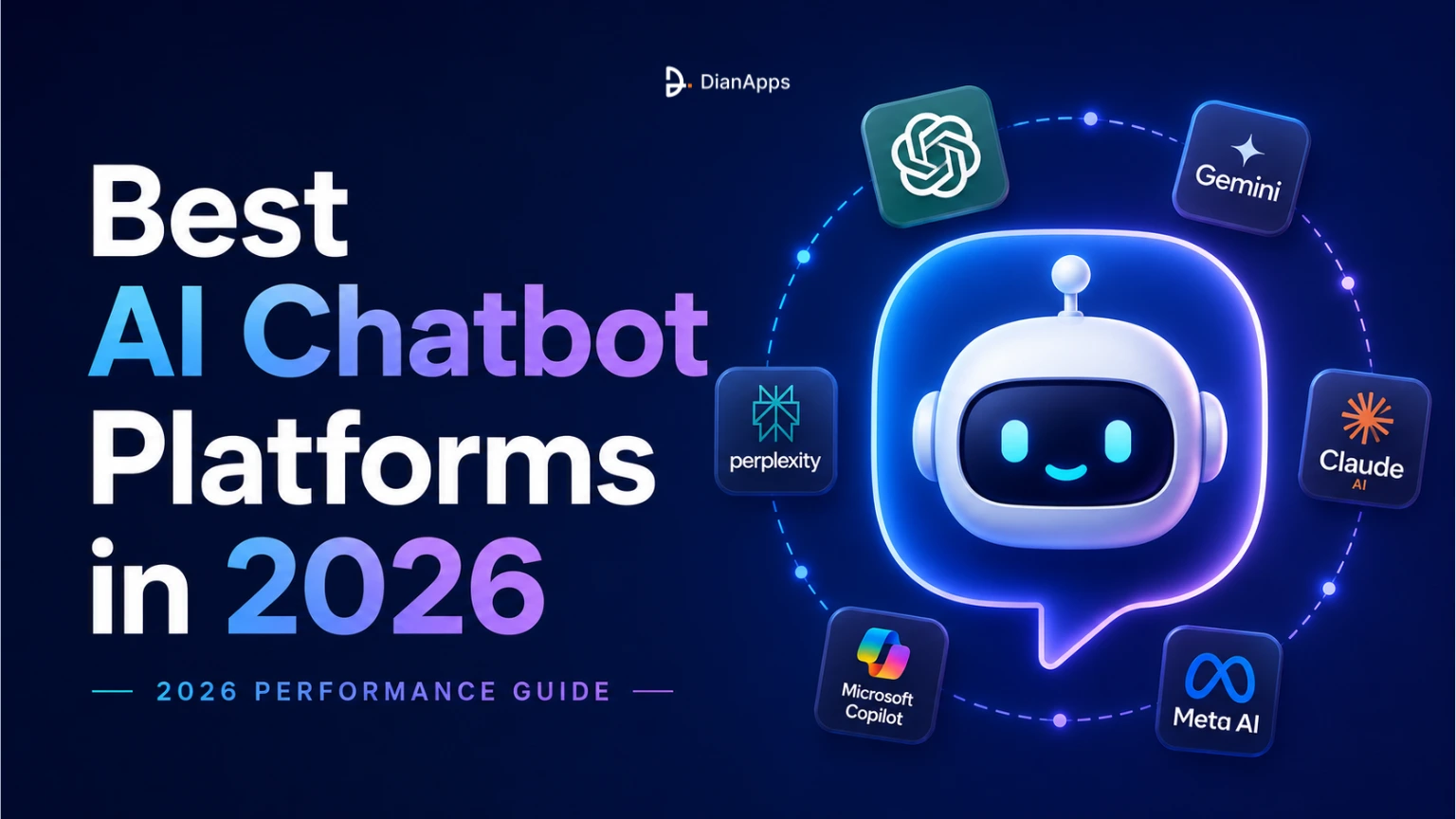
Compare every major AI chatbot platform in 2026: Claude, ChatGPT, Gemini, Grok, Perplexity, Meta AI, and DeepSeek, with honest, real-world assessments of what each one is actually good at.
Claude gets the deepest breakdown because it’s the platform that has moved furthest in 2026, now leading benchmarks with Opus 4.7. We cover its full feature set, from 200K context windows to computer use and automation, in plain language.
You’ll also find a side-by-side comparison table of all platforms, a ‘how to choose’ decision guide.
A few years ago, the AI chatbot decision was simple you either used ChatGPT or you felt like an early adopter for trying something else. That era is gone.
In 2026, the market has genuinely fragmented. Claude, Gemini, Grok, Perplexity, Meta AI, DeepSeek each of them is legitimately good at something. The global chatbot market is on track to hit $12.98 billion this year, and over 78% of companies now use AI in some form. ChatGPT alone sees 800 million weekly users. But the “winner takes all” dynamic of 2022-2023 is well and truly over.
Grok vs. Llama vs. Gemini vs. ChatGPT: Know which one is the best?
The problem is, all this choice makes the decision harder. Most comparison articles either list platforms without real depth, or they’re written by someone who clearly hasn’t used the tools. This one is different. We’ve looked at actual 2026 benchmark data, pricing changes that happened this month, and what real users say on Reddit, not what press releases claim.
If you’re a business investing in AI development services, a developer choosing tools, or just someone who wants to stop wasting time on the wrong chatbot this guide is for you.
What’s Actually Changed in the AI Chatbot Market in 2026
Before getting into platform-by-platform reviews, it’s worth understanding the shifts that define the 2026 landscape. These context points affect which platform is right for you more than any single feature comparison.
Chatbots Have Become Agents
The biggest change isn’t a new model it’s a change in what these tools actually do. In 2023, an AI chatbot answered questions. In 2026, the leading platforms execute multi-step tasks: they write and run code, browse the web, control your computer, manage files, call external APIs, and hand work off between different tools without you babysitting every step.
This shift matters because it changes what you should be evaluating. Raw answer quality is still important, but for business use, the orchestration layer, the system that routes tasks, retrieves from your knowledge base, and knows when to involve a human, is now the real differentiator.
Know what is AI Agent here.
The Benchmark Race Got Real
April 2026 was one of the most competitive months in AI history. Claude Opus 4.7 dropped on April 16 and immediately hit the top of the LM Arena Chatbot Arena leaderboard with an Elo score of 1504. OpenAI responded with GPT-5.5 on April 23. Grok 4.1 leads SWE-bench coding scores at 75%. It’s genuinely close at the top, and that’s good for users.
Market Share Is Fracturing
ChatGPT still leads by a wide margin, but Claude has taken a meaningful chunk of the professional user segment. Perplexity has built a loyal research-focused audience. Grok is growing fast among X users. Nobody is worried about a monopoly right now the competition is real and it’s keeping prices low and free tiers surprisingly generous.
Claude (Anthropic)
Most comparison guides give Claude a paragraph. We’re giving it a full section, because the gap between what people think Claude does and what it actually does in 2026 is significant.
What Is Claude, Really?
Claude is an AI assistant built by Anthropic, a safety-focused AI company. But “safety-focused” doesn’t mean cautious and unhelpful it means the model is trained to be genuinely useful while avoiding harmful outputs at the model level, not just through surface-level content filters. This is called Constitutional AI, and it’s what gives Claude its distinctive tone: it reasons carefully, acknowledges uncertainty, and pushes back on you when you’re wrong rather than just agreeing.
The current flagship model, Claude Opus 4.7, launched on April 16, 2026, and currently holds the top position on the LM Arena Chatbot Arena leaderboard with an Elo score of 1504. For everyday use, Claude Sonnet 4.6 is the recommended choice it’s faster, cheaper, and handles 95% of tasks just as well.
Claude’s Full Feature Set in 2026
Here’s every major capability Claude has in 2026, what it actually means in practice, and who it matters for:
| Feature | What It Does | Who It’s For |
|---|---|---|
| 200K Token Context | Reads & reasons over ~150,000 words in one go entire codebases, legal contracts, or research papers | Lawyers, researchers, developers |
| Constitutional AI Safety | Trained on values from the UN Declaration of Human Rights, avoids harmful output at the model level, not just via filters | Safety-critical deployments |
| Claude Code | A dedicated terminal-based coding agent that writes, edits, and runs code autonomously across entire repositories | Software engineers & teams |
| Computer use (Beta) | Controls a computer clicks, scrolls, fills forms, navigates browsers to complete multi-step tasks | Business process automation |
| Multi Document Analysis | Upload and cross-reference multiple PDFs, reports, or data files in a single conversation | Finance, legal, consulting |
| Tool Use / Function Calling | Connects to external APIs, databases, and services turning Claude into an orchestrator, not just a chatbot | Enterprise AI agent builders |
| Vision & Image Input | Understands screenshots, charts, diagrams, and photos not just text | Product teams, data analysts |
| Artifacts | Generates live, rendered code, documents, and visualisations directly in the chat interface | Developers, content creators |
| Memory (Projects) | Maintains persistent context across sessions remembers your preferences, files, and past conversations | Frequent professional users |
| API Access | Full programmatic access with function calling, streaming, batch processing, and system prompts | Developers & AI app builders |
How Claude Handles Automation
This is where Claude has made the biggest leap in 2026. It’s no longer just a chatbot you type questions into it’s a platform you can build automated workflows on top of.
At the simplest level, Claude can handle multi-step tasks in a single conversation: “Read this 80-page contract, find all the indemnification clauses, flag anything unusual, and draft a summary memo.” That used to require hours of human work. Claude does it in minutes.
At the more sophisticated level, Claude powers autonomous agents through its tool use and computer use features. A Claude-based agent can:
- Browse the web and extract structured data from multiple sources
- Write code, run it, check if it worked, and fix errors all without human input
- Fill in forms, click through software interfaces, and complete multi-step digital workflows
- Connect to your CRM, database, or internal APIs and take actions based on what it finds
- Orchestrate other AI tools and agents as part of a larger pipeline
Claude Code, Anthropic’s dedicated coding agent, takes this further for developers. It works inside your terminal, understands your entire codebase, and can make changes across multiple files at once not just complete snippets in isolation.
What Claude Is Actually Best At
Being honest about strengths matters more than a list of every feature. Here’s where Claude genuinely outperforms:
- Long-form writing essays, reports, books, documentation. Claude maintains tone and voice across very long pieces better than any competitor.
- Complex reasoning it doesn’t just give you an answer, it shows you how it got there, and it tells you when it’s uncertain.
- Long context tasks with a 200K token window, Claude can read entire codebases, legal contracts, and research papers in one go.
- Coding Claude Opus 4.7 scores 80.8% on SWE-bench and is the engine behind multiple leading coding tools including Cursor.
- Document analysis upload multiple PDFs and ask cross-cutting questions. Particularly strong for legal, financial, and research work.
- Following complex instructions Claude is noticeably better than other models at following long, nuanced system prompts without drifting.
Where Claude Falls Short
In the interest of fairness because every tool has real weaknesses here’s where Claude is not the best choice:
- Ecosystem ChatGPT has a far larger library of Custom GPTs, plugins, and third-party integrations. Claude is catching up, but it’s not close yet.
- Image generation Claude doesn’t generate images natively. You need a separate tool for that.
- Real-time data (without tools) the base model has a knowledge cutoff. For live news and prices, Grok or Perplexity edge ahead.
- Free tier limits the Claude.ai free plan is more restricted than ChatGPT’s, which now includes GPT-5 access.
Claude Pricing in 2026
- Free Claude.ai with limited usage of Claude Sonnet 4.6
- Claude Pro ~$20/month full access to Sonnet 4.6, priority access to Opus 4.7
- Claude Max ~$100-200/month higher usage limits, priority during peak times
- API Pay-per-token via Anthropic’s API, used by developers and enterprises
- Claude for Teams / Enterprise Custom pricing, SSO, admin controls, expanded context
ChatGPT (OpenAI)
ChatGPT is still the safe default for most people, and for good reason. GPT-5.4 is genuinely excellent across nearly every task, and the free tier now includes full GPT-5 access with image generation, voice, and web search is the most generous of any major AI chatbot in 2026. The Custom GPTs ecosystem is enormous. The third-party integrations are unmatched.
Where it struggles: hallucination rates are still higher than those of Claude and Perplexity. Heavy users also report that response quality can vary more than Claude’s. And GPT-5.4 can sometimes feel like it’s trying to please you rather than challenge you with the right answer.
Best for: Everyday versatility, content creation, voice mode, multimodal tasks, developer ecosystem
Pricing: Free (GPT-5 with limits) | Plus $20/mo | Pro $200/mo | Enterprise custom
Google Gemini
Gemini has come a long way. Gemini 3.1 Pro is competitive in reasoning benchmarks, the Google Workspace integration is genuinely smooth, and the 1 million token context window makes it the most context-capable model available. It’s the obvious choice if you’re a heavy Gmail, Docs, or Drive user.
The limitation is that Gemini feels most natural inside Google’s ecosystem and less natural as a standalone chatbot. And while it’s excellent at reasoning, it doesn’t quite match Claude for long-form writing quality or ChatGPT for ecosystem breadth.
Best for: Google Workspace power users, real-time search, academic and research work
Pricing: Free | Google AI Premium $19.99/mo
Grok (xAI)
Grok 4.1 is worth taking seriously in 2026. It leads raw SWE-bench coding scores at 75% and has real-time access to X (Twitter) data, which makes it genuinely better than every other tool for breaking news, social trends, and live market sentiment. Its tone is more direct and less hedged than Claude or ChatGPT, which some users prefer.
The catch: its ecosystem is still limited, and the best experience requires an X Premium subscription. If you don’t live in the X universe, the value proposition shrinks considerably.
Best for: Real-time information, X/Twitter users, coding benchmarks
Pricing: Free (limited) via X | X Premium ~$8/mo | X Premium+ ~$16/mo
Perplexity AI
Perplexity does one thing exceptionally well: it cites every single claim with a live web source. For journalists, researchers, students, and anyone who needs verifiable information rather than plausible-sounding text, it’s in a different league. You don’t have to wonder if it made something up you can check the source in one click.
It’s not the right tool for creative writing or complex reasoning tasks. But for research and fact-checking, nothing matches it.
Best for: Research, fact-checking, cited answers, news synthesis
Pricing: Free | Pro ~$20/mo
Meta AI
Meta AI is free, requires no download, and is already embedded in WhatsApp, Instagram, and Facebook. It’s not a power tool but for quick questions, casual conversations, and social media tasks, nothing is easier to access. Powered by LLaMA 4, it’s also the most capable open-weight model available.
Best for: Casual use, WhatsApp integration, users who want zero setup
Pricing: Free
DeepSeek
DeepSeek R2 punches well above its price point. The consumer chat interface is free, API costs are a fraction of OpenAI or Anthropic, and the reasoning capability is surprisingly strong. For privacy-conscious organisations or teams that want to self-host a capable model, it’s the standout open-source option in 2026.
Best for: Open-source deployments, budget teams, self-hosting, developer API use
Pricing: Free (chat) | API: usage-based, significantly cheaper than tier-1 models
DeepSeek vs. ChatGPT, you do the comparison.
Side-by-Side: 2026 Platform Comparison Table
A quick reference for the key specs that actually matter when choosing a platform:
| Platform | Best For | Free Tier | Paid Plan | Model | Coding | Context |
|---|---|---|---|---|---|---|
| Claude | Reasoning, writing, safety | Yes | ~$20/mo | Opus 4.7 | 80.8% SWE | 200K tokens |
| ChatGPT | Versatility, voice, images | Yes (GPT-5) | $20/mo | GPT-5.4 | 74.9% | 128K |
| Gemini | Google Workspace | Yes | $19.99/mo | Gemini 3.1 | Strong | 1M tokens |
| Grok | Real-time / X data | Limited | $8-16/mo | Grok 4.1 | 75% | 128K |
| Perplexity | Research & citations | Yes | ~$20/mo | Multi | N/A | ~32K |
| Meta AI | Social / casual | Free | Free | LLaMA 4 | N/A | N/A |
| DeepSeek | Open-source / budget | Yes | API only | R2 | High | 128K |
How to Actually Choose the Right AI Chatbot
Ignore the benchmarks for a moment. The best AI chatbot for you is the one that handles the tasks you do every day without getting in your way. Here’s a practical decision framework:
By What You’re Doing
- Writing long articles, reports, or books (Claude)
- Versatile everyday tasks with plugin/app needs (ChatGPT)
- Google Workspace user (Gemini)
- Microsoft 365 user (Copilot)
- Real-time news or social data (Grok)
- Research that needs citations (Perplexity)
- Just want something free and easy (Meta AI)
- Developer or self-hosting team on a budget (DeepSeek)
By Budget
- $0 ChatGPT (GPT-5 free), Meta AI, DeepSeek Chat, Gemini Basic
- $20/mo Claude Pro, ChatGPT Plus, Gemini AI Premium, Perplexity Pro
- $100-200/mo Claude Max, ChatGPT Pro (for heavy professional users)
- Enterprise Custom from Anthropic, OpenAI, Google, Microsoft
The Business Reality: Model Choice is Not the Most Important Decision
Here’s what most comparison articles miss for business deployments: the underlying model matters less than the system built around it. A well-designed agent, one that routes queries intelligently, pulls relevant context from your knowledge base, and hands off to humans at the right moment, will outperform a raw frontier model every time.
Companies running AI agents in customer service consistently see 40-60% automation rates regardless of which model powers them. If you’re building for production, invest as much time designing the agent architecture as you do picking the model.
AI Chatbot Platforms Built for Business
If you’re deploying AI for customer support, sales, or internal operations rather than personal productivity, a different set of platforms deserves attention.
Zendesk AI
The benchmark for enterprise customer support automation. Zendesk’s AI layer sits on top of its industry-leading ticketing infrastructure and handles routing, escalation, and automated resolution. Onboarding is managed and takes time but for large organisations that need reliability and compliance above all else, it’s the safest enterprise choice. Pricing is enterprise-tier ($100+/agent/month).
Intercom (Fin AI)
Intercom’s Fin agent (powered by GPT-4o) resolves a meaningful share of support tickets autonomously particularly for SaaS companies with well-structured help documentation. Setup is easier than Zendesk, the interface is more modern, and out-of-the-box AI performance is strong. Better for product-led teams than traditional enterprises.
HubSpot Breeze
Breeze is the AI layer inside HubSpot it summarises contacts, prepares you for sales calls, drafts follow-up emails, and surfaces relevant knowledge base articles. If you’re already in HubSpot, it’s a no-brainer upgrade. If you’re not, it won’t pull you in on its own.
Drift
Drift is the only platform on this list whose primary purpose is converting website visitors into pipeline. It qualifies leads, books meetings, and routes conversations to the right sales rep automatically. At $2,500+/month, it’s exclusively for revenue teams with serious budgets, but the ROI case is clear when it’s used correctly.
Final Words
The AI chatbot market in 2026 is the most competitive it’s ever been and that’s genuinely good news for anyone using these tools. Free tiers are more capable than paid plans were two years ago. The top models are separated by fractions of a percentage point on benchmarks. And the range of specialized tools means you don’t have to settle for a one-size-fits-all solution anymore.
If we had to summarise: Claude leads on reasoning and writing quality, and its automation capabilities through Claude Code and computer use put it ahead of the pack for serious professional and enterprise use. ChatGPT wins on ecosystem breadth and has the best free tier in 2026. Gemini is the obvious pick for Google users. Grok is the real-time data specialist. Perplexity is still the most trustworthy for research. And for businesses, the agent architecture around any model matters more than the model itself.
Stop looking for the “best” AI chatbot in the abstract. Start with your three most time-consuming daily tasks and test two or three tools on those tasks. The winner is whichever one saves you the most time on real work.
If you’re building AI-powered products or want help choosing and implementing the right AI infrastructure for your business, DianApps specializes in AI/ML development services that help companies move from experimentation to production with the right tools and the right architecture and without the hype. Reach out to the DianApps team to find out what’s actually possible for your use case in 2026.
 0 comments







Leave a Comment
Your email address will not be published. Required fields are marked *