














 0 comments





Key Takeaways:
- Regular architectural audits review system infrastructure across core engineering areas to spot reliability risks and unnecessary cloud spend early.
- Isolated multi-account governance structures protect core production systems while keeping access permissions neat across development environments.
- Redundant network configurations across distinct facilities keep essential web platforms running smoothly even when specific hardware fails.
- Engineering engagements deliver prioritized risk lists alongside working infrastructure scripts to fix hidden technical issues quickly.
- Teaming up with qualified cloud advisors opens up funding options that offset fixing initial engineering findings.
Quick Answer: AWS architecture consulting reviews cloud infrastructure across key technical areas to catch security flaws, hardware risks, and bad spend, giving your team actionable priority lists and deployment templates within weeks.
If your dev team built fast to hit tight deadlines, sudden spikes in traffic can quickly cause severe database latency and astronomical AWS invoices. Checking your setup against proven AWS reference architectures helps tech leads catch hidden single points of failure before an outage hits production. When you bring in seasoned cloud advisors, they add real operational rigor to messy infrastructure before technical debt stops product work. A formal evaluation takes about two to three weeks, giving your team a clear roadmap to fix urgent security gaps without stalling planned feature sprints.
Most startups ship code quickly by relying on flat networks, shared root keys, and wide open security groups. But as user traffic doubles, those early shortcuts turn into serious security vulnerabilities and unpredictable monthly bills. External audits allow tech leads to replace temporary workarounds with automated deployment pipelines so systems stay safe.
Why Formal Cloud Architecture Reviews Matter At Scale
When growing companies inspect their cloud setups, structured evaluations help engineering leaders tackle five specific pain points directly:
- Spot single points of failure across live environments so apps stay online even when an availability zone loses power.
- Catch hardcoded IAM keys, exposed S3 buckets, and unencrypted databases before bad actors find them.
- Delete abandoned staging servers, idle NAT Gateways, and unattached EBS volumes to trim thousands off monthly cloud bills.
- Align security settings with SOC 2 and HIPAA standards so your team passes official compliance audits without frantic last-minute patching.
- Clean up developer deployment workflows so engineers push fresh software without breaking core production services.
You can keep production environments running clean when you schedule regular health checks. If you partner with experienced AWS Consulting Services, your devs get direct hands-on assistance that removes massive stress during busy product launches.
Inside The Six Pillars Of The AWS Well-Architected Framework
Cloud engineers evaluate system health against standard industry practices so you can balance top app performance against monthly infrastructure costs. When developers follow the official AWS Well-Architected Framework, they find hidden architectural flaws long before those issues turn into expensive downtime.
Your cloud architect will examine your full stack across six core areas during a formal review:
- Operational Excellence checks monitoring tools and deployment scripts so engineers catch bugs before end users notice them.
- Security inspects account boundaries, access policies, and data encryption keys to block unauthorized access.
- Reliability reviews failover mechanisms, backup strategies, and service quotas so apps handle unexpected cloud disruptions smoothly.
- Performance Efficiency tunes database indexing, caching strategies, and EC2 instance sizing so queries run without high latency.
- Cost Optimization spots idle compute capacity and right-sizes resources so companies trim unnecessary cloud spend.
- Sustainability measures hardware utilization and data storage lifecycles to reduce total compute energy footprints.
Your team can scale workloads safely without piling on technical debt when you balance these core principles. Most teams find that fixing two or three major cost bottlenecks pays for the entire audit right away.
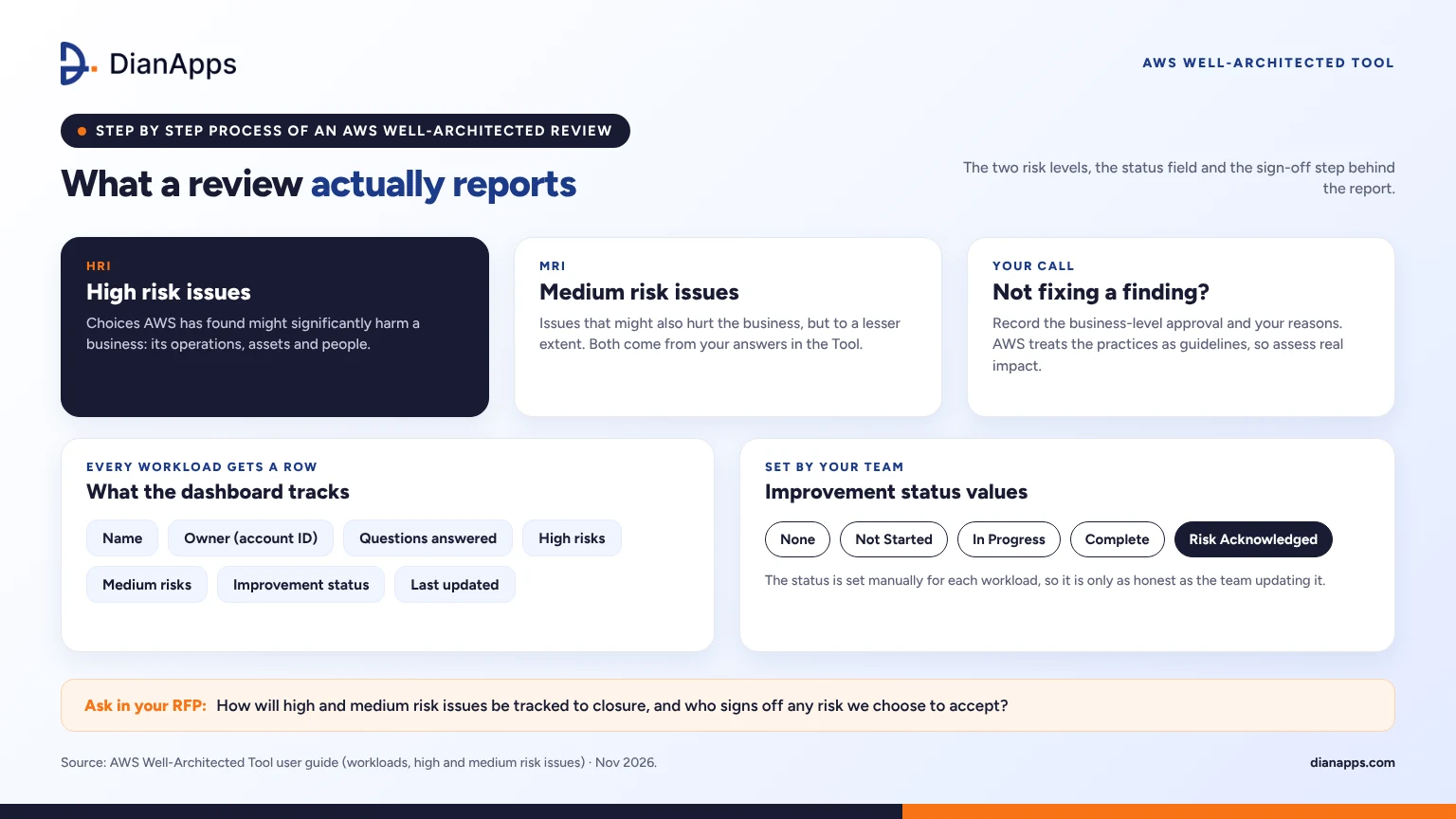
Step-by-Step Process Of An AWS Well-Architected Review
A structured review fits right into your regular sprint cycles without disrupting scheduled feature releases. The whole assessment process runs between two and four weeks from kickoff to final handoff, giving your team fast feedback on critical system risks.
The comparison table below details the key activities, main participants, and actual documents generated across every stage of the review:
| Review Phase | Key Activities | Participants | Output |
|---|---|---|---|
| 1. Scoping | Define scope boundaries | CTO, Lead Architect | Scoped charter |
| 2. Discovery | Conduct interviews | DevOps, Architects | Review record |
| 3. Prioritization | Categorize risks | Architects, Managers | Risk matrix |
| 4. Remediation | Implement fixes | Engineers, Advisors | Patched code |
If you set clear boundaries early, your discovery meetings stay focused on real infrastructure problems instead of endless theoretical debates. Prioritized task backlogs give your engineers clear assignments so they can patch critical vulnerabilities quickly.
Key Deliverables You Should Expect From Your Consulting Partner
External architects need to deliver real code modules and network blueprints instead of static slide decks that sit on a drive. Experienced consultants provide production deployment scripts, clear topology maps, and step-by-step fixing guides so your devs can move fast.
Your internal team receives five core assets once the deep technical audit wraps up:
- Executive summaries that translate technical flaws into clear business risks like potential outage costs, compliance gaps, and monthly waste.
- Prioritized risk matrices that group vulnerabilities by severity level alongside exact instructions for developer remediation.
- Detailed topology maps showing current VPC setups against target architecture diagrams to clarify data routing paths.
- Terraform or CloudFormation templates that give developers ready-to-deploy configuration code for quick security patches.
- Detailed operational runbooks outlining step-by-step procedures for handling database failovers, system backups, and traffic spikes.
When your developers work with these engineering assets, they can easily standardize settings across new environments. Good documentation ensures your team retains full technical knowledge long after the consulting engagement ends.
Audit Your Production Cloud Architecture
Schedule a structured AWS Well-Architected Review with certified solution architects to identify security gaps, reliability bottlenecks, and savings opportunities.
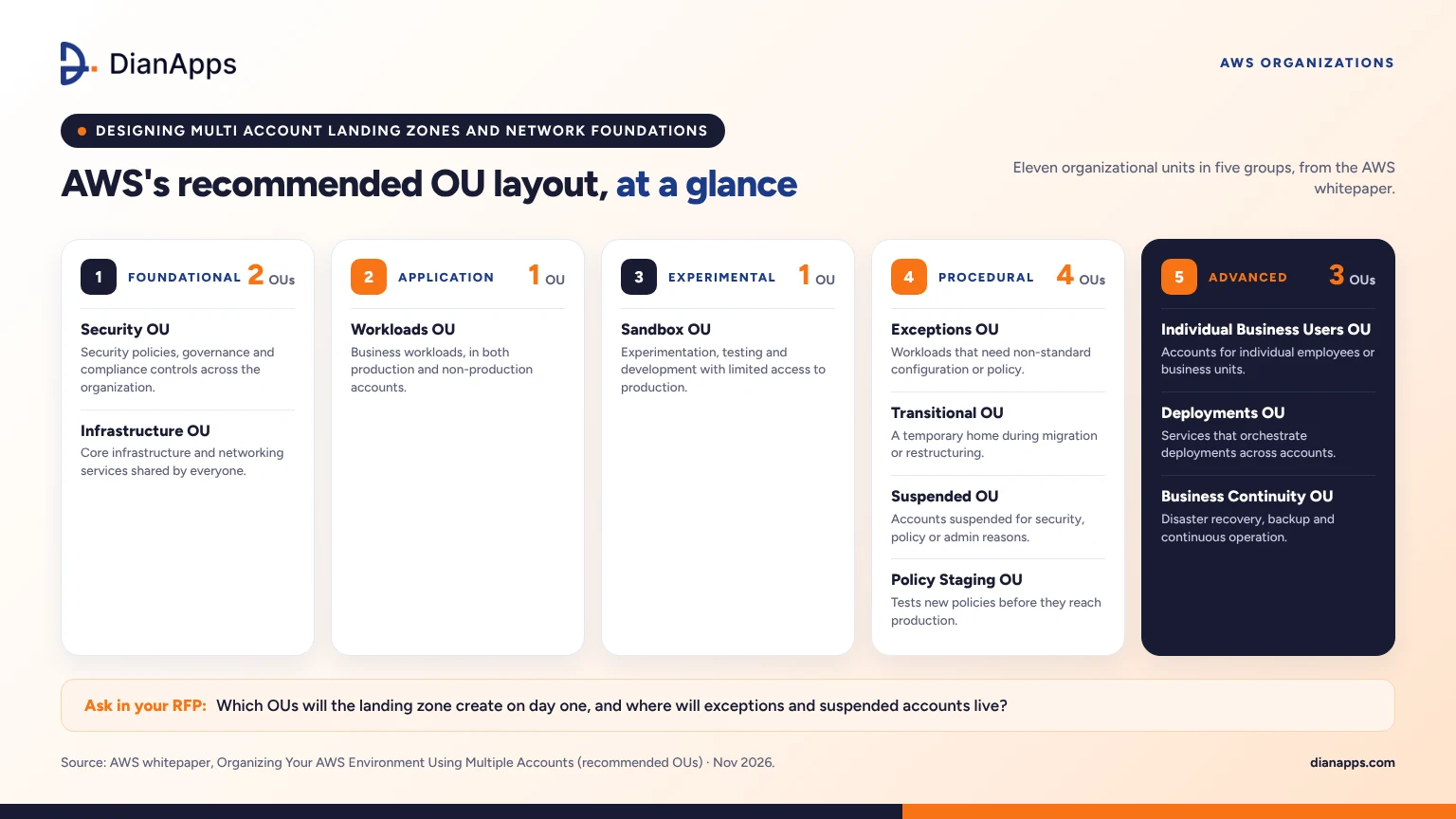
Designing Multi-Account Landing Zones And Network Foundations
If you run dev, staging, and production environments in a single AWS account, you create serious security hazards and messy billing reports. Setting up separate account boundaries helps growing companies enforce policy guardrails, track spend by team, and lock down live production data. You can read our detailed breakdown on AWS Landing Zone and Control Tower to see how automated account creation accelerates safe growth.
Modern cloud account foundations depend on five core structural pieces to keep your setup clean:
- Organized AWS Organizations hierarchies that isolate shared services, security tools, production apps, and testing sandboxes.
- Service Control Policies that block unapproved region usage, prevent disabling CloudTrail logs, and stop risky configuration changes.
- AWS Transit Gateway setups that route network traffic safely between private VPCs while inspecting packets with central firewalls.
- IAM Identity Center integration that connects corporate Okta or Google Workspace logins directly so developers drop long-lived access keys.
- Account Factory automation that provisions fresh, fully compliant accounts in minutes using preapproved IaC templates.
If you establish firm account boundaries early, you avoid painful data migrations when your team expands into new geographic markets. Centralized access controls make annual auditing straightforward across every environment you run.
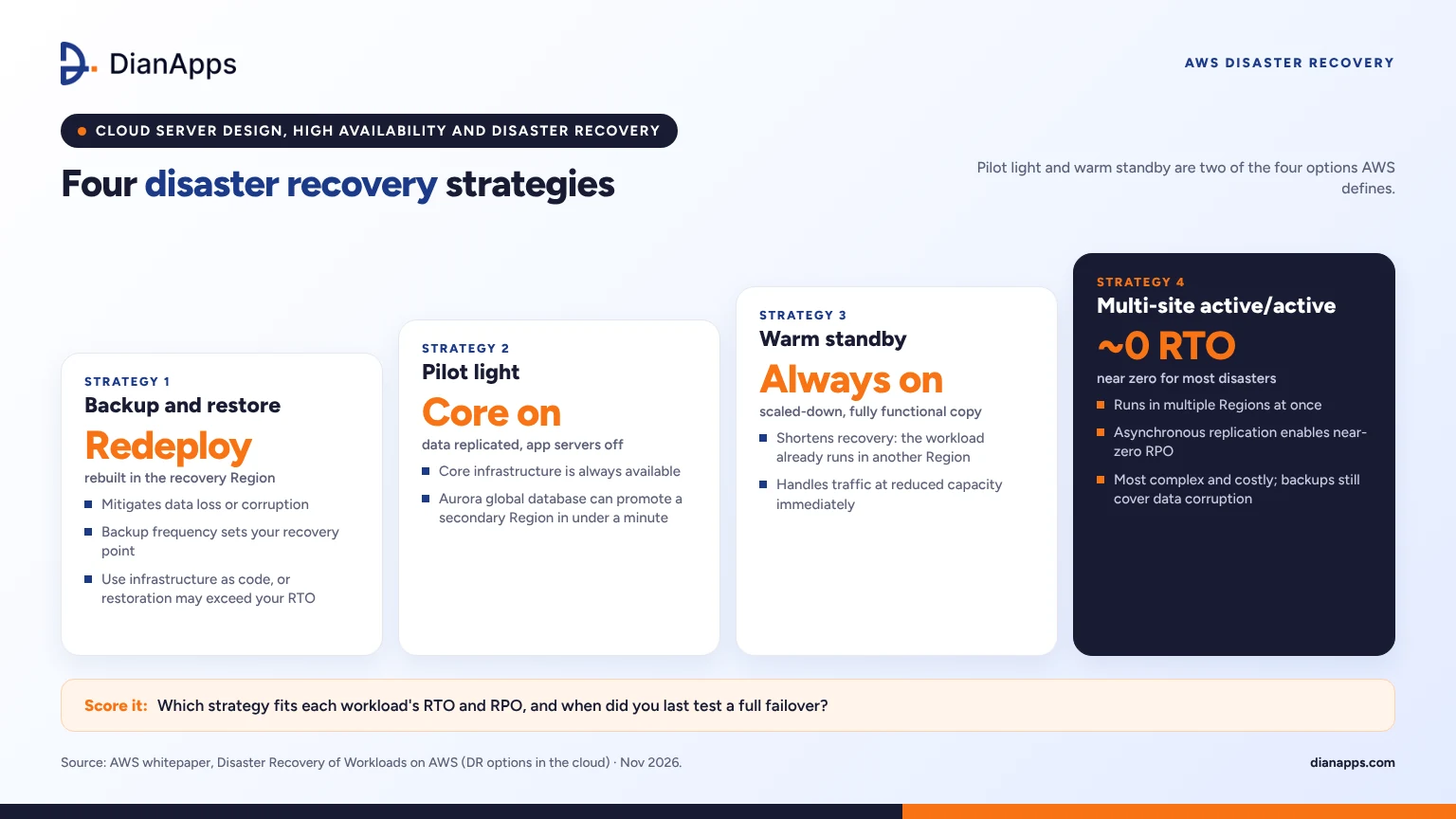
Cloud Server Design, High Availability, And Disaster Recovery
Your dev team needs a clear strategy for hardware crashes, traffic spikes, and cloud outages if you want to build strong systems. When you build multi-availability-zone redundancy, you prevent unexpected downtime whenever physical server hardware fails in a data center. You can check out our deep dive on AWS Regions and Availability Zones to learn how multi-region strategies protect critical uptime.
Resilient server design relies on five foundational architectural patterns:
- Spreading app instances and RDS read replicas across multiple physical data centers to survive isolated hardware outages.
- Configuring Auto Scaling groups that adjust compute capacity dynamically based on live CPU and memory metrics instead of static schedules.
- Setting up clear disaster recovery targets like Pilot Light or Warm Standby modes to meet strict recovery time objectives.
- Using containerized deployment tools like ECS or EKS to launch fresh compute nodes instead of applying manual patches to live production instances.
- Replicating critical database snapshots and S3 data blocks to secondary AWS regions to protect business records against rare regional disasters.
Redundant compute layers prevent isolated hardware bugs from escalating into total site outages. If you test your database failover routines twice a year, your engineers can confidently restore full service when an emergency hits.
Comparing Architecture Engagement Models: One-Time Audit Vs Ongoing Advisory
Your company will need different advisory setups as it grows, depending on internal dev bandwidth and near-term roadmap priorities. When you pick the right consulting model for your goals, project work stays lean and focused on business value.
The table below provides a direct side-by-side breakdown of common cloud advisory formats:
| Engagement Model | Ideal Stage | Duration | Primary Focus |
|---|---|---|---|
| Well Architected Review | Growing startups | 2 to 4 weeks | Risk discovery |
| Landing Zone Build | Scaling enterprises | 4 to 8 weeks | Account governance |
| Fractional Retainer | Lean engineering teams | 3 to 12 months | Strategic guidance |
| Modernization Delivery | Legacy platforms | 3 to 9 months | Refactoring execution |
If you choose the right model early, you avoid overpaying for full execution work when your team only needs architectural validation. Companies facing tight launch dates benefit greatly from embedded specialists who write production code right alongside internal engineers.
Application Architecture Modernization And Integration Patterns
When apps handle higher request volumes over time, old monolithic codebases quickly turn into bad performance bottlenecks. If you adopt event-driven queues, caching layers, and serverless tasks, you cut latency for scaling web platforms. You can check out our guide on custom software development company services to see how specialized partners update legacy applications.
Modern application updates lean on five proven integration patterns to maintain system responsiveness:
- SQS message queues that buffer sudden incoming traffic surges so backend database clusters don’t lock up during flash sales.
- ElastiCache memory layers that serve frequent database queries instantly to keep application response times under 50 milliseconds.
- CloudFront content delivery networks that cache media assets and static web pages at edge locations close to global users.
- API Gateway rules that enforce rate limits and validate JWT authentication tokens before requests reach core microservices.
- Lambda event functions that handle background image processing and data transformation tasks without paying for idle server time.
When you decouple monolithic code, you improve page load speeds while cutting day-to-day server maintenance. Your developers gain clear service boundaries that streamline automated testing across engineering sprints.
Build With Proven AWS Blueprints
Work alongside senior cloud architects to design secure multi-account landing zones, resilient VPC networks, and automated governance controls.
Essential Criteria For Selecting An AWS Architecture Partner
Many consulting agencies focus mostly on basic IT maintenance rather than hands-on cloud engineering. If you verify partner credentials and real project experience, you can pick the right consulting team with confidence. You can read our guide on AWS Partner Competencies explained to learn how official partner tiers work.
Engineering directors should evaluate prospective vendor partners against five essential requirements:
- Official AWS Well-Architected Partner status confirming the agency is authorized to run reviews and unlock AWS remediation credits.
- Proven AWS Competency badges that demonstrate verified experience across cloud migrations, DevOps, or industry security standards.
- Assigned lead solutions architects with deep production experience running discovery workshops instead of junior account managers.
- A heavy Infrastructure as Code mindset ensures every architectural recommendation comes with tested deployment scripts.
- Structured team walkthroughs and complete documentation handoffs ensure your internal developers retain total ownership of all system changes.
When you ask for anonymized sample reports during interviews, you quickly see how practical a vendor’s advice really is. Good advisors focus on upskilling your dev team so you do not stay dependent on third-party consultants long term.
Questions To Ask Before Signing An Architecture Consulting SOW
If you set explicit project scope upfront, you protect your timelines and budget from scope creep during technical reviews. Using structured vendor requirements helps engineering managers compare proposals objectively. You can read our practical guide on drafting an AWS consulting RFP to refine your sourcing process.
Before signing a consulting contract, ask prospective vendor partners these five practical questions:
- Which named solutions architects will lead our discovery sessions, and what is their track record with production workloads?
- Does the SOW include hands-on engineering hours to patch identified issues, or does it only cover assessment documentation?
- Will your team submit and manage our AWS partner credit application to offset remediation implementation costs?
- What specific IaC templates, network diagrams, and training workshops are included for internal developer handoff?
- How are follow-up review sessions structured after initial engineering deliverables are completed?
Upfront clarity turns architectural reviews into high-return investments that improve platform reliability. Your team walks away with clear priorities, ready to deploy code scripts, and immediate cuts to monthly cloud spend.
Validate Your Cloud Strategy With Experts
Connect with our AWS solution architects to review your workload requirements, remediation priorities, and AWS funding eligibility.
Conclusion
A formal AWS Well-Architected Review gives tech leads a clear roadmap to harden security, boost platform uptime, and cut wasteful cloud spend. When you evaluate workloads across key infrastructure pillars, your team spots single points of failure long before an outage impacts active users. Isolated multi-account landing zones, multi-AZ server setups, and decoupled event queues keep systems running smoothly as traffic expands. If you work alongside seasoned cloud consultants, your devs can fix critical risks fast without slowing down planned feature delivery.
 0 comments










Your email address will not be published. Required fields are marked *