













 0 comments





Key Takeaways:
- AWS Regions are separate geographic areas, and each one contains multiple AWS Availability Zones that keep applications running when a single facility fails.
- Latency, pricing differences, compliance rules, and service availability are the four factors that should decide which AWS Region to choose for any production workload.
- The AWS Mumbai Region and Hyderabad Region are serving Indian users best, while Local Zones in Delhi and Kolkata are bringing compute closer to North and East India.
- The AWS Sydney Region and Melbourne Region are covering Australia well, while the UAE Region is still recovering from 2026 damage, which makes cross-Region backups extremely crucial.
- An AWS landing zone is giving businesses a secure, multi-account foundation, so that every workload in every Region is following the same security and billing rules.
Quick Answer: AWS Regions are geographic locations containing multiple isolated Availability Zones. AWS currently operates 39 Regions and 124 Availability Zones. Choose the Region closest to your users that meets data residency requirements, such as Mumbai or Hyderabad for India, Sydney or Melbourne for Australia, the UAE Region for the Emirates, and US East or US West for American users. Verify service availability, pricing, and cross-Region backup needs before deployment.
Do you recall the last time a customer complained that your app was loading slowly, even though the servers were running perfectly fine and the team could not find a single error in the logs? In many cases, the problem is not the code at all; it is the distance between the user and the data centre, and this is exactly where choosing between AWS Regions is becoming one of the most important cloud decisions for any business. If you are still getting familiar with the platform itself, our guide on what AWS is covers the basics before you go deeper into Regions.
For businesses/organisations serving customers in India, Australia, the UAE and the US, this choice is getting even more complicated, as each market comes with its own latency expectations, pricing differences, compliance rules and local options like Local Zones. But which AWS Region to choose, and how are AWS Availability Zones fitting into the picture? Well, the answer depends on a few clear factors, so let’s break it down one by one.
What Are AWS Regions and AWS Availability Zones?
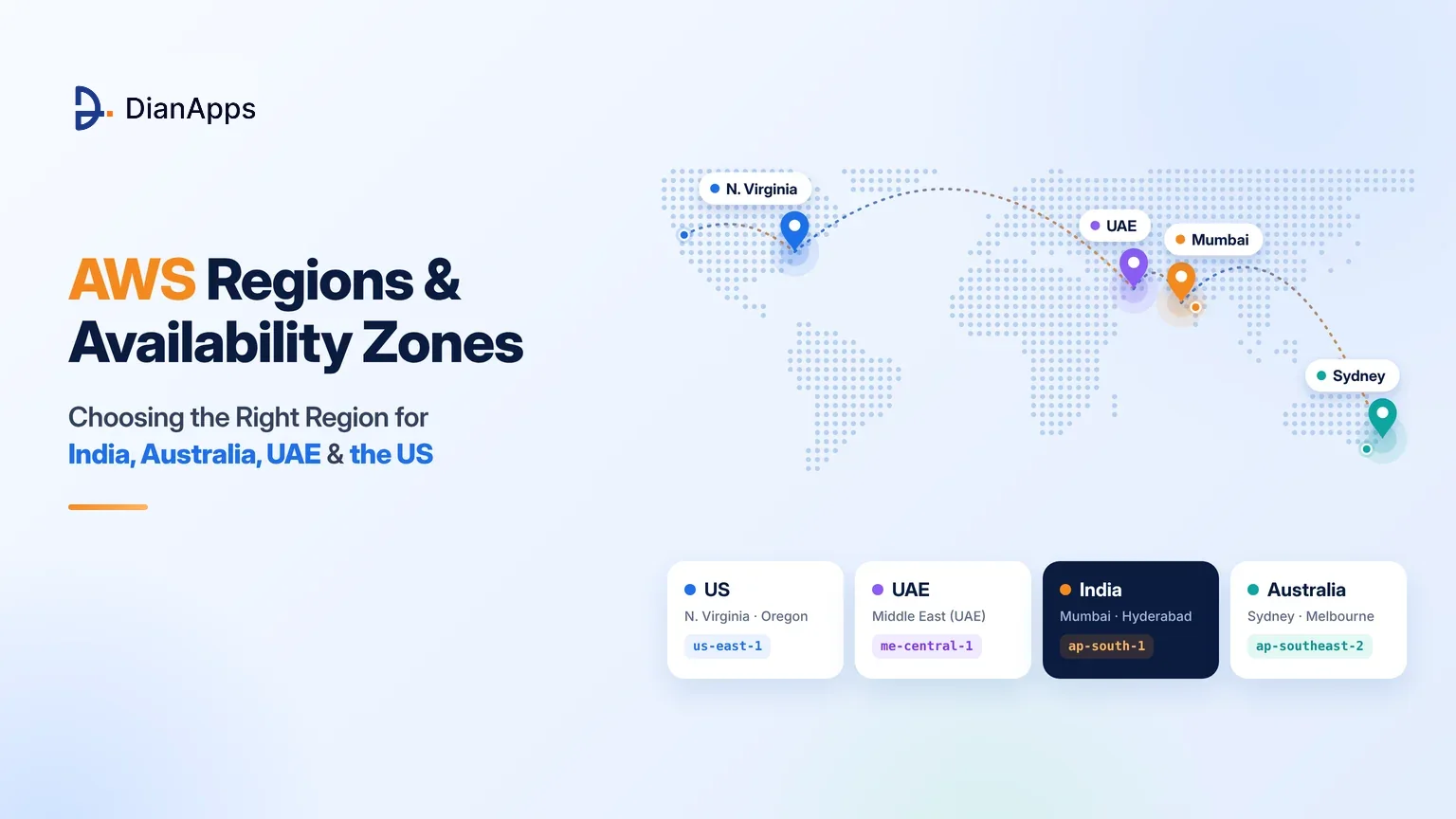
AWS Regions are separate geographic areas where Amazon is running clusters of data centres, and each Region is completely isolated from the others, so that a problem in one Region is not spreading to the rest of the world. Every Region carries a name and a code; for example, the AWS Mumbai Region is listed as Asia Pacific (Mumbai) with the code ap-south-1, which is the name developers are seeing in the console, the CLI, and their infrastructure code.
As of October 2026, AWS is operating 124 Availability Zones across 39 geographic Regions, and it has announced 7 more Availability Zones and 2 more Regions coming to Saudi Arabia and Chile, while also running Local Zones and Wavelength Zones for applications that need extremely low latency.
How AWS Availability Zones Keep Applications Running
AWS Availability Zones are one or more discrete data centres inside a Region, each with its own power, cooling and networking, and they are placed far enough apart that a fire, flood or power cut in one is not affecting the others. At the same time, they are connected with high-bandwidth, low-latency links, so applications are able to replicate data between zones in near real time without users noticing anything.
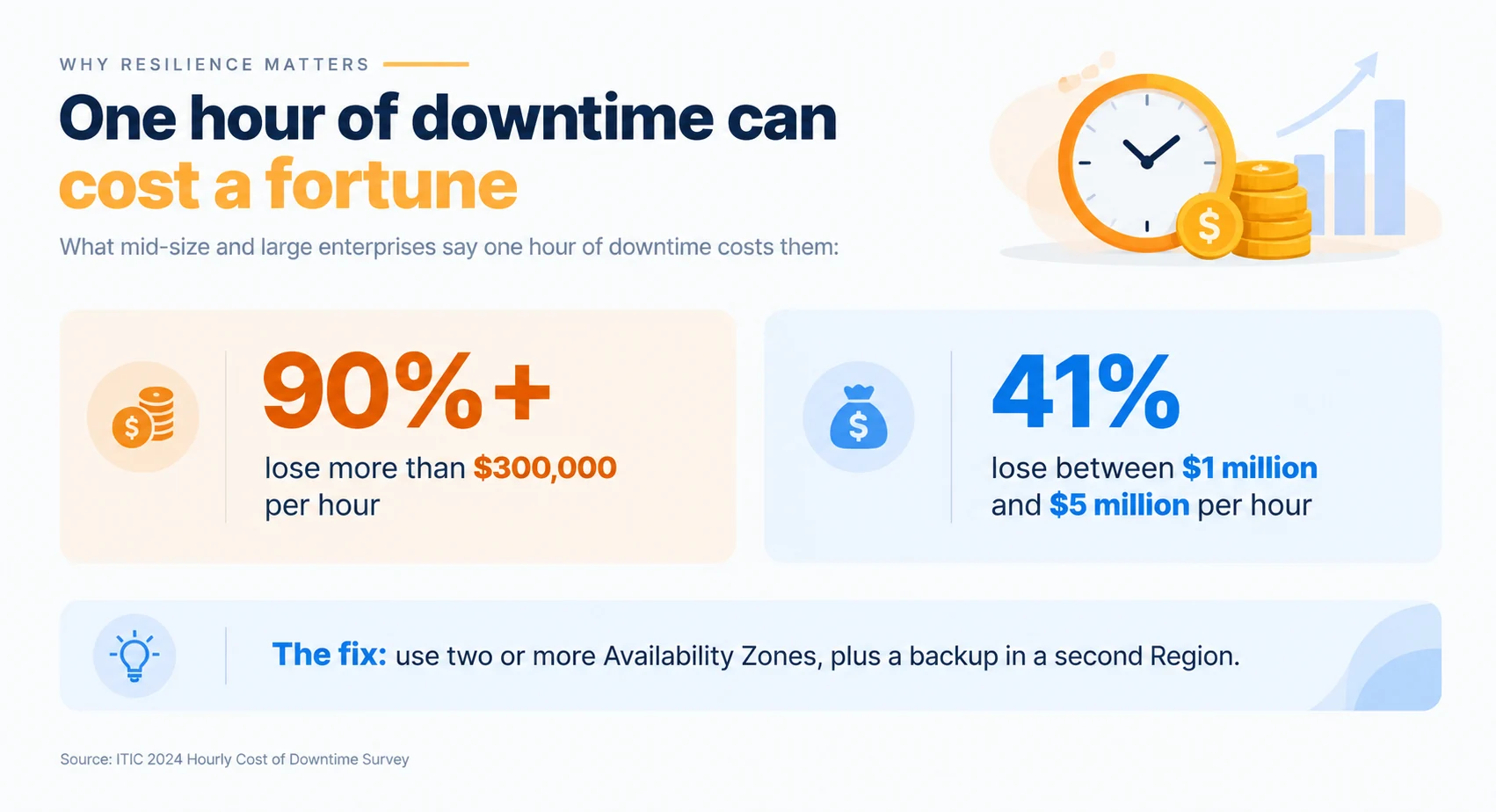
This is why AWS is recommending that production workloads run across at least two AWS Availability Zones, as a single-zone setup is saving a little money but is putting the entire application at risk whenever that one facility faces trouble. And that is not all; the events of 2026 in the Middle East are showing that even multi-zone designs need a copy in a second Region, because physical damage can sometimes affect more than one zone at the same time.
What Are AWS Local Zones?
Local Zones are smaller extensions of a parent Region that place compute, storage, and database services inside major cities, so that users in those cities are getting single-digit millisecond latency without the business needing a full Region nearby. They are ideal for gaming, live video, real-time trading, AR/VR and media rendering, where each and every millisecond affects the user experience and, eventually, the revenue.
For the markets covered in this guide, the Delhi and Kolkata Local Zones are attached to the ap-south-1 (Mumbai) Region, while the Perth Local Zone is attached to ap-southeast-2 (Sydney), and the US is hosting the largest number of Local Zones across cities like Los Angeles, Chicago, Dallas and Miami.
AWS Regions List for India, Australia, UAE and the US
Before comparing the factors in detail, here is a quick AWS Regions list covering the four markets, along with the Region codes that your engineering team will be using every day.
| Market | Region Name | Region Code | Availability Zones | Best Suited For |
| India | Asia Pacific (Mumbai) | ap-south-1 | 3 | Primary Region for Indian users |
| India | Asia Pacific (Hyderabad) | ap-south-2 | 3 | In-country disaster recovery |
| Australia | Asia Pacific (Sydney) | ap-southeast-2 | 3 | Primary Region for Australian users |
| Australia | Asia Pacific (Melbourne) | ap-southeast-4 | 3 | In-country disaster recovery |
| UAE | Middle East (UAE) | me-central-1 | 3 | Local hosting, impaired since March 2026 |
| Bahrain | Middle East (Bahrain) | me-south-1 | 3 | Severely affected in 2026; check status |
| US | US East (N. Virginia) | us-east-1 | 6 | Widest services and newest features |
| US | US East (Ohio) | us-east-2 | 3 | Low-cost East Coast alternative |
| US | US West (Oregon) | us-west-2 | 4 | West Coast users and AI workloads |
| US | US West (N. California) | us-west-1 | 3 | California users needing the lowest latency |
| US | AWS GovCloud (US-East/US-West) | us-gov-east-1/us-gov-west-1 | 3 each | Regulated government workloads |
This AWS Regions list only covers the markets discussed here, and the full region list is changing whenever new Regions launch, so it is worth checking the official AWS documentation before finalising the architecture. AWS has also introduced a planning tool called AWS Capabilities by Region, which lets teams compare services, features, APIs, and CloudFormation resources side by side across Regions, including forward-looking roadmap details.
Key Factors That Decide Which AWS Region to Choose
Deciding which AWS Region to choose is not about picking the biggest or the cheapest location; it is about matching the Region to your users, your budget, and your legal obligations, and the four factors below cover almost every decision, so let’s take a look.
Latency and User Proximity
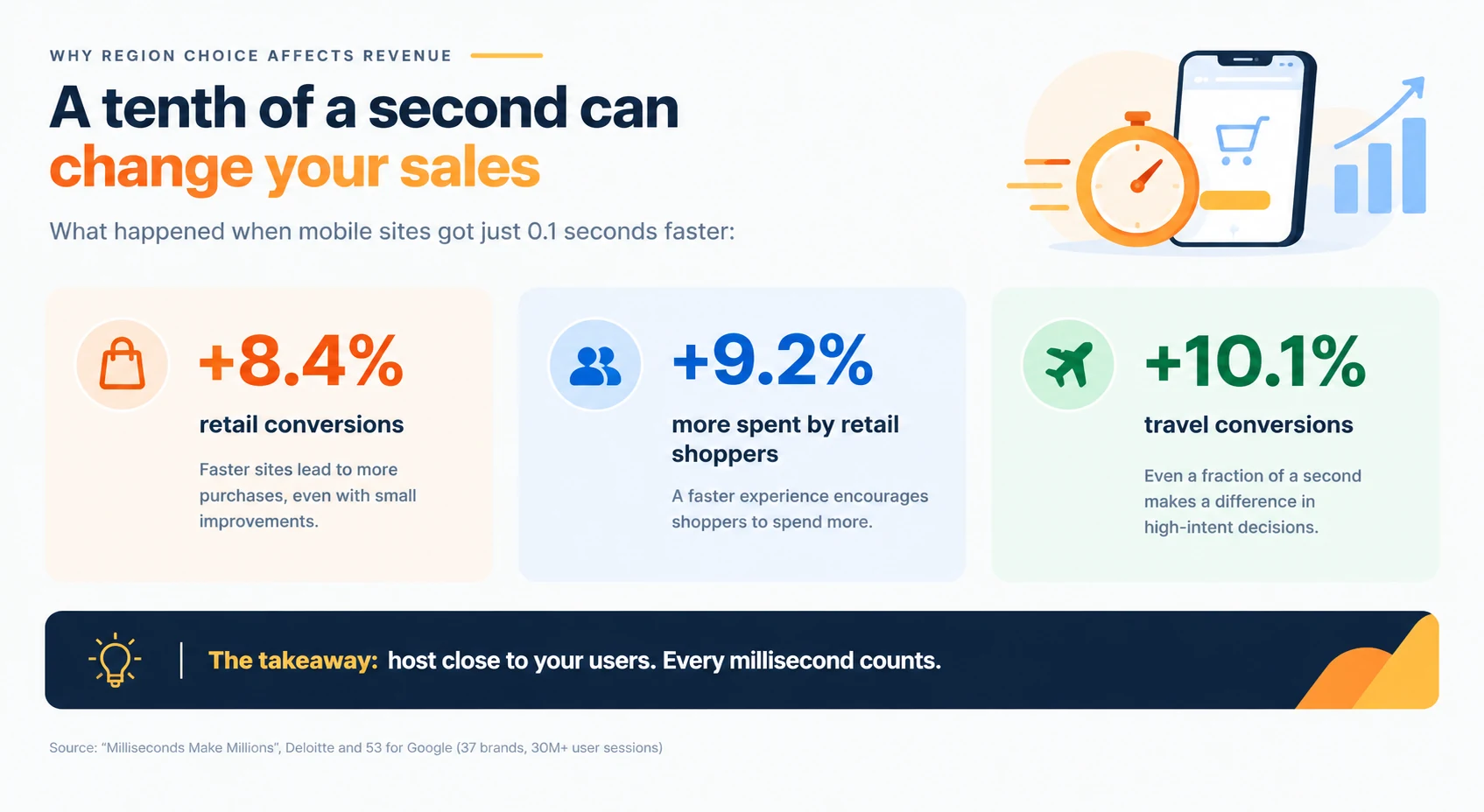
Latency is the time a request takes to travel from the user to the server and back, and it is mostly decided by physical distance, which means a user in Delhi is getting much faster responses from Mumbai than from Northern Virginia. For interactive apps like eCommerce checkouts, fintech dashboards, and multiplayer games, even an extra 100 milliseconds of latency is noticeably affecting conversions and the overall user experience.
| User Location | Nearest AWS Region | Indicative Round-Trip Latency |
| Delhi | Mumbai (ap-south-1) | 25 to 40 ms |
| Bengaluru | Hyderabad (ap-south-2) | 10 to 20 ms |
| Melbourne | Sydney (ap-southeast-2) | 10 to 20 ms |
| Perth | Sydney (ap-southeast-2) | 45 to 60 ms |
| New York | US East (N. Virginia) | 5 to 15 ms |
| Delhi | US East (N. Virginia) | 200 to 260 ms |
These figures are indicative ranges that keep changing with the ISP, the network route, and the time of day, so it is always better to measure real latency from your users’ cities using tools like CloudPing or AWS Network Manager before committing to a Region.
Pricing Differences Across AWS Regions
AWS is not charging the same price everywhere, as land, power, taxes, and local demand are different in each country, and these pricing differences apply to compute, storage, data transfer, and most managed services. US East and US West (Oregon) are usually the most affordable AWS Regions, while Asia Pacific and Middle East Regions are generally carrying a noticeable premium for the same resources.
| Region | m5.large On-Demand (per hour) | Difference vs US East (N. Virginia) |
| US East (N. Virginia) | $0.096 | Baseline |
| Asia Pacific (Mumbai) | $0.101 | Around 5% higher |
| Asia Pacific (Hyderabad) | $0.101 | Around 5% higher |
| Middle East (UAE) | $0.118 | Around 23% higher |
| Asia Pacific (Sydney) | $0.120 | Around 25% higher |
| Asia Pacific (Melbourne) | $0.120 | Around 25% higher |
According to published price tables, an m5.large is listed at $0.096 per hour in us-east-1, $0.101 in both Indian Regions, $0.118 in me-central-1, and $0.120 in both Sydney and Melbourne, so the AWS Mumbai Region is priced very close to the US for many instance families. Some AMD-based instances are even cheaper in India, as the m5a.large is listed at $0.056 per hour in ap-south-1 against $0.086 in us-east-1, which is making Mumbai a cost-efficient choice for Indian workloads.
The AWS Sydney Region, on the other hand, is costing roughly a quarter more for the same server, so Australian businesses should plan Savings Plans or Reserved Instances early to bring these pricing differences down. Data transfer out to the internet and data moving between Regions are also billed differently in each location, so every multi-Region design should be estimated in the AWS Pricing Calculator before it is approved.
Compliance and Data Residency
Compliance is often the factor that is deciding the Region before latency or price is even discussed, as many industries are legally required to keep certain data inside the country. AWS is holding certifications like ISO 27001, SOC 2 and PCI DSS across its Regions, but under the shared responsibility model, storing data in the right location and configuring it correctly is always staying with the business.
| Market | Key Regulations | Region Implication |
| India | DPDP Act 2023, DPDP Rules 2025, RBI data localisation, CERT-In directions | Keep regulated data in Mumbai or Hyderabad |
| Australia | Privacy Act 1988, APRA CPS 234 and CPS 230, IRAP | Use Sydney or Melbourne for regulated data |
| UAE | Federal PDPL (Decree-Law No. 45 of 2021), DIFC and ADGM laws | Local hosting with an approved backup location |
| US | HIPAA, FedRAMP, CCPA and other state laws | Commercial Regions, or GovCloud for federal work |
The country sections below explain how these rules are shaping the Region choice in each market, but legal teams should always confirm the final position, as sector regulators are often adding stricter requirements than the national law.
Service Availability and Resilience
Not every AWS service and instance type is launching in every Region at the same time, and newer Regions like Hyderabad and Melbourne are often receiving new features a little later than Mumbai, Sydney, or Northern Virginia. This is especially important for AI workloads, as specific Amazon Bedrock models and GPU instances are usually arriving first in the US Regions, so availability should be checked before the architecture is finalised.
Resilience deserves equal attention, as AWS’s us-east-1 Region faced a service disruption in October 2025 that affected DynamoDB and several other services because of a DNS configuration problem, and the 2026 damage in the Middle East is proving that one Region, however large, should never hold the only copy of a critical system.
Not Sure Which AWS Region Fits Your Users?
Our AWS experts are analysing your user base, latency needs, and compliance requirements to recommend the right Region setup for your business, before a single server is launched.
AWS Regions in India: Mumbai and Hyderabad
India is one of the fastest-growing cloud markets for AWS, with two full Regions in the country and Local Zones in Delhi and Kolkata that are extending low-latency coverage to the North and East. AWS is also committing an additional $13 billion to expand data centre capacity across its Mumbai and Hyderabad Regions, which is signalling a long-term commitment to Indian customers.
AWS Mumbai Region (ap-south-1)
The AWS Mumbai Region was launched in 2016 with three AWS Availability Zones, and it is the default choice for most Indian businesses because it offers the widest service catalogue in India at prices close to US levels. Startups, eCommerce brands, fintech platforms and SaaS companies serving Indian users are mostly running their primary workloads in the AWS Mumbai Region, with the Delhi and Kolkata Local Zones handling latency-sensitive parts like gaming servers or live streaming.
AWS Hyderabad Region (ap-south-2)
The Hyderabad Region was launched in November 2022, also with three AWS Availability Zones, and it is giving Indian organisations a second in-country location for disaster recovery that keeps data inside India. This is really important for banks, insurers and healthcare providers, as a Mumbai-to-Hyderabad recovery setup is meeting data residency expectations while still protecting the business from a Region-wide failure.
Compliance Considerations for India
The DPDP framework is moving on a clear timeline, as the DPDP Rules were notified on 13 November 2025, and the rules carrying almost every operational duty come into force eighteen months after publication, which places full substantive implementation at around May 12, 2027. Payment companies are also following RBI’s data localisation direction, while CERT-In’s 2022 directions require ICT system logs to be maintained within Indian jurisdiction for 180 days, which makes the AWS Mumbai Region and Hyderabad the natural home for these workloads.
AWS Regions in Australia: Sydney and Melbourne
Australia is served by two full AWS Regions and a Local Zone in Perth, and Amazon has announced an AU$20 billion investment to expand its data centre infrastructure in Australia, which is a strong sign of continued growth and capacity in the country.
AWS Sydney Region (ap-southeast-2)
The AWS Sydney Region has been running since 2012 and is the most mature AWS location in Australia, offering the widest range of services, instance types and partner integrations for Australian businesses. Most Australian enterprises, government agencies and startups are using the AWS Sydney Region as their primary Region, while the Perth Local Zone connected to it is helping Western Australian users get lower latency for real-time applications.
AWS Melbourne Region (ap-southeast-4)
The Melbourne Region opened in January 2023 with three AWS Availability Zones, and it is mainly being used as an in-country disaster recovery partner for the AWS Sydney Region, keeping both copies of sensitive data within Australia. This Sydney and Melbourne pairing is especially popular with banks, insurers and superannuation funds, as APRA-regulated entities are expected to demonstrate strong information security and operational resilience under CPS 234 and CPS 230.
On the compliance side, the Privacy Act 1988 and the Australian Privacy Principles govern personal data, while government workloads usually require services assessed under IRAP, which AWS is maintaining for a large set of services in its Australian Regions. The only real downside is the pricing differences, as the AWS Sydney Region is costing roughly 25% more than US East for general-purpose compute, so commitment-based discounts are making a bigger impact here.
AWS Regions in the UAE and the Middle East
The Middle East (UAE) Region, coded me-central-1, launched in 2022 with three AWS Availability Zones, and it quickly became the preferred location for UAE businesses that needed local hosting for government, banking, and healthcare data. However, the events of 2026 are changing how businesses are planning for this market, and it is important to understand what has happened before making any decision.
On 1 March 2026, two UAE facilities in ME-CENTRAL-1 were directly hit by drone attacks, while a third facility in the Bahrain Region was damaged by a strike nearby, with AWS linking the incident to the ongoing conflict in the Middle East. In September 2026, AWS stated that it cannot restore access to resources and data hosted exclusively in the Bahrain Region or in the UAE zone mec1-az2, and it has not given a restoration date for the UAE, with another Bahrain update expected in early 2027.
For businesses in the UAE, this is not a reason to avoid AWS Regions in the Middle East entirely; it is a clear reminder that the following practices are now essential, resulting in:
- Checking the AWS Health Dashboard for the latest me-central-1 status before launching any new workload in the Region.
- Keeping backups and replicas of critical data in a second Region that your regulators have approved for that data.
- Testing failover regularly, so that moving traffic to another Region takes minutes instead of days during an incident.
- Considering AWS Outposts or Dedicated Local Zones when data must legally stay in the UAE with more physical control.
On the compliance side, the UAE’s Personal Data Protection Law (Federal Decree-Law No. 45 of 2021) covers most personal data, while free zones like DIFC and ADGM are running their own data protection laws, and banking and healthcare often have stricter localisation rules. In terms of pricing differences, me-central-1 is costing roughly 23% more than US East for an m5.large, and nearby options like the AWS Mumbai Region or European Regions are often used as backup locations wherever the law allows it.
AWS Regions in the United States
The US is home to the oldest and largest AWS Regions, and for most American businesses the choice is coming down to Northern Virginia, Ohio, Oregon, or Northern California, plus AWS GovCloud for regulated government workloads. US East (Northern Virginia) is offering the widest service catalogue and usually gets new features first, but it is also the busiest Region, which is why spreading critical systems beyond it is a smart decision.
US East (Ohio) is offering the same low pricing as Northern Virginia with less congestion, which is making it a popular primary or disaster recovery Region for East Coast users, while US West (Oregon) is serving West Coast users and AI workloads at the same base price. US West (Northern California) is generally costing more, so it is mostly chosen when users or partners are concentrated in California, and the lowest possible latency is required.
For compliance, healthcare businesses are using HIPAA-eligible services under a Business Associate Addendum, federal agencies and contractors are relying on FedRAMP-authorised services and AWS GovCloud (US), and consumer apps are following state privacy laws like the CCPA, which generally do not require data to stay in any particular state.
Planning a Multi-Region AWS Architecture?
From Mumbai and Sydney to Northern Virginia, our certified AWS team is designing multi-Region setups that are fast, compliant, and ready for failover whenever something goes wrong.
What Is an AWS Landing Zone?
An AWS landing zone is a well-architected, multi-account AWS environment that is set up with security, identity, networking, logging, and billing guardrails before any application is deployed, so that every new workload is starting from a secure and consistent foundation. Instead of one large account where everything is mixed together, a landing zone separates workloads into accounts like production, development, security, and logging, all managed centrally through AWS Organizations.
The easiest way to build one is AWS Control Tower, which automates the setup and applying preventive and detective controls, and one of its most useful features for this topic is the Region deny control, which blocks resources in AWS Regions your business has not approved. This not only keeps data inside the right countries for compliance, it also prevents forgotten resources from quietly running and adding cost in Regions that nobody is monitoring.
A well-planned landing zone usually includes the following components, resulting in:
- A multi-account structure in AWS Organizations that separates production, development, security, and shared services cleanly.
- Centralised identity through IAM Identity Center, so that every team member is signing in once with the right permissions.
- Central logging with AWS CloudTrail and AWS Config, which stores audit trails safely in a dedicated log archive account.
- Guardrails like the Region deny control, which restricts resources to the AWS Regions that your compliance team has approved.
- Network design that plans VPCs, Transit Gateway, and connectivity across every Region the business is actively using.
For businesses running workloads across India, Australia, the UAE, and the US, a landing zone is the step that turns a collection of AWS Regions into one governed environment, and our AWS cloud services team is helping businesses build it on day one rather than retrofitting it later.
A Practical Checklist for Choosing Between AWS Regions
Once the factors are clear, the final decision on which AWS Region to choose is becoming much simpler, and the checklist below is helping teams avoid the most common and costly mistakes, so let’s take a look.
- Mapping where your users are located and measuring real latency from those cities to every shortlisted AWS Region.
- Listing every law and regulator that applies to your data, including sector rules, before shortlisting any Region at all.
- Confirming that every AWS service, instance type, and AI model you need is actually available in the shortlisted Region.
- Comparing pricing differences in the AWS Pricing Calculator, including data transfer between Regions and out to the internet.
- Deploying production across at least two AWS Availability Zones and keeping backups in a second approved Region.
- Adding Local Zones only where single-digit millisecond latency is genuinely affecting revenue or the user experience.
- Setting up an AWS landing zone with Region restrictions before the first production workload goes live for customers.
Following this checklist is not only reducing the risk of a costly migration later, but it is also giving leaders/decision-makers a clear and documented reason behind every Region choice, which is extremely useful during audits. If your workloads are already sitting in the wrong Region, our cloud migration services are moving them with minimal downtime, and our guide on how to choose an AWS consulting partner explains what to look for in the right team.
Final Thoughts
Choosing between AWS Regions is no longer a small technical setting that a developer picks once and forgets, as it is directly shaping how fast your app feels, how much your cloud bill is, and whether your business is meeting the data laws of every country you serve. For Indian users, the AWS Mumbai Region with Hyderabad as backup is making the most sense; for Australia, the AWS Sydney Region with Melbourne is the proven pairing; and for the US, the East and West Regions are offering the best balance of price and services.
The UAE is the market needing the most care right now, as the 2026 events are showing how important cross-Region backups and tested failover really are, even when a Region has multiple AWS Availability Zones. So whether you are launching your first workload or expanding into a new country, taking the time to plan latency, compliance, pricing differences, and a proper landing zone is definitely going to save money and stress later, and if you are still comparing providers, our AWS vs Azure vs Google Cloud guide is a good next read, while our team is always here to guide you from beginning until completion.
 0 comments










Your email address will not be published. Required fields are marked *