















 0 comments





Key Takeaways:
- Salesforce has made more than 70 acquisitions, but fewer than a dozen have significantly shaped the products buyers use today.
- Major acquisitions include Slack, Tableau, Informatica, MuleSoft, ExactTarget, Demandware, Vlocity, and ClickSoftware.
- Several acquired companies became major Salesforce products, including ExactTarget into Marketing Cloud, Demandware into B2C Commerce Cloud, and Vlocity into Industry Clouds.
- Acquisition dates can differ because sources may use the announcement date or the completed deal date.
- Some acquired products remain relatively separate, with their own names, pricing, contracts, or platforms. Tableau, MuleSoft, and Slack are notable examples.
- Salesforce typically acquires companies to enter important categories faster, fill platform gaps, or strengthen existing products.
- Not every acquisition becomes a permanent Salesforce product. Social Studio, Salesforce IoT, and other acquired technologies were later retired or absorbed.
- Salesforce’s recent acquisitions increasingly point toward data governance, integration, backup, and AI, reflecting its broader Agentforce strategy.
- For buyers, understanding an acquisition’s history can help explain integration requirements, separate contracts, product roadmaps, and long-term platform decisions.
Quick Answer: Salesforce has acquired more than 70 companies, but only a smaller group has had a major impact on the products customers use. Slack became Salesforce’s collaboration layer, Tableau remained a standalone analytics product, MuleSoft strengthened integration, Vlocity became the foundation for Industry Clouds, Demandware became B2C Commerce, and ExactTarget became the foundation of Marketing Cloud. Understanding what each acquisition became can help businesses make better decisions about Salesforce products, integrations, licensing, and future roadmap plans.
Salesforce has made more than seventy acquisitions. Fewer than a dozen changed the product you actually use.
Most articles on this are ranked lists of deal values – interesting once, useful rarely. The question worth answering is different: which product on your quote came from an acquisition, and what does that mean for how it behaves?
Because it does mean something. Commerce Cloud runs on a different platform from the rest of Salesforce because it was Demandware. Tableau overlaps awkwardly with CRM Analytics because Salesforce bought one and built the other. Every industry cloud you’re sold traces back to a company most buyers have never heard of.
The Deals That Shaped the Platform
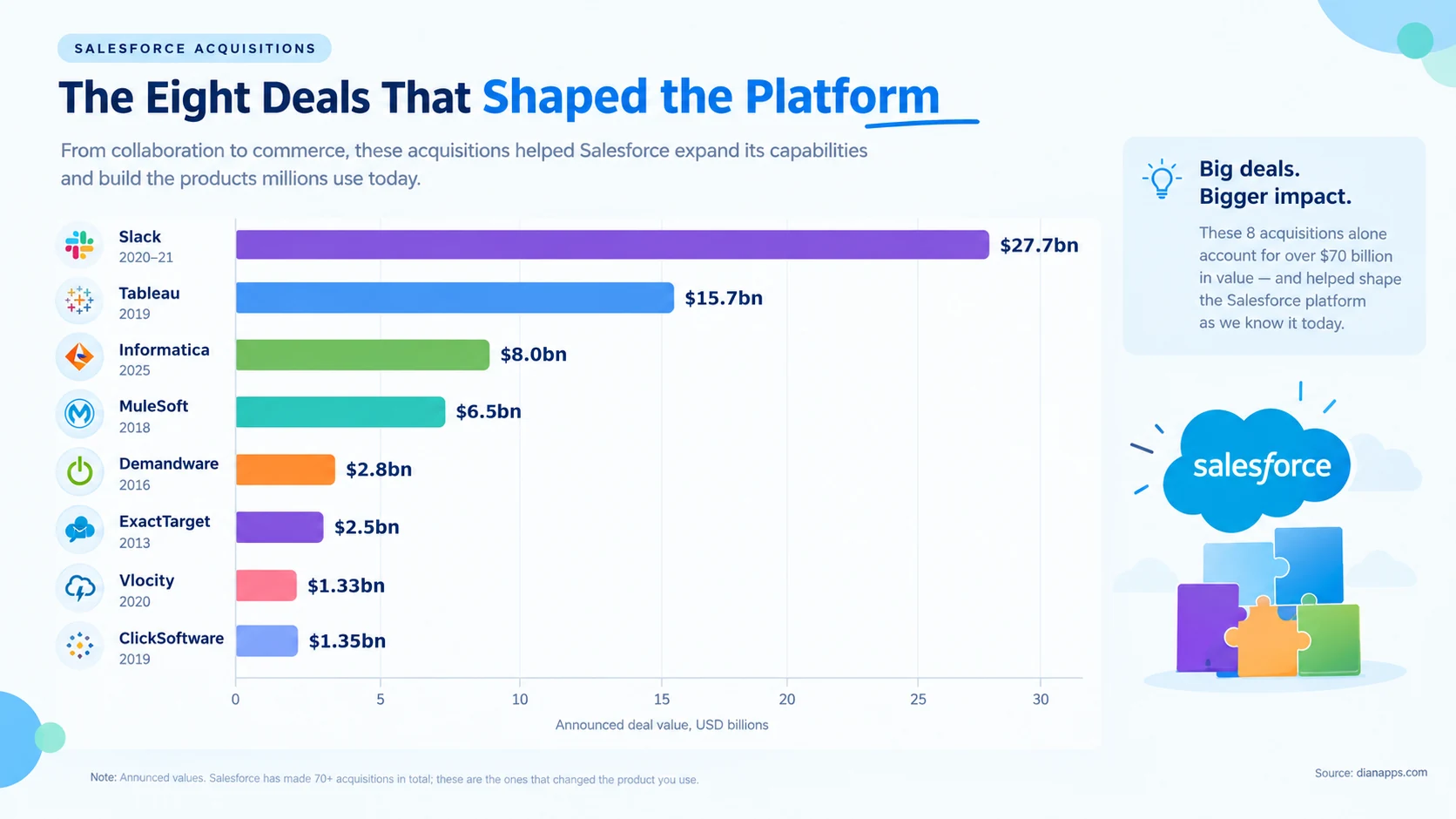
A note on the numbers before you cite them anywhere. Published figures vary between sources, sometimes substantially, because deals get reported at announcement and again at close, occasionally at different valuations. These are announced values, and they’re the figures most commonly cited.
Why Every Article Gives Different Dates
Worth resolving, because it’s the most common inconsistency in this topic, and it makes sources look unreliable when they’re not.
Salesforce announces a deal, then completes it, often months apart. Articles pick whichever date suits, and rarely say which.
| Deal | Announced | Completed | You’ll see it dated |
|---|---|---|---|
| Tableau | June 2019 | August 2019 | Either, depending on source |
| Slack | December 2020 | July 2021 | 2020 or 2021 |
| MuleSoft | March 2018 | May 2018 | 2018 |
And a signed agreement isn’t always a completed deal. Salesforce and Informatica held talks in 2024 that didn’t proceed; the acquisition happened in 2025. Articles written between those points describe the deal as abandoned, which was true when written and isn’t now.
The practical version of this for you: a deal being announced tells you nothing about when the capability appears in your org. That gap is frequently two years, and sometimes never.
What Each One Became
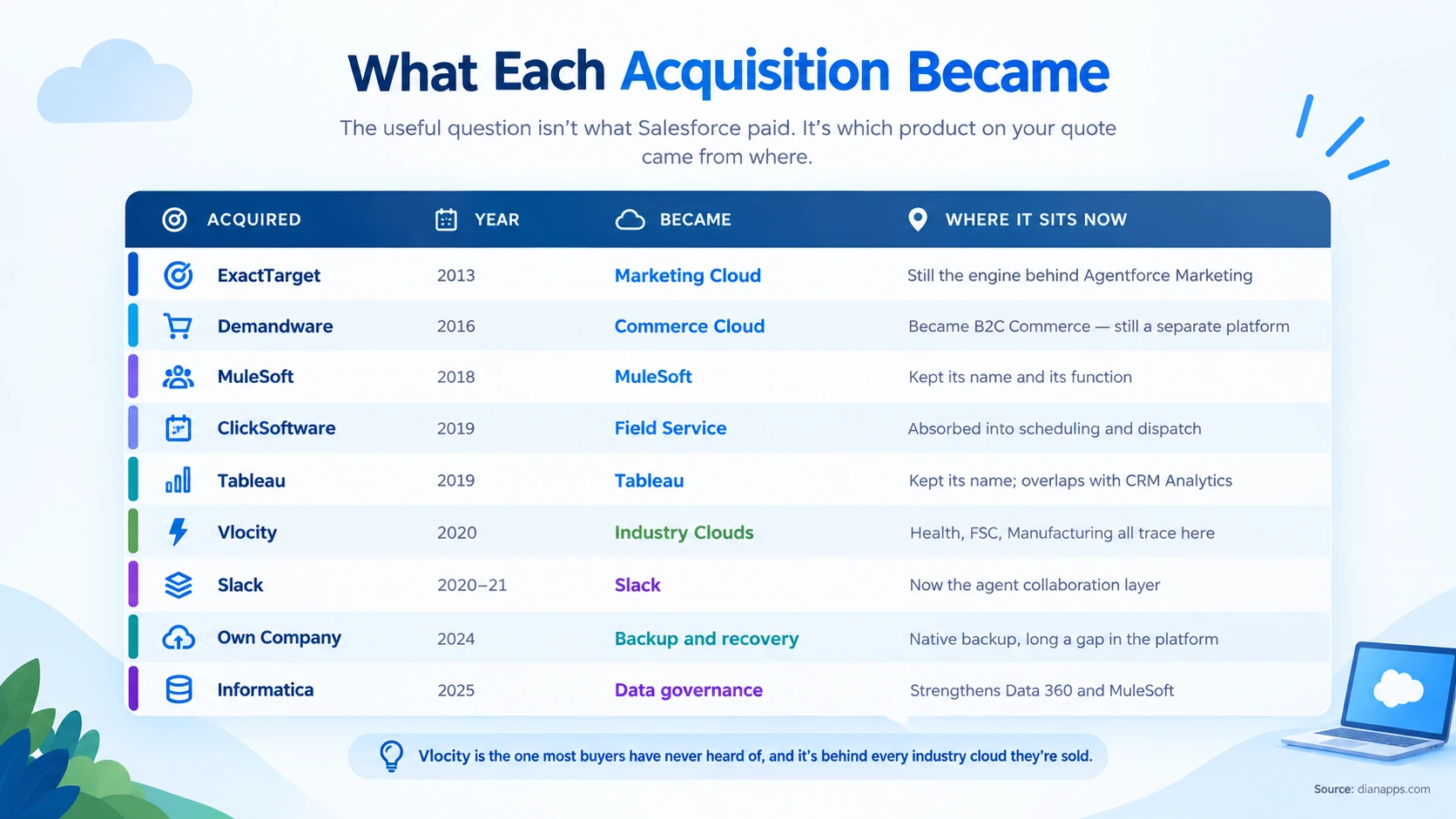
The three worth understanding in detail:
ExactTarget → Marketing Cloud (2013). Still the engine behind what’s now Agentforce Marketing. It explains why Marketing Cloud has always felt like a different product from the rest of Salesforce – because it was. It also explains the long-running confusion with Account Engagement, which came from a separate acquisition (Pardot, via ExactTarget) and remains a distinct product.
Demandware → Commerce Cloud (2016). This is why B2C Commerce doesn’t run on the Salesforce platform – it’s a separate system connected through an integration layer. B2B and D2C Commerce were built natively later. If you’ve ever wondered why Commerce integration is a genuine project rather than configuration, this acquisition is the answer. See Salesforce for retail and ecommerce.
Vlocity → Industry Clouds (2020). The most consequential acquisition most buyers have never heard of. Health Cloud, Financial Services Cloud, Manufacturing Cloud, and the rest all trace back to Vlocity’s industry-specific data models. When we say an industry cloud saves you six figures on data modelling, this is what you’re buying.
The Five Reasons Salesforce Buys
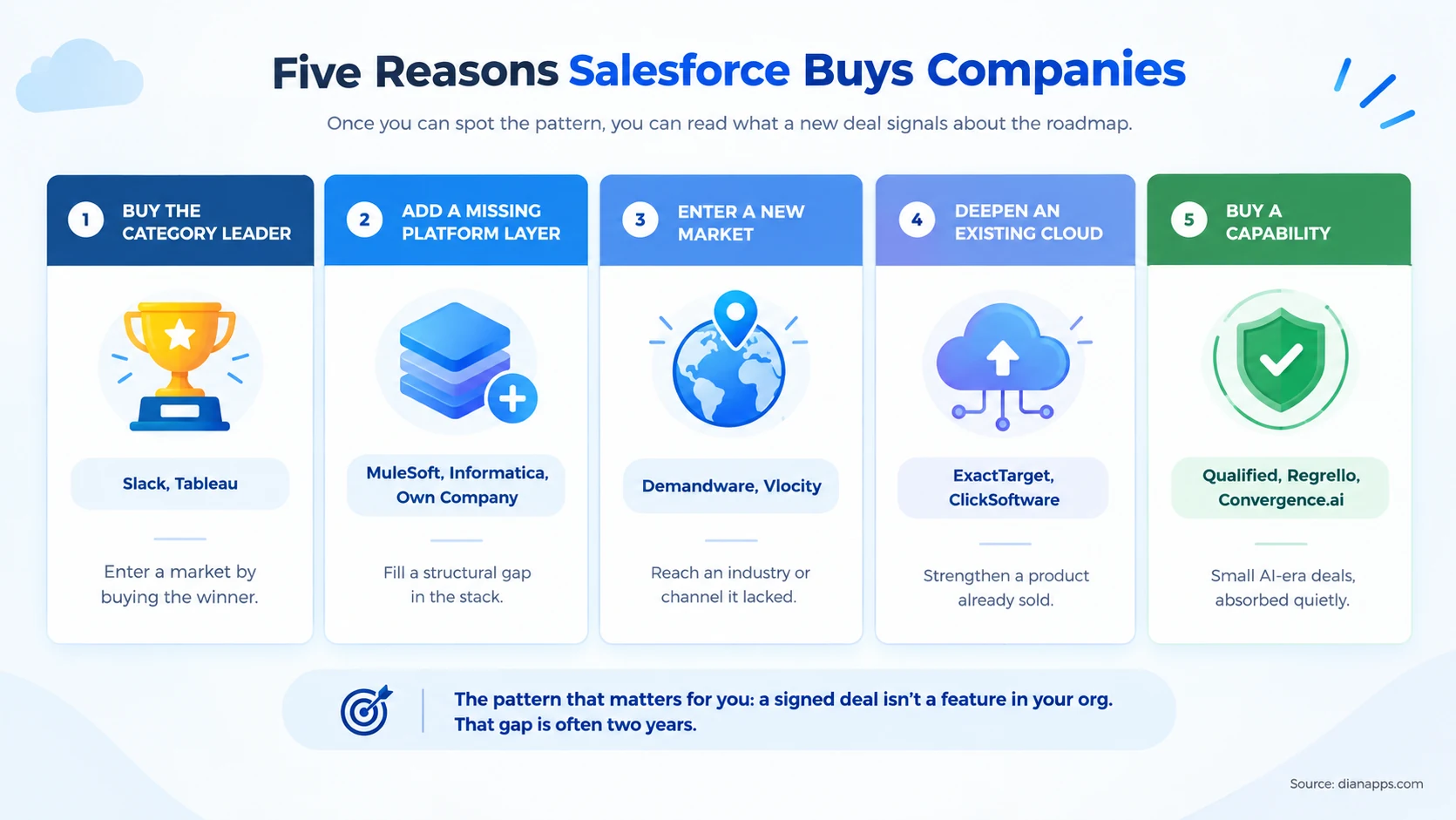
Once you can spot the pattern, a new acquisition becomes readable. When Salesforce buys a data governance company, it’s filling a platform gap – expect it to show up underneath products rather than as a product. When it buys a category leader, expect the name to survive and the product to stay somewhat separate.
The consistent logic: when a category becomes critical to CRM and building it internally would be too slow, Salesforce buys the established leader. That’s how it entered marketing automation, commerce, integration, analytics, field service, collaboration, backup, and now AI-ready data management.
What This Means If You’re Buying
Four practical implications, and they’re the reason this post exists rather than being trivia.
Acquired products often stay somewhat separate. Tableau, MuleSoft, and Slack kept their names, their pricing, and in some cases their account teams. “It’s all Salesforce” hides several contracts. See every Salesforce product.
Integration between acquired products is good rather than seamless. Salesforce invests heavily in stitching them together, and the joins are still visible. Ask specifically how two products connect rather than assuming.
Need Salesforce Integration Work?
Hire Salesforce developers to connect acquired products, build custom integrations, and make your Salesforce setup work as one system.
Acquisitions predict the roadmap. Informatica strengthens Data 360 and MuleSoft. If your architecture depends on data governance, that’s a signal worth reading. Conversely, a product line Salesforce hasn’t invested in for years is worth asking about. This is where Salesforce Consulting Services can help businesses assess their architecture, understand how acquired products fit together, and plan integrations around their actual requirements.
And acquisitions become certifications. Historically, an acquired technology shows up in Trailhead modules and certifications within one to two years – MuleSoft, Tableau, Vlocity, and Slack all followed that path. Useful if you’re planning skills as well as architecture. See Salesforce certifications.
The Full Timeline
| Year | Acquisition | Approx. value | Became |
|---|---|---|---|
| 2010 | Heroku | $212m | Developer platform, still standalone |
| 2011 | Radian6 | $326m | Social listening, later absorbed |
| 2013 | ExactTarget (with Pardot) | $2.5bn | Marketing Cloud, Account Engagement |
| 2016 | Demandware | $2.8bn | B2C Commerce Cloud |
| 2016 | Quip | $750m | Collaborative documents |
| 2018 | MuleSoft | $6.5bn | MuleSoft, unchanged |
| 2018 | Datorama | $800m | Marketing Cloud Intelligence |
| 2019 | Tableau | $15.7bn | Tableau, unchanged |
| 2019 | ClickSoftware | $1.35bn | Field Service scheduling |
| 2019 | Salesforce.org merger | - | Nonprofit and education products |
| 2020 | Vlocity | $1.33bn | Industry Clouds |
| 2020–21 | Slack | $27.7bn | Slack, now the agent layer |
| 2023 | Spiff | Undisclosed | Incentive compensation |
| 2024 | Own Company | ~$1.9bn | Backup and recovery |
| 2024 | Zoomin | Undisclosed | Content and knowledge |
| 2025 | Informatica | $8bn | Data governance under Data 360 |
| 2025–26 | Qualified, Regrello, Convergence.ai, Contentful, Waii, Bluebirds and others | Mostly undisclosed | AI-era capability deals |
Note on the recent AI-era deals. These are small, frequent, and mostly absorbed without a product launch. They’re worth tracking through release notes rather than press coverage – a signed agreement rarely corresponds to anything you can switch on.
Acquisitions That Faded
Not every deal produced a lasting product, and this half of the story is rarely told.
Radian6 and Buddy Media built Social Studio, which Salesforce later retired. Social listening turned out to be a feature rather than a platform.
Salesforce IoT, built partly on acquired technology, was discontinued.
Quip remains available but never became the collaboration layer it was positioned as – Slack took that role.
Datorama was folded into Marketing Cloud Intelligence rather than surviving as a brand.
The lesson for buyers: a product’s origin as an acquisition doesn’t guarantee its longevity. When evaluating something recently acquired, ask about roadmap commitment specifically, not just capability.
Where to Go Next
For the full current portfolio, every Salesforce product and Salesforce clouds compared.
For the acquired products specifically – MuleSoft · Heroku · Data 360 · Salesforce Functions retirement
For the industry clouds, Vlocity became: healthcare · financial services · manufacturing
For why Commerce integration is a project – Salesforce for retail and e-commerce.
For what the AI acquisitions are building toward, what is Agentforce?
For the platform context, what is Salesforce and how Salesforce works.
The Practical Version of All This
Acquisition history is interesting. What matters when you’re buying is narrower: which parts of your quote are genuinely one platform, and which are separate products wearing the same logo.
That distinction affects integration effort, contract negotiation, support escalation, and renewal timing – and it isn’t obvious from a proposal.
Have a Salesforce Proposal to Review?
Send us your proposal, and we’ll help you spot separate products, hidden integration work, and costs you may not have accounted for.
 0 comments





Leave a Comment
Your email address will not be published. Required fields are marked *