















 0 comments






Key Takeaways:
- AI agents automate mortgage workflows, from lead qualification and document collection to borrower follow-ups and pipeline monitoring.
- Lead intake and document processing agents help brokers respond faster, reduce manual work and improve file completion rates.
- AI agents support lender matching and compliance monitoring, while brokers retain responsibility for advice and lending decisions.
- Human approval gates, audit logs, data security and fair lending safeguards are essential when deploying mortgage AI agents.
- Starting with one workflow, measuring ROI and expanding gradually helps brokerages implement AI automation more effectively.
Quick Answer: AI agents for mortgage brokers automate tasks such as lead qualification, document collection, lender matching, compliance monitoring and borrower communication. They help reduce manual workload, improve loan processing efficiency and strengthen borrower relationships, while human brokers retain control over advice and decisions. Starting with intake or document processing, backed by compliance safeguards and measurable ROI, is the most practical implementation approach.
Every mortgage broker knows the feeling of a hot lead going cold because the follow up call slipped to tomorrow, while a borrower’s pay stubs sat unopened in an inbox and a lender’s updated rate sheet went unread. The work isn’t hard, it’s relentless, and it’s happening at a moment when the cost of producing a loan is sitting near record highs.
So what can AI agents for mortgage brokers realistically take off your desk without putting your licence at risk?
After building this kind of software through our AI agent development services, we’ve seen where agents are quietly paying for themselves and where they’re creating expensive new problems. This guide is covering six use cases, the measurable benefits, the risks worth planning for and a step by step implementation path, so let’s take a look.
What Are AI Agents for Mortgage Brokers?
AI agents for mortgage brokers are software systems that are pursuing a goal across several steps, calling your CRM, email, document portal and lender tools along the way, instead of waiting for a human to prompt each action.
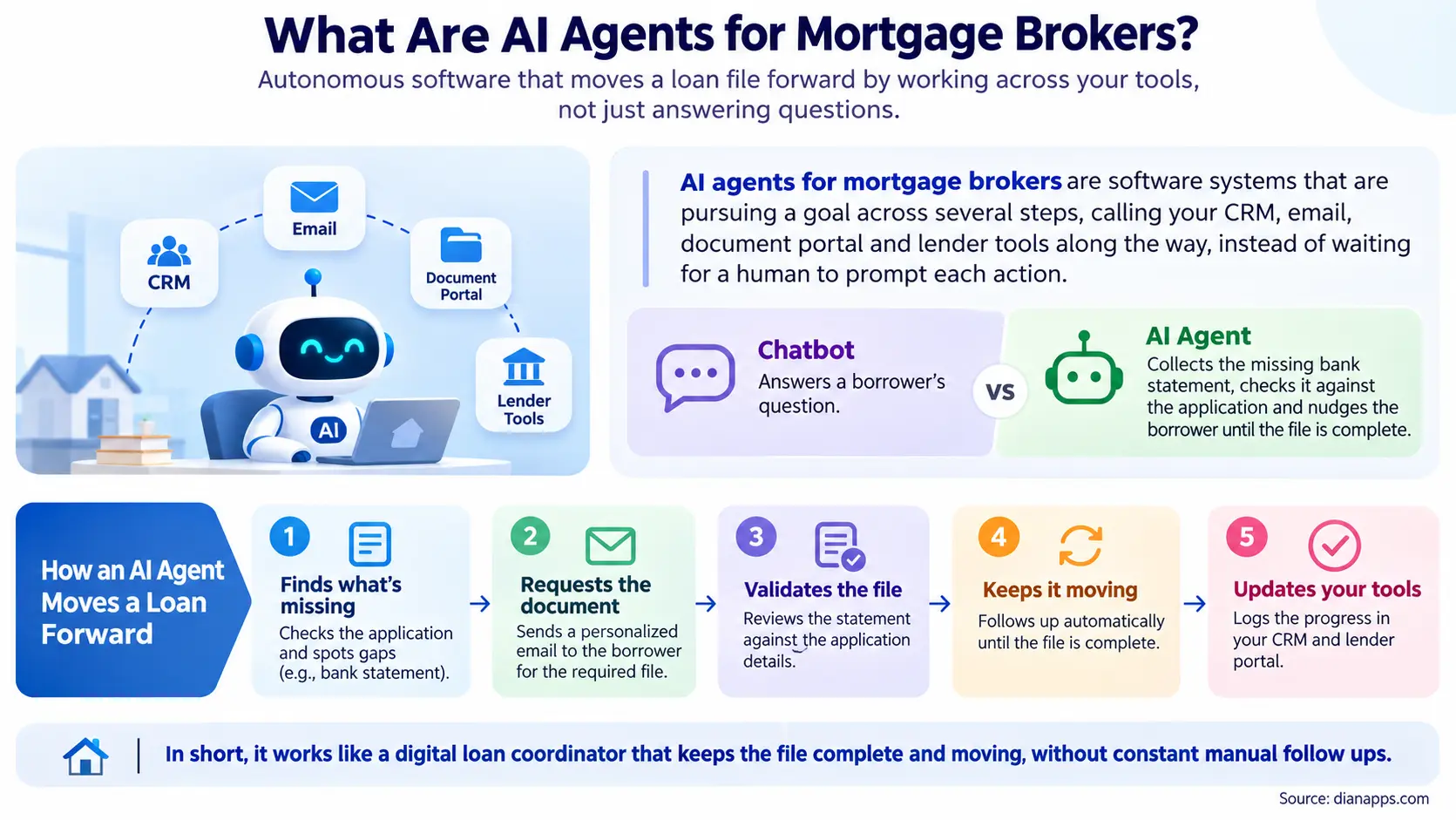
That autonomy is the whole difference from a chatbot, because a chatbot is answering a borrower’s question while an agent is collecting the missing bank statement, checking it against the application and nudging the borrower until the file is complete.
The line between an assistant and an agent is explained properly in our comparison of an AI copilot vs an AI agent, and for brokers the distinction matters because an agent is acting under your authority.
That means every agent needs clear boundaries on what it can send, submit or promise, and those boundaries are where good implementations are starting. But why is this suddenly the conversation in every brokerage? Well, economics explains most of it.
Why Mortgage Brokers Are Turning to AI in Mortgage Brokering Now?
AI in mortgage brokering is moving from experiment to necessity because the cost of each closed loan is leaving almost no margin for manual inefficiency. The pressures that are pushing brokers toward agents are showing up in the industry numbers:
- The Mortgage Bankers Association reported production costs of $10,936 per loan in the second quarter of 2026.
- Average pretax production profit was only $973 per loan in that same quarter.
- Roughly 65% of the direct cost to originate is employee compensation spent on repeatable tasks.
- Freddie Mac’s cost to originate analysis found AI driven digital capabilities can save up to $1,700 per loan.
Those figures are for lenders, but brokers are living inside the same workflow, and the same forty day file cycle is burning the same hours. The wider shift is covered in our look at AI agents in finance, and the use cases below are where brokers specifically are seeing results.
Use Case 1: Lead Qualification and Borrower Intake Agents
Mortgage broker automation is usually starting at the top of the funnel, because speed to lead is deciding who wins the borrower and most brokers are losing that race to voicemail.
An intake agent is responding within seconds, asking the qualifying questions a loan officer would ask, and writing the answers straight into the CRM. The typical intake agent is handling these jobs without human involvement:
- Replying to web, portal and social enquiries instantly with a conversational first touch.
- Collecting purchase price, deposit, income range, credit awareness and timeline in natural language.
- Scoring and routing the lead to the right loan officer based on product fit and capacity.
- Booking the discovery call directly into the officer’s calendar with a confirmation sent.
The officer is then starting every conversation already informed, which is lifting conversion without adding headcount, and the same pattern is described for other industries in our guide to AI agents for sales and marketing.
Use Case 2: Document Collection and AI Loan Processing Agents
AI loan processing agents are solving the single most annoying part of the broker’s week, which is chasing borrowers for documents and then checking that what arrived is actually what was needed.
A processing agent is sending the document request list, reading each upload as it lands, classifying it as a pay stub, bank statement or tax return, and flagging when a page is missing, expired or belongs to the wrong applicant. It’s also extracting the figures into the application so the officer isn’t retyping income from a PDF at nine at night.
This is a step beyond what older robotic process automation could do, since RPA is breaking the moment a document looks slightly different, and that difference is explained in our comparison of AI agents vs RPA vs traditional automation. With a complete file in hand, the next job is deciding where it should go.
Use Case 3: Pre Approval Readiness and Lender Matching Agents
A mortgage AI assistant for lender matching is comparing a borrower’s profile against the lender panel’s current criteria, which is a task brokers are doing from memory and spreadsheets today.
The agent is keeping lender guidelines, rate sheets and overlays current, then surfacing the handful of products that genuinely fit. The matching workflow we’re seeing brokers adopt is covering:
- Checking the borrower’s loan to value, debt ratios and credit profile against every lender’s published criteria.
- Flagging policy exceptions early, such as self employed income or a recent credit event.
- Ranking suitable products by rate, fees and likelihood of approval rather than rate alone.
- Preparing the comparison summary the broker is presenting to the borrower.
The broker is still making the recommendation and owning the advice, which is the right split, because the agent is doing the research and the human is doing the judgement. And that is not all, because the file then has to survive compliance.
Want to See an Intake or Processing Agent on Your Own Pipeline?
We’ll map one workflow from your brokerage and show you a working agent prototype within two weeks.
Use Case 4: AI Mortgage Compliance and Disclosure Monitoring Agents
AI mortgage compliance is the use case brokers are most nervous about, and rightly so, because disclosure timing under TRID, fair lending obligations under ECOA and state licensing rules aren’t forgiving of a missed deadline. A compliance agent isn’t replacing your compliance officer, it’s watching every file continuously for the things humans are catching too late, such as a loan estimate that’s about to breach its three business day window or a fee that changed without a valid changed circumstance.
It’s also checking that every borrower facing message the other agents are sending is free of steering language and is logged for audit. Because these agents are touching sensitive financial data, the security model matters as much as the logic, and our piece on AI agents for cybersecurity covers how agentic systems are being protected. Compliance that’s continuous is calmer than compliance that’s quarterly, which leaves the borrower relationship itself.
Use Case 5: Borrower Communication and Follow Up Agents
Agentic AI for mortgage lending is changing borrower communication because the agent is remembering every file’s status and the borrower’s preferred channel, then reaching out at the right moment without a loan officer setting reminders. The difference from a writing tool is that the agent is deciding when to send, what to say and whether a human should step in, and that gap is covered in our comparison of AI writing software vs an autonomous AI agent. The follow up agent is typically handling:
- Status updates to the borrower at each milestone, from submission to conditional approval to closing.
- Reminders for outstanding conditions, with escalation to the officer after two ignored nudges.
- Rate lock expiry warnings sent far enough ahead to act on them.
- Post closing check ins and annual review invitations that are keeping the relationship alive.
Borrowers are feeling looked after, officers are freed from the status call treadmill, and the brokerage is building the repeat business that most firms are leaving on the table.
Use Case 6: Referral Partner and Pipeline Visibility Agents
Mortgage brokerage AI is also earning its keep on the partner side, because real estate agents are sending referrals to whichever broker is keeping them informed, and silence is costing deals. A partner agent is giving each referring agent a live view of their client’s file, sending milestone updates automatically and flagging when a closing date is at risk so nobody is surprised at the table.
It’s also tracking which partners are sending the most fundable leads, which is helping the brokerage decide where to invest its relationship time. The real estate side of that same relationship is explored in our guide to AI agents for real estate, and brokers who connect the two are seeing referral volume grow without any extra lunches. With the six use cases laid out, the obvious question is what they’re worth, so let’s break it down.
Benefits of AI Agents for Mortgage Brokers, Measured Against Manual Work
The benefits of AI agents for mortgage brokers are easiest to see when the agent driven workflow is placed next to the manual one it’s replacing, because the gains are operational rather than magical.
| Workflow Area | Manual Process Today | With AI Agents | Primary Benefit |
| Lead response | Hours to a day, often missed | Seconds, every enquiry | Higher conversion |
| Document chasing | Repeated calls and emails | Automated requests and checks | Faster file completion |
| Lender matching | Memory and spreadsheets | Live criteria comparison | Fewer declines |
| Disclosure timing | Calendar reminders | Continuous file monitoring | Lower compliance risk |
| Borrower updates | Ad hoc status calls | Milestone driven messages | Better reviews and referrals |
| Partner reporting | Occasional check ins | Live pipeline visibility | More referral volume |
Taken together, these gains are translating into more closed loans per officer, lower cost per file and a borrower experience that is finally matching what digital lenders are offering. The honest picture also includes the risks, and brokers who skip them are the ones writing the cautionary tales.
Risks and Limits Brokers Should Plan For Before Deploying Agents
AI in mortgage brokering is carrying real risks, and pretending otherwise is the fastest way to lose a regulator’s goodwill or a borrower’s trust. The limits we’re asking every brokerage to plan around include:
- Hallucinated figures or product details presented confidently to a borrower who can’t tell the difference.
- Fair lending exposure if an agent’s lead scoring or matching is drifting toward protected characteristics.
- Data handling obligations for income, identity and credit information flowing through third party models.
- Over automation that removes the human moment borrowers are expecting on the biggest purchase of their lives.
- Vendor dependency when the agent’s logic, prompts and integrations aren’t owned by the brokerage.
None of these is a reason to wait, but each is a reason to design the guardrails first, keep a human approving anything that constitutes advice, and log every agent action so an auditor can follow the trail.
Worried About Compliance Before You Automate?
We build mortgage agents with approval gates, audit logs and fair lending checks designed from the start.
Implementation Step by Step: Rolling Out Mortgage Broker Automation
Mortgage broker automation is succeeding when it’s rolled out in a deliberate order, because the brokerages that switch on six agents at once are usually switching five of them off within a quarter. The sequence that is working in practice looks like this:
- Map one painful workflow end to end, with the people, systems and handoffs written down.
- Clean the CRM and document data first, since an agent is only as reliable as its inputs.
- Pilot a single agent with a human approving every outbound action for the first month.
- Measure conversion, cycle time and errors against the manual baseline before expanding.
- Add agents one at a time, connecting each to the shared audit log and escalation rules.
- Train loan officers on what the agent is doing and how to override it without a ticket.
Most brokerages are finding that intake and document collection are the safest first agents, because the upside is immediate and the compliance surface is manageable, while compliance monitoring and lender matching are following once the data foundation is proven.
Choosing the Right AI Agent Development Partner for Mortgage Work
A mortgage AI assistant built by a generalist team is usually looking impressive in a demo and failing on the first file with a non standard income document, which is why the partner selection matters as much as the technology. The questions worth asking are whether the team has handled regulated financial data before, whether they’re building on your systems or trapping you in theirs, and whether they can show how approval gates and audit trails are implemented rather than just described.
Ownership of prompts, logic and integrations should sit with the brokerage, and pricing should be tied to outcomes you can measure rather than seats you can’t. Our guide on how to choose an AI agent development company walks through the full checklist, and the short version is that the right partner is asking about your compliance process before asking about your budget. Once the partner is chosen, the remaining question is proving the investment.
Measuring the ROI of Agentic AI for Mortgage Lending
Agentic AI for mortgage lending is only worth the spend if the brokerage can prove it in numbers a managing director believes, and that means setting the baseline before the first agent goes live. The metrics that are telling the real story are usually these:
- Speed to lead, measured in minutes from enquiry to first meaningful response.
- Lead to application conversion rate for agent handled versus manually handled enquiries.
- Days from application to complete file, which is where document agents are showing their value.
- Cost per closed loan, including the agent’s running cost, compared with the prior quarter.
- Compliance exceptions caught before deadline versus after, tracked per month.
At current margins, removing even $1,000 of cost per file is roughly doubling per loan profit, so the business case rarely needs exaggeration, it just needs honest measurement and a baseline nobody is disputing.
Ready to Build the Business Case for Your Brokerage?
We’ll model the cost per loan, conversion and cycle time impact of agents on your actual volume.
Final Thoughts
So, are AI agents for mortgage brokers a genuine advantage or just the latest tool vendors are pushing? Well, they’re a genuine advantage for the brokerages that are treating them as staff with boundaries rather than magic with a monthly fee. The firms getting it right are starting with intake and document collection, keeping a human on every piece of advice, logging everything for the auditor and expanding only when the numbers are proving the case.
The firms getting it wrong are automating the borrower relationship out of existence or trusting a generic agent with regulated data it was never designed to handle. The cost pressure isn’t easing and the borrowers aren’t getting more patient, so the question is really about sequencing rather than whether. If you’d like help deciding which workflow to automate first, we’ve got you covered, and the first conversation is always about your process rather than our platform.
 0 comments










Your email address will not be published. Required fields are marked *